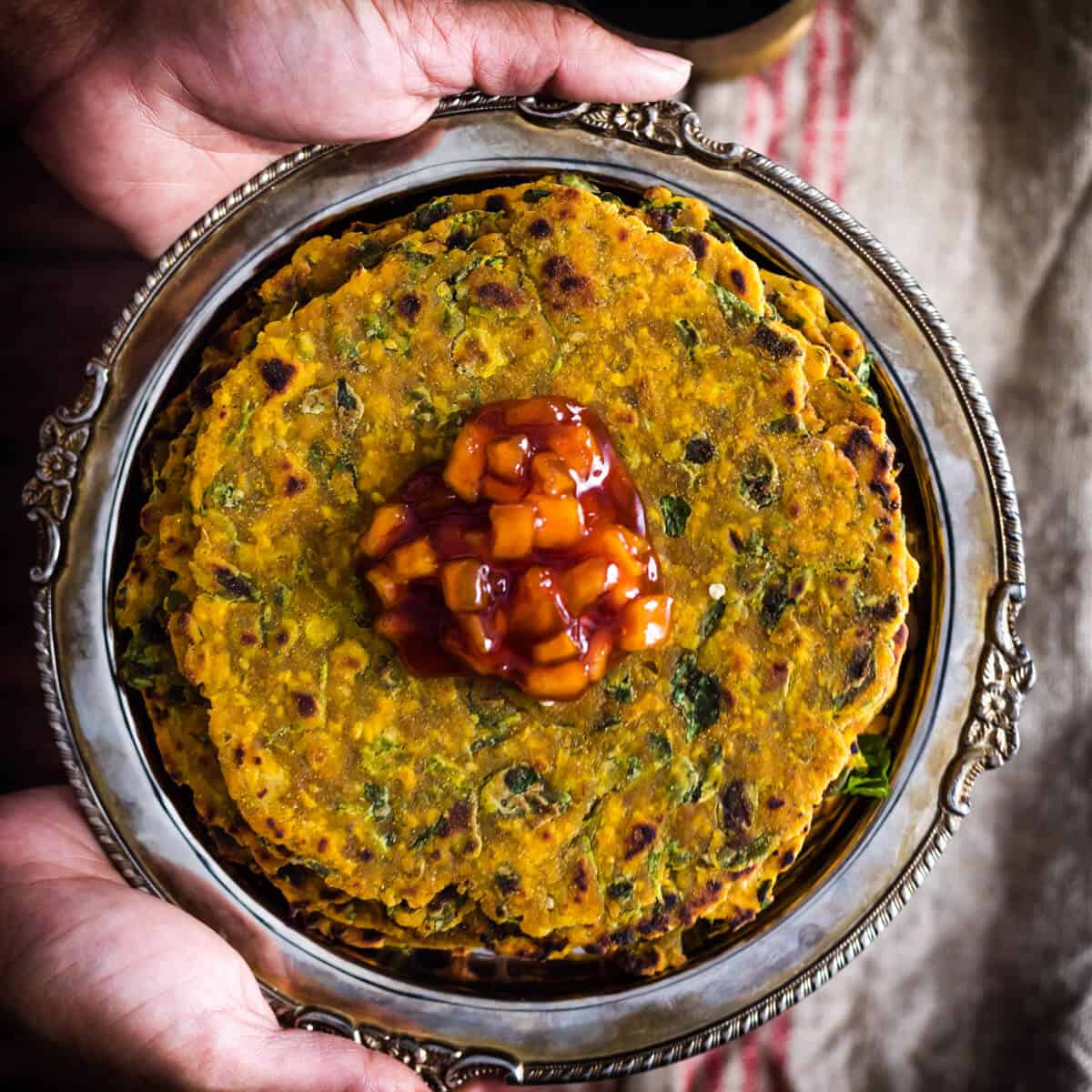
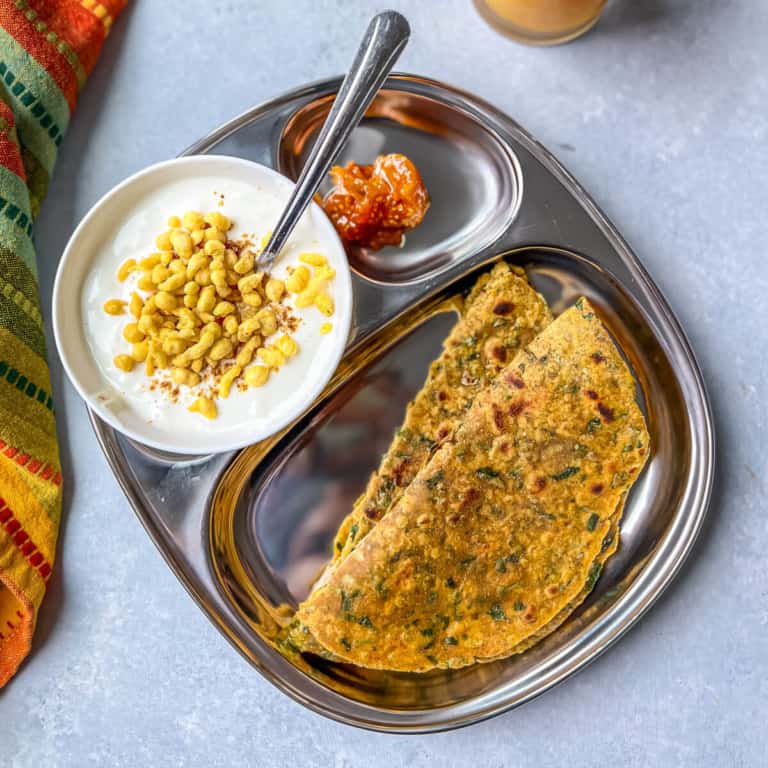
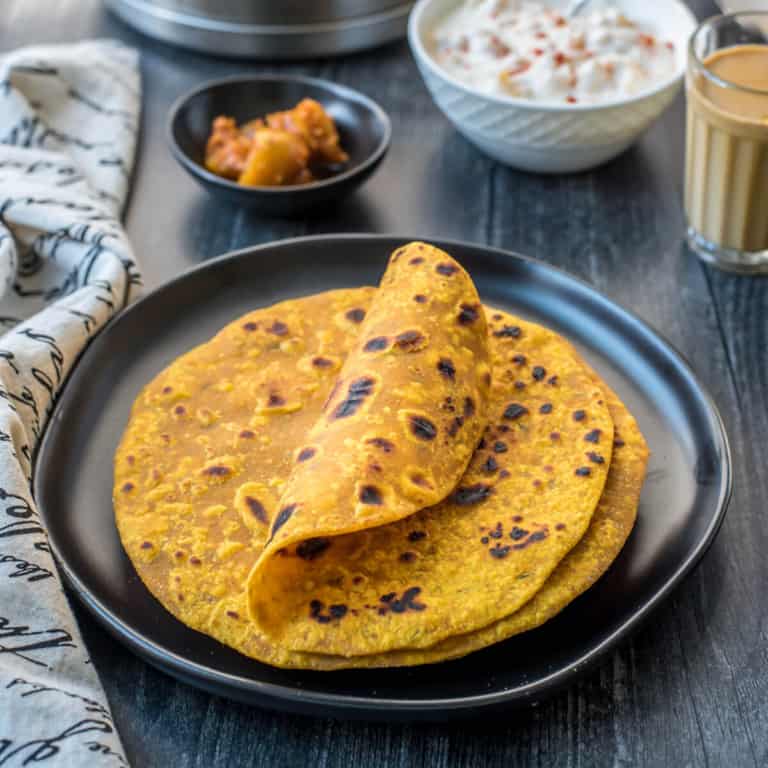
Methi na thepla combines fresh fenugreek leaves, whole wheat flour, and aromatic spices to make this delicious spiced Indian flatbread recipe. Ideal for a nutritious breakfast or snack, convenient for travel, or as a tasty inclusion in lunch boxes, the Gujarati methi thepla hits the spot every time - thanks to its unique flavor and […]
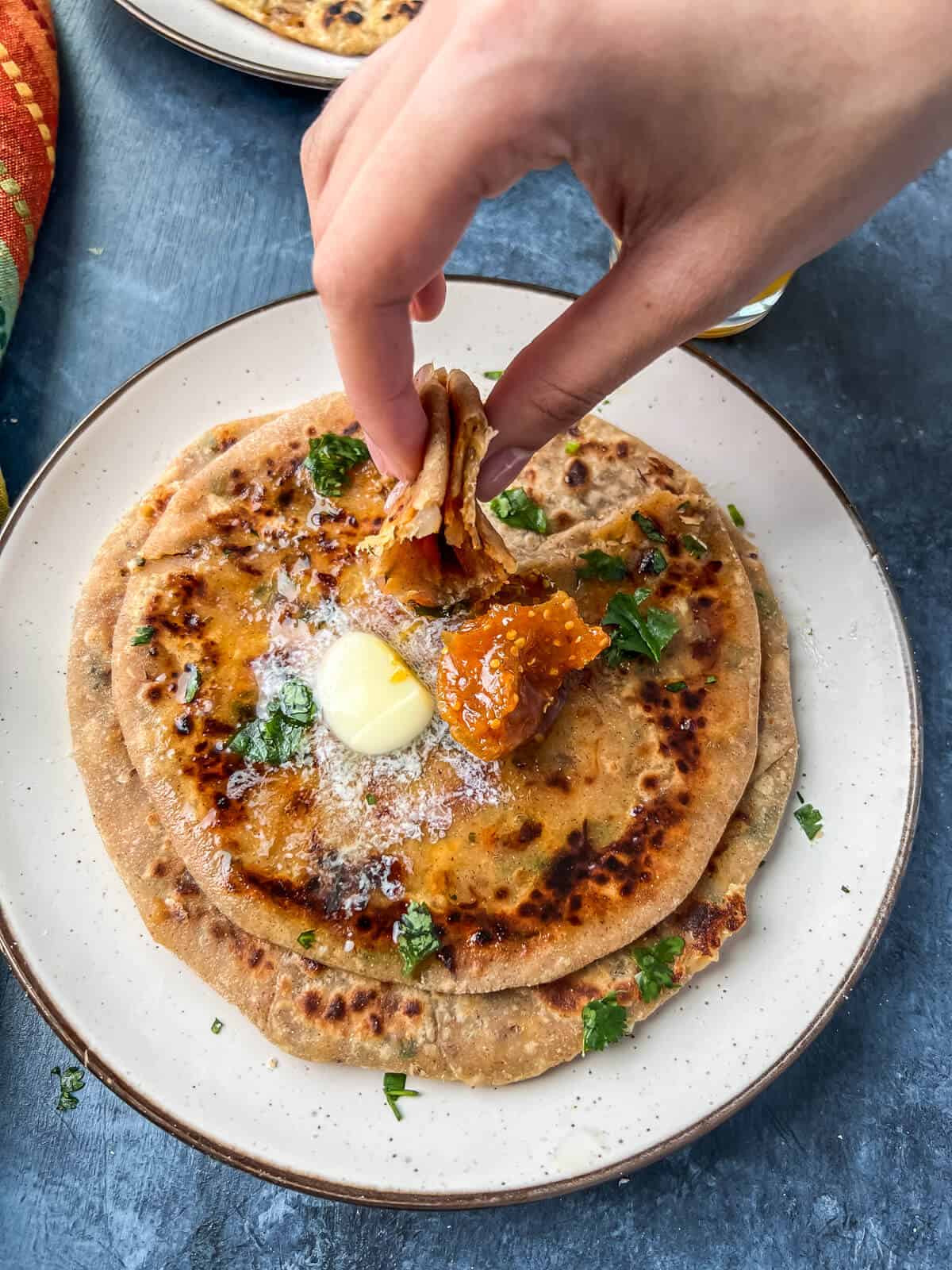
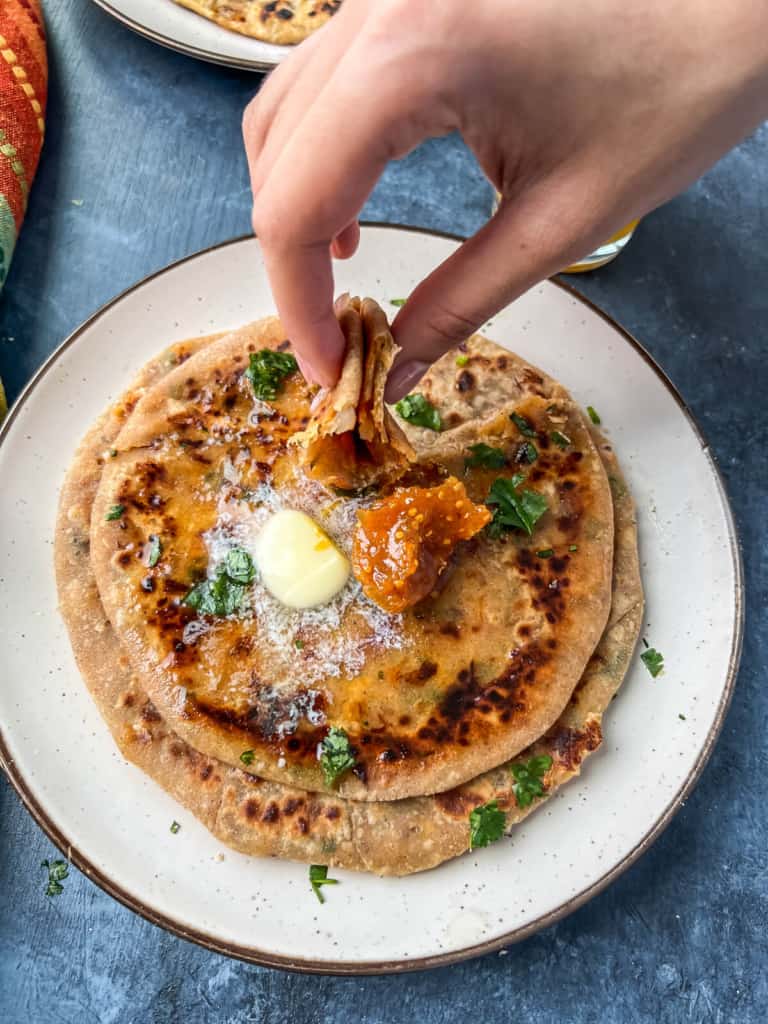
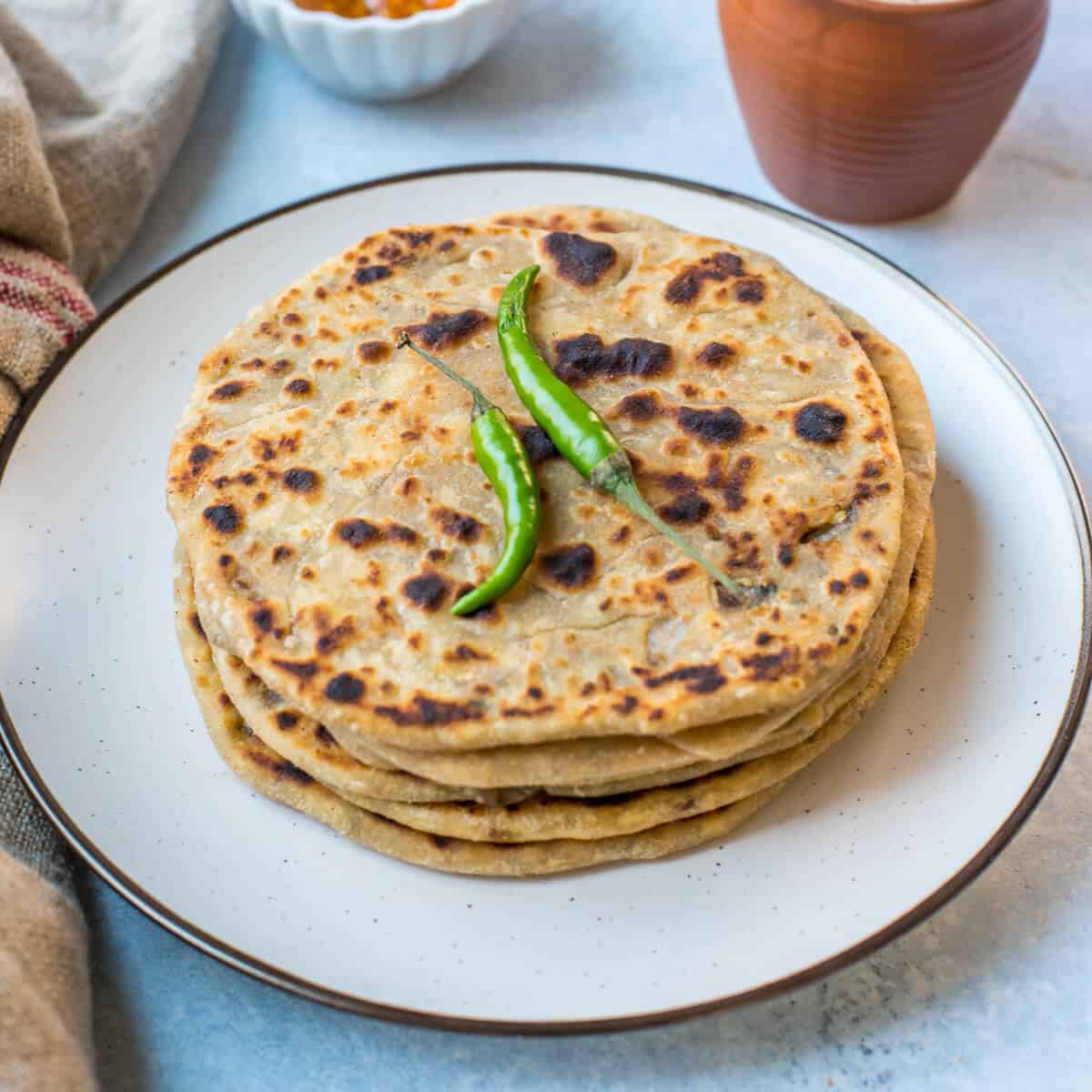
This flaky and savory cheese paratha is perfect for any meal of the day and is kid-friendly, thanks to its cheesy flavor. Serve it with raita, pickle, tomato ketchup, or a delicious paneer curry for a complete meal.
Easy Cheese Paratha
If you’ve never had a traditional North Indian paratha, I promise you that you are in for a real treat. That’s because these flaky and buttery Indian flatbreads are a delicious, satisfying, and hearty option for just about any meal.
This easy cheese paratha recipe is an excellent stuffed paratha recipe for beginners. It is much easier to roll and cook a paratha stuffed with melty cheese when compared to something a little more difficult, like the potatoes in my aloo paratha recipe.
Not only do you get the flaky texture of a plain paratha, but you also have a melty and cheesy center that will win over the pickiest of eaters.
When served with some creamy raita or a delicious paneer curry this simple dish easily becomes a meal – perfect for breakfast, lunch, or dinner. And while these are best warm, my kids don’t mind taking the leftovers in their lunch.
What is cheese paratha made of?
Cheese paratha, simply put, is a whole wheat bread stuffed with spiced cheese filling. The stuffing is made with mozzarella cheese for a delicious, stretchy center, but you can substitute half of the cheese for cheddar cheese or make my drool-worthy recipe for paneer paratha.
The paratha dough is made with whole wheat flour, then rolled and filled with cheese stuffing. The dough is then folded around the stuffing and rolled again. The rolled paratha is then shallow fried in ghee in a hot tawa or frying pan till golden brown spots appear. Talk about delicious!
Alternate names: In restaurant menus, you may find this paratha listed as chili cheese paratha or onion cheese paratha.
Onion cheese paratha
Reasons to love this recipe
It’s picky-eater-approved and kid-friendly.
Versatile – This cheese paratha recipe can be served for breakfast, lunch, or dinner.
Made with whole wheat flour – it is a healthier everyday option when compared to naan bread.
Although it’s best when served warm, it still tastes great when served cold, meaning it is perfect for adding to kids’ lunch boxes.
Here’s what you need to make the recipe
Ingredient notes
For the Dough:
Whole wheat flour – I prefer either Aashirwad whole wheat atta or Sujata chakki atta.
Avocado oil – The flavor works well with mozzarella cheese, but you could use any neutral-tasting vegetable oil.
Carom seeds – Also known as ajwain, these add a subtle flavor to the base of the paratha before the cheese stuffing is added.
Salt – A small amount of salt is added to the dough to provide flavor.
Water – You will need enough water to form a soft dough, and it should be at room temperature for the best results.
For the Cheese Stuffing:
Mozzarella cheese – I recommend using freshly grated mozzarella cheese, as it provides the best texture and gives that perfect melty cheese pull. You can substitute half of the cheese for cheddar cheese.
Onions – finely chopped, just like the green chillies. You can skip it but make sure to add more cheese so that you have enough filling for the parathas.
Spices and seasonings – You will need chaat masala, jeera (cumin seeds), and salt.
Aromatics – finely chopped cilantro and green chilies.
Storebought or homemadeghee – Traditionally used for frying the paratha and gives a delicious flavor.
Combine wheat flour, salt, a tablespoon of oil, carom seeds with 1 cup of water and start kneading. Add remaining water in small increments and continue to knead till the dough comes together as a ball.
Add the remaining oil to the dough and knead till the oil is absorbed.
If the dough is sticky, sprinkle approximately 1/4 teaspoon wheat flour (or more if needed) on the dough and knead again to form a dough that is not sticky. The dough should be supple and soft.
Cover the dough and set aside for 15-20 minutes.
Make the stuffing
Mix all the ingredients for the stuffing – onions, cheese, chaat masala, chili powder, cilantro leaves, jeera, green chilies, and salt- until they are combined. [Note: Don't prepare the stuffing in advance. Prepare it just before you are ready to roll the parathas. It is because the onions will start to lose water.]
1/2 teaspoon salt, 3 cups / 12 oz grated mozzarela cheese, 1 cup finely chopped onions, 1 teaspoon chaat masala, 1/2 teaspoon chili powder, 1/4 cup cilantro, 1 teaspoon jeera, 2 green chilies, 1/2 teaspoon salt
Rolling out the parathas
Divide dough into twelve equal portions and roll into balls.
Flatten the ball and cover both sides with flour.
Roll into a circular disc about 4 inches in diameter.
Place 2-3 tablespoonfuls of the stuffing in the center.
Grab the edges and pleat them and bring them together in the center.
Pinch them together to seal them.
Flatten the ball and cover both sides with flour.
Use your rolling pin to roll into a flat, round shape delicately. Dust flour on the base to prevent the dough from sticking while rolling.
Dust off excess flour from the paratha by placing it on the palm of one hand and then flip it on the palm of your other hand. Repeat this process 3-4 times.
Cooking the paratha
Place a tawa/frying pan on gas on medium heat. Once heated, carefully place the paratha on the tawa.
1/2 cup ghee for frying
Cook until small bubbles form on the top.
Turn it over and cook the other side for about 20 seconds. Add ghee to the side facing up.
Flip and cook for about 10 seconds. Use a spatula to press the edges so that they evenly cook. Now add ghee to the side facing up, flip and cook for another 10-15 seconds.
Skip the green chilies to make it kid-friendly. You can add a tiny bit of ground black pepper instead.
Different types of cheese – Replace 1/2 of mozzarella cheese with cheddar cheese in this recipe. You can replace mozzarella cheese with paneer (Indian cottage cheese), as in this paneer paratha recipe.
Skip onions – make sure to increase the amount of cheese so that you have enough stuffing for the dough.
Italian twist – Replace Indian spices/spice powders with a teaspoon of garlic powder, oregano each, and 1/2 teaspoon chili flakes.
Spice variations:Use dry mango powder instead of chaat masala to give it a tangy twist. You can also add 0.5 to 1 teaspoon of garam masala for some warmth.
Chili cheese paratha – Increase the amount of green chili for a spicy kick.
How to prep ahead
The dough stays in the refrigerator in an air-tight container for up to 3 days. Frozen for a month. Bring the dough to room temperature before rolling out the parathas.
You can make the cheese stuffing (don’t add the onions) up to 3 days in advance. You can chop onions and store them separately.
Storage tips
Refrigerator – You can store your parathas for 3-4 days in the refrigerator. For best results, store them in an airtight container and between sheets of parchment to prevent sticking (optional).
Freezer – These will keep well in the freezer for 2-3 months. Separate them with parchment paper when freezing, or they’ll stick together.
Reheat – For refrigerated parathas, reheat in a microwave (15-20 seconds) or reheat in a tava / skillet kept over medium heat. If parathas are frozen, use a tava/skillet to reheat for best results.
Serve it with
These delicious and flaky cheese parathas can be eaten on their own or served with raitas, yogurt, or pickle. They also pair very well with paneer curries. Here are a few of my favorites:
Boondi raita – This delicious recipe is made by soaking crispy chickpea flour balls in spice-infused creamy yogurt.
Onion raita – Made with ingredients you have at home and in less than 5 minutes. It is the perfect way to finish off a delicious Indian meal.
Kadai paneer – This restaurant-style recipe is made with freshly ground spices, chunks of paneer, and a blend of onions, peppers, and a spicy masala sauce.
Paneer makhani – Also known as paneer butter masala, this popular restaurant dish can easily be made at home.
Methi Malai Matar – An unforgettable vegetarian dish made with fresh fenugreek leaves, green peas, and soft chunks of paneer.
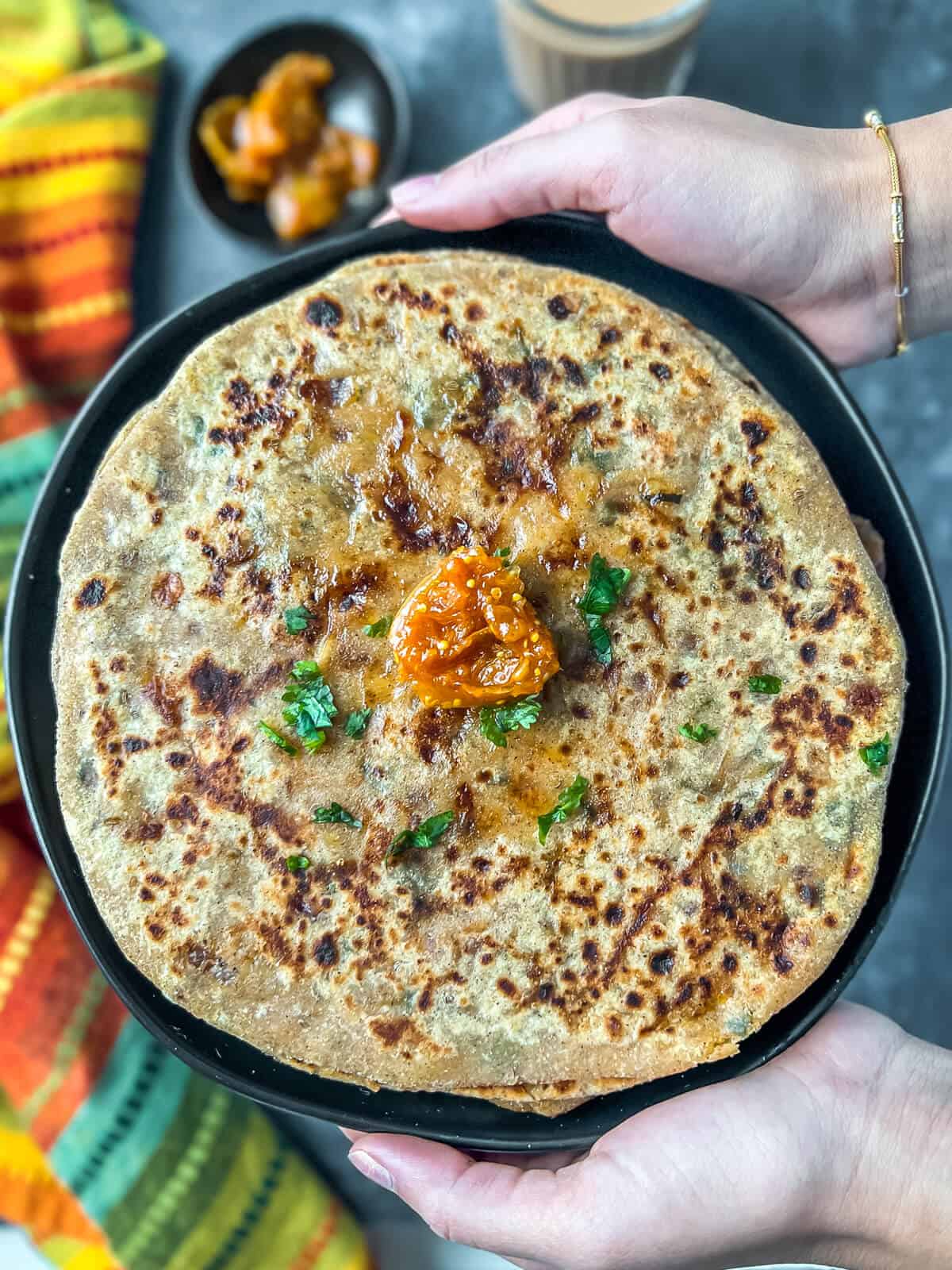
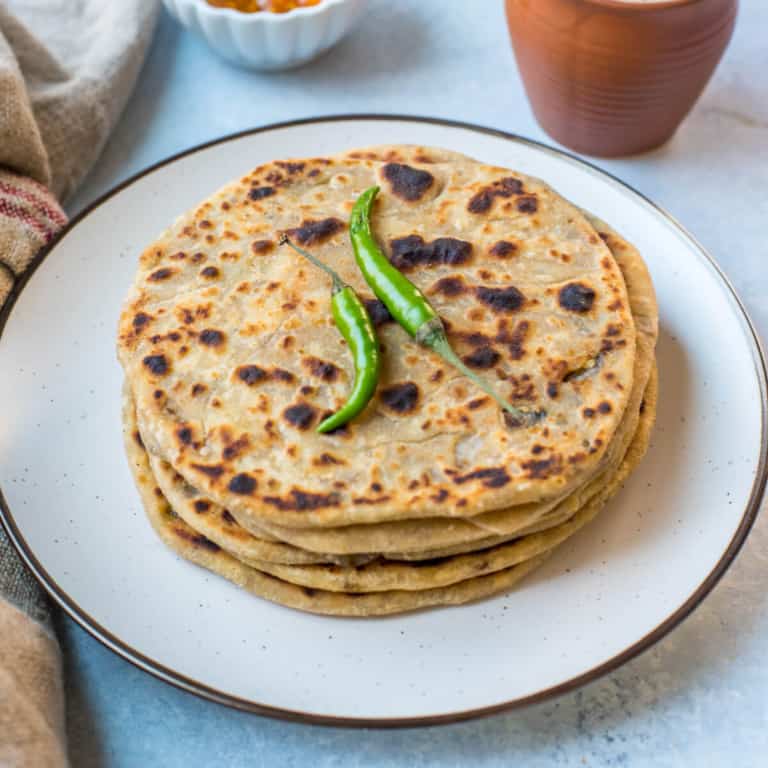
This savory and spicy Punjabi onion paratha is perfect for breakfast, lunch, or a delicious after-school snack. Filled with onions and aromatic spices, this stuffed paratha recipe definitely packs a punch.
Onion paratha / pyaaz ka paratha
Paratha is a popular breakfast food and accompaniment that is traditional to North Indian cuisine. Onion paratha (pronounced uh·nyn pr·aa·thuh) is a variation of the popular and common plain paratha.
I had never tried a stuffed paratha until a friend made me an onion-stuffed paratha one day. Onions, green chilies, and spice powders were combined together in the stuffing to create a savory and spicy paratha that made it irresistible.
No wonder I was floored with the very first bite.
While you can make this stuffed onion flatbread with any onion you have on hand, I like it especially well when made with finely chopped spring onions.
Since onion paratha is so savory, it works just as well for lunch or an after-school snack as it does for breakfast. And since it is made with whole wheat flour, it’s very satisfying all on its own.
Fun fact: Onions are called pyaaz or pyaz in Hindi and kanda in Marathi. That’s why this recipe goes by alternate names, such as pyaz ka paratha, kanda paratha, and pyaaz parantha. Other names include stuffed onion flatbread, onion roti, onion paratha or parotta, and onion parantha.
A quick note on parathas
While parathas use the same ingredients as rotis, they differ in their external appearance because of how the dough is rolled out. Parathas are thicker with crispy exteriors, while rotis are thinner and softer.
Parathas are made two ways – layered and stuffed. To make layered ones, divided portions of the dough are rolled into a circular shape. They are then folded and rolled again to create layers. This kind of paratha, when cooked, becomes crispy and flaky.
To make stuffed parathas like this stuffed aloo paratha or paneer paratha, the dough is rolled out to a circular shape and then stuffed with veggies and folded together to resemble a pleated dough ball. The ball is then rolled out to a circular shape and cooked till brown spots appear on both sides.
Want to learn how to make parathas in different shapes? In this plain paratha post, I share how to make it 3 ways – round, triangle, and square-shaped.
Reasons to love this recipe
This savory Indian flatbread is perfect for any time of the day. Enjoy it for breakfast or pack it for lunch, along with raita and/or green chutney.
Easy enough to serve on an everyday basis but unique enough to make for guests or special occasions.
It’s made with whole wheat flour, meaning it’s a healthy option when compared to restaurant-style bread like naan.
Here’s what you need to make the recipe
Ingredient notes/swaps
Whole wheat flour – I prefer either Aashirwad whole wheat atta or Sujata chakki atta.
Water – You will need enough water to form a soft dough. It should be at room temperature for the best results.
Salt – a small amount of salt is added to the dough to provide flavor.
Carom seeds – Also known as ajwain, these can easily be found at your local Indian grocery or online.
Oil – I recommend avocado oil, but you can use another neutral-flavored oil like sunflower oil.
For Stuffing:
Finely chopped onions – You can use white, yellow, or red onions. Spring or green onions work too.
Seasoning: you will need black salt, garam masala, fresh chopped cilantro (coriander leaves), jeera (cumin seeds), green chilies, salt, and dry mango powder (amchur powder). Note: you can also use a teaspoon of red chili powder instead of green chilies.
For frying:
Ghee – It is traditional to fry onion paratha in ghee, but if you would like them to be vegan, you can use oil.
Knead the dough until it is smooth, soft, and pliable.
To fix hard dough, sprinkle a spoonful of water and knead. Add more water as needed until the dough is neither hard nor sticky.
Sticky dough? Sprinkle a spoonful of dough and knead. Add more flour as needed until the dough is not sticky.
Rest the dough to allow time for the gluten to form. This makes it easier to roll out the dough and yields softer parathas.
Make sure to dust off the dry flour from the parathas before frying, or it dries up and turns hard.
Before storing it in an air-tight container or while packing it for lunch, let the paratha cool down for 5-6 minutes to prevent it from being soggy.
Pro tips for onion parathas
Chop the onions and green chilies finely, or they’ll tear the paratha while rolling.
Onions lose water when mixed with salt, so make the parathas immediately once the stuffing is prepared.
Note: Don’t forget to turn your exhaust fan on when making parathas, or else your smoke alarm may go off.
Variations to try
Make the dough without the ajwain (carom seeds).
For spring onion parathas, substitute regular yellow, white, or red onions with finely chopped green onions.
Onion paneer or onion cheese paratha: Add a tablespoon of grated cheese or paneer along with the onions in each paratha to make onion paneer paratha.
Use cooked stuffing: While this recipe uses raw onions, you can also use cooked onion stuffing. To do so, saute the onions along with spices in a tablespoon of oil until the onions have softened. Completely cool the onions before stuffing.
How to prep ahead
The best way to prepare this paratha in advance is to make the dough ahead of time. Follow the steps for making the dough as listed in the instructions, and when it is time to allow the dough to rest, store it in either the refrigerator or the freezer.
Refrigerated dough stays keeps in an air-tight container for up to 3 days.
The frozen dough keeps for a month.
Bring the dough to room temperature before rolling out the parathas.
Another prep step you can do in advance is to chop the onions. They can be chopped and stored in an airtight container for up to 3 days. Just make sure to chop them very finely, as otherwise, they may tear the paratha dough.
Storage tips
Refrigerator – You can store your cooked onion parathas for up to 2 days, but it is not recommended to store them for longer than that.
Freezer – Store your parathas in the freezer for 2-3 months. Separate them with parchment paper when freezing, or they’ll stick together.
Reheat – For refrigerated parathas, reheat in a microwave (15-20 seconds) or reheat in a tava / skillet kept over medium heat. If parathas are frozen, use a tava/skillet to reheat for the best results.
Serve it with
This delicious paratha pairs well with a variety of raitas or lime/mango pickles, as well as paneer-based curries. Here are a few of my favorite serving suggestions:
Onion raita – Make it with ingredients that you have at home and in less than 5 minutes. It is the perfect way to finish off a delicious Indian meal.
Boondi raita – Made by soaking crispy chickpea flour balls in spice-infused creamy yogurt. Perfect for serving with biryanis or with parathas and a side dish.
Matar paneer – A restaurant-style dish that is creamy, delicious, and easy to make at home.
Paneer butter masala – This take-out classic can easily be made at home in less than 40 minutes.
Combine wheat flour, salt, a tablespoon of oil, carom seeds with 1 cup of water and start kneading. Add remaining water in small increments as needed and continue to knead till the dough comes together as a ball.
Add the remaining oil to the dough and knead till the oil is absorbed.
If the dough is sticky, sprinkle approximately 1 teaspoon wheat flour (or more if needed) on the dough and knead again to form a dough that is not sticky. The dough should be supple and soft.
Cover the dough and set aside for 15-20 minutes.
Make the stuffing
Mix all the ingredients for the stuffing – onions, black salt, garam masala, coriander leaves, jeera, green chilies, dry mango powder, and salt till they are well combined.
2.5 cups finely chopped onions, 1 teaspoon black salt, 1 teaspoon garam masala, 1/4 cup cilantro, 1 teaspoon jeera, 2 green chilies, 1/2 teaspoon dry mango powder, 1/2 teaspoon salt
Rolling out the parathas
Pull a small piece approximately the size of a golf ball from the dough. Place the piece between the palms of your hands and shape them into a ball.
Flatten the ball and cover both sides with flour.
Roll into a circular disc about 6 inches in diameter.
Place about 1.5 tablespoonfuls of the stuffing in the center. Sprinkle flour over it to absorb any moisture.
Grab the edges and pleat them and bring them together in the center.
Pinch them together to seal them and flatten them using your palm.
Flatten the ball and cover both sides with flour.
Use your rolling pin to roll into a flat, round shape. Do this delicately – dusting flour as needed to help with this process.
Dust off excess flour from the paratha by placing it on your palm of one hand and then flip it on the palm of your other hand. Repeat this process 3-4 times.
Cooking the paratha
Place a tawa/frying pan on gas on medium heat. Once heated, carefully place the paratha on the tawa.
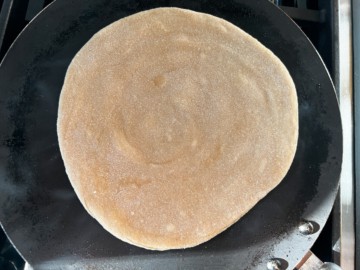
Place the paratha in the hot pan. Cook the paratha until small bumps form on the surface (approximately 1-2 minutes).
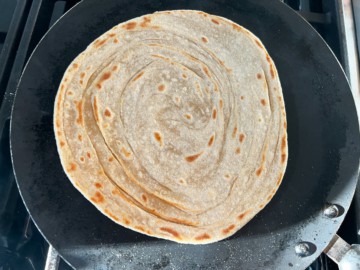
Flip the paratha onto the other side. Cook for 30-40 seconds or so until you see brown spots. Smear it with ghee and flip it.
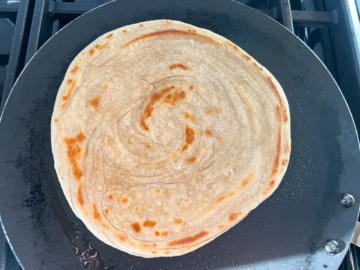
Cook for 20-30 seconds, then brush the side facing up with ghee. Use a spatula to press down the paratha so that it evenly cooks.
Flip it and cook it for another 15-20 seconds while pressing the paratha down with the spatula.
Transfer the paratha to a plate lined with paper towels. Repeat this process for the rest of the dough.
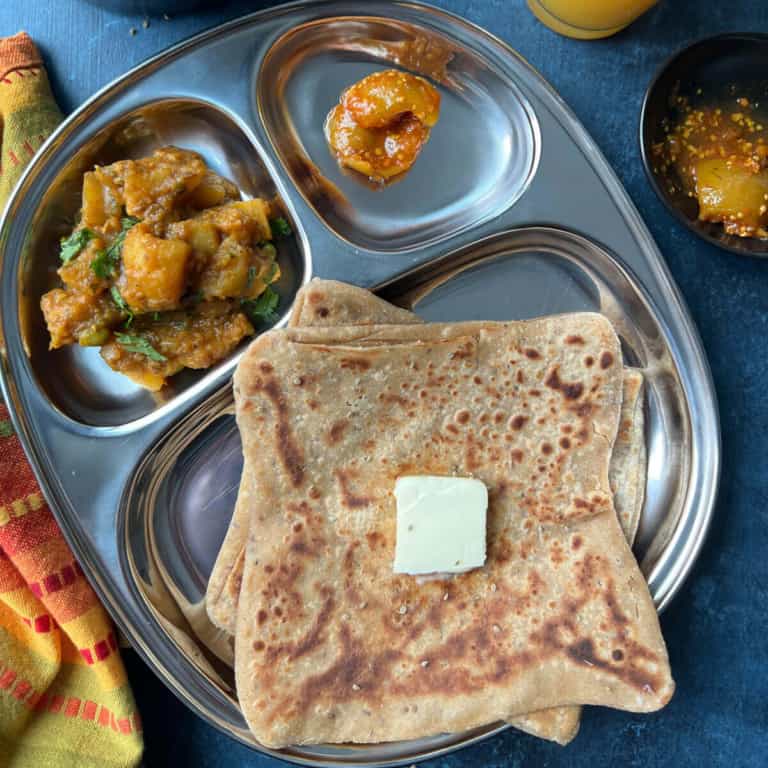
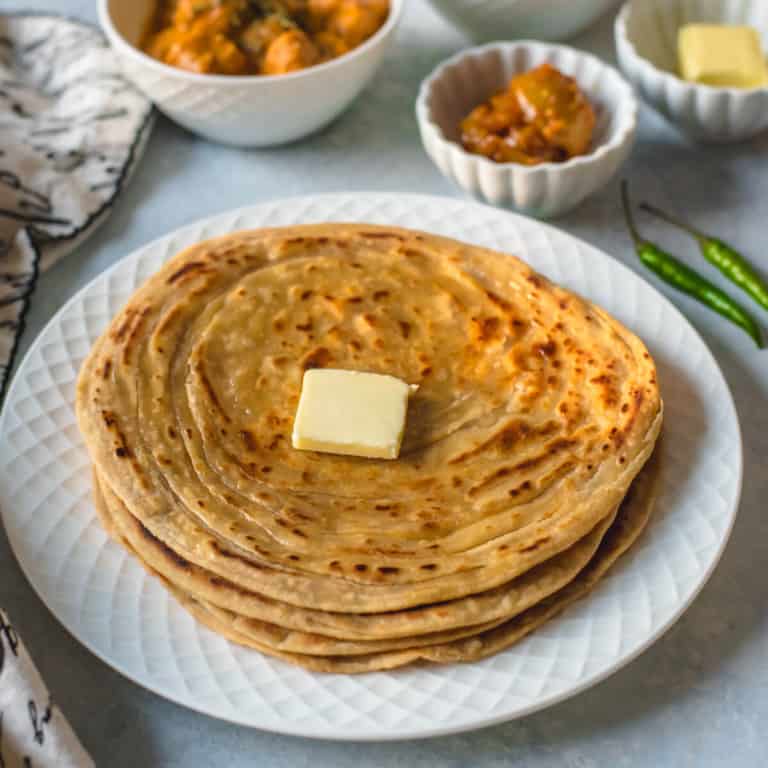
This step-by-step recipe will help you make the perfect parathas with crispy, flaky layers and golden brown spots. A North Indian staple, these plain parathas can be served for breakfast with butter, accompanied by a hot cup of chai and a side of pickle, or with curries to make a complete meal.
Plain paratha recipe
Growing up in a South Indian family meant that while idlis were a staple, parathas not so much. So when my friends would get this flaky flatbread for school lunch, it was a joyous moment for me.
While my friends loved the soft and pillowy texture of my mother’s homemade idli, I couldn’t get enough of the crispy (but soft) and flaky layers of her mother’s homemade parathas.
If you are a fan of this traditional flatbread like I am, you’ll love this post. The step-by-step photos will teach you how to make round, triangle, and square-shaped parathas in no time.
What is paratha?
Paratha is an unleavened bread that is popular in North Indian cuisine. It is made by making a dough using whole wheat flour (similar to that used for rotis). The dough is then rolled and then slathered with ghee and folded over to create many flaky layers.
Indian paratha has a similar effect to that of puff pastry or croissants, where the laminating and folding of dough in several successions allows the dough to develop a flaky texture with many layers of soft yet crispy bread.
Although plain parathas are often served with butter and a side of pickle for breakfast, they are also commonly served with curries to make a complete meal.
There are also two types of paratha: layered or stuffed. Layered parathas have spices or fillings added while making the dough, whereas stuffed parathas such as this aloo or paneer paratha have stuffings filled in during the rolling process.
History of the recipe
Paratha (pronounced pr·aa·thuh) is a common breakfast food and accompaniment in North Indian cuisine, although it originated in Peshawar, which is located in Pakistan.
Parathas, like much of Indian cuisine, were influenced by the surrounding region, with the recipe being adapted to meet the needs of the area. Parathas soon spread all over the Northern region of India and became an integral part of their cuisine and, thus, their culture.
While this popular Indian flatbread is most often known as paratha, there are many other types of paratha. Even plain paratha can go by a variety of names, including the following:
Roti paratha
Tawa paratha
Parantha
Parotta
Laccha paratha
Plain Paratha Recipe
Difference between paratha, roti, and naan
The biggest difference lies between naan and both paratha and roti.
You see, paratha and roti are made with very similar dough, and both are made with whole wheat flour, while naan is typically made with white flour. Both roti and paratha are unleavened, while naan is a leavened bread.
Both paratha and roti are everyday, common flatbreads that are prepared to serve with simple daily meals like dals and curries. Roti is consumed widely throughout India, while paratha is specific to North India.
In contrast, naan is commonly served in restaurants as an accompaniment to curries. It is more of a special occasion bread, especially since it is made with refined flour (maida), which is not considered healthy, and also uses yeast – which isn’t as common of an ingredient in Indian households as it is in America.
Finally, the texture is what sets each of these popular Indian flatbreads apart.
Naan has a thick, bubbly texture that is soft and slightly yeasty. Roti (also known as chapati) is mild, soft, and pliable (if you master the technique). While paratha is flaky, crispy, thicker than naan, and layered with ghee.
Here’s what you need to make the recipe
Ingredients
Whole wheat flour – I prefer either Aashirwad whole wheat atta or Sujata chakki atta.
Salt – a small amount of salt is added to the dough to provide flavor.
Oil – I used avocado oil, but you can use another neutral flavored oil like vegetable oil.
Water – You will need enough water to form a soft dough, which should be at room temperature for the best results.
Ghee – This is used during the rolling of the dough, as you smear each layer with melted ghee to create the signature flaky layers.
Knead the dough until it is smooth, soft, and pliable.
To fix stiff dough, sprinkle a spoonful of water and knead. Add more water as needed until the dough is neither stiff nor sticky.
Sticky dough? Sprinkle a spoonful of dough and knead. Add more flour as needed until the dough is not sticky.
Rest the dough to allow time for the gluten to form. This makes it easier to roll out the dough and yields softer parathas.
Make sure to dust off the dry flour from the rolled dough before frying, or it dries up and turns hard.
Before storing it in an air-tight container or while packing it for lunch, let the paratha cool down for 5-6 minutes to prevent it from being soggy.
Note: Don’t forget to turn your exhaust fan on when you are making parathas, or else your smoke alarm may go off.
Variations to try
Spice it up – Make masala paratha by adding 1/2 teaspoon of these spice powders – chili powder, coriander, and cumin powder while making the dough.
Ajwain paratha – Ajwain or carom seeds aid digestion. Add 1/2 tablespoon of ajwain (carom) seeds for every cup of whole wheat flour while making the dough and make the paratha as usual.
For a vegan version, use oil instead of ghee.
How to prep ahead
If you would like to prep ahead of time, I recommend preparing the paratha dough and cooking the actual parathas on the day you plan to serve them. You may store your dough in an air-tight container for up to 3 days in the refrigerator or frozen for up to 1 month.
Before rolling out your parathas, bring the dough to room temperature. Then divide, roll, and cook.
Storage tips
Refrigerator – Allow your paratha to cool for 5-6 minutes before transferring them to an airtight container. If you can, place parchment paper in between the layers to prevent sticking. They will store like this in the refrigerator for 3-4 days.
Freezer – Make sure your cooked paratha is completely cool before transferring it to the freezer. Separate each one with parchment paper (to prevent sticking) and place it in a freezer bag or container. They will store like this for 2-3 months. Heat to serve.
Reheat – For refrigerated parathas, reheat in a microwave (15-20 seconds) or reheat in a tava / skillet kept over medium heat. If parathas are frozen, use a tava/skillet to reheat for best results.
Serve it with
You can serve these crispy and flaky parathas with either ginger tea or masala tea., with a side of pickle or raitas as breakfast or brunch. You can also make them part of your main course accompanied by –
Instant Pot dal makhani – A creamy and delicious Punjabi lentil curry that graces the menus of Indian restaurants worldwide.
Methi malai matar with paneer – An unforgettable vegetarian dish made with fresh fenugreek leaves, green peas, and soft chunks of paneer.
Langarwali dal – a creamy and satisfying mixed lentil curry that cooks effortlessly in the Instant Pot.
Frequently asked questions
What is the difference between paratha and parotta?
While paratha and parotta are very similar and share a similar crispy and flaky texture, they are quite different. The biggest difference is that parotta is made with maida flour, which is refined and higher in gluten than the traditional whole wheat flour that is used to make paratha. This gives it a thicker, softer, and doughy consistency compared to paratha.
Which oil is best for making paratha?
The best oil for making homemade paratha is any cold-pressed, neutral-flavored oil. Avocado is an oil that works very well, thanks to its high smoke point and neutral flavor.
What flour is paratha made from?
Homemade paratha is always made with whole wheat flour. Some restaurants may mix all-purpose flour in the dough for a lighter flavor and texture.
Can you make paratha with butter instead of ghee?
You can use unsalted butter, but ghee is the healthier option, and I think makes the paratha taste better. If you have the time, you can clarify your butter which will give you similar results to ghee.
Why is my paratha hard?
To make soft parathas, it is important to dust off the excess flour before frying them. If not, the flour dries up the paratha making it hard.
How do you keep paratha soft in the lunchbox?
If you would like to pack your paratha for lunch, use oil instead of ghee since ghee solidifies. Also, let the parathas cool a bit before packing them, or the steam will make them soggy.
Which is healthier, roti or paratha?
While paratha is a delicious North Indian staple and (like roti) is made with whole wheat flour, roti is a healthier option since it can be made with less ghee or oil.
Other traditional flatbread recipes to try
If you enjoyed this simple and flavorful recipe for plain paratha, you must try a few of my other paratha recipes, as well as some of my other Indian flatbreads. Here are a few of my favorites:
Combine 3 cups of wheat flour, salt, and oil with 1 cup of water in a large bowl and start kneading. Add water in small increments and knead until the dough comes together like a ball.
3 cups whole wheat flour, 1/2 teaspoon salt, 2 tablespoons oil (avocado or vegetable), 1.5 cups water
Add 1/4th teaspoon oil to the dough and knead till the oil is absorbed.
If the dough is sticky, sprinkle approximately 1/4 teaspoon wheat flour (or more if needed) on the dough and knead again to form a dough that is not sticky. The dough should be supple and soft.
Cover the dough and set aside for 15-20 minutes.
Put 1/4 cup of flour in a medium sized container or a plate. Set it aside. We will need this flour while rolling out the dough.
1/4 cup whole wheat flour
Making parathas
Pull a small piece approximately the size of a golf ball from the dough. Place the piece between the palms of your hands and shape them into a ball.
Flatten the ball and cover both sides with flour.
Roll out the flattened ball into a circular shape (approximately 6 inches in diameter).
For square parathas
Smear the surface of the rolled-out dough with ghee. Take 1/3 portion of the rolled dough from the left side and fold towards the middle. Now fold 1/3 portion from the left till the folds overlap slightly. Brush it with ghee.
Now fold the top and bottom portion of the rolled dough towards the middle creating a square.
Place the square-shaped paratha in a small container filled with flour and cover both sides.
Use the rolling pin to roll it evenly into a square shape paratha using as little pressure as possible.
For triangle parathas
Smear the surface of the rolled out dough with ghee. Fold it into half and brush it with ghee again.
Fold again into half such that it resembles a triangle.
Place the paratha in a small container filled with flour and cover both sides.
Use the rolling pin to roll it evenly into a triangular shape paratha using as little pressure as possible
For round parathas
Smear the surface of the rolled-out dough with ghee. Sprinkle some flour evenly.
Start from one end of the circle and roll towards the other until it resembles a log.
Roll the log inward into a coil. Once you reach the end, pull the edge and tuck it under the coil.
Flatten the coil until it looks like a disc. Dip the flattened disc in the flour.
Place the disc in a small container filled with flour and cover both sides.
Roll out the flattened ball evenly into a circular shape (approximately 7-8 inches in diameter). Dust more flour as needed to help with the rolling.
Cooking paratha
Heat a pan / tawa over medium-high heat.
Dust off excess flour from the paratha by placing it on your palm of one hand and then flip it on the palm of your other hand. Repeat this process 3-4 times.
Place the paratha in the hot pan. Cook the paratha until small bumps form on the surface (approximately 1-2 minutes).
Flip the paratha onto the other side. Cook for 30-40 seconds or so until you see brown spots. Smear it with ghee and flip it.
Cook for 20-30 seconds, then brush the side facing up with ghee. Use a spatula to press down the paratha so that it evenly cooks.
Flip it and cook it for another 15-20 seconds while pressing the paratha down with the spatula.
Transfer the paratha to a plate lined with paper towels. Repeat this process for the rest of the dough.
Serve it hot with dal, vegetable or chicken curry.
Notes
To fasten up the process, roll out the next paratha as one cooks in the pan.
Make sure to dust off the excess flour from the paratha before you cook it. This prevents the paratha from getting hard.
Before storing it in an air-tight container, let the paratha cool down a bit so as not to make it soggy.

 Login
Login