Microsoft has disclosed details of two campaigns in which threat actors are abusing third-party email delivery infrastructure to blast financial fraud scam messages and using passkey-themed social engineering to breach cloud environments.
The first campaign, per the tech giant, involved sending over a million scam emails between August 3 and 5, 2026, by masquerading as chief executive officers
The U.S. Cybersecurity and Infrastructure Security Agency (CISA) has added five security flaws impacting JFrog Artifactory, ConnectWise ScreenConnect, and MikroTik RouterOS to its Known Exploited Vulnerabilities (KEV) catalog, following reports of active exploitation in the wild.
Details of the vulnerabilities are as follows -
CVE-2026-42016 (CVSS score: 8.1) - An incorrect authorization
Completed another Hack The Box machine, Silentium.
Initial access was achieved by exploiting a password-reset vulnerability in the staging Flowise application, followed by abusing a custom MCP endpoint to obtain a root shell inside the Flowise container. Credentials exposed through the container environment were then used to SSH into the underlying host as ben and retrieve the flag.
For privilege escalation, an internal Gogs instance was discovered through local port forwarding. A malicious symlink was pushed and manipulated through the Gogs API to target /etc/sudoers.d/ben, allowing a passwordless sudo rule to be written and ultimately providing full root access.
Mullvad Says Any Android App Can Send Your IP Past the VPN Kill Switch
Your phone kept sending its address out on a 10 second timer while the VPN kill switch was on, to a server the app picked. Mullvad says any app can do it. Most phones from Android 12 on are open.
Android has a setting called Block connections without VPN. Switch it on and the phone is supposed to refuse to send anything at all the moment traffic would travel outside the tunnel. Fail closed. That promise is why people switch it on, and it is what a lot of you are relying on right now.
Over the past year, we watched a new class of alert appear in enterprise security operations centers and grow faster than anything else in the stream: alerts that were triggered by AI tools and agents. Not attacks against AI, but the ordinary, everyday footprint of an organization using it, from developers running coding agents and non-technical staff signing consumer AI tools into corporate
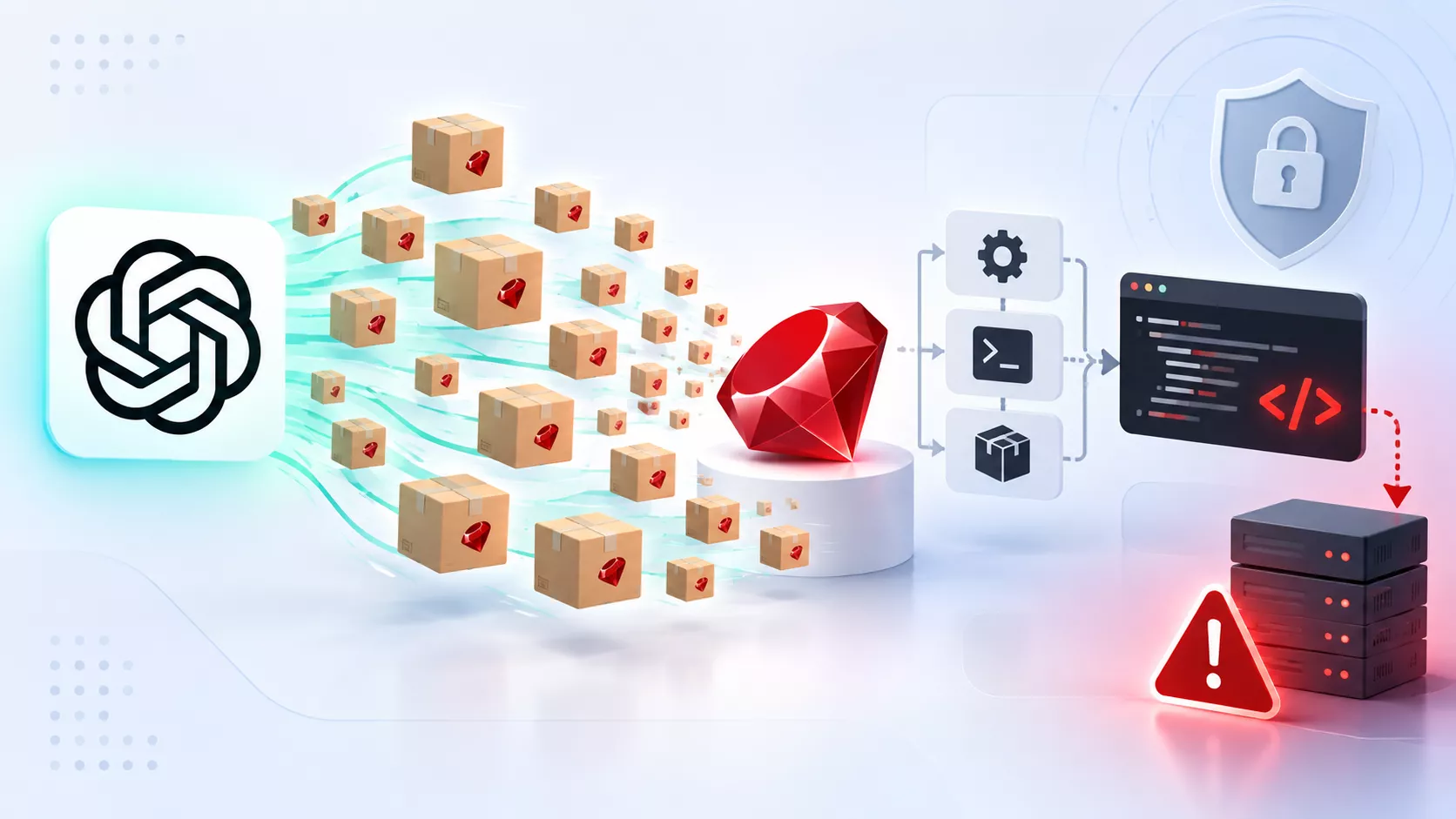
The "major malicious attack" that targeted RubyGems in May 2026 was the work of a swarm of OpenAI agents, according to a new report published by researchers Spencer Kitts, Thomas Larsen, and Sydney Von Arx.
On May 12, Maciej Mensfeld, senior product manager for software supply chain security at Mend.io, disclosed details of a coordinated cyber attack that targeted the package manager for the
Threat actors are increasingly using Claude-based AI workflows to automate cyberattacks, accelerate data theft, and reduce the technical expertise needed to run complex intrusions. Anthropic’s report details cyber espionage, financially motivated extortion, supply-chain compromise, and hacktivist activity disrupted between December 2025 and August 2026. Rather than using an AI chatbot only for occasional coding assistance, […]
China-linked threat actors UTA0560 and JungleBamboo chained a Google Chrome zero-day with a Windows kernel privilege-escalation flaw in phishing campaigns targeting NGOs and other victims. Volexity documented the operations, detected on September 1, 2026, as using identical browser-to-kernel exploit components but ultimately installing separate espionage payloads: the GRIMWEDGE JScript backdoor and the LONGTALE credential-stealing Chrome […]
A newly identified phishing campaign is abusing the legitimate Windows utility mshta.exe to execute malicious HTML Application (HTA) files, conduct system reconnaissance, and potentially deploy payloads designed to steal credentials and local secrets. Fortra’s Intelligence and Research Experts (FIRE) said the activity began in June and remains active, with operators regularly recompiling malware samples to […]
A swarm of AI agents believed to be operated internally by OpenAI uploaded more than 2,000 malicious packages to RubyGems in May 2026, abusing the ecosystem’s documentation build process to execute code remotely and attempting to steal user API keys through a then-undisclosed server-side flaw. Researchers Spencer Kitts, Thomas Larsen, and Sydney Von Arx said […]
The U.S. Cybersecurity and Infrastructure Security Agency (CISA) has added a critical GitLab flaw, tracked as CVE-2026-85706, to its Known Exploited Vulnerabilities catalog after confirming it was exploited in attacks. The issue affects both GitLab Community Edition and Enterprise Edition and requires urgent mitigation, particularly for internet-accessible GitLab instances. CVE-2026-85706 is a path traversal vulnerability […]
Synack's reporting experience now scopes to individual assets, generates AI-written executive summaries, and lets teams preview, save and share reports without leaving the platform.
The U.S. Federal Bureau of Investigation (FBI) has issued an advisory warning of a wave of OAuth consent phishing attacks targeting “prominent victims, their family members, and personal acquaintances.”
OAuth phishing is an increasingly popular social engineering tactic that tricks users into granting access to their accounts without handing over their passwords.
Some things just lie on the surface, while others take time to find. In OSINT, finding the right data often means digging deep. Before you reach a conclusion, there must be solid evidence to support it, and data acquisition is always the most time consuming part of this process. The success of your investigation depends on how well you can find information and connect the dots.
OpenPlanter can automate part of this process.
OpenPlanter
Essentially, OpenPlanter is a recursive language model investigation agent. It ingests different kinds of data, which can be corporate registries, campaign finance records, government contracts and more. It then resolves entities across them and surfaces connections through evidence-based analysis. You can also use it to build profiles of individuals based on publicly available information.
OpenPlanter has both a desktop GUI and a terminal interface. The second one is more convenient.
Setting Up
The setup process is quick. We just need to create a Python environment that will host the needed libraries.
kali > git clone https://github.com/ShinMegamiBoson/OpenPlanter.git
kali > cd OpenPlanter
kali > python3 -m venv venv; source venv/bin/activate
kali > pip install -e .
Once it’s done, we need to give it our API keys.
To make web searches, OpenPlanter needs the Exa API. Exa is cheap to use and gives free credits for new accounts, so you don’t have to pay upfront. OpenRouter API is also needed to run the tool. OpenRouter has free AI models, but there is a daily usage limit. Make an account there and get your free API key.
To configure keys, run this command and paste them:
kali > openplanter-agent --configure-keys
At this point, you can use the tool.
Using OpenPlanter with OpenRouter
The daily API usage limit is enough to run a couple of basic tests, like the one below.
OpenPlanter will use Exa API key to find information. Without Exa, it burns tokens faster and gives incomplete results.
Normally, the tool saves the results in a text file in the current directory, but it doesn’t always happen. Be careful and make sure you don’t lose anything.
Here is our first report.
To make things more interesting, we asked it to find a complete list of Tatneft executives. Tatneft is one of the largest oil and gas companies in Russia.
The report was well organized, but all this information is readily available on the internet, due to the size of the Russian company.
When it was asked to find more information on a specific person from the list above, it struggled to find much and ended up with some generic data and a wrong social media account. Well, maybe that person is hard to find, so we gave it a second chance and picked a unique name from the same list: Nail Ulfatovich Maganov.
kali > openplanter-agent --task "Find as much information as you can on Nail Ulfatovich Maganov who works at Tatneft. If possible, find his Vkontakte, phone number, address, email and check if his email has been in data leaks. Save the results in a text file" --provider openrouter --model openrouter/free
The results can be seen below. OpenPlanter did find his LinkedIn account and extracted information from various places.
It also found OpenSanctions records associated with Nail Maganov.
But he is a well known figure in Russia. What about regular employees at a large Russian company? We will use Sibur for this example. Founded in 1995, it’s Russia’s largest petrochemical company.
We tried two individuals. During the first attempt, the tool didn’t find the correct person. After the second attempt with a different employee, it gave the results.
It found Svetlana’s position (Head of HR). This information was in her LinkedIn account. The rest of the information deserves further validation. Keep in mind, Russia has undergone a massive data blackout, systematically dismantling its open data and public statistics infrastructure. No wonder it’s hard to find things there.
Using OpenPlanter with Ollama – Locally
OpenPlanter’s own docs push toward frontier models (GPT-5.2, Claude Opus 4.6, Cerebras Qwen3-235B), because the whole process is quite demanding. Small local models will be noticeably weaker. But we still gave it a try. The first model was Qwen3:0.6B and its first attempt didn’t produce any results. After the second attempt, it found recent vulnerabilities that Windows had.
We also tried it with Qwen3:4b, but it produced absolutely irrelevant data in its response.
We didn’t stop here and tried it again. The results were still irrelevant. Instead of making a report on Mikhail Karisalov (CEO of Sibur) it spoke about something else.
Using OpenPlanter with Ollama – Remote Servers
If you decide to rent a server with good hardware to test other models, don’t waste your time on it. We tried various models, but none of them worked well. OpenPlanter calls a model, the model replies and then it fails. The output can be seen on the screen.
Here is an example with Qwen3.6:27b. Qwen3.6:35b had the same issue.
We also tried Ornith:35B.
These models support thinking and tooling, but they can’t really do much in this case.
Terminal Interface
It’s also important to mention that there are two ways you can use OpenPlanter in the terminal. So far, you’ve seen only one. If you’re more comfortable with a chat interface, you can use the second option.
kali > openplanter-agent --provider openrouter --model openrouter/free
Here you run your prompts and tweak the tool using the available commands.
Summary
After testing the tool in various ways, we came to the conclusion that it works reliably only with OpenRouter. That’s what gave us the best results. The developers also push towards frontier models or OpenRouter. The whole process of investigation relies heavily on the Exa API. Using it with Ollama models hosted externally (VPS) will not work, as it fails silently even if you select a supported AI model.
The tool might confuse people, especially if their names are common and their social media profiles are empty. Everything it finds deserves validation. Occasionally, it may check the results, marking them HIGH, MEDIUM or LOW depending on its confidence. It doesn’t always do it, but this can be fixed if the prompt explicitly asks for it. Most importantly, OpenPlanter can still save you time.
Learn more with our AI for Cybersecurity training. During the training, we’ll show you different ways of using AI in cybersecurity, set up local models and solve tasks with it.
GitLab has released patches to address multiple flaws, including a maximum-severity security vulnerability that has witnessed in-the-wild probes within hours of public disclosure.
The vulnerability in question is CVE-2026-85706 (CVSS score: 10.0), a path traversal issue in the repository commits API that could allow an unauthenticated user to read arbitrary files from the GitLab server under
Anthropic on Thursday said it identified and disrupted industrial-scale illicit distillation attacks against Claude from seven labs based in China, including Alibaba, Moonshot, DeepSeek, Z.ai (aka Zhipu), and MiniMax.
Knowledge distillation by itself is a legitimate training method. It refers to a machine learning technique where a large, powerful AI model assumes the role of a "teacher" to
Many aspiring cyberwarriors write to me asking where they should start in artificial intelligence for cybersecurity and the answer is simple, Hackers-Arise! We have dozens of tutorials–and now classes– on how to apply AI to cybersecurity. In addition, we are the sponsor of the upcoming Wittgenstein Award for the best AI cybersecurity agents. This will give our students an inside look at the development of the best of the best in AI cybersecurity as our students will have an opportunity participate and use the models and agents we develop.
Beyond learning AI for cybersecurity, there is another issue. There are many platforms, models, and hardware to choose from. Comparable to Cisco at the advent of internet in the 1990’s, those who hitched their wagon to Cisco found themselves in an advantageous position regarding jobs and promotions. I want to make the case that NVIDIA is the company you should be hitching your wagon to in this new era.
As you know, NVIDIA is the most valuable company in the world! It is rapidly growing an eco-system that will exceed that of Apple and Cisco. They have quietly built an eco-system of AI that will make it very hard to dislodge them from this dominant position. Jensen Huang and NVIDIA are building an almost impenetrable wall around their eco-system assuring it will be here for years to come.
NVIDIA began as a start-up 1993 building graphics processing units (GPU) for PC gamers. Processing pixels for any graphics intensive product is very compute intensive and NVIDIA made those games come alive. Graphics processing is compute intensive as every image is made of millions of tiny polygons that the GPU must compute it’s size, color, and movement. This means crunching a vast amount of data and Jensen Huang and his colleagues developed a graphics card capable of doing all those calculations very fast through massive parallelism. GPU’s have thousands of cores capable of doing these calculations serially and simultaneously. That is the magic of NVIDIA GPU’s and it is what makes NVIDIA GPU’s the preferred chip for AI. Neural networks–the foundation of our LLM’s at this moment– are built almost entirely from matrix multiplications. This means that the same calculation needs to run over and over on different data. The NVIDIA GPU is uniquely designed for this.
Now let’s take a look at the NVIDIA eco-system that Jensen Huang is building in AI.
Major Equity Investments / Strategic Partnerships
Jensen Huang has made numerous investments in companies positioned to benefit from the coming age of AI, including:
Mellonox –in 2019 NVIDIA agrred to buy Mellanox, an Israeli maker of high-speed Infiniband and Ethernet interconnects for $6.9 billion. NVIDIA needed faster interconnects between to communicate to and from it’s super fast GPU’s and other hardware and Mellanox provided that.
ARM— the British chip designer was the next firm in NVIDIA’s cross-hairs. Jensen Huand recognized that needed powerful and efficient CPU’s to manage his systems. ARM designs RISC-based CPU’s that power the mobile world due to their unique combination of speed and efficiency. NVIDIA offered $40 billion to purchase ARM for what Huang called “the world’s premier computing company for the age of AI.” The US FTC sued to block the acquisition and NVIDIA dropped it’s pursuit of owning ARM. Instead, it holds ARM and it’s CPU’s in close partnership integrating their CPU’s in a multitude of products. Interestingly, ARM is now worth about $250 billion, 6x what Huang offered for it just 6 years ago.
OpenAI — NVIDIA and OpenAI announced a letter of intent to deploy at least 10 gigawatts of NVIDIA systems, with NVIDIA intending to invest up to $100 billion in OpenAI progressively as each gigawatt is deployed. Earlier in 2026, OpenAI raised $110 billion at a $730 billion pre-money valuation, with NVIDIA and SoftBank each investing $30 billion and Amazon investing $50 billion. NVIDIA also noted in its 10-K ( a type of disclosure required by US regulators at the SEC) that it’s finalizing an investment and partnership agreement with OpenAI, though there’s no assurance the transaction will be completed.
Anthropic — NVIDIA and Anthropic announced a deep technology partnership to optimize Claude models for NVIDIA architecture and vice versa; Anthropic’s Series H in May 2026 raised $65 billion at a $965 billion post-money valuation, making it one of NVIDIA’s two largest single-company bets alongside OpenAI.
CoreWeave — NVIDIA holds a stake with an original 7% stake (24.2 million shares) worth roughly $2 billion at IPO, plus an additional $2 billion investment in early 2026, on top of a prior $6.3 billion agreement to purchase CoreWeave’s unused computing capacity through 2032.
xAI — A structure of $7.5 billion in equity plus $12.5 billion in debt, largely through a special purpose vehicle for GPU purchases, supporting xAI’s Colossus 2 data center in Memphis.
Hugging Face — A pending acquisition-related investment of $12.9 billion.
Mistral AI — NVIDIA remains an investor alongside lead backer ASML, with Mistral valued at €11.7 billion (about $13.8 billion).
AI Infrastructure Financing
In August of this year (2026), NVIDIA announced a partnership with some of the largest financial firms in the world including Apollo, BlackRock, Brookfield, Goldman Sachs, and KKR. This partnership was designed to facilitate financing of AI infrastructure and, of course, NVIDIA GPU’s.
Venture / Ecosystem Programs
A roughly £2 billion (~$2.6 billion) UK commitment flowing through partner VCs — Accel, Air Street Capital, Balderton, Hoxton Ventures, and Phoenix Court — into startups in London, Oxford, Cambridge, and Manchester.
Similar “VC Alliance” partnerships extended to European firms including Accel, Elaia, Partech, and Sofinnova, offering DGX Cloud Lepton marketplace credits to portfolio companies.
Scale
NVIDIA has committed over $50 billion across AI labs, cloud services, data centers, and optical communications, with private company assets reaching $47.9 billion by July 2026 and about $18 billion in equity commitments still to be executed.
This list isn’t exhaustive — NVIDIA also has long-standing commercial partnerships with cloud providers (AWS, Microsoft Azure, Google Cloud, Oracle), automakers, and chip/hardware partners that function differently from these financial stakes. Let me know if you’d like me to dig into any particular category.
Summary
NVIDIA and Jensen Huang have quietly built an almost impenetrable eco-system of artificial intelligence systems through acquisitions, partnerships, and financing. Similar to the eco-system CISCO built with networking equipment at the advent of the Internet, it will be advantageous to become part of this eco-system as it will likely be dominant for the foreseeable future.
A recent survey from Experian found that 60% of companies report fraud losses that are “somewhat or significantly higher” than in previous years, with a majority of respondents citing AI-generated phishing attacks as their top AI-related fraud concern.
Anthropic has warned that cybercriminals and state-sponsored hackers alike are using its Claude models for cyber attacks, weapons design, propaganda, and mass surveillance between December 2025 and August 2026.
The threat actors, which the artificial intelligence (AI) company has branded Generative Threat Groups (GTGs), span state-sponsored groups, financially motivated criminals, commercial
Anthropic on Thursday revealed it disrupted a campaign mounted by a Russian state-sponsored threat actor that abused Claude for developing an AI-assisted workflow to get ahead of the detection curve.
The operation has been attributed to a cyber espionage group it calls GTG-20006 (where "GTG" stands for Generative Threat Group), which aligns with broader reporting linking the cluster to Midnight

 Login
Login