Reading view

There are new articles available, click to refresh the page.

NASA’s MAVEN Illuminates New Understanding of Auroras at Mars
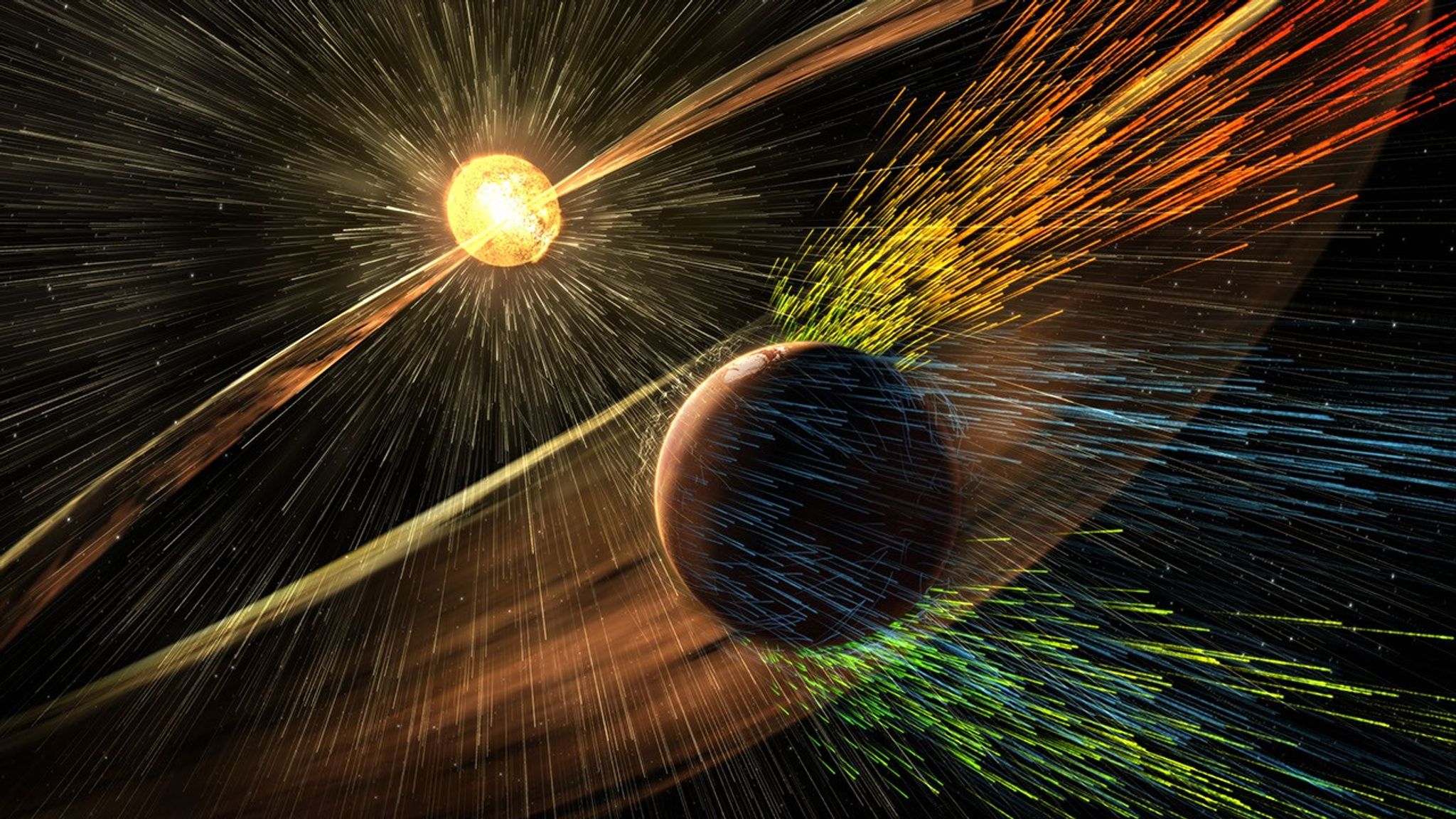
This illustration depicts charged particles from a solar storm stripping away charged particles of Mars' atmosphere, one of the processes of Martian atmosphere loss studied by NASA's MAVEN mission, beginning in 2014.
This illustration depicts charged particles from a solar storm stripping away charged particles of Mars’ atmosphere, one of the processes of Martian atmosphere loss studied by NASA’s MAVEN mission.
NASA/GSFC

NASA MAVEN (Mars Atmosphere and Volatile Evolution) mission scientists have uncovered a key puzzle piece in understanding certain types of auroras on Mars, finding that they form in a similar way to Earth-based auroras.
 
Results published Thursday in Nature Communications show the same mechanism that circulates and catapults charged particles into Earth’s atmosphere is happening at Mars on much smaller scales because of differences in the two planets’ magnetic fields.
 
The MAVEN spacecraft, in orbit around Mars, experienced a loss of signal with ground stations on Earth on Dec. 6, 2025. On June 3, NASA declared the mission had concluded after finding the spacecraft to be unrecoverable. However, data from the mission is still being used to inform NASA science and future missions to Mars.
 
When the Sun’s magnetic field lines get close to Earth’s magnetosphere, the large magnetic bubble protecting the planet, they can reconnect and inject energy and mass throughout Earth’s magnetosphere and magnetotail, ultimately firing electrons back into the atmosphere to generate Earth’s auroras. This process, called the Dungey cycle, drives electrical currents, accelerates charged particles that create auroras, and controls the circulation of plasma in Earth’s magnetosphere and ionosphere.
 
This new study shows that a miniature version of the Dungey cycle is happening over Mars’ strong crustal magnetic fields, which gives scientists a better look into the physics of Martian auroras.
 
“We knew that magnetic reconnection was happening at Mars but did not expect it to be like the Dungey cycle,” said Shaosui Xu, lead author of the study and associate research physicist at the Space Sciences Laboratory at the University of California, Berkeley.
 
Mars does not have a global magnetic field like Earth. Earth’s magnetic field is created by our planet’s churning core, while Mars has numerous miniature magnetospheres that arise from intensely magnetized crust scattered around the planet.  These regions were formed around 4 billion years ago when lava cooled in the presence of Mars’ ancient global magnetic field, which has since disappeared due to intense solar wind stripping the planet’s atmosphere.
 
The MAVEN mission has observed highly localized auroras over these crustal fields, similar to Earth’s auroras at the poles, but it wasn’t until now that scientists could fully understand the physics of how they form. The study used several instruments aboard the MAVEN spacecraft to build up a picture of the Dungey-like behavior: the Magnetometer and Solar Wind Electron Analyzer instruments, which were used to determine the magnetic configuration and derive electrical currents, and the STATIC (Suprathermal and Thermal Ion Composition) instrument, which was used to measure plasma flows in the ionosphere.
 
“We really pushed the limit of STATIC to get the data we needed,” said Xu. “It was the final piece to the puzzle in understanding these localized auroras.”
 
The realization that a Dungey-like cycle was happening within these crustal magnetic fields answered the question of how the electrons were being energized to create the auroras. It also shows that a Dungey-like mechanism can happen on both large and small scales, giving more insight into where in the solar system this process could be taking place.
 
“This is a remarkable result that changes how we think of Martian auroras and is another important step toward understanding why Mars and Earth have evolved so differently despite being governed by the same underlying physics.” said Shannon Curry, MAVEN’s principal investigator and a research scientist at the Laboratory for Atmospheric and Space Physics at the University of Colorado Boulder. “I am incredibly proud of our team’s work on this discovery and excited to uncover new insights into the Red Planet and its evolution.”
 
By finding out more about this process, scientists also are gaining a better understanding of how the solar environment interacts with the Red Planet as a whole, which is essential for future robotic and crewed missions.
 
“I remember in graduate school discussing with my advisor how the cycling of crustal magnetic fields could work at Mars,” said Xu. “It’s incredible to be part of the team that found the answer to that question.”
 
The MAVEN mission is part of NASA’s Mars Exploration Program portfolio. The mission’s principal investigator is based at the Laboratory for Atmospheric and Space Physics at the University of Colorado Boulder, which also is responsible for managing science operations and public outreach and communications. NASA’s Goddard Space Flight Center in Greenbelt, Maryland, manages the MAVEN mission. Lockheed Martin Space built the spacecraft and is responsible for mission operations. NASA’s Jet Propulsion Laboratory in Southern California provides navigation and Deep Space Network support.
 
For more information on NASA’s MAVEN mission, visit:
 
https://science.nasa.gov/mission/maven/
 
Karen Fox / Alana Johnson
Headquarters, Washington
240-285-5155 / 202-672-4780
karen.c.fox@nasa.gov / alana.r.johnson@nasa.gov
 
Lonnie Shekhtman
NASA’s Goddard Space Flight Center, Greenbelt, Md.
lonnie.shekhtman@nasa.gov
 

NASA’s New Horizons Spacecraft Wakes from Hibernation in Good Health

3 min read

NASA’s New Horizons Spacecraft Wakes from Hibernation in Good Health

Following its longest hibernation period ever of nearly a year, NASA’s New Horizons spacecraft has emerged in good health and is ready to begin transmitting science data gathered in the distant Kuiper Belt far beyond Pluto.

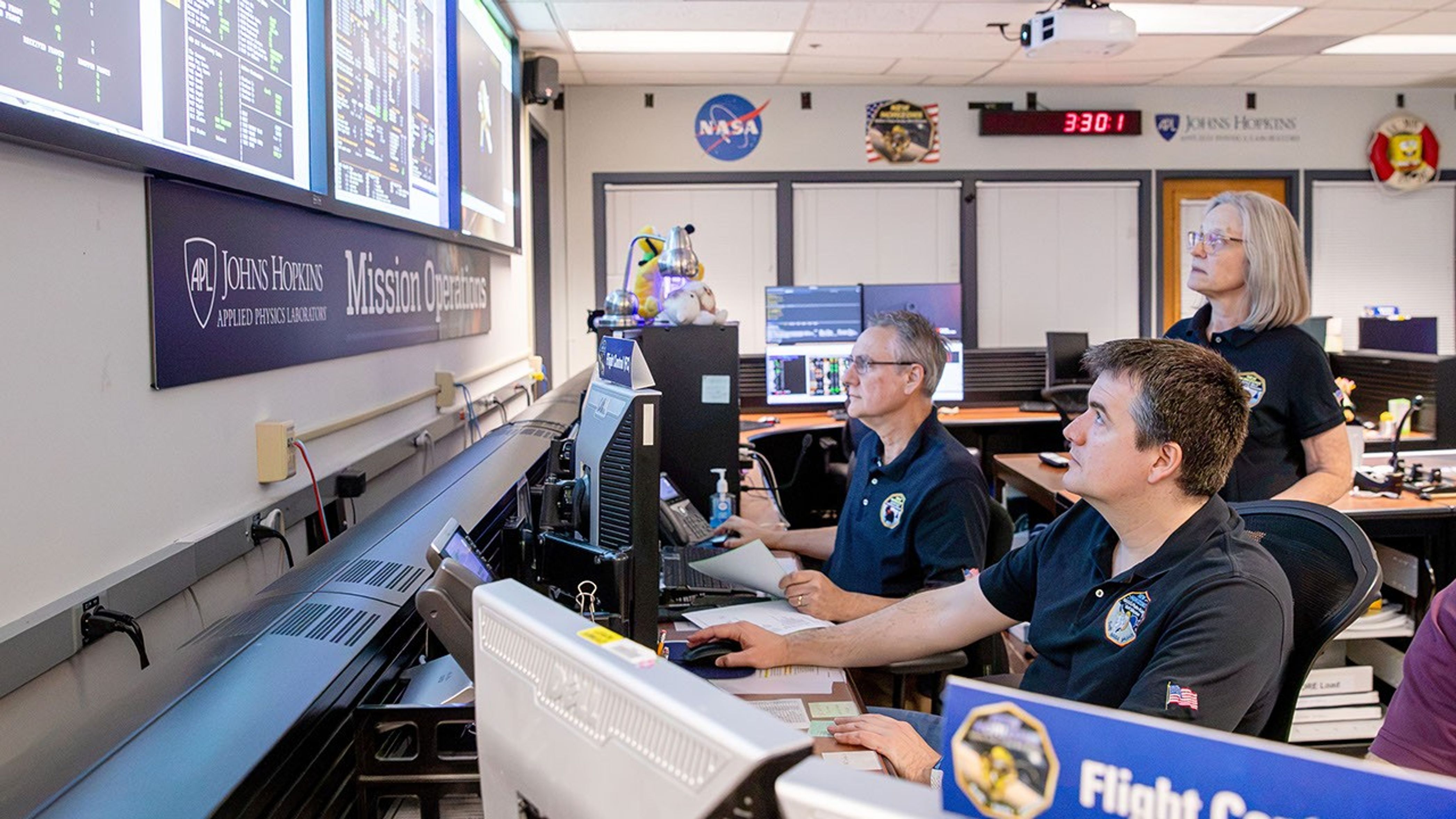
Flight operators at computers in a mission control center monitor spacecraft data on large wall displays.
From left, flight controllers Mark Lahr and Josh Albers, and Mission Operations Manager Alice Bowman, monitor telemetry streaming from NASA’s New Horizons spacecraft to the mission operations center at the Johns Hopkins Applied Physics Laboratory in Laurel, Maryland, on June 24, 2026. Now approximately 5.9 billion miles (9.5 billion kilometers) from Earth, New Horizons is ready to begin transmitting science data after being awakened from its longest ever, nearly yearlong hibernation period.
NASA/Johns Hopkins APL/SwRI/Justin Gladden

On June 23, flight controllers at the Johns Hopkins Applied Physics Laboratory (APL) in Laurel, Maryland, confirmed New Horizons, acting on stored commands uplinked to its main computer last July, had safely awakened from a 321‑day hibernation period that began Aug. 7. With the spacecraft now approximately 5.9 billion miles (9.5 billion kilometers) from Earth, the radio signals carrying that confirmation took about 8 hours and 52 minutes to reach the APL Mission Operations Center via NASA’s Deep Space Network station near Madrid, Spain.

The mission team typically places New Horizons in resource‑saving hibernation mode during long cruise periods. While the spacecraft is hibernating, operators do not send commands or retrieve data, but the spacecraft continues gathering and storing data around the clock from its heliospheric plasma sensors, Solar Wind at Pluto and the Pluto Energetic Particle Spectrometer Science Investigation, as well as its space dust detector, the Venetia Burney Student Dust Counter.

Alice Bowman, the New Horizons mission operations manager at APL, said the spacecraft reported back to Earth, via the Deep Space Network, with a weekly status beacon. “Every status report through this hibernation period was ‘green,’ meaning all was well aboard New Horizons each and every week,” she said.

As New Horizons resumes active operations, Bowman noted, the team will begin downlinking spacecraft health and safety data, followed by data from the three scientific instruments. In about three weeks, the spacecraft’s onboard Alice ultraviolet spectrograph will look at the hydrogen gas distribution in the outer heliosphere, while the Solar Wind at Pluto, the Pluto Energetic Particle Spectrometer Science Investigation, and the Venetia Burney Student Dust Counter instruments continue their measurements, and the ground team conducts a series of spacecraft and instrument checkouts.

The team also is completing upgrades to the ground‑system software that will make it easier to maintain operations of the spacecraft. Tests are already underway and are expected to continue through the year.

New Horizons is operating on updated autonomy logic designed for operations farther from the Sun and to accommodate the expected reduction in power and the naturally occurring increase in radio‑signal travel time.

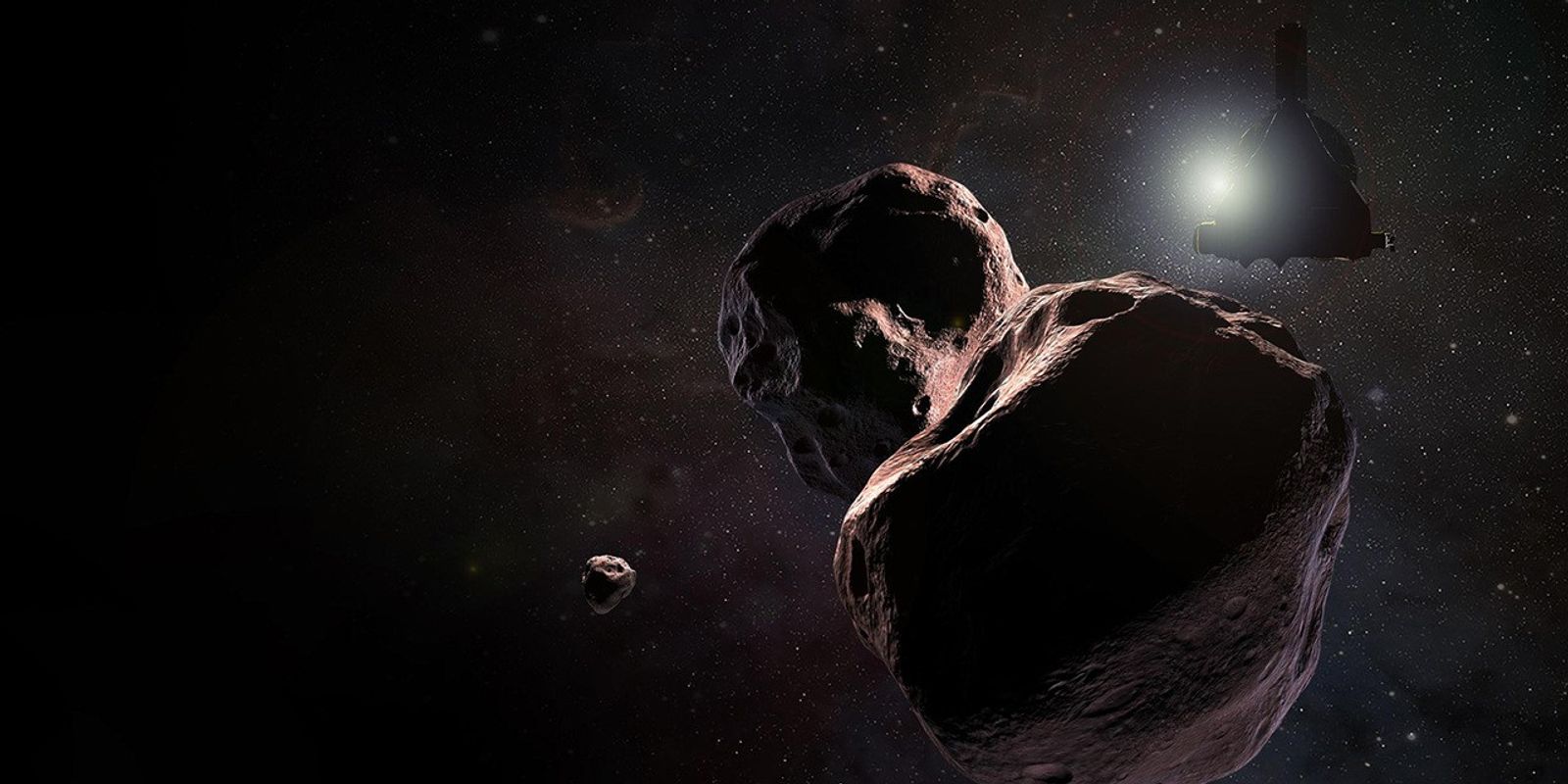
The NASA spacecraft’s exploration of this distant region of the solar system marks the latest step in a journey that began in January 2006 with the fastest launch on record; a flyby of Jupiter in February 2007 that included stunning views of the gas giant and its moons; the first exploration through the Pluto system in July 2015; the first exploration of a Kuiper Belt object, Arrokoth, in January 2019, and unique studies of the Sun’s outer heliosphere and dozens of additional Kuiper Belt objects since then.

For more information on NASA’s New Horizons mission, visit:

https://science.nasa.gov/mission/new-horizons/

What’s Up: July 2026 Skywatching Tips from NASA

A predawn Moon-and-planets meetup, a returning comet, a great chance to see the Milky Way, and Saturn’s rings at a new angle.

Skywatching Highlights

  • July 7: Last Quarter Moon
  • July 11 + 12: Dawn alignment of the Moon, Mars, Saturn, and Uranus
  • July 14: New Moon; best dark-sky window for Comet 10P/Tempel 2 and the Milky Way
  • Later in July: Saturn’s unusually thin rings are a rewarding telescope target
  • July 21: First Quarter Moon
  • July 29: Full Moon

Transcript

An early morning hangout with the Moon and planets, a comet swings by, prime time for the Milky Way, and Saturn’s rings shine at a new angle. That’s What’s Up for July.

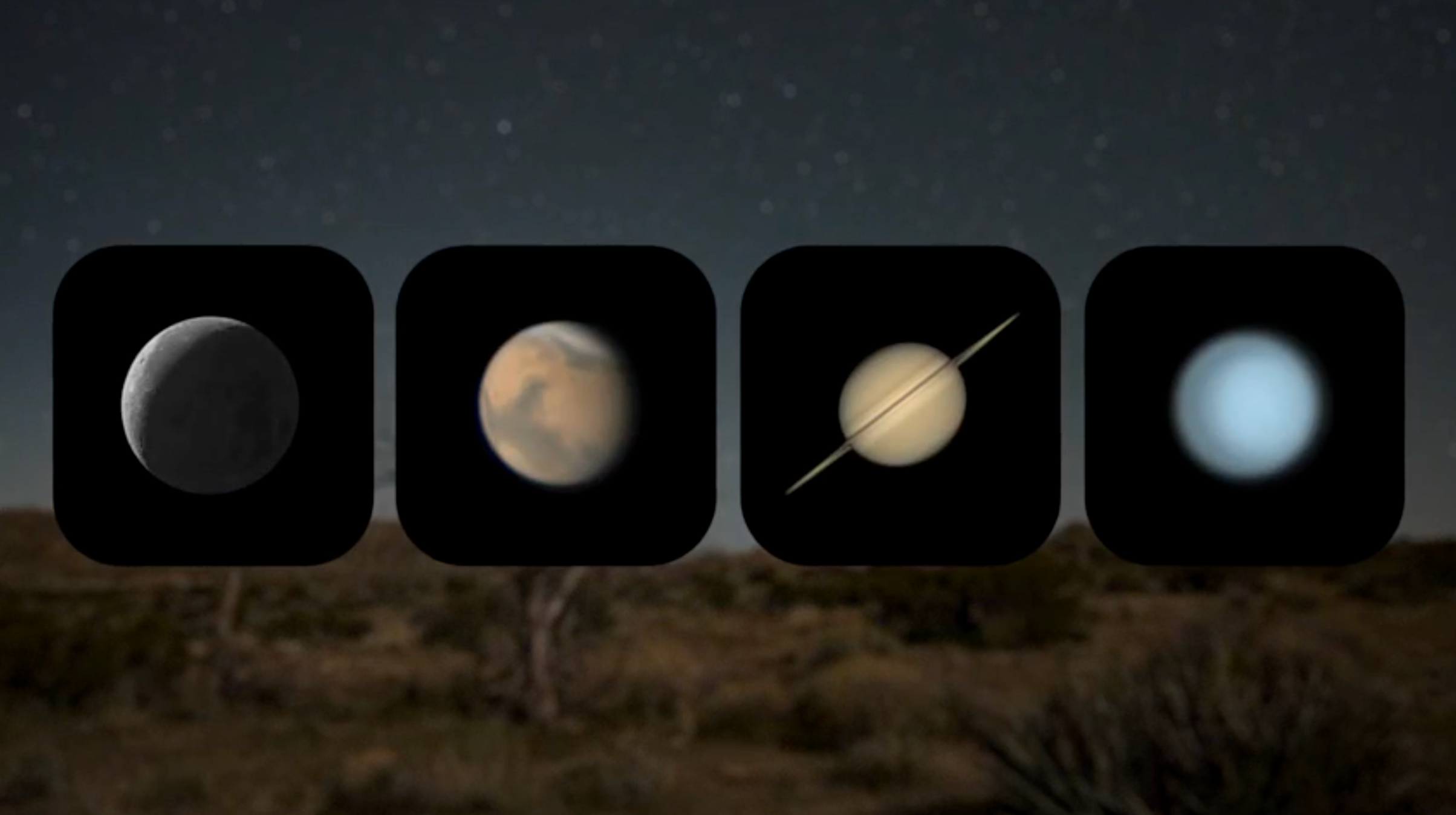
Before sunrise on July 11 and 12, look toward the eastern sky for a lineup of the Moon and planets. On these mornings, the waning crescent Moon helps point the way to Mars, with Saturn shining nearby in the morning sky.

Uranus is in the same general part of the sky, too, but it is much fainter, so you will need binoculars or a telescope to see it.

Mars will look like a small reddish point of light, Saturn is brighter and easier to spot, and the Moon makes the whole scene easy to locate.

Four black squares agains a night sky image. From left to right, the squares show the Moon, Mars, Saturn and Uranus.
Before sunrise on July 11 and 12, the Moon, Mars, Saturn, and Uranus will parade in the eastern sky.
NASA/JPL-Caltech

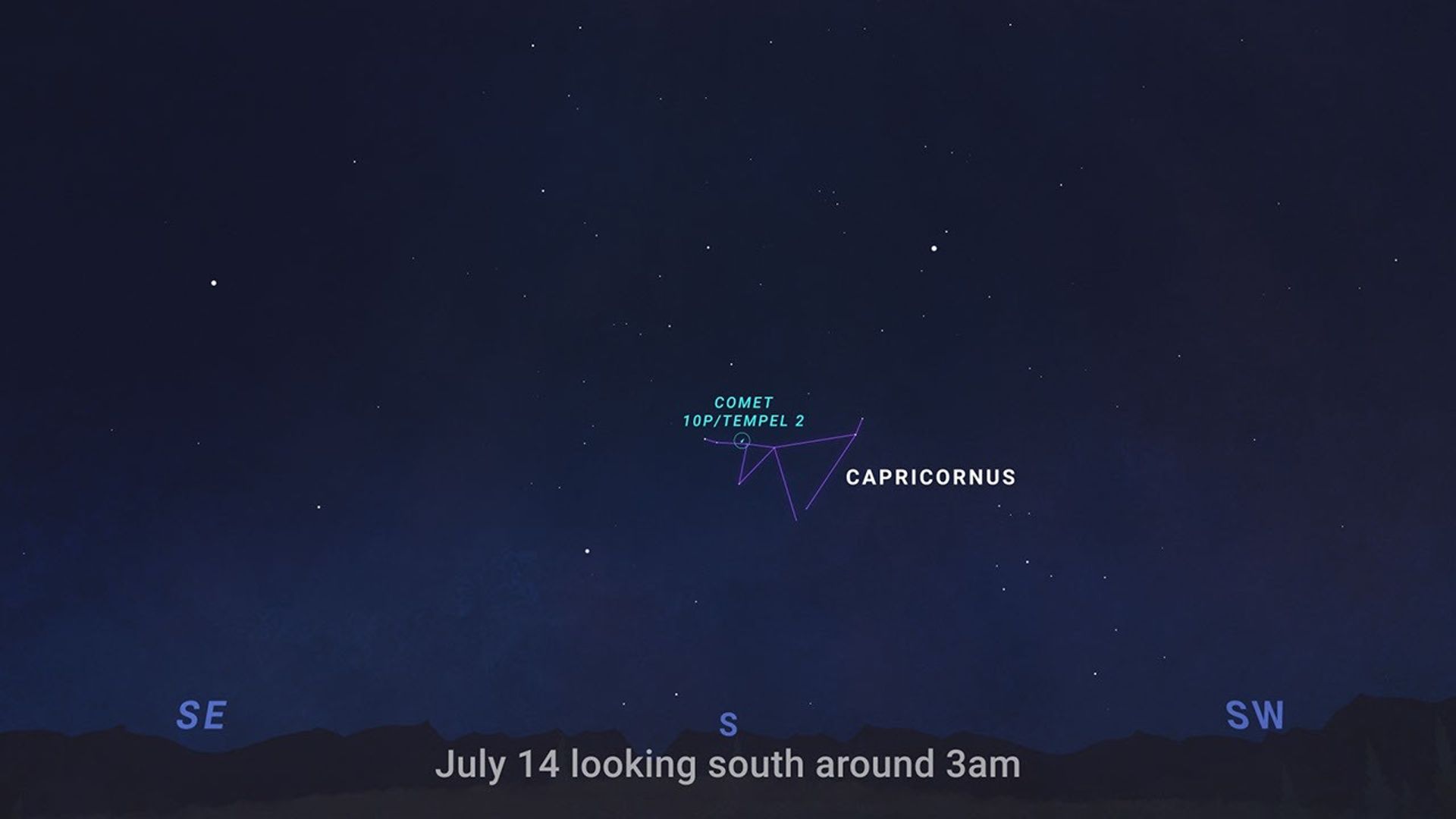
Around the New Moon on July 14, Comet 10P/Tempel 2 swings by.

This is a short-period comet, meaning it returns to the inner solar system on a regular orbit. In this case, it comes back about every 5½ years. It is not a dramatic comet that you see just by looking up at the sky, though.

Through binoculars or a telescope, find the constellation Capricornus and look for a small fuzzy glow nearby, possibly with a brighter central knot and a short, broad, fan-shaped tail.

For the best chance to view the comet, head somewhere dark, away from city lights. Start looking once the sky is fully dark, ideally about 45 to 60 minutes after sunset.

What's Up - Comet 10P/Tempel 2 - July 14, 2026
NASA/JPL-Caltech

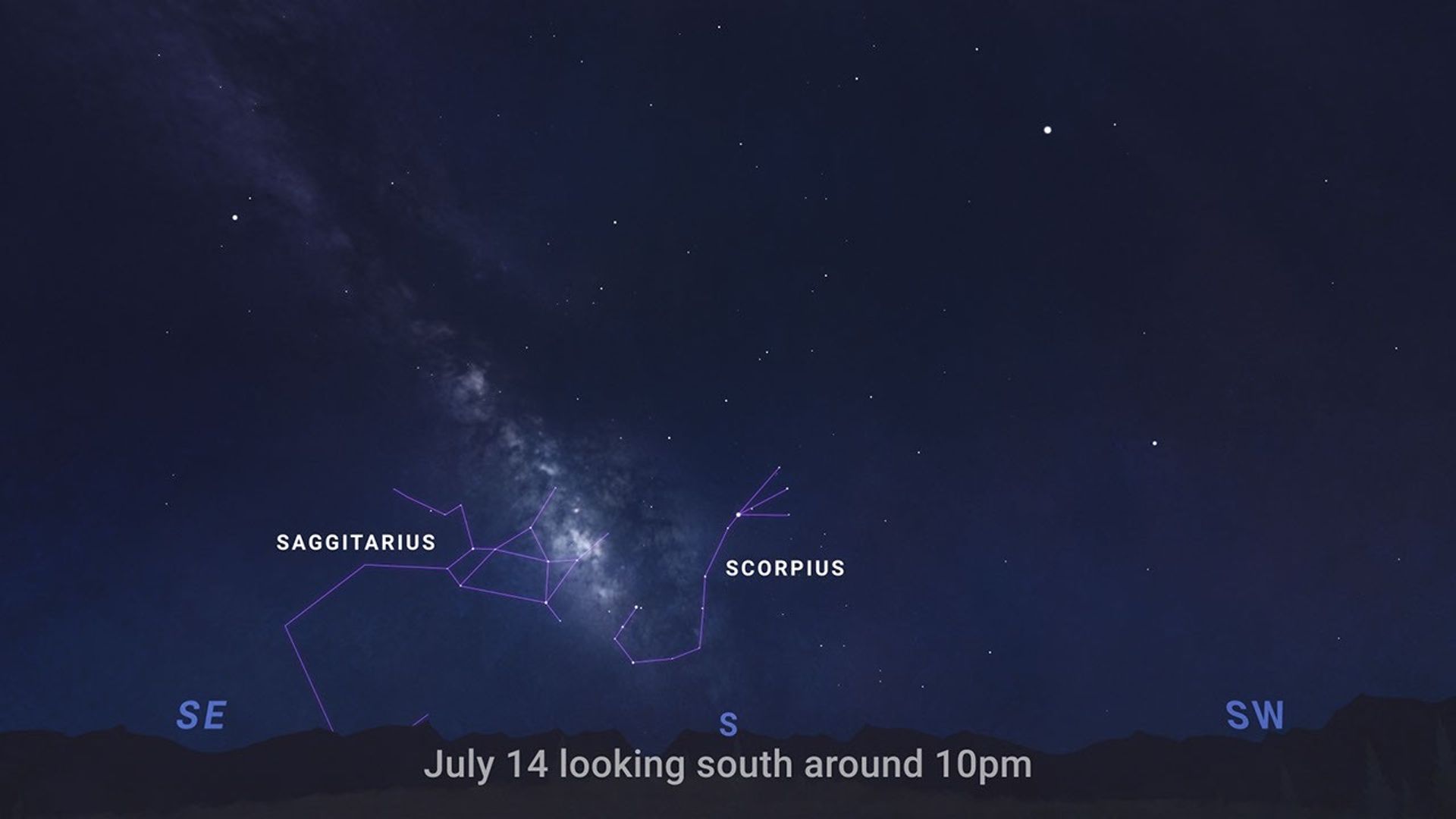
Those same dark nights around the July 14 New Moon are also the best time this month to look for the Milky Way.

From a dark location, away from city lights, the Milky Way appears as a pale, cloudy band across the summer sky. The bright, cloudy region of the Milky Way marks the direction of the galactic center. It looks so dense because we’re looking toward one of the most crowded parts of our galaxy, where countless stars glow behind dark clouds of cosmic dust.

Late in the evening, look low in the southern sky for a group of stars shaped like a big hook or scorpion tail. That’s Scorpius. The bright, cloudy part of the Milky Way is nearby, close to another group of stars called Sagittarius.

For the best chance to see the Milky Way, go somewhere dark, give your eyes time to adjust, and try not to look at your phone.

What's Up - Milky Way July 14, 2026
NASA/JPL-Caltech

Later in July, Saturn is a rewarding target for telescope users.

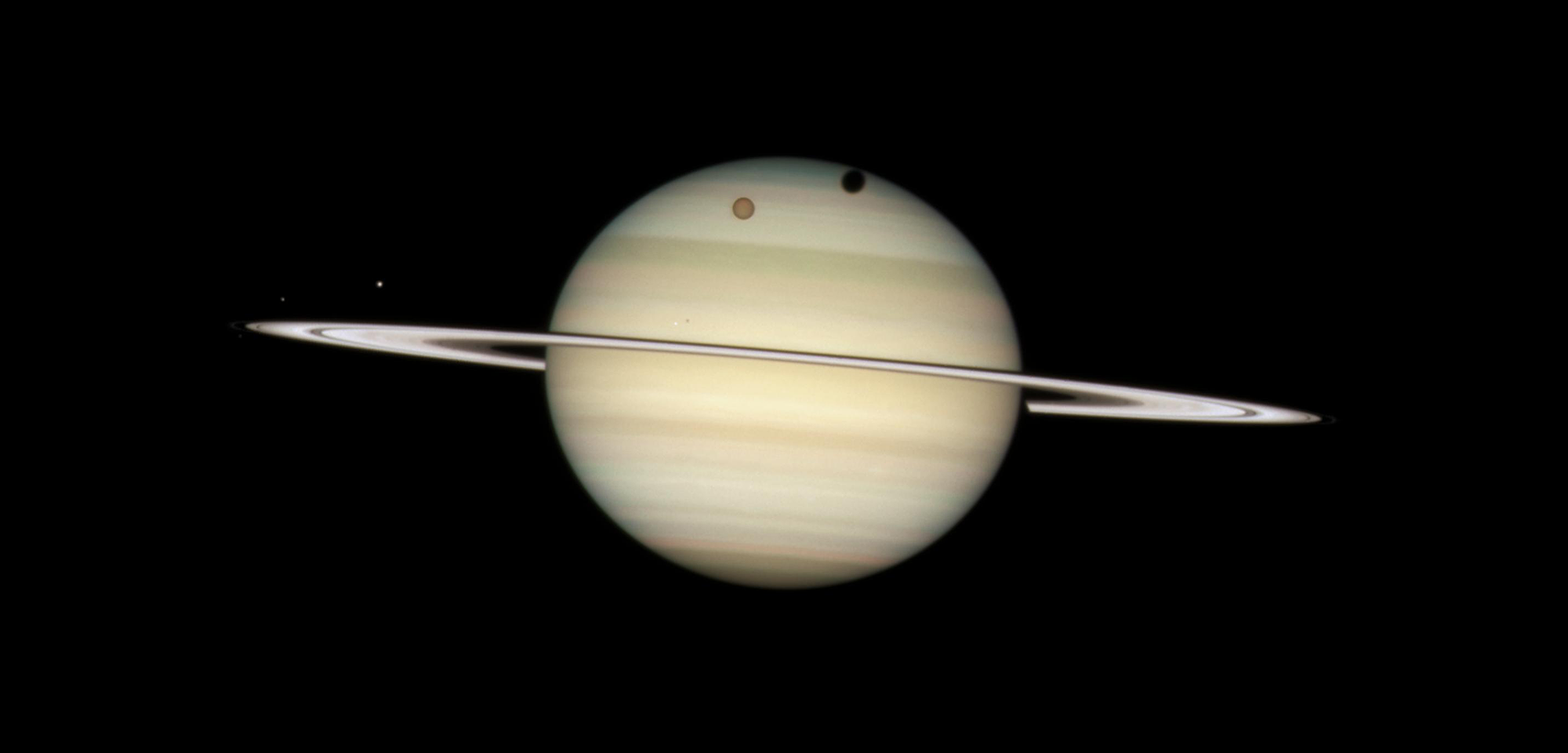
Saturn’s rings are still tilted at a very shallow angle from our point of view, making them look unusually thin. The rings aren’t disappearing, but how they appear from Earth is changing. It’s a great reminder that our view of the solar system is always in motion.

Quadruple Saturn Moon Transit
Saturn is famous for the intriguing rings that encircle it. As Saturn orbits the Sun, though, our view of its rings changes. Roughly every 15 years (halfway through Saturn’s almost-30-year orbit), Saturn’s rings appear edge-on, sometimes seeming to disappear altogether. On Feb. 24, 2009, when Saturn’s rings were nearly edge-on, Hubble tracked four of Saturn’s moons as they passed across the face of the giant ringed planet.
NASA, ESA, and the Hubble Heritage Team (STScI/AURA)

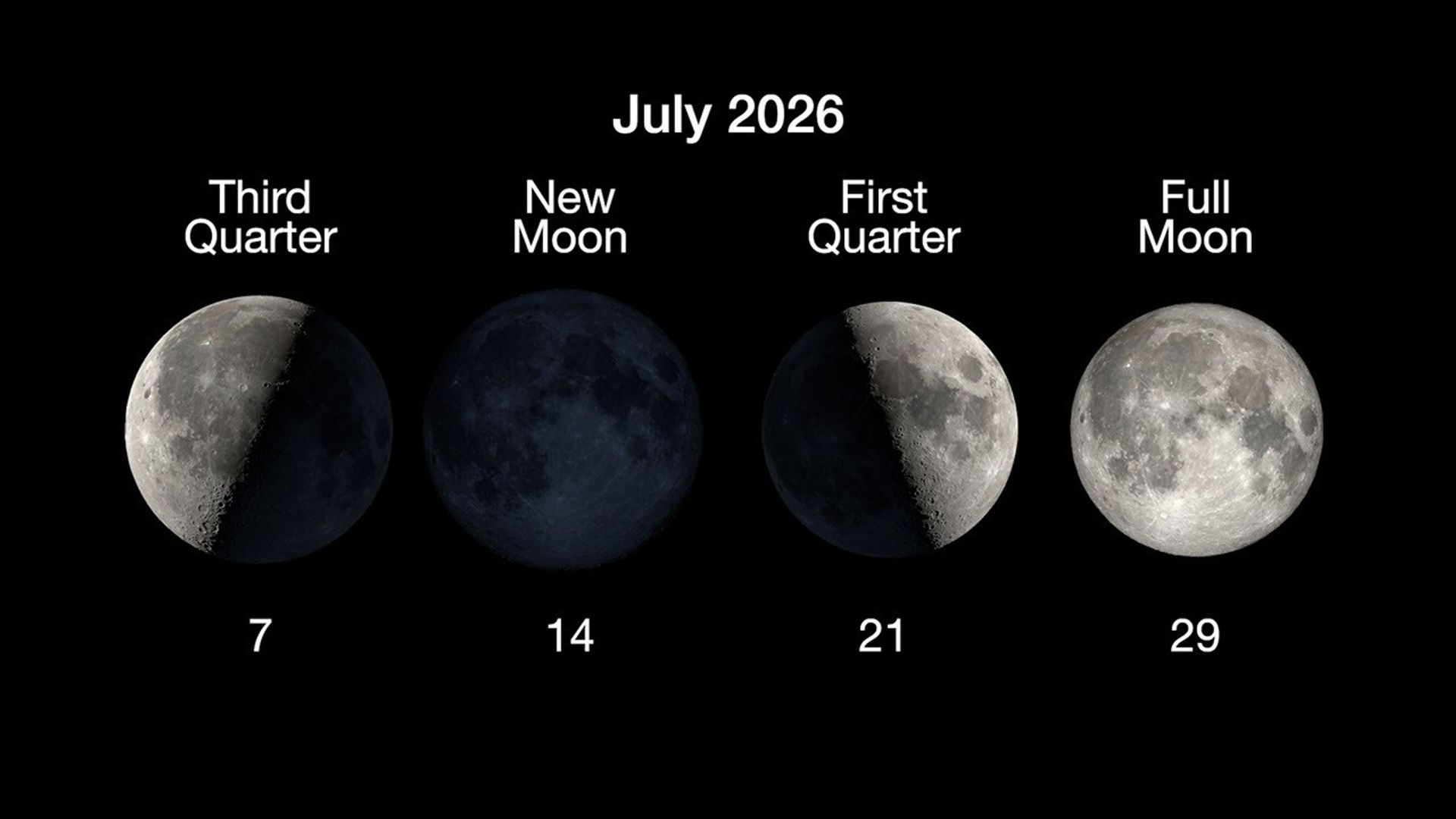
Here are the phases of the Moon for July.

Chart showing June 2026 moon phases: Third Quarter on the 7th, New Moon on the 14th, First Quarter on the 21st, and Full Moon on the 29th.
NASA/JPL-Caltech

You can stay up to date on all of NASA’s missions exploring the solar system and beyond at science.nasa.gov. I’m Raquel Villanueva from NASA’s Jet Propulsion Laboratory, and that’s What’s Up for this month.

Keep Exploring

Discover More Topics From NASA

❌