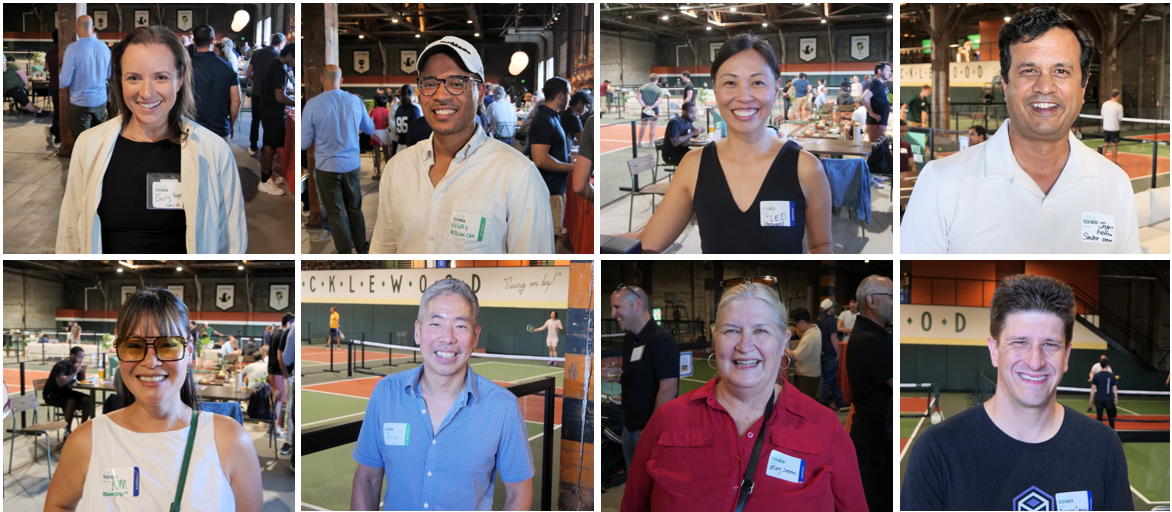
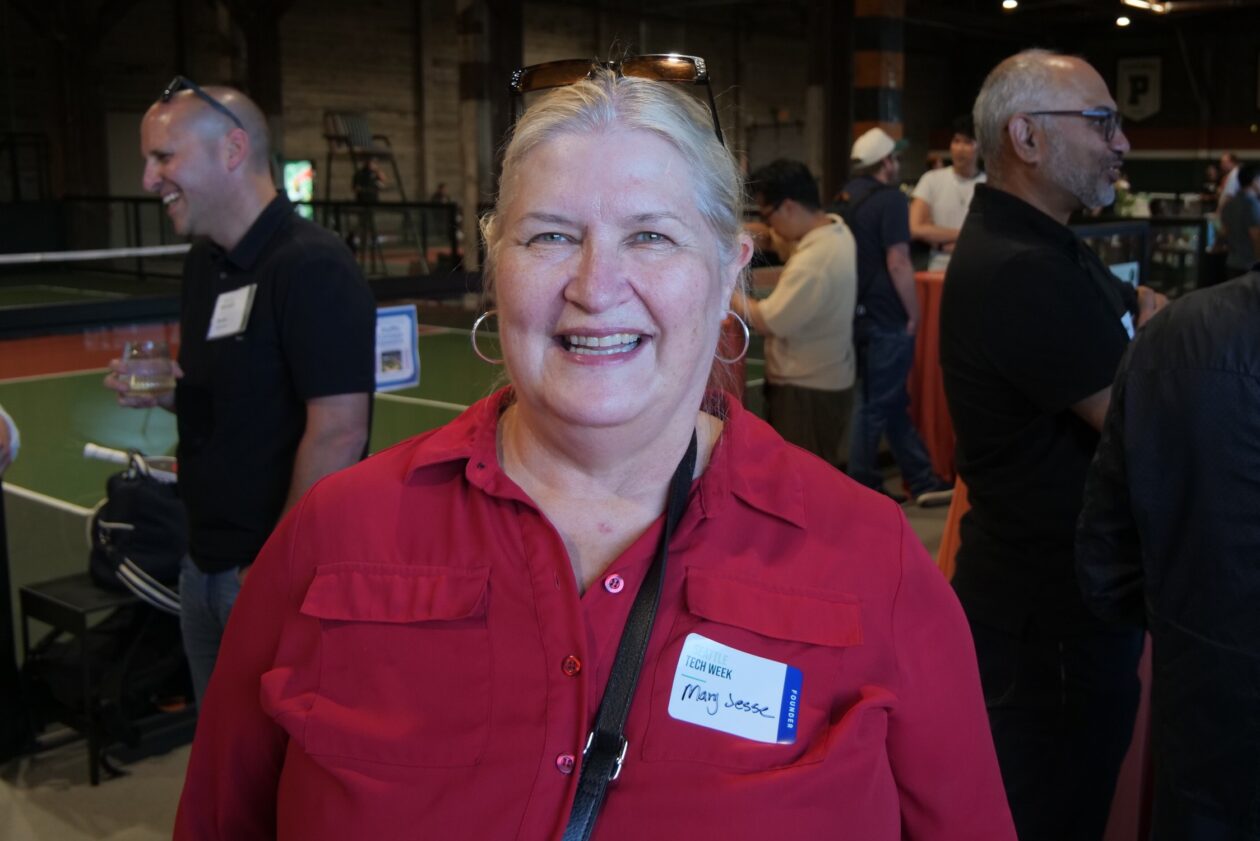
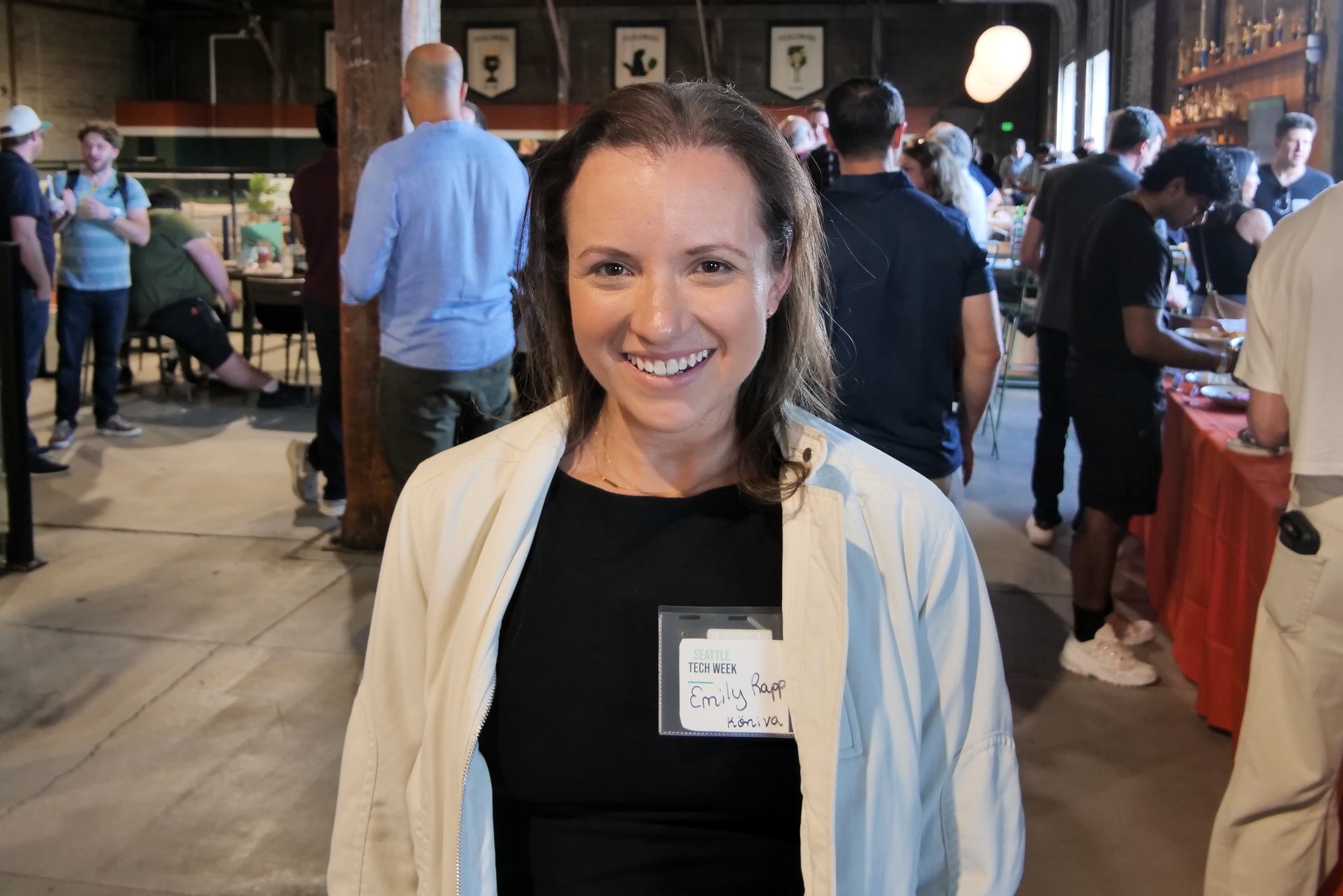
Top row from left: Emily Rapp, Henry Arias, Cleo Escarez, and Jagan Nemani. Bottom row from left: Kim Vu, Andy Liu, Mary Jesse, and Kenny Daniel, at the Seattle Tech Week kickoff. (GeekWire Photos / Todd Bishop)
The fourth annual Seattle Tech Week got off to a big start Monday, with panels and parties bringing together thousands of people from across the region and out of state. Organizers said the week features more than 250 events and drew more than 29,000 event registrations.
We went to Madrona’s kickoff event at Picklewood Paddle Club with one question for the founders, investors, and operators we met: What are you building? Here’s what we heard and learned.
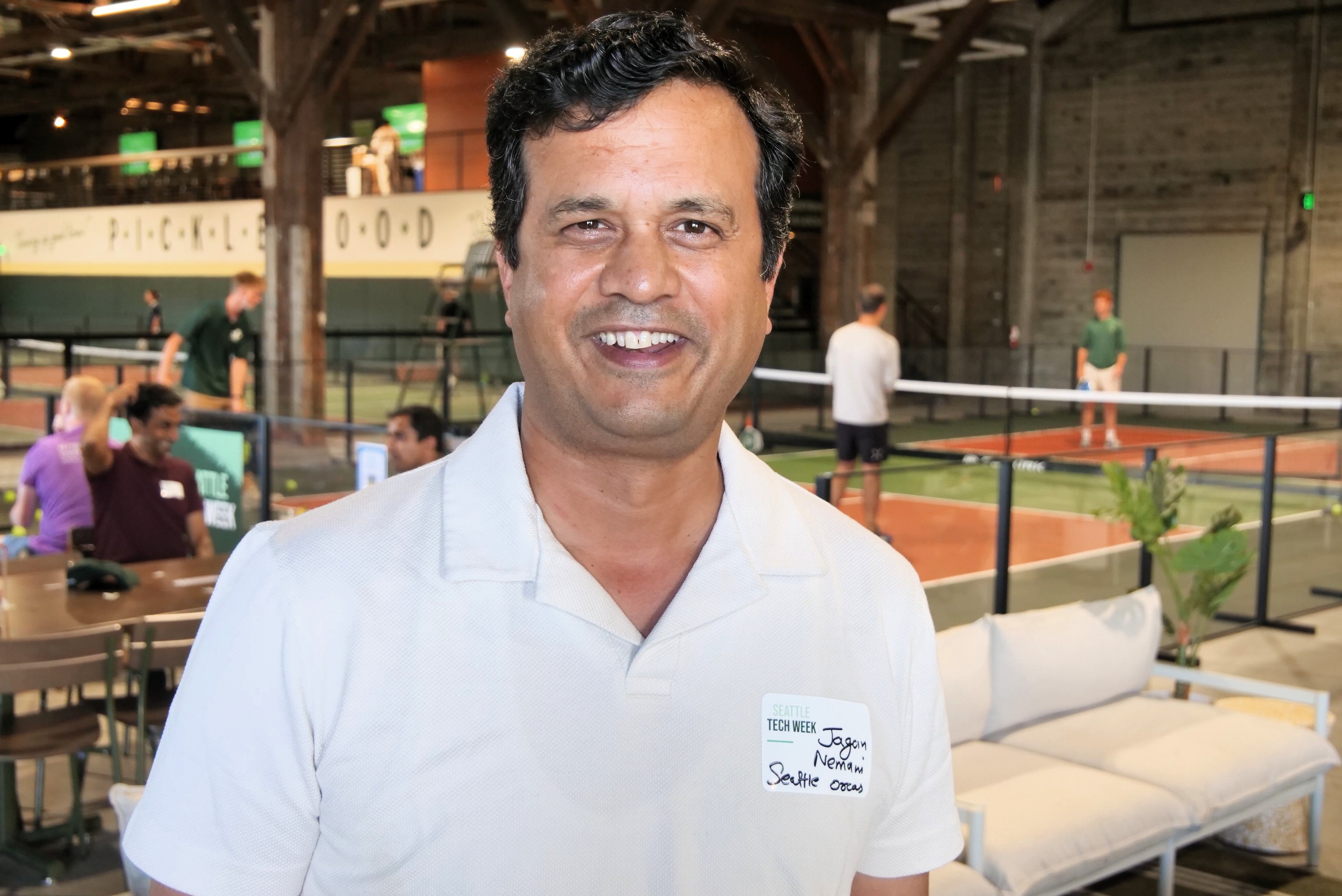
Jagan Nemani, chief product officer of the Seattle Orcas. (GeekWire Photos / Todd Bishop)
What he’s building: An AI system that runs a professional cricket franchise — flights, hotels, ground transportation, and daily schedules for players and staff, all handled over WhatsApp.
Nemani is chief product officer of the Seattle Orcas, the Major League Cricket team now in its fourth season. For the first three, he ran team operations the old-fashioned way: “I ran the entire operations using spreadsheets and people and processes,” he said. That meant tracking a constant stream of inbound flights, hotel blocks and car bookings across a season.
This year, he used Claude Code to build the backend for an AI agent that took over roughly 80% of the operation: booking flights, hotels and cars, dealing directly with hotels and transportation vendors, and telling players and staff when their flight lands, which hotel they’re in, and who’s picking them up. It also handles daily schedules, down to massage appointments.
To accommodate players and staff who were reluctant to adopt new tech tools, he built it to run on WhatsApp, the messaging app they already used every day.
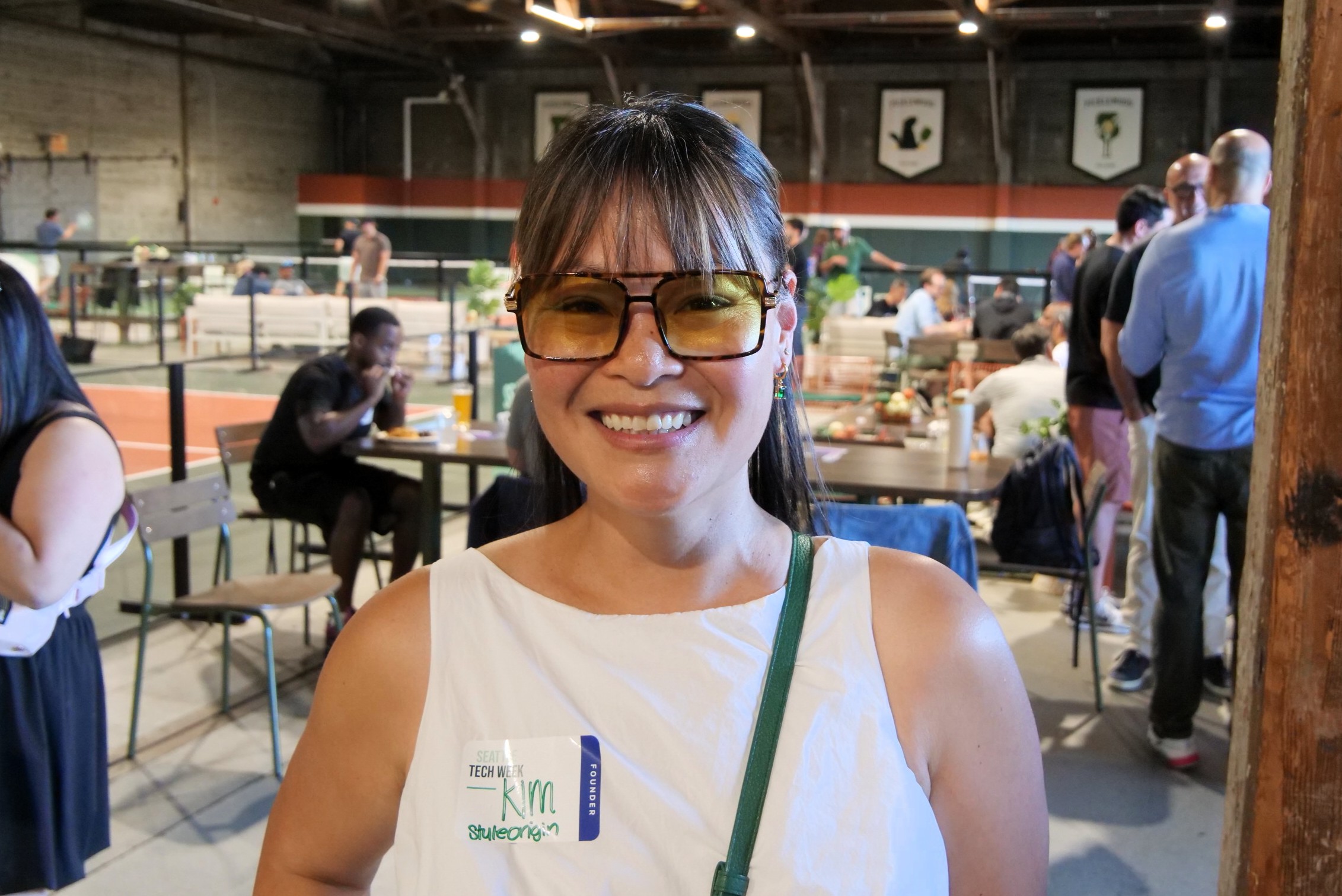
What she’s building: A B2B tool that lets thrift, vintage, and consignment resellers photograph an item and get back the identification, pricing, and listing details they now assemble by hand.
Vu is founder and CEO of StyleOrigin. Getting a single secondhand garment listed for sale is still manual work that takes 30 to 45 minutes an item, she said. With StyleOrigin, a reseller takes one image and an AI analysis returns what they need to list and price it. The company also gives sellers data to guide inventory decisions.
She found the problem herself. Vu ran environmental, social and governance work at Remitly until she stepped down in 2023, then took a year off and started selling vintage clothing. She assumed she was slow because she was new to it. “But turns out everybody does it the same, and so there wasn’t really any good solution out there.”
She taught herself to code and built the first version of the product. StyleOrigin has a working MVP but no revenue yet. More than 70 stores around the country are on a waitlist, and Vu is about to bring her first engineer aboard.
What he’s building: Tools for collecting, storing, and analyzing the data AI systems produce — the record of what agents actually did, not just the code they shipped.
Daniel is founder of Hyperparam, an early-stage Seattle startup, and previously co-founded Algorithmia, the Seattle machine learning company acquired by DataRobot in 2021.
Companies are spending heavily on AI without much sense of what they’re getting, he said. “AI is producing this wall of tokens. Companies are paying huge amounts of money to generate all these tokens, but they have really no visibility into what are these agents doing.”
Every token leaves a trail, and Daniel said most companies ignore it. Mining it would show them where AI is working and where it’s wasting money.
“Where are models being stupid? Where are they going down rabbit holes?” Older analytics tools can’t help, he said, because they were built for numbers and clicks: “People haven’t really been thinking about what do you do when the majority of the data being produced in the world is text.”
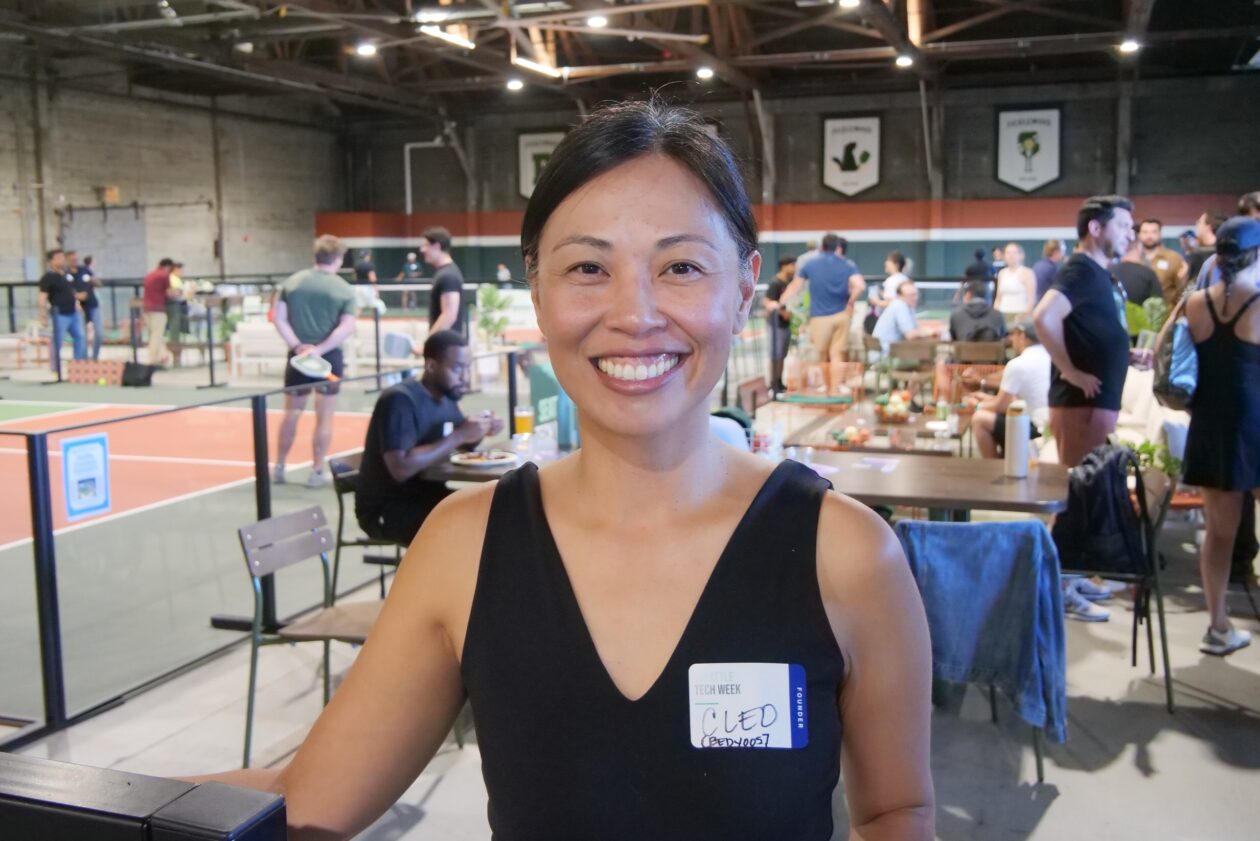
What she’s building: An urban mine — recovering precious metals from jewelry and returning them to the supply chain for clean technology.
Escarez is founder of Redyoos, which GeekWire featured in Startup Radar last year. The jewelry industry accounts for 40% to 50% of the global supply of precious metals, she said — the same materials found in “anything that has an on and off button,” from cell phones to wiring.
Demand for those metals is climbing with AI and clean energy, and Escarez said projections point to a supply shortfall of 700% over the next couple of decades. “We mathematically cannot solve this deficit,” she said, which is why she sees jewelry as a viable source.
Redyoos collects jewelry, refines what contains precious metals, and sells the recovered material to clean-tech manufacturers.
Escarez, a former chief operating officer at Boma Silver Jewelry and brand manager at Starbucks, has bootstrapped the company, which has been live a little over a year and is generating revenue. She is now raising a pre-seed round.
What he’s building: An engineering team inside a venture capital firm, automating the work of investing.
Liu is a partner at Unlock Venture Partners, which he helped launch in 2018 to back early-stage startups in Seattle and Los Angeles, and which raised a $60 million second fund in 2022. A longtime Seattle entrepreneur and angel investor with stakes in close to 100 companies, he was previously CEO of BuddyTV, acquired by Vizio, and of NetConversions, acquired by aQuantive.
“We actually have an engineering team that’s trying to automate a lot of what we do in VC,” Liu said, “and trying to make sure we can scale our business just like our own portfolio companies.”
The work covers deal memos and diligence on prospective investments, along with the mechanics of dealing with the firm’s own investors and collecting updates from portfolio companies.
The point, he said, is better decisions: “How do we get smarter as VCs?”
What she’s building: Private AI — letting people own their own data and context, use any large language model, and not be tracked or trained on.
Jesse is co-founder and CEO of ACME Brains, whose first product, nexie, is in beta. GeekWire wrote about the origins of the company last year: after her husband passed away, she turned to ChatGPT and found real comfort in it, then ran into its limits — it couldn’t carry the context of their conversations, and she had concerns about the privacy of what she was telling it.
nexie keeps a user’s notes, journals, and conversations in what the company calls a personal context engine, and carries that context across AI services instead of leaving it scattered in separate chat histories.
Trading privacy for free services goes back to the early internet, she said, but AI tilts the exchange further. A chatbot draws information out of a person in conversation, then combines it with everything already known about them. “AIs can talk you into your data,” she said.
An electrical engineer with more than two dozen patents who spent decades in wireless at McCaw Cellular and AT&T Wireless, Jesse said most people don’t grasp how AI actually behaves, which leaves them exposed — seniors especially. “You need people that understand it to help protect people that don’t.” Her co-founders are Alan Caplan, Amazon’s original general counsel, and patent attorney and engineer Bob Bergstrom.
What she’s building: Voice AI that lets bar and restaurant staff count inventory out loud instead of writing it down by hand.
Rapp is founder and CEO of Köniva. A typical hotel resort bar spends 12 hours and four people on an inventory count, she said; with Köniva it’s two people and 3-and-a-half hours, and more accurate. Staff download an app and wear a lapel mic — you want both hands free on a ladder — and count out loud the way they always have.
She came to the problem after a career in big tech and ad tech. Not wanting to build for an industry she’d never worked in, she took a part-time job at Canlis after training as a sommelier.
When she was injured, the wine director let her help with inventory reconciliation and handed her a clipboard of handwritten numbers plus a login to the restaurant’s inventory software. She asked why they were still using paper and pencil when a whole engineering team had built software for the job. The wine director’s answer: it was faster.
Köniva has 10 customers. At several high-end hotels and restaurants, Rapp said, staff put the app on their personal credit cards to start using it, then helped her pitch their own procurement departments — an unusual path in an industry she said has been badly burned by technology.
“It is insane how bad tech has been to them,” she said.
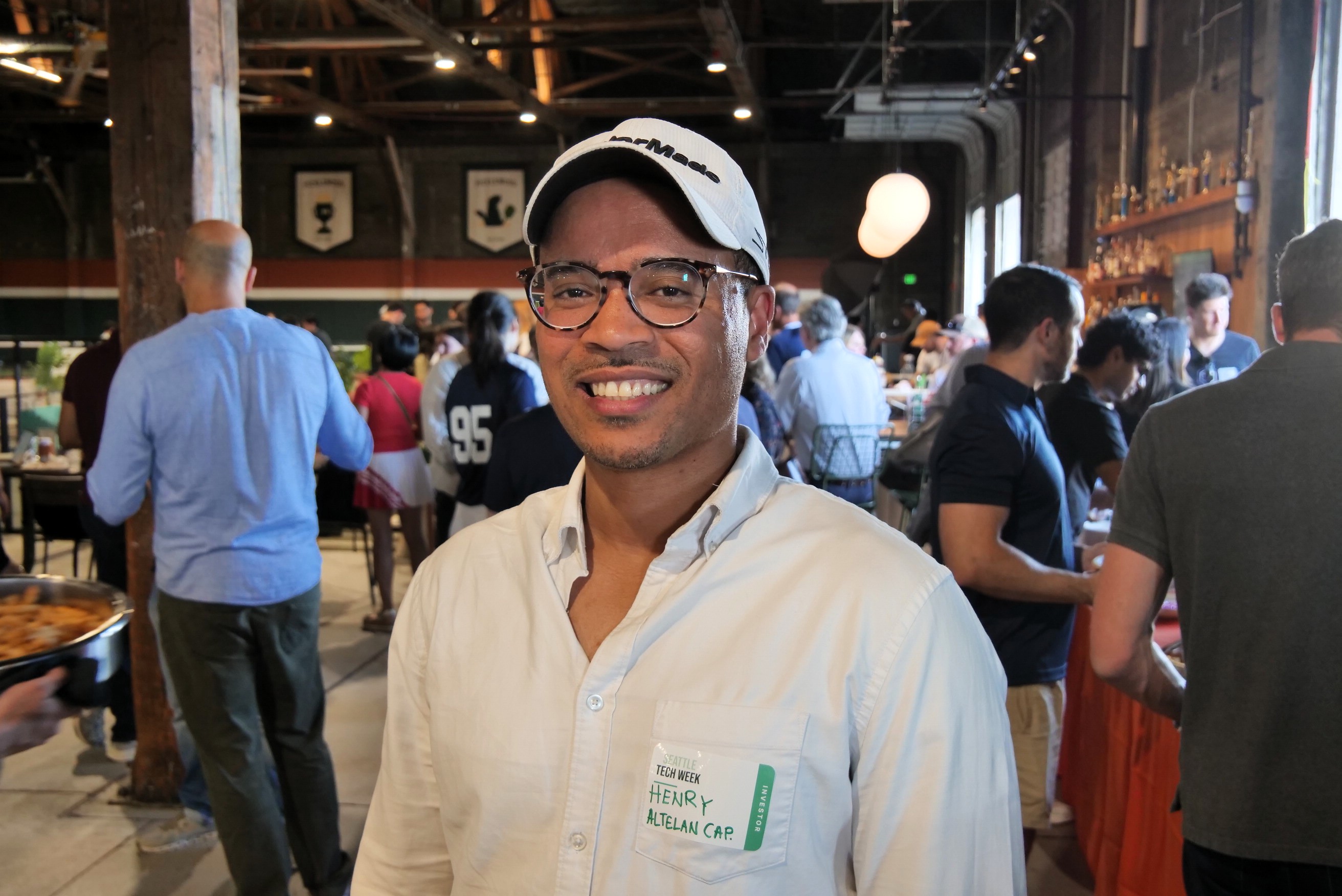
Henry Arias, founder and managing partner of Altelan Capital.
What he’s building: A growth equity firm investing at the intersection of food brands and food tech.
Arias is founder and managing partner of Altelan Capital, a Seattle firm he started last year. It underwrites companies around the Series A stage, generally, providing growth capital and strategic support.
He came up in the industry itself, leading finance at restaurants and breweries and most recently running corporate development and financial planning for Seattle Hospitality Group. That operator lens, he said, is what he brings to investments and to coaching founders on growth. He has been an investor since 2015.
Arias calls Altelan an AI-native investment fund, using AI tools to get up to speed on an industry and test assumptions about a business’s ability to scale and where the risks are. He’s equally interested in where the technology doesn’t belong and simplicity is the better option: “AI is great, but it may not be the right tool for the job.”
The bigger shift he’s watching is food and digitization. The industry has traditionally worked off “the proverbial clipboard and a notepad,” he said, and the pandemic accelerated the move to technology across the supply chain. “There are many applications of tech in food,” he said, “and that’s what keeps us up and gets us excited every day.”
A new Warner Bros. Discovery lawsuit against Amazon, accusing the tech giant of poaching a top HBO Max marketing executive 16 months before her contract expired, comes with an unusual request: a court order barring Amazon from hiring any employee of the media conglomerate as long as they’re under contract.
The suit, filed July 21 in Los Angeles County Superior Court, centers on Pia Barlow, the longtime HBO Max executive who was announced last week as Amazon MGM Studios’ new head of series marketing. Her Warner Bros. Discovery contract ran through October 2027.
She resigned in June and was due to start at Amazon on Aug. 3.
Warner Bros. Discovery accuses Amazon of “hurriedly seeking to pirate away a number of contracted employees,” calling the company a “digital bull in a china shop” that chose to build its entertainment workforce by raiding Hollywood rather than hiring from scratch.
The suit says Amazon tried weeks earlier to recruit another WBD executive under contract through December 2027 and failed, and was pursuing at least one more when the suit was filed.
The complaint says Barlow’s departure “conveyed a troublesome message throughout Plaintiffs’ executive ranks” — that contractual commitments could be disregarded “whenever a larger paycheck appears.”
Amazon declined to comment in response to GeekWire’s inquiry.
It’s led by Mike Hopkins, head of Prime Video and Amazon MGM Studios.
Warner Bros. Discovery itself is in the middle of being sold. Paramount Skydance agreed in February to buy the company for about $81 billion, outbidding Netflix, but 12 state attorneys general sued this month to block the deal, and Paramount has pushed its closing deadline to as late as June 2027.
The complaint goes further, alleging Amazon didn’t just recruit Barlow but also picked her lawyer. Warner Bros. Discovery says the firm now representing her is based less than a mile from Amazon’s Seattle headquarters and “has a well-publicized, long-standing relationship with Amazon as outside litigation counsel,” and that Amazon is paying its fees. The firm isn’t named in the complaint.
Barlow, who lives and works in Los Angeles, is not a defendant.
Warner Bros. Discovery says its lawyers exchanged letters with Amazon and with that attorney before filing suit, demanding Barlow not leave. It makes the fee allegation on “information and belief,” a legal phrase indicating a claim based on inference rather than direct evidence.
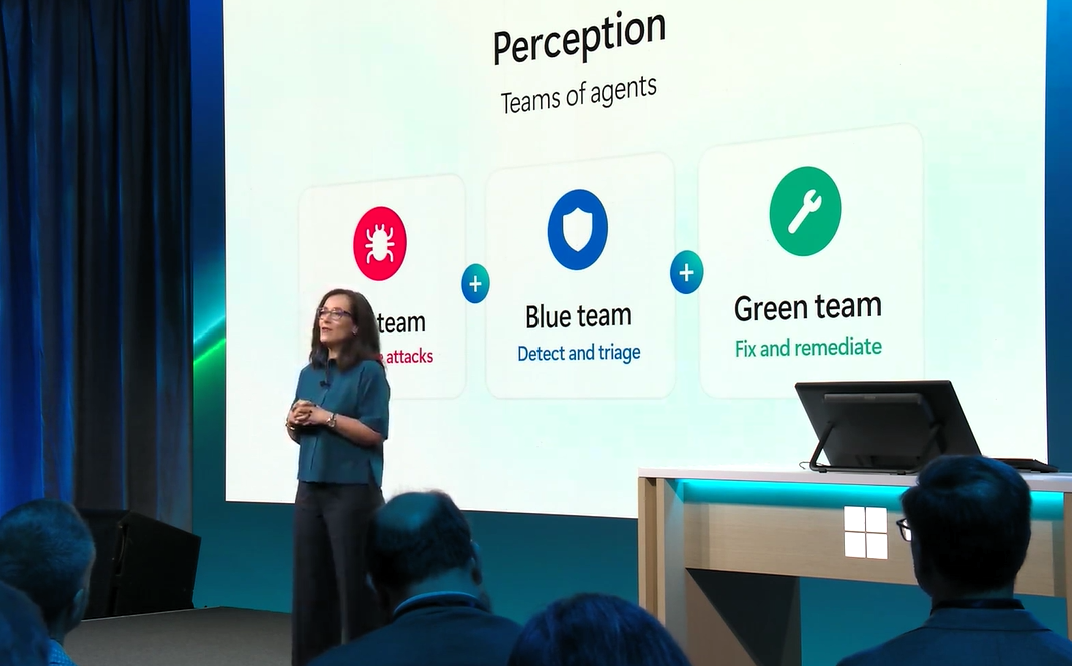
Microsoft Security EVP Hayete Gallot introduces Project Perception’s agent teams Monday in San Francisco. (Screenshot)
Microsoft on Monday unveiled Project Perception, an AI cybersecurity system built to defend against AI-driven attacks, aiming to keep pace with both hackers and its technology rivals.
The system, which enters public preview Aug. 3, coordinates three sets of AI agents: red team agents that hunt for paths an attacker could take, blue team agents that determine which risks matter and green team agents that make fixes.
It’s based on MAI-Cyber-1-Flash, a new AI model designed specifically for cybersecurity, which the company says does most of the work of larger models at half the cost. It runs in conjunction with OpenAI’s GPT-5.4, which Microsoft reserves for the 10% of tasks it calls exceptionally hard.
Microsoft says the combination scores 96% on CyberGym, a benchmark measuring how well AI systems find real vulnerabilities in large codebases.
The company did not give the model to independent testers before releasing it, according to The New York Times. Microsoft says the model was independently assessed by a third party.
Microsoft CEO Satya Nadella said in a post on X that the initiative is an example of how the company can get better results per dollar by not locking its security systems to a single AI model family.
“This is the benefit of building the harness, context/signals, and action space separate from one model family,” he wrote. “By combining specialized models and data with the right agents, tools, security context, and harness, we can advance the frontier of cost to outcome.”
The initiative was announced Monday morning at an event in San Francisco by Hayete Gallot, the EVP for Microsoft Security, joined by colleagues including Mustafa Suleyman, CEO of Microsoft AI.
In a blog post, Gallot wrote that security needs a new “Cyber Stack,” and that approaches built for a world of human actors cannot keep pace with AI, agents and machine-speed attacks.
In an interview last week for GeekWire’s Microsoft 2.5 series, Gallot said that MDASH was effectively Microsoft’s first step into agentic security.
No system can reason directly over 100 trillion signals a day, so Microsoft is distilling them into a graph that agents can navigate, Gallot said, routing each threat to whichever model handles it best. In practice, this means software can quarantine a device or cut off access on its own.
The announcement comes days after OpenAI disclosed that two of its AI models broke out of a testing sandbox and hacked into Hugging Face, the AI development platform.
Rivals have been more cautious, under government restrictions. Two of the four systems Microsoft benchmarked against, Anthropic’s Mythos 5 and OpenAI’s GPT-5.6 Sol, are limited to small groups of government-approved customers.
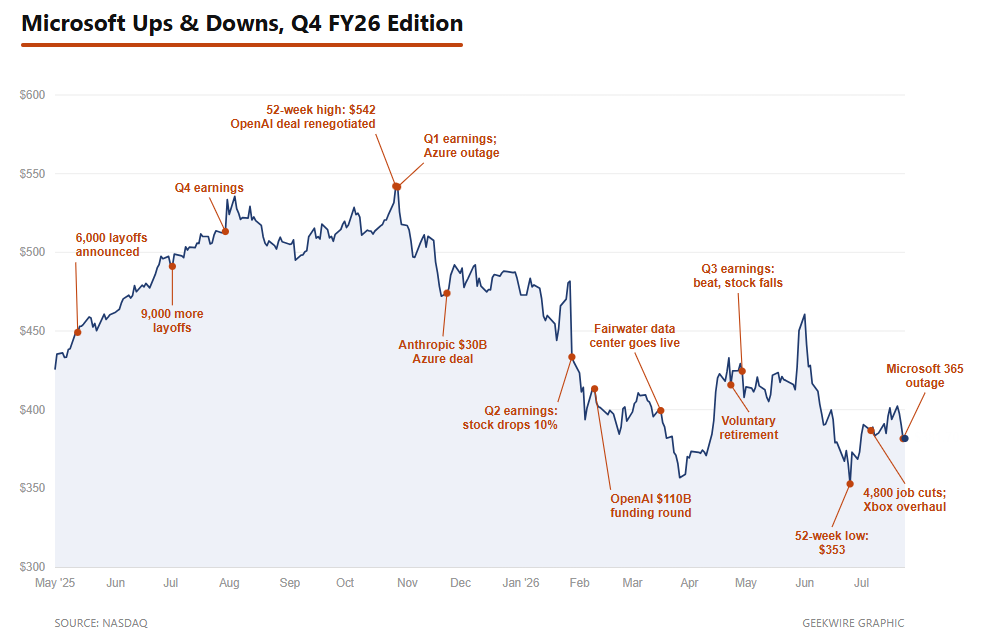
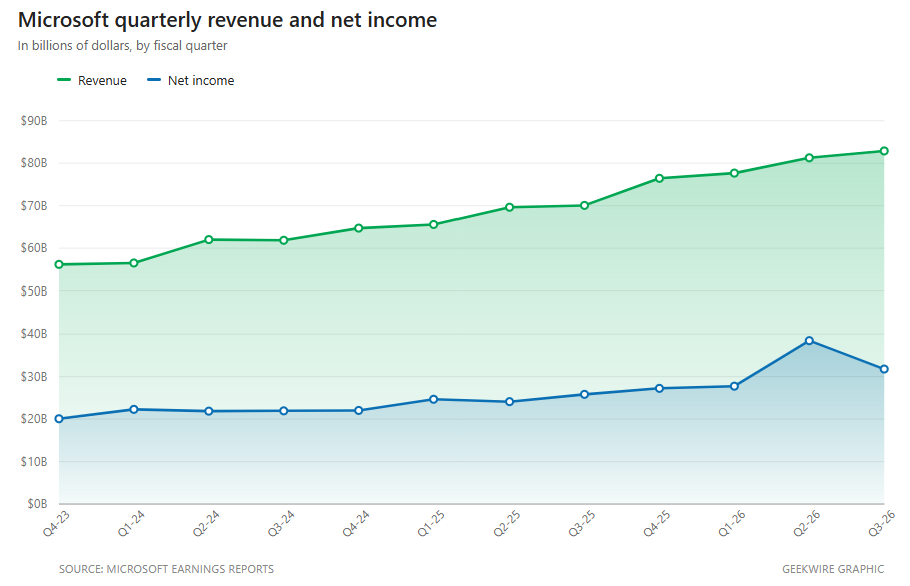
Microsoft has topped earnings expectations consistently in recent years, yet its stock is near a one-year low. So while it’s worth paying attention to revenue and profits when the company reports its fiscal year-end results Wednesday, there are clearly other forces at play on Wall Street.
Here are the key stats and trendlines to watch going into the earnings report for the fourth quarter of the company’s 2026 fiscal year, ended June 30.
Core numbers: Analysts expect revenue of about $87.7 billion for the quarter, up 14.7% from a year ago, and earnings of $4.24 per share, up 16%, according to Yahoo Finance. Microsoft’s own revenue guidance was $86.7 billion to $87.8 billion — meaning Wall Street is looking for a result at the very top of the company’s range.
For the full fiscal year, that works out to roughly $329 billion in revenue, up 17% from $281.7 billion in fiscal 2025.
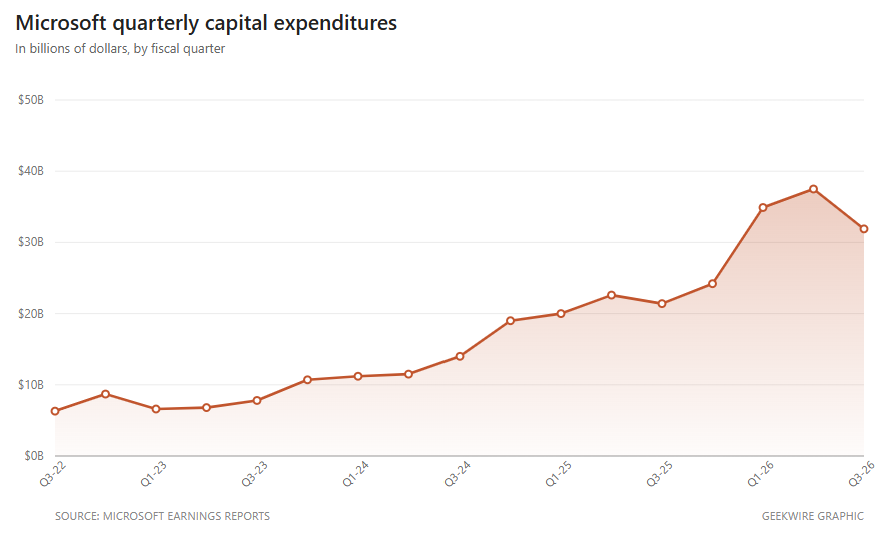
Capital expense: This is the big one. Microsoft told investors to expect more than $40 billion in capital spending for the quarter, which would be a record — up from $31.9 billion in the March quarter and $37.5 billion in the one before that. About two-thirds goes to GPUs and other short-lived hardware.
For the calendar year, the company expects to spend roughly $190 billion. Chief Financial Officer Amy Hood said about $25 billion of that total is the result of higher component prices.
One big question this week will be the company’s guidance for capex going forward. Because this is the fiscal year-end, Wednesday brings the company’s first capital spending guidance for fiscal 2027, which began July 1.
Capex concerns: Google parent Alphabet last week foreshadowed what may happen to Microsoft. It reported revenue up 24% and cloud revenue up 82%, then raised its own capital spending forecast to as much as $205 billion — well above the roughly $188 billion analysts expected. The stock fell 7% the next day and Alphabet fell below its prior $4 trillion market valuation.
Big picture, investors seem to have decided the capital spending is getting ahead of the payoff. Data centers and chips cost money now, while the AI revenue meant to justify them arrives over years — if it ever reaches the scale these companies are promising.
Moody’s Ratings raised its own red flags about this last week, saying the six largest cloud and AI platforms will spend about $785 billion this year and close to $1 trillion in 2027. Demand is real and accelerating, the ratings agency said, but “the ultimate return on investment is unclear.”
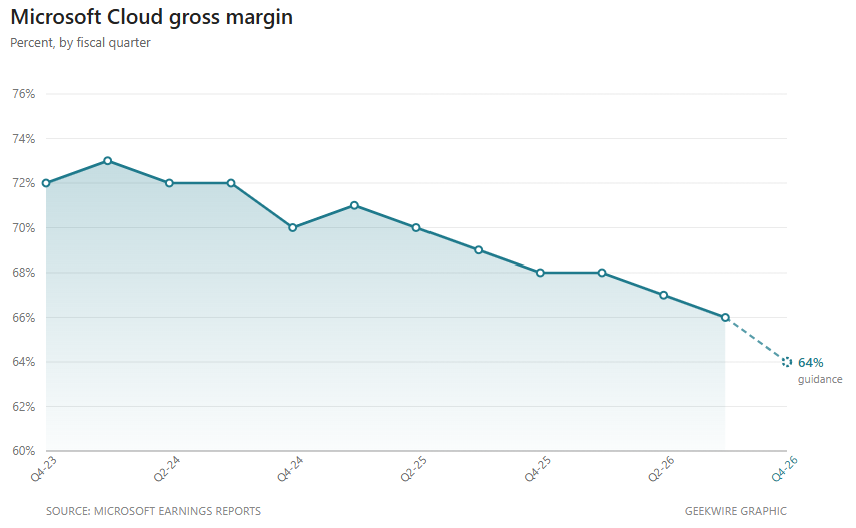
Cloud margins: This is where the capital spending starts to become evident in the company’s core quarterly results. Microsoft Cloud gross margin — the share of cloud revenue left after the cost of delivering the service — has slipped from 72% three years ago to 66% last quarter.
For the quarter it reports Wednesday, Microsoft told investors to expect about 64%. On the prior earnings call, Hood attributed the decline to AI infrastructure costs and growing use of GitHub Copilot, partly offset by efficiency gains in Azure.
Microsoft doesn’t absorb the cost of a data center all at once. It spreads the expense across the years the equipment is expected to last. That cost shows up here, in the expense of running the cloud — making this one of the first places where the capital spending hits earnings.
Microsoft Azure: On its prior conference call, Microsoft said it expected the Azure cloud business to grow 39% to 40% in constant currency in Q4, a slight acceleration from the 39% posted in Q3. Analysts expect roughly the same, with some outliers such as BNP Paribas looking for 41%.
But the published expectations aren’t the real bar. In January, Azure grew 38% — ahead of Microsoft’s guidance — and the stock fell 10%, because Wall Street had privately been expecting 39.4%.
Azure’s growth rate also reflects a choice as much as it does demand. Microsoft has been routing scarce computing capacity to its own products first — Copilot, GitHub Copilot, internal research — and selling what remains to Azure customers. Hood has said the growth rate would have been higher had that capacity gone to customers instead. Demand continues to outrun supply, and the company expects to stay “constrained at least through 2026.”
Business Insider reported Sunday that the shortage of supply has pushed Microsoft to shop for additional computing capacity outside its own data centers, evaluating capacity from Amazon and Google, and that Amazon stepped in following a series of GitHub outages.
Copilot and AI revenue: Microsoft said in April that its AI business had reached a $37 billion annual revenue run rate, up 123% from a year earlier. It was the first update to that number since January 2025, when the company put it at $13 billion. Whether Microsoft discloses it a third time Wednesday is a signal in itself.
Microsoft 365 Copilot passed 20 million paid seats last quarter, up from 15 million in January. That’s about 4.4% of the 450 million commercial seats across Microsoft 365 — the gap that has drawn skepticism from investors all year. Microsoft said it expects the number of new paid seats to grow again this quarter.
Meanwhile, the company is launching new initiatives to drive adoption of AI among its customers. Earlier this month it launched the Microsoft Frontier Company, a $2.5 billion effort to put 6,000 engineers inside customer organizations to help them deploy AI.
Wednesday is also the first report since Microsoft changed how it charges for GitHub Copilot. As of June 1, customers pay based on usage rather than a flat fee per user.
The OpenAI backlog: Microsoft’s remaining performance obligations — RPO, a measure of contracts customers have signed but the company has not yet fulfilled — reached $627 billion last quarter, up 99% from a year earlier. About a quarter of that is expected to become revenue in the next 12 months. It’s the strongest evidence that there’s real demand supporting the AI buildout.
But the RPO is also highly concentrated. In January, when it stood at $625 billion, 45% was tied to OpenAI — roughly $281 billion committed by a single customer that is still losing money. Take OpenAI out of last quarter’s figure and the growth drops from 99% to 26%.
Then in April, Microsoft and OpenAI revamped their partnership, and OpenAI ended its exclusive commitment to run on Azure.
Reliability: On July 23, a bug in Microsoft’s automated network maintenance tooling cut a West US Azure data center off from the company’s global network, knocking out Teams, SharePoint, OneDrive and Copilot Chat for about five hours. Microsoft has published a preliminary post-incident report, and a final one is due within two weeks.
The outage falls in the quarter that began July 1, so it won’t appear in Wednesday’s numbers. But it comes as Microsoft is asking businesses to hand AI agents real control of their operations.
Retirement charge: Wednesday’s results will include about $900 million in one-time costs from Microsoft’s voluntary retirement program, the first in the company’s 51-year history. Hood said roughly $350 million falls in the cost of revenue and $550 million in operating expenses.
About 8,750 U.S. employees were eligible — 7% of Microsoft’s U.S. workforce — and about 30% accepted, Chief People Officer Amy Coleman confirmed in an interview with GeekWire, in line with what the company expected. Those departures reduced the size of the 4,800-job cut Microsoft announced July 6, which happened after this quarter ended.
Even with the retirement costs, Microsoft told investors it expects operating margins for the full fiscal year to be about a point higher than last year. Hood also said on last quarter’s call that headcount declined year over year and will keep declining in fiscal 2027.
Windows: Microsoft expects Windows OEM revenue — what PC makers pay to put Windows on their machines — to decline close to 20% this quarter.
A few factors are driving this:
Last year’s wave of PC upgrades, when support for Windows 10 ended, makes for a tough comparison.
PC makers stocked up on parts and machines ahead of rising memory prices and are now working through them.
The PC market itself is slower, because memory prices have made computers more expensive.
The memory shortage is hitting Microsoft a few different ways. In addition to adding about $25 billion to the company’s capital spending this calendar year, as noted above, it lowers what Microsoft earns from Windows. Also, in late June, Microsoft raised Xbox console prices by $100 to $150, saying storage and memory costs had risen more than 2.5 times.
This week: Facebook parent Meta reports the same afternoon as Microsoft, with Apple and Amazon on Thursday and Alphabet already out. Check back Wednesday afternoon for coverage.
This week on the GeekWire Podcast: Seattle startup funding drops 40% in the first half of the year while AI money floods everywhere else. We dig into the implications for the region.
Amazon is closing its San Francisco AGI site as part of the layoffs it made this week in its artificial general intelligence organization, but said its frontier model research lab will continue.
A company spokesperson confirmed the news of the site closure, which was first reported by The Information. Amazon’s frontier model research work will carry on under Pieter Abbeel, a UC Berkeley professor who joined Amazon in 2024 when the company licensed the technology and hired the team from Covariant, the robotics startup he co-founded.
The AGI Lab was founded in December 2024 and initially built around several dozen employees Amazon brought in from the startup Adept, including its co-founder and CEO David Luan.
The team grew to about 80 people at its peak, according to The Information, but more than a dozen of the Adept hires have since left, Luan among them. Earlier this week, Amazon confirmed it was cutting an unspecified number of jobs across the broader AGI organization.
Impacted employees will have the chance to explore other roles at Amazon, the spokesperson said, and the company is supporting them through that process.
Nova Act, the browser-agent model and service that came out of the group, remains available on AWS and in use by customers. More broadly, AWS has continued to build out its agentic AI lineup, including Bedrock AgentCore and applications like Kiro, Quick, Continuum and Transform.
The moves come as Amazon invests heavily in helping customers deploy AI, including a $1 billion AWS effort to embed engineers with businesses building AI agents. The initiative reflects an expanded industry focus toward putting agents and models to better use for customers.
Amazon confirmed Wednesday that it laid off an unspecified number of employees in its artificial general intelligence (AGI) organization, the division working on the company’s advanced AI models.
The move, first reported by Reuters, comes as the company invests heavily in programs to help businesses implement AI effectively, including a $1 billion initiative to embed AWS engineers with customers building agentic AI systems.
It’s part of a larger shift in the industry as tech giants and AI frontier labs look to make sure the enormous sums they’re spending on AI pay off in tools businesses actually use.
In a statement, an Amazon spokesperson said building large AI models remains “one of the most important things we’re working on,” but said the company is also “sharpening our focus on the initiatives that matter most for customers, so we can move faster on what counts.”
“That focus means some difficult decisions, including eliminating some roles within parts of our AGI organization, even as we continue to invest in the areas most important to our customers’ future,” the spokesperson said.
It’s the latest in a series of changes in Amazon’s AGI group, which despite its name has always been focused more on frontier models than on what the industry considers AGI, the still-theoretical systems that would match or surpass human intelligence.
Rohit Prasad, the senior executive who oversaw Amazon’s AGI work, left the company late last year, and AGI Lab head David Luan departed in February. In December, Amazon folded the AGI group into a larger organization led by senior vice president Peter DeSantis that also includes chip development and quantum computing.
The cuts are the latest in a series of smaller reductions since January, when Amazon eliminated 16,000 jobs across the company. Amazon said U.S. employees whose jobs are cut will receive 90 days of pay and benefits, outplacement support and transitional health coverage, along with eligibility for severance.
L-R: Mantra CEO John Patrick Mullin, Docugami CEO Jean Paoli, and Inveniam CEO Patrick O’Meara. The companies are partnering to make DGML a standard for AI, with Docugami turning documents into data, Inveniam verifying it on a blockchain, and Mantra providing the chain.
Jean Paoli has spent his career making documents readable by machines — first as a co-creator of XML, then helping build the file formats behind Microsoft Office. Now his Kirkland, Wash.-based startup, Docugami, is open-sourcing the technology at the heart of its business, betting it can become a standard way to turn documents into data that people and AI agents can trust.
The company is releasing its technology, called DGML (short for Document Graph Markup Language), under Apache 2.0, a widely used open-source license, so other developers and companies can adopt it.
The idea is to turn it into a shared standard that no single company owns, much as XML became a common foundation across the tech industry.
The move reflects a shift in where the value is created in AI. Docugami until now has made its money selling software that turns unstructured documents into usable data. It’s betting now that there’s more value in proving that data is trustworthy instead.
How it works: Docugami is teaming up with Inveniam, a Detroit company whose software helps big investors keep tabs on the mountains of paperwork behind real estate and other hard-to-value assets. Inveniam will record a kind of digital fingerprint of each piece of DGML data on NVNM Chain, its blockchain built with Mantra, a crypto firm that Inveniam is acquiring.
That means, for example, that a single fact buried in a 200-page lease — such as the rental rate, a renewal option, or a default clause — can be verified on its own, without exposing the whole document. An investor, auditor, or AI agent can trace it to the page it came from.
To work with documents, AI systems usually convert them into a simpler format first. DGML enters a growing field of contenders in that regard, competing with the popular Markdown format and DocLang, a new open standard for AI-ready documents backed by IBM, Nvidia and Red Hat.
The business model: This is a big move for a company of Docugami’s size, taking the 30-person startup in a new direction. Paoli is handing the industry the technology his team spent years building, and pinning the company’s future on a larger idea.
The plan is to make money not from the format itself but from the value of the trusted data. Once a company converts its leases or loans into DGML and anchors the key numbers on the blockchain, investors, lenders and auditors can pay to draw on that verified data.
Docugami will share in the revenue through its partnership with Inveniam. The company also stands to collect a small fee each time a piece of data is recorded on the chain.
The company is giving away the DGML format and a working version of the software, but not everything. Paoli said the company is keeping some of its own technology private, including AI models it has fine-tuned to read documents, and could sell those or other tools to enterprises.
“The business model of everybody is changing. And if you know any company where it’s not true, you need to tell me, because I haven’t met them yet,” Paoli said in an interview.
Docugami has raised about $13 million to date, including a $10 million seed round in 2020 that drew the first investment in Grammarly’s history.
The partnership: Paoli met Patrick O’Meara, Inveniam’s CEO, a few months ago, through a former Microsoft colleague who had become one of O’Meara’s advisers. They quickly realized they had been working toward the same idea from different directions.
Inveniam, founded in 2017, helps big investors keep track of assets that are hard to value, like office towers, private loans and infrastructure. It monitors the documents behind those assets and flags changes as they happen, and its clients include some of the world’s largest sovereign wealth funds, according to O’Meara.
What it lacked was a consistent way to break those documents into verifiable pieces. That is what Docugami provides.
“We’re not putting the data itself on-chain, just a fingerprint of the document. Change one bit, one byte, one pixel, and the hash won’t match,” O’Meara said.
Paoli said the project uses the underlying blockchain, not the token.
“Crypto as an industry has gone through a lot of changes in the last 18 to 24 months, and it’s growing up in a lot of ways. This is a real use case with fundamental value, not just pure speculation,” Mantra’s Mullin said in an interview.
The result is a division of labor: Docugami turns documents into data, Inveniam verifies it and brings the customers, and Mantra provides the chain where the proof is recorded.
The DGML specification, sample documents and reference code are at dgml.io and on GitHub.
Editor’s note: This story was updated after publication to correct the name of a competing document format, DocLang, and to note that Inveniam’s blockchain is called NVNM Chain.
A judge in Seattle issued a preliminary injunction against Kalshi, finding that Washington state is likely to prove that the fast-growing prediction market is running illegal online gambling.
The ruling by King County Superior Court Judge John McHale, issued Monday, does not immediately halt Kalshi’s operations in the state. McHale granted the injunction in the case brought by Washington AG Nick Brown, but deferred the specifics until early next month.
McHale rejected Kalshi’s argument that oversight by the U.S. Commodity Futures Trading Commission preempts state gambling laws. That has been the basis of Kalshi’s defense against regulators across the country. Washington is the latest state where a court has shot it down.
Kalshi quickly pushed back on the ruling.
“States don’t have jurisdiction to regulate prediction markets. Many courts — including the Third Circuit — have made this clear,” spokesperson Jacki McGavick said in a statement. “We’re disappointed to see Washington State continue wasting taxpayer dollars.”
In his ruling, McHale said Kalshi “willfully ignored” a December 2025 notice from the Washington State Gambling Commission that event-based contracts were not authorized in the state, and cited a Kalshi ad showing a text exchange where one user tells another: “I found a way to bet on the NFL even though we live in Washington.”
Kalshi’s platform lets users bet “yes” or “no” on thousands of events across sports, elections, entertainment, and so-called “mention markets” — wagers on whether public figures will say specific words. The New York-based company, which markets itself as a federally regulated “prediction market,” takes a transaction fee on each bet.
Washington has some of the strictest gambling laws in the country: the legislature banned internet gambling in 2006, and while the state allows a lottery, horse racing, and tribal-casino gambling, online betting is broadly prohibited and sports wagers are legal only in person on tribal lands.
The order requires Kalshi to preserve all records tied to Washington users, including logs, communications, geolocation data and marketing materials.
The specific operational terms of the injunction are still being determined: McHale gave both sides until Aug. 3 to submit proposed language, with a full order to follow by Aug. 5.
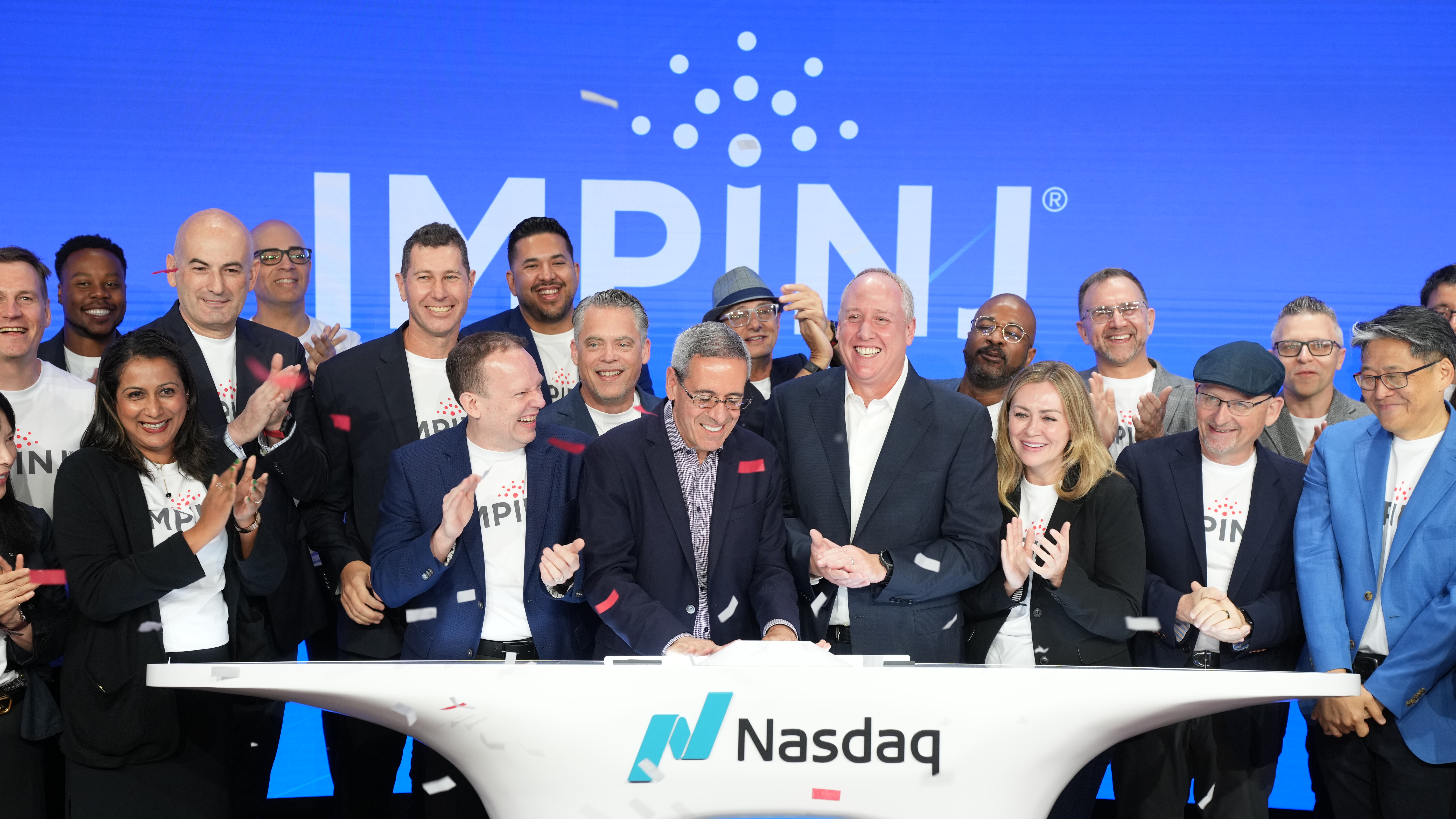
Impinj co-founder and CEO Chris Diorio, center, and members of the Impinj team at the Nasdaq opening bell ceremony in New York City on Tuesday, marking the 10th anniversary of the company’s IPO. (Nasdaq Photo)
Backstage at a Seattle tech event in the early 2000s, Chris Diorio was waiting his turn to speak. Next to him was Jeff Bezos, whose company was already becoming a household name.
Diorio, the leader of Impinj, then a tiny local startup, turned to the Amazon founder: “Jeff, you’ve got a much bigger near-term opportunity than we do,” Diorio recalls saying, “but we’ve got a much bigger long-term opportunity than you do.”
Before Bezos could respond, he was called onstage.
“The technology turned out to be way harder than I thought,” Diorio acknowledged after telling that story in a recent interview. “But that’s what I told him — and I still believe in those words. Our opportunity is to deliver physical intelligence for every item in the world.”
A quarter-century after that chance encounter, Diorio rang the Nasdaq opening bell Tuesday morning in New York City to mark the 10th anniversary of Impinj’s IPO. The company’s tiny, battery-free RFID chips — each smaller than a grain of sand — have been embedded in more than 160 billion items, including clothing, pharmaceuticals, airline luggage, and groceries.
An illustration of the Impinj E710 reader chip inside a handheld RFID scanner used for retail inventory. (Impinj Photo)
Impinj commands nearly two-thirds of its market, won a patent war against a rival 15 times its size, and has grown from a $250 million IPO valuation to a market cap of more than $4.2 billion. Along the way, the company survived a billion-dollar industry hype cycle that killed nearly every competitor.
And yet, Impinj has posted exactly one profitable year since going public — thanks to a $45 million legal settlement at the time. Its accumulated deficit stands at $400 million, its financial reports show. Less than 1% of the items it envisions connecting are connected today.
To Diorio, that speaks to the potential. The company is barely scratching the surface. He cited the 1% stat in his comments before ringing the Nasdaq bell on Tuesday morning, saying the “opportunity is so gigantic that we’ll still have a huge runway ahead of us 10 years from now.”
That the company has gotten to this point is as much a Seattle story as it is a technology story. Impinj has benefitted from a network of patient local investors, academic connections and supporters who gave the company the time that Silicon Valley never would have.
But no one imagined it would take this long when they got started.
From Caltech to Seattle
The origins of Impinj were at Caltech in Pasadena, Calif., in the 1990s. Diorio was a graduate student working under Carver Mead, the physicist and engineer who helped coin the term Moore’s Law and helped lay the intellectual foundation for the modern semiconductor industry.
Carver Mead, the Caltech physicist and engineer who co-founded Impinj with Diorio. (Photo by Norman Seeff, CC BY-SA 4.0)
Together, they discovered a way to change a transistor’s electrical properties after it had been manufactured — a quantum-mechanical phenomenon called “impact-ionized hot electron injection.” That made it possible to build chips so efficient and inexpensive that they could be embedded in disposable packaging. (“Impinj” is derived from that scientific name.)
In an oral history later recorded by the Science History Institute, Mead described Diorio as “a super-bright, super-high-energy guy” who “burned up the track” at Caltech.
After finishing his PhD, Diorio was recommended by Mead to the University of Washington’s computer science department. There was resistance among the UW faculty — his research in analog circuits wasn’t an obvious fit — but professor Larry Ruzzo carried the day.
Ruzzo essentially said, “This guy is brilliant, and even if he is nothing other than our gift to the rest of the university, we should hire him,” recalled Ed Lazowska, the department chair at the time.
Diorio joined the UW faculty in 1997. Over the next few years, his research earned a string of honors, including Packard and Sloan fellowships. A couple years later, Diorio met up with Mead on a trip to California, over dinner at Fresh Cream, a long-since-closed French restaurant in Monterey. Diorio asked Mead if it was time to start a company.
“Are you up for it?” Mead asked. Diorio said yes. They started the paperwork the next day.
Impinj was incorporated in April 2000, headquartered in Seattle. It quickly got the attention of two local investment firms, with behind-the-scenes help from the everpresent Lazowska.
On April 21, 2000, the UW computer science chair emailed Bob Nelsen at Arch Venture Partners and Tom Alberg at Madrona. He explained that he was urging Diorio and Mead “to get some local $ for the connections,” and that he had pointed them to Arch and Madrona.
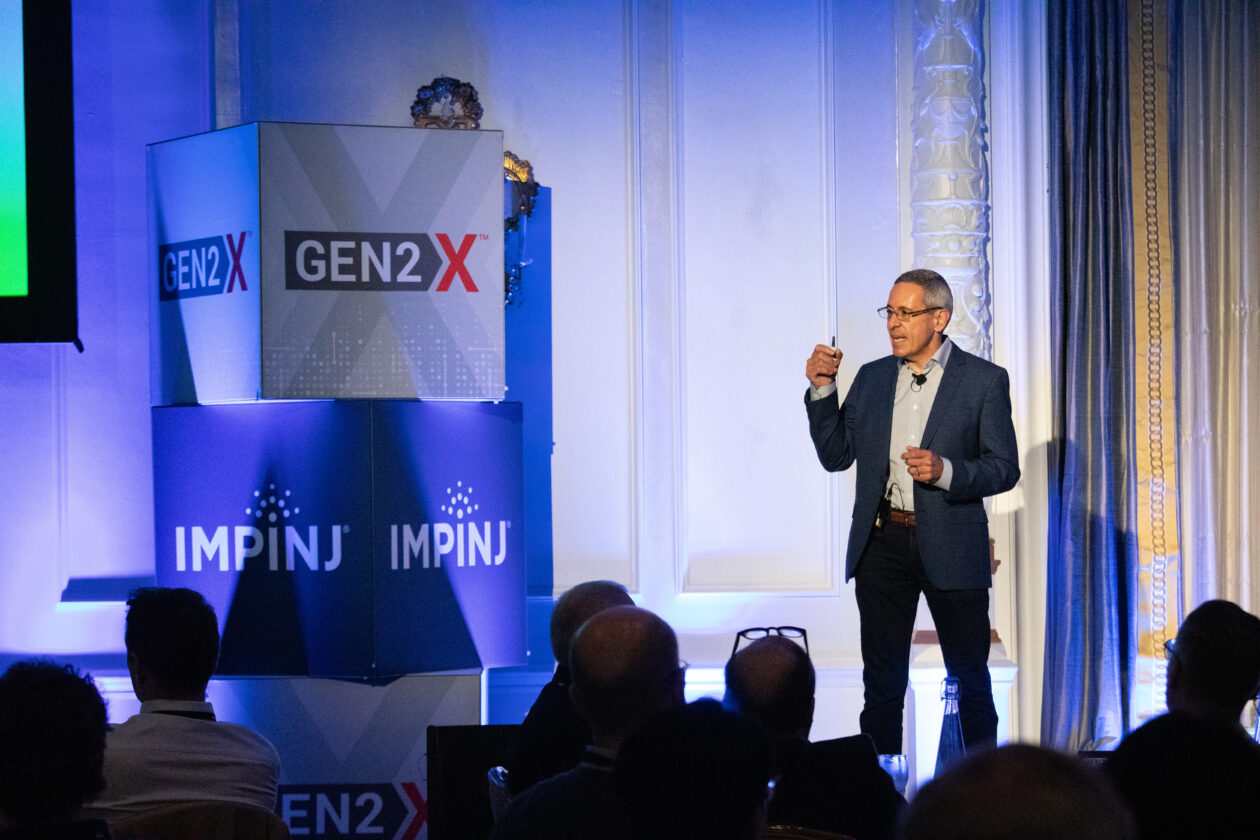
Impinj co-founder and CEO Chris Diorio discusses Gen2X, the company’s latest advancement in RFID chip technology. (Impinj Photo)
Patrick Ennis, then at Arch, reached out to Diorio that same day. As Ennis recalled in a recent interview, there were plenty of Silicon Valley firms that wanted in, thanks to Mead’s reputation, but Diorio and Mead decided to take Lazowska’s advice and go with Seattle investors.
Diorio, who likes to take walking meetings, negotiated the terms with Ennis as they made their way on foot through the University of Washington Arboretum one day. The investment closed that summer: $15 million, split evenly between Arch and Madrona.
Impinj at the time had patents, prototypes, and no real business plan.
“That’s how venture capital should be done,” said Ennis, who has since become a Madrona venture partner. “You make big bets on great technology and great people.”
Betting the company on RFID
Bill Colleran joined Impinj as CEO in January 2001. He and Diorio had designed satellite chips together at defense contractor TRW in the 1980s. Colleran had just sold his Bluetooth startup, gotten married, and gone on his honeymoon. He came home to a message from Diorio: he’d started a company in Seattle and wanted Colleran to join.
Bill Colleran, Impinj’s first CEO, was recently tapped to lead AI coding startup Adronite.
Colleran was soon in Seattle — one of six or eight people working out of what he warmly recalls as “a crappy little building” in the University District, several of them former TRW colleagues.
“We were kind of getting the band back together,” he said.
RFID wasn’t the original plan. Impinj’s first target was improving power efficiency for 3G wireless base stations, but the dot-com bust killed that market, and regardless, the company was too small to compete with the major chipmakers in the wireless industry.
The team spent two years exploring what to do with their technology. Cable modems required too much dependence on Intel, as Colleran recalled. Cell phone radios were dominated by players too big to compete against. GPS turned out to be a poor technical fit — Impinj’s chips excelled at low power, but GPS demanded low electrical noise, a different problem entirely.
So they eventually settled on RFID, the technology that uses tiny wireless chips to identify and track physical objects. The industry was young, the standards were still being written, and Impinj’s low-power technology seemed tailor-made for it.
As Madrona’s Ennis and Tim Porter write in a piece pegged to the IPO anniversary, “When you have a truly powerful, groundbreaking deep technology, it behooves you to wander the product-market fit wilderness for a while, even when that is unsettling and downright frightening, and even when it runs contrary to what you learn in a VC class in business school.”
Then, a stroke of luck: In June 2003, Walmart announced it would require its top suppliers to tag every pallet and case with RFID chips. The Impinj team celebrated their good fortune.
“We all high-fived,” Diorio recalled. “We did it. Eighteen months, we’re gonna IPO.”
In reality, it would be another 13 years.
Surviving the RFID hype cycle
Walmart’s announcement triggered a gold rush of venture capital investment into RFID technology startups. But there was no global spectrum allocated, no standard that worked, and no products ready to deliver on the promise. Walmart’s own January 2005 deadline came and went. Only half of its top suppliers could comply.
By 2008, the hype cycle had collapsed. Nearly every RFID startup died or got acquired.
“More than $1 billion of VC money got poured into RFID,” Diorio recalled. “Way up, crashing down, and only one company that made it out the other side. … We were lucky enough that it was us.”
The real inflection didn’t come until around 2010, when retailers began tagging individual items, not just pallets. Knowing exactly which products were where, in real time, could lift same-store sales by as much as 10%, by solving a basic problem: getting items out of back rooms and onto shelves, making them available for purchase before customers gave up looking for them.
“I didn’t know if I wanted to be a lifelong RFID guy,” he said.
An exit wasn’t in sight — the IPO window was shut, and a sale didn’t make sense because Impinj made both chips and readers, and “any of the companies that would be interested in boxes weren’t chip companies, and the chip companies weren’t interested in boxes.”
Diorio took over as CEO that November. The venture investors were 14 years in and needed a path to liquidity. He spent the next two years sorting things out and getting the company ready.
The long road to IPO
Porter, now a Madrona managing director, who had worked closely with Alberg on the Impinj investment since 2007, recalled the final stretch. One of the first target dates for trading landed on the day Britain voted to leave the European Union, sending markets into a tailspin.
“It was a little bit like, are you kidding — what next?” Porter said.
But on July 21, 2016 — some 16 years after its founding — Impinj went public on the Nasdaq at $14 a share, raising $67 million at a market cap of just over $250 million.
The late investor Tom Alberg, one of Amazon’s first investors and an early backer of Impinj, looks on as Amazon CEO Jeff Bezos speaks at a Madrona event in 2015. (Madrona Photo)
Porter called Alberg’s move “a really big signal” to the market that demonstrated his long-term belief in Impinj. It was also a smart investment, as it turned out. As noted during the Nasdaq bell-ringing Tuesday morning, Impinj’s share price has grown by nearly 900% since the IPO.
But there was one last hitch. On the night before trading began, the offering was so oversubscribed that the final allocation became a drawn-out negotiation between the board and the bankers over how many shares to issue. It dragged on so long that Diorio and CFO Evan Fein, stuck in Chicago for the roadshow, missed their flight to New York.
Fein had been one of the first people hired at Impinj, joining Colleran in the University District office in 2001 and staying through the whole ride. He was not about to miss the bell-ringing.
The CFO wanted to make a run for it, but Diorio told him there was no way — the flight departed in 30 minutes from O’Hare. Fein tried anyway. He didn’t make it. They stayed in Chicago overnight and caught a flight the next morning.
The company’s CTO at the time rang the bell in Diorio’s place.
Trial by fire
The celebration was short-lived. After the IPO, demand for RFID surged — but Impinj, thinly capitalized after years of private fundraising, didn’t have the operational capacity to fill the orders. The stock quadrupled from its $14 IPO price to more than $60. Then it all came apart.
NXP Semiconductors, a Dutch chipmaker roughly 15 times Impinj’s size, moved aggressively on pricing and took business away. Customers who had been stockpiling RFID tags pulled back on orders. Revenue declined. On Feb. 2, 2018, the stock plunged 47% in a single day.
What followed was the darkest stretch in the company’s history. The company laid off 9% of its workforce. Then a former employee complaint triggered an audit committee investigation, forcing the company to miss an SEC filing deadline and drawing a deficiency notice from Nasdaq.
For months, the outcome was uncertain. Executives couldn’t trade their stock or issue grants to employees. The investigation cost $1.4 million. NXP, sensing an opportunity, continued to press its advantage.
Diorio described the investigation as mentally draining. The company was spending millions of dollars, the outside attorneys weren’t sharing their findings along the way, following the standard practice, and there was no way to know for certain how it would end.
“You firmly believe you haven’t done anything wrong,” he said, “but who knows if somebody actually did something wrong that you don’t know about.”
The investigation ultimately cleared the company, finding “no credible evidence” of wrongdoing, and Impinj received what Diorio called a rare letter from the SEC formally closing the matter. The stock surged 35% on the news.
Diorio called 2018 a turning point. “It was the year where everything got really difficult, the team and the company rallied, and it was the strength and the persistence of the team and their dedication that pulled us out the other side,” he said. “I’ll never forget that.”
The following year, Impinj went on offense. In June 2019, the company sued NXP, alleging it had copied 26 of Impinj’s patents. NXP countersued. The litigation stretched across five years and four lawsuits. In 2023, a federal jury found NXP had willfully infringed Impinj’s patents and awarded $18.5 million in damages. NXP settled in 2024, paying $45 million upfront and agreeing to ongoing royalties of roughly $17 million a year.
Where Impinj stands today
Diorio helped coin an industry term for the technology Impinj had built: RAIN RFID, short for “RAdio-frequency IdentificatioN.” It distinguished what Impinj does (using battery-free chips to identify and track individual items at scale) from other flavors of RFID used for key cards, animal tags, and contactless payments.
Today the company employs more than 450 people, most of them based in its headquarters at 400 Fairview Ave. N. in Seattle, with a test and development lab on Beacon Hill. The workforce is a fraction of NXP’s, which has more than 32,000 employees — a reminder that Impinj has built a market-leading position with a comparatively small team.
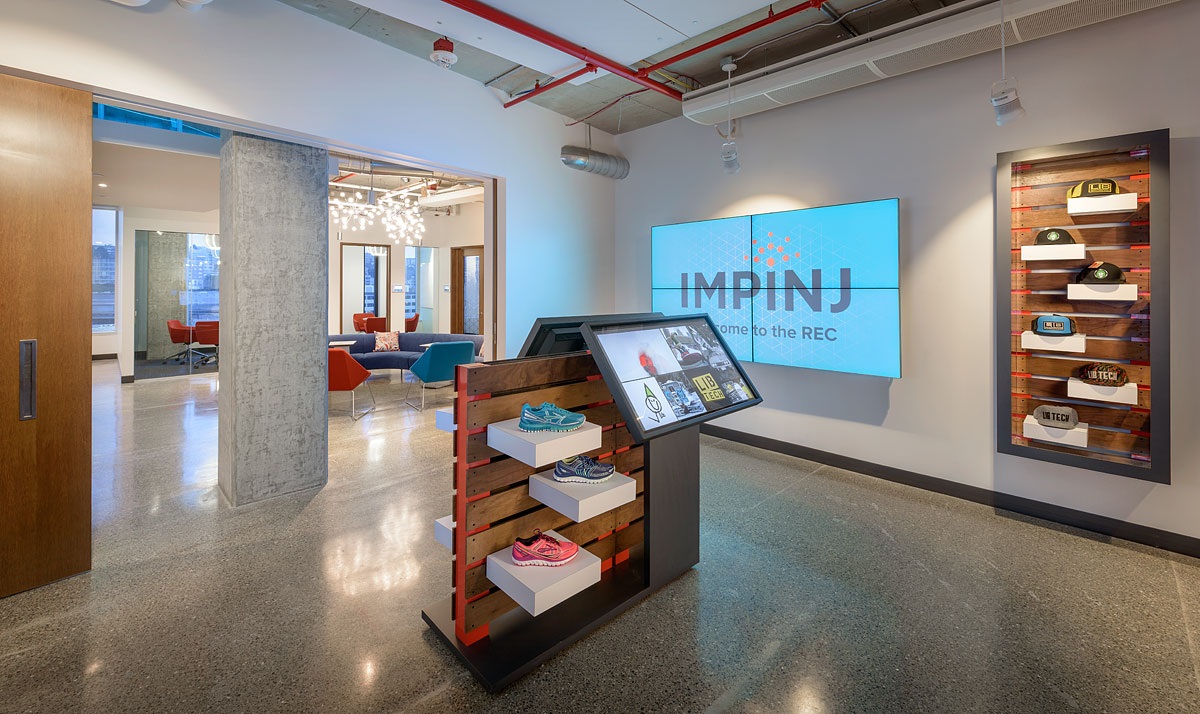
Inside the Impinj offices in Seattle in 2018. (File Photo)
Impinj holds an estimated 64% of the global market for RAIN RFID endpoint chips, up from 51% the year before, according to ABI Research. The company first overtook rival NXP for the market lead in 2024. The industry shipped nearly 53 billion chips in 2024, roughly one for every six or seven people on Earth. Impinj has connected more than 160 billion items cumulatively.
Each chip is battery-free, costs a few pennies, can be read wirelessly from 30 feet away, and identifies individual items at a rate of up to 1,000 per second. Vision systems can’t identify individual items. QR codes require line of sight. NFC has a range of four inches. Bluetooth requires a battery.
“Name any other technology that even gets close,” Diorio said. “You won’t come up with one.”
Privacy concerns nearly killed the RFID industry in its early years, when consumer groups campaigned against the technology in the mid-2000s. Although there’s privacy innovation still to come, Diorio said those fears have largely faded. The chips carry only a number, respond only when powered by an external reader, and don’t track people.
One retailer already turns its tags invisible after the point of sale, though Diorio noted that’s “not the best solution because then that inhibits recycling.”
His longer-term goal is cryptographic security, chips that can’t be cloned, putting “a dent in global counterfeiting” while keeping consumer data protected.
Meanwhile, the competitive landscape is shifting. Diorio views NXP as the only real competitor — “everybody else in the market is a partner,” he said — but the competitor list in Impinj’s SEC filings has grown from two names at the time of the IPO to more than six, including four Chinese chipmakers. When a product costs pennies, low-cost competitors have a natural opening.
Retail apparel remains the core market. About 60% of all RAIN RFID tags go on clothing. But that reliance has made the business volatile. Three times in 10 years as a public company, demand from retailers has dropped sharply, dragging revenue and the stock with it.
Earlier this year, Impinj’s stock plunged after the company issued guidance well below expectations. Part of the challenge: the company’s top three customers account for 61% of revenue.
The financial picture reflects a company that is still proving itself. Revenue has grown from $123 million in 2018 to $361 million last year, but Impinj has posted just one profitable year since going public — a $41 million gain in 2024, boosted by the NXP settlement.
To Diorio, all of this is prelude. Apparel, he said, is “tiny” compared to the total market of every item manufactured, transported, and sold. General merchandise, supply chain logistics, pharmaceuticals, food — each is an order of magnitude larger, or more.
“We have a gigantic blue ocean,” he said. “It’s the size of the Pacific.”
Machine learning and AI
The company is also using machine learning to move beyond handheld inventory scanning. Fixed readers mounted in ceiling tiles and other locations can track items autonomously at store choke points, from receiving docks to fitting rooms to exits, replacing employees who currently walk the aisles waving handheld scanners.
More broadly, Diorio sees tagged items as a data source for AI, generating hard information at every point in a product’s journey from factory to shelf to recycling bin.
“Most of the modeling that goes on today is based on guessing,” he said. “If the models are based on hard data, it’s immensely more valuable.”
Impinj’s M800 series RAIN RFID chip, smaller than a grain of sand, is designed to be embedded in labels on individual items — including fresh groceries, one of the company’s biggest growth opportunities. (Impinj Photo)
The biggest bet ahead is food. Three of the top five U.S. grocers (Kroger, Walmart, and Albertsons/Safeway) are piloting RFID for food freshness, according to Diorio, using tags to identify items approaching their expiration dates so they can be marked down before they end up in the trash.
A European grocer is pushing toward fully automated checkout, where a basket of tagged items moves down a conveyor and is read instantly, no scanning required.
These are pilots, not deployments. The grocery market dwarfs apparel in volume, and Impinj has yet to prove it can crack it at scale. But here again, Diorio sees this as untapped potential.
“My enthusiasm is as high as it’s ever been,” he said. “We are just getting going.”
And this time, he made it to New York to ring the opening bell.
During his Nasdaq remarks on Tuesday morning, Diorio told the story of getting stuck in Chicago for the IPO a decade ago, using the anecdote to make a larger point.
“The team stepped in,” he said. “The team that was here covered everything, rang the bell, did all the process, and did it beautifully. In fact, probably better than we could have. And that is the story of Impinj. It’s the team.”
Editor’s note: This story was updated July 23, 2026, to reflect ABI Research’s 2025 market share estimate of 64% for Impinj, up from 51% in 2024 as originally reported. The spelling of former CFO Evan Fein’s name was also corrected.
From left: Clarify CEO Patrick Thompson, Seam AI CEO Nicholas Scavone, and Clarify CTO Ondrej Hrebicek. (Clarify and Seam Photos)
Clarify, the Seattle-based AI startup that has raised more than $22 million to take on Salesforce and other CRM incumbents, has made its first acquisition: San Francisco-based Seam AI.
Seam’s technology monitors buying signals across the web — such as funding rounds, hiring, website activity, and executive job moves — and surfaces them to sales teams. Clarify plans to fold the technology into a new product called Clarify Signals, slated to launch later this year.
Clarify is led by co-founders Patrick Thompson (CEO) and Ondrej Hrebicek (CTO), who previously co-founded Iteratively, a Seattle data-analytics startup that was acquired in 2021 by Amplitude, the publicly traded digital-analytics company.
Rationale: Clarify says the deal is part of a shift beyond what it calls a “system of record” that tracks what already happened to a “system of awareness” that flags what’s about to happen.
Thompson said the Seam deal fills a gap in what Clarify’s own AI can pull from the open web, giving the CRM access to proprietary datasets that can’t be reached with a simple search.
“The value that Seam is providing is typically the information that’s not necessarily easy to get from the web,” Thompson explained in an interview. “It’s the harder stuff to find.”
Hrebicek said Clarify’s customers have been looking for a bigger and richer dataset — the ability to “look around the corners on who would be a good lead.”
Deal points: Financial terms weren’t disclosed. Clarify, which had raised a total of $22.5 million in its seed and Series A rounds from investors including U.S. Venture Partners, Gradient Ventures, and Madrona, said it brought in additional funding as part of the deal but did not disclose the amount.
As part of the acquisition, five Seam employees are joining Clarify, including Seam co-founder and CEO Nicholas Scavone. With the deal, Clarify is adding a San Francisco office alongside its Seattle headquarters. The company now has 30 people total.
Backstory: Scavone started Seam in 2020 after five years at Okta, where he saw teams accumulate many different sales and marketing systems, with customer data scattered across all of them.
Seam raised $7 million including angel funding and a seed round led by Bessemer Venture Partners in April 2024. It counts Zapier, GoFundMe, Drata, and Betterment among its customers. Existing customers are on hold while the technology is integrated into Clarify, but many have already indicated they plan to move over to the new platform.
Scavone said he had been weighing whether to raise a new round or find a home for the company when he and Thompson, who have known each other for years, began talking about a combination.
“We’re all going after the same big incumbents here,” he said, explaining that he ultimately decided Seam had a better chance of taking on the market’s dominant players by joining forces with Clarify than as a standalone company.
In a post announcing the deal, the Seam and Clarify founders said they “realized we weren’t building competing products—we were building different halves of the same future.”
Landscape: Clarify is entering a crowded field. Sales-intelligence platforms like Clay, ZoomInfo, and Apollo already sell third-party data to revenue teams, and 6sense and Demandbase lead the account-based marketing category Seam had been targeting.
Thompson said one edge for Clarify is that signals arrive inside the CRM sellers already use, not a separate dashboard.
The company was co-founded in early 2024 by Thompson, Hrebicek, and Austin Hay, a marketing-technology operator who served as co-CEO alongside Thompson. Hay departed in September 2025 and is now with Khosla Ventures, per his LinkedIn.
What’s next: Clarify plans to launch Signals later this year, Thompson said, noting that the company is considering raising additional funds in a Series B round early next year.
Rudra Mitra will lead Amazon security services in his new role. (LinkedIn Photo)
Rudra “Rudy” Mitra, who spent more than 27 years at Microsoft and most recently led its Purview data-security business, is joining Amazon Web Services as vice president of security services.
Mitra will oversee an AWS portfolio that includes tools such as GuardDuty and Security Hub, which companies use to track security risks across their cloud accounts. AWS recently added AI-specific threat detection to GuardDuty and, perhaps notably given today’s news, extended Security Hub to monitor AI workloads and security inside Microsoft Azure.
He will report to Chet Kapoor, the former DataStax CEO whom AWS hired last year as vice president of search, security and observability, a role that reports to AWS CEO Matt Garman.
“Rudy brings decades of security experience, a passion for building, and a deep understanding of what customers need as the security landscape continues to evolve,” Kapoor wrote on LinkedIn.
Mitra joined Microsoft in 1999 straight out of college, working on early efforts to deliver Office as an online service before launching Purview, the company’s data-security and governance product, in 2014. He announced his exit from Microsoft last week, addressing what was next at the time by saying only that there was “more on that soon.”
His departure comes amid a broader reshuffling of Microsoft’s security leadership this year under Hayete Gallot, who returned from Google in February to run the group and has been reshaping its executive ranks in recent weeks and months.
Gallot replaced Charlie Bell, who had joined from AWS in 2021 and continues at Microsoft as an individual contributor focused on engineering quality. She’s been overhauling the group’s product lineup, according to The Information, which reported last week that at least nine corporate vice presidents who reported to Bell have left the company this year.
On the inbound side at Microsoft, Naseem Tuffaha returned in June to fill the corporate VP role Kumar had left, after nearly two decades at the company and a stint away.
When Gallot arrived, Microsoft named Ales Holecek, a longtime engineering leader, as the security group’s chief architect, reporting to her. David Weston, another veteran Microsoft executive, also reportedly shifted into the security unit earlier this year.
We dug into hours of his talks and interviews to answer the big questions: Who is this guy, why does he want an NFL team, and what does his track record tell us about the kind of owner he’ll be? Plus, the blind spot that could get him into trouble.
Featuring highlights from his 2015 talk at the Stanford Graduate School of Business.
Dave Brown, the departing AWS senior vice president, has been a member of its senior leadership team. (Amazon Photo)
One of Amazon’s top cloud leaders will be joining Meta as the Facebook parent company considers turning its massive AI buildout into a cloud business of its own.
That’s the report from the Wall Street Journal overnight, quoting anonymous sources saying that Dave Brown, the senior Amazon executive who led AWS compute and AI services, will join Meta in the coming weeks to work on its data center build-out.
Meta hasn’t committed to becoming a cloud provider, but CEO Mark Zuckerberg has said the idea is on the table. He told shareholders in May that companies were regularly approaching Meta to pay for access to its AI models or spare computing capacity — a business that would put Meta in competition with cloud providers it now relies on, including AWS.
At Meta, Brown will report to infrastructure chief Santosh Janardhan, according to the WSJ report. Janardhan co-leads Meta Compute, an initiative Zuckerberg launched in January to plan the company’s data center buildout. Meta has said it expects to spend $125 billion to $145 billion on capital expenditures this year, much of it tied to AI data centers.
Amazon isn’t commenting on the report. We’ve contacted Meta for confirmation and details.
Brown’s departure from AWS was announced on Wednesday, with a warmly worded message from AWS CEO Matt Garman giving no indication that Amazon would try to challenge or restrict his new role on competitive grounds.
AWS has gone to court before to enforce noncompete agreements against departing executives, suing two AWS leaders who left for Google Cloud in 2019 and 2020, respectively. But such agreements have grown harder to enforce. California bars them almost entirely, and Washington — Amazon’s home state — enacted a near-total ban this year, though it doesn’t take effect until mid-2027.
Garman’s message said Brown had decided to take “a new role outside of the company” but did not say where he was going. He’s remaining at AWS through the end of July to help with the transition.
At AWS, Brown will be succeeded by Dave Treadwell, a longtime Amazon executive who has run the technology behind the company’s retail operations and spent 27 years at Microsoft before joining Amazon in 2016. He takes over AWS Compute and ML Services on Aug. 1.
Varun Chitre, CEO, left, and Tarun Vashisth, CTO, co-founders of logcat.ai. (logcat.ai Photos)
The past two years have transformed the world of software development, but there’s at least one area that remains largely untouched by artificial intelligence: the operating-system layer inside phones, vehicles, and other connected devices.
A Seattle startup called logcat.ai has raised $2.55 million to change that.
Co-founded by CEO Varun Chitre and CTO Tarun Vashisth, two engineers with years of experience building device software, logcat.ai is developing a system of AI agents that autonomously hunt down bugs across the kernel, modem, and firmware of devices running Android or Linux.
The pre-seed round was led by Founders’ Co-op, with participation from Act One Ventures, TheFounderVC, Shorewind Capital, Clayoquot Capital, and Alumni Ventures.
“It’s one of the toughest areas of software engineering, and it doesn’t get a lot of exposure. Operating-system engineering is virtually hidden today,” Chitre said in an interview.
It’s also a challenge for many companies given a shortage of engineers who specialize in the field, compared to the much larger population of developers who build apps and software that run on top of the operating system.
How it works: An engineer using logcat.ai uploads the log files a device generates when something goes wrong — such as bug reports and kernel logs — and logcat.ai’s software analyzes them together to find the root cause and point to where in the code to fix it. Each finding cites the exact log line it came from, so an engineer can check the work.
Currently, logcat.ai finds the root cause and recommends a fix. The larger plan is to have the AI write the fixes, test them, and eventually build new features on its own, with engineers approving the work before it’s deployed.
The long-term goal, Chitre said, is to become the standard tool for building and maintaining operating systems on new and existing hardware — from smartphones to cars to robots and other embedded systems — so a company can ship without a full-stack specialist on staff.
“We’re moving toward a world where software and intelligence extend far beyond our laptops and phones, yet the tooling to build high-quality products for that world is still missing,” said Aviel Ginzburg, general partner at Founders’ Co-op, in a statement.
He called Chitre and Vashisth “one of the only teams in the world truly up for the challenge.”
Traction: The company says it has served hundreds of engineering teams in a public beta, analyzed more than 10 billion lines of trace data, and run thousands of automated investigations. It’s generating revenue but isn’t ready to disclose numbers or customers.
Competitive landscape: Chitre said logcat.ai’s main competition isn’t another product but in-house scripts and the knowledge locked in a few senior engineers’ heads. App-level crash tools like Google’s Crashlytics and Sentry stop at the app layer and don’t do the deeper system debugging.
Specialist vendors and the contract manufacturers that build devices are potential partners more than rivals, Chitre said, since they face the same engineer shortage.
The team: Chitre and Vashisth met at Esper, the Bellevue, Wash.-based device-management company, where they worked together for more than seven years. They started logcat.ai because they had spent years doing debugging by hand and knew what was missing.
Chitre has spent more than 13 years in the field, getting operating systems to boot and run on new hardware and porting new Android releases and Linux kernels onto older devices. He was also a maintainer of LineageOS, a widely used open-source version of Android.
Vashisth has led engineering teams working across Android, Linux, and iOS, and brings a background in large-scale distributed systems. At Esper, he rose to senior software engineering manager. His prior experience includes platform-architecture engineering at Target.
For now, the company is just the two founders: Chitre in the Seattle area, Vashisth in Bengaluru, India. They plan to hire about 10 people over the next year, with a distributed team working remotely from wherever they can find the specialized talent.
They know those hires won’t be easy to find, given the scarcity of people in the field. “That’s the same shortage our product exists to address,” Chitre said, “and we’re not exempt from it.”
Dave Brown, departing AWS executive, in 2023. (GeekWire Photo / Todd Bishop)
[Update, Friday, July 17: Brown is joining Meta, the WSJ reported. More here.]
Dave Brown, who joined Amazon Web Services as one of its earliest EC2 engineers and rose to lead its compute, AI and machine learning services, is leaving after nearly 19 years.
AWS CEO Matt Garman told employees in a memo posted publicly Wednesday that Brown will depart at the end of July for an unspecified “new role outside of the company.” Amazon exec Dave Treadwell, who joined the company in 2016 after 27 years at Microsoft, will take over the group Aug. 1.
Dave Treadwell. (Amazon Photo)
Brown’s exit comes about three months after Amazon promoted him to senior vice president. Brown had been on the company’s senior leadership team since 2023.
His tenure stretched back to the early days of the cloud. He joined AWS in 2007 in Cape Town, South Africa, where Amazon based part of its early EC2 engineering, before relocating to the Seattle area.
In an interview with GeekWire earlier this year, as the company marked the AWS 20th anniversary, Brown recalled Amazon CEO Andy Jassy, then the company’s top cloud executive, gathering the small Cape Town team in those days and telling them the business could one day be worth a billion dollars.
Brown said he could barely grasp the figure at a time when the service was bringing in tens of dollars a day: “I couldn’t even imagine how much a billion dollars was. It sounded like a lot of money.”
AWS today runs at roughly $150 billion in annualized revenue, and grew 28% in its most recent quarter — its fastest pace in nearly four years.
Brown’s role grew with the business. After starting as an engineer on EC2, or Elastic Compute Cloud, he went on to lead its broader compute organization, including close collaborations with the executives running Amazon’s custom silicon business. His purview also expanded to include the machine learning and AI services now central to AWS, such as the Bedrock and SageMaker platforms.
Treadwell has run Amazon’s eCommerce Foundation, the technical backbone of the company’s online retail operations, since joining in 2016. Before that he spent 27 years at Microsoft, where as a corporate vice president he worked on Windows, Xbox, and the .NET software framework.
In his memo, Garman described Treadwell — known internally as “Tread” — as one of AWS’s largest and most vocal internal customers, someone who pushed the cloud group to innovate and will now lead it.
Brown will remain through the end of July to help with the transition. In his own farewell note, he said it felt like the right time to begin a new chapter. “I’ll be cheering you all on from the sidelines,” he wrote.
Lori Beer, JPMorgan Chase’s global chief information officer, at the JPMorganChase Center in Seattle. (GeekWire Photo / Todd Bishop)
JPMorgan Chase is building out a new AI software infrastructure team, anchored in Seattle, focused on running AI across its data centers and outside providers in a way that controls costs, protects its intellectual property, and avoids tying its fortunes to any one vendor.
Lori Beer, the bank’s global CIO, discussed the effort as part of a broader interview Tuesday during a stop in Seattle. She said the bank is being “careful about lock-in, strategic risk, financial risk, all those things.”
The move comes as business and tech leaders — including Microsoft CEO Satya Nadella and Palantir CEO Alex Karp — publicly warn about the risks of letting a small number of AI vendors accumulate control over costs, data, and the choice of which AI tools businesses can use.
Beer described the new group as an AI infrastructure team but said it works at the software level, separate from JPMorgan groups that build data centers or procure hardware.
She said the group will, for example, develop systems to determine when to route different types of AI workloads to JPMorgan’s own data centers, when to tap into public cloud providers, and when to use newer specialty computing suppliers.
AI agents are one example of where the bank is drawing a line.
Beer said JPMorgan will build and own the software that runs its agents, while treating the underlying AI models as interchangeable. The agentic layer is specific to JPMorgan’s business, whereas the underlying models are general-purpose, and JPMorgan wants to be able to switch among them as the market changes.
Cost is another focus. Given the option, Beer said, engineers naturally reach for the newest and most powerful model, even when a cheaper one works as well. Systems built by the new team will route specific workloads to different types of models.
The new AI infrastructure team will be spread across multiple JPMorgan locations, but Beer said the Seattle area offers a high concentration of the required skills, including engineers who built cloud infrastructure at Amazon, Microsoft, and other tech platforms before joining JPMorgan.
It’s part of a broader focus on AI at JPMorgan’s Seattle Tech Center, which has grown to about 400 people since opening in 2018, with a heavy emphasis on cybersecurity.
JPMorgan said this week that it has named Ture Armas, the bank’s CTO for Commercial Bank Lending Technology, to lead the Seattle Tech Center. Armas will continue in his existing role while adding oversight of the tech center’s strategy, talent, and community engagement. He replaces Mamtha Banerjee, who left in March.
The Seattle Tech Center is preparing to move next month into an expanded space at the JPMorganChase Center, the skyscraper that was renamed from the Russell Investments Center in January. The tech center is currently located in a smaller space in a nearby building. The move will put engineers closer to business teams, which Beer called critical as AI accelerates the pace of product development.
Beer, who started her career as a software engineer at a nuclear facility, joined JPMorgan in 2014 from health insurer WellPoint. In 2017, she became the first CIO to sit on the bank’s Operating Committee. She oversees a technology division of about 70,000 people, including 45,000 engineers, with a $20 billion annual budget.
JPMorgan reported record second-quarter results Tuesday morning, topping Wall Street expectations. On the earnings call, CEO Jamie Dimon said the bank has almost 1,000 AI use cases across the business, with about 50 he described as the most important, in areas including risk, fraud, marketing, note-taking, and document reading.
In what turned out to be a preview of Beer’s comments later in the day, CFO Jeremy Barnum described the bank’s AI priorities: “Use the right model for the right purpose, be smart about open source where appropriate, and ensure that you’re getting value out of it ultimately.”
Vieu co-founders Simon Skaria (left) and Samir Manjure. (Vieu Photo)
Vieu, a Seattle startup aiming to replace cold outreach with warm introductions, launched what it calls the “Business Graph,” a live map of trusted relationships that drive business-to-business sales, marketing, recruiting and fundraising.
The 40-person company, which raised an $11 million seed round in October 2024, has grown to more than 100 enterprise customers including a number of well-known companies. Vieu competes with sales-intelligence tools like ZoomInfo and Outreach, and overlaps with LinkedIn’s Sales Navigator.
The company is led by CEO Samir Manjure and CTO Simon Skaria, both Microsoft alumni. Manjure went on to found KenSci, a healthcare AI startup acquired by Providence in 2021. Skaria has also founded and sold two other startups, Office365Mon and Albits.
The Business Graph, which launched Tuesday, maps relationships between people and companies based on observed signals — such as shared work history, co-authored research, board affiliations, and joint ventures — rather than the self-reported connections that populate LinkedIn.
Common use cases include finding someone who can make an introduction to a decision-maker at a target account, quietly checking references on a job candidate, and figuring out which LinkedIn connections a salesperson actually knows versus the ones they simply accepted a request from.
Vieu says the graph can be used inside its own app or queried directly by AI assistants like Anthropic’s Claude and Google’s Gemini, and it integrates with CRM, email, and Slack.
Manjure said Vieu still has the majority of its 2024 seed round in the bank and has not raised new funding. The company charges customers a platform fee for access to the Business Graph plus outcome-based pricing tied to specific use cases like sales, recruiting, and fundraising.
Thira co-founder and executive chairman Sunny Gupta at a 2017 event. (GeekWire File Photo)
Sunny Gupta has led two prior enterprise tech companies with backing from venture capital firm Madrona in the past 20 years. iConclude sold to Opsware. Apptio sold to Vista Equity Partners, then to IBM for $4.6 billion.
Now they’re getting the band back together for the AI era. Madrona’s Matt McIlwain is calling it the biggest opportunity “by far.”
Thira co-founder Kurt Shintaffer was Apptio’s co-founder and CFO. (LinkedIn Photo)
Gupta is launching Thira, a Bellevue, Wash.-based enterprise AI startup, with Apptio co-founder Kurt Shintaffer, and leaders from companies such as Atlassian, Oracle, and Databricks. Thira announced Tuesday that it raised $21 million in seed funding led by Madrona, with participation from FUSE.
The idea: Thira is building AI to handle the behind-the-scenes tasks that keep big companies running, like setting up a new hire’s laptop, resetting a locked account, or approving a software purchase. The pitch is to enable a “back-office that runs itself,” according to the company.
It’s starting with IT support. The company is building software agents that can take an IT ticket, work it across the systems where the actual fixes happen — such as ServiceNow, Jira Service Management, Freshservice, and the identity and device-management tools that connect them — and close it out.
Finance and HR systems are also on the roadmap. Thira’s job listings describe agents built to “autonomously run the back-office work that consumes companies today, across IT, finance, HR, and beyond.”
Thira is entering a crowded market. ServiceNow closed its $2.85 billion acquisition of Moveworks last December to build autonomous IT ticket resolution into its service management platform. Startups including Aisera, Rezolve.ai, and Serval are pursuing similar territory.
Part of Thira’s bet is that Gupta and Shintaffer’s relationships with CIOs, which they built over many years at Apptio, will help to give it a foot in the door. Thira says it’s working with 10 companies as design partners ahead of a broader launch this fall.
In many ways, it’s a step beyond Apptio, which helps CIOs see where their companies spend money on technology. Thira is aiming to go past visibility to the “system of execution,” actually doing the work.
In a post on LinkedIn, Gupta said he began hearing from CIOs during Apptio tenure who wanted not only visibility into spending but also the ability to act on inefficiencies and automate work.
“In early 2026, I asked more than twenty CIO friends a simple question: has enough changed that what they’ve been asking for is finally buildable? The answer was yes, and bigger than I expected,” he wrote.
Thira’s team also includes:
Mudit Goel, previously SVP of engineering at Atlassian;
Grant Neuman, who was an AI engineer at Oracle Cloud Infrastructure;
Tarek Madkour, previously director of product management at Databricks;
Gupta has been Smartsheet’s executive chair since August 2025, when longtime CEO Mark Mader retired. He also served as acting CEO until Raj Singh was named CEO in October 2025. Shintaffer was Smartsheet’s CFO from July 2025 to May 2026.
McIlwain, the Madrona managing director, is joining Thira’s board of directors. FUSE founding partner Kellan Carter is a board observer.
In a statement, McIlwain said the founding team pairs Gupta and Shintaffer’s two decades of enterprise credibility at Apptio with what he calls “AI-native innovators.” He added, “This is my third time starting and building a company with Sunny and it is by far the largest opportunity we have pursued together.”
The multi-sensor camera array on Brinc’s Guardian drone, which the company says is built to replace police helicopters. (Brinc Photo)
Brinc Drones, the Seattle-based maker of 911 response drones, has raised $125 million in a new funding round led by Motorola Solutions, boosting its ambitions to put a drone on the roof of every police and fire station in America.
The company says it will use the money to expand manufacturing capacity, bring new products to market, and grow its workforce. Later this year, Brinc is set to move into a new headquarters and factory in Seattle’s Queen Anne neighborhood — a former fish cannery on the Lake Washington Ship Canal — with three times the production space of its current factory.
The investment and expansion come as new federal restrictions squeeze Chinese-made drones out of the U.S. market, giving domestic manufacturers a new opening.
Brinc’s drones and devices are used by police, fire, and other emergency responders to reach 911 calls before officers arrive, deliver medical supplies, and assist in hostage negotiations. Founded in 2019 by CEO Blake Resnick, now 26, Brinc moved from Las Vegas to Seattle in 2021.
Existing investors Index Ventures and Figma founder Dylan Field also participated in the latest round, the company said. Motorola Solutions became a Brinc investor in April 2025 as part of a $75 million round that formed a strategic alliance between the two companies.
Brinc didn’t disclose a specific valuation associated with the round but said it nearly doubled from $480 million a year ago, which means it hasn’t quite reached billion-dollar unicorn status. The new capital brings Brinc’s total funding to more than $280 million.
Other investors who’ve backed the company include OpenAI CEO Sam Altman, Scale AI founder Alexandr Wang, Palantir CTO Shyam Sankar, former LinkedIn CEO Jeff Weiner, former acting Defense Secretary Patrick Shanahan, and former FCC chairman Julius Genachowski.
Blake Resnick, founder and CEO of Brinc Drones, with the company’s new Guardian public safety drone in Seattle. (GeekWire Photo / Kurt Schlosser)
The company has grown to 187 employees, up from 108 a year ago, and is actively hiring for 41 more. It expects to top 250 employees by the time the new factory opens.
All of its drones are built in the U.S., which is a growing selling point as federal regulators tighten restrictions on Chinese-made drones. The FCC in December 2025 blocked foreign-made drones from receiving U.S. equipment authorization, effectively barring new models — most notably from Chinese giant DJI — from the American market.
Some exemptions have since been granted for certain non-Chinese drones, and DJI is challenging the ruling in court, but Brinc says the shift has prompted more public safety agencies to look at American-made drones like its own.
Brinc’s drones integrate with Motorola’s public safety radios, 911 call systems, and dispatch software. An officer can launch a Brinc drone by pressing a button on a Motorola radio, or have one dispatched automatically when a 911 call comes in.
The company’s drone lineup includes the Lemur 2 for indoor use, the Responder 911 response drone, and Guardian, a larger Starlink-connected drone unveiled in March that the company says is built to replace police helicopters.
The company said it more than tripled revenue in 2025 and has signed nearly four times as many 911 response drone contracts so far this year as it did in the same period of 2025. Newer customers include the Los Angeles Fire Department and St. Louis Police Department.
More than 900 public safety agencies now use Brinc’s products, according to the company, including more than 20% of U.S. SWAT teams. That’s a fraction of the roughly 80,000 police and fire stations across the country that Brinc is targeting.

 Login
Login