❌

Reading view

There are new articles available, click to refresh the page.

It’s GNU Radio Companion, But in the Browser
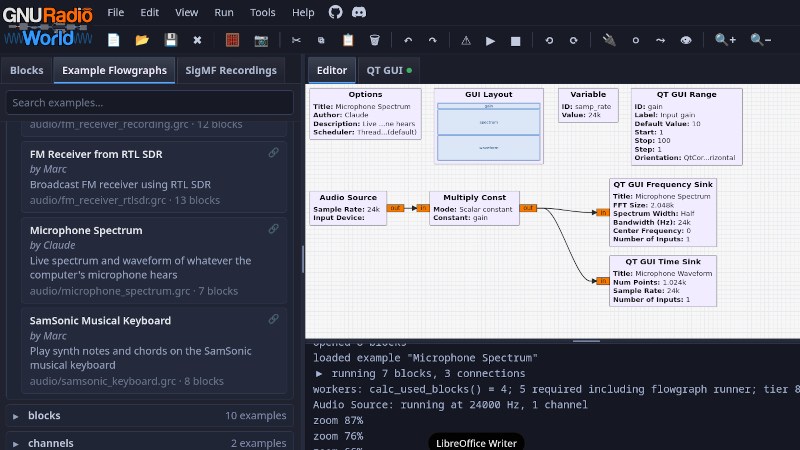
The progression of the web browser from a tool for simple static information browsing into a do-everything computing environment has been inexorable, with package after package making the jump. Today it’s the turn of GNU Radio Companion, lowering the barrier to software defined radio considerably. It’s the work of [Marc Lichtman], who’s name you may recall if you have ever used pysdr.org.

Loading it up gives you a very familiar window if you’re used to GNU Radio Companion, and it comes with a set of example flowgraphs that cover a large range of applications. It supports a collection of software-defined radios (SDRs) including the well-known RTL-SDR, and if that’s not enough it can also use your sound card. There is even a set of recorded off-air captures to experiment with.

We’ve spent a while here playing with it, and it does everything we’re used to from the version outside the browser. The only thing we’re told it won’t do is work with a networked SDR, but that’s no deal breaker.

Thanks [Marcus MΓΌller] for the tip.

A 1990s Homebrew OS With GUI And Web Browser, In AM29000 Machine Code

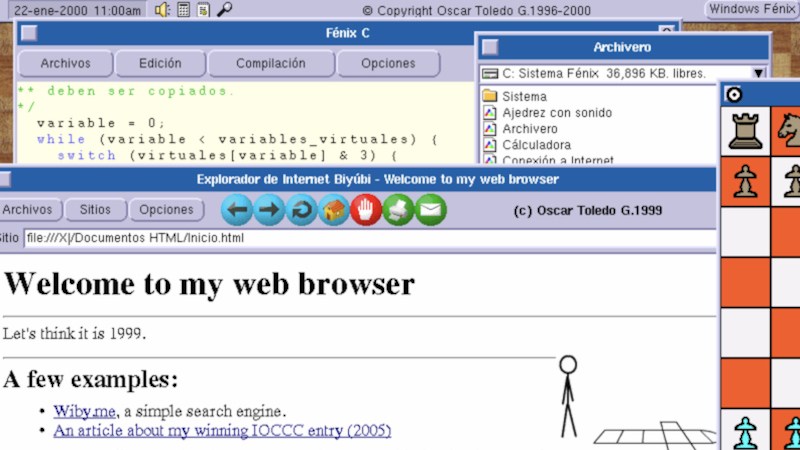
The AM29000 series of processors were AMD’s entry into the world of super-fast next-generation silicon of the late 1980s. It was a time when ARM was still a niche architecture in a British educational computer, the 68000 series was still a major player, and it was by no means certain that the x86 would maintain its position. It therefore wasn’t an unreasonable choice for someone building a high performance computer at the time, which is what [Oscar Toledo G.] and his father did. If that wasn’t enough, he went on to write an operating system for it in AM29000 assembly, complete with a GUI, a C compiler, and an up-to-date web browser for the late 1990s. The story makes for an engaging read.

It’s written across two parts, with the first looking at the computer and the early software development, and the second at the C compiler and web browser. It’s a tale of epic mastery of the machine, and something we remember ourselves, piecing together knowledge in a time before the Internet placed it all at our fingertips. Tales such as hand porting β€” we can’t really say compiling β€” C code into AM29000 machine code are completely next-level. You have to read these two write-ups, and there’s even an in-browser emulator should you want to try it.

Meanwhile, in case you think something is a little familiar here, he’s the same person who brought us a Transputer in the browser.

❌