
Reading view

There are new articles available, click to refresh the page.

Hackaday Europe 2026 – Build A Cable Modem For Your Arduino

Even for those of us that are quite technically minded, we spend precious little time thinking about the cables that carry our signals and do all the important work we need them to do on a daily basis. A great deal of theory and engineering goes into making things like telephone lines and HDMI cables work, but we mostly just plug them in and get on with whatever we’re doing.

If this is your experience, you might find the Hackaday Europe talk from [Michael Wiebusch] to be particularly interesting. He dives into transmission line theory from an accessible standpoint, explaining how two disparate signals can go in opposite directions on the very same wire. Then he demonstrates the theory by building a cable modem… well, sort of!

Signal

Michael begins his talk by discussing the Telegrapher’s Equation, but only as a fakeout. Given the limited time on offer, he decided a quicker, easier explanation of the physics involved would be more appropriate. Key to this was explaining the difference between cables and transmission lines. To create a true transmission line, by his definition, he explains that there is a necessity to have two conductors that are relatively close together. Such a transmission line is effectively a distributed network of inductances and capacitances all the way down, though often we talk about “lossless” transmission lines for modelling purposes. He also covers the point of coaxial cables, wherein one conductor is wrapped around another to shield a signal from external noise, and to prevent signal from leaking out.
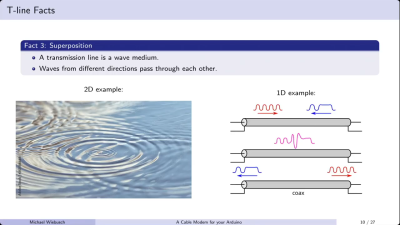
Transmission lines allow signals to pass in opposing directions, much like ripples on a pond will pass through each other, retaining their form. Credit: talk slides

There are several basic facts to remember about transmission lines. They are fundamentally just channels down which EM signals can travel. It’s also good to remember that they delay signals. To a human, the signal may appear to travel instantaneously, but it does take time. This also has other impacts; for example, coax cables are filled with plastic, a material in which the speed of light is roughly 66% of the speed of light in a vacuum.

This slows the rate at which the field of an EM signal can travel to this fundamental limit. [Michael] also notes that transmission lines, as a wave medium, essentially allow waves travelling in different directions to pass each other, much like ripples spreading on the surface of a pond. This is why it’s possible to have bidirectional communication on a single transmission line. It’s also important to terminate a transmission line properly, such that the wave you’re transmitting down it ends where you want it to—at the receiver. Fail to terminate your transmission line, and you’ll have that wave bouncing back and forth which is undesirable for clear transmission.
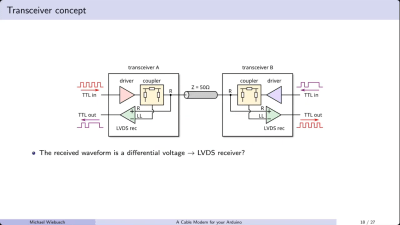
The coupler allows sending and receiving signals via a single transmission line. Credit: talk slides

[Michael] demonstrates basic transmission line theory by building a sort of cable modem out of an Arduino and some supporting hardware. He notes it’s not really a modem—there is no modulation or demodulation going on. Instead, he’s simply squirting TTL signals into either end of a cable and receiving them on the other end. The “black box” that couples the signals into and out of the transmission line is a simple directional coupler. Built out of resistors and an op-amp, it allows sending a signal down a transmission line, as well as receiving a signal coming the other way. The design works all the way down to DC logic level signals, which let [Michael] use it to send TTL signals up and down 50-ohm and 75-ohm coaxial cables. He notes this has very obvious practical applications where it’s desirable to reduce cable counts when sending signals in multiple directions, relating this directly to his professional work on science experiments.

If you’ve ever wanted to get two devices talking over a single cable in a relatively easy fashion, then [Michael’s] talk may be valuable to you. At the very least, it’s a great way to learn some of the basics of transmission lines and better understand what’s going on when you shoot a signal down a random bit of wire. It’s all good stuff.

A ‘painful’ reset for Xbox: 3,200 job cuts, studio spinoffs, and a vow to return to growth in 2027

(Microsoft Image)

Xbox CEO Asha Sharma laid out a wide-ranging plan to overhaul Microsoft’s gaming division Monday, calling it the most significant restructuring in Xbox history and disclosing that the business has been losing 64 cents on every dollar invested in its game studios.

As detailed in a memo to employees, the changes include roughly 3,200 job cuts through the fiscal year — about 20% of the Xbox workforce — the spinoff of four game studios, a new COO, and a plan to flatten management from as many as 14 layers to no more than five.

“We will return to growth in 2027,” Sharma wrote. “History is full of companies that mistake longevity for inevitability. We will not be one of them.” 

Sharma, a startup veteran and former Microsoft AI leader, was named Xbox CEO in February

“I know this is painful,” she wrote. “These changes will directly affect people who have poured their creativity into building XBOX. Many joined us through acquisitions, while others were recruited here, or sought us out because they loved this industry and loved XBOX. Today’s decisions do not reflect their talent or dedication.”

But she also reiterated what she said in a memo last month: Xbox’s business is not healthy, operating at margins 3-10x lower than industry peers after years of heavy spending that failed to produce the expected growth. 

About 1,600 of the Xbox job cuts take effect Monday as part of a broader round of 4,800 layoffs across Microsoft. The remaining Xbox reductions will come in the months ahead. Sharma acknowledged that a year-long restructuring “creates additional challenges” but said “it is not possible to make all the necessary changes in a single day.” 

Sharma said the cuts reach across Activision, Bethesda/ZeniMax, Blizzard, King, Mojang, and Xbox Game Studios, though no publicly announced games are being cancelled.

Several game studios will be spun out as standalone ventures, removing the costs from Microsoft’s books while giving the studios a chance to survive on their own.

  • Compulsion Games (South of Midnight) and Double Fine Productions (Psychonauts) will return to their management teams as independent studios, keeping their intellectual property and current projects. 
  • Ninja Theory (Hellblade) and Undead Labs (State of Decay) will shift to new owners with funding to complete their current games. 
  • In France, Arkane (Dishonored, Deathloop) is beginning a legally required consultation with its employee works council to determine its future. 

Sharma will also take on direct oversight of game studios Mojang (Minecraft) and King (Candy Crush), Xbox’s two largest studios by monthly active players. 

In addition, she is establishing a new chief operating officer role with end-to-end financial responsibility across content, hardware, platform, and services. Helen Chiang, a nearly two-decade Xbox veteran who led Mojang and the Minecraft franchise, has been promoted to the role. Dave McCarthy, a 17-year Xbox veteran who helped build the platform, is retiring. 

Across the division, Sharma wrote in the memo, Xbox will cut vendor spending by 50% and reduce management layers from as many as 14 to no more than five.

The overhaul follows a 25-year period in which Microsoft largely subsidized Xbox as a strategic bet on the living room. Microsoft CEO Satya Nadella has said that era is over, noting that YouTube creators make more money from Xbox games than Microsoft does.

Xbox at a crossroads: 25 years later, Microsoft is done playing around

Xbox at a gamescom briefing in 2014. Microsoft is pressing its games division to turn a profit. (Microsoft Photo)

In 2007, Microsoft’s Xbox 360 consoles started dying — overheating until three lights on the front blinked red, a defect gamers came to call the “red ring of death.” Microsoft’s response was to extend the warranty on every machine and take a charge of more than $1 billion to fix the problem, making it one of the costliest product failures in the company’s history.

Microsoft could afford it financially, but the bigger factor was strategy. Xbox was a bet on the living room, and for a company minting money on Windows and Office at the time, losing a billion or so was a justifiable cost of staying in the game.

Nearly two decades later, that patience has run out.

“Going forward, this cannot continue,” the new Xbox CEO Asha Sharma wrote in a memo to employees last month, offering a blunt assessment of a business that has spent more than $20 billion over five years, only to see its core revenue fall by nearly half a billion dollars, running at a thin 3% profit margin, by Microsoft’s own internal measures.

With thousands of layoffs expected to be announced across Microsoft as soon as next week, the Xbox division is likely to be among the hardest hit.

The cuts reach across the company — including sales and consulting — part of a restructuring that has become routine around the close of Microsoft’s fiscal year. But for Xbox, they’re an early step in a broader effort to reset the business, rein in costs, and position the division for healthier profits.

Microsoft CEO Satya Nadella has been blunt about it: the company has spent years subsidizing Xbox rather than profiting from it, and that era is over. The videos and livestreams of people playing Xbox games that fill YouTube generate more money than Microsoft makes from the games themselves, he noted in an appearance on the Hard Fork podcast.

“No one can accuse Microsoft of not having invested for the last 25 years,” Nadella said. “And now we have to turn this into a sustainable business.”

Long-term strategic bet

Turning it around means breaking a pattern that runs through Xbox’s history.

Xbox launched in 2001 and lost money for most of its first decade. Microsoft absorbed the losses and stayed in — going up against Sony’s PlayStation and Nintendo — because it saw a strategic prize in owning a piece of the living room, and later mobile. Online gaming also gave the company early experience running services at scale, which fed its cloud ambitions.

Over time, the goal shifted from selling hardware to selling subscriptions.

Xbox Live, launched in 2002, turned online play into recurring revenue. Game Pass, which arrived in 2017, let players pay a monthly fee — the top tier is about $23 — for a library of games, including Microsoft’s own new releases the day they come out. The idea was to get people paying for Xbox everywhere: consoles, PCs, phones and the cloud.

And when growth stalled, Microsoft doubled down. It paid $7.5 billion in 2021 for Bethesda, the studio behind Fallout and The Elder Scrolls, then $69 billion in 2023 for Activision Blizzard (whose games include Call of Duty, World of Warcraft, Diablo and the mobile hit Candy Crush) the largest acquisition in Microsoft’s history.

A series of economic headwinds

In recent years, almost everything about the economics of gaming has turned against Xbox at the same time.

Hardware loses money, and AI is making it worse. Microsoft sells consoles at or below cost, banking on games and subscriptions to make up the difference. But AI data centers are consuming so much memory and storage that chip prices have spiked. That has forced Microsoft to raise Xbox console prices, most recently a $100-to-$150 hike this summer that it blamed directly on component costs.

Xbox lost the console war. By most estimates, Sony’s PlayStation 5 has outsold the Xbox Series X and S more than two to one. A smaller base means fewer game sales and subscriptions to offset the upfront hardware losses. That has left Xbox a distant second for the entire generation.

Revenue is shrinking. Even setting aside the games it gained from Activision, Xbox’s annual revenue has fallen nearly $500 million over five years — while the money going into the business keeps climbing. It has been investing more to earn less.

Microsoft’s most recent quarterly filing shows gaming revenue of $16.8 billion for the nine months through March, down about $1.1 billion, or 6%, from a year earlier.

Game Pass cuts into sales. Handing subscribers a new game the day it launches undercuts the roughly $70 they would have paid to buy it. The service delivers steady subscription income, but thinner economics on the games themselves.

Activision didn’t fix the margins. Even with one of gaming’s most profitable businesses folded in, Xbox earns only about 3 cents of profit on every dollar — well under the 17 to 22 cents typical in the industry. If the biggest acquisition in company history can’t move the margin, little will.

Every spare billion is flowing to AI. Microsoft is pouring more than $100 billion a year into the data centers and chips behind its AI push, trying to capitalize on the boom. Against a risk and payoff that big, a gaming business that barely breaks even feels like yesterday’s strategic bet.

What’s next for Xbox

The cuts have already started. In recent weeks, Microsoft has signaled plans to close or sell some studios, including Ninja Theory, maker of the acclaimed “Hellblade” series.

Shedding staff, studios and marketing will lift Xbox’s profit margins in the near term. What it won’t do is fix the underlying problem: a business can trim its way to a better number only so much before it has to generate more revenue.

Sharma’s plan, so far, is to concentrate on Xbox’s biggest franchises, funding blockbusters like Halo and Fallout while pulling back elsewhere. It’s leaning on Game Pass and releasing most of its games on PCs and rival consoles from Sony and Nintendo, reaching players well beyond Xbox’s shrinking base, even as it holds back a few new exclusives like Gears of War to give owners a reason to stay.

Microsoft is also rethinking the console itself. In her memo, Sharma described a “hardware component crisis” that has left the company unable to make as many consoles as players want, and called for “a new business model and partnerships” for its hardware.

How far the reset ultimately goes is an open question. The Information reported that Microsoft has weighed making Xbox a standalone subsidiary, a joint venture, or a spin-off, though nothing is imminent.

Microsoft’s response to the Xbox 360 “red ring of death,” July 6, 2007. (Seattle Post-Intelligencer / NewsBank)

Whatever happens next, it’s clear that times have changed. In 2007, as the red ring of death crisis emerged, Peter Moore, who ran the Xbox business at the time, and his boss Robbie Bach went to then-CEO Steve Ballmer to ask for the money to repair and replace the failing consoles.

Ballmer didn’t flinch. “What’s it going to cost?” he asked, as Moore later recalled.

Told it was $1.15 billion, Ballmer said, simply: “Do it.”

Moore credits that decision with saving Xbox. There would have been no Xbox One, he said, without Ballmer’s willingness to spend more than a billion dollars to protect the brand.

Nearly two decades later, Microsoft is done writing that kind of check.

❌