AI agent workloads can vary dramatically in token use, making cloud costs difficult to forecast. New research shows why IT and finance teams need workflow-level controls.
A little over a month after the Department of Defense (DOD) bragged that nearly half of its 3.5 million employees were using AI at work, members of the Army’s Combat Capabilities Development Command (DEVCOM) received an email informing them that they were burning through tokens, and needed to limit use.
“Although the Army CIO announced in May 2026 that they were offering unlimited tokens, by mid-June the Army CIO pool was exhausted of tokens and had to re-establish limits,” the email reads. The email goes on to say that although the Army has chosen to renew token usage at “its current levels,” it’s unclear “if the Army CIO pool will be renewed after 1 Oct.”
The Army uses Ask Sage, a multimodal generative AI platform where users can run different large language models (LLMs), including Alphabet’s Gemini, Meta’s Llama, and OpenAI’s ChatGPT. “Apparently the whole Army burned through the whole year of tokens for just one service,” says an Army employee who spoke to WIRED anonymously because they were not authorized to speak to the press.
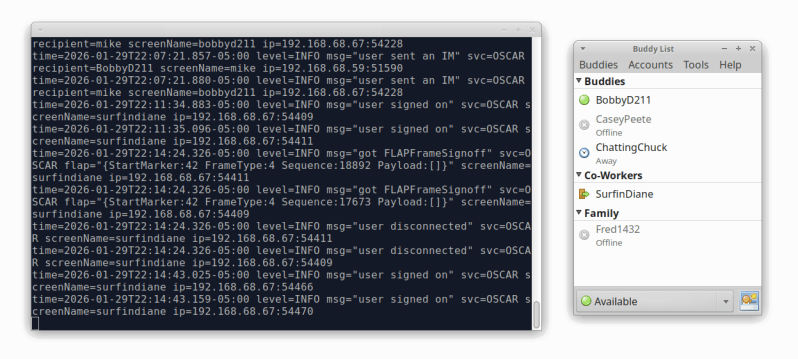
Do you remember AIM? It may suprize you to hear that AOL’s instant messanger was actually supported all the way up to 2017– two years after Discord launched. Unlike Discord, AIM is a protocol, not a platform. Everything on your favourite Discord server is at the mercy of the corporate masters of said server; you can’t just spool up your own. Not so for AIM, as [Veronica] explains, both on her blog and in a YouTube video that we’ve embedded below.
The key is the fact that the AIM protocol isn’t locked into AOL’s now-defunct servers; it was reverse engineered in its prime for open-source messengers like Pidgin. You can host your own server, too, using the OpenOscarServer by [mk6i]. Even better, it’s not just AIM, but ICQ! In the sort of irony you only get in real life, the OpenOscar community does all its support on a Discord server. But then, they couldn’t hardly do it over AIM or ICQ these days.
For those of you who were too old or too young to get sucked into the 90s instant messenger craze, these protocols don’t just create chat rooms, that would be the even older Internet Relay Chat protocol, but usually worked more like SMS text messages. You have a contact list, and you send messages to your contacts via a server that acts as a hub. Once upon a time, that server was AOL’s, but now thanks to the OpenOscar project, it can be anybody’s computer. Of course, like texting, you can rope all of your contacts into one big group chat, and the protocol does support images and VOIP. (Which is starting to sound a lot like Discord.)
If you’re tired of your friend-group being at the mercy of American tech companies, [Veronica]’s blog post serves as a good guide to get you started running OpenOscarServer on a Linux system; she used a virtual private server but figures a Raspberry Pi ought to have enough grunt if you don’t have a huge number of people signed up.
For completeness, we should mention that while AOL pulled the plug on AIM nearly a decade back, ICQ, the other protocol supported by OpenOscarServer, lasted straight through until 2024.
Thanks to Keith Olson for the tip! Our tipsline is based on decentralized “electronic mail” technology that anyone can access.
Apple lost its EU court challenge over iOS and the App Store, keeping both under the Digital Markets Act as another legal challenge still remains possible.
This may say more about us than the current state of the telephone network, but unless your Grandma is still kicking, how many phone calls do you take that are actually worth picking up? Around here it’s one variety of scam or another, with the odd cold-calling salesperson to round it out.
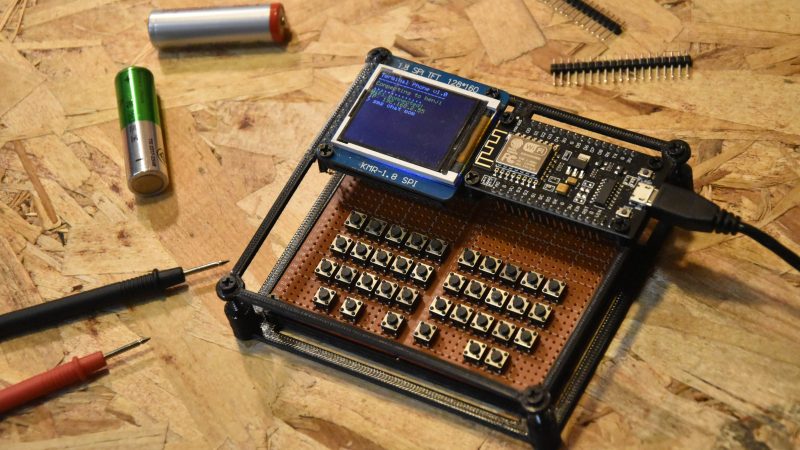
So when we saw [Bolan Xu]’s texting-only TERMINUS cell phone project, it took but a minute to decide that, yeah, we wouldn’t miss the telephone part of the phone very much either.
The trade-offs are immense when compared to your smartphone; there’s no voice, no web browser, no social media, and no camera. But on the flip side there’s also no spyware and no annoying spam calls. Besides, he’s built a QWERTY keyboard onto this thing, and that does seem to be what most of us miss in this era of black rectangles.
In terms of electronics, its rocking a tiny OLED display for you to read your messages on, driven by an ESP8266. When WiFi is available the plan was to bridge over the internet in an SMS version of VOIP, but [Bolan Xu] ended up installing a cellular modem in it anyway.
As you can tell from the skeletal case, this is very much a prototype, but it is a promising project. We’ve seen ESP-based phones before, but they tend to be a bit smarter, and run on ESP32 instead of the more modest ESP8266.

 Login
Login