Login
Login
Tech In Plain Sight: Meet The Robot That Does CPR
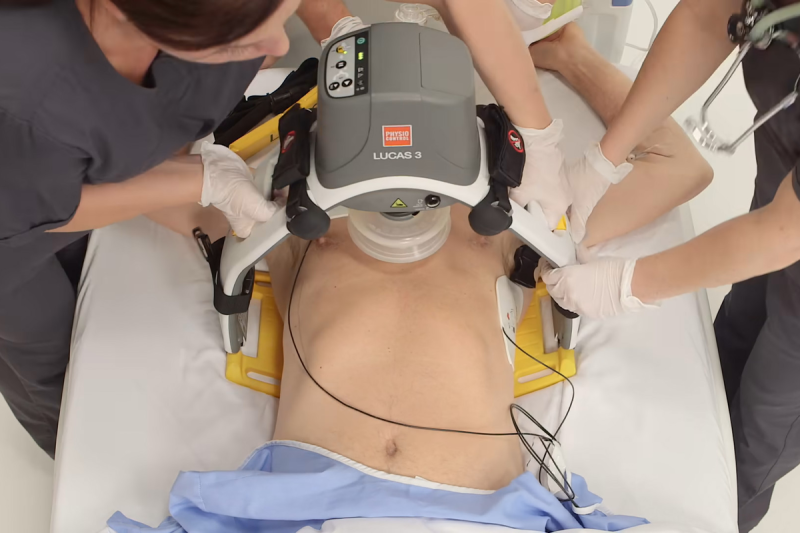
Usually in Tech In Plain Sight, we talk about technology you probably see every day, even if you don’t notice it. But we hope you don’t get to see one of the latest crop of medical robots, such as the LUCAS chest compression system. If you watch the popular TV series “The Pitt”, though, you may have caught a glimpse of one of these medical marvels. They aren’t fiction. They are very real devices.
Calling them robots might be stretching the definition a little. They don’t roam the halls looking for patients. But once attached to someone in cardiac arrest, they can take over one of the most important — and physically demanding — parts of CPR: chest compressions.
Keep The Blood Moving
When someone’s heart stops pumping blood, time is critical. CPR doesn’t normally restart the heart on its own. Instead, chest compressions produce enough blood flow to keep oxygen reaching the brain and heart while rescuers work on the underlying problem and, when appropriate, use a defibrillator.
Doing that well is harder than it looks on television. Current American Heart Association guidelines call for adult chest compressions 100 to 120 times per minute, at least 5 cm deep but generally no deeper than 6 cm, while allowing the chest to recoil fully between compressions. Interruptions should be kept to a minimum.
That’s hard physical work. In fact, studies show compression depth begins to fall after only about 90 to 120 seconds, which is one reason CPR teams normally swap compressors every two minutes. But a robot doesn’t get tired.
Meet LUCAS
LUCAS stands for Lund University Cardiopulmonary Assist System, reflecting the device’s origins in Lund, Sweden. Early versions entered clinical use around 2002-2003 and were pneumatically powered. Later versions replaced the compressed-gas system with an electric motor and battery.
The current LUCAS 3 looks something like a small drill press straddling the patient as you can see in the video below. A backplate goes beneath the torso, and a frame locks onto it. An electrically driven piston presses a suction-cup-like pad against the sternum. Internally, the motor drives a belt and ball screw that moves the piston up and down.
Factory settings are around 102 compressions per minute and roughly 53 mm compression depth for a typical adult, although parameters can be configured.
Beyond tirelessness, another obvious advantage is that LUCAS doesn’t need hands. Medics can deal with ventilation, drugs, defibrillation, IV access, and the dozens of other things occurring during a cardiac arrest. More importantly, the device can keep compressing while a patient is being carried, wheeled through corridors, or transported in an ambulance — situations where doing good manual CPR is awkward and sometimes dangerous to the practitioner.
So Does It Save More People?
You might reasonably expect perfectly regular machine CPR to beat a tired human. Large randomized trials haven’t demonstrated that, however. The 4,471-patient PARAMEDIC trial found 30-day survival of 6.3% with LUCAS versus 6.8% with manual CPR, not a statistically significant difference. The 2,589-patient LINC trial similarly found essentially identical four-hour survival — 23.6% versus 23.7% — and no significant improvement in longer-term neurological outcomes.
That doesn’t make the machines useless. It says something slightly different: high-quality mechanical CPR hasn’t proven superior to high-quality manual CPR as a routine replacement. The International Liaison Committee on Resuscitation currently recommends against routine mechanical CPR, while specifically noting that it can be a reasonable alternative when sustained manual compressions are impractical or would endanger the practitioner.
One issue is setup. Installing the machine adds a time penalty: compressions must stop briefly while the backplate and mechanism are positioned. Good training is essential to keep that interruption short. Another problem is that some studies show potential links to higher rates of internal chest injuries, such as bleeding around the lungs. There have also been rare device malfunctions or power failures that can compromise care.
Not The Only Game In Town
LUCAS isn’t alone. ZOLL’s AutoPulse takes a very different mechanical approach. Instead of a piston pushing on one spot, a motor tightens a broad load-distributing band around the patient’s chest.
There’s also the German corpuls cpr, which returns to the piston idea but uses a cantilevered single-arm mechanism. That leaves much of the chest unobstructed and makes the system useful during procedures such as cardiac catheterization.
So perhaps these aren’t quite the autonomous robot doctors science fiction promised us. But when your heart has stopped, and a machine is tirelessly pumping your chest a hundred times a minute while the medical team works around it, you probably won’t complain. We hope you don’t have to find out.
We’ve seen DIY devices, though certifying medical devices for actual use isn’t for the faint of heart. Robots can also help train humans to do better CPR.
Featured image is a still from the instructional video “Physio-Control LUCAS 3 Chest Compression System – Hospital Use” by MFI Medical.