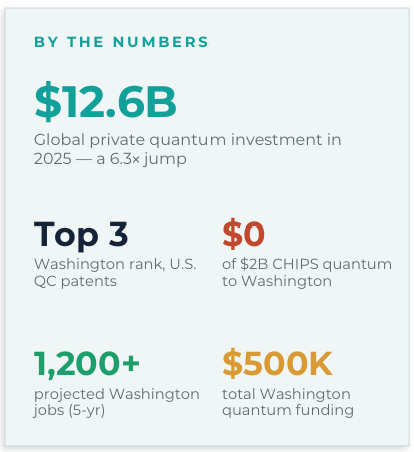
Chart from “Quantum Technology in Washington State.”
Washington state has assembled the country’s deepest bench of quantum technology assets — including two major cloud platforms, a national lab and the first U.S. quantum computer factory — but has captured almost none of the federal money now driving the industry.
That disconnect is the focus of a report released Tuesday morning by the Washington Technology Industry Association, the Northwest Quantum Nexus and the state Department of Commerce.
Since a January 2023 assessment, Washington state’s quantum ecosystem “has grown denser, more visible, and physically larger,” reads the report, authored by Nirav S. Desai, CEO of innovation consultancy Moonbeam Exchange. “Yet the state has fallen behind peers on the coordinated public investment that converts assets into a resilient cluster.”
The report makes five recommendations:
Use the governor’s office to convene a standing group — universities, the Pacific Northwest National Laboratory, companies, investors and the Commerce Department — that decides which federal grants to pursue and assembles joint bids for funding.
Pick one to three specialties to compete in, such as post-quantum cryptography or industry applications, rather than chasing all of quantum.
Build the workforce at all three levels: developers first, then the missing undergraduate and technician programs.
Position the Seattle region and Washington state as a landing pad for Japanese, Korean and Taiwanese quantum companies.
Create a single point of contact for founders, and promote the quantum machine access the state already has but hasn’t advertised.
“This isn’t a resource problem; it’s a coordination problem, and that’s the good news,” said Nick Ellingson, WTIA’s vice president of innovation and entrepreneurship, in a news release.
Quantum computers, which have yet to be proven commercially viable, can hold multiple states at once and could eventually solve problems beyond the reach of conventional machines.
The report points to efforts by states including Illinois, Maryland and Colorado, which have committed $500 million, roughly $200 million and $127 million respectively to quantum campuses and research hubs.
In Washington state, Microsoft and Amazon are among the major tech companies leveraging their research to build quantum platforms and technology. Maryland-based IonQ’s Bothell, Wash., plant, the country’s first dedicated quantum computer factory, employs about 100 people, part of an expansion the report says could generate 1,200 to 2,000 jobs within five years.
Gov. Bob Ferguson vetoed $100,000 for a state quantum strategy in May 2025, citing fiscal pressure, while directing the Commerce Department to build industry partnerships and produce policy recommendations. Tuesday’s report was funded by a grant administered by Commerce.
In April, Ferguson steered $500,000 from the state’s Strategic Reserve Fund to IonQ’s Bothell expansion, Washington’s first direct investment in quantum.
Illinois, by comparison, has committed more than $500 million to the Illinois Quantum and Microelectronics Park, a campus near Chicago anchored by PsiQuantum and IBM.

 Login
Login