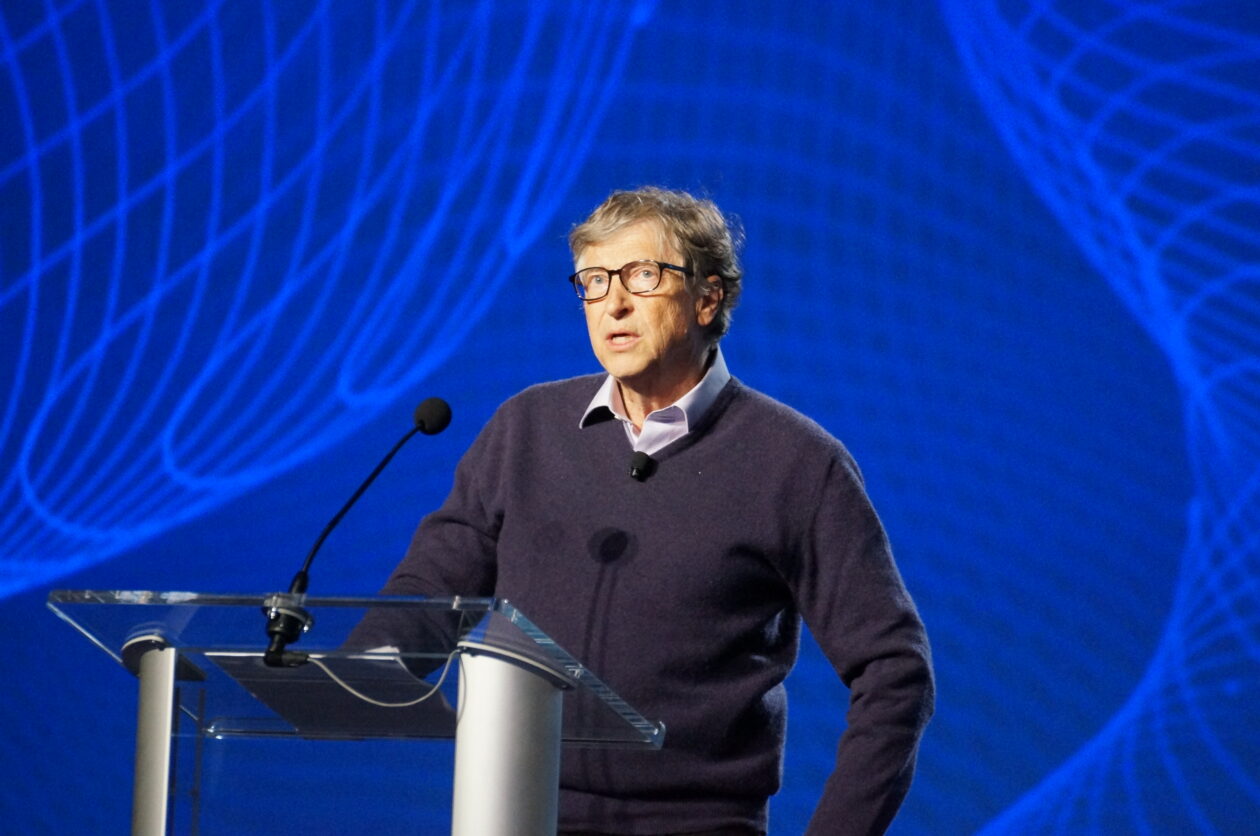
“AI could be a great equalizer — or widen the gap,” Bill Gates writes in a new Gates Foundation report. (GeekWire File Photo / Todd Bishop)
The Gates Foundation is pledging to spend at least $1 billion over the next two years on artificial intelligence for health workers, farmers and teachers, largely in the world’s poorest countries, funding AI tools for people the market would otherwise overlook.
The bet is that AI can help reaccelerate the world’s progress against child mortality, poverty and disease, which has slowed sharply as governments cut global health funding.
The Seattle-based foundation’s new financial commitment, released Monday evening in conjunction with its 10th annual Goalkeepers Report, illustrates the double-edged sword of AI at a moment when the U.S. in particular is preoccupied with what the technology might damage or destroy.
Bill Gates, who issued his own AI warnings in an essay three weeks ago, writes in the new report that the risks “are real and deserve serious attention.” He adds, “AI could be a great equalizer — or widen the gap. This is not a long-range prediction. It’s a present-tense choice.”
In this case, Gates writes, he’s focusing on “the possibility that AI, if shaped well, could expand who has access to solutions, opportunities, and knowledge that has too often been out of reach.”
The window is short, he writes: “I believe that the decisions made in the next 12 to 18 months — about how AI is built, funded, and deployed — will determine whether this technology primarily benefits the people who already have the most or reaches those who have the least.”
Gates Foundation CEO Mark Suzman, in an interview with GeekWire, called the $1 billion a “down payment,” saying he expects the figure to grow significantly after the first two years.
For this first installment, 40% of the money will go to education, 40% to health care, 10% to agriculture and 10% to digital infrastructure, including datasets in languages the models don’t handle, according to the foundation.
More than 90% of the data used to train early large language models came from English-language sources, according to the report. Leading AI speech recognition systems make errors less than 6% of the time in English and more than 60% of the time in Yoruba, a West African language spoken by tens of millions of people, for example.
Most people in Africa use feature phones rather than smartphones, Suzman said, so the tools have to work by voice. That means collecting recordings of speech, not just written text, in local accents and including children’s voices. He said the foundation works with Google and Microsoft on AI language initiatives.
Winding down: Gates announced in May 2025 that he would give away virtually all his wealth and close the foundation in 2045, which requires doubling its spending over those 20 years. The foundation had previously planned to close 20 years after his death.
As part of that plan, the foundation will need to give away $200 billion before it shuts down. Its budgeted payout is $9 billion this year, the largest in its history. Suzman said the $1 billion over two years comes out of its core budget.
Goals for its final two decades include cutting preventable child deaths in half again, eradicating polio and malaria, and bringing tuberculosis and HIV under control.
The report’s data section shows how far off the pace the world is. Child mortality, neonatal mortality and HIV are all projected to miss their 2030 targets. HIV incidence is on track to fall only to 0.22 new cases per 1,000 people, more than 10 times the target of 0.02.
Early AI results: The report makes the case that AI could change those trajectories. It points to a number of tools already in use in different settings:
Penda Health, a network of affordable clinics in Nairobi, Kenya, where an AI tool built into patient records has raised diagnostic accuracy by 16 percentage points.
In the U.S., seventh graders using a tool called Kiddom Atlas across 21 middle schools gained the equivalent of six extra months of learning in a single year.
In India, the state of Maharashtra runs a free AI advisory service called MahaVISTAAR that has signed up more than 740,000 farmers, with 70,000 more joining every month.
The foundation has supported all three, according to the report’s endnotes. The endnotes also cite OpenAI’s account of its work with Penda Health on the clinical copilot.
One caveat: the evidence behind the examples is early. Suzman said the education work is “still on a relatively small scale,” and pointed to agriculture as the area already operating at size.
Suzman said the foundation spent years experimenting with AI without committing at this scale, wary of getting ahead of what the technology could actually deliver in its areas. Progress in the models over the past year, and results from early investments, convinced him otherwise.
“We now can state with a pretty high degree of confidence there are real deliverables that we can see across health, across education, across agricultural development,” he said.
What AI won’t fix: Asked whether AI can substitute for the money the U.S. and other governments have cut from global health, Suzman said: “Sadly, no.” The cuts run to “tens of billions of dollars,” he said, and they are hitting basic services now. He cited the purchase of bed nets and antiretroviral drugs, and care for mothers before and after birth.
“That’s affecting families right now with a real impact,” he said. “Ideally, you combine the two [AI and aid funding], and that’s how you get hugely accelerated progress.”
Suzman said the foundation will keep pressing the U.S. to remain a leader in global health. Despite the cuts, he said, it has been encouraging to see the country stay a partner in programs such as the Global Fund to Fight AIDS, Tuberculosis and Malaria, and he noted that Congress has moved to fund these areas more fully than the administration has.
“We believe that currently reflects the U.S. public’s broad view and support for these areas, when you can see the concrete results,” he said.
The Epstein review: Asked how the scrutiny of Gates’ ties to Jeffrey Epstein has affected the foundation’s work, Suzman pointed to the external review the foundation released in July.
Conducted by the law firm WilmerHale, it found no evidence that Epstein received foundation money or that the foundation knew of his crimes. It counted roughly 30 meetings from 2011 to 2014, involving Gates and nine other foundation leaders and staff, and found that staff had repeatedly raised concerns about associating with him.
The board adopted the recommendations that followed, among them centralized vetting of brokers and co-funders and tougher conflict-of-interest rules.
Suzman expressed optimism that the review has cleared the way for the foundation to keep working across the full range of governmental and philanthropic partnerships. “Hopefully it’s full speed ahead,” he said, “and with these AI shifts, that’s more important than ever.”
Welcome to Edition 9.10 of the Rocket Report! This week we're celebrating a historic moment in Europe when a German rocket company successfully put its launch vehicle into orbit. Isar Aerospace became the first purely commercial European company to reach orbit, and impressively it did so on just its second launch attempt. How quickly can they scale up operations? How quickly will the second European launch firm reach this goal? Big questions, which for now we don't have answers to.
As always, we welcome reader submissions, and if you don't want to miss an issue, please subscribe using the box below (the form will not appear on AMP-enabled versions of the site). Each report will include information on small-, medium-, and heavy-lift rockets as well as a quick look ahead at the next three launches on the calendar.
Isar Aerospace takes a huge step forward. Isar Aerospace, founded in 2018 by three students at a German university, successfully launched a privately developed rocket into low-Earth orbit on Saturday from a Norwegian spaceport inside the Arctic Circle. The two-stage rocket, Spectrum, became the first fully commercial launch vehicle in Europe to reach orbit, Ars reports. With Saturday’s success, Isar becomes the clear leader among a pack of several European launch startups vying to inject some competition into Europe’s stagnant launch market.
A new report says Seattle’s economy “may not be in decline, but it is in danger.” (GeekWire Photo / Kevin Lisota)
An independent study commissioned by the City of Seattle says the city’s tax structure is unique among its peers in the way it “specifically penalizes the hiring of senior, high-compensation workers,” with that penalty falling overwhelmingly on large tech employers.
Overall, Seattle’s business taxes are actually in line with competing cities, write researchers from the economic consulting firm Formation in the new report. But Seattle’s taxes are “particularly distortionary when it comes to hiring high-wage employees,” they add.
Mayor Katie Wilson helped design the tax, known as JumpStart, before taking office. But even the strongest supporters of new local and state taxes would concede that Seattle is “reaching the limits of how much it can tax the industries and people that it is depending upon to drive its growth,” the researchers write.
Another risk for the city is the resulting concentration of the tax base. Three-quarters of the payroll tax on large employers comes from 10 companies. Nine of them are in tech-related sectors.
A big company shifting 10,000 workers out of Seattle would cost the city about $50 million a year in payroll tax revenue, the researchers say in an accompanying slide deck, without naming Amazon explicitly. That’s more than a quarter of the $175 million deficit the city projects for next year.
In that way, much of the city’s financial future depends “on the marginal location and compensation decisions of a handful of employers,” the report says. Because much of the taxed compensation is vesting stock, it adds, the city’s revenue is exposed to “the single most volatile attribute of these firms — one the city has no ability to forecast or influence.”
Reducing that dependence through growth is the bigger point of the report.
The 127-page assessment, called “Seawall: Building a Resilient Seattle Economy,” goes well beyond the topic of taxes. The title refers to Seattle’s rebuilt waterfront seawall, engineered to hold back the water and also let marine life take hold. The researchers offer this as a model for protecting the city’s economic base while building a more diverse economy on top of it.
A decade of growth lifted wages at every level of the income spectrum, the report finds. Few other U.S. regions spread prosperity as broadly. But the same growth made Seattle far more expensive, especially for families.
Fast-forward to today, and the report sees an economy that’s dangerously concentrated, “significantly more AI-exposed than the national average,” short of the electricity it will need, and no longer producing mid-sized companies.
In danger, not in decline: The report is also careful to point out the city’s unique position and strengths. Seattle’s tech workforce is “almost peerless,” it says: 23% of the nation’s AI engineers are based in the region, and output per tech worker is more than double the national average.
The region also has the rare combination of a big tech industry and a strong manufacturing base.
Seattle “may not be in decline, but it is in danger,” the researchers write — “not because it is losing its place in the industry, but because the industry could undergo a radical change, and arguably already is.”
The concern that Seattle is becoming “the next Cleveland,” raised in a GeekWire column in February by Seattle tech veteran and angel investor Charles Fitzgerald, is “likely hyperbolic,” the researchers write. (They acknowledge that it “caused quite the stir this past winter.”)
The report points instead to Portland and Los Angeles as the more relevant warnings, citing Portland’s pileup of new business taxes and Los Angeles’ failure to turn a deep talent pool into jobs.
Fitzgerald responded Wednesday evening on his blog, Platformonomics, writing that the city “has finally acknowledged there is such a thing as an economy.” His main objection was who wasn’t in the room: “No businesses were involved, but that seems to be the norm hereabouts on economic matters.”
The report’s acknowledgments list dozens of interviewees, including the Seattle Metropolitan Chamber of Commerce, the Washington Roundtable and the Tech Alliance. No large tech employer is among them.
Ryan Donahue, a co-founder and managing partner at Formation, said in an email that the researchers interviewed many business representatives but no large companies directly, saying he expected a predictable message from their government affairs teams.
The person who led the report’s tax and cost analysis previously ran Amazon HQ2 recruitment at the Virginia Economic Development Partnership, the agency that landed the project for Arlington, Va., Donahue said, providing insights into how firms like Amazon weigh those decisions.
A path forward: The report recommends that the city focus on five industries: artificial intelligence, cleantech, maritime, life sciences and space. Cleantech is the priority, the report says, because Seattle owns or regulates much of what the sector needs, from Seattle City Light to building codes, permitting and land use.
The Seattle Office of Economic Development commissioned the report from Formation in 2025, under then-Mayor Bruce Harrell, to examine the drivers of the city’s business climate.
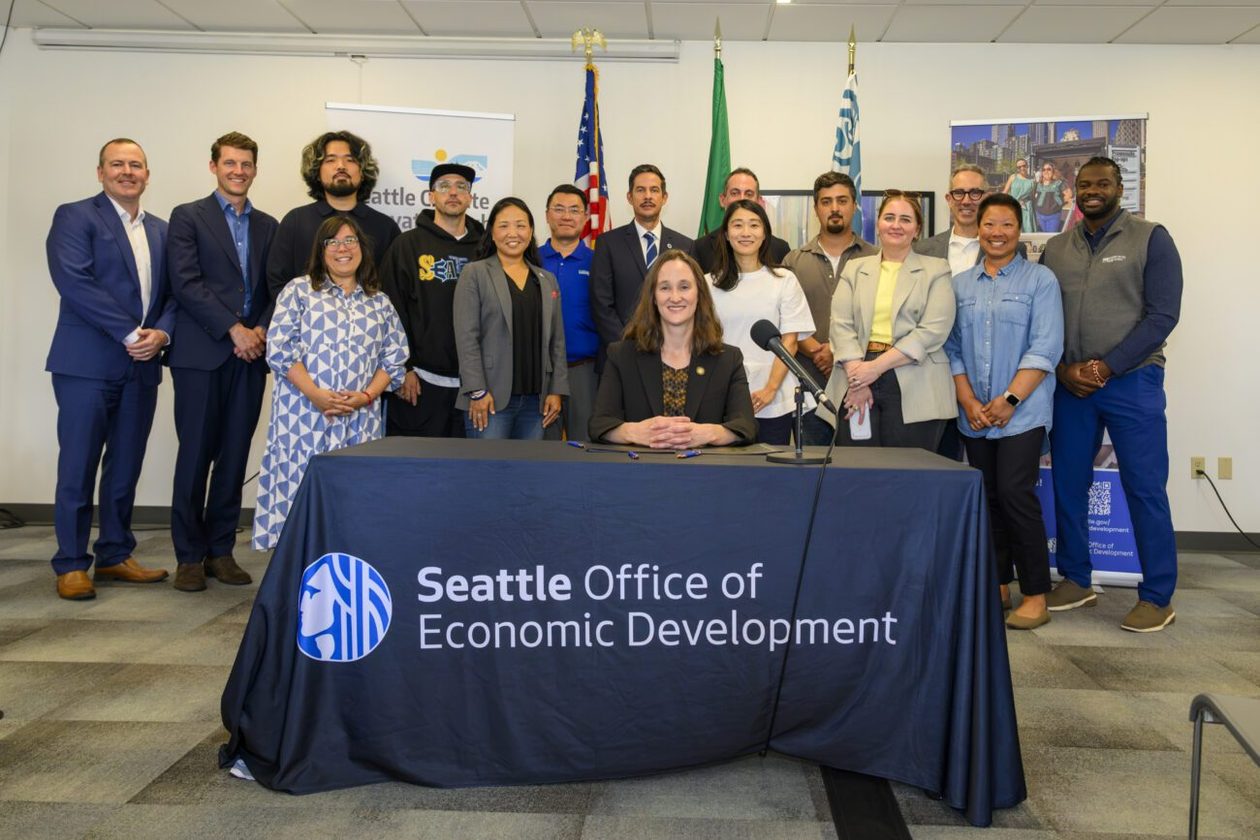
Harrell’s successor, Mayor Wilson, released the report Wednesday afternoon alongside an executive order convening a task force of business, labor, community and civic leaders, directing the city to improve permitting pathways, and calling for a proposal to create a Seattle Strategic Initiatives Fund.
In releasing the report, Wilson’s office said the findings “are independent and are not City policy.” But speaking on KUOW-FM’s Soundside as the report was released, the mayor called it “fantastic,” describing it as “super nuanced,” and urging listeners to take the time to read it.
The cost of a hire: JumpStart, the payroll expense tax, applies to large employers based on the compensation they pay to high-earning workers in Seattle. Approved by the City Council in 2020 and in effect since 2021, it was created to fund affordable housing, small-business support and climate programs, but the city has increasingly used it for general government operations.
Wilson helped create the tax before running for mayor, saying on her campaign website that she “played an instrumental role in designing and passing” the payroll tax.
Under JumpStart, hiring a software engineer at $650,000 in total compensation costs about $17,000 a year more in Seattle than in Bellevue, the report says. For an employee earning more than $1 million, the difference exceeds $33,000. San Francisco imposes no per-employee tax at all, and New York City’s equivalent is less than $6,000, according to the researchers.
That $17,000 reflects the tax’s top rate, which this year applies only to employers with about $1.3 billion or more in Seattle payroll. Two or three companies at most are in that tier, the report says. At the city’s lowest rate for that pay level, the same engineer would cost about $11,800, according to Seattle’s published rates.
The rate rises with an employee’s pay, and a company that crosses one of the city’s payroll thresholds pays the higher rate on every qualifying worker, not just the next hire.
“No other comparison city has a tax with both of these features,” the report says.
An issue of perception: Business leaders interviewed for the study described JumpStart as a problem “not primarily for its cost but because the process of enacting it communicated that the city’s governing orientation is fundamentally extractive.”
The researchers add: “Whether or not that characterization is fair, it is the operating perception, and perception shapes location decisions.”
But the researchers stop short of recommending a change. Taxes have “modest effects on firm location and expansion decisions,” they write, and Seattle is unlikely to lose its biggest employers to other regions, because the alternatives are either more expensive or have weaker talent.
“The Eastside is the only real threat in that regard,” the report says.
The study is blunt about what is at stake in keeping those employers. “If they leave,” it says, “Seattle won’t become more equal, it will just become poorer.”
What to do about taxes? The report does not recommend raising or lowering that top rate. Research on how firms respond to local taxes draws on thousands of firms across dozens of jurisdictions, it says, and “cannot tell us how any one firm will respond to any one tax change.”
With two or three firms in the top tier and “one firm by far the most dominant,” the question “is fundamentally a question about how that single firm will react.” It adds, “That is not a question this report, or the literature it draws on, is equipped to answer.”
GeekWire has contacted Amazon for comment on the report.
Other tax options that have been floated — vacancy taxes, wealth taxes, head taxes beyond JumpStart, expanded gross receipts schemes — are “either disallowed under state law or would, if enacted, likely push out the firms and workers Seattle most needs to retain,” the report says.
And once the state’s new 9.9% tax on income above $1 million takes effect in 2028, Seattle earners above that level will face a combined state and local marginal rate of about 10.5%. Pushing meaningfully above that, the report says, “would be a high-stakes tax experiment.”
Mayor Katie Wilson with business, labor and community leaders after signing an executive order on the economy Wednesday at the Seattle Office of Economic Development. (City of Seattle Photo)
Where Wilson stands: The mayor has already conceded the Bellevue point. “I don’t think it’s good that it is less expensive to do business in Bellevue than in Seattle,” she said in May. “We’re going to be taking that into consideration.”
She defended the tax in June, crediting it with helping Seattle recover from the pandemic and cautioning against blaming downtown’s problems on any single cause.
Her relationship with the tech community has been rockier. At a Seattle University event in April, asked about that state tax, Wilson said concerns about wealthy residents leaving were “super overblown” — then waved and said, “the ones that leave, like, bye.” The moment drew national coverage and criticism from Seattle investors.
A bet on cleantech: Taking a step back, the report says Seattle’s best opportunity is in cleantech, a category it defines broadly to include clean energy generation, energy efficiency and sustainable production methods and materials.
The shift is already showing up in local venture funding. Cleantech and energy companies took 3% of the venture capital raised by Seattle-area private companies from 2016 to 2020, and 20% from 2021 to 2025, according to Crunchbase data cited in the report. Three companies — TerraPower, Helion and Group14 — account for 70% of that.
The city “should be most concerned about AI but most active in cleantech,” the report says.
AI will ultimately be more important to Seattle’s future, the researchers explain, but the city has almost no ability to shape it. Cleantech is different: Seattle owns the electric utility, writes the building codes and controls permitting and much of the land.
The city can also use its own purchasing power to create a market for what these companies build, the report says, pointing to a New York program that used public housing demand to bring a new cold-climate heat pump into production.
To reach the top tier of cleantech ecosystems, the report says, Seattle would need a dedicated entity putting at least $5 million a year into growing the sector, funded through ratepayer charges, philanthropy, corporate sponsorship and competitive federal grants.
What’s next:According to the city, Wilson’s executive order calls for the task force to convene industry roundtables in the coming months. The report’s own first-year list runs to ten items, including a business-led commission on the city’s fiscal exposure, with an emphasis on AI, and structured visits with 50 companies across the five industries it identifies.
Others include naming a senior staffer in the mayor’s office to run the city’s AI agenda, and a childcare cost-sharing pilot split three ways between employee, employer and city, with the city’s share paid out of JumpStart.
On taxes, the report’s primary recommendation looks beyond City Hall. It urges Wilson to build a cross-partisan coalition of mayors and county executives to press Olympia for new municipal revenue tools, including changes to the state’s 1% cap on property tax growth.
A caller on KUOW asked Wilson whether there’s a limit to how much Seattle should grow. She said she shares the concern, then pointed back to the report, which she said makes clear there is “no graceful path” for Seattle to cool down its growth.
Welcome to Edition 9.09 of the Rocket Report! This edition includes an update from Blue Origin on the groundbreaking of a new Payload Processing Facility in Florida. It has been about a month since the company offered any meaningful news on its heavy-lift New Glenn rocket, which remains grounded after an on-pad explosion at Cape Canaveral Space Force Station in May. The official line from Blue Origin is that the company is targeting a return to flight with New Glenn by the end of the year, but there's good reason for skepticism.
As always, we welcome reader submissions. If you don't want to miss an issue, please subscribe using the box below (the form will not appear on AMP-enabled versions of the site). Each report will include information on small-, medium-, and heavy-lift rockets, as well as a quick look ahead at the next three launches on the calendar.
Isar Aerospace is ready to try again. Isar Aerospace is about to make the next attempt to launch the Spectrum rocket into orbit, with a weeklong launch window set to open Friday at Andøya Spaceport in Norway, the Norwegian Broadcasting Corporation (NRK) reports. The German launch company aims to deliver several small CubeSats to orbit with the two-stage Spectrum rocket. A test flight of the privately funded launcher failed shortly after liftoff last year, and Isar has attempted to launch the second Spectrum rocket several times since January, only to be thwarted by technical problems and the unavailability of the launch range in northern Norway.
If you’re intending to transmit on the VHF band, you’re probably going to reach for a handheld or some kind of rackmount rig in your ham shack. But you needn’t bother with all that complexity, when you can use the computer on your desk to spit out such signals using a simple browser tool from [Efe].
The concept is straightforward—[Efe]’s tool manipulates pixel clocks in order to create spurious transmissions from your computer’s graphics hardware. The math pencils out pretty easily—multiply the horizontal resolution by the vertical resolution by the refresh rate, while paying attention to the precise timing of the video standard your monitor is using, and you’ve got your transmission frequency. For example, for a screen displaying 1080p at 60 Hz, with the CEA-861 timing standard, your horizontal and vertical resolutions are 2200 and 1125 respectively when paying attention to the requisite blanking intervals. Multiply those by 60 hz, and you’ll find you’re creating a signal at 148.500 MHz. Leverage this by displaying the right pattern of black and white pixels to maximise changes in voltage state on the HDMI or DisplayPort lines, and you might create a strong enough signal that you can actually pick something up. [Efe] created a tool to display these patterns to send simple Morse code messages over VHF just by flickering your screen just right.
You can test the transmitter tool for yourself here, right in your browser. You’ll want to hold your radio’s antenna nice and close to the monitor to see if you can pick up much of a signal. After all, the monitor, connectors, and cable are all built to optimize for clear signal transmission to the display, while preventing signal from leaking out to interfere with surrounding equipment.
Of course, a fair warning—you’re not supposed to intentionally transmit on bands you’re not licensed for, even if it’s incredibly weak and unlikely for anyone else to notice in a scenario like this. Still, it’s an interesting project that shows you just how electromagnetic interference can leak out of just about anything under the right conditions.
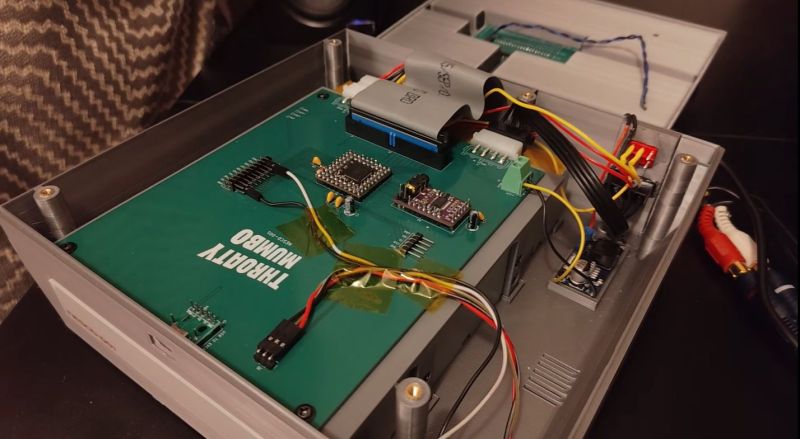
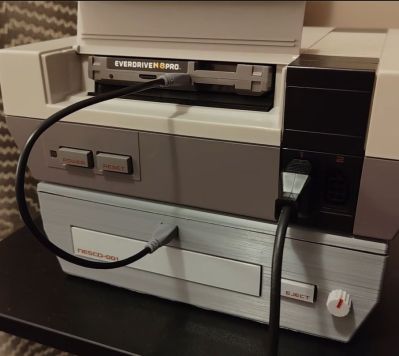
The introduction of optical media in the form of CDs meant a revolution in the world of gaming consoles, escaping the restrictions of a few dozen MB of storage and instead offering a theoretically infinite amount of storage through the miracle and tedium of swapping discs. After the SNES narrowly escaped getting a CD add-on and the N64 doubled down on cartridges, we can now at least get an impression of what it’d be like if the Nintendo Entertainment System had been gifted a CD add-on back in the 1980s, courtesy of a project by [Throaty Mumbo].
The NES future we could have had.
There’s also an accompanying video containing typical hijinks and a demonstration of this system. Initially [Throaty Mumbo] was going to make a SNES CD add-on to match that console’s initial prototype, but doing it for the NES seemed more fun. Obviously, since the NES is quite limited hardware-wise it was always going to be a struggle, even if the original front-loading NES conveniently has a mostly unused expansion slot.
On the custom PCB there is an RP2350B microcontroller that mediates between an Everdrive N8 Pro cartridge and an IDE CD drive, along with a PCM5102 audio DAC. The expansion port is hereby used to receive the audio samples on its audio mix input pin, along with power. After boot the game ROM is read off the CD by the MCU and streamed over USB to the Everdrive.
Welcome to Edition 9.08 of the Rocket Report! Some major news this week from the state of Louisiana, previously associated with space due to NASA's aging Michoud Assembly Facility near New Orleans. Now the state has a chance to become the epicenter of SpaceX's Starship program as the company plans to invest up to $100 billion to construct factories and multiple launch pads for the super heavy lift rocket. It would utterly transform coastal Louisiana.
As always, we welcome reader submissions, and if you don't want to miss an issue, please subscribe using the box below (the form will not appear on AMP-enabled versions of the site). Each report will include information on small-, medium-, and heavy-lift rockets as well as a quick look ahead at the next three launches on the calendar.
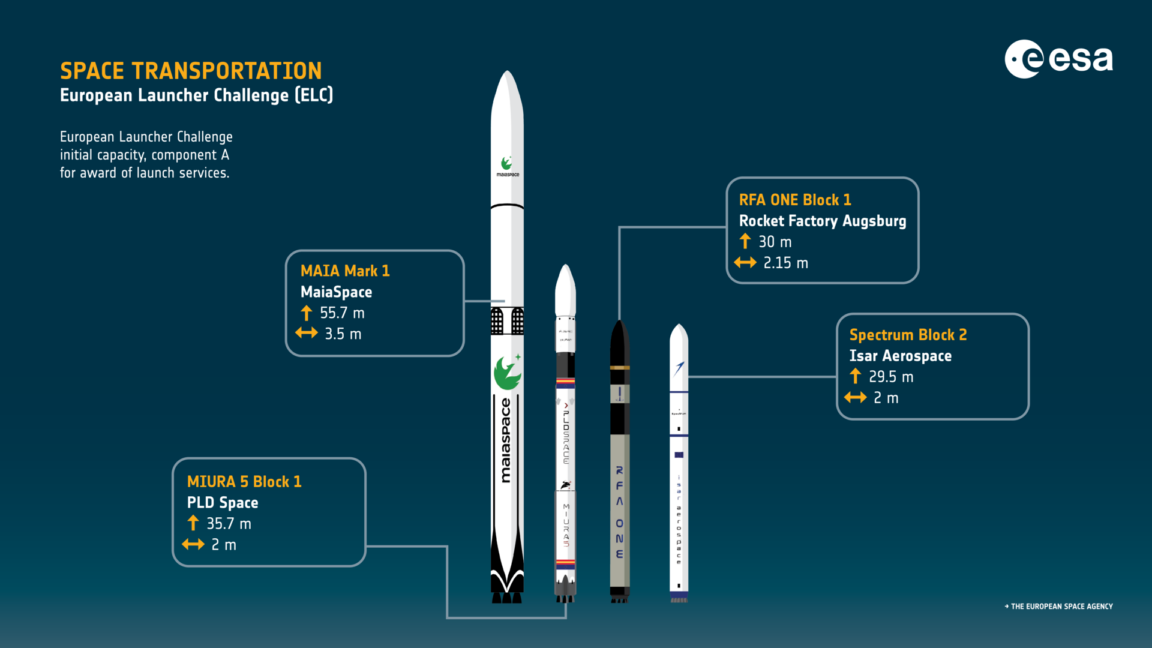
ESA announces big launch challenge contracts. The European Space Agency said Thursday it signed contracts with a handful of European launch startups to help them continue development of their vehicles. "The European Launcher Challenge is ESA’s initiative to expand European launch service supply and ensure more robustness in Europe’s access to space," the space agency said of the award, which supports the development and operation of small launch vehicles in Europe. For some of these firms, the funding will provide a key lifeline.
For the first time in decades, NASA has rolled out one of its iconic astronaut training aircraft with a bold, new look.
The space agency debuted a new livery on one of its T-38 jets in celebration of its program to return astronauts to the Moon. The Artemis design retains nods to what made the "white rocket" immediately recognizable, but adds a new colorway and painted graphics to make clear where NASA is headed.
"This new 'Artemis' livery has a black and white paint scheme with blue and red stripes that separate those two paint schemes," said Sean Brady, who proposed and designed the new livery while serving as the T-38 project pilot in NASA's Aircraft Operations Division (AOD), part of the Flight Operations Directorate at Johnson Space Center in Houston. "The Artemis program logo in the back and a picture of the Moon is on the left and right side of the rear fuselage."
Auger co-founders Leigh Anne Clark and Dave Clark at the company’s Bellevue, Wash., office. (GeekWire File Photo / Todd Bishop)
One of the Seattle region’s most notable tech startups is moving its headquarters to Texas.
Supply chain technology startup Auger will maintain a major engineering office in Bellevue, Wash., where it got started. But the company’s co-founder and CEO, Dave Clark, the former Amazon operations chief, is officially back in Dallas, and he took the company’s HQ with him.
Founded in 2024, Auger has raised $150 million, including a $50 million Series B round led by Eclipse in July. Its software connects the systems that companies use to run their supply chains, integrating AI to help automate them. Its customers include Meta, Fanatics and Kimberly-Clark.
Clark, in an interview with GeekWire, said the move is about talent and family, not taxes. For one thing, Texas happens to better suit him and Auger co-founder Leigh Anne Clark, his wife. They’re running toward something rather than away, he said. They both grew up in the Southeast, and they had always intended to return to Texas at some point.
“I’d rather have a really hot month of August than a really gray month of February,” he said.
Dallas is also a place where you run into supply chain specialists at the coffee shop like you do software engineers in Seattle, he said. That’s a key talent pool for Auger at this stage in its evolution. Another bonus: Texas is more central to corporate customers across the country.
The magazine D CEO in Dallas, which first reported the news of Auger’s HQ relocation this week, noted that the company did not seek state or local incentives as part of the move.
Clark confirmed in the GeekWire interview Tuesday that taxes weren’t a factor, noting that he couldn’t even quantify what the tax advantages would be. However, he said, “There’s a lot I like about the way the state of Texas manages and works with business.”
When asked what he would say to people in Seattle who might see another warning sign in a startup like Auger moving its HQ somewhere else, he didn’t shoot down the premise.
“If you’re in that position, I think you’re right to be worried, in the sense that there’s a lot of discussion about things in the state of Washington and Seattle that are not particularly friendly to business,” he said.
Clark didn’t point to any particular policy or issue but said he has sensed an “anti-business” sentiment that concerns him since moving back to the Seattle area from Texas to launch Auger.
“Seattle should just be careful,” he said. “It’s not preordained that they win these things. It’s not preordained that these big companies stay in town.”
The Pacific Northwest has enormous resources to compete globally, he added, and there’s no reason it shouldn’t be “a phenomenal draw to anybody and everybody coming in.”
The region has “many, many strengths, and we should leverage them to the advantage of the community,” he said. “And sometimes I think the rhetoric gets in the way of it.”
Auger has about 115 people in Bellevue — engineers and supply chain data scientists — and Clark said he expects that office to grow 20% to 30% over the next year or two. He and Leigh Anne will both be back there regularly, he said, working alongside the team.
“Nothing’s changing there,” he said.
The company’s new HQ in North Dallas occupies part of the 15th floor of One Galleria Tower, centrally located between neighborhoods north and south of the city, with a quick run to DFW International Airport, as Clark pointed out in the D CEO article.
The office currently has about 15 people, most hired in recent months for sales, go-to-market and supply chain roles. Many of them had been traveling to Bellevue until the new space opened. Clark expects to add another 20 to 30 people in Dallas by the middle of next year.
As in Bellevue, where Auger subleased its space from Microsoft and bought the furniture for $1, the Dallas office came furnished. This time the furniture cost $10. (There goes Texas’ reputation for affordability.)
“It cost me 10 times more for the furniture in Dallas,” Clark joked. “I like nice things, cheap.”
Clark spent 23 years at Amazon, rising to lead its global operations and later its worldwide consumer business, and was one of the chief architects of the logistics network behind the company’s delivery operation. He left in 2022 to become CEO of Flexport, departing the freight startup the following year, before starting Auger.
Leigh Anne Clark is Auger’s president of fashion and beauty, leading the company’s work in an industry known for waste-prone supply chains. The couple, who met in Kentucky in 2000 while Dave Clark was at Amazon, have two sons, ages 14 and 11.
With its rapid hiring and significant early funding rounds, Auger rose quickly to No. 31 on the GeekWire 200, our ranking of Pacific Northwest tech startups. Because the GeekWire 200 is limited to companies based in the region, the headquarters move puts Auger’s standing in jeopardy.
Informed of this predicament, Clark made his pitch to stay on. “We still have a lot of dev there,” he said of the Bellevue office. “I think you get grandfathered into the list in some way, right?”
Meanwhile, the business keeps growing. Clark said Auger signed two major contracts Tuesday with customers he declined to name. The Bellevue office marked them with a bell-ringing, and the two offices celebrated together over a video call. A second bell is on order for Dallas.
“We’ll have dual bells that we’ll ring together,” Clark said.
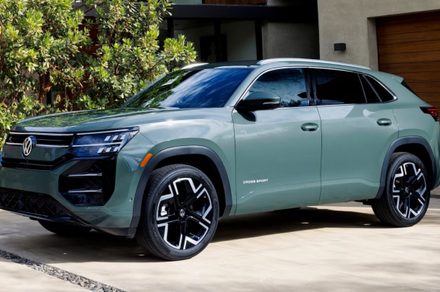
Volkswagen's redesigned 2027 Atlas Cross Sport gets a sportier look, a genuinely upscale interior, and a more powerful engine, arriving in showrooms early next year.
 Login
Login