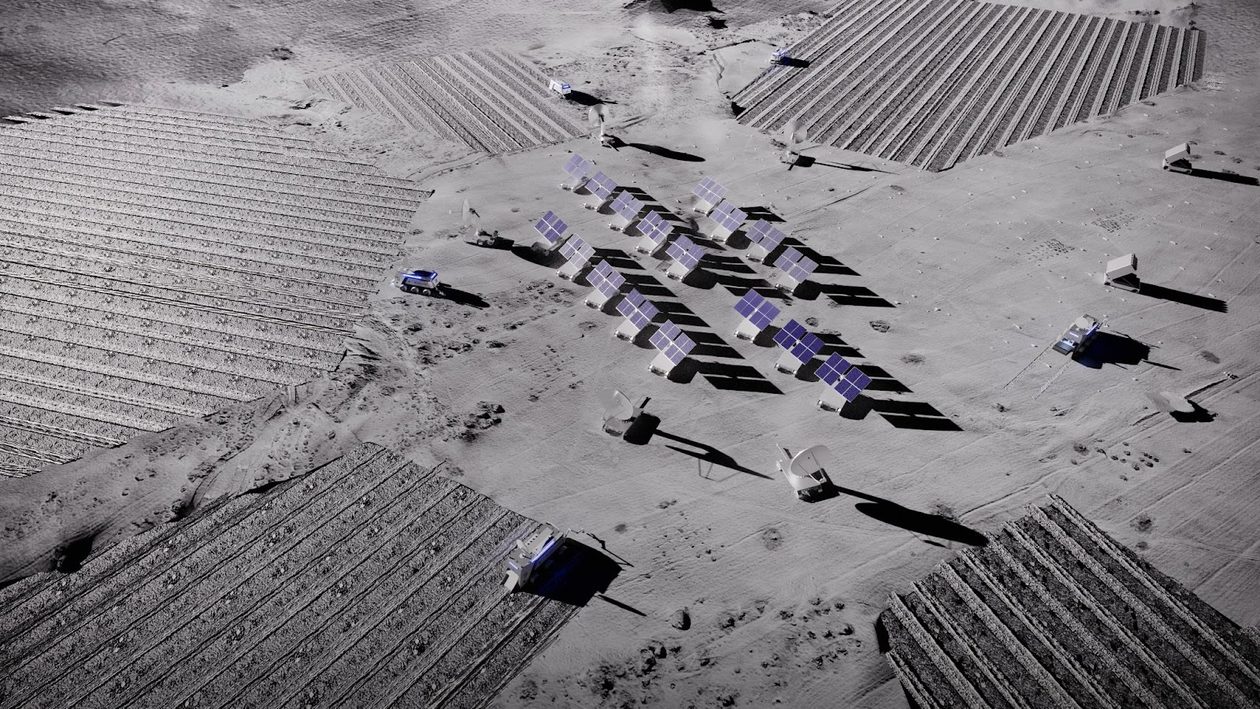
An artist’s conception shows a mining operation on the moon, including harvesters and a solar power plant. (Interlune Illustration)
Seattle-based Interlune has raised $5 million in fresh funding to support a business plan that involves building space infrastructure as well as mining the moon for helium-3 and other valuable resources.
The funds were raised through a Simple Agreement for Future Equity, or SAFE, in which investors provide upfront cash to a startup in exchange for shares to be issued during a future priced round. Interlune used the same approach to raise $5 million earlier this year.
Interlune said existing and new investors participated in its latest SAFE offering, which came to light today in a regulatory filing with the Securities and Exchange Commission.
“The company’s continued traction with government contracts, along with major milestones across the space ecosystem over the past year, makes this a beneficial approach ahead of our next priced round,” Interlune CEO Rob Meyerson said in an emailed statement.
When Interlune was founded in 2020, the company focused primarily on developing technologies for extracting resources from lunar rocks and soil, also known as regolith. Helium-3 leads its target list because that material is more abundant on the moon than on Earth and is highly valued for applications ranging from medical imaging and quantum computing to fusion power. The price for helium-3 can exceed $9 million a pound.
Meyerson noted that Interlune’s business plan is no longer limited to space mining. “In response to growing market demand, we’ve expanded our product offering to include space infrastructure and survival services, leveraging the same technologies we’ve been developing to harvest natural resources from space,” he said.
UK data centres may yield 75% fewer permanent jobs than predicted while facing severe energy grid constraints. Read the latest thinktank and legal analysis
Anthropic reportedly ended talks to acquire Decart AI for $6 billion after due diligence, though the companies could still pursue a future partnership.
OpenAI is committing $1 billion in subsidized Daybreak access and support to help cyber defenders protect critical infrastructure and fix flaws faster.
Patagonia is attracting multibillion-dollar AI data center plans, but power infrastructure and connectivity gaps could determine which projects get built.
Anthropic reportedly signed a $35 billion Lambda cloud deal tied to a Texas data center leased by Nvidia and developed by Hut 8 for Claude computing capacity.

 Login
Login