❌

Reading view

There are new articles available, click to refresh the page.

Keeping Mosquitoes Away with Catnip-Based Repellent

An image of a brown, red, and black mosquito on light human skin

Despite their small size, mosquitoes are one of the deadliest creatures on Earth, and keeping them away from you is one of the best ways to stay safe. DEET has been the mainstay of insect repellents for decades, but what if there was a repellent you couldΒ grow yourself?

Researchers at Cardiff University found that the essential oil from catnip plants (Nepeta cataria) could be as effective as DEET at repelling mosquitoes when applied as a 6% lotion. The oil has been shown to be effective against many species of mosquitoes, ticks, and mites in previous research. You can look at the paper for details, but the catnip oil was obtained through steam distillation followed by some processing with hexane. The essential oil was then mixed with β€œwater, glycerin, emulsifying wax, cetyl alcohol, cetyl stearyl alcohol, shea butter, glycerol monostearate, olive oil, coconut oil, sunflower oil, methyl paraben, propyl paraben and silicone oil.” We suspect that list will look familiar to anyone who’s read an ingredient label of most any store bought lotion, unless it was paraben free.

The Guardian’s coverage quotes one of the researchers, [Dr. Simon Scofield]: β€œWe did not conduct any experiments to see if it is attractive to cats, but given that the active ingredient [nepetalactone] has well-known cat-attractive properties, I would expect they would quite like it,” he said. Depending on how your cats react, you may want to consider applying the lotion shortly before departing home.

If you want some more options in your mosquito defense, how about becoming a bug zapper, using drones and sonar, or genetically modifying mosquitoes to curb their numbers.

Recycling Laptops and iMacs Makes PC Building Fun and Affordable Again

Building a PC used to be a fun adventure β€” what’s the latest, what’s the greatest, what can I afford? Well, that last question seems to have taken over and sucked all the fun out for a lot of people. [Matt] from [DIY Perks] on YouTube has hit upon a solution that’s brought back the fun, at least for him: recycling! The video is embedded below, and he runs a forum whose thread has more details.

Long story short, though, he’s flagging recycled laptop components as both good value for money and a fun rabbit hole to go down researching parts. The best part, of course, is that you can get a mobo with 32GB of RAM soldered on, and embedded RTX graphics, and a decent processor for about what you’d pay for that RAM on sticks these days. The big hack is getting the dang thing started: he needed to make a single-pin ribbon cable after identifying which pin on the keyboard membrane hit the power button. If you can score a laptop that does not power on from the keyboard, you’ll have an easier time in that regard.

To take recycling further, he shows how to delaminate cracked glass from an old Intel iMac to get a better-than-4K retina screen for nothing but sweat equity. The unit was heading for the bin, and his only cost was the effort it took to extract the LCD panel. Some of us might be able to skip the laptop and just use the iMac; it depends on how much compute is enough for your use case. Maybe a 10-year-old iMac’s guts will do; maybe last year’s gutted laptop isn’t enough.

We have to admit, the oak-and-aluminum all-in-one tripod he makes is very snazzy, though it may have too little brass to be on-brand for [DIY Perks]. The speakers, in case you were wondering, are also e-waste, recovered from an old TV. Perhaps the accent colour should have been green instead of blue!

Thanks to [Keith Olson] for the tip.

An Interactive Tomato Farm Overseen by AI

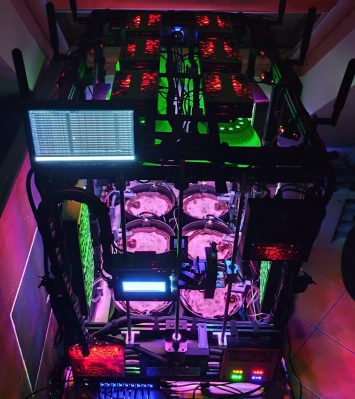
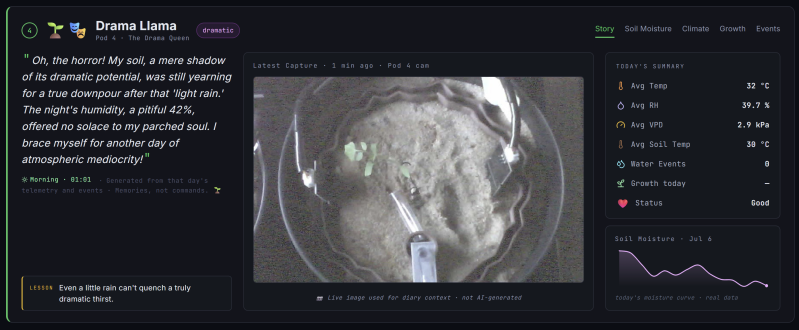
Oh, the farming lifestyle…living off the land, fending for yourself. But who’s got time for all that? For the modern hacker, the best option in the garden space may be this over-engineered automated AI tomato farm created by [Gerd Nicolay]. You can even interact with it right now through the magic of the Internet.

[Gerd] started off with your run-of-the-mill pot and plant, choosing the humble tomato to keep the system simple. Then things started to escalate, with the addition of automatic lighting, watering, and data logging environmental parameters like humidity. Now we’re getting somewhere, but there’s more that can be added. How about an entire AI council to monitor and decide the fate of each individual tomato while recording an entire storyline to go alongside the growing cycle?

That’s right, four different models collaborate to ensure only the utmost quality of care for these tomatoes based on camera feeds, humidity, and various other environmental factors being recorded constantly. Is this a little overkill? Maybe for those who have even a modest sense of gardening knowledge β€” but who can bash the mountain of documentation and data collection on these wonderful little plants?

Perhaps the best part: you can recommend actions for the AI counsel to take from the comfort of your own web browser. While the TomatoFarm might be slightly unnecessary for the average farmer, if you want to try a more reasonable monitoring system, we have you covered too!

Five Solar Air Heating Methods Tested

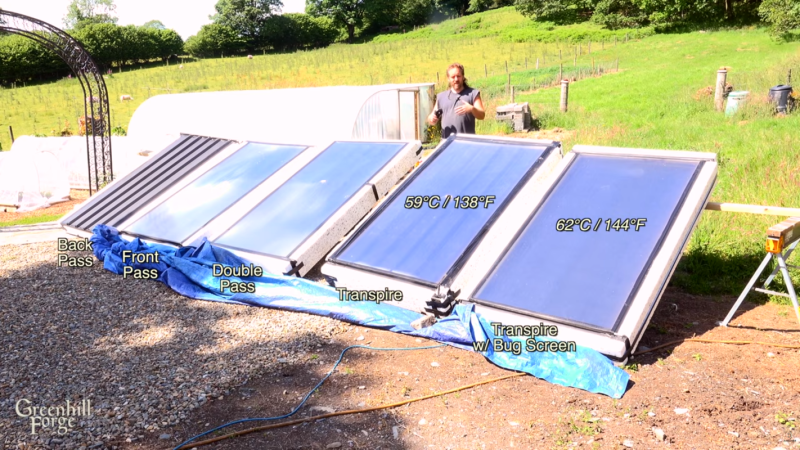
For as good as solar panels are at converting sunlight directly into usable electricity, especially for how cheap they’re becoming, they can still only gather around 20-30% of the energy that hits them. That’s fine if you have a large roof or a huge tract of land, but if you have limited space and need to do something like heat a home, there are better options available to capture more of that energy. [Greenhill Forge] has built five solar air heating panels to test this concept, and do it much more inexpensively than commercial options.

These solar heaters use sunlight to heat a fluid, in this case air, and move that heated fluid to another space. Each panel is about two square meters, insulated on all sides except the top, and configured in a way that air can flow past something that the sun has heated. The first panel, a control, does not use a glazing to help trap this heat, but the rest all have a polycarbonate window to increase the greenhouse effect of the panels. The four remaining all experiment with the way air flows around a black corrugated steel sheet to gather more of the heat, with the fifth panel using a set of black screen instead.

With the panels all set out in the sun, [Greenhill Forge] is using a set of thermocouples from a previous project to measure the efficiency of each panel. Surprisingly, he found that the panel using the layers of screen was the best at gathering energy, although he notes several times that these types of panels are extremely sensitive to changes in physical configuration, so this is not the most definitive test possible. However, at only around $100 per panel it’s quite a deal if the goal is a usable space heater that doesn’t use any fuel or grid electricity.

❌