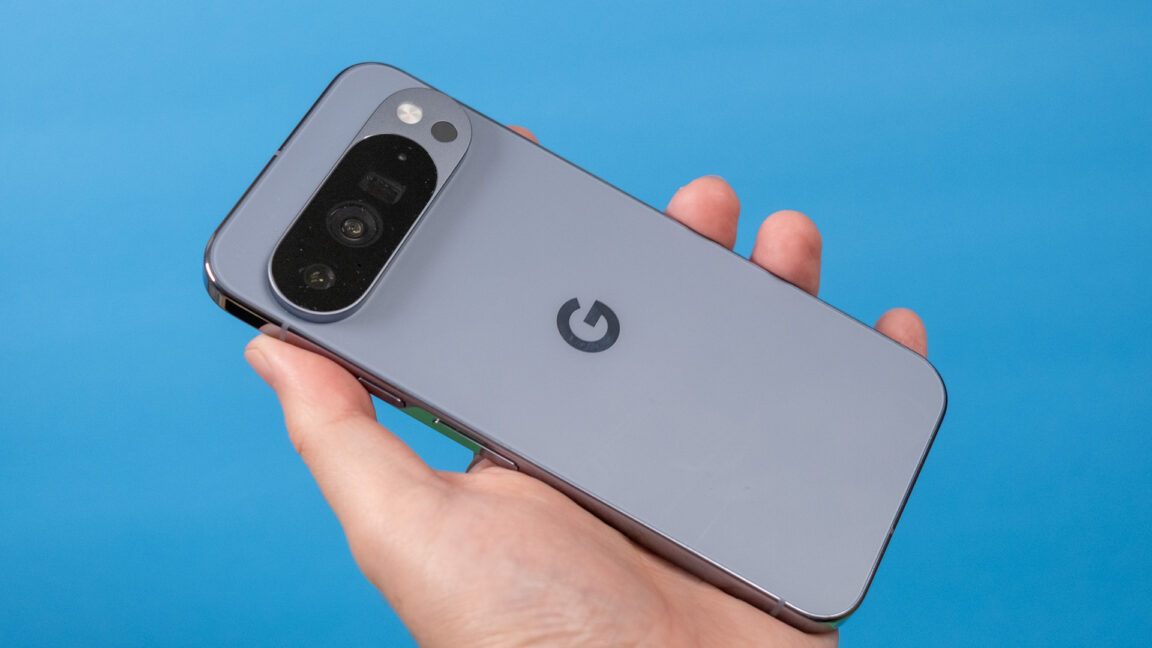
In early 2025, Atlanta resident Samuel Tunick was on his way home following a trip abroad. After landing in the US, customs agents demanded access to his Pixel phone, which was running an alternative version of Android called GrapheneOS. Rather than hand over his data, Tunick used a clever feature of the software to delete everything. Now, he's facing federal charges.
The first hearing in this case happened last week, according to The Guardian, during which government attorneys and agents claimed that Tunick was subjected to a standard secondary interrogation at an international airport. During that encounter, agents were "looking for anything that’s prohibited." However, Tunick's legal team alleges he was targeted for his activism.
Tunick was involved with a group called Defend the Atlanta Forest, which opposed the construction of an enormous law enforcement training facility in the area often known as Cop City. What Tunick didn't know, according to his lawyers, was that he'd been placed on a watch list for his actions and that Customs and Border Protection had discussed over email plans to detain him upon his arrival back in the US for "suspected terrorism activities."
Bernie Sanders and Donald Trump agree on almost nothing. But they do agree that the public should own a piece of the AI industry.
The Vermont senator and the president disagree on both the structure and stake of public ownership, but the idea is being discussed at the highest levels of government. Even OpenAI and Anthropic back versions of the idea, though Anthropic’s is a tax rather than a stake. Let’s tune in.
The table below summarizes preliminary proposals and shows how far apart they stand, from a voluntary sliver to an outright seizure. After taking a stake in Intel, the president said he wanted “many more cases like it.” Treasury paid $8.9 billion for 9.9% of Intel in August 2025; by the following spring the stake was worth roughly $36 billion, increasing the appetite for such deals. The Pentagon has already taken 15% of a rare-earth miner. This is a pattern, not a one-off.
The argument for these proposals is a public-finance argument, and a strong one. The science under AI grew out of decades of federally funded research. The training data came from the writing, code, and art of millions of people who were never asked and never paid.
The cleanest versions cost the taxpayer nothing up front, because the equity is contributed rather than bought. That is not the Intel model, which Washington bought for cash; it is the AI version now on the table, where the shares would be donated. If the bubble bursts, the public is out nothing. If it holds, the public owns a slice. A bet with no ante is a rare thing in public finance.
Source
Stake
Structure
Bernie Sanders
Roughly 50% government position (reported figures vary)
Federal sovereign wealth fund; government holds voting shares; ~$1,000-per-person dividend
Trump administration
Case-by-case equity stakes; 9.9% of Intel (now ~$36B)
Direct federal ownership; framed as a taxpayer “windfall”
OpenAI
~5% of equity (~$42.6B) contributed voluntarily
“Public Wealth Fund” modeled on Alaska’s; returns distributed to citizens
Anthropic
No equity
Taxes on AI firms to fund worker support, possibly UBI
Proposals as of July 2026; talks remain preliminary and any federal version would require an act of Congress.
There’s a real danger, though, in what the government becomes when it owns a piece of the industry it is supposed to regulate. A public stake in AI can be a dividend or a trap, and the whole difference lives in the fine print.
Three things separate the dividend from the trap. The first is the size of the stake. The second is a wall between the government as owner and the government as referee, so the hand that banks the dividend never writes the safety rules. The third is a fence around the money: proceeds earmarked for the workers the technology displaces, not swept into the general fund. None of the three enforces itself.
Here’s a loose historical precedent. In 1998, 46 states settled with the tobacco industry for about $206 billion, paid out over 25 years. The states came to lean on the yearly checks, which quietly made them partners in the survival of the product they were supposed to fight. And the money drifted: today states spend only about three cents of every tobacco dollar on the anti-smoking programs the settlement was meant to fund.
A stake with no end date makes the government a permanent co-owner of the industry it regulates, and permanence is one thing that turned a tobacco settlement into a tobacco dependency. The answer is a fixed end date. The same law that creates the stake should set the year it must end. This is known as a sunset clause.
If Uncle Sam owns a stake, he should collect the dividend through the buildout years, then sell it down on a fixed, published schedule until the position is gone. Ten or 15 years. Economists can pick the number. The deadline should be set in law from the start, so a future Congress cannot quietly extend it.
Temporary co-ownership lets the public bank the upside of the boom without leaving the referee holding shares in the game for good. Sanders and Trump, from opposite ends of the political spectrum, have seized on a real grievance and reached for the permanent version of the remedy, which is the version most likely to curdle. Of course, sunset clauses are not etched in stone either.
Another challenge is that the moment Washington owns pieces of its AI champions, other capitals follow — Beijing, Brussels, the Gulf — each taking a stake in its own, and the claim that American platforms answer to no government gets harder to make. A vendor with the state on its cap table is not a neutral one. No wall and no expiration date solves this problem.
A stake also puts the government in the business of picking winners. Own a piece of OpenAI or Anthropic and Washington acquires a financial interest in their business, and a reason to favor them when it writes the next rule or signs the next contract. The startup is forced to compete against incumbents favored by the feds. And in the fast-moving AI field, the players change rapidly.
AI’s economic challenges are real and the grievance underneath these proposals is legitimate, but government ownership is the wrong remedy. The conflict of interest is real, the precedents are bad, and it’s hard to imagine that a referee with money on the game will be neutral.
Still, the momentum is real, too. Sanders, Trump, and the labs are all pushing versions of the same idea, and one of them may pass. If it does, the temporary version with guardrails beats the permanent one: price it honestly, wall it off, aim the money at the damage, give it a hard end date. None of that is a reason to take the stake. It is only what keeps a bad idea from calcifying into a worse one.
The House voted 308-117 to pass the Sunshine Protection Act, which would make daylight saving time permanent nationwide and end the twice-yearly clock change. The bill faces an uncertain future in the Senate, "where one G.O.P. leader said it was unclear whether it could move ahead and at least one Republican appears inclined to try to block it," reports The New York Times. Some sleep experts oppose permanent daylight saving time, arguing that year-round standard time better aligns with circadian rhythms and winter morning safety. The New York Times reports: President Trump has championed the effort to save an extra hour of daylight before nightfall and make the time zone permanent, describing the ritual of moving clocks forward in the spring and back in the fall a "ridiculous, twice yearly production." "We are going with the far more popular alternative, Saving Daylight, which gives you a longer, brighter Day," Mr. Trump wrote in a social media post in May. "And who can be against that."
A sizable bloc of Florida Republicans in Congress is leading the charge on legislation that would do just that, mandating daylight saving time nationwide for the entire year. Representative Vern Buchanan of the Tampa Bay area is backing the bill, and Representative Anna Paulina Luna, another Tampa Bay-area Republican, cosponsored it. House leaders agreed to allow a vote on the measure this week as a sweetener for Ms. Luna in their efforts to persuade her to lift a legislative blockade she had maintained as she sought to force Senate action on a voting restriction bill Mr. Trump has championed.
Google DeepMind chief Demis Hassabis is calling for a U.S.-led AI standards body to review frontier models for national security risks such as cybersecurity and biological threats. His proposal would create a federally overseen public-private organization, initially voluntary and eventually mandatory for U.S. deployment. CNBC reports: Google DeepMind boss Demis Hassabis, a Nobel laureate, said in an article posted on X on Tuesday that "urgent action" was needed to address risks associated with artificial general intelligence (AGI) -- the point at which AI matches or surpasses human intelligence. "We've already seen the challenges frontier models pose for cybersecurity, and other threats including nuclear and bio risks may soon emerge as capabilities continue to advance," he said.
[...] Hassabis said the U.S. was well positioned to lead in developing an AI framework "given its economic and technical standing." "It could establish a new Standards Body modelled on a federally overseen public-private partnership or self-regulatory organisation, much like the Financial Industry Regulatory Authority (FINRA), with a board that includes independent leading technical experts and open-source representatives," he added. FINRA regulates brokerage firms and exchange markets in the U.S.
The proposed body would need "substantial" funding "in order to attract world-class technical talent and provide the necessary compute resources for large-scale testing," Hassabis said. Funding would "likely" come from industry, he added. Frontier labs would initially voluntarily share models with the body for review up to 30 days before release, before becoming mandatory for deployment in the U.S. market after being shown to be "effective." "Specific agentic AI tests could look for attempts to bypass safety guardrails or signs of deception, and ensure best practices, such as digitally watermarking AI-generated images and generating human-readable output tokens to understand model reasoning," Hassabis said. Further reading: Over 200 Economists Say 'We Must Act Now' On AI's Economic Impact

 Login
Login