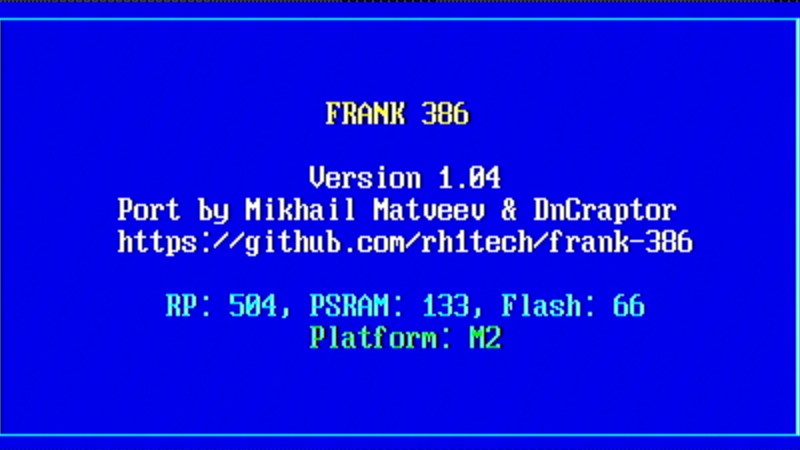
We’re at a fortunate moment: microcontrollers available at modest prices are edging into the capability level previously reserved for full-fat systems and can, through emulation, run software beyond classic 8-bit home computers, consoles, or old arcade games. A project we’ve been watching for a while is tiny386, an emulator for ESP32 boards that provides a 386 PC with just enough 486 and 586 instructions enabled to run a modern Linux kernel. Now we’re pleased to note that this platform is making it to the RP2350, with ports for both the FRANK emulation platform and the Waveshare Pi Zero boards. You can now have a 32-bit PC with all the peripherals, including VGA and DVI/HDMI, for the cost of an inexpensive development board.
Having seen tiny386 run on its minimum-spec ESP32 platform, we’ll concede that while it’s usable, it’s not the fastest experience, but the RP2350 port promises better performance. It’s not for a modern full-fat Linux distro, but should work well for running older operating systems such as DOS, or Windows 3.1 and 95, or even a lean Linux setup. This has fascinating potential: while these systems are old, they still have an enormous software library. The idea of useful general-purpose computing, 1990s style, in the palm of the hand, is interesting.
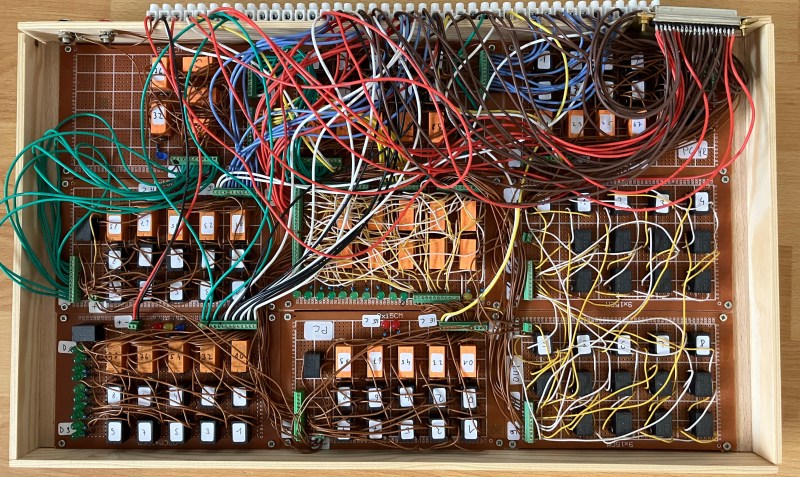
You want Retro? We did, when we started our retrocomputing challenge. [Peter] decided that transistors weren’t retro enough, and sent us this lovely homebrew relay computer, complete with 16- bit CPU, which is rather more bits than one normally associates with clicky clacky contacts.
The architecture is very simple– it just uses an accumulator register, ACCU, and goes from there. All mathematics and save/load operations go through ACCU. There whole instruction set is only 19 commands, and he’s used that set to program such lovely things as calculating 3 digits of Pi– which only took 8 minutes of glorious clicking. There’s a demo video of that embedded below. [Peter] has even implemented a display by hooking his computer to a 32×32 LED matrix, but don’t expect it to relay updates really quickly.
If this computer looks familiar, it’s because its earlier incarnation was one of the more “extra” entries in last year’s one-hertz challenge, where it was used to blink an indicator lamp. Yes, even relay computers apparently get started with the “blinky” sketch.
If you want in on the fun, our retrocomputer challenge runs until October 27th, so there’s lots of time left to turn back the clock.
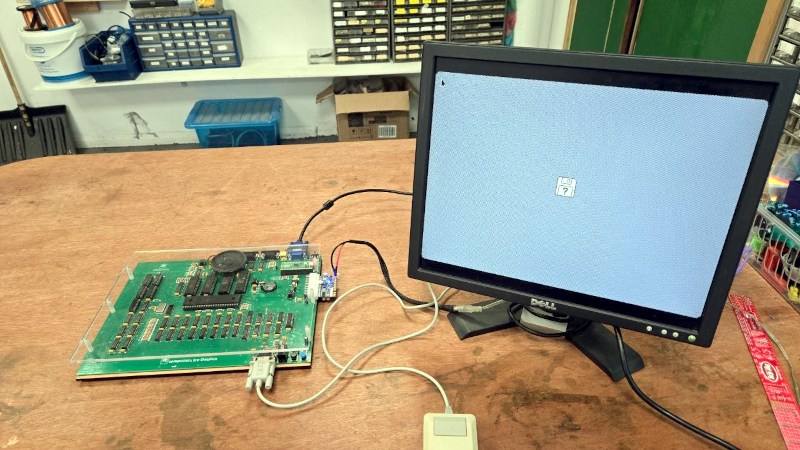
Apple hardware has always been proprietary, sometimes to an extreme. But that’s not to say that it’s impossible to make something that does the same job, which is what [DosFox1] appears to have done with the OSHintosh. It’s an open source PCB that implements a Mac 512k. Is it a 68k Hackintosh? You decide.
While it boots into a classic Mac OS image, it’s not quite a Mac. For a start, there are no disks, and no SCSI. Instead it boots from a disk held in ROM, which we guess will be a lot faster than the floppy from back in the day. They’ve even managed to do it on a 2-layer board, which means that despite its size, it shouldn’t be too expensive to have made.
We’re not sure quite what the legality of dumping a Mac ROM image to the ROM on this board would be, but assume for a moment that you own a copy in a defunct original Mac. This board can’t yet replace the original due to the disk issue, but given that original Macs are now long in the tooth, a modern replacement for those who must have hardware rather than an emulator sounds like a good idea. Perhaps for some people it will join the FPGA Amiga.
Although hard disks weren’t a common feature yet in many home computers in the 1980s, they were becoming increasingly more affordable. For relative meanings of the word ‘affordable’, naturally. This is illustrated by the 12 MB HDD for the Radio Shack TRS-80 that [Clint] over at LGR recently took a peek at.
Costing a cool $3,495 in 1983 – or $11,932 in 2026 USD – this 12 MB storage wonder used a Tandon TM-603 full-height 5.25″ HDD inside. Lacking a working TRS-80 to try it out with, the video is limited to just a basic powering up and opening up of the unit, but [Clint] will be donating it to a computer museum who can hopefully put it to use again.
The connection to the TRS-80 computer is handled by a ribbon cable, while the HDD has its own built-in power supply, rated at 60 Watt.
On the main board for the external HDD controller there is a Signetics 8X300 microprocessor that forms the brains of what makes it into an external drive for the TRS-80. Despite its age, it still looks brand new inside, so despite the Rifa capacitors in the PSU, [Clint] decided to power it on. This resulted in an auditory experience that’s probably best compared to a very rusty jet engine spinning up after languishing for a decade prior to spooling up for take-off.
Hopefully we’ll find out whether this particular unit and its HDD are still working in 2026.
Physical media is having a bit of a revival at the moment, and vinyl is getting a lot of attention with claims about its supposed superiority over digital audio. Music CDs, on the other hand, have received a more muted revival.
If the name Packard Bell sends you back to beige desktop towers, chunky CRT monitors, floppy disks and dial-up modem screeches, Acer has a surprise for you.
The early days of people having internet in their homes were pretty wild. Viruses were pretty much everywhere, and unlike now, many users had no clue what to do with them. I was a tween in the early '00s, but I remember intervening when my mom's PC had what felt like hundreds of them, with pop-ups and ads covering up the entire desktop, impossible to remove.
Plug a phone into a modern charger and the first 10 minutes are impressive. The next 20 are not.
This is not a defect. It’s the connected device protecting itself. As temperature rises during charging, a smartphone’s battery management system reduces the current it will accept, because heat accelerates the chemical degradation that permanently reduces battery capacity. The charger may be capable of delivering more, but the device simply stops taking it.
For anyone building products in the portable power category, this creates an uncomfortable gap between specification and experience. A device rated at 25 watts is accurate in the sense that it can deliver 25 watts. Whether it delivers 25 watts for the duration of a charge is a different question, and one the specification does not answer.
The specification gap
The gap matters commercially because it is invisible at the point of purchase and obvious in use.
Consumers compare wattage figures on packaging. They don’t compare thermal curves, because thermal curves are not published publicly. The result is a category where products differentiate on a number that describes peak output rather than sustained output, and where the actual user experience of two products with identical specifications can diverge substantially.
This is particularly acute in magnetic wireless charging. Inductive power transfer generates heat at both the transmitting and receiving coils, and the magnetic attachment that makes these products convenient also places the heat source in direct contact with the device it is charging. Convenience and thermal performance are working against each other by design.
The industry’s response for the past several years has been materials science. Graphite sheets, thermal interface materials, conductive housings, and heat-spreading layers have all improved how efficiently accumulated heat moves away from the source. Each generation has been incrementally better than the last.
But passive dissipation has a structural limitation: it can only move heat that has already been generated, and only as fast as the surrounding air will accept it. In a sealed, pocket-sized enclosure, that ceiling arrives quickly. Improving the materials slows the rate of temperature rise. It does not prevent the temperature rise.
Moving from dissipation to removal
The alternative is active thermal management, which is standard in stationary electronics and largely absent from portable ones for reasons that are easy to understand. Fans add volume, weight, moving parts, and noise. In a product category defined by portability, each of those is a meaningful cost.
At Anker, which manufactures charging and power products, engineering teams spent the past several development cycles working on whether that tradeoff could be made acceptable rather than eliminated. The approach involves several interacting systems: a micro centrifugal fan, dual airflow channels routed to avoid interference with the magnetic array, a three-layer graphene heat-spreading layer, and a control algorithm that modulates fan speed based on real-time temperature and battery state rather than running at a fixed rate. The result is that the Anker MagGo Power Bank 2 Pro has become the world’s fastest and coolest wireless power bank.
In internal testing, at 77 °F (25 °C) ambient, the back of the power bank stays below 96.8 °F (36 °C) throughout wireless charging, 21.6 °F (12 °C) below the international standard limit of 118.4 °F (48 °C), for a comfortable grip. Comparable magnetic power banks in the same testing typically reached 113 °F (45 °C) or higher within 20 minutes. The functional consequence is that the connected device does not reach the threshold at which it begins reducing charge acceptance, so 25 watts of Qi2.2 magnetic wireless charging is delivered as a working rate rather than an opening rate. In practice, an iPhone 17 Pro reaches 50% charge in 25 minutes. The Anker MagGo Power Bank 2 Pro’s premium performance in both charging speed and thermal management is certified by SGS, an independent testing and certification company.
The same principle applies in reverse. Recharging a power bank generates heat too, which is why devices in this category are often slow to recharge, leaving users with an empty accessory at the moment they need it. Active cooling during input allows the unit to accept 45 watts and reach 80% in 52 minutes.
What this suggests about the category
There is a broader pattern here worth naming, because it is not unique to charging.
When a category improves along a single axis for long enough, the constraint usually migrates somewhere else. Charging spent a decade optimizing power delivery. Power delivery is now, for most practical purposes, solved: the electronics can supply more energy than the receiving device is willing to accept. The binding constraint moved to thermal management, and the industry continued optimizing the axis it had always optimized, because that is the axis the specifications describe.
Recognizing when a constraint has moved is difficult precisely because the old metric keeps improving. Wattage figures have continued to climb. Products have continued to get faster on paper. The measurement stayed valid while quietly ceasing to describe the thing users experience.
For product organizations, the practical question is whether their specifications still measure the constraint or merely measure the capability. The two align until the constraint shifts and specifications rarely shift with it.
The transparency problem
A second implication follows from the first. If sustained performance differs meaningfully from peak performance, and if only peak performance is disclosed, then buyers cannot evaluate the products in front of them.
This is one reason Anker is adding displays on charging products. The Anker MagGo Power Bank 2 Pro shows real-time power, temperature, battery level, and estimated time remaining. Some of that is user convenience. But some of it is a Anker stating a deliberate position—this category deserves to have the complete and accurate data made transparent to all.
Anker expects independent reviewers to test these claims and considers our internal numbers to be the correct outcome. The gap between specification and experience closes faster when the experience is measurable. The Anker MagGo Power Bank 2 Pro will be available in the U.S. on September 17, 2026.
This content was produced by Anker. It was not written by MIT Technology Review’s editorial staff.
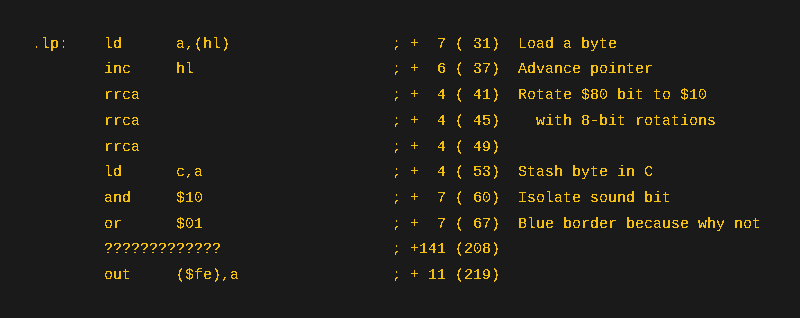
[Michael] has a thing for playing audio over beepers using a single bit. He’s done it with the Apple ][ and the IBM PC. This time he turns to the ZX Spectrum. He didn’t get quite as good a result — at least not yet — but he did manage to get some things working. He documents everything, so even though this wasn’t a successful week, there’s sometimes more to learn from reasonable failures than from unreasonable successes.
Of course, the whole thing relies on pulse code or pulse width modulation. Of the two techniques, PWM should produce better results. However, he wasn’t able to get PWM working yet. Some other target computers drive the buzzer through a dedicated hardware timer. However, with the Spectrum, it is all software.
Getting multichannel music was another algorithm, and that makes for an interesting read, too. We are sure next week there will be more, and if you are interested in this sort of thing, going back to some previous weeks will show you a lot more, too.
 Login
Login