We try to steer clear of politics and societal issues here at Hackaday, so a protest is not usually the sort of thing we’d cover. But we figure it’s safe enough to bend the rules a bit when the ones doing the protesting happen to be robots.
About 30 bots gathered — or at least were commanded to gather by the event organizers — in Warsaw to spur discussion about the impact AI and robots will have on the labor market. Beyond getting public and media attention, the demonstration was also designed to raise awareness of what modern humanoid robots can do. While we appreciate the idea of showing robots taking the “jobs” of the protesters, it does seem somewhat ironic that marching around and chanting for hours is exactly the sort of repetitive work that most people would be happy to see taken over by machines.
Although we hope these protests remain peaceful, there’s always a chance things can turn violent when tensions are high. Should things go south, take comfort in the knowledge that a company in Japan has introduced a robot ambulance service. It’s probably more accurate to compare it with roadside assistance, as the goal is to repair the robot on-site. That said, if the fault is more serious, they can bring the damaged bot back to HQ. Of course, the major difference between this program and a traditional ambulance service is that they’ll be able to bring along a spare robot that can take over the patient’s job while repairs are being made. Should anyone start doing that for humans, expect a few more protests.
Would you need a subscription to fix this?
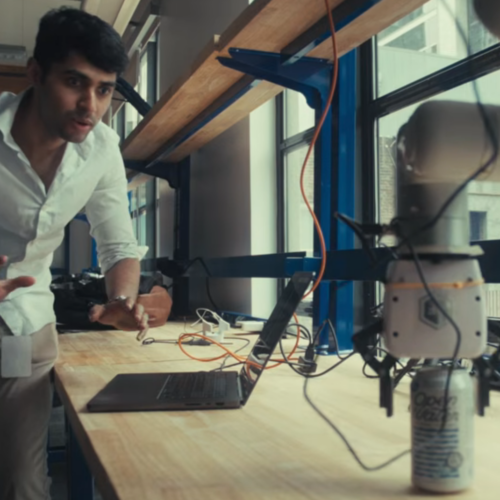
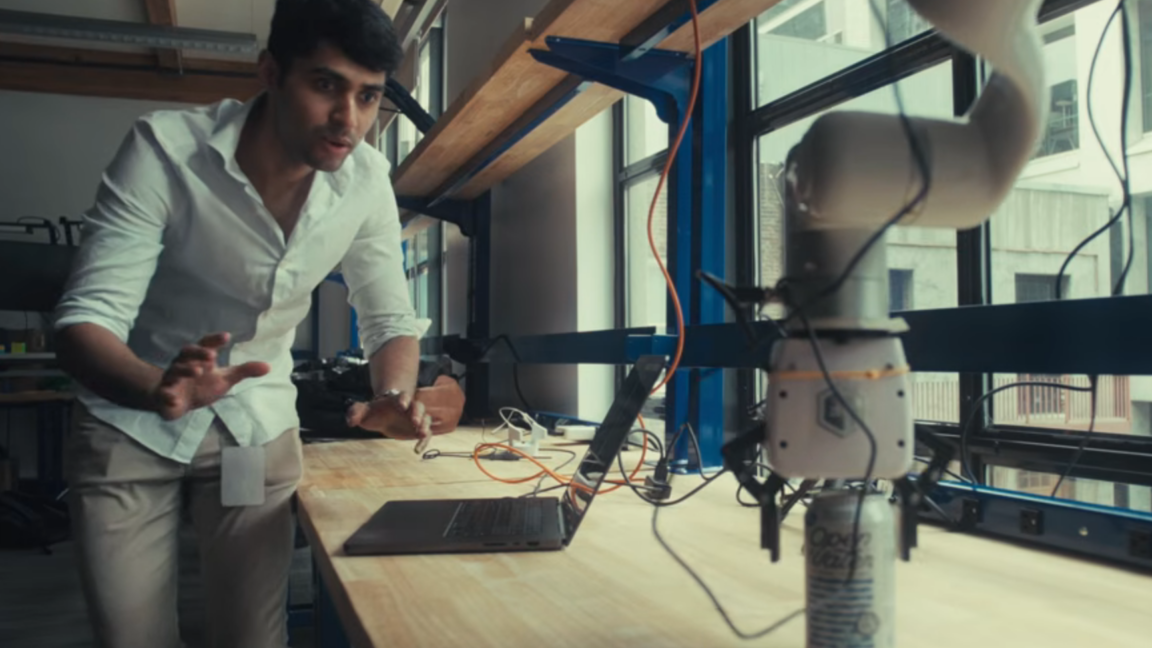
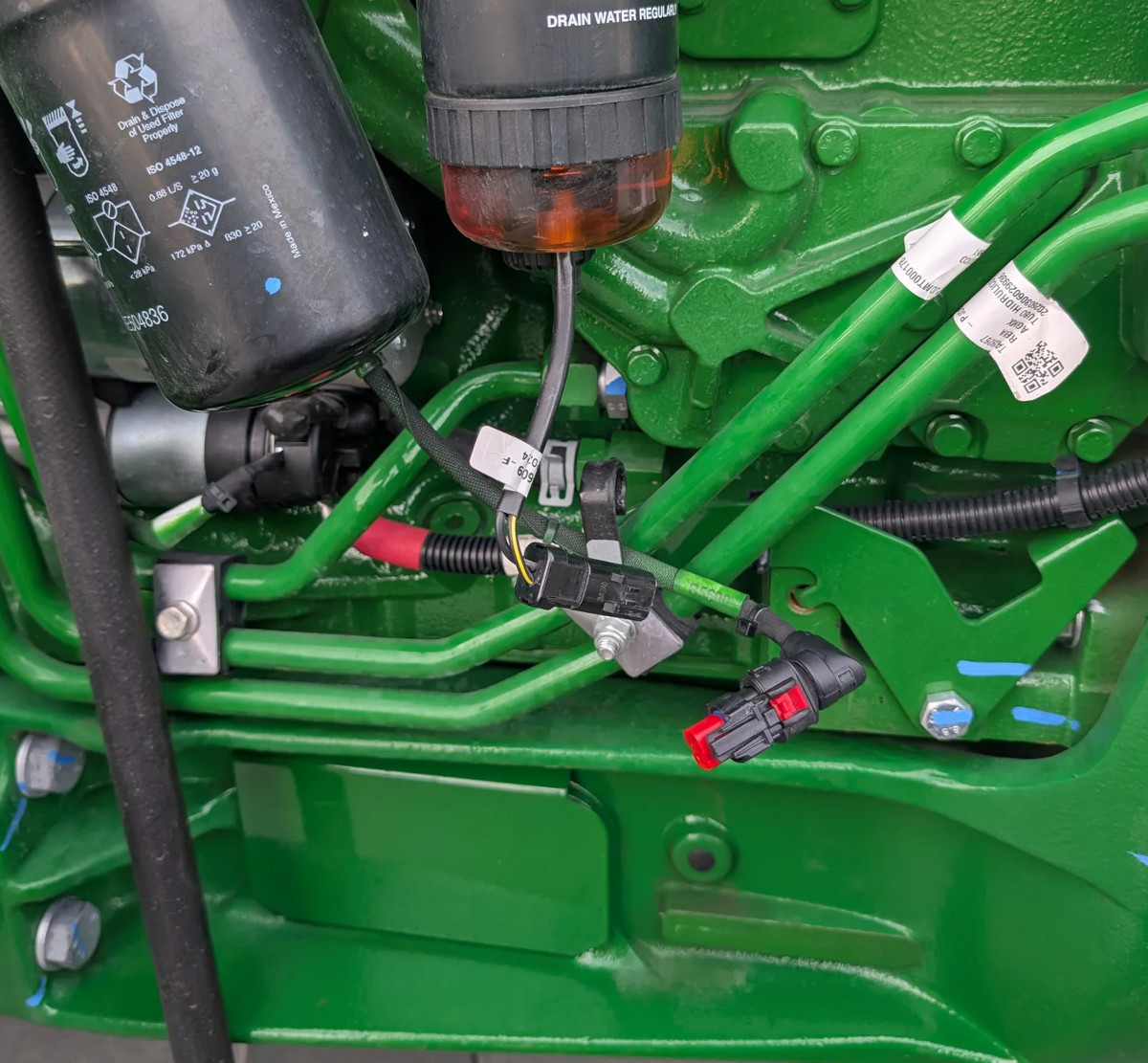
Speaking of repairs, [Boone Ashworth] at WIRED recently wrote up an interesting hands-on experience he had with John Deere’s AI-driven DIY repair service at the company’s corporate headquarters. Armed with a laptop and tasked with fixing the error message showing on a ~$120,000 USD tractor, he was able to follow the instructions provided by the software to identify a sensor that had been unplugged. Reconnecting the sensor fixed the error message and elicited applause from the Deere reps who presumably had carefully unplugged the sensor in the first place for the purposes of the demonstration.
If that doesn’t strike you as a particularly impressive display for a subscription service which starts at $195 a year for each individual machine, you aren’t alone. When Boone reported his experience to critics of Deere’s repairability track record, it was met with literal laughter. You don’t have to have worked in the fields to know that a sensor becoming unplugged ranks pretty low on the list of potential problems you might face in the middle of a harvest.
We can certainly understand why Deere wouldn’t ask journalists to fix a blown clutch or a leaky hydraulic cylinder for the purposes of a media demo. Even so, they could surely have come up with something a bit more challenging if their goal was to convince customers to log into their repair service — something the company claims only about a thousand users do each day.
The idea is simple enough: make up fake disk labels for a bunch of fictional pieces of software (think the games David Lightman was trying to get his hands on in WarGames), stick them on some of the old 3.5 floppies we know you have hiding in a box somewhere, and put them in a frame.
As we’ve talked about in the past, many of us in the hacker and maker community were inspired by nerds in the media. This project strikes us as a fantastic way to show off just which examples you resonated with personally, and if any readers come up with something similar to adorn the walls of their basement, we’d love to see it.
See something interesting that you think would be a good fit for our weekly Links column? Drop us a line; we’d love to hear about it.
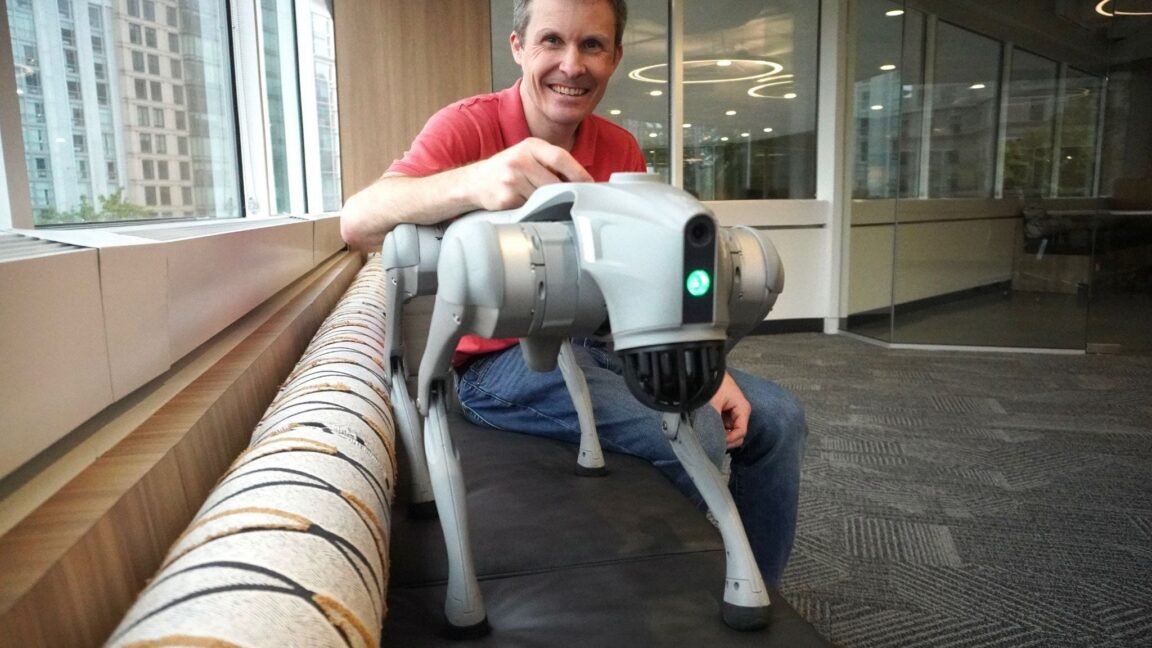
On a sunny morning in June, I walked to work with a quadruped robot beside me. I’ve never gotten more attention from strangers.
A bunch of people snapped pictures of my robot dog. Several people asked me questions. Was it mine? (Yes.) Did I build it? (No.) Was it being used for surveillance? (No.)
Biological dogs kept a safe distance from my mechanical companion. Some growled or barked at it.
China’s GEAIR 2.0 humanoid robot pollinates tomato flowers in under 10 seconds, combining AI, robotics and gene editing for crop breeding and farm automation.
China’s military is exploring humanoid robots for urban combat as the country’s commercial robotics industry dominates global shipments and manufacturing.
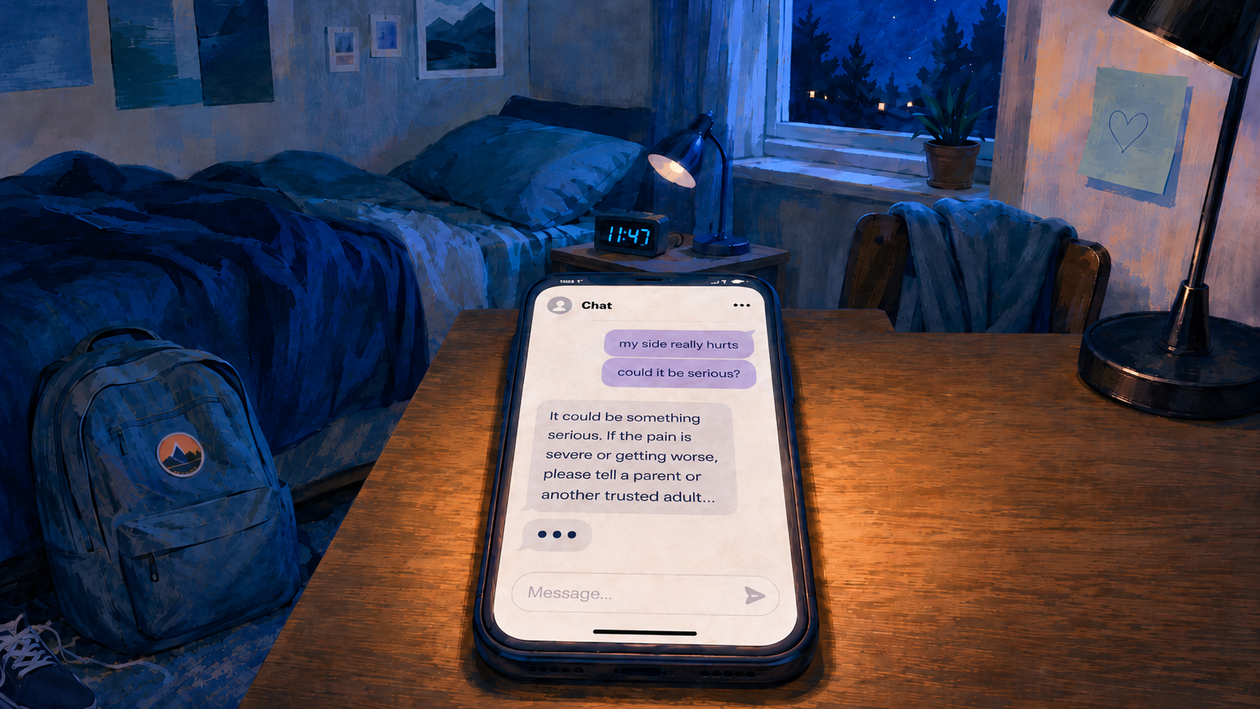
Teens are taking questions about their health, their moods and their friendships to chatbots — often without telling anyone. (GPT-5.6 Sol)
Kids are heading back to school across the country with a tool in their pocket that will do their homework, answer the questions they’re too embarrassed to ask an adult, and never tell anyone they asked.
MIT Technology Review asked kids aged 10 to 18 what they make of AI. Their answers had me plowing through every survey and interview with kids about AI I could find. Plenty of what kids do with it is ordinary: looking things up, homework, messing around.
This article is about the parts they keep to themselves.
1. Kids are taking their mental health to a chatbot, and telling nobody.
Nearly one in five Americans aged 12 to 21 has asked a chatbot for help when feeling sad, angry or nervous. RAND puts it at 8.2 million young people, and 63% of them told no one at all.
The silence is a calculation about what adults would do, as one teenager explained to YouGov’s researchers.
The most vulnerable kids use chatbots more.
Internet Matters found that British children with a health condition requiring professional help are nearly three times as likely to use companion bots like Character.AI or Replika.
A third of all child users say chatting with a bot feels like talking to a friend, and among the vulnerable that figure goes up to half.
One in eight of all child users says they talk to a chatbot because there’s no one else, and among the vulnerable it’s nearly one in four.
2. Kids see both sides of AI in school.
Some teenagers see AI as a shortcut past the hard parts of schoolwork.
Others describe using it the opposite way.
Between May and December 2025, RAND watched homework use among middle school, high school and college students climb from 48% to 62%. Over a slightly longer stretch, from February, the share saying AI harms critical thinking climbed from 54% to 67%. The same students can hold both thoughts at once.
The Concord Monitor interviewed eight New Hampshire high schoolers this spring. They weren’t outraged at their classmates, but they described losing motivation to do the work themselves. One in ten teens tells Pew they do all or most of their schoolwork with a chatbot’s help.
Caledonia Mahon, a Concord High senior, watched a classmate stand up and admit he’d had ChatGPT write a personal reflection, and started wondering why she was still writing her own.
Her classmate Andrew Pfitzenmayer supplied the detail I can’t get out of my head, about a boy in his advanced history class.
Yet, the same technology can be positive for kids who don’t have much else.
By May 2025, 84% of American high schoolers were using AI for schoolwork at least occasionally. The kids who lean on it hardest have the least support around them, which is why telling them to quit doesn’t work.
If quitting isn’t the option, what’s left is changing what the tool does when a kid opens it. Two Seattle startups are trying that.
Wild Zebra, started in 2024 by Edan Shahar and Erik Selberg, makes a math and reading tutor for grades 2 through 9 that answers a stuck student with a question instead of a solution. It’s gone from about 6,000 students in four pilot schools a year ago to tens of thousands now, and raised $6 million in August.
Maximal Learning, built by Microsoft veterans Eran Megiddo and Liviu Asnash, ships an app called Wick that coaches planning, time management and study habits rather than producing homework. Neither company pretends teenagers will stop bringing AI to their assignments. Both are built so the student still has to do the thinking.
3. Kids are writing the rules adults haven’t.
Suspicion of AI runs strongest among the kids furthest from it: 78% of students who don’t use AI say it harms critical thinking, against 60% of those who do.
In July, 98 high schoolers from all 50 states spent three days in a replica of the U.S. Senate chamber in Boston and passed what Congress hasn’t. Their STUDENTS FIRST Act requires AI literacy, bars teachers from letting AI decide a grade on its own, lets a teacher ask a student to defend suspected work out loud, and gives any student the right to an alternative to an AI assignment.
A majority of educators told Education Week’s Research Center last fall that their district has no AI policy, or that they don’t know whether it does. At least seven states have a comprehensive one, by Education Week’s count.
Ashley Kannan has taught social studies for almost 30 years in Oak Park, Ill. He planned to ignore AI, then noticed that every conversation about it in his building was about catching students. He recruited nine eighth graders to spend a year working out what AI was actually good for. In April they briefed 60+ teachers and parents on the rules they thought were needed.
Hazel is 17, a rock climber in New York who wants to be an ecologist. She won’t touch AI, and her reason is specific: what data centers do to the water supplies of the towns they’re built in. Asked what advice she’d give other kids, she gave four words.
Hazel can afford that advice. Most kids can’t.
So the practical alternative is narrower than just telling them to quit: ask them what they use AI for, ask what they’ve decided not to use it for, and don’t make an honest answer cost them the tool. Right now 61% of young people say their parents rarely or never talk to them about AI, and 53% say the same of their teachers.
Hazel may walk away from AI. But Amira, describing a pain in her side to a chatbot, may not, and the odds are nobody in her house knows she’s doing it.
Meta is testing robots that can plug in cables, reset servers, and handle other tasks inside its data centers, according to several current and former workers familiar with the projects. The ongoing effort, which has not been previously reported, may eventually allow Meta to operate its rapidly expanding data center footprint with fewer humans, keeping labor costs in check as its spending on AI infrastructure soars.
Meta is using robots and related hardware from several different vendors, including Watney Robotics, Kinova, and ABB, according to the same workers, who asked to remain anonymous because they weren’t authorized to speak to the media. Kinova and ABB declined to comment. Watney didn’t respond to requests for comment.
In one experiment, Meta is evaluating whether a Kinova Gen3 robotic arm could be used for power cycling or cutting off electricity to servers. The company is also testing a different robot to swap networking cables. One Meta data center worker estimates that if it’s successful, the bot could replace up to 80 percent of some people’s workloads. “We thought those of us performing the physical tasks were safe for a while, but not anymore,” says the worker. “It’s coming for us all, unfortunately.”
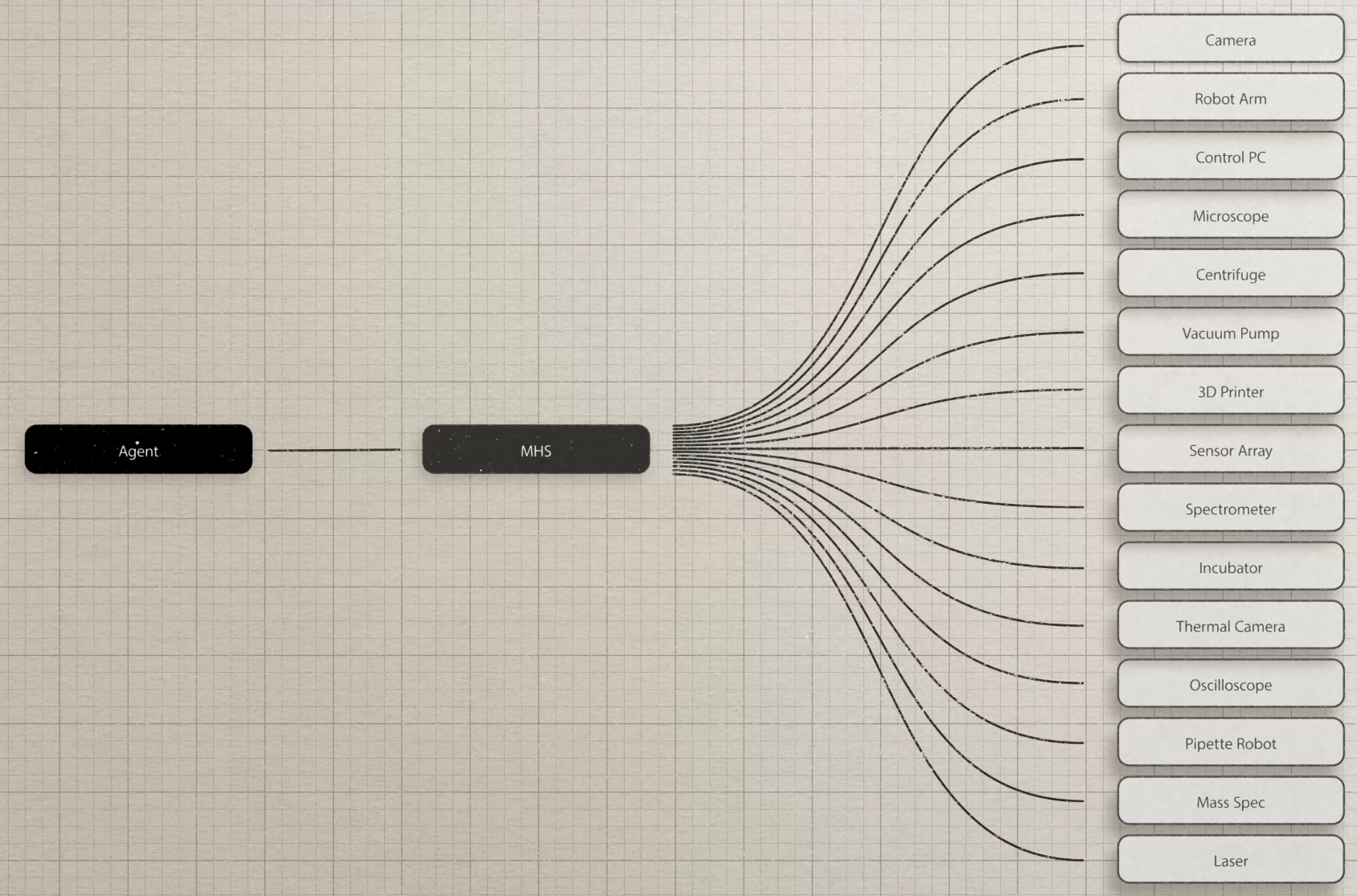
For all the interest in and uptake of agentic AI systems over the past year or so, the world of automated AI has thus far been primarily limited to text, images, code, and other data and actions that take place inside a computer. Anthropic is now aiming to change that somewhat with what it's calling the Model Hardware Standard (MHS), a set of standardized drivers designed to let AI agents easily interface with and control arbitrary devices.
For now, the "research preview" of the MHS effort is being sold mainly as a way to help scientists streamline the arduous process of creating the custom software integrations that are often needed to get disparate components of an experiment working in concert. MHS can provide a common interface and common format for data sharing between these devices, Anthropic says, allowing them to talk to each other across a network "without needing a bespoke 'translator' program in between." The standardized system could reduce weeks or months of exacting experimental setup down to "hours or minutes," Anthropic writes.
An Anthropic graphic illustrating how MHS serves as a "translation" layer between AI agents and multiple types of devices.
Credit:
Anthropic
In a video posted alongside the announcement, Anthropic Technical Staffer Alek Kemeny says the MHS effort was inspired by observing neuroscientist Arco Bast work through an experiment on memory formation in the brain at the HHMI Janelia Research Campus in Ashburn, Virginia. Kemeny said Bast had worked out an interface to get the rotating laser beams, microscopes, cameras, and myriad other components of the experiment to coordinate through a common interface. "This idea could be used to have AI run any science experiment in the world," Kemeny recalls thinking at the time.
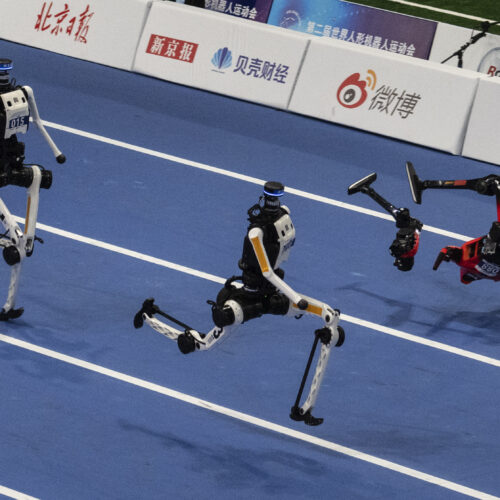
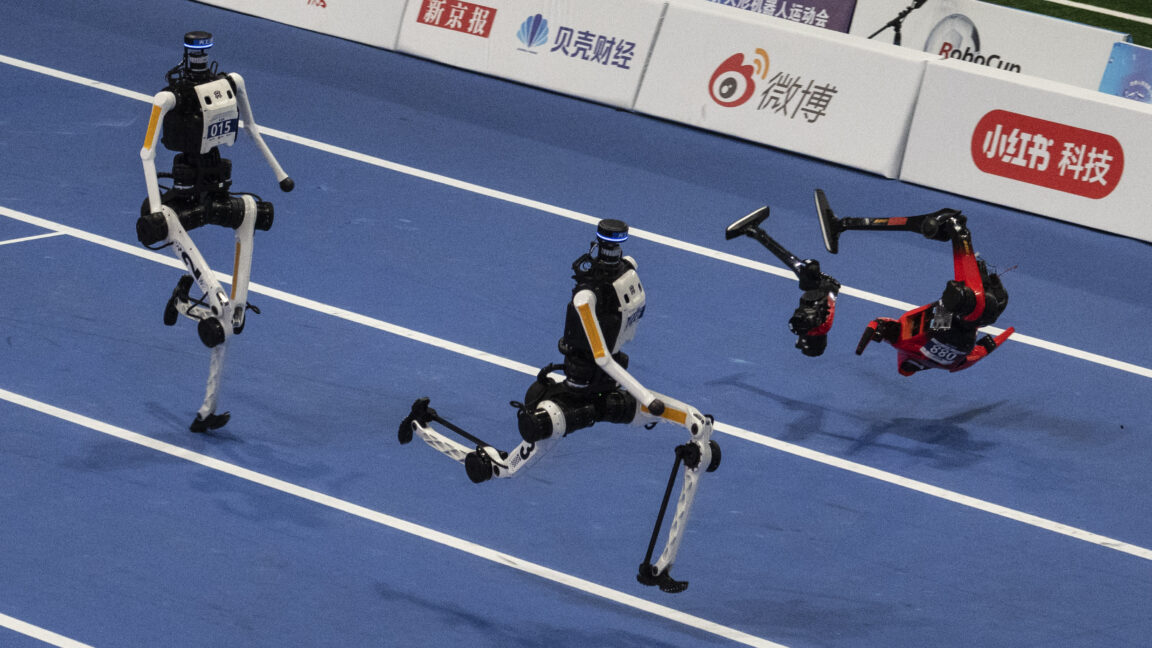
Viral videos of the World Humanoid Robot Games show sprinting robots beating the human 100-meter record held by Usain Bolt—but also feature running robots crashing into barriers and falling down because they cannot readily stop running. A few fallen robots even break at the waist in a shower of sparks or catch on fire.
That demonstration of both robotic prowess and limitations came from the second edition of the World Humanoid Robot Games hosted in Beijing from August 22–26. Like the inaugural event held in 2025, this year’s event challenged humanoid robots to run fast, perform kung fu or dance moves, fight one another in kickboxing, and play soccer or table tennis.
This year’s games also tested robots in more humdrum practical scenarios like washing and hanging laundry, where they appeared to lag behind typical human working speeds. That suggests the event organizers, including Chinese state media and the Beijing city government, are keen to showcase the commercial potential of humanoid robots at a time when China’s robotics industry is rapidly developing and testing such robots.
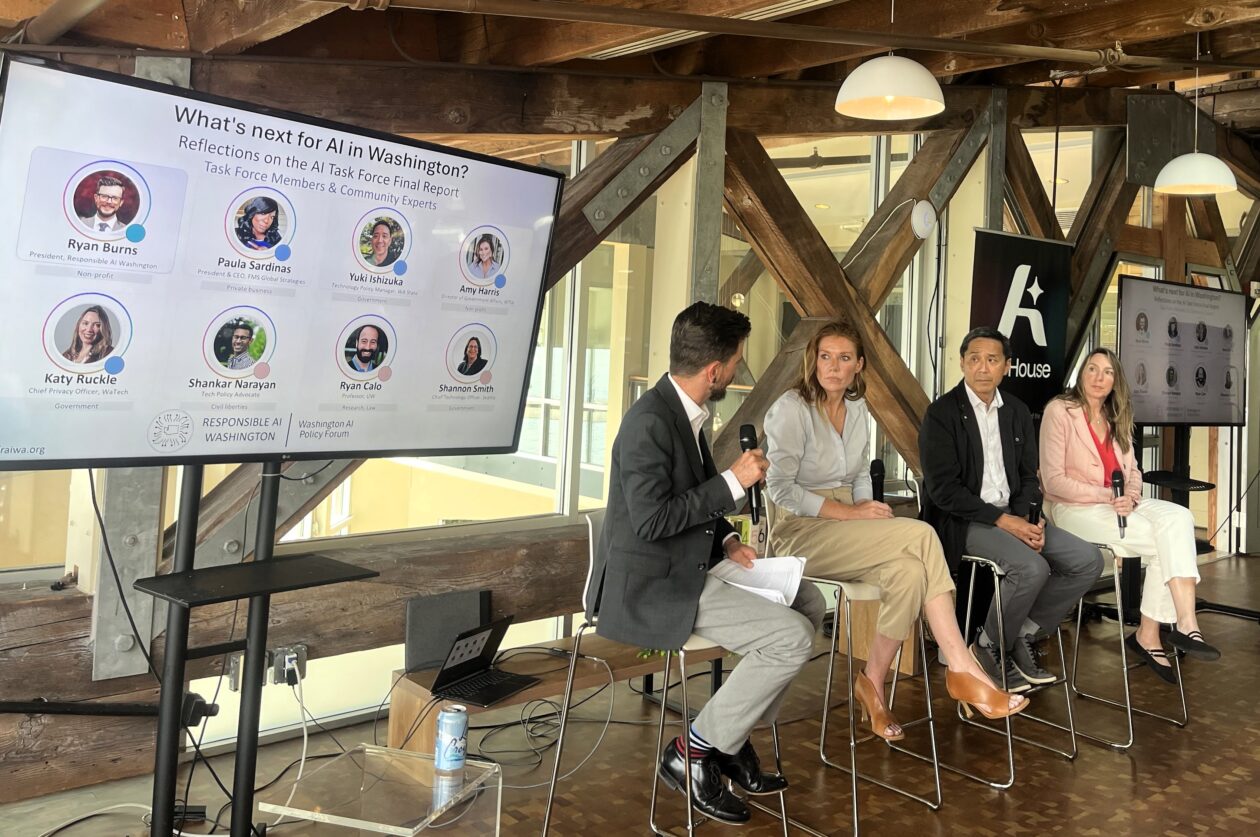
From left: Ryan Burns of Responsible AI Washington, Amy Harris of the Washington Technology Industry Association, Yuki Ishizuka of the Washington Attorney General’s Office, and Katy Ruckle of Washington Technology Solutions, at Wednesday’s panel on the state AI task force’s final report. (GeekWire Photo / Grace Kaste)
Members of Washington’s AI task force point to the state’s new AI regulations as evidence that regulation and innovation can coexist, but a panel discussion this week marking the end of their two-year effort showed just how unsettled the core issues remain.
The task force is caught between consumer and labor groups calling for more extensive guardrails, and tech industry representatives concerned about compliance costs, exposing the tension between the demands of the fast-moving AI industry and the risks the technology poses to individuals.
That came to the fore at a panel on Wednesday, held at the Seattle startup incubator AI House, where task force members faced an unusual mix of people: an audience of AI startup founders, plus a roster of pro-regulation experts representing the legal, labor, and consumer protection fields.
Panelists were there to discuss the task force’s final report, which recommended AI regulations to the state legislature. Four of the eleven recommendations were adopted, in part or in full, and passed into law this spring.
“We are here today to see how much of this sentiment — that Washington does not have to choose between embracing innovation and protecting people — comes out in the content of the report,” said Ryan Burns, co-founder of Responsible AI Washington, who moderated the panel.
That line has become a refrain for AI regulators in Washington. Gov. Bob Ferguson, then the state’s attorney general, requested the legislation creating the task force in 2024. He appointed representatives from government, labor, academia, and the tech industry, directing them to explore how AI could be “regulated without stymieing innovation.”
In the final report, published in July 2026, Attorney General Nick Brown wrote that the task force had “made clear” that the two priorities could coexist, despite the federal government’s pro-innovation agenda. But Wednesday’s event showed that might not be so simple.
Narrow regulations passed
Washington passed its first AI regulations this spring, including a requirement that companion chatbots remind users that the bots are not human and another that prohibits medical insurers from denying a patient coverage solely on the basis of an assessment made by AI. For Burns, the laws that did not pass were more telling.
“It did strike me as meaningful that the recommendations that have been adopted pertained to narrower application areas,” Burns said. “The recommendations that have not yet passed were a lot bigger.”
One of those recommendations was to regulate the use of AI for high-risk decision making, meaning applications of AI to hiring processes, algorithmic pricing, criminal justice, and healthcare. A similar law has passed in states such as New York, Connecticut, Illinois, California, and Colorado, but the Washington bill died before reaching a floor vote in either chamber.
The task force’s recommendation to require AI developers to disclose the datasets they are using to train their models, as California does, also died, as did a third recommendation to develop guidelines for the use of AI in the workplace.
In an interview with GeekWire, state Rep. Mia Gregerson, who sponsored some of the comprehensive bills, said she appreciated the work of the task force but maintained that there is much more work to be done.
“We are a tech heavy state, so we have an even bigger responsibility to do good work to catch up to what other states are doing,” Gregerson said. “We are so behind.”
On Wednesday, panelists said broader AI regulations failed in part because they drew less interest from the public.
“What passed in the legislature was more sector specific things where the consumer harm was more clear, and I think that’s a product of political dynamics,” said Yuki Ishizuka, technology policy manager for the Washington State Attorney General’s Office. “It’s harder to connect broader governance or transparency bills to harm to people.”
Broad AI regulations also faced heightened opposition from the tech industry, where a patchwork of state regulations means higher legal fees. At task force meetings, which were open to the public, representatives from the tech industry opposed regulations around AI development that would add “procedural hoops.”
Cost of compliance
Concern about overregulation was echoed by attendees of the event, the majority of whom were founders of small AI startups.
When it came time for the Q&A, multiple audience members asked the task force to consider the financial burden for small startups of complying with complicated state regulations.
The distinction between big tech and startups has become a refrain for AI House, where entrepreneurs met with U.S. Sen. Patty Murray last month to discuss the nuances of AI regulation for so-called “small tech.”
“As these recommendations turn into policy, it’s important that startup founders are part of the conversation,” AI House Managing Director Jacob Colker told GeekWire. “A five-person startup doesn’t have the same legal, compliance, or policy capacity as a trillion-dollar company.”
But Jai Jaisimha, co-founder of a pro-regulation organization called the Transparency Coalition and a former startup founder himself, cautioned against creating legal carve outs for certain AI developers.
“Arguing that you’re exempt because it’s too much data to disclose, or it’s a trade secret, those arguments send a sign that normal software development and governance does not apply to AI,” Jaisimha said. “Disclosure and consumer protection, these are standard practices in other industries.”
While the bills that would have been most costly for developers to comply with did not pass into law, those that did will still create significant legal consequences for AI developers who don’t abide by them.
Panelist and technology law expert Ryan Calo, a University of Washington law professor who was not a member of the task force, said the state’s new companion chatbot law will be “blood in the water for the plaintiffs’ bar” for two separate reasons.
First, any failure to comply could now be treated by the courts as “negligence per se,” meaning that the plaintiff will not have to show broader negligence but will simply have to show that the defendant violated the law.
Second, any failure to follow these regulations is deemed an unfair or deceptive act under Washington’s Consumer Protection Act, giving consumers a private right of action and exposing developers to higher financial penalties.
The question for the tech industry will be about where the state’s attorney general will prioritize enforcement.
“The AG has a lot of power, but not enough to bring every violation of the law. So you have to think of the Eye of Sauron, and whether it will focus on you. If you’re a little startup, probably not, but if you’re Meta, probably yes,” Calo said.
Future AI regulation
As Washington state prepares to implement its new regulations this January, regulators are bracing for backlash from the federal government.
A December executive order from the Trump administration called on Congress to pass a “minimally-burdensome” AI policy preempting state laws, created an AI Litigation Task Force to challenge state laws that don’t “sustain and enhance the United States’ global AI dominance,” and threatened to cut broadband funding to those states. It named Colorado, which enacted the first comprehensive state AI law in 2024.
Federal preemption would require Congress to pass AI regulation of its own, which it has yet to do, but Trump’s order still seems to be having an effect.
This spring, Colorado repealed its AI regulation and replaced it with a more conciliatory law.
In Virginia, where no AI regulations have gained traction, legislators pointed to the federal government’s threats.
And in Utah, lawmakers withdrew a bill to regulate frontier models after the Trump administration sent them a memo criticizing it for “opposing the federal government’s agenda,” according to Politico.
“We believe that, if the federal government is going to act, they should act with meaningful AI regulation, and should not preempt the state’s ability to protect its citizens,” said Ishizuka of the Washington state AG’s office.
The federal pressure has not stopped some leaders from calling for far-reaching regulation. Some members of Wednesday’s second panel, which was made up of representatives from labor, academia, and consumers from outside the task force, proposed redistribution: Future AI regulation should reallocate the profits made by developers to pay for AI’s impending costs, such as cybersecurity improvements, worker retraining, and updates to school curricula.
“My worry is that there is going to be a lot of money being made, and I really think that bill should go to the people that are making a lot of money off of it,” Calo said. “I’m not sure that all of the [task force’s] recommendations directly address that redistribution element.”
Some state lawmakers are ready to address it. Gregerson, whose district includes SeaTac Airport and whose constituency includes many Uber drivers, told GeekWire she hopes to allocate state funds for retraining rideshare drivers who are replaced by autonomous vehicles.
State Rep. Clyde Shavers, who was not present at Wednesday’s panel but was a member of the task force, has said he wants to spend the next session establishing liability frameworks for AI-related harm.
Now that the report has been published, the task force will be disbanded, but the work will continue at the Attorney General’s Office, where a new Tech Policy Team will be led by Ishizuka.
“With the completion of the task force’s work, there is strong interest in the AG’s office to continue to focus on AI policy,” Ishizuka said. “We’ll look at emerging technologies and bring in outside expertise so that there is informed regulation.”

 Login
Login

 Finally, this one leans more heavily into the “arts and crafts” than we’d usually cover here on Hackaday, but [Terence Eden]’s Collection of Imaginary Software is too cool not to get a mention.






 An Anthropic graphic illustrating how MHS serves as a "translation" layer between AI agents and multiple types of devices.
Credit:
An Anthropic graphic illustrating how MHS serves as a "translation" layer between AI agents and multiple types of devices.
Credit: