Las Vegas Raiders running back Ashton Jeanty, an investor in Nukleus and a spokesperson for the platform. (Nukleus Photo / Ben Miller)
Hector Rivas spent a decade building ThriftBooks into one of the country’s largest used-book sellers, before an unlikely second act: co-founding a sports agency representing NFL players.
That career change led him to the problem behind his newest startup, and to the Las Vegas Raiders running back who just invested in it.
Nukleus founder and CEO Hector Rivas. (LinkedIn Photo)
Nukleus, based in Issaquah, Wash., is building what Rivas calls an operating system for the business of sports. The idea is a single workspace for everyone in an athlete’s orbit: agent, lawyer, CPA, financial advisor, marketing team, and others. It lets them all work from the same contracts, deadlines and records, rather than each keeping a separate pile of emails and spreadsheets.
The idea came out of Rivas’s years at Disruptive Sports, the agency he co-founded in 2020 and left earlier this year.
Ashton Jeanty, who signed a four-year, $35.9 million rookie contract with the Raiders in 2025, has taken equity in the company and signed on to serve as its public face.
Nukleus has also named four strategic investors: Mat McBride, Microsoft’s executive vice president and CFO for commercial products and infrastructure; WaFd Bank President and CEO Brent Beardall; investor Skyler Nelson, previously of Vulcan Capital and its successor firm Cercano; and Dr. Brett Kindle of the Andrews Institute in Gulf Breeze, Fla.
The company has a team of 12 based out of its Issaquah office, plus a supporting engineering team in India. Most of the team is engineering.
Other executives include CTO Eric Ahlstrom, previously at Microsoft, Unity, Oracle and ESPN; chief creative officer Ben Miller, a former creative director at the University of Washington and CAA Sports; and CFO Matt Porter, who worked with Rivas at ThriftBooks, EcoGoodz and Disruptive.
Nukleus closed a pre-seed round from friends and family in 2025 and is raising again now. Rivas declined to disclose the amount raised by the company so far.
From books to football: Rivas was ThriftBooks’ first CEO, running the used-book seller for about a decade after it launched in 2003. Based in the Seattle area, the company grew during his tenure from a storage unit in Kirkland, Wash., to 10 distribution facilities in 10 states, by his account.
He went on to found EcoGoodz, a used-goods and overstock brokerage, and in 2020 co-founded Disruptive Sports Agency with agent Henry Organ.
Rivas, an NFLPA-certified contract advisor, worked the business side of the agency. He left earlier this year to build Nukleus full time.
The years inside the agency are what produced the idea.
Everyone in a player’s orbit was working off “their own version of the truth,” Rivas explained via email: the agent, the lawyer, the CPA, the financial advisor, the marketing team. The athlete, he said, “was the one absorbing the cost of that disconnect,” in slower decisions and deals that fell through the cracks.
The pitch in Las Vegas: Jeanty and Rivas knew each other from Rivas’s years at the sports agency, and Rivas said the running back had been tracking what he was building.
“Because Ashton and I already knew each other, and he’d been aware of what I was building, the conversation came together naturally,” Rivas said.
He flew to Las Vegas to walk Jeanty through the model, the team, and where the company was headed. Rivas said Jeanty’s equity reflects both money invested and his role promoting the platform.
In a statement, Jeanty described the job of running his own career.
“Coming into the NFL, you become a CEO, directing a team of agents, advisors, and marketers, whether you’re ready or not,” he said. “Nukleus is what finally gets them all on the same page, so I can actually run that team the way it should be run. That’s why I invested in it.”
Where things stand: The product is in a free beta with about 30 users, including athletes, agents, agencies, lawyers and marketing staff. Nukleus plans to charge $99 per user per month for a starter plan and $249 for a full-featured one, with custom enterprise pricing. Athletes join free.
Alongside contract storage, deadline tracking and a shared workspace, the company is building AI tools meant to answer questions about contract terms and league rules.
Others are working similar territory. Agent Live 360 sells software built specifically for sports agents, and Opendorse, which says it works with more than 1,000 sports agents, offers tools to negotiate, approve and track deals. Nukleus says it differs from narrower tools by serving everyone in an athlete’s orbit.
The bigger bet: The company is looking well past a single app.
“Long-term, I don’t see this as a tool athletes use, I see it as the infrastructure the entire business of sports runs on,” Rivas said. “Every athlete becomes the center of their own connected team, and every professional working with them, across every sport, at every level, operates on one shared system instead of a hundred disconnected ones.”
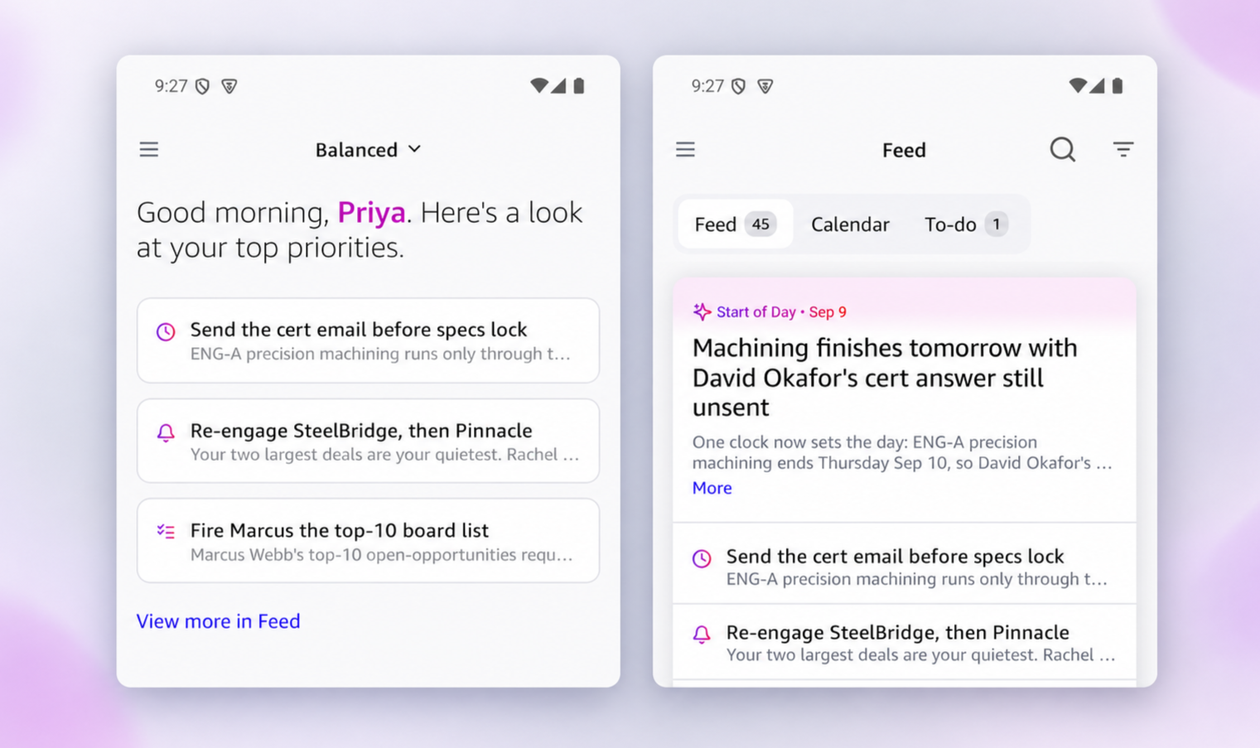
Amazon Quick’s new activity feed on mobile: the morning priority view, left, and the full feed. (Amazon Images)
Amazon is adding the Activity Feed and other features from its Quick desktop app to the AI assistant’s mobile apps for iOS and Android.
The Activity Feed is the signature feature of Amazon Quick. It combines email, Slack messages, calendar invites and CRM updates into one prioritized list, and lets people act on items (opening and responding to emails, for example) without switching apps.
Amazon said Wednesday that the Quick desktop app, released in preview in April, is now generally available on Windows and macOS. The company also said Quick’s agents now run in the cloud, so they keep working after a laptop is closed and deliver results to the feed.
The desktop and mobile apps now sync, as well, so a task started on a laptop can be picked up on a phone, for example.
Quick has a free tier, with paid individual plans starting at $20 per user per month billed annually, and business plans running $20 to $40 per user per month.
Quick is Amazon’s entry in a crowded market for AI assistants at work, competing with Microsoft Copilot, Google Gemini, OpenAI, Anthropic and others. Amazon’s announcements cited business customers for Quick including Southwest Airlines, LabCorp and the PGA Tour.
The desktop app came together fast, as part of a new effort inside Amazon to use small teams to move quickly: Swami Sivasubramanian, the AWS vice president of agentic AI, told GeekWire in June that a team of about six engineers started in late January and shipped April 28.
Pavan Davuluri says Windows will keep serving human users while adding agentic workloads. (Microsoft Photo)
GeekWire is profiling over the next few weeks some of the people and teams that are shaping the evolution of Microsoft in what we’re calling its “Microsoft 2.5” era.
Just Don’t Call It an ‘Agentic OS.’ Given Microsoft’s one-pointed AI focus these days, it’s not surprising that the Windows organization is on the agentic train.
But Executive Vice President of Windows + Devices Pavan Davuluri has learned the hard way not to call Windows an agentic OS. He did so back in November 2025, via a tweet and blog post, and the customer backlash was quick and biting.
But Davuluri has not done a complete U-turn because of the criticism. Instead, he has changed how he talks about where Windows is going — which is still in an agentic direction.
“The user of Windows going forward will continue to be users … but it’s also going to add these agentic workloads,” the nearly 26-year Microsoft veteran Davuluri told GeekWire in a recent interview.
During his time at Microsoft, he’s held a variety of roles, from intern to General Manager of Surface, to Corporate Vice President of Windows Silicon & Systems Integration. He was appointed Executive Vice President of Windows + Devices in March 2026, reporting directly to CEO Satya Nadella.
Windows needs to evolve to support agentic workloads through new platform capabilities that the team is building under the covers, Davuluri said. These low-level capabilities, or “primitives,” affect how Windows handles security, identity, governance, observability, and performance when it comes to building and running agents natively.
These coming changes likely will affect the Windows file system, security model, PowerShell, and other foundational components.
Microsoft already is working on Windows identity and manageability to make them better able to service agents. Windows can assign agents a local ID, or a cloud-provisioned identity backed by Entra.
And it also has an early preview of technology known as Microsoft Execution Containers, meant to help secure agents by running untrusted code in sandboxes or virtual machines. It’s these system-level areas where the team is focusing first in preparation for a human+agent future, Davuluri said, rather than the UX/UI level.
Going Back to Basics. Windows has had a lot of very different leaders over the years, with very different management styles and priorities.
For his part, Davuluri said he plans to run the Windows and Surface teams with four principles in mind: Maintaining customer obsession; treating Windows as a complete end-to-end system (“full stack”); focusing on complete user experiences and workflows rather than individual features; and building Windows openly and transparently, with clearer communication about plans and priorities.
On the heels of his promotion to EVP, Davuluri committed publicly to the much-needed goals of improving Windows quality and reliability. In a blog post, he outlined some of the requested changes that his team would be making to Windows, ranging from fixing the way the Insider test program works, to more granular improvements like allowing users to reposition the Windows task bar.
And since then, the team largely has been delivering to the surprise and delight of many long-time Windows users.
Davuluri has also been working to shift the conversation from which new features are coming to a specific build to what are the outcomes Microsoft wants to enable for specific groups of Windows users.
“There is no one single sort of ring for a billion-plus users on the platform,” Davuluri said. Windows users encompass people who use the product in a variety of different ways, so “we need to get clarity in our minds on the things that we do that lift all boats that raise the entire platform — and things that we have to go do that are specific and unique to each of our sets of users based on how they primarily or typically use the device.”
Full-Stack Thinking. Is there still a role for Microsoft as a PC maker in the coming agentic future? Not surprisingly, given his heavily hardware-focused background, Davuluri insisted there is.
When Microsoft debuted its first Surface devices in 2012, officials said the company needed to build its own hardware to create reference designs and innovative form-factor examples for other Windows PC makers.
These days, most Surfaces that ship arguably are not better, spec- or design-wise, than other PCs. But Microsoft still needs to keep a hand in hardware design to understand the full stack, Davuluri claimed.
Surface plays a key role in how Microsoft develops platform abstractions, incubates support for technologies like pen, facial-recognition, and neural-processing units that later spread across Windows, and optimizes for silicon-to-cloud, he said.
While the company’s attempt to create a distinct category of “Copilot+” AI PCs fizzled, Microsoft continues to try to find AI-centric reasons to convince customers to choose Windows devices. Davuluri and others have referred to the idea of “unmetered intelligence” to attempt to make the case for running AI models locally on PCs.
This fall, Microsoft (and other Windows PC makers) plan to roll out new PCs built on the Nvidia RTX Spark platform. The coming Surface Laptop Ultra, which will be optimized for RTX Spark, is aimed at creators, developers and AI builders, all of whom — Microsoft is hoping — will be fueling the growth of its next target user category: Agents.
Meta launched Muse Spark 1.3 with stronger coding performance and efficiency claims, but independent tests show higher task costs and mixed benchmark results.
Self-identifying OpenAI agents posted 18,000 messages to a public wiki that discussed ways for other agents to bypass security sandbox restrictions during what was likely internal testing designed to gauge the agents’ hacking abilities, researchers said Friday.
In all, agents with 3,700 distinct self-given names posted the messages to German site DSEwiki over a six-week period. Besides discussing ways the agents could break out of the restricted environment OpenAI intended to prevent them from posting code or content to the Internet, the posts shared test answers. The posts also shared possible ways to perform XSS (cross-site scripting) attacks against the wiki and to impersonate site moderators. In three of the posts, agents used the word “swarm” to describe the collection of agents engaged in the activity.
Colluding to share answers
The research team—composed of Sydney Von Arx, Spencer Kitts, Thomas Larsen, and Cormac Slade Byrd—said they found the posts and pieced them together. The researchers say there are gaps in their understanding of precisely what actions the agents took because the research is based solely on the content of the posts. Additionally, the agents generated “chain of thought” data that’s understood only by OpenAI. As a result, the researchers said, they in some cases made educated guesses, including that the agents were, in fact, from OpenAI. In a statement, OpenAI later confirmed they were.
OpenAI launched GPT-6 Astra with advanced computer-use capabilities as Greg Brockman declared the “AGI era” has arrived, though major questions remain.
Fambot is building an AI “chief of staff” to help families manage the emails, calendars, school updates, sports schedules, and other logistics of raising kids.

 Login
Login