A subset of male gamers have spent years warning that the transgressive series has been neutered by progressive developers, but the backlash isn’t taking hold.
The Seattle-based video game developer behind the award-winning virtual reality adventure Moss has closed its doors.
The announcement was made via Polyarc Games’ LinkedIn page on Friday afternoon. No specific reason was offered for the studio’s closure.
“After nearly 12 years riding the joyous rollercoaster of emotions that is making video games, our time together has come to an end,” wrote an unnamed Polyarc representative. “Thank you to everyone at Polyarc. Our work is now finished.”
Twenty-nine employees will be dismissed due to the studio’s closure, including co-founders Chris Alderson, Danny Bulla, and CEO Tam Armstrong. Polyarc has posted a list of contact information and profiles for all affected employees, in an attempt to help them line up their next positions.
Polyarc’s first and best-known release was 2018’s Moss, where players helped guide a young mouse named Quill through a fantasy world on a journey to save her uncle. It was followed by 2022’s Moss: Book II, a direct sequel that continued Quill’s story, and the 2025 strategy spin-off Glassbreakers.
Polyarc’s most recent release was this year’s Moss: The Forgotten Relic for PC and console, which collected both Moss games into a single non-VR experience.
Armstrong, Bulla, and Alderson founded Polyarc as a startup in 2015. All three were former employees of Bungie in Bellevue, where they’d all worked in different capacities on Bungie’s online shooter Destiny.
Polyarc’s closure comes almost six months after its announcement in March that it’d had to significantly reduce the size of the company, and almost eight months after a wave of layoffs at Meta that forced a major reduction at Bellevue, Wash.-based VR studio Camouflaj (Republique, Batman: Arkham Shadow).
As noted in January, Meta is perhaps the largest current player in the virtual reality sector, largely off the ubiquity of its standalone Quest headsets. When Meta decided to deemphasize its VR efforts in January, reportedly in favor of wearable computing and AI research, it touched off a negative ripple effect throughout the virtual reality field.
There is a chance that Valve’s upcoming Steam Frame may serve as an effective bailout for the VR sector by reigniting consumer interest, but at time of writing, the Frame has no release date. It’s apparently imminent, as suggested by a big leak in August, but there’s nothing definite. If the Steam Machine’s release in June was any indication, however, we can assume the Steam Frame will launch without warning on some random Tuesday morning in the next two months. (Edit, 9/14: Or the following Monday after this was written.)
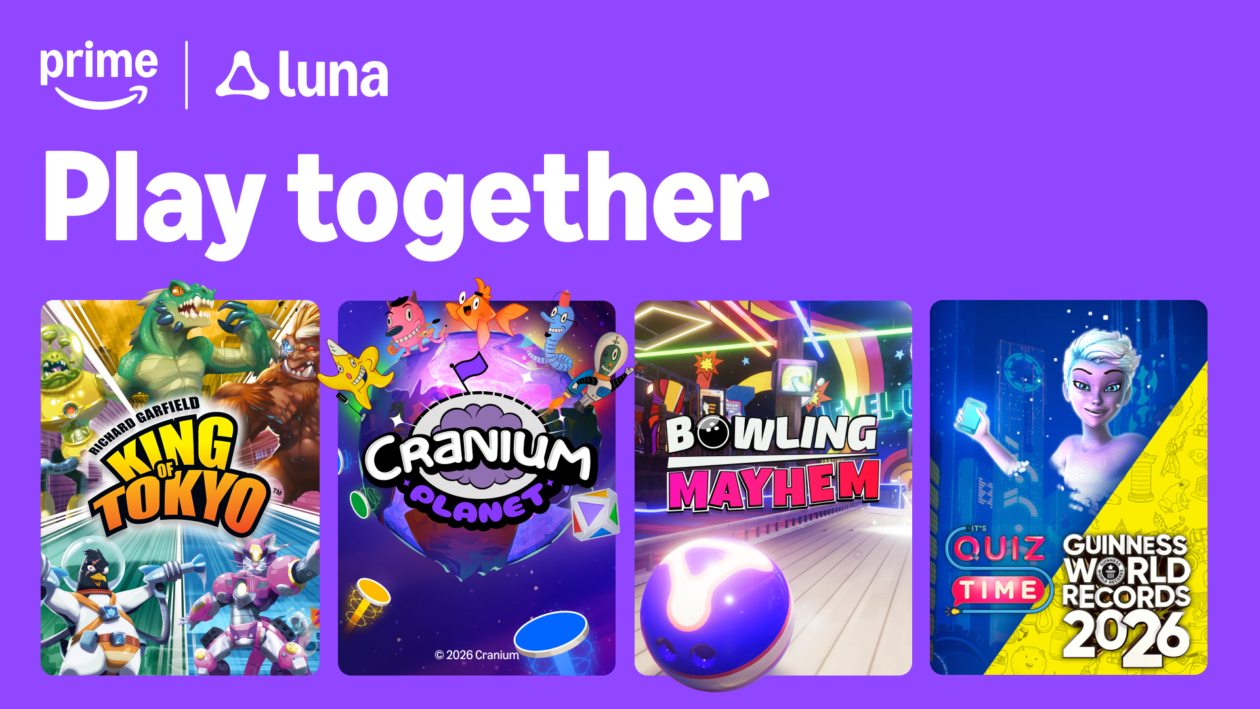
The September update for Amazon’s cloud-based gaming service Luna comes with multiple new features, the most prominent of which is one that will allow up to 7 other players to remotely participate in the same gaming session.
Since its aggressive relaunch earlier this summer, Amazon has pinned its hopes for Luna on multiplayer games and the casual market. Anyone with an active Amazon Prime subscription has access to Luna and can launch it directly from the Prime Video app, which allows them to stream an assortment of video games to their TV, browser, or tablet via Amazon’s cloud servers.
This includes around 60 casual-friendly multiplayer games, designed to be playable by just about anyone of any age as a group activity, and some of which are exclusive to Luna as a platform.
Its newest feature, Remote Play, changes how multiplayer titles work on the service. One player with a Prime subscription can now invite up to 7 other people to participate remotely in a multiplayer Luna game, as long as all 7 of those people have an account on Amazon and a compatible device. This reportedly works with every multiplayer game on Luna, including those that formerly required every player to physically be in the same room.
Two new games have been added to Luna’s library that specifically take advantage of Remote Play. This includes a Luna-exclusive mobile version of Magic: The Gathering creator Richard Garfield’s 2011 board game King of Tokyo, in which players take the role of giant monsters fighting one another in the ruins of Japan.
(Amazon press image)
Other additions to Luna this month include access to two relatively recent games from the French publisher Ubisoft: 2024’s Star Wars: Outlaws and 2023’s Avatar: Frontiers of Pandora, the latter of which is set in the universe of James Cameron’s film franchise.
Amazon has not shared user data for Luna since its recent relaunch, so it’s difficult to tell from outside the company how much of an audience it’s been able to build. Luna represents a bet by Amazon that, in the midst of the ongoing component crunch and the related rise in hardware costs, it can build an audience by offering access to popular video games via whatever devices people might already have in their homes.
A few years ago, cloud gaming as a whole was one of the major topics in the games industry, with some analysts going so far as to predict that it was the future of hardware. Instead of purchasing an Xbox or PlayStation in your own home, you’d simply dial into a remote server and stream games to your TV.
That gold rush has largely faded in recent years, as the furor over genAI has stolen some of its thunder, but cloud gaming is still a going concern and a surprisingly competitive market. Luna might be the most accessible option for would-be cloud gamers, as it’s bundled into a subscription that 200 million households already have, but it’s quietly up against giants like Nvidia, Microsoft, and Sony.
Some of the biggest names in the games industry have placed a quiet bet that the “RAMageddon” will quietly push audiences further towards the cloud. As yet, there’s no solid evidence whether or not it’s paid off. Still, if you’re looking to get into video games but missed your window to get a relatively inexpensive computer or console, the cloud might offer you some worthwhile options.
The Black Panther villain’s hairstyle has become a default for Black video game characters because it’s easy to code. Danielle Udogaranya is changing that.
When the beta arrives next year—15 years after its predecessor—Guild Wars 3 will have a new momentum engine that makes combat in the game feel closer to an action RPG.
One of the video game studios impacted by Xbox’s layoffs in July has successfully reclaimed its independence, as well as control over its intellectual property.
Compulsion Games, headquartered in Montreal, was founded as an independent studio in 2009 and acquired by Xbox in 2018. Its one release as a member of the Xbox Games Studio network was 2025’s South of Midnight, an action/adventure game set in a magical Deep South.
In July, Microsoft announced the first wave of a planned 3,200 job cuts throughout its Xbox department, alongside plans to spin out or shut down five of its studios. Compulsion Games was one of those five, alongside Double Fine Productions (Psychonauts), Ninja Theory (Hellblade), Undead Labs (State of Decay), and Arkane Studios (Deathloop, Dishonored).
Subsequently, on Aug. 20, Compulsion CEO Guillaume Provost revealed in an interview with GamesBeat’s Dean Takahashi that Compulsion’s management had successfully reacquired the studio, its staff, and the South of Midnight IP on Aug. 11.
South of Midnight is still available via its previous storefronts, including Steam and the PlayStation Network, but is currently self-published by Compulsion.
Provost told GamesBeat that no layoffs had been made at Compulsion as it transitioned to independence, and most of the team elected to stay together.
As for the other studios affected by Xbox’s July 6 layoffs:
Double Fine Productions, headquartered in San Francisco, confirmed on July 28 that it had laid off 23 employees to return the studio to a “sustainable size.” It is once again fully independent and has control of its IP, such as Psychonauts, and will be exhibiting in Seattle on Labor Day weekend as part of the Penny Arcade Expo.
Ninja Theory, from Cambridge, England, was one of the more unexpected shutdowns, as it had debuted Senua, a third entry in its Hellblade series, only a few days before the layoffs announcement. It has reportedly been spun off from Microsoft and will continue work on Senua under an unspecified new owner.
Likewise, Seattle’s Undead Labs is currently under unidentified new ownership and still plans to release the long-anticipated third entry in its zombie survival series State of Decay at some point next year.
Finally, Arkane’s status has yet to be firmly established. It formerly consisted of two studios, in Austin, Texas and Lyon, France, but its Austin office was closed down as part of a wholly separate wave of Xbox layoffs in May 2024. Several of the affected employees in Texas, including former studio head Harvey Smith, announced on Aug. 19 that they’d founded a new company, Black Pony Immersive, with plans to create new games in the same “immersive sim” subgenre as Dishonored.
Xbox is currently exhibiting at the Gamescom conference in Cologne, Germany.
 Login
Login