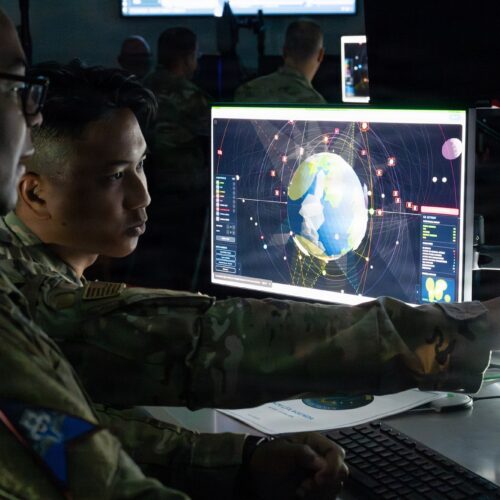
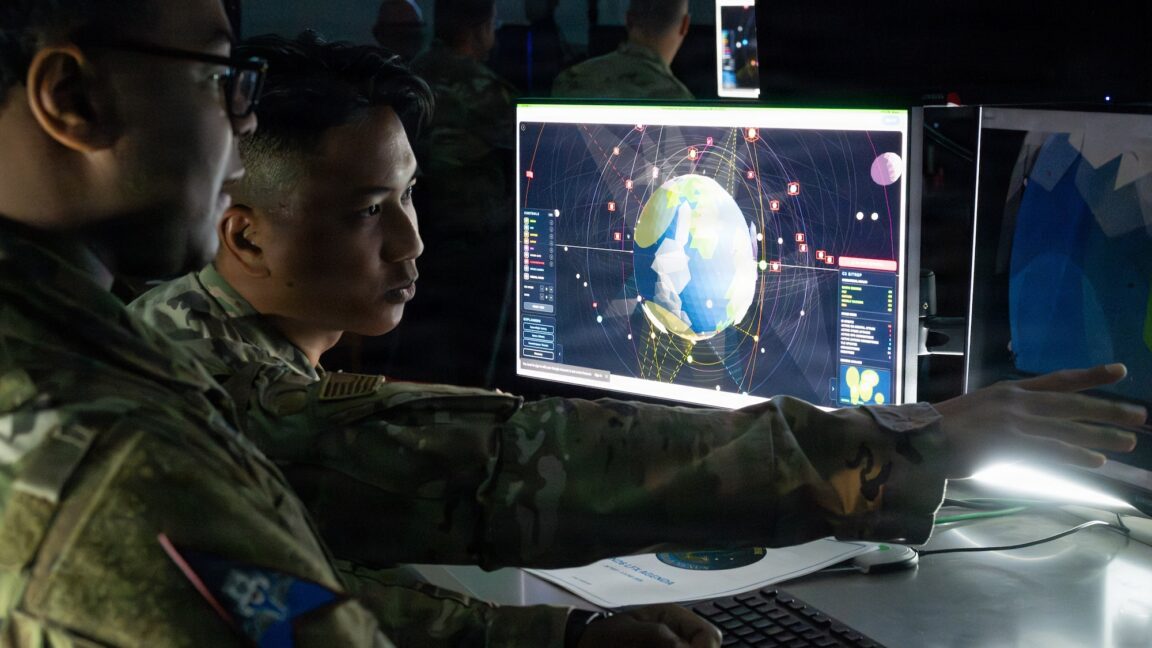
Air Force Secretary Troy Meink made the first public declaration Monday that the United States has placed "space control weapons" in orbit, an announcement that will surely reverberate in the power centers of Beijing and Moscow.
Space Force officials have previously expressed their interest in acquiring space-based weapons, and Pentagon leaders have become more open to discussing space warfare in recent years. Therefore, Meink's announcement Monday at the Air and Space Forces Association's annual Air, Space & Cyber Conference near Washington, DC, was not entirely unexpected.
“Today, we continue to ensure we remain ready to meet the challenges of evolving threats, wherever they exist. This is why the United States now has on-orbit space control weapons capable of defending the joint force against hostile adversary action,” Meink said in prepared remarks.
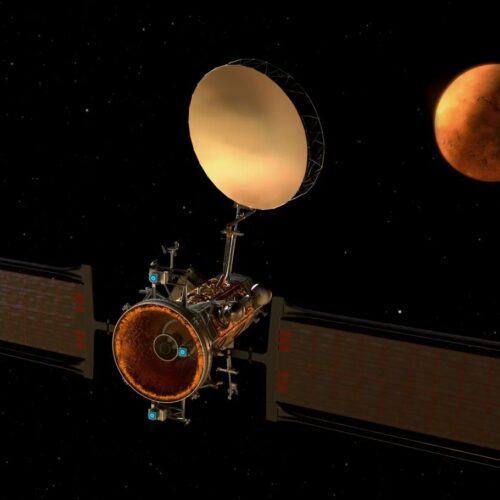
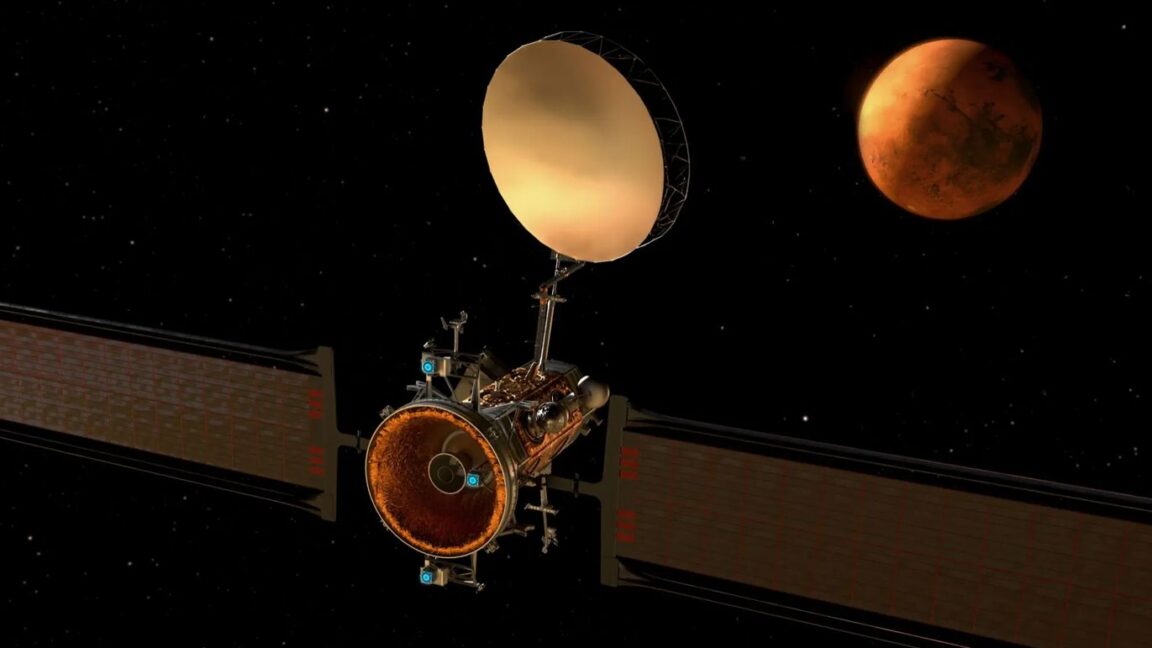
In theory, developing a spacecraft that will fly to Mars, insert itself into orbit around the red planet, and relay transmissions back and forth to large satellite dishes on Earth is a relatively straightforward proposition.
NASA's procurement of a "Mars Telecommunications Network" spacecraft, however, has turned out to be one of the most engrossing dramas of the year for the US space agency.
The agency finally reached a decision earlier this month, selecting Blue Origin to develop, launch, and operate a $700 million spacecraft at Mars. However, the main competitor for the award, Rocket Lab, was not happy—at all. On Friday, the company filed a protest of NASA's decision with the US Government Accountability Office.
If you’re in motorsport, or maritime, or mining fields, you can always call on a technician to come down and fix something when it’s broken. You can lay hands on the parts, reconfigure things, make repairs, and get something working again. In space, that’s seldom possible. If you’re lucky enough to have a manned mission, you might be able to make some running repairs; if you’re working with an unmanned robot, probe, or satellite, your potions are altogether more limited. If you can’t find a fix, it’s game over—a particularly brutal result when huge budgets and years of work are on the line.
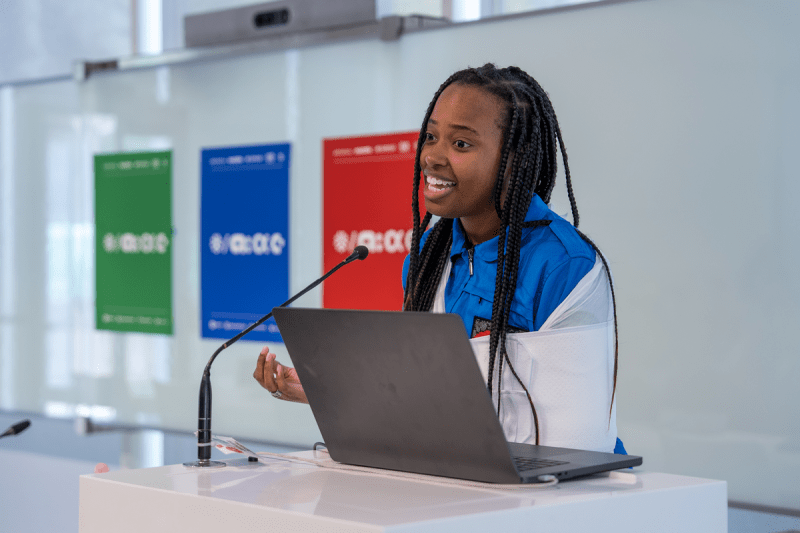
Janelle Wellons came down to Hackaday Europe to talk about space. More particularly, the engineering and debugging operations that keep all sorts of space programs alive. Her talk dives into some of the creative solutions engineers have had to come up with to save million-dollar missions from becoming unrecoverable boondoggles.
Janelle came down to Hackaday Europe to talk about space, because she lives and breathes it. An experienced aerospace engineer, she’s worked at NASA JPL and iSpace, contributing to the success of missions taking place far from our humble globe. She drew on that experience to talk through what it takes to keep a mission on the rails when things go a little sideways, which happens in space, just as it does anywhere else.
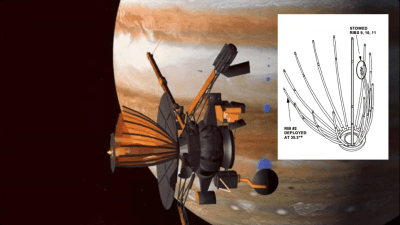
Galileo was supposed to have a powerful high-bandwidth link back to Earth. When the antenna failed to deploy, NASA engineers had to get creative to find a solution, as Janelle explains in her talk. Credit: talk slides
A fantastic example of that, retold in her talk, is the Galileo mission. It was built to travel far across the solar system, eventually winding up at Jupiter to study the Red Giant and its moons. The probe was engineered with a pair of communication systems—a low-gain antenna for vital signs and management, and a high-gain antenna for sending science data and images back to Earth. The high-gain antenna was key to the mission, capable of offering 10,000 times the bandwidth of the low-gain antenna.
Tragically, though, the high-gain antenna never got to play its starring role. It didn’t deploy properly after launch, and that left NASA with a probe capable of capturing all this fantastic science data, but no way to send it home at a reasonable data rate. Janelle steps through the multiple hacks that make the most of the communication link with the low-gain antenna. NASA engineers whipped up compression algorithms for images and science data, and figured out how to array several Deep Space Network antennas for better signal. This netted an effective data transfer rate of 1,000 bits/second with the low gain antenna. It was still a far cry from the 134 kilobits per second that should have been possible with the high-gain antenna, but a huge leap forward from the 8-16 bits originally possible with the low-gain rig. Ultimately, it saved the mission, allowing the capture of mountains of scientific data on the largest planet in the solar system.
“NASA Astronaut Christina Cook is also working through troubleshooting steps of the waste management system that’s aboard the Integrity spacecraft.” – Ground control, Artemis II mission, 2026
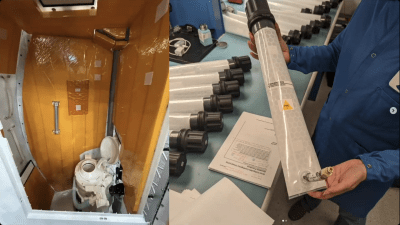
Left—the Artemis II toilet, a leap forward in space-based waste management technology. When it’s working, anyway. Right—the collapsible contingency urinals (CCU) used to capture and store liquid waste when the Artemis II’s main toilet was out of order. Credit: talk slides
Another great story told by Janelle concerned the Artemis II mission. The lunar flyby was part of NASA’s efforts to eventually return to the Moon itself, and was notable for debuting some special new hardware—the toilet. Unlike previous visits to the moon as part of the Apollo program, Artemis astronauts travel in luxury, with a proper commode built to handle the specific requirements of the zero-gravity space environment. Unfortunately, though, this new hardware had plenty of teething problems.
Early attempts to repair the system involved attempting to reprime the toilet’s pump by adding water to the system. It wasn’t long before the toilet threw another error, though. On the short-duration Artemis II mission, the toilet was set up to vent urine to space. Only, venting wasn’t working—with the suspicion being that the vent pipes had frozen over. The trick to solve this was simple—turning the spacecraft to face the vents towards the sun, so as to heat them enough to melt the blockage. Janelle also notes that during the multiple periods the toilet was down, the astronauts had to rely on alternative means of passing waste—showing a slide of the “collapsible contingency urinals” that did the job.
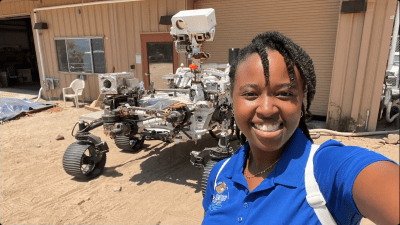
Janelle’s selfie, taken with the Perseverance twin rover at NASA JPL. Credit: Talk slides
There’s also a great look at Perseverance’s twin, which lives here on Earth. Janelle has been down to the Mars yard at NASA’s Jet Propulsion Laboratory, where engineers, in her words—”test before you do.” The problem is, when you’re driving a robot on a foreign planet, you can’t just send someone over to repair a broken wheel or flip it back up if it tips over. Thus, many maneuvers and operations are rehearsed in the Mars yard with the twin of Perseverance, running it over recreated obstacles to determine a safe plan of attack.
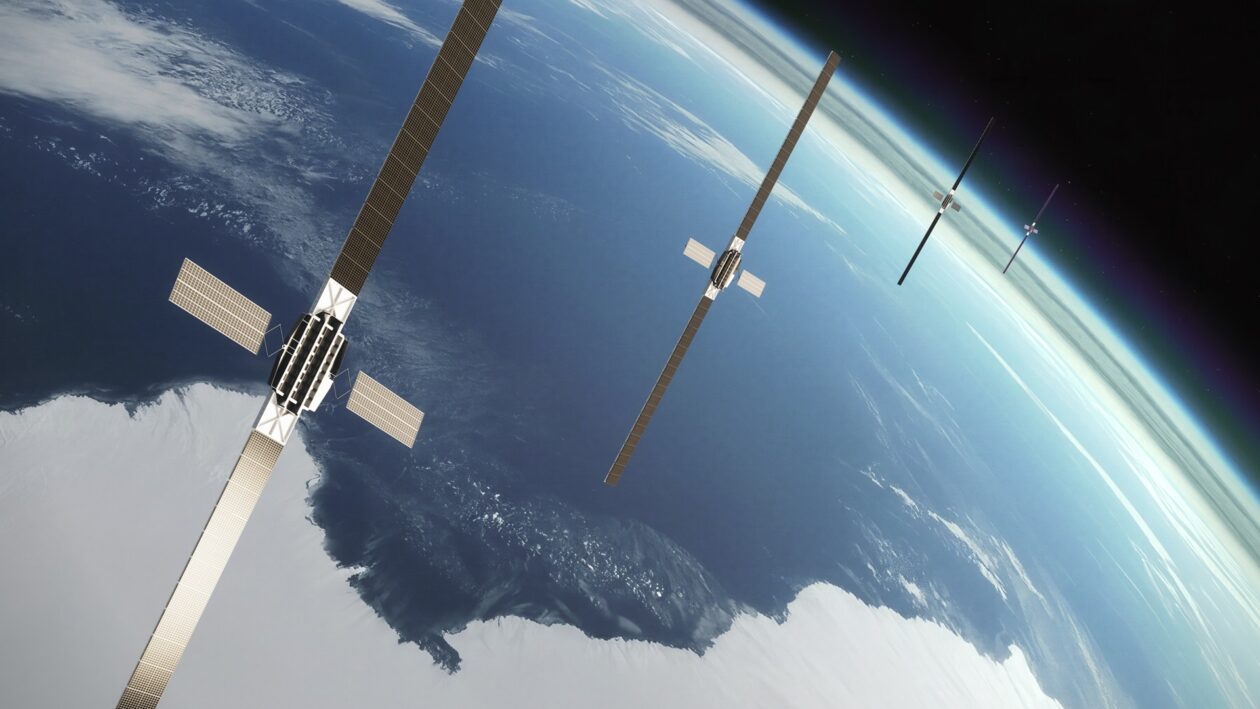
An artist’s conception shows several Sophia Space satellites in orbit. (Sophia Space Illustration)
Sophia Space and SLI, an aerospace leasing venture based in Washington, D.C., say they’ve agreed on a $300 million asset-financing framework that will support the creation of a 10-satellite constellation for high-performance computing.
The details of the arrangement are as notable as the bottom line: Sophia Space will build the satellites, leveraging the startup’s patented TILE technology for modular in-space data processing. SLI will purchase the satellites under the terms of a financing agreement.
“SLI as the lessor will purchase the satellites from Sophia, hold title to the assets, and lease them to the end user on a long-term basis in exchange for fixed monthly or quarterly payments,” Max Yergan, the company’s senior vice president for investments, explained in an email. “Full control and operational responsibility for the assets sit with Sophia and the end user, who will determine between them how operations are handled.”
Sophia’s satellites are designed to deliver on-orbit edge data services for a wide variety of applications. “The demand we are underwriting exists today,” Yergan said. “Earth observation, weather and supply-chain analytics, disaster response and defense ISR [intelligence, surveillance and reconnaissance] users all face the same constraint now: They collect far more data than they can bring to the ground, and its value decays while it waits to be downlinked. Processing on orbit addresses that directly.”
The constellation’s first launch is targeted for as early as 2028. SLI would pay out funds linked to development and launch milestones, all the way through verification that the on-orbit network performs to pre-agreed standards.
The arrangement is laid out in a non-binding letter of support. “The non-binding nature is a reflection of where we are in the process, and is typical of large asset financings,” Yergan explained. “It sets the commercial framework so both parties can commit resources while definitive documentation is negotiated.”
Leasing arrangements are often seen in aviation and the maritime industry, but this is a relatively new concept for satellite ventures.
“This is the first time that this approach has been applied to this kind of constellation, but not the first time for in-space assets,” said Gareth Zundel, SLI’s senior vice president for communications. “In December 2025 we announced the acquisition of two AscendArc satellites that will be offered to operators on leasing terms. Then, in March this year, we did a similar deal with ReOrbit. We do believe, however, that we are the first leasing company to specialize in the space sector.”
Rob DeMillo, Sophia Space’s CEO and co-founder, said the arrangement demonstrates how far the commercial space industry has come.
“Asset financing didn’t invent aviation or shipping, but it accelerated them at scale,” he said in a news release. “We’re doing the same for orbital computing. This approach with SLI signals that Sophia Space’s space infrastructure is mature enough to attract the capital structures that have historically built terrestrial infrastructure.”
The approach also gives Sophia Space — which is headquartered in Pasadena, Calif., but also has strong ties to the Seattle area — access to capital without diluting the equity held by current investors, including Unlock Venture Partners in Seattle.
“Sophia has the technology, the team and the vision. What had been missing was access to scalable, non-dilutive capital,” said Praveen Vetrivel, SLI’s CEO. “This framework provides it, giving them the capacity and flexibility they need to build the next layer of digital infrastructure.”
Each of the 10 satellites in the constellation will link together six of Sophia’s TILE (Thermal Integrated LEO Edge) modules, with four Nvidia Jetson processors on each module. That adds up to 240 edge computing servers in orbit.
“These 10 spacecraft are dedicated to this transaction,” Yergan said. “Sophia’s other programs and partnerships involve separate spacecraft and separate funding and are not directly affected by this facility.”
Sophia Space has previously said that it plans to start selling TILE systems and related components to customers in 2028. The company is also collaborating with Axiom Space, Armada and Kepler Communications on separate in-space computing initiatives.
In June, Sophia Space announced the conclusion of a $7 million financing round that brought the company’s total funding to $22 million. That round took advantage of an arrangement known as a Simple Agreement for Future Equity, or SAFE, in which investors provide cash to a startup in exchange for the right to receive stock later.
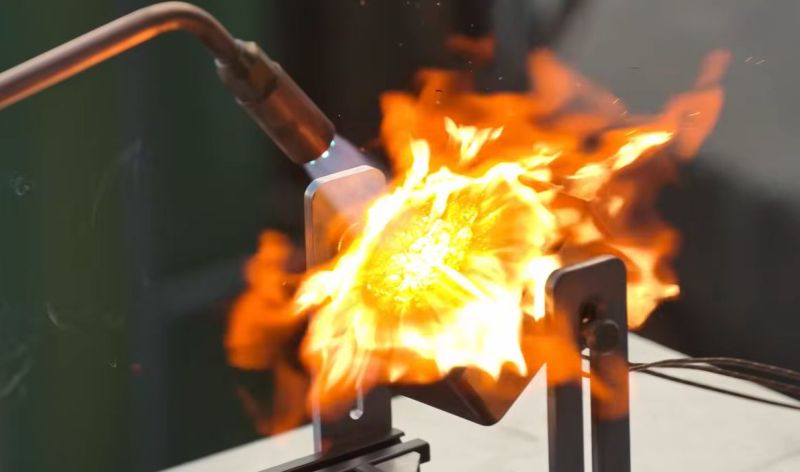
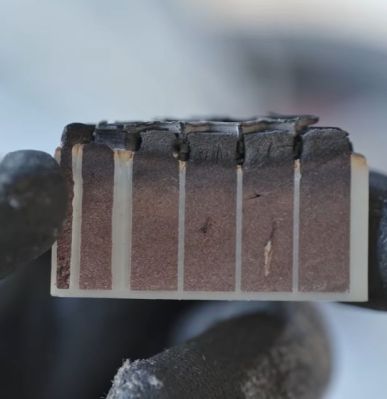
After the Orion capsule of the Artemis I lunar mission returned to Earth, it was found that massive chunks of its heatshield had been ripped off, posing a serious risk to any future missions. In a recent video in which [polymatt] takes a break from repairing old laptop shells and the like, he tries to recreate the Orion’s heatshield using a variety of methods and materials.
For this test a number of samples were created, each using the same kind of segmented structure as the larger Orion heatshield. The filler was created from the published materials for the heat shield by NASA, requiring just serious mixing.
The resulting samples were then cured with thermocouples inserted, before they got blasted with the heat from a propane torch, trying to simulate the various re-entry patterns.
Perhaps unsurprisingly, the results matched the findings by NASA for why the Orion’s heat shield had failed, being the build-up of gases due to the sustained pyrolysis processes that eventually fractured the material. Despite some experimental flaws that injected residual heat from the copper structure, this still seems to be a pretty good setup to test ablative heat shields in DIY lab conditions.
Launched in 1976, LAGEOS-1 (LAser GEOdynamic Satellite) is unusual in that it contains no instrumentation, no electronics, no power supply, and no means of propulsion. It’s spherical, weighs just under 407 kg, and looks a bit like a disco ball. It may not be accurate to say it does nothing, but unlike most satellites its role is entirely passive. It’s also one of the oldest scientific satellites still in service.
The lens-like objects covering the surface of LAGEOS-1 are corner cube retroreflectors, which have the nifty effect of always reflecting incident light right back towards its source.
Ground stations fire short laser pulses at it and measure the time it takes for the light to return, a form of time-of-flight ranging. Since LAGEOS-1’s orbit is highly stable, it provides a reliable reference point for measuring even tiny changes in the Earth itself. The size, shape, rotation, and more of our planet can be measured as a result. LAGEOS data (LAGEOS-2 was launched in 1992) has also been used in tests of general relativity.
Its orbit and construction were deliberately chosen so that atmospheric drag and other disturbances would be minimal. The simple, maintenance-free design combined with an extraordinarily stable orbit means LAGEOS is expected to circle our world for millions of years to come.
LAGEOS-1 also contains a message to the future in the form of two identical plaques prepared by Dr. Carl Sagan just in case there’s anyone around to find it some day. Check out the short 1975 video from NASA, embedded just below.
A new study suggests Mercury may have shrunk about 30% more than scientists previously thought, losing as much as 14 miles in diameter as its interior cooled and contracted over billions of years. "That's significant for a planet barely 3,000 miles (4,900 kilometers) across," reports the Associated Press. From the report: Mercury's rough surface, continually reshaped by debris hurled from impact craters, may have hidden the true extent of the loss, according to the researchers whose findings appear in the journal Geophysical Research Letters. The news comes one week after a pair of European and Japanese spacecraft shed its cruising platform and advanced toward Mercury. Known as BepiColombo, the linked craft are expected to enter orbit around Mercury in November before splitting up for a fuller survey.
BepiColombo's laser instrument should confirm how much Mercury is withering as a result of internal cooling, said Gaku Nishiyama, the study's lead author who is taking part in the space mission. The shrinkage could be even more than his team is estimating based on measurements from NASA's Messenger spacecraft in the 2010s. Only one other spacecraft has ever visited Mercury, NASA's Mariner 10 in the 1970s.
If you ask most satellite companies aside from SpaceX, they will tell you the world doesn't have enough capacity for launching payloads into orbit. This is despite the blistering launch cadence we've seen around the world in recent years, led by SpaceX's Falcon 9 rocket.
Customers in any sector will, of course, usually welcome competition. Theoretically, competition will lead to lower prices and allow the best to rise to the top. It seems like the customers buying launch services were right. SpaceX is dialing back its Falcon 9 launch program, and there is no certainty about when SpaceX's reusable next-generation super-heavy-lift rocket, Starship, will carry anything to orbit besides the company's own Starlink satellites.
So it's no surprise satellite operators are cheering the success of a new launch provider. This was especially the case a few days ago, when Germany's Isar Aerospace reached orbit for the first time with its Spectrum rocket. The launcher delivered a batch of CubeSats to low-Earth orbit from a spaceport in northern Norway, and Isar tasted success after its first test flight ended in failure last year.
NASA has released a document that provides some initial details about the proposed United States Space Academy, and it's clear that the space agency wants to move quickly in establishing the institution.
According to the document's timeline, NASA seeks a groundbreaking for a permanent campus no later than next year, the first class to be enrolled and begin studies in temporary facilities in 2028, and a transition to a permanent campus in 2031.
Pretty much every rocket company in the United States, save one, has embraced two fundamental tenets: reusability and diversification.
Most famously, SpaceX branched out from reusable rockets to pursue and dominate a growing spectrum of space services: cargo delivery, human spaceflight, satellite production, broadband, and, perhaps soon, orbital data centers and in-space manufacturing. Blue Origin is evolving from a pure rocket company into a satellite manufacturer, robotics developer, and, most recently, a potential competitor for SpaceX's Starlink network.
Rocket Lab used a different approach to diversify after achieving success with its small Electron launch vehicle. The company relocated its headquarters from New Zealand to Southern California, started building spacecraft and payloads, and then went on a spree of corporate acquisitions to expand into satellite communications and take on a new role as a merchant supplier of satellite components and sensors. It's now in a stage of advanced development of its partially reusable next-generation Neutron launch vehicle.
Welcome to Edition 9.10 of the Rocket Report! This week we're celebrating a historic moment in Europe when a German rocket company successfully put its launch vehicle into orbit. Isar Aerospace became the first purely commercial European company to reach orbit, and impressively it did so on just its second launch attempt. How quickly can they scale up operations? How quickly will the second European launch firm reach this goal? Big questions, which for now we don't have answers to.
As always, we welcome reader submissions, and if you don't want to miss an issue, please subscribe using the box below (the form will not appear on AMP-enabled versions of the site). Each report will include information on small-, medium-, and heavy-lift rockets as well as a quick look ahead at the next three launches on the calendar.
Isar Aerospace takes a huge step forward. Isar Aerospace, founded in 2018 by three students at a German university, successfully launched a privately developed rocket into low-Earth orbit on Saturday from a Norwegian spaceport inside the Arctic Circle. The two-stage rocket, Spectrum, became the first fully commercial launch vehicle in Europe to reach orbit, Ars reports. With Saturday’s success, Isar becomes the clear leader among a pack of several European launch startups vying to inject some competition into Europe’s stagnant launch market.
The European Space Agency is moving "full steam ahead" with development of a robotic mission to Venus after NASA officials determined they were unlikely to fulfill a commitment to provide a US-built radar instrument for the spacecraft, the mission's project scientist said.
The European orbiter, named Envision, will map the Venusian surface at 10 times higher resolution than the last radar mission sent to Venus by NASA in the 1990s. The planet is enshrouded in a blanket of thick clouds of sulfuric acid, rendering its mysterious surface unseen by optical cameras in orbit. Radar is the most effective way to penetrate the clouds of Venus to reveal the terrain below, and scientists will use Envision to look for signs of active volcanism.
NASA and ESA signed a memorandum of understanding in 2024 outlining their partnership on Envision. NASA agreed to supply a US-made synthetic aperture radar instrument, Envision's primary means of mapping the surface of Venus, along with providing tracking and communications support through NASA's Deep Space Network. In exchange, ESA would include US researchers on Envision's science team. Europe would build the Envision spacecraft and the rest of its science instruments and provide the launch on an Ariane 6 rocket.
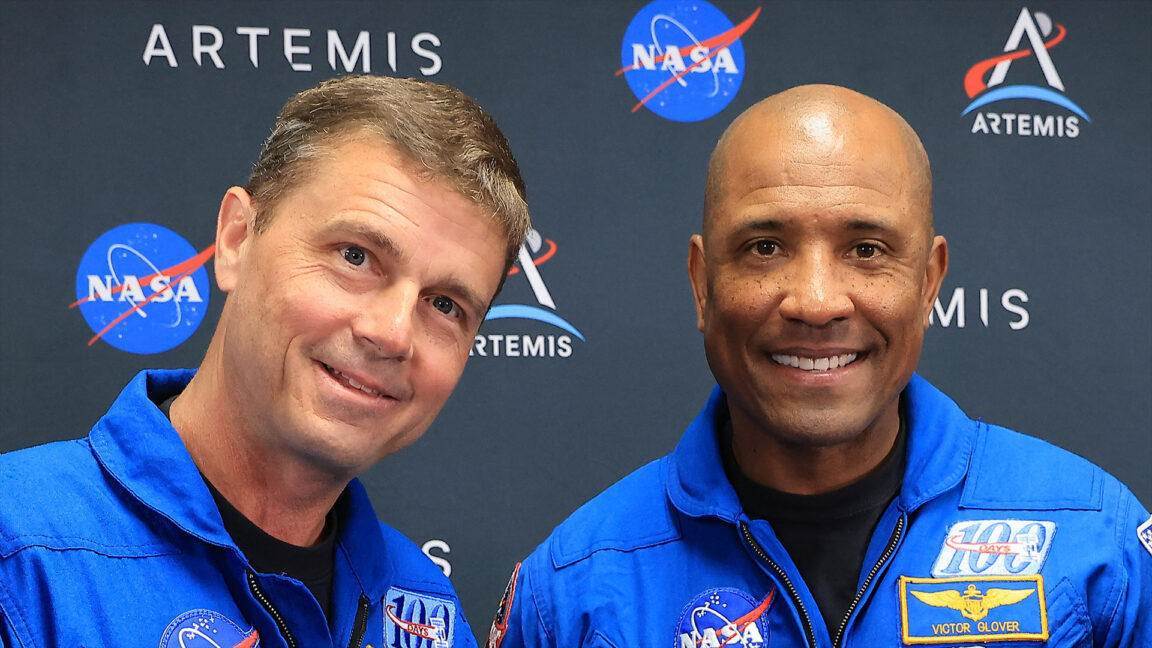
The commander and pilot of NASA's Artemis II mission have gained a new distinction five months after splashing down from the Moon: They're not fully retiring from the space agency.
Reid Wiseman and Victor Glover are the first astronauts to join NASA's emeritus program, enabling them to continue to support the work being done at Johnson Space Center in Houston. They will remain available to train and mentor the current workforce while still being able to pursue employment and opportunities outside of NASA.
"I have asked NASA ... to not use the term 'retire' as much, but technically emeritus is a retirement program," Glover told collectSPACE.com on Wednesday. "It's something we have typically done for scientists when they have groundbreaking research, and they want to go back to academia to teach or to research and publish."
alternative_right shares a report from ScienceDaily: A new analysis of more than 1,700 supernovae is questioning whether the universe is really accelerating at all. After accounting for the ages of the stars that produce these explosions, researchers found signs that cosmic expansion may actually be slowing. They also argue that the apparent acceleration changes with direction, which would be difficult to explain with dark energy. Other cosmologists dispute the conclusion, setting up a major test for upcoming observatories. The analysis has been published in Monthly Notices of the Royal Astronomical Society.
The conclusion is disputed, though. The report mentions a separate paper co-authored by Professor Maria Vincenzi, also at the University of Oxford, that "concludes that observations continue to support an accelerating universe."
All of a sudden, French entrepreneur Hèlene Huby is seemingly everywhere.
This week she is serving as one of two envoys, alongside astronaut Thomas Pesquet, at a high-profile International Space Summit convened by French President Emmanuel Macron. The government's website for the event describes her as chief executive of "the fastest-growing space company in Europe."
Also this week, that firm, The Exploration Company, announced a significant capital raise of $450 million in Series C funding. Although not spectacular by the standards of some US space businesses, this is the largest-ever Series C funding round by a Europe-based space company, and likely the largest funding round ever raised by a female-led company in Europe.
The West8 office building in Seattle’s Denny Triangle neighborhood. (Image via West8Seattle.com)
General Motors is expanding its presence in the Seattle region with a new downtown office slated to open in early 2027.
The automotive giant signed a lease for a 43,000-square-foot space at West8 in the Denny Triangle neighborhood, with plans to bring together employees across digital products, autonomous vehicles, IT, HR, and marketing, the company announced Wednesday.
GM currently employs about 200 remote workers in the region. A spokesperson said the new office will bring those existing team members together while providing room to recruit additional talent. The layout will feature a mix of traditional workstations, flexible lounge seating, and collaborative huddle spaces.
When the office opens, it will follow GM’s hybrid work policy, requiring employees living within a 50-mile radius to work on-site three days a week.
GM said tapping into Seattle’s deep technology talent pool will help grow its concentration of technical staff and attract engineers specializing in artificial intelligence and machine learning. The company credits its Seattle-area software teams with building the technical foundation behind its on- and off-vehicle platforms.
Located at 2001 8th Ave., the West8 building sits two blocks from Amazon’s headquarters campus and the Spheres. Amenities available to GM staff will include a fitness center, bike storage with showers, an onsite café, outdoor spaces, and covered parking equipped with EV charging stations.
The Seattle footprint adds to GM’s network of major tech hubs outside Michigan, including locations in Austin and the Bay Area.

 Login
Login
 After the Orion capsule of the Artemis I lunar mission returned to Earth, it was found that massive chunks of its heatshield had been ripped off, posing a serious risk to any future missions. In a recent video in which [polymatt] takes a break from repairing old laptop shells and the like, he tries to