This week on the GeekWire podcast: Microsoft and Amazon both reported quarterly numbers, and both stocks rose on cloud results that beat expectations. Is all that AI spending paying off? And in related news, Microsoft sees a rare annual headcount decline, hitting product R&D hardest.
Plus: Satya Nadella builds a Power BI dashboard out of an analyst’s research report, and touts it on the earnings call to make a bigger point. Jeff Bezos names Amazon’s chips business as the long-awaited fourth pillar. And AI House managing director Jacob Colker delivers a much-needed pep talk for Seattle tech, calling on the region to recognize and build on its strengths.
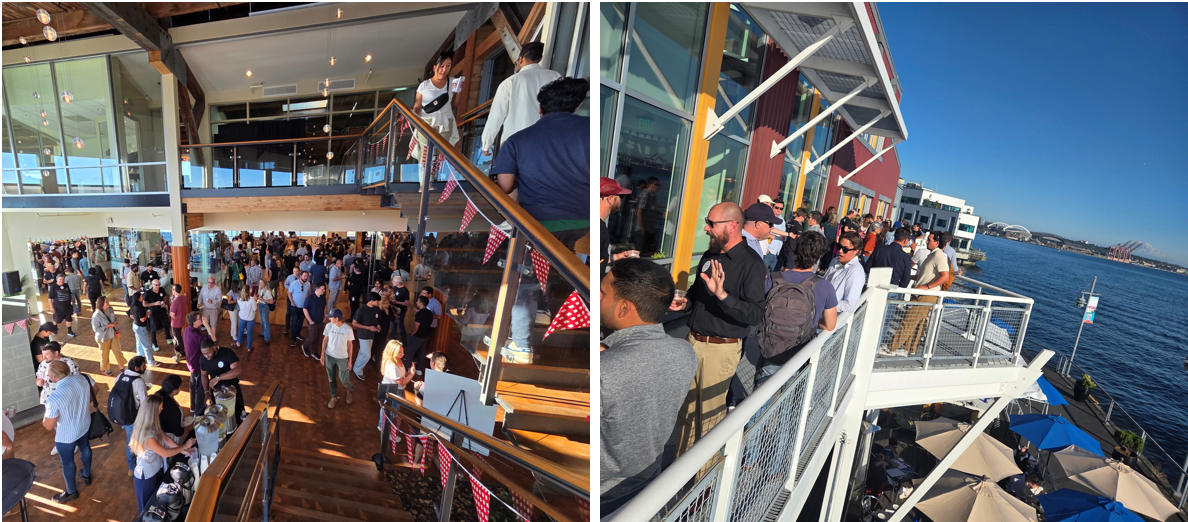
Seattle Tech Week attendees fill AI House at Pier 70, spilling onto the deck overlooking Elliott Bay. (GeekWire Photos / Todd Bishop)
Attending as many Seattle Tech Week events as possible and talking with as many people as I could, I was struck by the number of people looking for work and the volume of visitors from the Bay Area, including a number of investors looking to get a sense for what the regional tech scene is about.
It was hard not to imagine them being impressed with the sheer level of engagement and enthusiasm, even if they didn’t happen to catch Jacob Colker’s rallying cry. With more than 250 events (and waiting lists for many of them) it was more than any one person could take in.
It wasn’t Seattle AI Week — that’s still to come in October — but given the moment in tech and the world, the topic of artificial intelligence was naturally the main throughline of the week.
A panel that changed my perspective was early in the week, called “Foundation Models Go Vertical,” hosted by the Seattle pre-seed firm Ascend at Washington 1000 downtown. Founding general partner Kirby Winfield told the room that 600 people had tried to get in.
One of the biggest insights was from Manos Koukoumidis, CEO of Kirkland-based Oumi and a former Google Cloud AI engineering manager who led large language model efforts there.
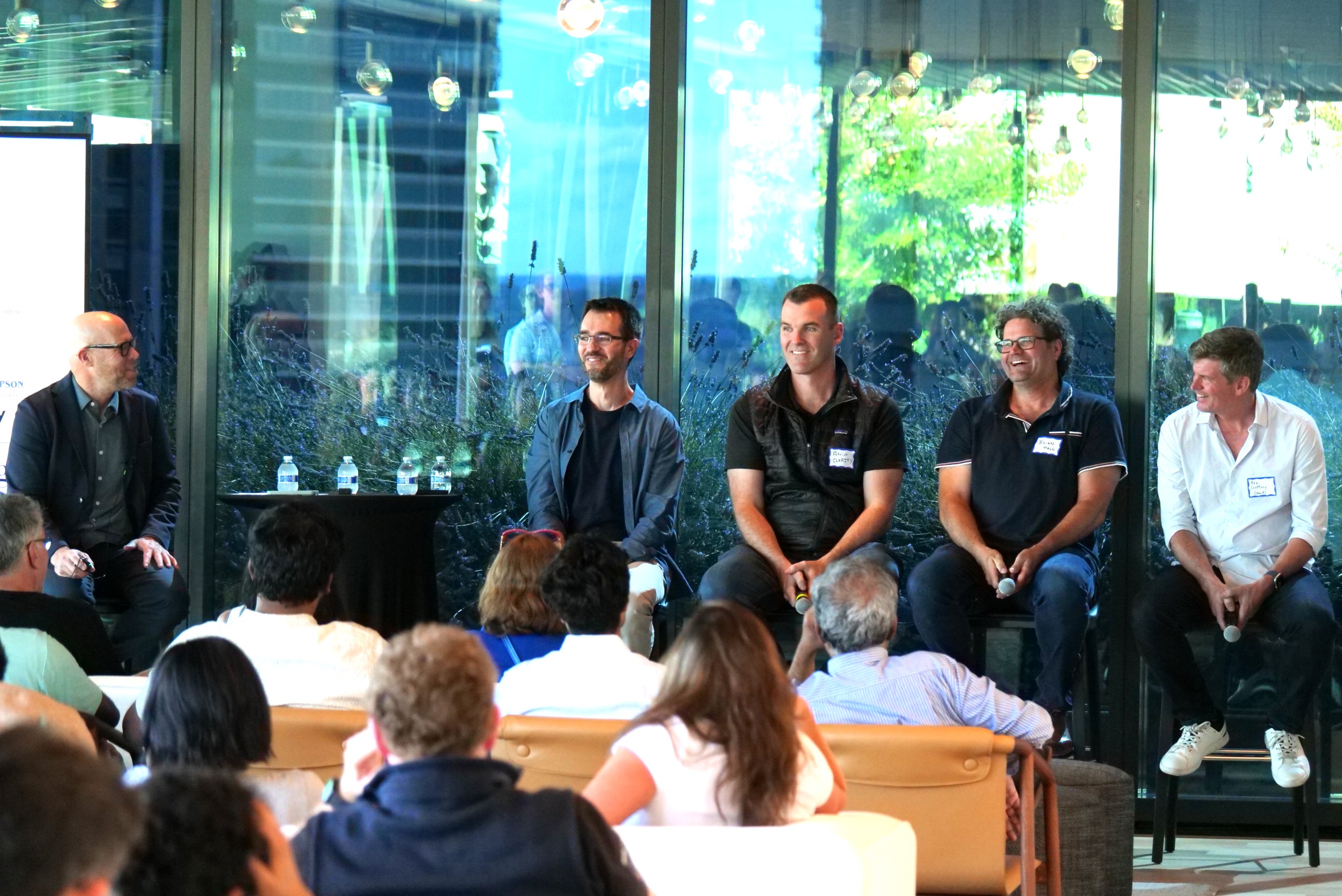
From left: moderator Boaz Ashkenazy of the Shift AI podcast, Manos Koukoumidis of Oumi, Patrick Thompson of Clarify, Brian Hall of Mistral AI, and Ben Gaffney of OpenAI at the “Foundation Models Go Vertical” panel, hosted by Ascend. (GeekWire Photo / Todd Bishop)
Companies that are racing to build on top of the frontier models, he said, are renting a kind of intelligence that has very little to do with their own businesses.
“Enterprises are using a model that is trained on 5% of the world’s data that sits on the web, not the other 95%,” he said, referring to the data sitting inside their own organizations.
Which led him to the question (and the point) that I keep coming back to: If the intelligence at the center of the product belongs to someone else, he asked, “are you really an AI company, or an application company on top of somebody else’s intelligence?”
The next day, in the audience for a recording of the Founded & Funded podcast by Seattle Tech Week organizer Madrona, I posed the question that we debated on last week’s episode of our GeekWire Podcast: what should Seattle founders and investors make of venture numbers that rank Philadelphia, Austin, and New York ahead of them?
It was the right place to ask, given that the show featured Nizar Tarhuni, EVP for research and market intelligence at PitchBook, which tracks the numbers, and Madrona partner Sabrina Albert.
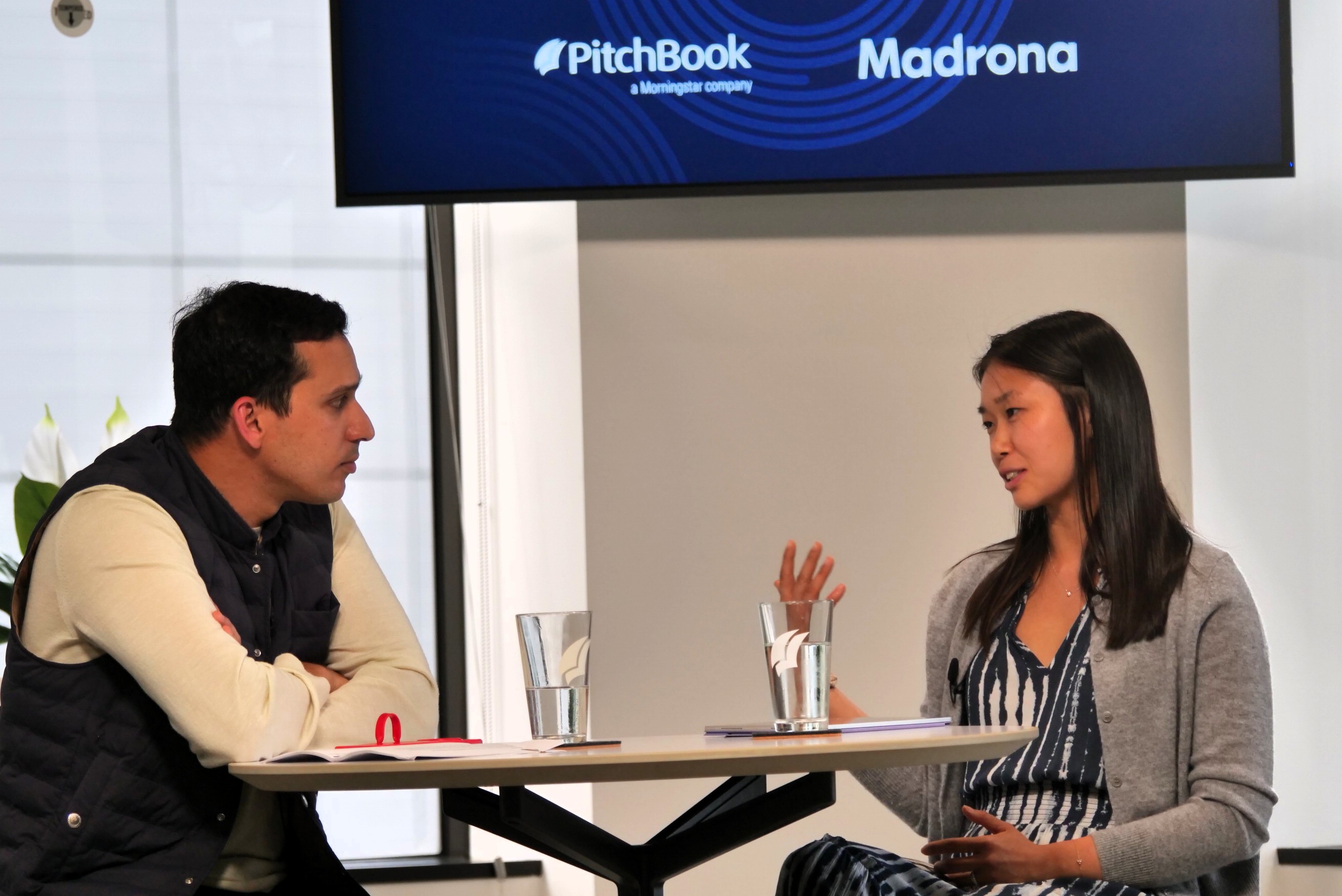
PitchBook’s Nizar Tarhuni and Madrona partner Sabrina Albert during a live recording of Madrona’s Founded & Funded podcast at Seattle Tech Week. (GeekWire Photo / Todd Bishop)
Albert pointed out that the numbers don’t capture everything. A company can have a big engineering group in Seattle, or even a co-founder here, and still be counted as a Bay Area company, she said. Large engineering offices for OpenAI and Anthropic are the latest examples.
Tarhuni made a similar point: “There’s so much talent in some of the biggest unicorns that are actually working out of Seattle,” he said. In terms of overall economic activity, he added, “there’s a lot more here that doesn’t make its way into those numbers.”
Other quotes and insights that stood out from the sessions we attended:
Patrick Thompson, CEO of Seattle-based Clarify, said his company’s Anthropic bill had tripled in three months. He has shifted spending to AWS Bedrock, citing reliability problems, and now runs smaller models locally on his own laptop for low-level work.
Madrona’s Albert, on the shift to selling outcomes: “Before, when you were thinking about traditional software, you would charge for a seat or a unit of software. But now you can really fundamentally change it. … If I deliver this outcome for you, then you can actually pay me for it.”
Ken Horenstein, founder of Pack Ventures, which invests in startups tied to the University of Washington, on the knock that Seattle is slow: research institutions here are “choosing problems that are 10, 15, 20, 50-year problems,” he said. “Sometimes people put that as a negative rap on us because we don’t go really fast and flame really bright like you might see in other markets. But I actually think that can be used as a benefit.”
Ben Gaffney, deputy general counsel at OpenAI, on the notion that AI is thinning out headcount: “Even within the legal team that I work in, we need more people. Even though we’re getting all these massive productivity gains, it isn’t like you don’t need people to supervise this stuff.”
Brian Hall, the longtime Microsoft, AWS and Google executive who became chief marketing officer at Mistral AI in June, on where this all ends up: “We’re gonna laugh when we thought that AI was gonna save us time.”
Ascend’s Winfield, on the limits of what investors provide: “If I invested in you, it’s not because I’m smart about your market. It’s because you’re smart about your market. … If you’re looking for answers from your investors, you’re in trouble.”
Karl Siebrecht, co-founder and CEO of Flexe, at a networking event, telling founders to stop networking: “Spending time as a founder trying to market yourself to investors, I think, is a fallacy. If you focus on building a valuable company … I can promise you, investors will find you.”
Molly Klein, founder and CEO of Perk Events, who runs some of GeekWire’s biggest events, on why any of this happens in the first place: “Events are hands-down the strongest business development tool that you have,” she said. “One conversation may take six emails in three weeks. At an event, it happens in 10 minutes, because you’re getting that face-to-face time.”
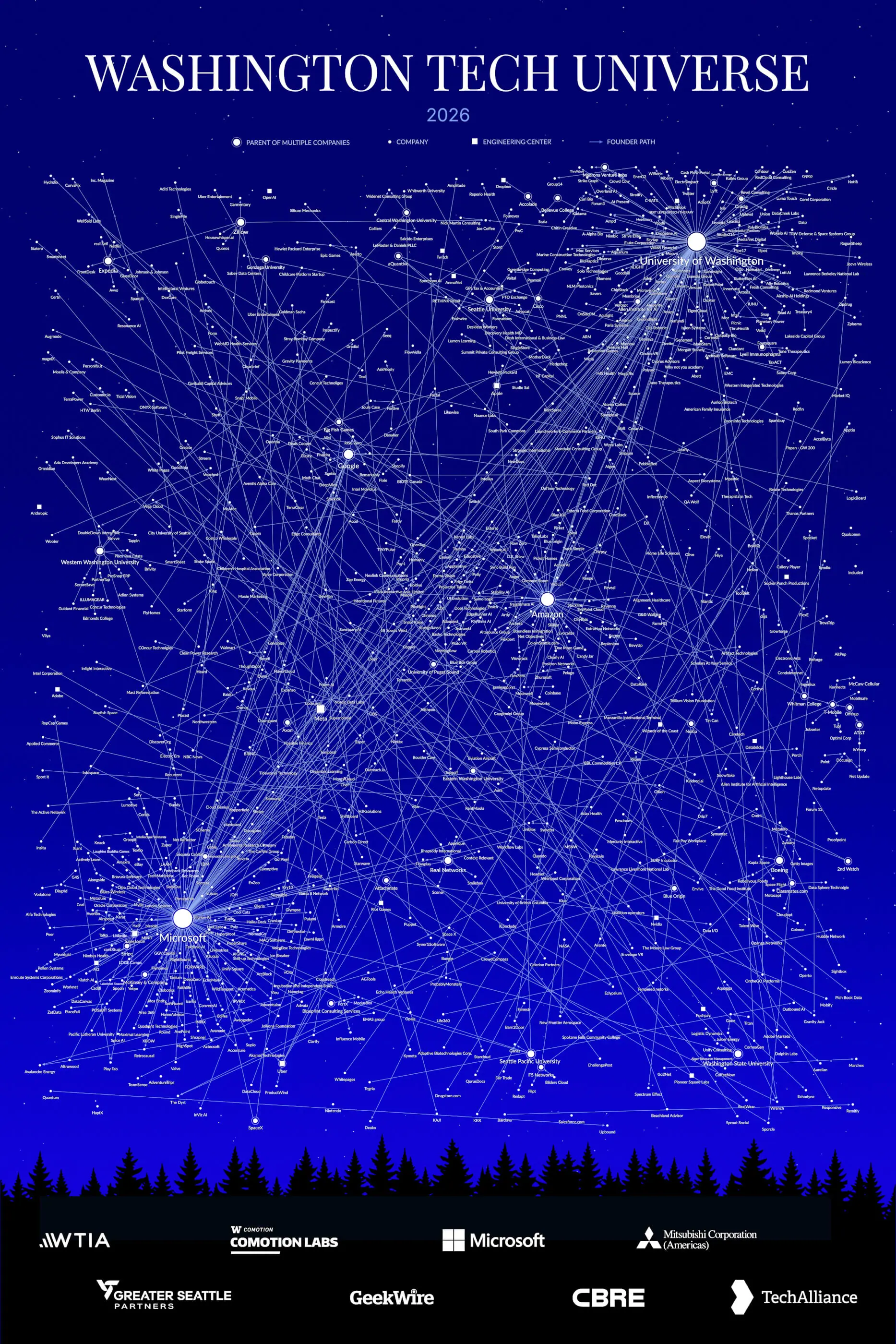
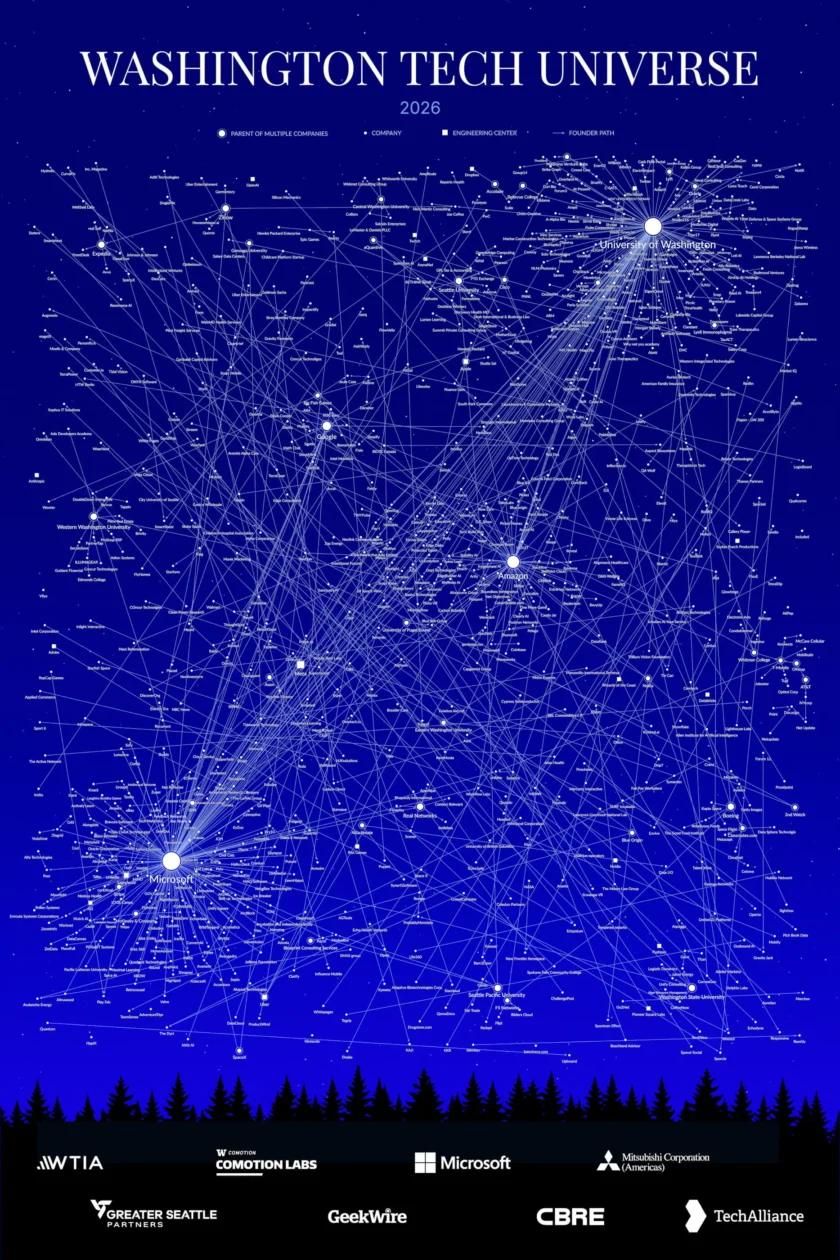
How interconnected is Washington’s tech industry? Enough that a large share of the state’s companies can trace their lineage to Microsoft, the University of Washington, Amazon, and a handful of other institutions.
A new visualization from the Washington Technology Industry Association (WTIA), unveiled this week, charts those family trees. But the “Washington Tech Universe” map offers only a partial view: Washington is home to 25,000 tech companies, and just 625 are featured.
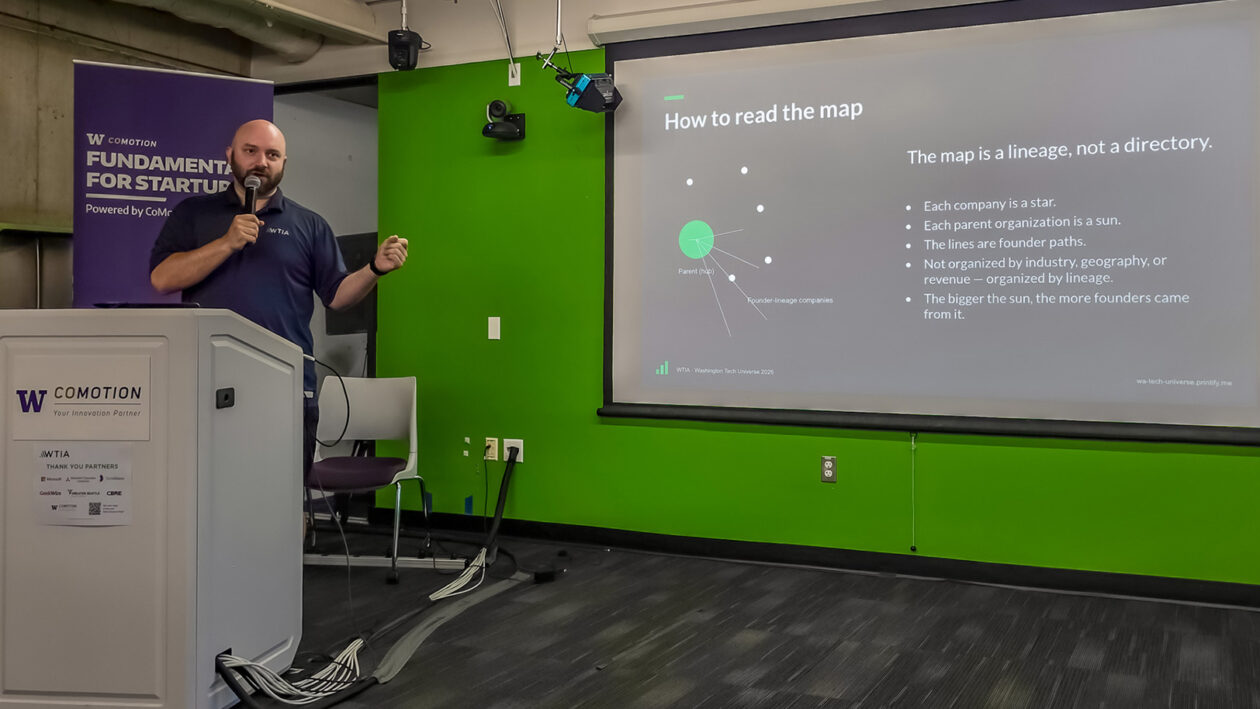
“This is not a ranker of all the best companies,” said Nick Ellingson, WTIA’s vice president of innovation and entrepreneurship, during a presentation at Seattle Tech Week. The point, he said, is to show the region’s connectivity and to make the case for investing in the community as a whole.
The “Tech Universe Map” comes 11 years after the trade group published a similar visualization. According to Ellingson, the update came because people kept asking for it, not because of a single event. It’s unrelated to WTIA’s efforts to help Washington establish a public AI narrative.
That said, the 2026 edition is markedly different from the one in 2015: The new map looks at the entire state, aiming to comprehensively chart the connections among different companies, while the prior version was limited to companies in Seattle, with a more narrow focus on acquisitions and similar data.
Microsoft and UW produce the most founders
WTIA’s data shows that today, Washington has four main founder “hubs,” with Microsoft being the largest. About a quarter of the mapped companies — 161 of 625 — have at least one founder who came out of Microsoft. UW is the second with 143 companies, followed by Amazon, which anchors 58 firms. Google rounds out the group with 20 connections, though it’s a pipeline that didn’t exist in WTIA’s 2015 map.
WTIA’s Vice President of Innovation and Entrepreneurship, Nick Ellingson, unveils the 2026 “Tech Universe Map” at the University of Washington’s Comotion Lab on July 27, 2026, explaining how to read the map. (Photo by Ken Yeung, click to enlarge)
UW isn’t the only school producing founders. WTIA’s map traces company lineages to Washington State, Western Washington, Central Washington, Eastern Washington, Whitman College, Seattle University, and Seattle Pacific. Still, UW accounts for 70% of the map’s university connections.
Broken down, the data shows that nearly two out of three companies (64%) grew out of another company listed on WTIA’s map. A third came out of a university, or out of a company that operates in Washington without being headquartered here.
Google is the clearest example of the latter since it’s based in California but has a significant presence here. Moreover, WTIA found that 44% of mapped companies had founders who previously worked at two or more Washington organizations before starting theirs.
Ellingson called the hubs “gravity wells that bend the entire region toward the next generation of founders” in the announcement.
However, he cautioned that this pipeline concentrated around four main sources could be a risk. Some of the hubs he expects to grow next, such as Google, OpenAI, Anthropic, and Nvidia, are headquartered elsewhere and maintain engineering centers here, a presence that is easier to scale back. Microsoft, Amazon, and UW aren’t going anywhere. The next generation of hubs has no such guarantee.
To mitigate this risk, Ellingson called for broad community support for these hubs, saying it would keep the flywheel going.
These companies, he said, “are growing not just the jobs at their companies, but they’re creating the next employers, venture-scale startups, and tech companies that go on to build amazing things, and hire the next generation of talent here and bring more talent to the area, who then go and create their own startups.”
The next hubs are forming around AI
WTIA also recognized AI’s impact on Washington’s tech ecosystem. Although the technology was not a formal selection criterion, it became evident that AI would be a dominant theme among the featured companies. In fact, firms like Read AI, Karat, Yoodli, Outreach, and Pictory appear on the map for the first time. And Ellingson revealed that “many of the startups on the map are AI startups.”
“Twenty-three percent of the AI talent in the United States is here in Seattle,” he said.
That, along with the burgeoning startup ecosystem, is why organizations like the Allen Institute for AI (Ai2) and AI House, are poised to have large constellations of their own. AI House was formerly the AI2 Incubator. It spun out as an independent entity in 2022 and rebranded in June.
WTIA noted that Ai2 is the first research lab on its map to operate as a “founder factory.”
Other AI companies making their presence known on the “Tech Universe Map” include OpenAI and Anthropic. While not Washington-native, both AI model makers have established or expanded their outposts in the state since 2015.
Ellingson predicted that, like Ai2, both would eventually become major hubs.
How companies were selected
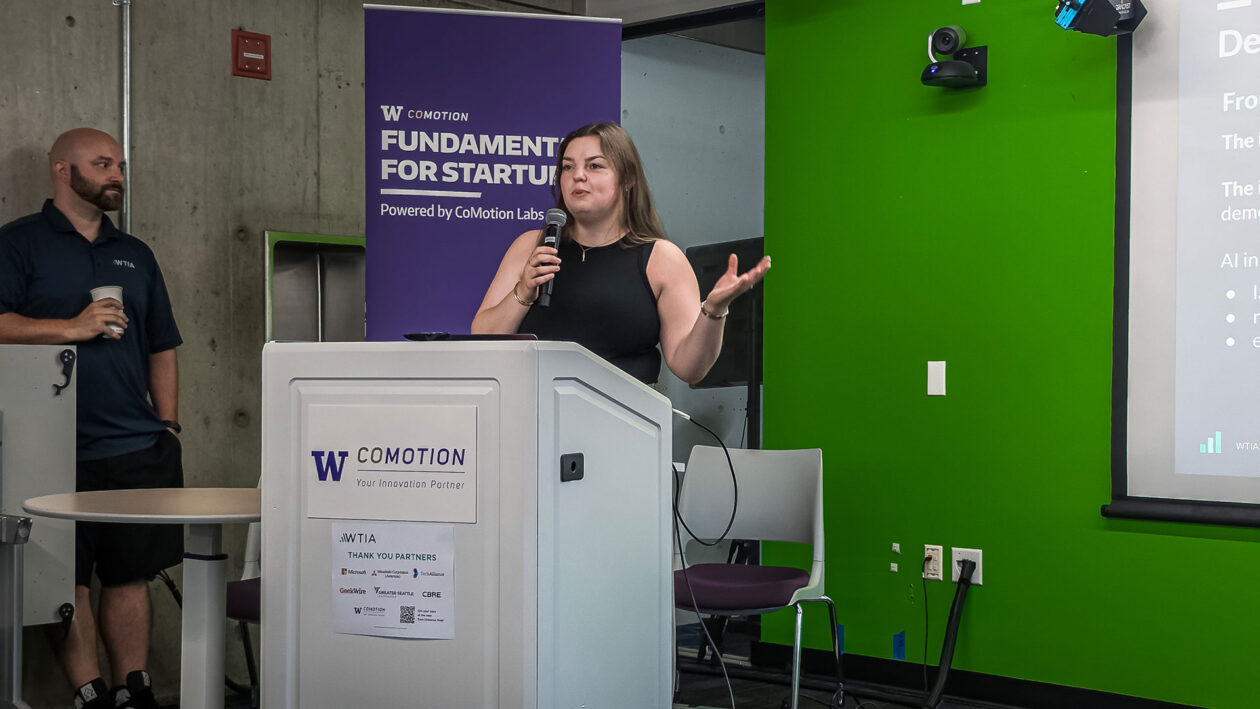
UW alumni Jessica Forcucci explains her design process in creating WTIA’s 2026 “Tech Universe Map.” (Photo by Ken Yeung)
To create the “Tech Universe Map,” WTIA started out with a dataset of 3,500 Washington-based tech companies with at least $1 million in funding or revenue according to PitchBook.
The group was filtered further to those that were headquartered or had notable engineering centers in the state, were still active, and had “meaningful” Washington-grown connections through founder or university lineage. The GeekWire 200 was also used in the process.
WTIA enlisted the help of UW graduate Jessica Forcucci and a team of designers to create the visualization. In brief remarks, Forcucci explained her vision for the “Tech Universe Map,” saying the goal was to “demonstrate the interconnectivity” these companies had with each other.
Predicting what the next map will look like
As Washington’s tech ecosystem evolves, Ellingson predicted there will not only be bigger constellations of AI companies, but also quantum, fusion and advanced energy, and space and defense. He believed more tech clusters will blossom statewide beyond King County.
Ellingson said WTIA is seeing real growth in Wenatchee, the Tri-Cities and Spokane. Those regional clusters are small now, he said, but he expects them to be substantial by 2031.
To make the next map happen, Ellingson urged people to open doors for others, make introductions without expecting anything in return, and give first, building community and forming new constellations.
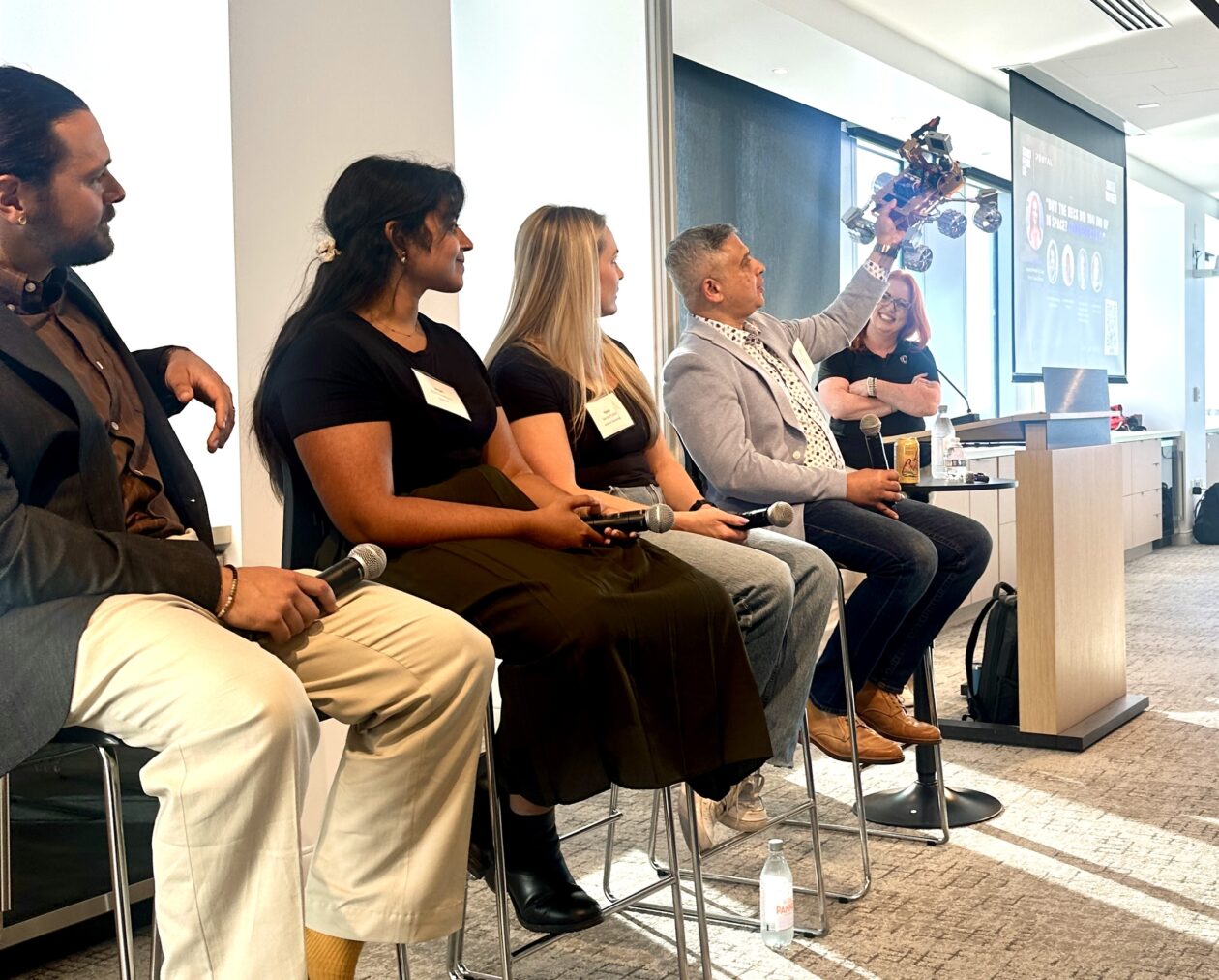
Joydeep Hazra, program director for electric vehicles at South Seattle College, holds up a prototype Mars rover during a Seattle Tech Week session. He’s surrounded by, from left, Alec Courtright, technical program manager at EarthDaily Federal, Anjali Roychowdhury, lead software engineer at SpaceX; Kayla VanderPutten, technical recruiter at Anduril Industries; and moderator Amy Miller, head of people and talent at Portal Space Systems. (GeekWire Photo / Alan Boyle)
The road to space isn’t always a straight line. Sometimes, the itinerary for a career in the space industry begins with years of experience in other tech fields. And sometimes, it starts at an espresso stand.
“I actually started as a barista at SpaceX, and I somehow got recruited to go build Starlink satellites,” Kayla VanderPutten, a technical recruiter at Anduril Industries, said Monday at a downtown Seattle Tech Week session focusing on the intersection of space and technology. “I don’t know why they let me do that, but I was there for the first 500 satellites before I transitioned into recruiting.”
Over the course of 25 years, Joydeep Hazra’s career path took him through a series of jobs in telecommunications and network engineering, including management positions at Nokia, Mavenir and TRIDENTX. Now he’s the manager of a federally funded program focusing on electric vehicles at South Seattle College — and he’s getting involved in aerospace as well.
Last week, South Seattle College and the nonprofit Mars Society announced a partnership to build a space research station on campus, complete with a habitat that can be used for simulating missions on the moon or Mars.
The electric vehicle program could help students prepare for careers building Mars rovers, like the Chinese-built prototype rover that Hazra displayed during the Seattle Tech Week session.
Other technical fields could provide further opportunities for space-centric crossovers.
“When you’re building a lunar habitat, there are a lot more things to do than just going up and down in the rocket, and that’s where all of us count,” Hazra said. “Interoperability, frequencies, microgrids, plumbing, psychology, cooking — everything is going to be super-important, because without that, the lunar habitat would only have robots from China, and not our astronauts.”
South Seattle College isn’t the only Seattle-area school expanding into the final frontier: Two years ago, Amazon Leo (formerly known as Project Kuiper) partnered with Lake Washington Institute of Technology in Kirkland to launch a certification program for satellite technicians. Amazon also offers a Career Choice program that gives non-technical employees, such as workers in fulfillment centers, the opportunity to train for satellite manufacturing jobs.
VanderPutten’s career followed a less formal path. While she made coffee for the engineers at SpaceX, she also made conversation about the satellites they were building — and eventually jumped at the opportunity to join them.
“When you’re trying to build 10 satellites a day, it has to be really, really easy to do,” she said. “Once I moved onto the floor, the engineers really wanted my feedback, and I really enjoyed that. I don’t know if they always enjoyed my feedback, because it sometimes created more work for them. But that was probably the biggest surprise — being brand new and having these really talented engineers want my feedback, and want to help improve their designs based on what I was seeing.”
From there, she transitioned into recruiting for tech ventures. In June, she started a new job at Anduril, a defense tech company that’s rapidly expanding in Seattle. So, as a recruiter, what would she tell someone who’s not highly technical but is interested in the space industry?
“I would tell new grads and people who are junior in their careers to be curious, to learn how everything works together, and to ask questions,” she said. “You might feel that your question is silly or dumb, and you don’t want to embarrass yourself. But I can guarantee you that someone else in that room is going to have that question, and now you can go on and help other people.”
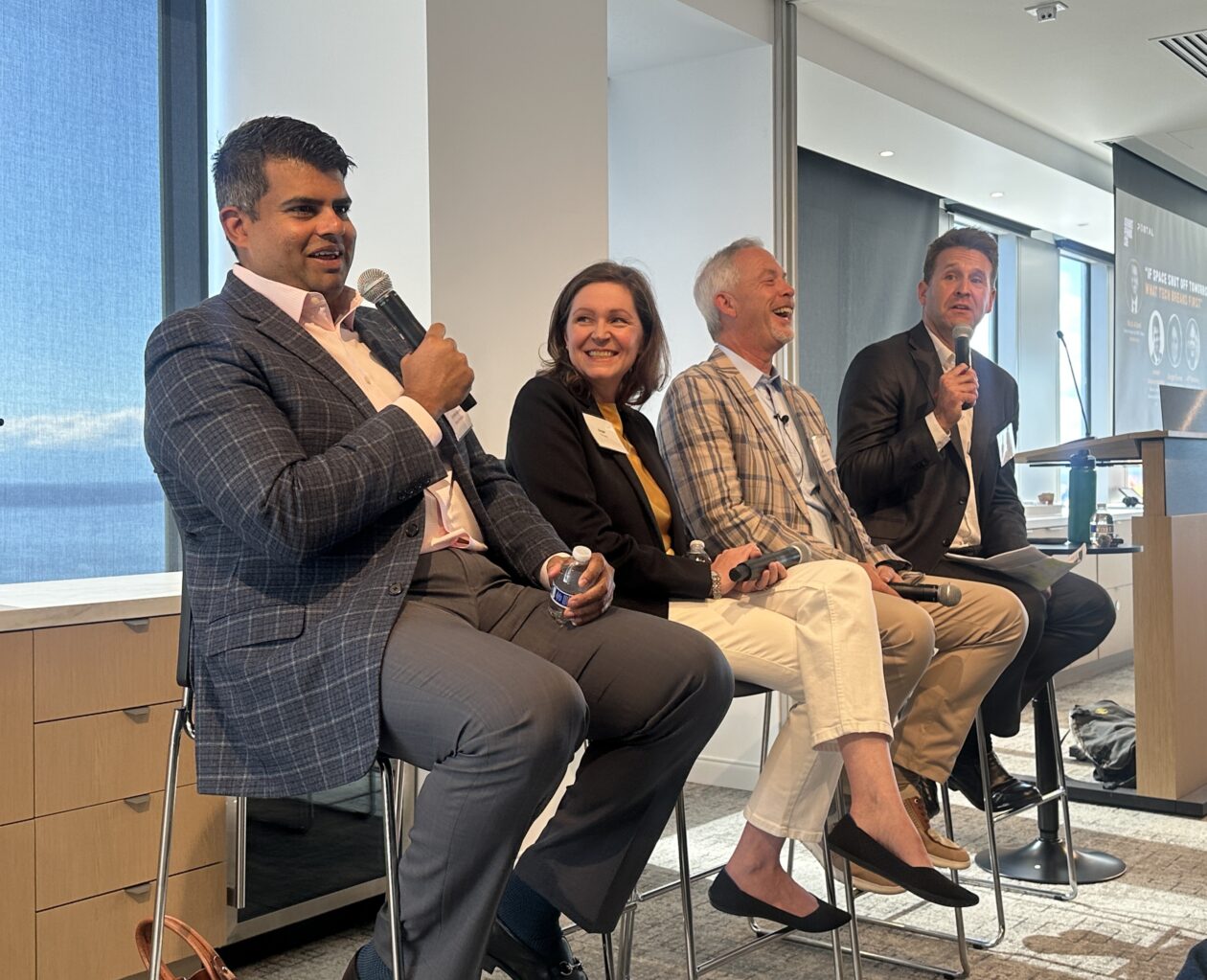
Another Seattle Tech Week panel focused on the impacts that space technology has on society and the economy. Here, a comment from Joseph Gnanapragasam, director of investment banking at BofA Securities, draws laughs from Ginger Florea, a former intelligence official; Portal Space Systems CEO Jeff Thornburg; and KIRO 7 meteorologist Nick Allard, the panel moderator. (GeekWire Photo / Alan Boyle)
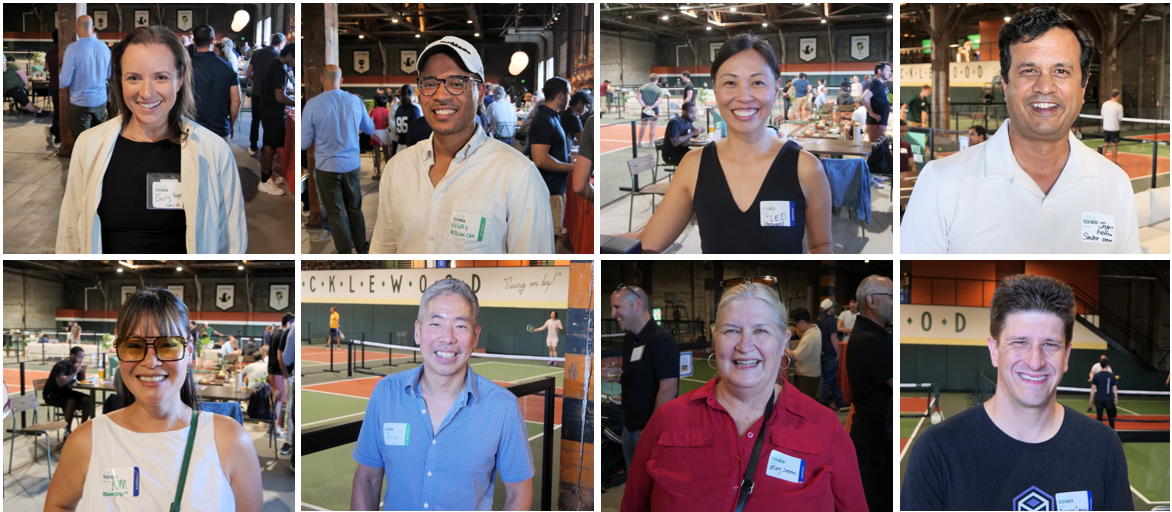
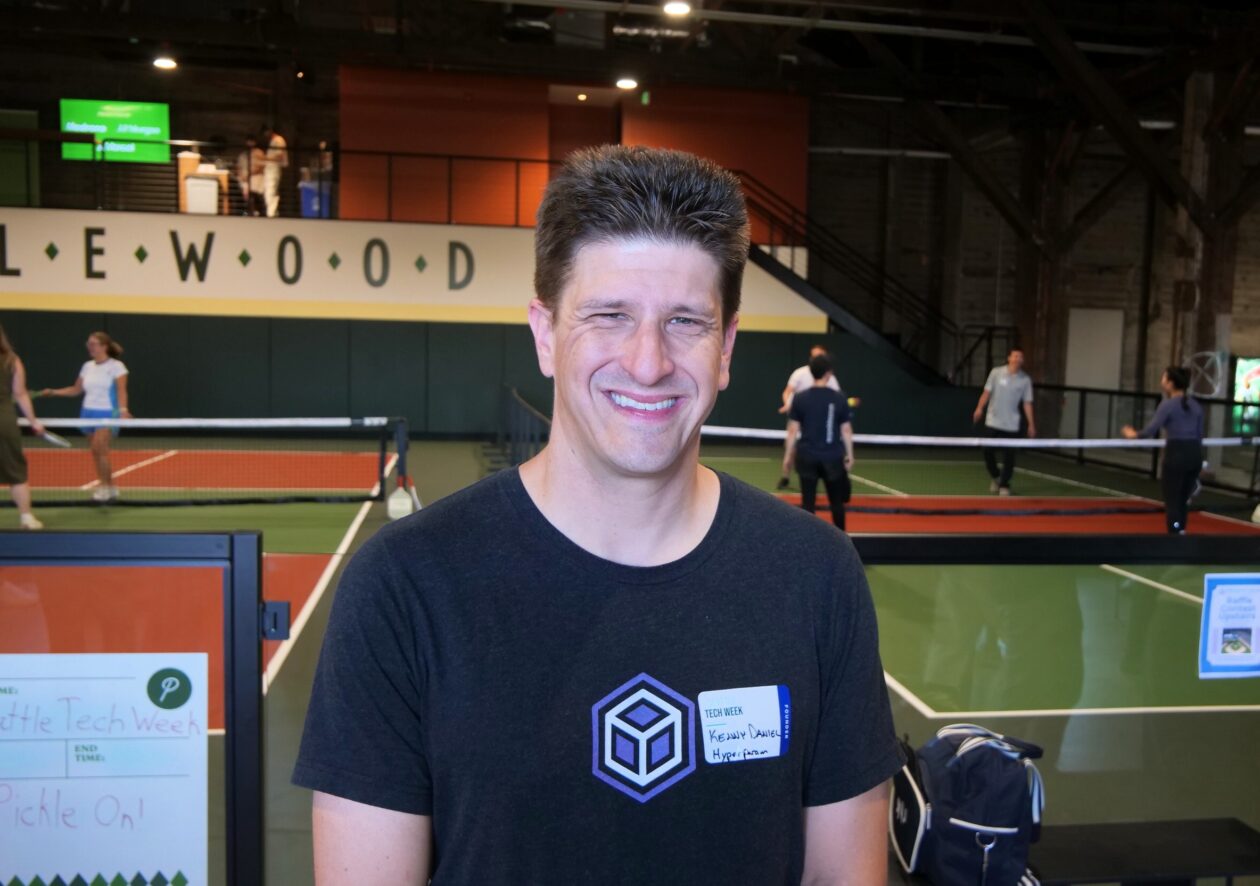
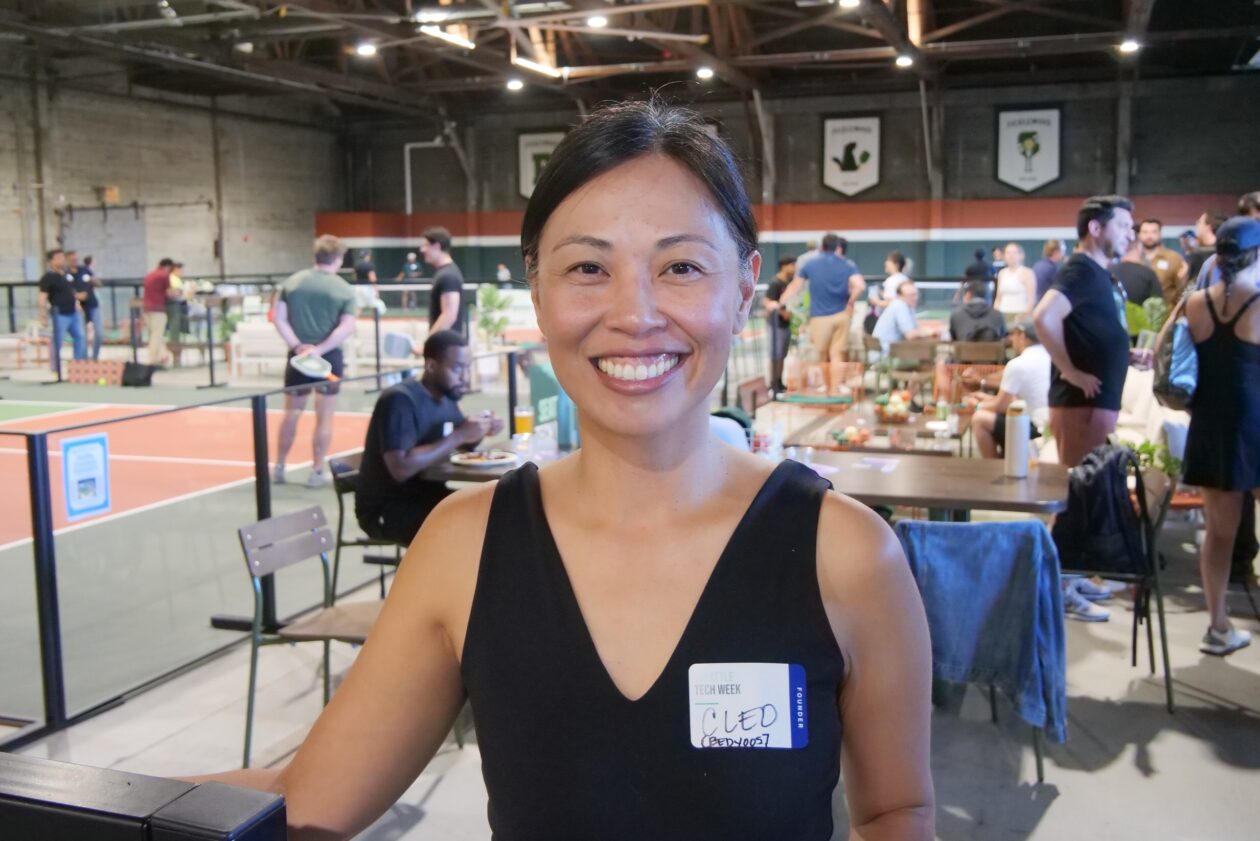
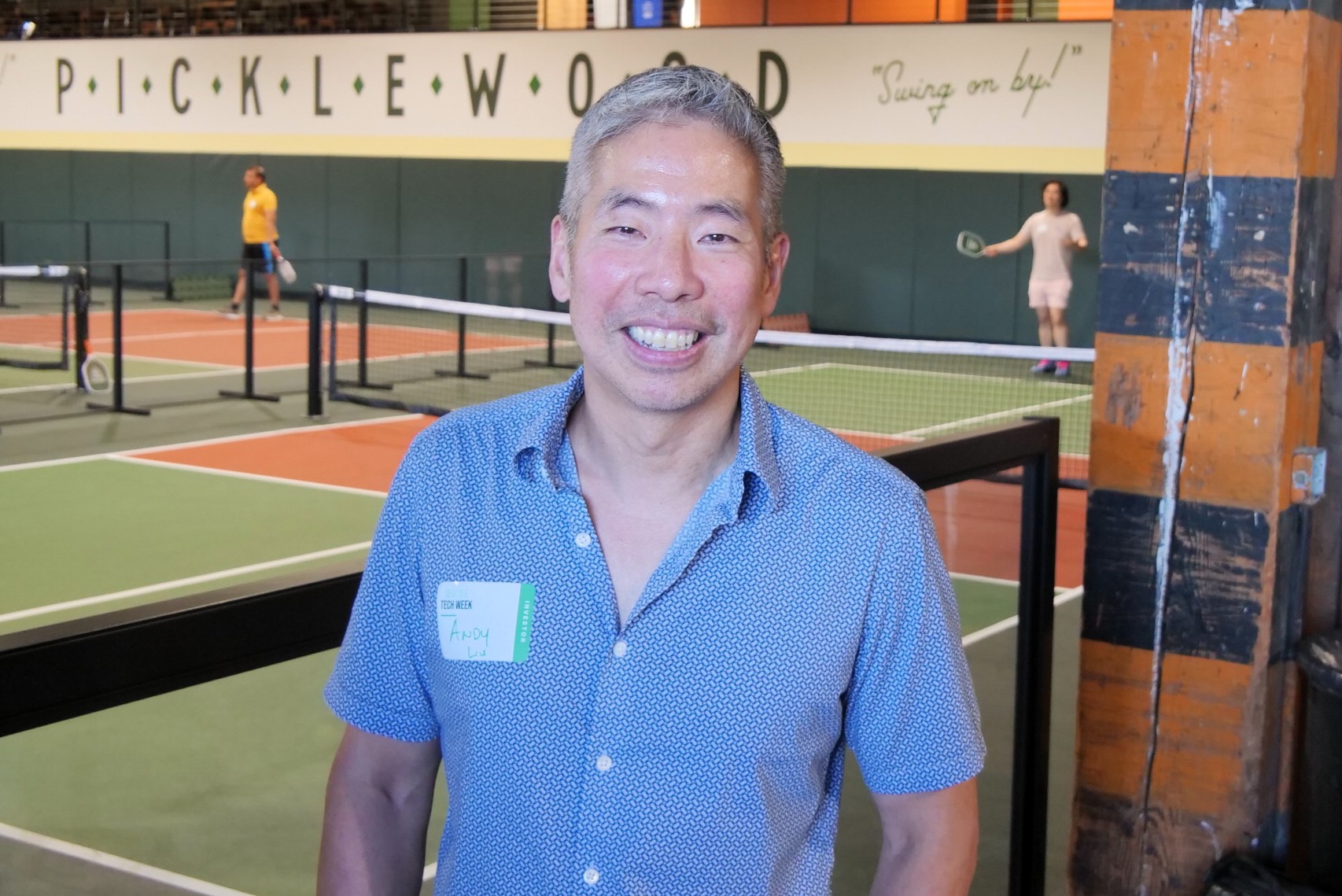
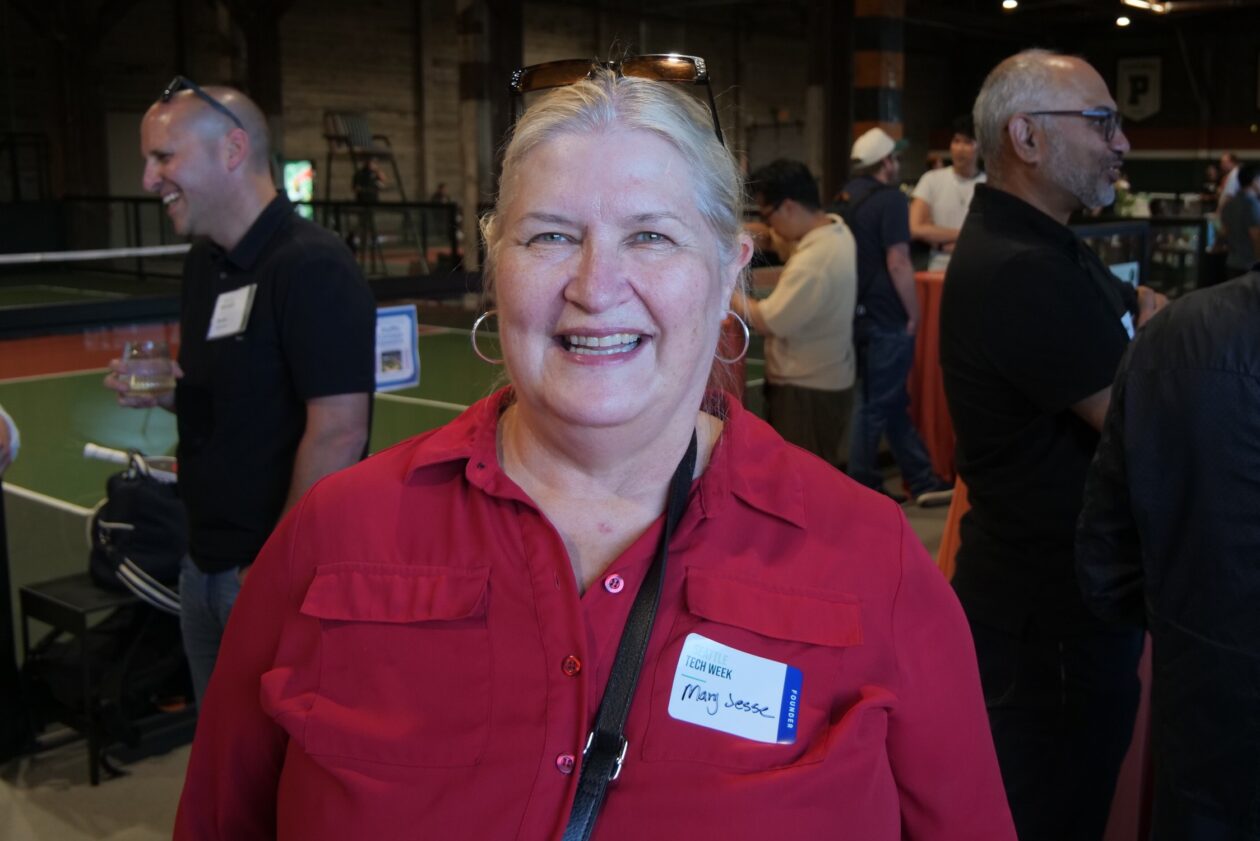
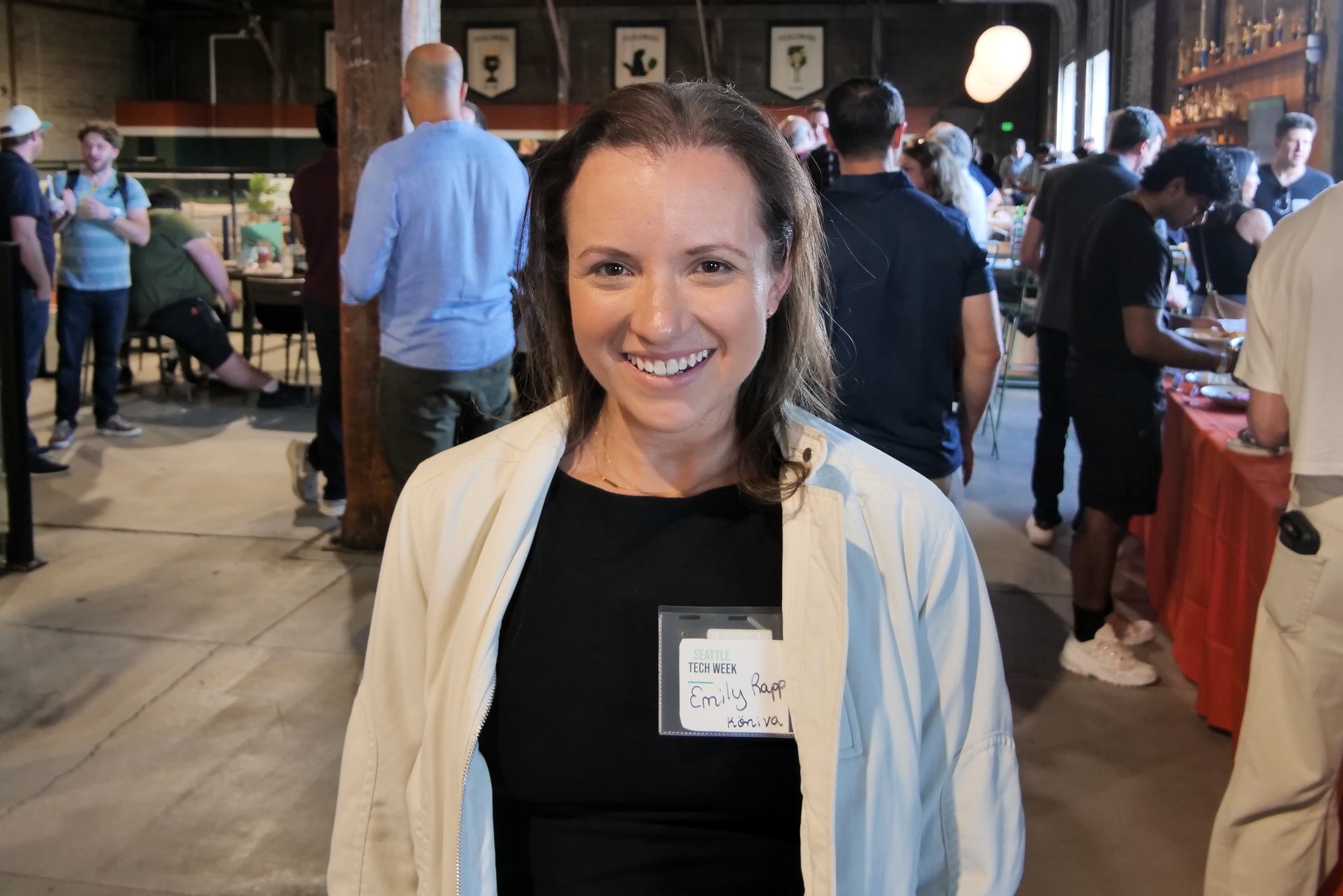
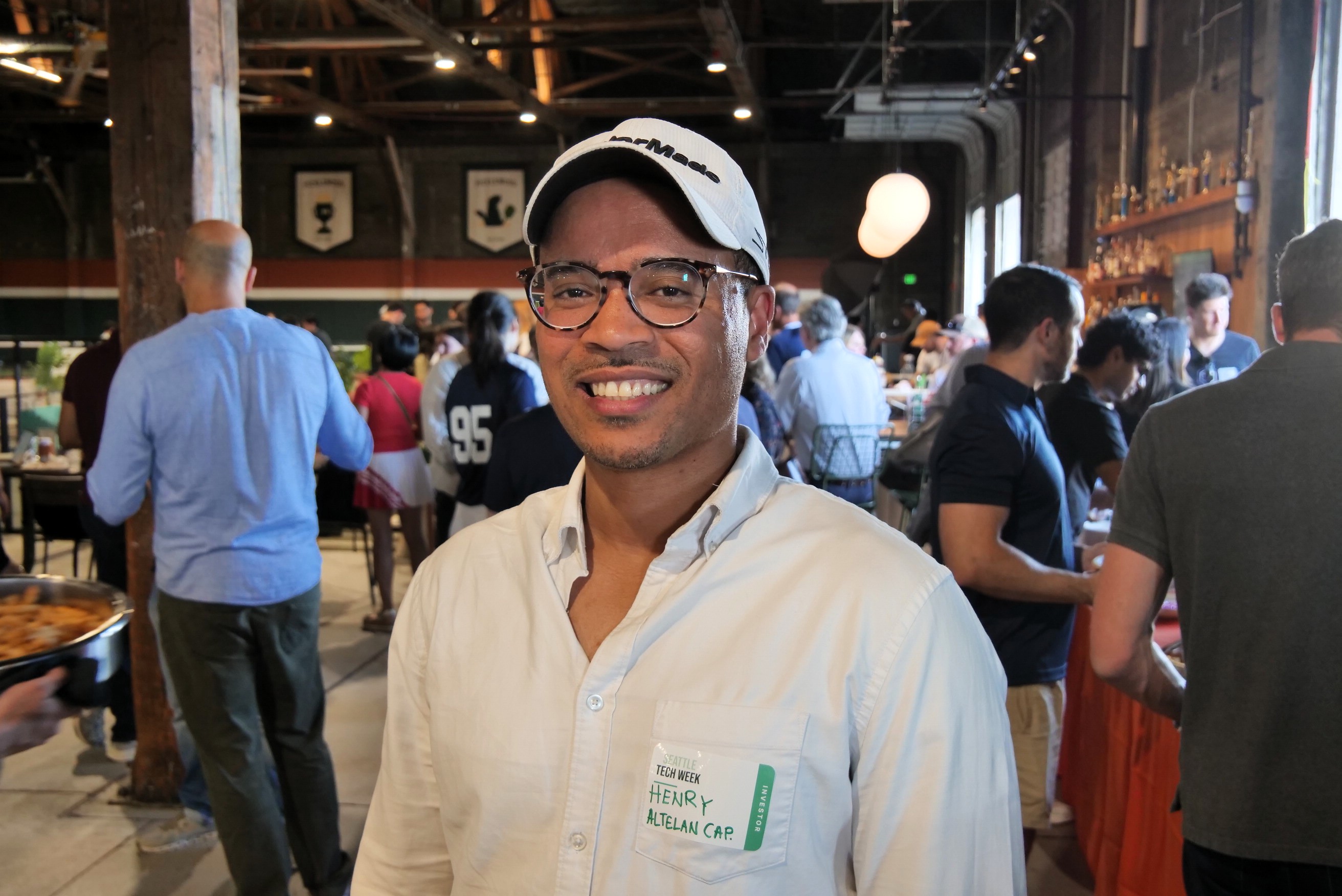
Top row from left: Emily Rapp, Henry Arias, Cleo Escarez, and Jagan Nemani. Bottom row from left: Kim Vu, Andy Liu, Mary Jesse, and Kenny Daniel, at the Seattle Tech Week kickoff. (GeekWire Photos / Todd Bishop)
The fourth annual Seattle Tech Week got off to a big start Monday, with panels and parties bringing together thousands of people from across the region and out of state. Organizers said the week features more than 250 events and drew more than 29,000 event registrations.
We went to Madrona’s kickoff event at Picklewood Paddle Club with one question for the founders, investors, and operators we met: What are you building? Here’s what we heard and learned.
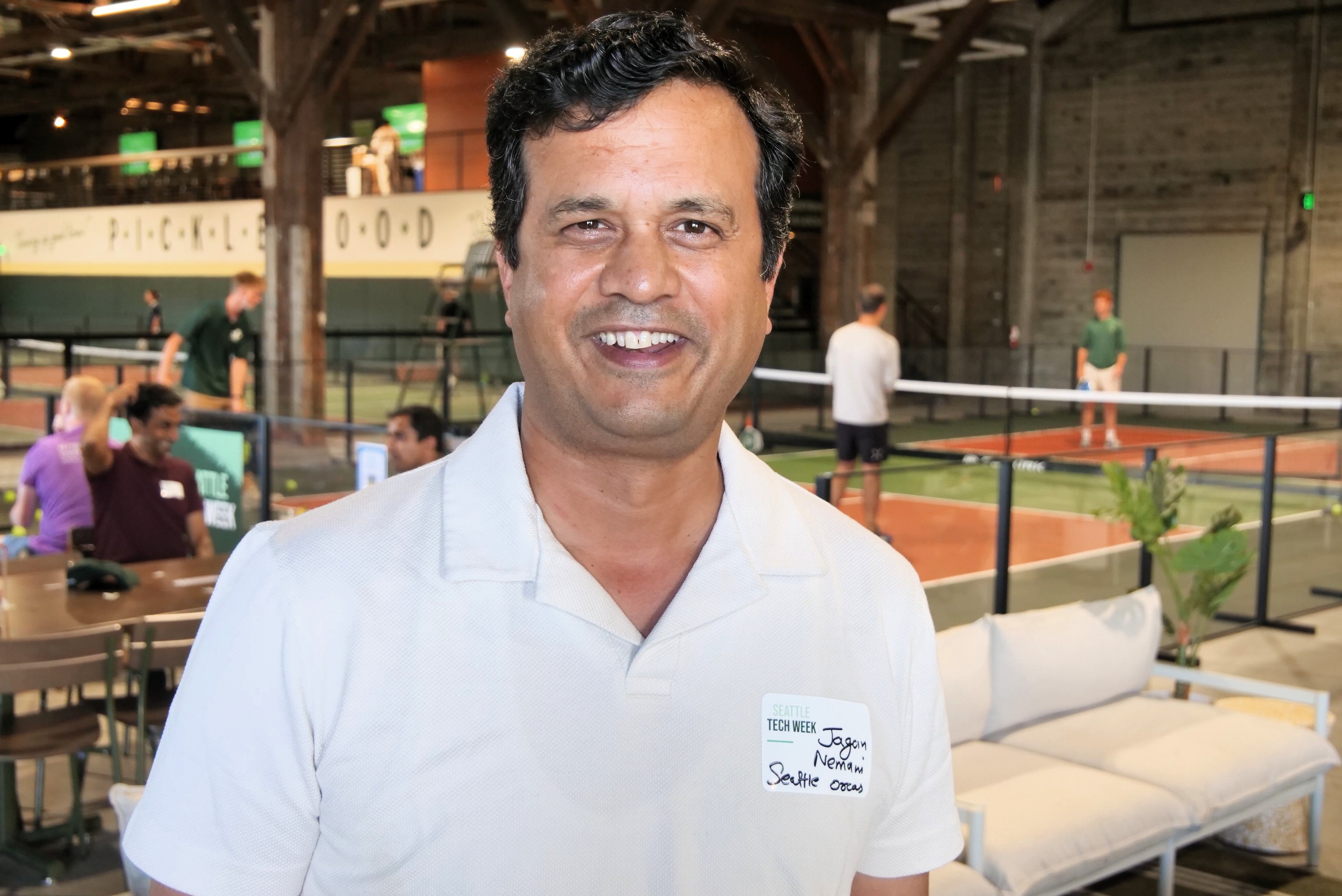
Jagan Nemani, chief product officer of the Seattle Orcas. (GeekWire Photos / Todd Bishop)
What he’s building: An AI system that runs a professional cricket franchise — flights, hotels, ground transportation, and daily schedules for players and staff, all handled over WhatsApp.
Nemani is chief product officer of the Seattle Orcas, the Major League Cricket team now in its fourth season. For the first three, he ran team operations the old-fashioned way: “I ran the entire operations using spreadsheets and people and processes,” he said. That meant tracking a constant stream of inbound flights, hotel blocks and car bookings across a season.
This year, he used Claude Code to build the backend for an AI agent that took over roughly 80% of the operation: booking flights, hotels and cars, dealing directly with hotels and transportation vendors, and telling players and staff when their flight lands, which hotel they’re in, and who’s picking them up. It also handles daily schedules, down to massage appointments.
To accommodate players and staff who were reluctant to adopt new tech tools, he built it to run on WhatsApp, the messaging app they already used every day.
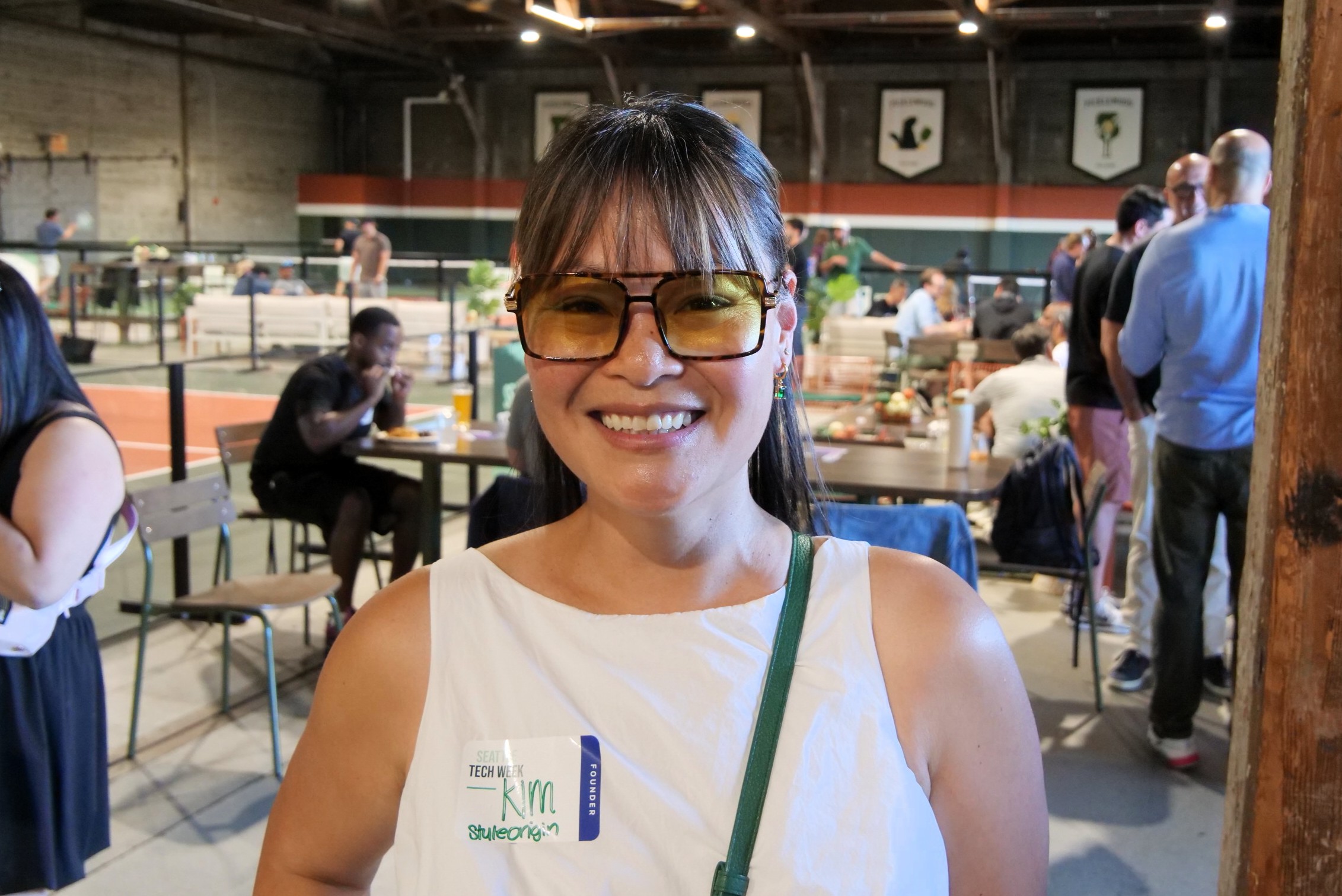
What she’s building: A B2B tool that lets thrift, vintage, and consignment resellers photograph an item and get back the identification, pricing, and listing details they now assemble by hand.
Vu is founder and CEO of StyleOrigin. Getting a single secondhand garment listed for sale is still manual work that takes 30 to 45 minutes an item, she said. With StyleOrigin, a reseller takes one image and an AI analysis returns what they need to list and price it. The company also gives sellers data to guide inventory decisions.
She found the problem herself. Vu ran environmental, social and governance work at Remitly until she stepped down in 2023, then took a year off and started selling vintage clothing. She assumed she was slow because she was new to it. “But turns out everybody does it the same, and so there wasn’t really any good solution out there.”
She taught herself to code and built the first version of the product. StyleOrigin has a working MVP but no revenue yet. More than 70 stores around the country are on a waitlist, and Vu is about to bring her first engineer aboard.
What he’s building: Tools for collecting, storing, and analyzing the data AI systems produce — the record of what agents actually did, not just the code they shipped.
Daniel is founder of Hyperparam, an early-stage Seattle startup, and previously co-founded Algorithmia, the Seattle machine learning company acquired by DataRobot in 2021.
Companies are spending heavily on AI without much sense of what they’re getting, he said. “AI is producing this wall of tokens. Companies are paying huge amounts of money to generate all these tokens, but they have really no visibility into what are these agents doing.”
Every token leaves a trail, and Daniel said most companies ignore it. Mining it would show them where AI is working and where it’s wasting money.
“Where are models being stupid? Where are they going down rabbit holes?” Older analytics tools can’t help, he said, because they were built for numbers and clicks: “People haven’t really been thinking about what do you do when the majority of the data being produced in the world is text.”
What she’s building: An urban mine — recovering precious metals from jewelry and returning them to the supply chain for clean technology.
Escarez is founder of Redyoos, which GeekWire featured in Startup Radar last year. The jewelry industry accounts for 40% to 50% of the global supply of precious metals, she said — the same materials found in “anything that has an on and off button,” from cell phones to wiring.
Demand for those metals is climbing with AI and clean energy, and Escarez said projections point to a supply shortfall of 700% over the next couple of decades. “We mathematically cannot solve this deficit,” she said, which is why she sees jewelry as a viable source.
Redyoos collects jewelry, refines what contains precious metals, and sells the recovered material to clean-tech manufacturers.
Escarez, a former chief operating officer at Boma Silver Jewelry and brand manager at Starbucks, has bootstrapped the company, which has been live a little over a year and is generating revenue. She is now raising a pre-seed round.
What he’s building: An engineering team inside a venture capital firm, automating the work of investing.
Liu is a partner at Unlock Venture Partners, which he helped launch in 2018 to back early-stage startups in Seattle and Los Angeles, and which raised a $60 million second fund in 2022. A longtime Seattle entrepreneur and angel investor with stakes in close to 100 companies, he was previously CEO of BuddyTV, acquired by Vizio, and of NetConversions, acquired by aQuantive.
“We actually have an engineering team that’s trying to automate a lot of what we do in VC,” Liu said, “and trying to make sure we can scale our business just like our own portfolio companies.”
The work covers deal memos and diligence on prospective investments, along with the mechanics of dealing with the firm’s own investors and collecting updates from portfolio companies.
The point, he said, is better decisions: “How do we get smarter as VCs?”
What she’s building: Private AI — letting people own their own data and context, use any large language model, and not be tracked or trained on.
Jesse is co-founder and CEO of ACME Brains, whose first product, nexie, is in beta. GeekWire wrote about the origins of the company last year: after her husband passed away, she turned to ChatGPT and found real comfort in it, then ran into its limits — it couldn’t carry the context of their conversations, and she had concerns about the privacy of what she was telling it.
nexie keeps a user’s notes, journals, and conversations in what the company calls a personal context engine, and carries that context across AI services instead of leaving it scattered in separate chat histories.
Trading privacy for free services goes back to the early internet, she said, but AI tilts the exchange further. A chatbot draws information out of a person in conversation, then combines it with everything already known about them. “AIs can talk you into your data,” she said.
An electrical engineer with more than two dozen patents who spent decades in wireless at McCaw Cellular and AT&T Wireless, Jesse said most people don’t grasp how AI actually behaves, which leaves them exposed — seniors especially. “You need people that understand it to help protect people that don’t.” Her co-founders are Alan Caplan, Amazon’s original general counsel, and patent attorney and engineer Bob Bergstrom.
What she’s building: Voice AI that lets bar and restaurant staff count inventory out loud instead of writing it down by hand.
Rapp is founder and CEO of Köniva. A typical hotel resort bar spends 12 hours and four people on an inventory count, she said; with Köniva it’s two people and 3-and-a-half hours, and more accurate. Staff download an app and wear a lapel mic — you want both hands free on a ladder — and count out loud the way they always have.
She came to the problem after a career in big tech and ad tech. Not wanting to build for an industry she’d never worked in, she took a part-time job at Canlis after training as a sommelier.
When she was injured, the wine director let her help with inventory reconciliation and handed her a clipboard of handwritten numbers plus a login to the restaurant’s inventory software. She asked why they were still using paper and pencil when a whole engineering team had built software for the job. The wine director’s answer: it was faster.
Köniva has 10 customers. At several high-end hotels and restaurants, Rapp said, staff put the app on their personal credit cards to start using it, then helped her pitch their own procurement departments — an unusual path in an industry she said has been badly burned by technology.
“It is insane how bad tech has been to them,” she said.
Henry Arias, founder and managing partner of Altelan Capital.
What he’s building: A growth equity firm investing at the intersection of food brands and food tech.
Arias is founder and managing partner of Altelan Capital, a Seattle firm he started last year. It underwrites companies around the Series A stage, generally, providing growth capital and strategic support.
He came up in the industry itself, leading finance at restaurants and breweries and most recently running corporate development and financial planning for Seattle Hospitality Group. That operator lens, he said, is what he brings to investments and to coaching founders on growth. He has been an investor since 2015.
Arias calls Altelan an AI-native investment fund, using AI tools to get up to speed on an industry and test assumptions about a business’s ability to scale and where the risks are. He’s equally interested in where the technology doesn’t belong and simplicity is the better option: “AI is great, but it may not be the right tool for the job.”
The bigger shift he’s watching is food and digitization. The industry has traditionally worked off “the proverbial clipboard and a notepad,” he said, and the pandemic accelerated the move to technology across the supply chain. “There are many applications of tech in food,” he said, “and that’s what keeps us up and gets us excited every day.”

 Login
Login