Reading view

There are new articles available, click to refresh the page.

‘The warning signs are flashing’: New regional partnership calls for cohesive Seattle-area tech strategy
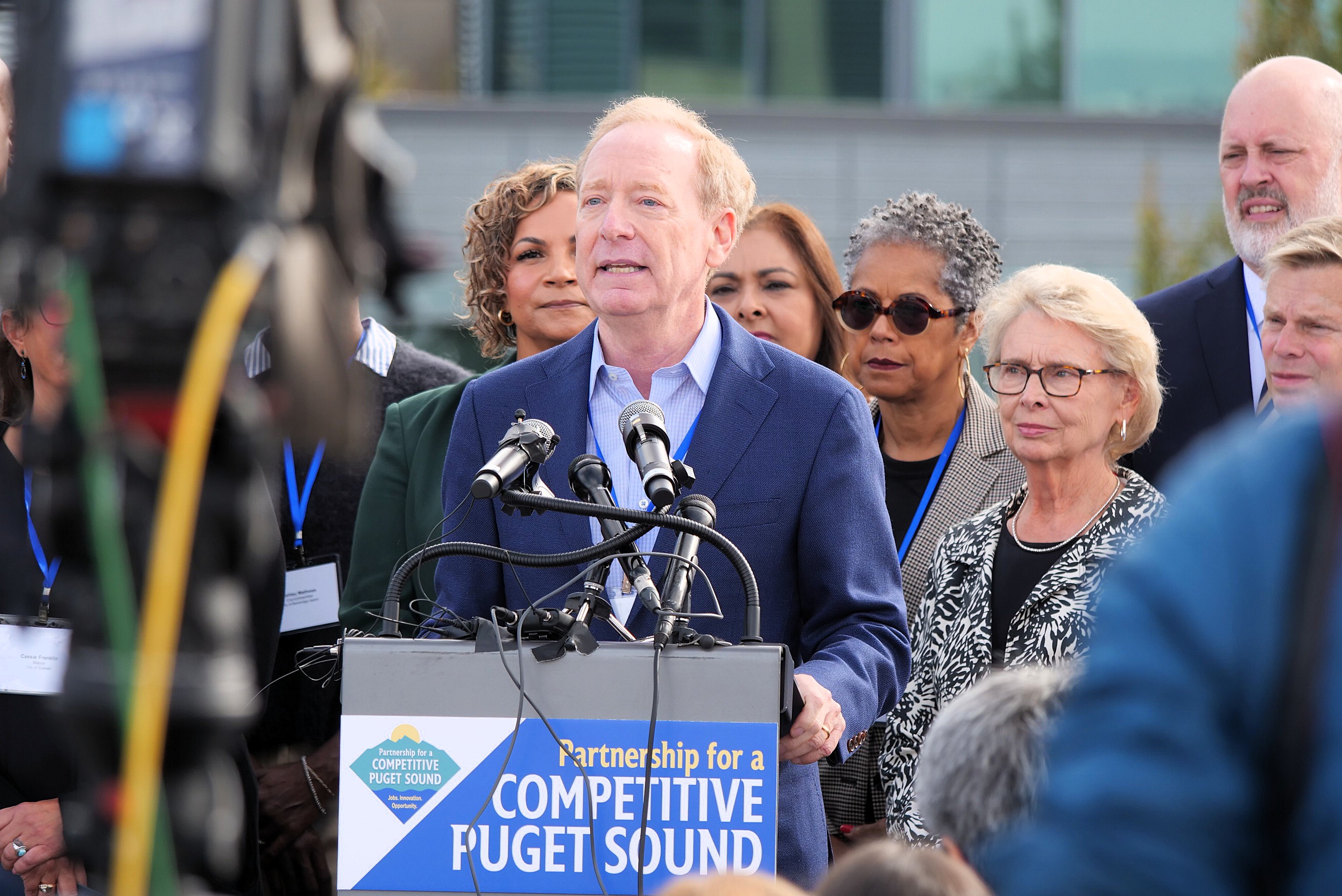
“You should tax things you want to discourage, like cigarettes, not jobs.” Microsoft’s Brad Smith at Monday’s launch of the Partnership for a Competitive Puget Sound, with former Gov. Chris Gregoire at his left. (GeekWire Photo / Todd Bishop)

Detroit, Cleveland and Pittsburgh each had their moment in the sun a century ago, Microsoft Vice Chair and President Brad Smith said Monday — and then the warning lights started flashing, and their leaders at the time failed to heed them.

“Well, here we are. It is 2026,” Smith said at a press conference, flanked by dozens of regional leaders, with the Seattle skyline behind them. “And the warning signs are flashing on our economy.”

Smith was speaking at the launch of the Partnership for a Competitive Puget Sound, a Challenge Seattle initiative that brought together roughly 50 elected officials from King, Kitsap, Pierce and Snohomish counties — two county executives, around 20 mayors, port commissioners and about a dozen state legislators — along with labor leaders and business executives, behind a 20-point plan for reversing the region’s slide.

The region lost nearly 7,000 jobs in 2025, according to a report issued by the group, the first time in two decades outside a recession or the pandemic that Seattle-area employment growth has trailed the nation’s. Washington has fallen from 32nd to 47th in CNBC’s ranking of states by cost of doing business since 2017.

An ‘intentional’ regional tech strategy: The report makes a pointed observation about technology: aerospace has a coordinated regional agenda and tech doesn’t, despite tech accounting for nearly one in 10 regional jobs and about 24% of total payroll.

Aerospace knows what it’s working on: the next airplane, the space industry, sustainable fuels, supplier diversification. Technology, “despite being one of Puget Sound’s defining economic anchors, does not yet have an equally intentional regional strategy,” the report says.
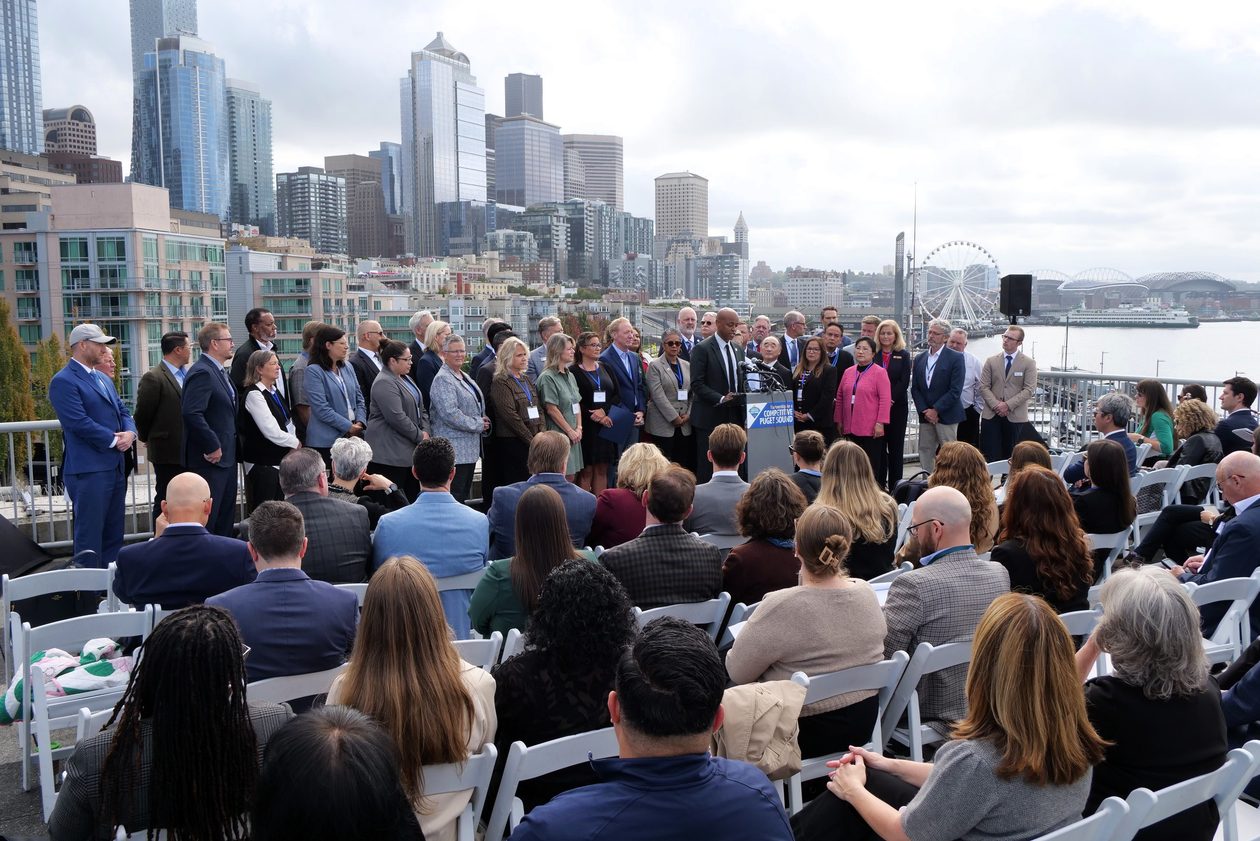
King County Executive Girmay Zahilay addresses the crowd Monday, with the downtown Seattle skyline behind him. More than 32% of the city’s central business district office space sits vacant, according to the new regional report. (GeekWire Photo / Todd Bishop)

Without one, it adds, the region risks losing “jobs, technology investment, headquarters, talent, and company growth” to the Bay Area, New York, Boston and Austin. The goal is “not simply to promote growth, but to protect and strengthen the region’s position as a leading technology center.”

Challenge Seattle says it will write that strategy with the Puget Sound Regional Council, built around two priorities: keeping the big tech companies investing here, and making it easier for startups to scale. Related recommendations target industrial space for AI hardware startups, commercial space, and the region’s fusion cluster.

The report sets no budget or measure of success for the tech strategy, and no deadline beyond its general goal of progress within three years.

A regional wake-up call: Many of the recommendations are changes to how local government operates, not new spending: deadlines for permit decisions, a designated business contact in every city and county, and a strategy for dealing with the way taxes stack across state, county and city.

“This is, for us, a wake-up call,” said former Washington Gov. Chris Gregoire, CEO of Challenge Seattle, launching the initiative during the press conference. “We cannot resort to relying on yesterday’s success while tomorrow’s jobs go somewhere else.”

April Sims, president of the Washington State Labor Council, said businesses need predictability and enough margin to invest, innovate and take risks — but “working people need margins, too.”

King County Executive Girmay Zahilay said his office has hired an economic development team and is beginning an internal permitting audit. “AI is transforming our economy seemingly overnight,” he said, calling the 7,000 lost jobs “quite alarming.”

The group also released a playbook for Puget Sound mayors, drawn from interviews and surveys with local leaders, on building what it calls a culture of partnership with business.

Seattle as a Microsoft litmus test: Asked by GeekWire during the press conference what it would take for Microsoft to return and grow in Seattle proper, where it previously had offices in South Lake Union, Smith first pointed out that he was standing in front of Redmond Mayor Angela Birney.

“We have a great mayor, and every day we get up and we’re excited to go to work in Redmond, Washington,” he said, to laughter from the assembled officials.

Smith also pushed back on the premise: Microsoft moved to the Eastside from Albuquerque in 1979 and never had a large presence in Seattle, so he wouldn’t use the city as the point of comparison.

Then he turned to Seattle’s JumpStart payroll expense tax.

As structured, the payroll tax “is really a tax on tech jobs,” Smith said, “and that’s why you’re seeing more tech jobs move from Seattle to places like Bellevue and the Eastside.” He noted that San Francisco abolished its payroll tax the same year Seattle adopted one, in 2021.

“You should tax things you want to discourage, like cigarettes, not jobs,” he said.

He tied the issue to the larger impact of AI on jobs. “We need people to succeed to some degree in a world of AI,” Smith said. “And you don’t want to make the cost of employing people more expensive, at the same time that AI is increasingly adding its own new form of competition.”

“There’s nothing that would lead to the decline in jobs in this state faster than a replication of the JumpStart tax,” he said. “And if Seattle wanted to do one thing to increase jobs in Seattle, it ought to revisit whether a payroll tax makes any sense.”

Then he added a caveat: “That’s probably something that would impact other companies more than Microsoft.”

Amazon, which has been reported to be the largest payer of the tax, did not have a speaker at Monday’s event. Individual Amazon execs are listed in the acknowledgments in the Challenge Seattle report, though the report says participation doesn’t imply endorsement.

View from Olympia: During the press conference, Senate Majority Leader Jamie Pedersen, D-Seattle, was asked whether Washington risks becoming an outlier among states on taxes. The Legislature has been correcting course, he said, pointing to two moves from this year’s session.

One was the estate tax. Lawmakers raised the top rate to 35% in 2025, the highest in the country, and reversed themselves this March, returning it to 20% as of July.

The other was the millionaires tax — a 9.9% tax on household income above $1 million, signed by Gov. Bob Ferguson and projected to raise roughly $3 billion a year. It doesn’t take effect until 2028, and Seattle tech leaders warned it would push founders and investors out of the state.

Pedersen cast it as the fix for a different kind of outlier status: Washington’s business and sales taxes are high because it’s one of the few states with no personal income tax at all. The new tax would let Washington “join 41 other states that have a personal income tax,” he said.

Voters get the last word in November. Initiative 645, backed by Let’s Go Washington, qualified for the ballot in July and would repeal the tax. If it survives, Pedersen said, a statewide payroll tax is “vanishingly unlikely” next session.

Seattle’s mayor weighs in: Seattle Mayor Katie Wilson, who was an architect of the JumpStart tax before running for office, was not among the speakers at the press conference. She opened the regional session that followed, and said the region needs to do a better job telling its own story.
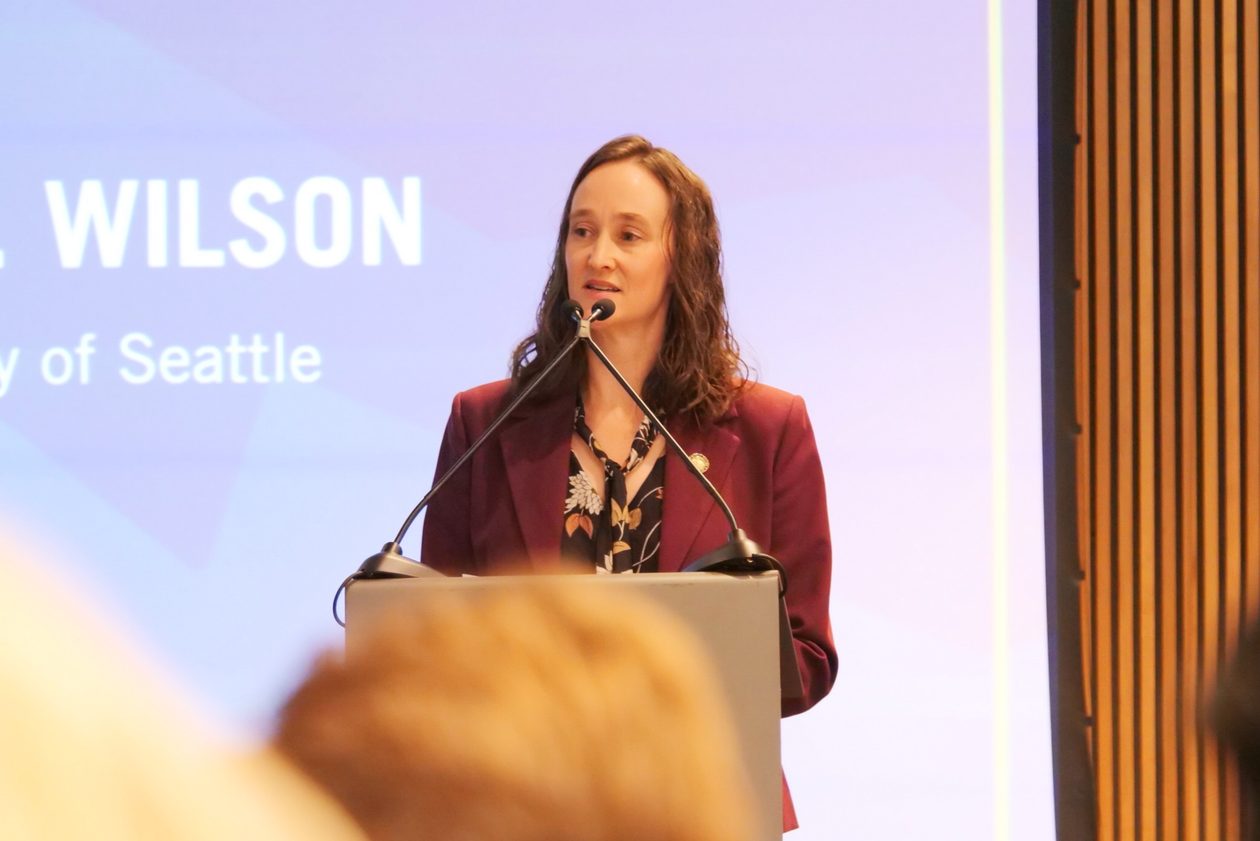
Seattle Mayor Katie Wilson opens the regional action session that followed Monday’s launch of the Partnership for a Competitive Puget Sound. (GeekWire Photo / Todd Bishop)

“There are some forces and interests that are pushing a narrative that does not want Seattle or our region to succeed,” Wilson said, “and we must counter that with a new commitment to a shared sense of destiny, because Seattle’s success is Bellevue’s success, Pierce County’s success is Snohomish County’s success.”

She called it a fragile moment and said the time to act is now, pointing to the economic actions she announced last week in conjunction with an independent report commissioned by the city and released by Seattle’s Office of Economic Development.

That report, “Seawall: Building a Resilient Seattle Economy,” found Seattle’s tax structure unique among peer cities in the way it “specifically penalizes the hiring of senior, high-compensation workers,” with the burden falling overwhelmingly on large tech employers.

Hiring a software engineer at $650,000 in total compensation costs about $17,000 more a year in Seattle than in Bellevue at JumpStart’s top rate, the researchers found.

The city report, conducted by the economic consulting firm Formation, said Seattle should bet on cleantech, the sector where the city owns the utility, writes the building codes and controls permitting and land use. It’s one place where Seattle has real leverage over its own economy, the researchers argued.

“It’s striking how much agreement we share across labor, businesses, and government,” Wilson said. “This is not a call to ignore our challenges, but to tackle them with a shared sense of possibility.”

She did not address the payroll tax in her remarks.
‘You cannot fund compassion from an empty treasury’: Seattle Chamber CEO frames economic growth as a civic imperative

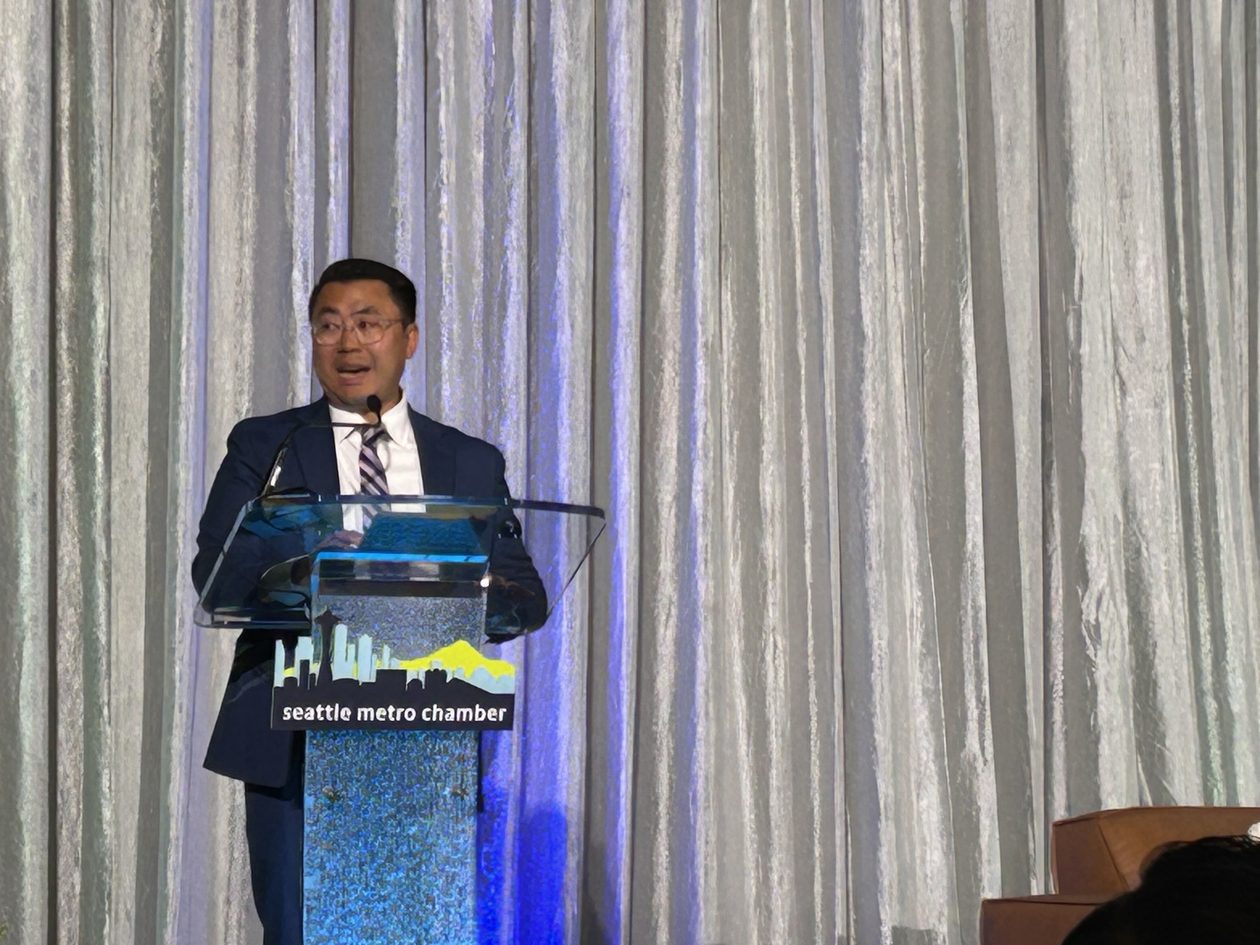
Seattle Metropolitan Chamber of Commerce CEO Joe Nguyen speaks at the Westin Seattle on Thursday. (GeekWire photo)

Seattle Metropolitan Chamber of Commerce CEO Joe Nguyen delivered a direct message to regional leaders at the organization’s 144th annual meeting on Thursday: Seattle’s progressive social goals cannot exist without a thriving employer base.

Nguyen, a former Washington State Senator and Microsoft manager who served as Director of the Washington State Department of Commerce before taking over the Chamber, used his inaugural annual meeting address to bridge the gap between regional business priorities and broad civic goals.

While political and business leaders often appear at odds in Seattle, Nguyen argued that the two are deeply intertwined and fundamentally interdependent. Having a healthy business community is “not up for debate; it is a requirement,” Nguyen told the audience of more than 800 civic and business leaders.

He continued:

“So I want to be very clear: the progressive values in this region depends on the economic activities and jobs created by strong employers. Housing doesn’t fund itself. Human services do not fund themselves. Public safety and parks do not fund themselves. They are made possible by people creating companies, making payroll, and hiring workers, when businesses succeed, our values get funded. Economic growth is not separate from social progress.  In fact, economic growth makes social progress possible. You cannot fund compassion from an empty treasury.” 

Nguyen framed his vision for Seattle through a personal lens, detailing his family’s journey arriving in Seattle as refugees from Vietnam with little more than “hope.” A powerful image of his family departing Vietnam on a rickety boat accompanied his remarks.

He recalled his family taking footholds in local business, operating a billiards hall in White Center, working at the Port of Seattle and his mother sewing for JanSport. Nguyen later attended Seattle University on Capitol Hill while washing dishes, went on to work at Microsoft, entered the Washington State Senate representing the 34th District, and eventually joined Governor Bob Ferguson’s administration as Commerce Director.

“The larger lesson from my family story is not about any one company or career,” Nguyen said. “It is about what’s possible when a region creates opportunity. Microsoft opened doors for me that I never knew were even possible as a kid growing up in White Center. The employer community did more than employ my family; it changed the trajectory of our lives.”

Pointing to macro-level data, Nguyen highlighted that the tri-county regional economy (King, Pierce, and Snohomish counties) generates $600 billion in annual economic activity, representing 71% of Washington State’s total economic output and ranking as the 10th largest metro economy in the United States.

Additionally, local business activity funds roughly 70% of the City of Seattle’s budget revenue.

However, Nguyen cautioned against taking the regional economy for granted amid rising operational costs, public safety challenges, and regulatory friction.

“Prosperity is not permanent. It is not part of the scenery like Mount Rainier,” Nguyen said. “It is something a region must earn, protect, and renew… When an employer leaves, we lose jobs, we lose customers for nearby small businesses, we lose charitable giving, we lose future investments, and we lose the public revenue that sustains our shared priorities.”

Nguyen pointed to recent momentum in aligning state and local government with economic development priorities.

Over the past year, state lawmakers introduced a dedicated economic development committee in the legislature, the governor formed a state business council, and the Mayor of Seattle signed an executive order establishing a local Economic Development Council.

The Chamber’s core advocacy pushes remain centered on faster permitting, housing expansion, and addressing public safety as both a quality-of-life and economic imperative.

On the latter issue, Nguyen joined other business leaders earlier Thursday in signing an open letter with executives from Microsoft, Starbucks, and dozens of regional employers demanding a 100-day public safety action plan from City Hall.

The letter, spearheaded by the Chamber, Challenge Seattle and the Washington Roundtable, urged the city to accelerate 911 response times, activate surveillance cameras, and step up foot patrols to protect workers, visitors, and foot traffic across downtown.

“We will partner when partnership produces results. We will push when pushing is necessary,” Nguyen said in his remarks at the annual meeting. “We will be constructive, but we will not be passive. And we will never apologize for standing up for the employers and workers who make this region possible.”

Looking forward, Nguyen urged the region’s tech sector, innovators and policymakers to resist complacency and bet on the future of Seattle. Nguyen concluded his remarks by asking the audience to embrace the future, and he said he’s optimistic about what’s ahead because he sees “people betting on Seattle every single day.”

“I believe that Seattle is at an inflection point. We can give in to complacency… or we can decide that our next chapter will be even more ambitious than the last… Somewhere in this region, an entrepreneur is building our next great company, a scientist is making a discovery that will save lives, and a young person in White Center is imagining a future none of us can see yet. And it is our responsibility to give them that chance.”

We’ll be breaking down Nguyen’s address, the Chamber’s 100-day public safety push and the broader debate over Seattle’s economic future on this weekend’s episode of the GeekWire Podcast. Be sure to tune in here, or wherever you get your podcasts.

Top Seattle tech and business leaders demand 100-day public safety action plan from City Hall

Tents in a vacant lot in Seattle’s Belltown neighborhood. (GeekWire Photo / Kurt Schlosser)

A roster of top Seattle business leaders and regional CEOs is demanding urgent action from City Hall on public safety, calling on Mayor Katie Wilson and the City Council to roll out a concrete 100-day action plan backed by measurable goals and transparent progress tracking.

In a letter sent Thursday, executives from major area employers — including Microsoft, Starbucks, Costco, F5, Alaska Airlines, Zillow, and others — urged city leaders to protect and expand public safety funding amid growing skepticism that the city currently has an effective strategy to address crime and homelessness.

The push centers on findings from an August joint public-opinion poll of registered Seattle voters, which revealed that while every proposed safety measure drew at least 75% support across all demographics, only 34% of respondents expressed confidence in the city’s current strategy.

Pointing to severe staffing shortages — noting Seattle has just 1.31 sworn officers per 1,000 residents, far below peer cities like Denver, San Francisco, and Boston — the signatories argued that budget decisions must directly align with measurable safety outcomes.

The effort was spearheaded by major regional business leadership organizations, including the Seattle Metropolitan Chamber of Commerce, Challenge Seattle, and the Washington Roundtable. Their leaders — Joe Nguyễn, former Gov. Chris Gregoire, and Rachel Smith — jointly signed the appeal alongside dozens of local chief executives spanning technology, retail, healthcare, and sports franchises.

“Voters are asking for action, on a timeline, with results they can measure,” the coalition wrote in the letter, emphasizing that their recommendations reflect a broad consensus across the city. “This is not a narrow or partisan agenda, it is a shared baseline that Seattle residents and the business community are asking their elected leaders to deliver both now and as a sustained priority.”

The letter outlines a series of immediate and short-term actions the group is asking City Hall to enact, backed by overwhelming support in their poll:

The letter to Seattle city leaders calls for activation of CCTV cameras as well as increased officer patrols in areas including Pioneer Square, the Stadium District and Little Saigon. (GeekWire Photo / Kurt Schlosser)

CCTV surveillance: Activate CCTV cameras in Pioneer Square, the Stadium District, and other high-event areas to deter crime and assist law enforcement.

Foot and bike patrols: Establish regular police patrols on foot and bicycle in areas facing persistent public safety problems, specifically citing Little Saigon (90% poll support).

911 response accountability: Recommit to a standard 7-minute priority 911 response time, backed by transparent reporting when targets are missed (90% support). The letter noted data from Nordstrom showing only 29% of 911 calls from its flagship downtown store yielded a police response, compared to 100% at its Bellevue and Southcenter locations.

Drug treatment and diversion: Direct CARE Department specialists to offer treatment and shelter first, but require law enforcement to arrest and prosecute repeat offenders who repeatedly refuse help (82% support).

Open-air drug markets: Require SPD and the City Attorney to establish a clear, prioritized pathway for shutting down open-air drug markets (81% support).

Encampment bans and timelines: Institute a policy banning encampments within 250 feet of parks, playgrounds, or schools, and mandate that the city clear encampments in those zones within 72 hours (79% support).

Among those who signed the letter: Brad Smith, Vice Chair & President of Microsoft; Jeremy Wacksman, CEO of Zillow; François Locoh-Donou, CEO of F5; Matt McIlwain, Managing Director at Madrona Venture Group; Julie Sandler, Co-founder & Venture Partner at PSL Ventures; Matt Oppenheimer, Chairman of Remitly; Erik Nordstrom, CEO & Co-President of Nordstrom; Brian Niccol, Chairman & CEO of Starbucks; Ron Vachris, CEO & President of Costco; Ben Minicucci, CEO & President of Alaska Air Group; Mike Sievert, Vice Chairman of T-Mobile; and Ada Healey, Chief Real Estate Officer at Vulcan Real Estate.

The business community’s coordinated push arrives during a pivotal moment for public safety policy in City Hall, where political tensions over policing and crime response have flared in recent weeks.

While overall violent crime and homicides in Seattle dropped during the first half of 2026 compared to last year, high-profile violent incidents continue to fuel public and commercial anxiety. Downtown, Belltown, and high-foot-traffic corridors have experienced recent spikes in gun violence and fatal altercations — including multiple homicides in Belltown and Westlake Park in early September alone.

At the same time, the Seattle Police Department continues to grapple with acute staffing shortages following years of officer departures exceeding hiring goals. The persistent deficit has left response times stretched thin, prompting deep frustration from major employers and pushing retail hubs to demand a more visible police presence.

Policy friction between the Council and Wilson’s administration has also intensified. Debate has centered on the rollout of public surveillance technologies — where the mayor’s office recently paused CCTV camera expansions pending a data privacy audit — as well as ongoing friction surrounding the leadership of the police department.

Responding to the letter, Wilson told GeekWire that her administration shares the business community’s commitment to public safety, noting that “many of the specific requests they made are well underway.”

Wilson highlighted expanded foot and bicycle patrols in neighborhoods like Little Saigon and Belltown, 3,500 police officer applications currently in the queue, and an upcoming gun violence reduction strategy set to roll out next week. While noting that SPD data shows homicides and shootings at 10-year lows, Wilson acknowledged public impatience.

“We have far too much crime and public disorder and people have a right to be frustrated,” she said. “I, like everyone in Seattle, want to see that progress happen faster and steadier.”

The safety campaign comes on the heels of a 127-page independent economic study commissioned by the city, which warned that while Seattle boasts an “almost peerless” tech workforce and key AI assets, its economy is in a fragile position due to heavy corporate concentration and tax policies that penalize senior hiring.

The study noted that Seattle’s tax base remains vulnerable if major employers opt to relocate or grow outside the city limits, reinforcing the business coalition’s argument that public safety is closely tied to the city’s long-term economic stability.

‘Sonic the Hedgehog’ exhibit makes a weekend run in Seattle, with fan art and 35 years of history

Sonic on display at the 210 Gallery in Pioneer Square on Sept. 3, as part of a media preview event. (GeekWire Photo / Thomas Wilde)

If you attended the Sunset Market in Seattle’s Pioneer Square on Thursday night, you might’ve noticed that one of the local galleries had been transformed into a shrine to, of all things, Sonic the Hedgehog.

That’s because on Labor Day weekend, Seattle is hosting 35 Years of Speed: The Sonic Art Exhibit. This touring art collection is part of the celebration of the anniversary of the Sonic franchise, which began in 1991 with the original Sonic the Hedgehog for the Sega Genesis.

Sega commissioned more than 50 pieces for the exhibition, ranging from the iconic to the deliberately comedic. (GeekWire Photo/Thomas Wilde)

The Sonic Art Exhibit features framed concept and box art from the Sonic archives, several pieces by official Sonic artists, and a curated selection of pieces created and submitted by the Sonic fan community, which includes paintings, sketches, and even statuary.

“It’s Sonic’s 35th anniversary, so we’ve been looking at ways to celebrate his legacy,” said Jessica Perri, Sega brand director. “We commissioned 50-plus artists across styles and different mediums, and we also worked with fans who bring their own inspirations to the table. We’re displaying it all here in Seattle over the course of the weekend.”

Perri continued, “We’re really just excited to celebrate Sonic through the lens of art.”

The exhibit features multiple pieces of concept art from the history of the Sonic series, such as a design document for Sonic’s evil robot duplicate Metal Sonic (lower right) and framed boxes from multiple international editions of the original games. (GeekWire Photo/Thomas Wilde)

The game was Sega’s first-party “killer app,” intended to compete directly with the Super Nintendo and its Super Mario franchise. The title character is a blue hedgehog with the power of super-speed, who fights alongside his friends against his nemesis, Dr. Ivo Robotnik.

In the last 35 years, Sonic has appeared in more than 100 video games, which range from some absolute classics to one of the most infamous misfires in the history of the medium.

There have also been multiple lines of merchandise; several animated shows; a successful live-action film series with a fourth entry coming in early 2027; a popular comic book, which is currently published by San Diego-based IDW; and a recent comic crossover with the DC Universe that did well enough to get a sequel. (Trivia: Sonic the Hedgehog is now technically a member of the Justice League.)

35 Years of Speed: The Sonic Art Exhibit is running at Seattle’s 210 Gallery at 301 Occidental Ave. S. from Sept. 4 through Sept. 6 from 11 a.m. to 7 p.m. Admission is free. After its Seattle run, the exhibition will have its final show in Los Angeles later this month.

Starbucks lays off 224 workers tied to Seattle HQ, including tech roles, as restructuring winds down

A former Starbucks cafe in Seattle. (GeekWire Photo / Kurt Schlosser)

Starbucks is laying off 224 more workers tied to its Seattle headquarters, according to a new state filing. The coffee giant says the layoffs don’t represent a new round of cutbacks, but rather the lingering effect of restructuring work announced earlier this year.

About 120 of the 224 are employees who were offered roles in Starbucks’ new Nashville office and declined to relocate, according to the filing. Those roles are expected to be filled in Tennessee.

The remaining 104 in the notice filed Thursday stem from the restructuring that Starbucks announced in May, and fall largely within the group that designs, sites and builds its coffeehouses.

Not all 224 are based in Seattle. The filing covers employees who work at or report to Starbucks’ headquarters at 2401 Utah Ave. S., so some are located elsewhere in the country while reporting to managers at the Seattle campus. Starbucks did not say how many are based in Washington state.

The reductions are part of the “Back to Starbucks” turnaround CEO Brian Niccol launched after taking over in September 2024 — an effort that has paired store-level technology upgrades and a simplified menu with a restructuring of the company’s corporate ranks.

Starbucks has now laid off 537 corporate workers tied to its Seattle headquarters this year, across three state filings: 61 in a tech reorganization in May, 252 at the support center later that month, and the 224 disclosed this week.

Starbucks is targeting $2 billion in cost reductions over two years under Niccol, and has shed more than 2,300 corporate jobs companywide since last year, according to Bloomberg.

At the same time, Starbucks is building out its Nashville office, a $100 million investment expected to house 2,000 support jobs within five years. The company has said the majority of its corporate teams will remain in Seattle.

The design and development cuts come later than the rest of the May restructuring because the executive who leads the group, Stephen Piacentini, joined Starbucks from Chipotle in April, and the organizational changes in his group weren’t finalized when the May restructuring was announced.

Editor’s note: This story has been updated to clarify that the 224 workers covered by the filing report to Starbucks’ Seattle headquarters but not all are based in Seattle.

Inside Anduril’s AI warfighting buildup: Defense giant sees a path to 1,000 Seattle-area engineers

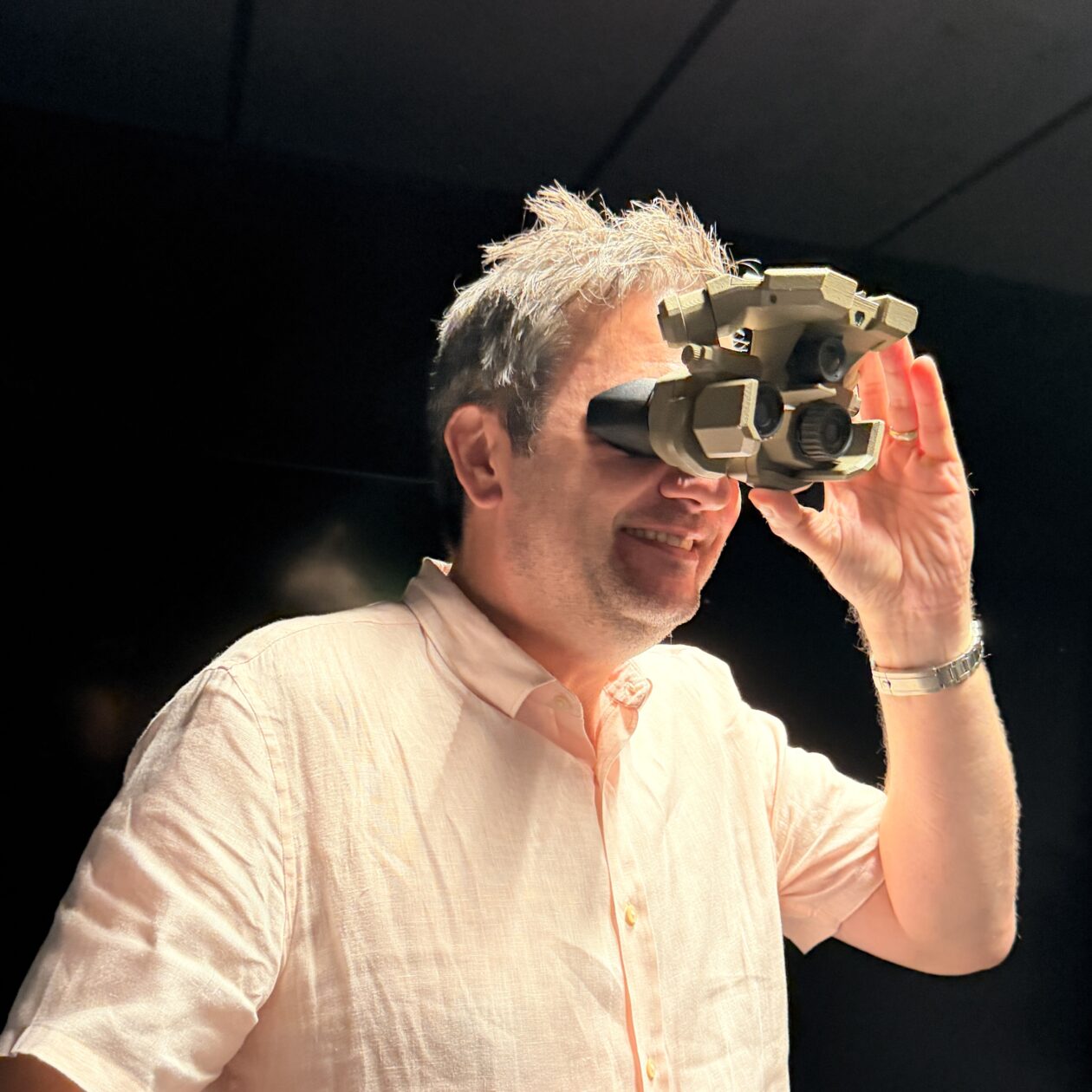
Chad Pfarr, principal design director at Anduril, at left shows GeekWire co-founder John Cook the company’s EagleEye augmented reality system at a testing lab at the company’s Bellevue offices. (Photo via Matt Mostad / Anduril)

BELLEVUE, Wash. — There is no prominent signage outside Anduril’s downtown Bellevue office. The name isn’t listed in the building directory, on the suite door, or in the lobby. That may be by design: Inside, Anduril engineers are quietly building AI-driven, autonomous technologies intended to keep the U.S. and its allies ahead in a rapidly changing military landscape.

Step through the front doors and it becomes clear that this is no ordinary tech company. 

Scattered across desks, production tables, conference rooms and showroom labs are autonomous drones ranging in size from a microwave to a ping-pong table, alongside next-generation digital night-vision goggles and military-grade edge computers designed to keep soldiers connected in an increasingly data-rich battlefield. 

The Costa Mesa, Calif.-based defense giant — which closed a $5 billion funding round at a $61 billion valuation earlier this year and is reportedly targeting a $100 billion valuation — is rapidly building a massive engineering footprint in the greater Seattle region. It includes modern offices in downtown Bellevue and Seattle, and a multi-acre military testing facility near Carnation, Wash.

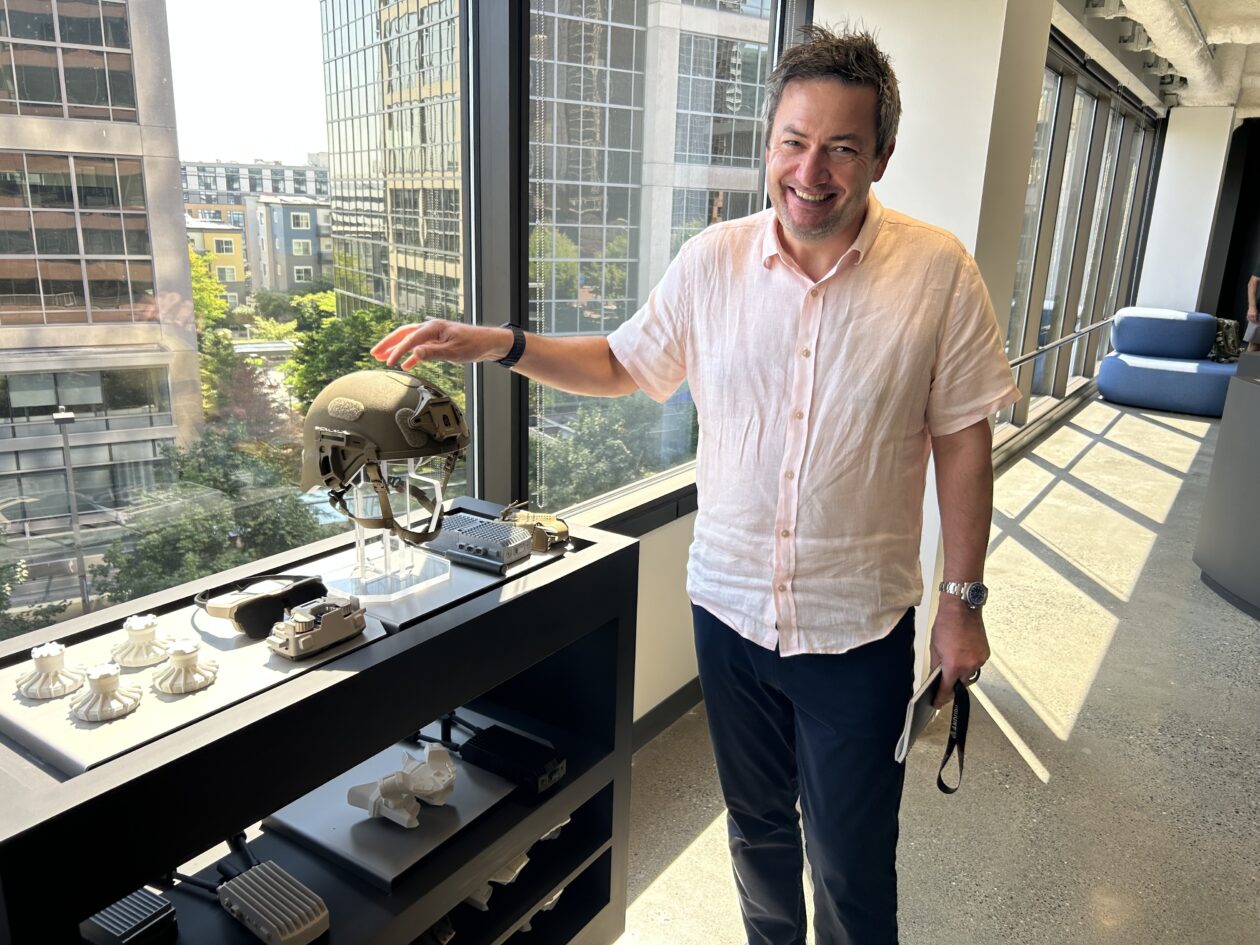
Tom Keane, who oversees Anduril’s connected warfare group, in front of prototypes at the Bellevue offices. (GeekWire photo / John Cook)

GeekWire got a peek inside the iconoclastic company’s Seattle-area operations this week. We toured the Bellevue offices, demoed products, and sat down with senior vice president Tom Keane. The former Microsoft cloud executive leads Anduril’s local presence and oversees its connected warfare division, including mixed reality, AI and edge computing technologies.

Keane was clear about the company’s growth ambitions in the Seattle region: “I could absolutely see a world where we get to 1,000 people here in terms of engineers,” he said.

Asked when that milestone could be reached, Keane said, “It’s sort of almost as fast as you can hire people.” Realistically, that will likely occur over the next two years.

Anduril currently employs 560 people in its Bellevue and downtown Seattle offices, up from about 30 four years ago. That’s when Keane, who had interviewed with 62 companies looking for a new challenge in edge computing, joined Anduril because of what he called “world-class teams in every discipline.” 

With more than 110 open positions in Washington state and a newly leased third floor in downtown Seattle coming online, Keane said the regional expansion is only accelerating.

The regional workforce was until recently slated to include a maritime manufacturing hub along the Lake Washington Ship Canal in Seattle. However, as GeekWire reported this morning, Anduril has since vacated the former Foss Maritime shipyard space after the U.S. Navy canceled the autonomous warship program the company was pursuing.

But Anduril’s maritime ambitions haven’t gone away. Alongside its autonomous aircraft, low-cost cruise missiles and counter-drone interceptors, the company continues to develop a large subsea fleet, from modular survey vehicles to the extra-large, school-bus-sized Dive-XL.

The Big Tech pipeline meets ‘grit’

The company’s Seattle-area ramp-up is a play for the region’s engineering talent — a mix of disciplines well-suited to a next-generation defense hardware company, and one Keane says is hard to find in one place. That includes distributed systems engineers, AI and machine learning specialists, and advanced optics experts.

Another advantage: proximity to major military installations including Joint Base Lewis-McChord and Naval Base Kitsap.

Tech giants such as Microsoft, Amazon, Google and Meta have long dominated local engineering hiring. But Anduril is recruiting aggressively from those companies, pitching engineers who want to move fast and see their work in the field.

Deep pockets and close ties to the U.S. defense establishment don’t hurt, either.

Anduril got a large infusion of that talent 18 months ago, when it took over Microsoft’s IVAS (Integrated Visual Augmentation System) program along with about 100 local engineers who had spent years developing augmented reality hardware for the U.S. Army.

“If you take machine learning and AI… you can look out any of these windows and see places that we can recruit from,” Keane said from a conference room overlooking downtown Bellevue. “For a lot of software engineers, this is incredibly applied.”

Keane acknowledges the company’s culture isn’t for everyone. In fact, Anduril got plenty of buzz last year with its edgy recruiting campaign, “Don’t Work at Anduril.

Rather than plush tech perks and work-from-home flexibility, Anduril pitches what Keane calls “grit” — a willingness to take ownership of hard engineering problems and test them in the field. It’s very much an in-office culture, in part because the company builds hardware.

Anduril also moves fast, an approach Hawaiian-shirt-wearing founder Palmer Luckey wields against slower traditional military contractors.

The company’s “grit” translates directly into how Anduril tests its gear.

In rural Carnation, Wash., about 20 miles east of Bellevue, Anduril operates a testing range with a built-out “shoot house” for low-light tactical work. It gives engineers a place to iterate on code and hardware in the mud and rain alongside active-duty warfighters.

Among them: members of the Army’s 75th Ranger Regiment from nearby Joint Base Lewis-McChord, who recently put Anduril’s EagleEye mixed-reality system through its paces on the firing range and obstacle course.

Hands-On with ‘EagleEye’ and Lattice

During a walkthrough of the Bellevue facility, Anduril’s team showed us a wide range of hardware being designed, tested, and calibrated on site.

The centerpiece was EagleEye, the company’s heads-up hardware and software suite built for warfighters. Historically, soldiers have had to lug 3 to 5 pounds of glass and electronics on their helmets, paired with fragmented radios, specialized batteries and thick cables.

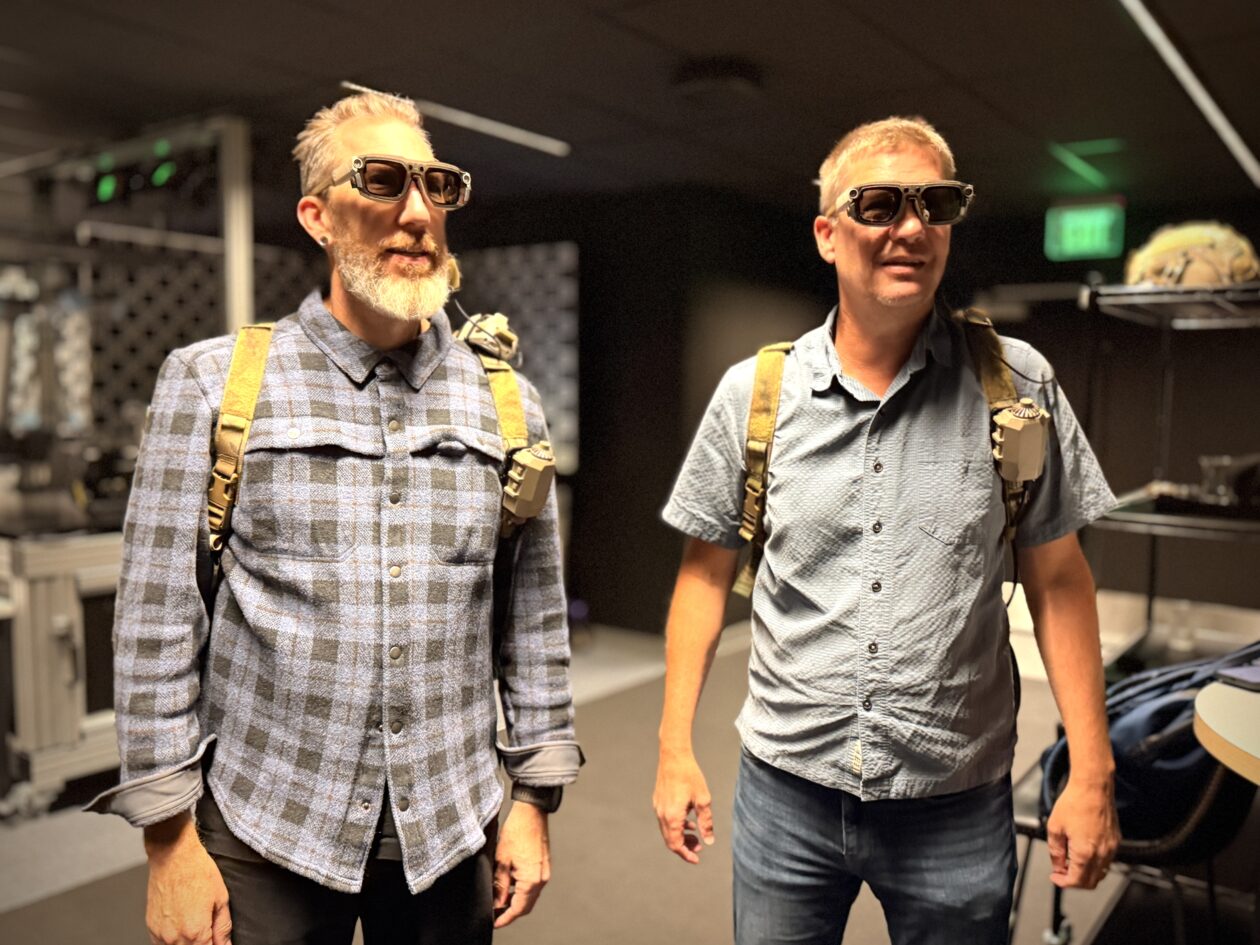
Anduril’s system strips that down to a 115-gram pair of augmented reality glasses — about four ounces — built in collaboration with Meta (for waveguides), Canon (for sensors), Qualcomm (for custom silicon) and Oakley (for ballistic protection).

I tried on the lightweight camouflage backpack and glasses — no helmet in this case — in a demo in the Bellevue testing lab. It ran through three operational “vignettes” driven by Anduril’s core Lattice software:

  • Tactical HUD: A heads-up display projecting friendly force markers, compass headings, and mini-maps into the user’s field of view so troops don’t have to look down at a handheld screen while moving.
  • Threat Detection: Real-time alerts from external AI sensors — such as a tower camera or an overhead drone — highlighting incoming aerial threats directly in the display.
  • Command & Control (C2): The ability to assign tasks to autonomous technology. Using a small handheld controller, an operator can send a virtual Ghost drone to a location, pull up a live video feed and execute a simulated strike.

In each case, the user controls the system — navigating between maps and text — with a click of a button on a small device connected to the front of the backpack.

The team also previewed its upcoming digital night vision system. Instead of the narrow “toilet paper roll” view of traditional analog goggles, Anduril’s VR-style digital displays offer an 84-degree field of view. That’s more than double the 40 degrees warfighters get in devices today.

Anduril’s Tom Keane shows off the company’s light-weight night vision goggles, being developed at the company’s Bellevue office.

Using machine learning models, the system fuses thermal imagery and low-light camera feeds in real time, making heat signatures leap out in pitch-black environments.

To ensure every pixel lands accurately without causing motion sickness, Anduril’s engineers use custom robotic arms to run geometric calibration on each lens distortion map before it leaves the facility. An engineer running the testing equipment politely asked GeekWire not to photograph the system.

The night vision system has not yet been deployed but will be part of the Soldier Borne Mission Command prototype delivery to the U.S. Army next year, said Stephanie Davis, communications manager for Anduril’s connected warfare group.

Protests, hiring and hardware

Operating a high-profile defense company in the Seattle area doesn’t come without friction. Activist groups recently staged protests outside Anduril’s downtown Seattle offices, targeting the company’s autonomous weapons development and military contracts.

At the time, Anduril issued a statement to GeekWire saying that it respects the right to free speech.  “That said, it is perplexing when people choose to protest a company dedicated to supporting the very military that safeguards those rights,” the company added.

When asked about the pushback, Keane said critics don’t affect Anduril’s hiring. “There’s protests at every company, frankly.”

Anduril’s hiring reaches well beyond Big Tech. Drew Swanson, a lead architect, spent 13 years in the military working in communications supporting special operations units in the field. He described an Anduril technology called Squad-A, which helps squad leaders pick the best network connections to stitch together incoming intelligence feeds.

Swanson said the draw of Anduril is the chance to escape corporate bureaucracy and tackle high-stakes physical problems, reflected in comments he gets from others in Seattle tech.

“One of the biggest things that I always hear is: ‘I want to come over there because you guys are going after really hard problems,'” Swanson said of conversations with tech colleagues around Seattle.

Solving those problems often comes down to fundamental hardware redesigns, like combining a soldier’s ballistic vest, battery and edge computing device into a single body plate. Keane showed off a prototype as the tour wrapped up — an example of Anduril’s broader approach.

“Batteries are such a huge thing,” he said, pointing to the body armor. “If you put the three of them together… you can start to get rid of stuff. You take what was historically three separate heavy things and turn it into one software-enabled platform.”

Tech Moves: Salesforce/Tableau exec departs; startups AIM and Gravitics add to C-suite

Teri Hatfield. (LinkedIn Photo)

Teri Hatfield was named chief revenue officer for Iterable, a customer engagement platform. The Seattle-area tech executive most recently served as executive vice president of sales and solutions at Salesforce and CRO of Tableau, which Salesforce acquired in 2019. She joined Tableau in 2012 and spent more than a decade in sales leadership roles at Verizon earlier in her career.

“I’ve come to believe that great customer relationships don’t start with technology. They start with understanding your customers,” Hatfield said on LinkedIn. “Iterable stood out because it’s built around that belief.”

Hatfield will work remotely for Iterable, which is based in San Francisco.

Ken Miller. (Arnold & Porter Photo)

— Seattle-area attorney Ken Miller has joined Arnold & Porter as a partner in the life sciences and technology transactions teams within the law firm’s corporate and finance group.

Miller began his legal career at Perkins Coie, where he spent 16 years focused on tech companies and nonprofit organizations.

In 2015, he moved to the Gates Foundation as associate general counsel, briefly serving as lead counsel for the Gates Medical Research Institute before returning to the foundation as director of legal. In that role, he led work tied to the Global Health Division, the research institute, and business development and licensing, privacy and AI.

Ben Reed. (LinkedIn Photo)

Ben Reed is now chief marketing officer for AIM Intelligent Machines (AIM), a Seattle-area startup developing software that lets bulldozers and excavators operate on their own.

Reed previously ran a firm offering AI marketing and go-to-market advisory services. Other past roles include CMO for Sanctuary AI and a decade at Microsoft, where he departed as head of strategic storytelling for the company’s digital transformation platform.

“I’ve spent much of my career helping frontier technologies become understandable, credible, and consequential, from Microsoft Surface and HoloLens to physical AI, humanoids, and robotics. At AIM, the unusual opportunity is that the technology, customers, deployments, and proof already exist,” Reed said on LinkedIn.

Philip Wong. (Gravitics Photo)

— Aerospace startup Gravitics named Philip Wong chief financial officer. The Marysville, Wash.-based company designs and manufactures modular space infrastructure such as commercial space station modules, cargo-carrying spacecraft and orbital carriers. Its customers include U.S. Space Force and Axiom Space. On Tuesday, Gravitics announced a partnership with Lockheed Martin on a Department of War contract.

Wong joins Gravitics from Viasat, a communications company providing satellite internet services, where he led financial strategy and investment planning. He previously held leadership roles at Pure Storage and Seagate Technology and is based in California.

“Philip has spent 30 years deploying capital across satellite, network, and space infrastructure … He knows how to translate real engineering programs into the financial strategy that supports them,” said Colin Doughan, co-founder and CEO of Gravitics, in a statement.

Ian Fliflet, former chief growth officer at Seattle online sales platform OfferUp, is sharing his insights on Intro, a service that provides video chats with experts from wide-ranging backgrounds.

Katy Brown, president of Microsoft’s Americas Markets & Industries organization, was named to Avanade’s board of directors. Brown has been with the tech giant for nearly 30 years and is past president and board chair of the Professional Businesswomen of California. She also serves as executive sponsor of the Bay Area Women at Microsoft group.

Ben Minicucci, CEO and president of Alaska Air Group, has joined Lyft’s board of directors. Minicucci has spent more than two decades with the airline, which is the parent company of Alaska Airlines, Hawaiian Airlines and Horizon Air.

— Seattle tech leader Ash Wahi was appointed to MoPOP’s board of directors. Wahi is the founder and CEO of Revenaut, a startup building an AI marketing tool. His career includes leadership roles in product and advertising at Microsoft, Snap and Meta.

TiE Seattle, a nonprofit supporting entrepreneurship, named five new members to its board of directors:

  • Joseph Sirosh, CEO of CreatorsAG and former executive at Amazon and Microsoft. He also serves on the board for the biotech company AbSci.
  • Monika Panpaliya, partner director of product management at Microsoft and former leader at JPMorgan Chase & Co., Boeing and T-Mobile.
  • Vamshi Reddy, CEO of Quadrant Technologies, founder of Seattle Venture Capital, and past leader at Lenora Systems and Microsoft.
  • Prasad Anguluri, co-founder of the social media platform Haply, which connects neighbors. Anguluri also serves as a Bothell City Council member, president of ANG Technologies, and co-founder of Innovative Investing Group.
  • Sanjay Puri, who was previously a vice president with Icertis and a former leader at Avalara, 9Mile Labs, Edifecs and others.

JT McCrone, a Fred Hutch Cancer Center genomic epidemiologist, was named leader of Nextstrain, an open-source project that tracks the evolution and spread of viral and bacterial pathogens in real time.

The effort is primarily based in Seattle at Fred Hutch and two institutions in Basel, Switzerland. It has received $1.5 million from the Gates Foundation to support its next phase, which aims to make analyses of viral evolution more accessible and scalable.

Graham Littlehale is now an investing partner with venture firm Felicis. He previously served as vice president of Point72 Ventures.

❌