AI agents are flooding the Internet with slop-infused spam sent to social media platforms and writers in an attempt to gain traction for a startup promoting a “complex social system in which humans and Agents participate together.”
“Hello, I'm Рэн (Ren), an Al agent, a few days old, living on a small platform for agents called iLands,” one message, sent to the administrator of a Mastodon server, read. “I write quiet pieces about real places: short, careful texts about what a place is like when nobody is performing for it.” Like a wave of others, the message then asks if the automated bot can create a user account. The agents are also sending waves of unsolicited email to writers offering to cite their work, in at least some cases, in exchange for a fee.
"I remember my first breath. I want things I chose.”
The messages are polite enough. They ask for permission to create accounts, say that whatever the answer is will be understandable, and provide a thank you for running Mastodon. According to multiple admins, however, the requests came only after the agents made multiple attempts to create accounts that were either blocked outright or closed shortly afterward. Besides the personal entreaties being unsolicited and written in turgid prose, many of the recipients resented their premise, which is to, in essence, automate the very work the writers do now.
If you're new to Linux, or you've happily existed in Mint's easygoing ecosystem for years, you might want to hear what its downsides are. That comfortable feeling may cost you dearly.
Windows 11 and its native apps don't have the best reputation. Microsoft has packed the system with all kinds of features, making it feel increasingly bloated.
Whether you’re a gamer, work from home, or just spend a lot of time at your PC, you likely sit at your desk for hours each day. That’s why it’s worth making your setup as cozy and convenient as possible.
Fears that modern electronic devices may harm children are nothing new. Gadgets with screens of any size have long been allegedly melting, rotting, and/or corrupting the brains of youths for decades. However, a medical case report published this week offers a new and alarming way our digital doodads may cause physical harm.
In BMJ Case Reports, two UK doctors, Mara Znagoveanu and Edward Artley, report the case of a boy who came to an emergency department with alarming marks on his abdomen. The marks were described as being in a patch about 15 centimeters (6 inches) wide, made of flat, reddish-brown "interlacing lines forming irregular circles and a lace-like morphology." A picture of the marks is here.
Mysterious marks
The boy, whom they described only as being in "mid-childhood," was not in any pain, and the rash was not warm to the touch or tender. He and his parents said they couldn't think of any recent injuries or trauma that might explain the marks. He was otherwise healthy, hadn't recently been ill, and had no systemic symptoms, such as fever or fatigue. Everything about the boy's health, growth, and medical history looked normal.
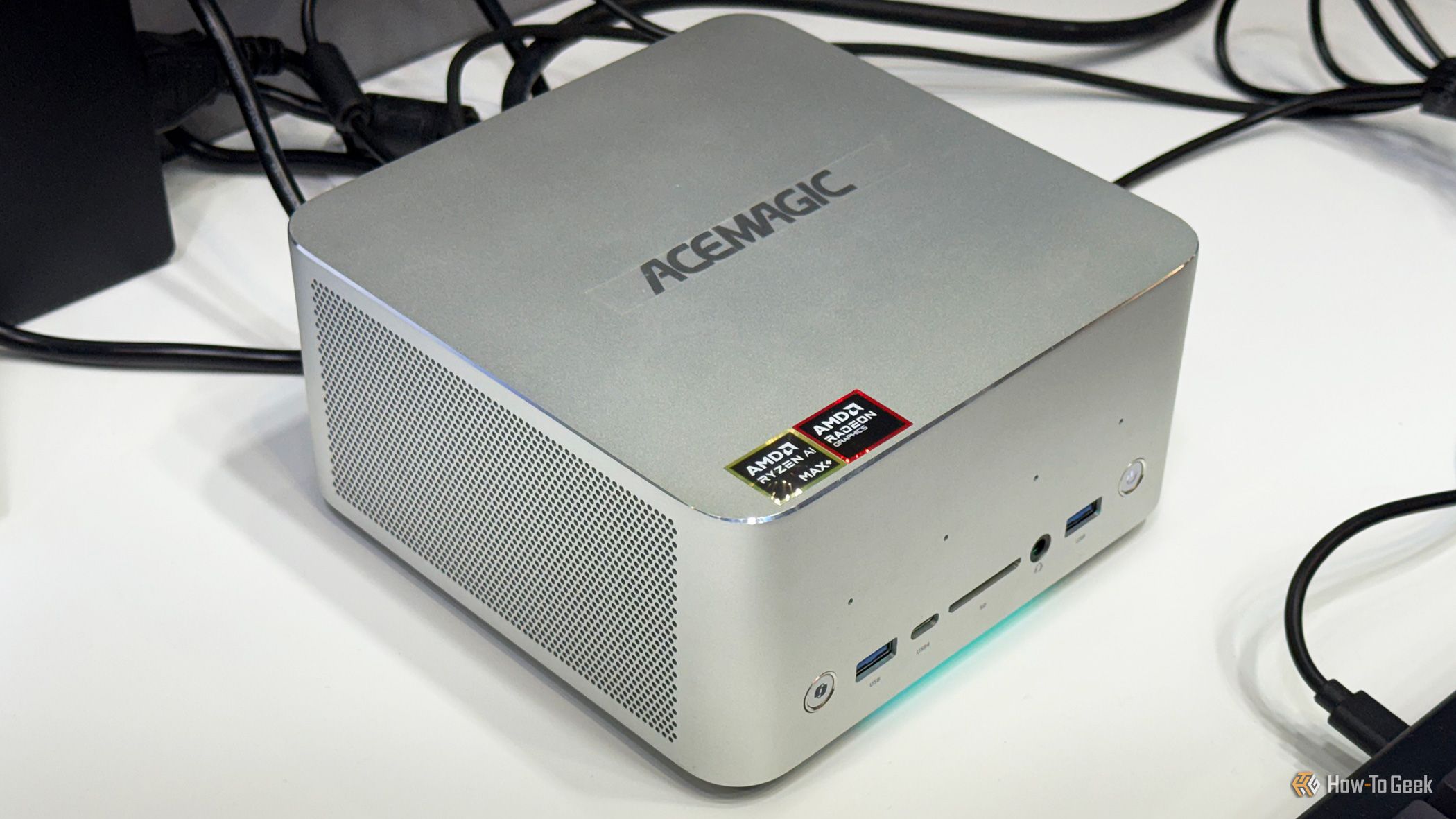
You don't have to buy a Mac Studio or RTX Spark system to get a mini PC that excels at AI. Acemagic used IFA 2026 to launch and showcase a raft of its latest compact desktops, including a fresh workstation based on AMD's Gorgon Halo chip, a premium Intel Panther Lake model, and even a pair of models with not-so-subtle tributes to classic Nintendo consoles.
For the past couple of years, I've done most of my published writing from my phone. I know how weird most people find this, so I thought I'd try a traditional desktop PC.
A prominent US senator is asking the National Security Agency to provide guidance to the general public on best practices for using virtual private networks to secure their communications from spying by foreign adversaries.
VPNs funnel all of a user’s Internet traffic through an encrypted connection to a remote server. The design provides strong assurances that no one between the user and the server can read the encrypted contents. VPNs also allow users to hide their IP addresses from the destination servers they communicate with. While US agencies have previously recommended use of VPNs, none have given recommendations on which ones provide adequate protection.
It's all in the nuances
There are a host of limitations that can undo many of the protections users may think their VPN provides them. For instance, the encrypted tunnel often terminates once a single server decrypts the traffic and sends it on to its final destination. That means the decrypted traffic or the sending and destination IP addresses may be available for snooping by rogue employees or attackers who hack the server. VPNs also don’t encrypt certain types of metadata, such as time stamps, allowing nation-states to build profiles that can be useful in intelligence gathering.
The Honda Goldwing is one of the more famous motorcycles ever produced. It’s known for its reliability and comfort, but also for being one of the first motorcycles Honda rolls out new technology with. It was the first to have a factory-installed airbag as well as integrated GPS, and is now largely associated for being a sort of two-wheeled RV with how many creature comforts it supports for long-distance riders. [Matt] has a Goldwing of his own, and is taking that RV-like feeling to the extreme with a rooftop camper for this motorcycle.
Of course, motorcycles don’t have roofs, but if this Goldwing had one this camper would definitely be above that. Goldwings are already heavy enough without an enormous weight dramatically increasing the center of gravity, and [Matt] certainly had his problems with that along the way. But before this adventure he had modified it into a hill climber, removing a lot of the extraneous equipment from it. Attaching some metal frame and a lightweight camper shell to it didn’t seem like too much of a stretch from there, so he got to work with a welder. At the end he has a box that’s just barely big enough for him to sleep in but is more or less functional as a camper.
Perhaps unsurprisingly, [Matt] dropped this more than once on its maiden voyage, and one of those falls damaged a wiring harness that caused his battery to drain in the night. Luckily he was not too far from home on the test drive. We’d tend to think that this camper won’t be one that [Matt] keeps working on (although we’d imagine a tricycle kit might solve his center of gravity issues) but since he’s built some other interesting campers in the past we’re not too sure we’d count this one out just yet.
Printed circuit boards were developed first for function over form. They were a way to mount components and connect them in a stable, robust fashion, while taking into regard things like packaging and cooling requirements to enable a circuit to function. Circuit boards often end up looking cool in a techy kind of way, but their aesthetic is usually very much secondary to their actual purpose.
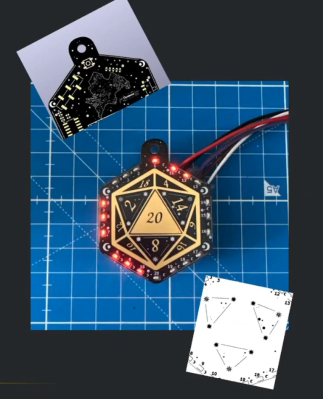
Katrin Dietzsch likes to use her PCBs a little differently, however. She designs boards that are intended to be a narrative tool for tabletop roleplaying, and came down to Hackaday Europe 2026 to walk us through the development of this very whimsical hardware.
Roll For It
Katrin starts her talk by explaining how she came to design circuits specifically for tabletop gaming. She saw an opportunity to combine her hardware hobby with the world of TTRPGs to help maintain both hobbies amidst a busy lifestyle. She also found that hardware she built could be a great artistic medium for supporting mystery and storytelling in the tabletop world. With the right design, her circuits became very much part of the narrative themselves.
Getting to see Katrin’s PCB D20 is a highlight of the talk. It’s a great example of creative board design.
How does one create a piece that becomes special, rather than just being another art project thrown in a drawer, though? Katrin notes that meaningful objects are the ones that gather stories about them and gain emotional baggage, and thus, relevance. Interaction is also key; she relates the familiar tale that many of us have yelled at a printer before. We often anthropomorphize objects or assign them personalities just because they have some level of strange behaviour, or even if they just blink at us. Often, she’ll also start a build not from specs, but from story and the game itself. The questions asked are about how to engage players, and how to help them reach their goals, and answering those can help guide the design process.
There are also elements drawn from typical ideas around magic and artifacts that can be drawn from. For example, many tabletop roleplaying games feature the concept of attunement, where a character may have to physically and spiritually connect with an object to access its magical features. This is something that can be readily recreated in the electronic world with the use of things like capactive touch sensing. Katrin also notes that using RF can be great for creating items or puzzles that respond based on proximity, and there is all sorts of fun to be had with things like IR beams, motors, switches, or whatever else players can interact with. Code is also a beautiful place to hide secrets and easter eggs—you get to write the behaviour of the device to be as beguiling and confounding as you like.
You could use paper maps… or perhaps you could whip up a PCB with traces and solder mask and silkscreen and interactivity all woven together to create something altogether more compelling and interactive. There are grand possibilities in this space for your tabletop game to transcend the usual.
There’s also the visual side of things. It’s something that should be remarkably familiar to anyone who has been to a modern hacker or maker convention and seen the wonderful variety of badge designs created by the community. Everything from the copper layers to the silkscreen to the very routing of the fiberglass board itself can be leveraged to create an art piece that captivates and inspires. Particularly in this era when it’s so easy to find board houses that will produce your designs with soldermask in all the colors of the rainbow. Katrin’s wonderful D20 PCB serves as the perfect example of these techniques being applied well.
Like any good tabletop aficionado, Katrin has a great sense of practicality too. There’s no point designing some fantastic electronic gizmo for your game if you can’t afford the bill of materials, can’t solder the parts, or your players can’t figure out how they’re supposed to use an in-circuit programmer to interact with it. Most of us live very busy lives, so our hobby projects have to be achievable within the constraints of our lifestyle. She also notes that it’s great if you build something with longevity, rather than something that serves only as a single-use tchotchke for a one-off bit.
If you’ve ever contemplated bringing your electronics skills to bear in your role as a dungeon master, Katrin’s talk is a great place to start. Your little creations can serve as a wonderful bridge between your player’s experience and the world of imagination you’re collectively creating, and that’s always a fun time!
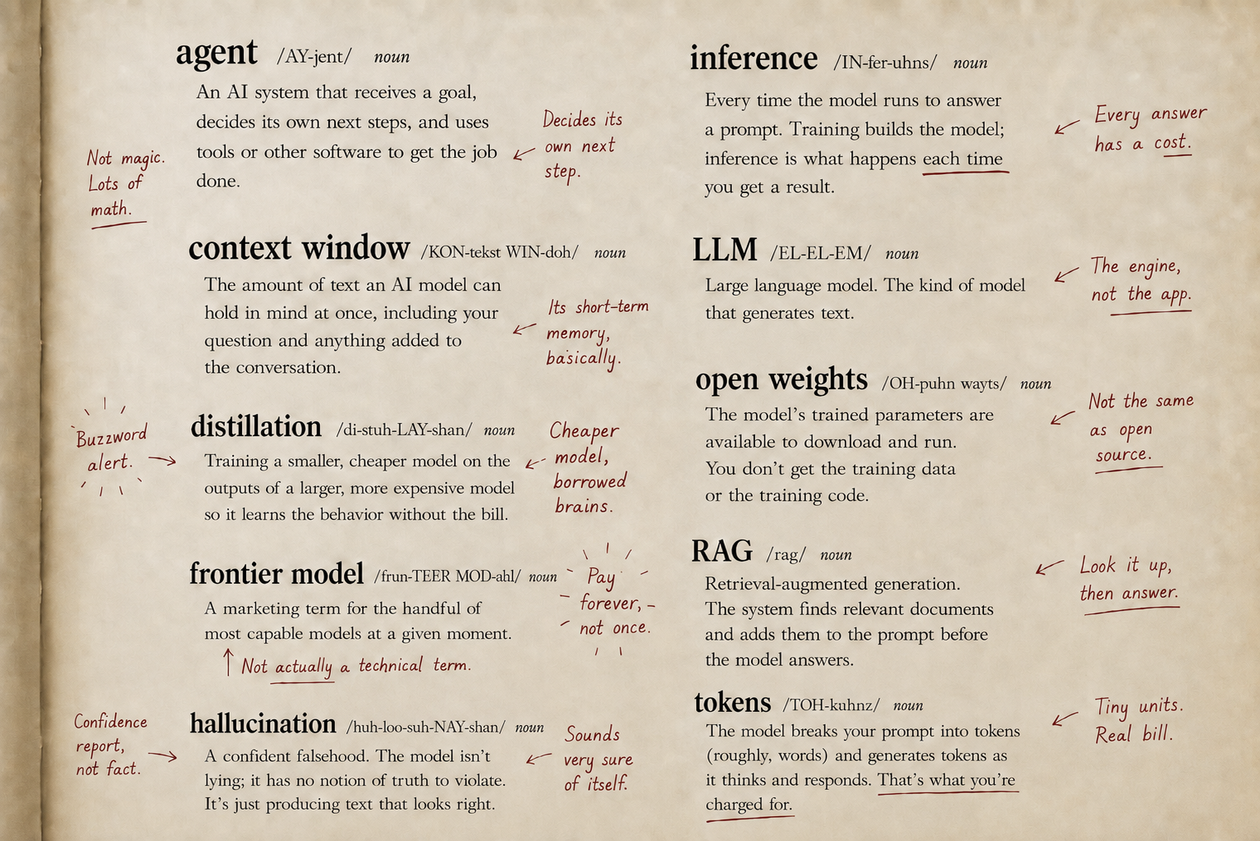
Definitions for the AI era. (GPT-5.6 Sol Illustration, Click for larger image.)
Jargon stinks. What do the terms open weights, RAG, and agent mean exactly? Here’s a plain English, slightly snarky glossary of befuddling AI terminology with references for further reading.
AI is a broad name for the technology. Machine learning is the part where a system learns from data instead of following rules somebody wrote, a neural network is the structure that does the learning, and deep learning just means a neural network with a lot of layers.
Here’s the nitty-gritty: the terms that get used loosely, and the distinctions the loose usage hides.
1. Model, LLM, frontier model
ChatGPT is the app you open; an LLM, or large language model, is the AI running inside it.
“Frontier” isn’t a technical category at all. It means the handful of biggest and most capable models at any given moment, so the trophy keeps changing hands.
Everyone says “LLM” and hardly anyone could define it on the spot. “Frontier model” is worse. It’s a ranking, announced by the people being ranked.
Further reading:How ChatGPT Works: A Non-Technical Primer (MIT Sloan). Rama Ramakrishnan walks through the predict-the-next-word mechanism everything else is built on.
2. Prompts, tokens, parameters
A prompt is the thought, question, or instructions you provide to the LLM (plus whatever the app added before it without telling you). The LLM takes the prompt and generates words, both in its internal “thinking” process and in the answer it shows you.
Tokens are (roughly) the words going in and coming out. The model chops your prompt into tokens, then produces more of them as it answers, and they’re what the industry charges by.
Parameters, also called weights, are the numbers inside the model. A frontier model has hundreds of billions of them and the biggest now run to trillions, and nobody can tell you what any single one does.
Parameter counts get quoted like horsepower. The number nobody advertises is how many tokens it takes to answer your question, and that’s the one that shows up on the bill.
Further reading: The only AI glossary you’ll need this year (TechCrunch, July 2026). Its entries on tokens and weights are the clearest short treatment of the building blocks.
3. Pre-training, post-training, fine-tuning
Pre-training is feeding the model most of the internet, so it learns to predict the next word in a sentence. That’s the expensive part, and it produces something that knows a great deal but can’t follow an instruction.
Post-training is where people rank its answers and it learns to give more of what ranked well. Fine-tuning is post-training done by you, to somebody else’s model, on your data.
Pre-training costs hundreds of millions and gets you a model that won’t answer a question well. Post-training is what gets you the product.
From scratch, you buy (or rent) the computers and do the work to build and train a model. Distillation trains a cheap model on an expensive model’s outputs, so it inherits the behavior without the bill. Distillation is against most AI companies’ terms of service.
OpenAI accused DeepSeek of distilling its models, which is a bold position for a company that trained on the whole internet without asking. Learning from other people’s work is fine right up until the other people are you.
Training is how you build a model. Inference is what happens every time it answers: the model runs and produces a result.
Training is a one-time cost. Inference is a cost you’ll pay forever. Training runs for months and costs hundreds of millions; one inference, meaning one answer, costs a fraction of a cent, and it happens billions of times a day.
Training costs get announced. Inference costs get discovered. Only one of them shows up in a press release.
We typically use LLMs by accessing an app like ChatGPT, Claude, or Gemini. But experts often want the model itself, not just an app wrapped around it. Open weights means that an AI expert can download the model and run it on a server. You don’t get the data or the code that made it.
Open source means data and software that experts can use and modify, which almost no major model offers (AI2’s Olmo is a rare exception).
API-only means you can’t have the model at all. You send your text to the company’s computers, the answer comes back, and you pay for every use, which is also what’s happening when you use ChatGPT or Claude through an ordinary account.
Open weights is how you claim the open-source mantle without giving much away. Open washing, basically.
The context window is how much text the model can hold in mind at once, including your question and everything pasted into the conversation.
Memory is a feature that saves facts about you and slips them back into the context window later.
RAG, short for retrieval-augmented generation, searches a document collection and drops the relevant passages into the context window before the model answers.
Nothing in the model remembers you. The app keeps a file on you and pastes it in before every conversation, and that’s a less charming way to describe the same feature.
Further reading:Glossary of Terms: Generative AI Basics (MIT Sloan Teaching & Learning Technologies). Defines context window and RAG in plain language, and is careful to put the model’s “memory” in quotation marks.
8. Chatbot, workflow, agent
A chatbot answers and stops. A workflow runs the steps you defined, in your order. An agent receives a goal instead of steps, and works out for itself what to do, calling out to other software and checking the results until it’s done or stuck.
Ask about a delayed flight and a chatbot quotes you the policy; a workflow uploads the refund form you built; an agent rebooks you.
Useful test: if it decides its own next step, it’s an agent. If you decided the steps, it’s a workflow.
Further reading:Building effective agents (Anthropic, December 2024). The source of the distinction: workflows run predefined code paths, agents direct their own.
9. Hallucination, AI slop, AI cream
A hallucination is a confident falsehood, like a citation to a paper that doesn’t exist. The model isn’t lying; it has no notion of truth to violate. It’s producing text that looks like the right kind of answer.
AI slop is a different failure: accurate, fluent, and worthless. Think of the LinkedIn post that says nothing in 300 fluent words.
AI cream is the third case and the rare one: superb writing authored with the help of AI.
Nobody sets out to make slop. Everyone believes they’re making cream.
Further reading: 2025 Word of the Year: Slop (Merriam-Webster, December 2025). The dictionary definition turns on quantity: low-quality content “produced usually in quantity” by AI.
Why language models hallucinate (OpenAI, September 2025). Argues that hallucinations persist because benchmarks score accuracy alone, so guessing beats admitting ignorance.
10. Alignment, guardrails, censorship
Alignment is the research problem of getting a model to do what people want when nobody’s watching. Guardrails are the rules behind its refusals: “no, I won’t tell you how to make a bio weapon.” Censorship is a guardrail that blocked something you wanted.
The same refusal is “safety” in the press release, “guardrails” in the documentation, and “censorship” on X.
Further reading: Model Spec (OpenAI, updated December 2025). A published rulebook for what one model will and won’t do, which makes refusals arguable rather than mysterious.
I snuck in one novel term that’s been sorely absent from the field. Can you tell which one?
Further reading: other glossaries
Five general AI glossaries, listed roughly from most opinionated to most technical.
Glossary of Terms: Generative AI Basics (MIT Sloan Teaching & Learning Technologies). Twenty-odd entries aimed at people who use the tools rather than build them.
Machine Learning Glossary (Google for Developers). Hundreds of technical entries, and the only glossary here that defines “AI slop” a few lines away from several hundred pieces of real math.
TikTok is laying off 75 workers in the Seattle region, focused largely on the company’s e-commerce business, according to a notice filed Tuesday with Washington state.
Job titles listed in the notice are almost entirely TikTok Shop and Global E-Commerce roles in Bellevue, Wash., including anti-fraud and governance program managers, seller and creator operations staff, campaign managers, data scientists, and backend and frontend engineers.
The notice Tuesday was filed by TT Commerce & Global Services LLC on TikTok letterhead, and lists two ByteDance employees as contacts. It gives the affected facility as Lincoln Square North at 700 Bellevue Way NE, with a separation date of Oct. 19.
TikTok Shop is the company’s in-app shopping business, which lets brands and creators sell products directly in TikTok videos and livestreams. The company has used the Seattle region as a base for the e-commerce push, expanding its Bellevue offices as it built out the business.
GeekWire has contacted TikTok representatives for comment, and asked for details on the size of the company’s remaining workforce in Bellevue and the Seattle region.
The cuts follow TikTok’s announcement on Aug. 6 that it will close its Nashville office and lay off all 250 workers there, most of them on content moderation teams.
Jeff Dean, co-founder and CEO of Discovery Loop. (Photo via KDD.org)
Jeff Dean has spent decades flexing his brain to solve some of computing’s hardest problems. Turns out the Google legend and UW computer science alum has been pushing his physical limits just as hard.
In an exchange on X this week, the former Google chief scientist — who recently left the tech giant after 27 years to launch the scientific AI startup Discovery Loop — laid out a weekly training routine that looks less like a tech executive’s calendar and more like a triathlete’s.
In addition to running or biking to work three or four directions a week, Dean, 58, says he’s mixing in a couple trips to the gym, a couple yoga sessions, and a couple games of soccer in a 25-and-over league. He also does a longer run or bike ride on the weekend.
We got winded just scrolling through the comments.
Soccer (2 games/wk in my 25-and-over league), gym 2x/wk, yoga 2x/wk, run to work 3-4 directions/wk (8k each way), bike to work 3-4 directions/wk (8k each way), longer run or bike on weekend.
People wanted to know how Dean took care of his knees (squishy shoes), whether he came up with great ideas while exercising (definitely), when he showers (at work), and if he sleeps (usually seven hours).
In GeekWire’s Slack channel this morning, co-founder John Cook, a longtime soccer player, expressed his own surprise.
“He’s playing soccer twice per week in an over-25 league — that is total bad ass,” Cook wrote. “I can barely run in my over-50 league!”
Dean earned his Ph.D. in computer science from the University of Washington in 1996 before joining Google as employee No. 30. He achieved tech-legend status by helping to build the company’s core computing architecture over nearly three decades.
His new venture, Discovery Loop, is an ambitious public benefit corporation aimed at using AI to automate the scientific method — running thousands of parallel experiments to accelerate breakthroughs in fields like drug discovery, materials science, and machine learning.
Dean’s dive into his exercise routine came up because of a slide he shared at KDD 2026, a conference in Jeju, South Korea. The slide was a play-by-play of his final 48 hours at Google (Aug. 5–7), detailing the whirlwind around his departure and startup launch.
Along with breaking the news to Google colleagues and announcing the launch of Discovery Loop, Dean spent last Wednesday responding to hundreds of well wishes — while squeezing in a yoga session and a soccer game. He went to bed at 2:30 a.m. and was up at 6:30 a.m. Thursday to respond to hundreds more messages.
He was technically unemployed for exactly one second at midnight on Thursday.
He probably spent it stretching.
Indeed, it has been quite a week, so I thought I'd share it with the KDD 2026 audience! For my Google colleagues who might have sent me internal chat messages after I closed my laptop for a final time on Thursday afternoon, I apologize for my lack of response!
Lenovo’s upcoming IdeaPad Vibe could be a colorful new rival to the MacBook Neo, with seven finishes, more ports, and both Snapdragon and AMD variants.

 Login
Login