❌

Reading view

There are new articles available, click to refresh the page.

Mesh Network Telephony Over Bluetooth on Android Phones
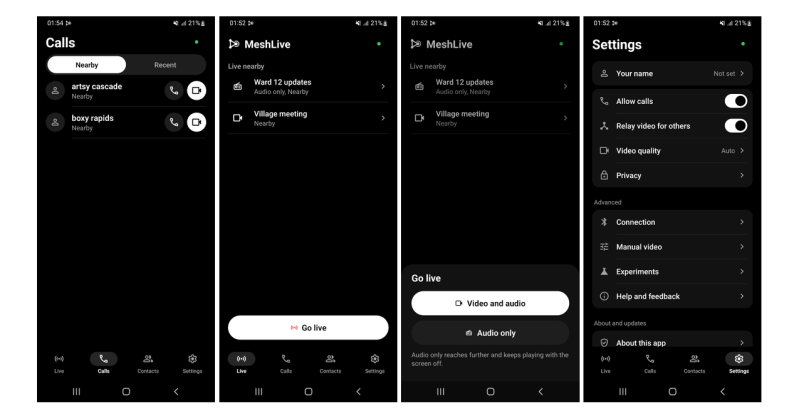
Telephony is a bit of a mixed bag. On the one hand, being able to talk to people in far off places is kind of neat, at least in theory. On the other hand, you’re usually reliant on a centralized network, which isn’t ideal to the mindset of most hackers.[Gautam]’s MeshLive project deals with that last one, offering a decentralized mesh network solution based on Bluetooth for Android phones that can handle both voice and video.

Rather than relying on dedicated hardware, this particular mesh piggybacks on your phone, and exists only as an Android application. Calls are end-to-end encrypted for both voice and video — though two-way video calling is still experimental. More testing has gone into video broadcasting, where a stream goes out one-way. The capability is available for voice, as well.

Each user has a unique identifier that can be scanned to create contacts, but it isn’t otherwise clearly identifiable to everybody. You’ll only appear with a random name that changes every 15 minutes to other users in range who aren’t your contacts. Range is of course the Achilles heel of this project, since it’s using the Bluetooth hardware of ordinary smartphones. It’s possible to extend the range of Bluetooth significantly with the right hardware, but we imagine most folks aren’t carrying directional antennas around with them. While every phone does forward the signal to as many others as it can, it can only do so for about 20 meters.

Of course LoRa remains the protocol of choice for mesh networking, though it’s normally used for text messages only. We have seen voice packets over LoRa, but anything LoRa requires dedicated hardware while this only requires an app.
Car’s Camera Footage Backed up to NAS

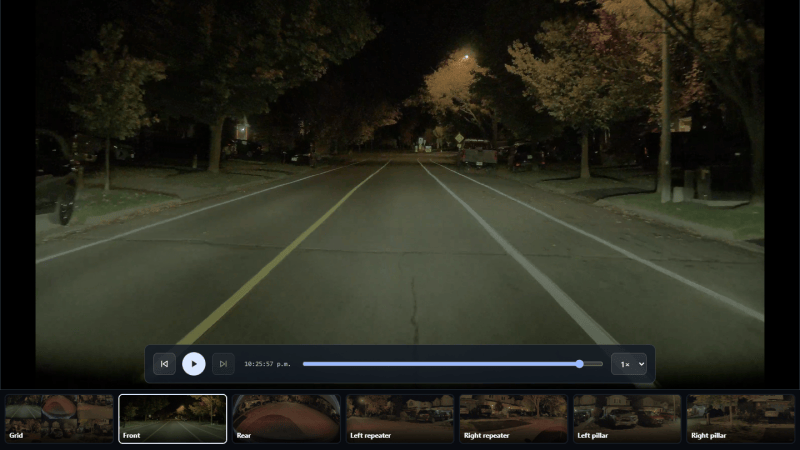
For as many sensors, cameras, and computers as there are on modern cars, they ought to be a dream to poke around in and customize to one’s liking. Unfortunately they’re generally plagued by the same locked-down, proprietary software that most consumer electronics ship with, making it very difficult to interact with these systems in ways the manufacturer doesn’t approve of. There are a few exceptions to this rule, though, and [Sasha] built this system which backs up the footage from their electric car’s on-board cameras automatically to a NAS.

The system is built around a Raspberry Pi Zero 2 W which plugs directly into a USB port in the car’s glovebox. To set it up, the software only needs to be flashed onto the Pi and then it can be controlled from a smartphone. It can connect to any NAS over a variety of protocols and keeps track of what footage has been backed up, and can even automatically restart a backup if the car drives away before it has completed. It also automatically frees up space on the car’s internal drives by deleting any files that have already been synced to the NAS. All of the data is kept in the user’s control as well, and nothing leaves the LAN unless the user sets up backups to a cloud service on their own.

If you have the correct electric car and a Pi other than a Zero 2 W, [Sasha] also has a package for other Raspberry Pis that should work. Unfortunately this was designed for a specific electric car; other makes and models won’t work with this out of the box, but we hope that won’t stop others from checking out the GitHub page anyway trying to figure out what’s going on under the hoods of their car’s electrical and computer systems. Sometimes this leads to things you might not expect, like using the car itself as a video game controller.

Hackers Hijack D-Link, Ubiquiti Devices To Resell Your Stolen Bandwidth

An anonymous reader quotes a report from BleepingComputer: A proxyjacking campaign has impacted devices in 34 countries, monetizing victims' internet connections through a commercial residential proxy network. The operator installed Pawns.app, a legitimate bandwidth-sharing application that lets users earn money by sharing their internet connections, on devices without the owners' consent. Pawns.app account holders are rewarded for allowing traffic from other users to flow through their network, provided it runs on trusted, non-blocking IP addresses. By installing the app on multiple systems, the attacker likely accumulated larger payouts. Threat intelligence company GreyNoise discovered the campaign while investigating suspicious activity at an unnamed organization, and identified at least 143 compromised devices worldwide. According to researchers, the attacker exploited known vulnerabilities in D-Link ShareCenter NAS (CVE-2024-3272 and CVE-2024-3273), Ubiquiti UniFi Video NVR (CVE-2021-44228), and SAP NetWeaver Visual Composer (CVE-2025-31324) to install the Pawns.app software. Hikvision and Dahua DVR/NVR devices were also targeted, though the specific vulnerabilities exploited were not identified. In some cases, the report says the attackers configured SSH key authentication to maintain backup access to the compromised systems.

Read more of this story at Slashdot.

Rocket fuel: Seattle-area startups raise a record $3.5B as national VC funding cools

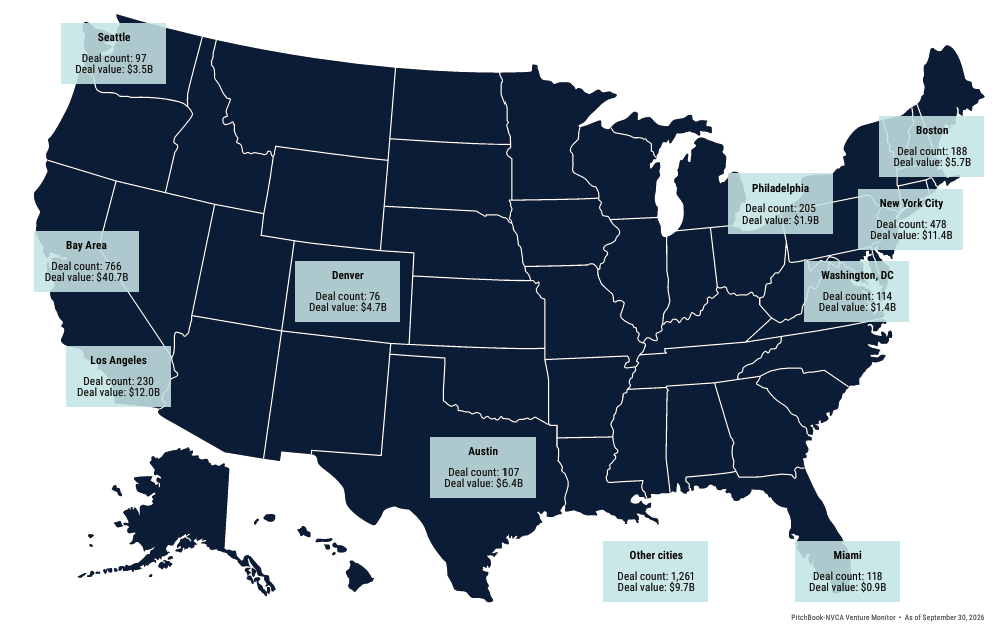
Q3 2026 VC deal activity by U.S. metro area. Note: PitchBook’s map uses broader regional boundaries than the metro-area figures in this story (PitchBook-NVCA Graphic, click to enlarge.)

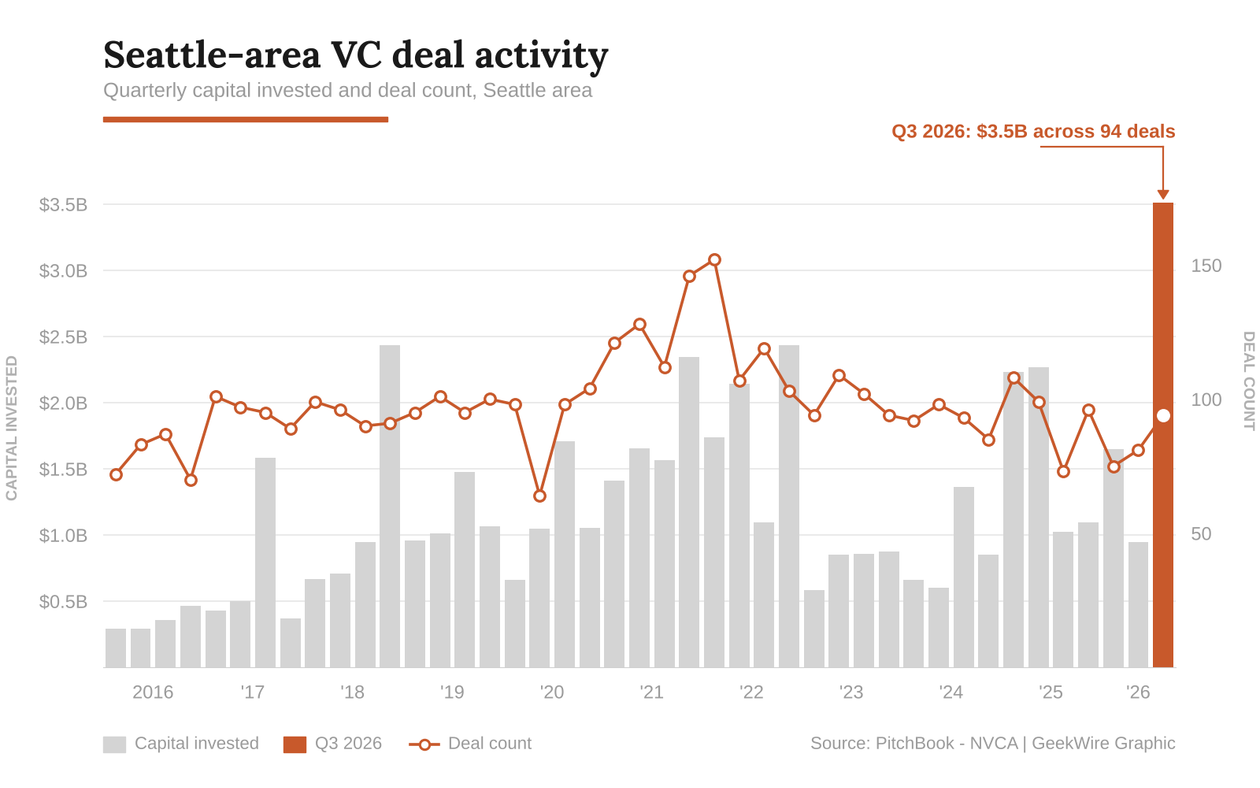
Seattle-area startups raised $3.5 billion in venture capital in the third quarter, the most in any quarter going back at least a decade, led by big rounds for Kent-based rocket maker Stoke Space, Bellevue developer platform Temporal and Everett fusion company Helion.

That’s more than triple the $1 billion raised in the region in the same quarter a year earlier, according to the PitchBook-NVCA Venture Monitor. It’s also more than $1 billion above the previous quarterly high of about $2.4 billion, reached in late 2018 and again in late 2022.

Most of the money went to a handful of companies building physical things: rockets, satellites, spacecraft and fusion power plants. Three space companies in the region raised $1.6 billion combined: Stoke, Redmond-based Starcloud and Seattle’s Hubble Network.

Nationally, the trend went the other way. U.S. venture funding fell 40% from the prior quarter, to $98.4 billion, as the giant rounds for frontier AI labs that drove the first half of the year tapered off.

Seattle ranked seventh among U.S. metro areas for venture dollars in the quarter. The Bay Area led with $40.7 billion, followed by Los Angeles, New York, Austin, Boston and Denver. Denver’s $4.2 billion came largely from a single $3.9 billion round for AI data center developer Crusoe.

By number of deals, Seattle ranked eighth, with 94.

The total includes Helion’s $500 million round, which the company announced in June but PitchBook counts in the third quarter. Even without it, the quarter would still be the region’s biggest on record.

Hubble Network raises $200M to reach $1.6B valuation as startup expands satellite Bluetooth network

Illustration: Hubble Network satellite in orbit
An artist’s conception shows one of Hubble Network’s satellites in orbit. (Hubble Network illustration)

Seattle-based Hubble Network has reached a $1.6 billion valuation after raising $200 million in new funding to power its satellite-based Bluetooth connectivity network. The fresh capital propels the startup into unicorn territory as it works to connect billions of everyday, off-the-shelf devices directly to space.

The Series C round, led by Smith Point Capital, with Seraphim, Carthona Capital, Earthshot Ventures, Y Combinator, and RPM Ventures, brings total funding to $300 million. Hubble Network raised $70 million a year ago.

Hubble currently operates six satellites in low-Earth orbit and plans to expand to a full 60-satellite constellation built with satellite operator Muon Space by 2030. The company says its hybrid network — which blends ground-based tracking with satellite coverage — is live for pilot customers today, including software firm Samsara, with data speeds and update frequencies set to increase as more spacecraft launch.

“When we said we’d connect Bluetooth chips to satellites, most of the industry said the physics wouldn’t allow it,” Alex Haro, CEO and co-founder, said in a news release on Wednesday. “Today we’re turning that early skepticism into a global opportunity.”

Hubble’s swift rise underscores the Seattle region’s growing status as an epicenter for low-Earth orbit satellite development. While heavyweights like SpaceX’s Starlink facility in Redmond and Amazon’s Leo satellite division in Kirkland focus on high-bandwidth orbital internet, Hubble is carving out a distinct niche in low-power, direct-to-satellite IoT connectivity — reinforcing the Pacific Northwest’s footprint across commercial space technology.

The company, which employs about 70 people, is No. 135 on the GeekWire 200, our ranked index of the Pacific Northwest’s top startups.


Hubble’s system works via a software update, allowing standard Bluetooth Low Energy (BLE) chips — found in everyday items like package trackers, vehicles, and pharmaceuticals — to broadcast signals directly to space. By pairing a ground-based network of nearly 90 million scanners with its satellite constellation, Hubble aims to replace costly cellular trackers with a setup running on roughly 50-cent chips and $4 monthly subscriptions.

Founded in 2021 by Haro, who previously co-founded location-sharing app Life360, and CTO Ben Wild, who invented Amazon Sidewalk, Hubble is positioning itself to disrupt traditional asset tracking by making global monitoring economically viable for everyday goods.

Haro noted that combining terrestrial and space networks drops tracking costs low enough to extend real-time visibility beyond high-value cargo to routine consumer items, like tracking a new pair of shoes directly from a warehouse to a front doorstep.

The company has no connection to NASA’s Hubble Space Telescope. Instead, Hubble Network’s name plays off the idea that its network can serve as a hub for BLE transmissions.

❌