NASA and IBM have released an open-source AI model trained on a large collection of lunar observations to help scientists analyze the Moon at scale. "The NASA-IBM Lunar Foundation Model gives scientists a foundation to explore the Moon at scale, connecting observations across instruments, revealing patterns that are difficult to see in isolation, and providing an open platform the global research community can build on," said IBM director of research for Europe, Juan Bernabe-Moreno. The Register reports: It is claimed as the first AI model to integrate observations captured in a range of modalities (data formats), and at different viewing angles and spatial scales. Instead of sifting through maps and images by hand or using low resolution machine learning models, scientists can use this to analyze geographic features, the pair say. In particular, NASA and IBM hope researchers will be able to discover previously unidentified lunar ice deposits, analyze volcanic features called Irregular Mare Patches, and identify and classify craters.
Lunar ice indicates the presence of water and oxygen, which may be useful for future manned missions. It is found in permanently shadowed regions, which are among the most difficult areas to observe. The NASA-IBM model combines multimodal and multi-resolution observations to better predict where ice may be present on the lunar surface. Alongside the model, IBM and NASA scientists compiled an open-source lunar dataset from over 30 spatially-aligned layers, using data from nine instruments across four missions. It combines tens of thousands of images and maps showing various geophysical properties of the lunar surface.
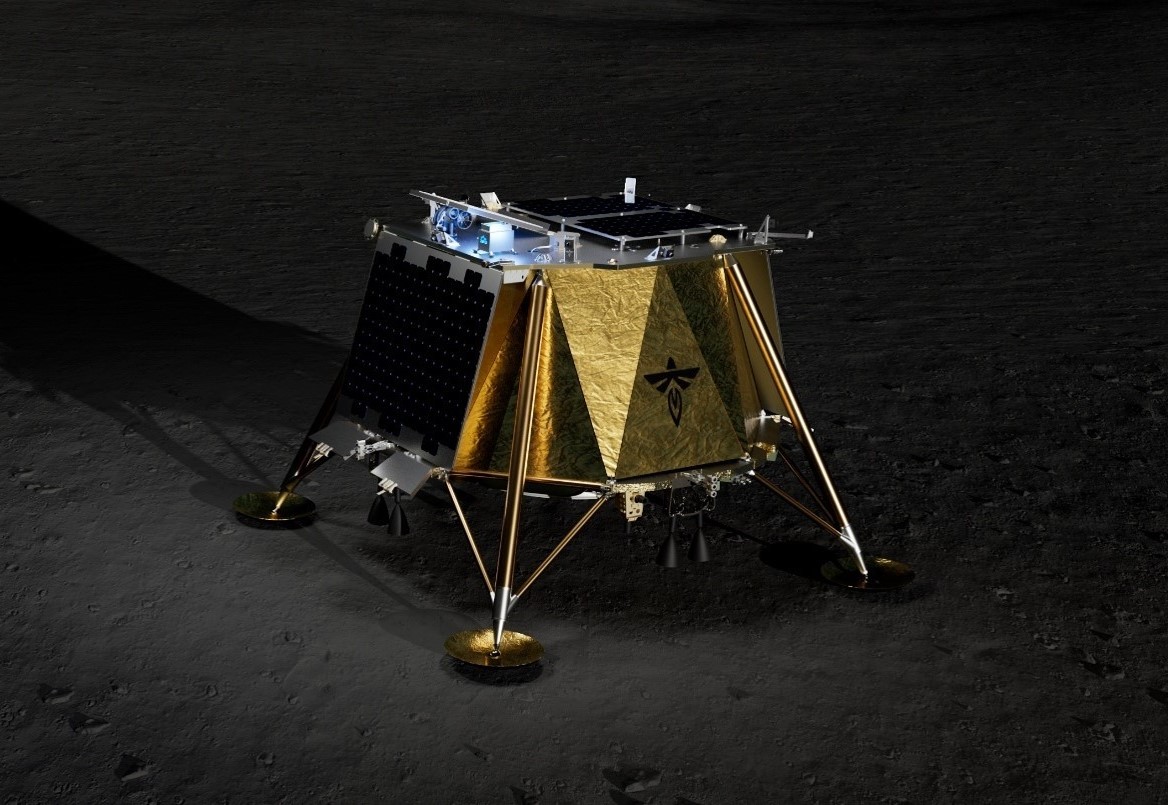
An artist’s conception shows Firefly’s Blue Ghost lander on the moon’s surface during the lunar night, with Zeno Power Systems’ radioisotope heater unit highlighted with a blue glow on the left side of the lander’s top deck. (Firefly Aerospace Illustration)
A nuclear-powered heater built by Zeno Power Systems is slated to fly to the moon aboard Firefly Aerospace’s Blue Ghost lunar lander for a demonstration mission that could take place as early as 2028.
Zeno’s Seattle engineering hub played a leading role in developing the radioisotope heater unit, which will be powered by americium-241, a radioactive isotope typically recovered from recycled nuclear material.
The unit will provide 5 watts of thermal energy — enough to sustain the payload during the lunar night, which lasts 14 Earth days. Firefly’s first solar-powered Blue Ghost lander, which touched down on the moon in March 2025, operated successfully through the lunar day but gave up the ghost shortly after sunset.
“Our first Blue Ghost mission gave us firsthand insight into the moon’s extreme thermal environment, where we measured temperatures ranging from more than 230 degrees F during the lunar day to below -275 degrees F at night,” Ray Allensworth, Firefly’s vice president of spacecraft, said today in a news release. “Now we’re looking forward to advancing technologies that can extend missions beyond sunset and support long-duration surface operations required for NASA’s Moon Base initiative and the growing lunar economy.”
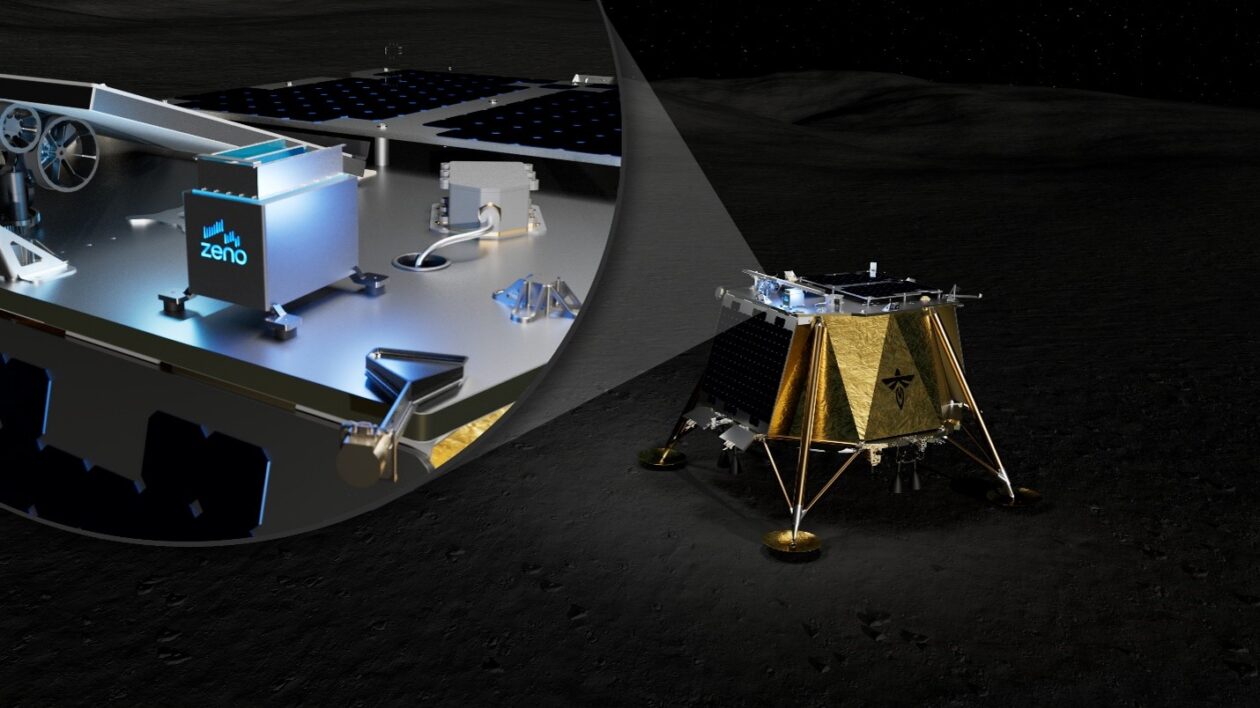
This illustration provides a closeup view of Zeno’s radioactive heater unit on a Blue Ghost lander. (Firefly Aerospace Illustration)
The lander will rely on solar power to run NASA-funded science payloads on the moon’s near side during the lunar day. When night falls, Zeno’s payload will go into operation and transmit data back to Earth.
“Hardware capable of surviving the extreme cold of the lunar night will be essential to enabling sustained operations on the moon,” said Tyler Bernstein, CEO and co-founder of Zeno Power. “NASA’s Moon Base program has identified the need for technologies such as radioisotope power systems to support future lunar exploration, and Zeno is proud to answer that call to demonstrate this capability aboard Firefly’s Blue Ghost mission.”
Beyond radioisotope heater units, Zeno is developing radioisotope power generators to supply electricity for missions on the moon and in extreme environments on Earth. “As demand for long-duration lunar infrastructure grows, we are building the production capacity to support future commercial and government missions,” Bernstein said.
“Zeno has raised $105 million to date in private investment and has 95 employees,” Kelsey Bates, the company’s communications manager, told GeekWire in an email. The Seattle hub accounts for the largest proportion of those employees.
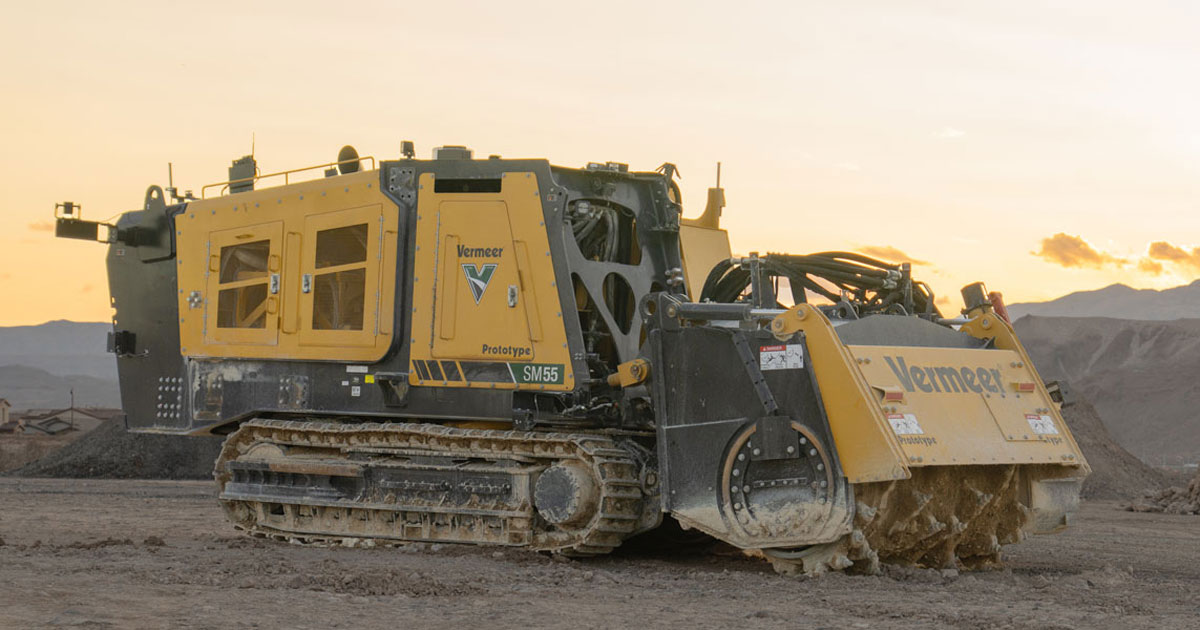
This full-scale prototype of Interlune’s lunar excavator was developed in partnership with Vermeer in 2025. Testing as shown was done with auxiliary components. (Interlune / Vermeer Photo)
Seattle-based Interlune is expanding its partnership with Vermeer, an Iowa-based industrial equipment manufacturer, to develop construction tools for use on the moon.
The two companies forged their initial strategic partnership to further Interlune’s plans to extract helium-3 from tons of moon dirt and rocks, also known as regolith. Their full-scale prototype of a lunar excavator was unveiled a little more than a year ago.
At the time, Interlune was focused on mining helium-3 and bringing it back to Earth for applications ranging from quantum computing to medical imaging and nuclear fusion. But a major shift came in March when NASA announced a 10-year, $30 billion initiative to build the infrastructure for a moon base.
Interlune co-founder and CEO Rob Meyerson said he and his teammates realized that the partnership with Vermeer could support NASA’s plans. “We went back to Vermeer … and we decided that it made sense to formally expand the partnership to focus on all these other things that we’ve had in mind,” Meyerson told GeekWire.
For example, a lunar construction project is likely to involve building roads, compacting surfaces, digging trenches for underground utilities and moving rocks to clear space for a habitat. Heavy equipment might be needed to build protective berms around nuclear reactors.
“When I left NASA and came to work for Vermeer, my hope always was to be able to re-merge my passion for aerospace, specifically for the human exploration and human colonization of the moon and Mars, with my coming back to my family business … and use what I knew Vermeer was best at on Earth to do important work on the moon and Mars,” he told GeekWire.
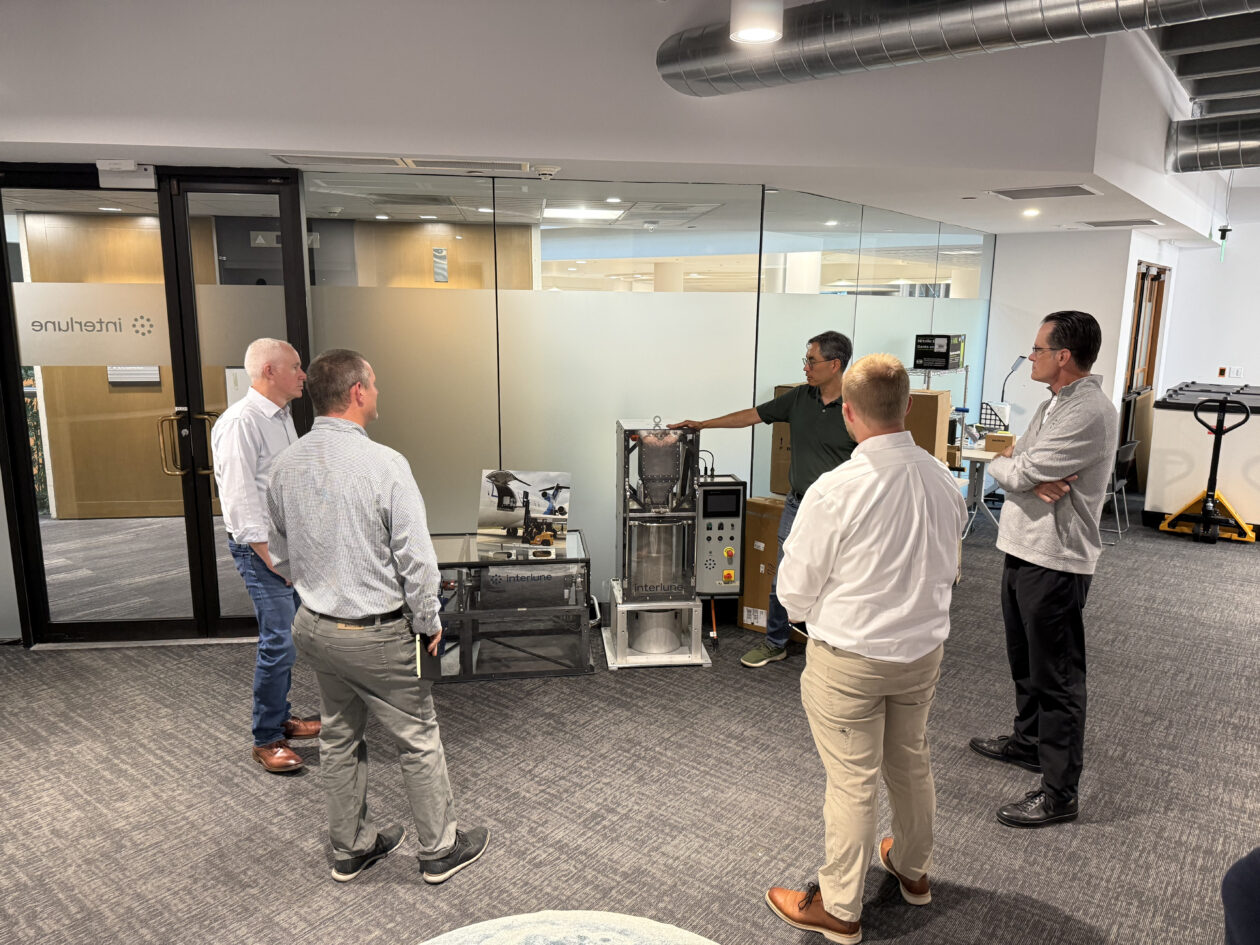
Executives get a look at a regolith-processing experiment at an Interlune lab in Seattle. Gary Lai, Interlune’s chief technology officer, is pointing at hardware. Interlune CEO Rob Meyerson is at far left, and Vermeer CEO Jason Andringa is at far right. (Interlune Photo)
“We want to really formalize the partnership so that we can start to think beyond prototypes, and think about sustainable operations, systems that are resilient to the environment,” he said. “That is what Interlune and Vermeer bring together as a team.”
Interlune will work with Vermeer to build a demonstration tool that could be put on a lunar vehicle and sent to the moon in 2028 or 2029. “It is going to be something around leveling, rock removal and compaction,” Meyerson said. “That will be the priority for the first one.”
Andringa said Vermeer would follow Interlune’s lead on the requirements for a lunar site preparation tool. “It would most likely involve what we call surface mining, which is a big drum attachment on a machine that basically mills out a level of the very top part of the regolith, and then it could be compacted,” he said. “Depending on the exact location on the moon and the exact properties of the material, you might just need to go over it with the drum one time.”
A lunar site-leveling tool could look something like the drum attachment mounted on this surface mining vehicle. (Vermeer Photo)
Over the longer term, Interlune and Vermeer would add to the toolkit. “Sometime in the future, you may have a specific-purpose machine that the two companies put together, that is specially designed just for that industrial operation, rather than the missions that NASA has in mind for the LTV,” Meyerson said.
In the meantime, Interlune is continuing work on its helium-3 mining initiative. The company’s first space mission, known as Crescent Moon, involves sending a multispectral camera to the lunar surface later this year. The camera is designed to estimate how much helium-3 is present in the soil around the landing site.
Interlune’s second mission, Prospect Moon, recently received $6.9 million in NASA funding for design and development. That mission is currently due for launch in 2028 and will test methods for extracting helium-3 and hydrogen from lunar regolith.
“We have the team in place, and things are going well,” Meyerson said. “We’re ticking through all of our milestones with the NASA team.”
Meanwhile, Vermeer is pursuing a separate partnership with Texas-based Astroport Space Technologies, which is developing its own suite of robotic systems for lunar construction projects. “Interlune and Astroport are aware of each other, and both of them feel as though there’s going to be plenty of work to go around,” Andringa said.
Andringa emphasized that the work on lunar construction equipment makes up just a small percentage of what Vermeer does. About 10 of Vermeer’s 4,500 employees are working on moon projects, and even those employees have other projects in their portfolio, he said.
Nevertheless, Andringa acknowledged that there’s something inspirational about extending the company’s reach beyond Earth. “It’s always going to be a small part of Vermeer, but it’s going to be a super-engaging, motivating, fun, stimulating, challenging part of Vermeer,” he said. “And you know what? What we learn to build stuff and fly stuff and operate stuff on the moon is just going to make us even better at the job sites where Vermeer machines work on Earth. That’s the reason we’re doing it.”

 Login
Login