A Cambridge-led study suggests comets rarely delivered useful quantities of life’s molecular ingredients to early Earth because impacts destroyed them and surviving material wouldn’t have stayed concentrated at the surface for long.
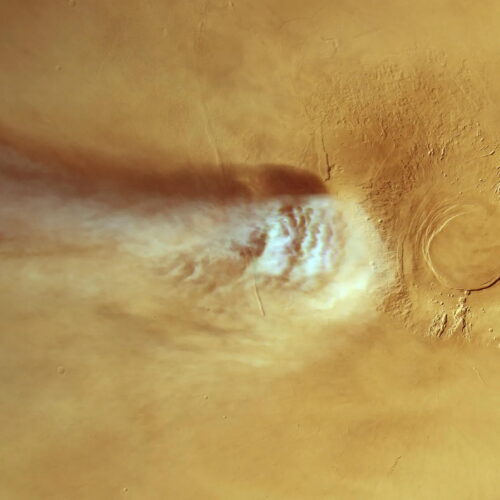
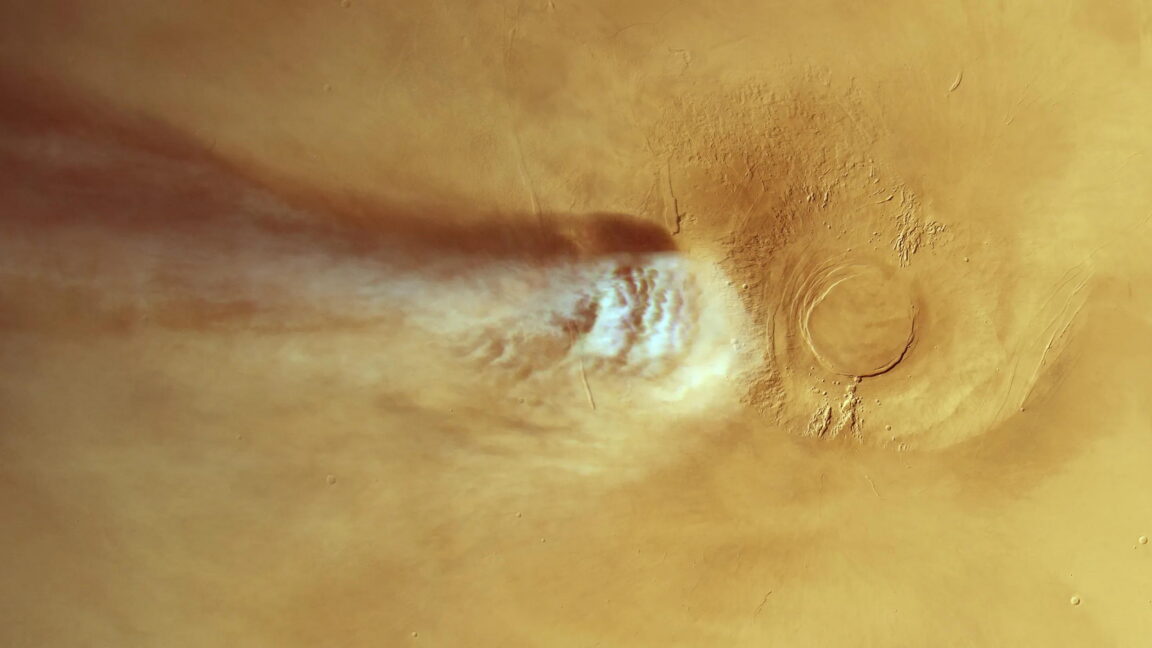
Every morning during the Martian spring and summer, a thin and extremely long cloud emerges, only to disappear again. The wispy formation appears near the volcano Arsia Mons and gradually elongates until it reaches over 1,000 miles—about the distance from New York to Kansas City as the crow flies—before dissipating. This cycle then repeats for several months.
Since it was first recorded by a probe in 2018, scientists have been unable to find a plausible explanation for the existence of this cloud, often referred to as the Arsia Mons Elongated Cloud (AMEC). Until now. Recently, researchers successfully modeled the cloud’s formation for the first time, their results suggesting that it may be driven by a physical process that has never been directly observed in any planet's atmosphere.
"We found that we needed to include some exotic physics… physics that, while included in textbooks, is treated as theoretical and usually thought not to happen in nature. It certainly hasn’t been seen in action before," Jorge Hernández-Bernal, a planetary scientist at Paris’ Sorbonne Université and lead author of the study, said in a press release. "Once we included this physics in our simulations, the AMEC emerged just as we hoped.”
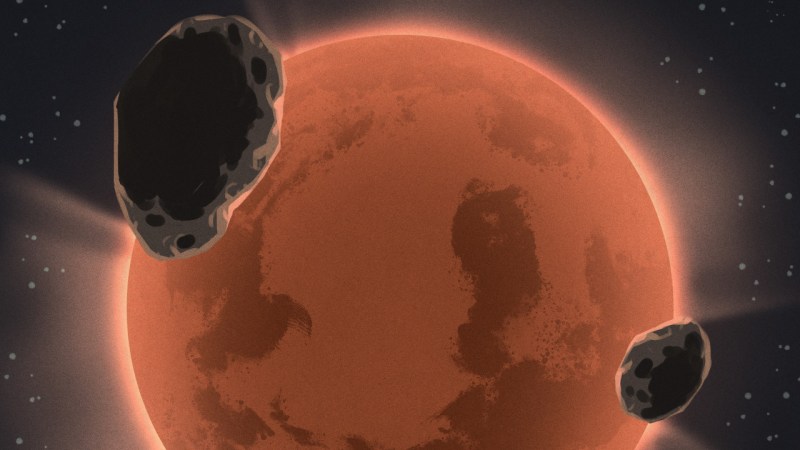
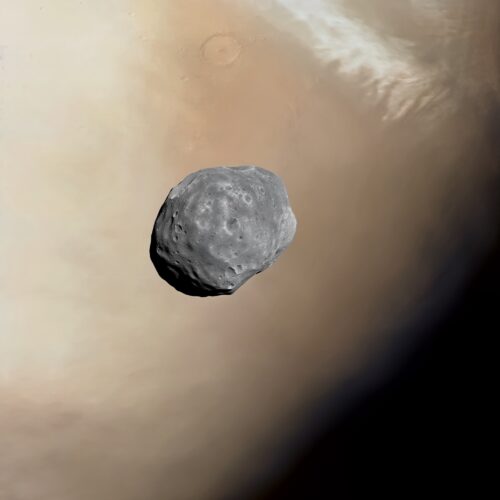
Humanity has been sending robotic explorers to Mars since the 1970s, and for our efforts we’ve been rewarded with not only incredible imagery of the Red Planet’s magnificent desolation, but a wealth of information about the alien world and how it’s changed over the last several billion years. But comparatively, we know almost nothing about the planet’s two moons, Phobos and Deimos. In fact, as recently as the 1960s, there were some scientists that believed the unusual shape, mass, and orbit of Phobos hinted at the possibility that it was no moon at all, and was in actuality a derelict spacecraft of some type.
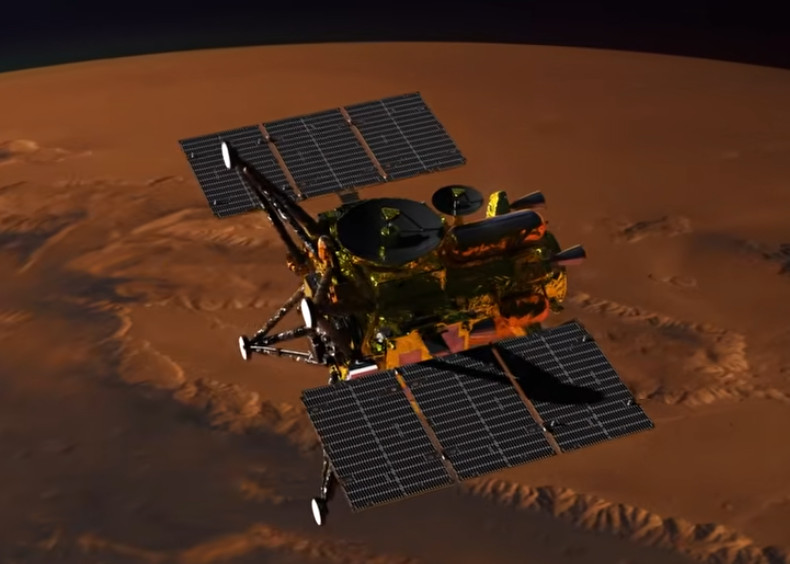
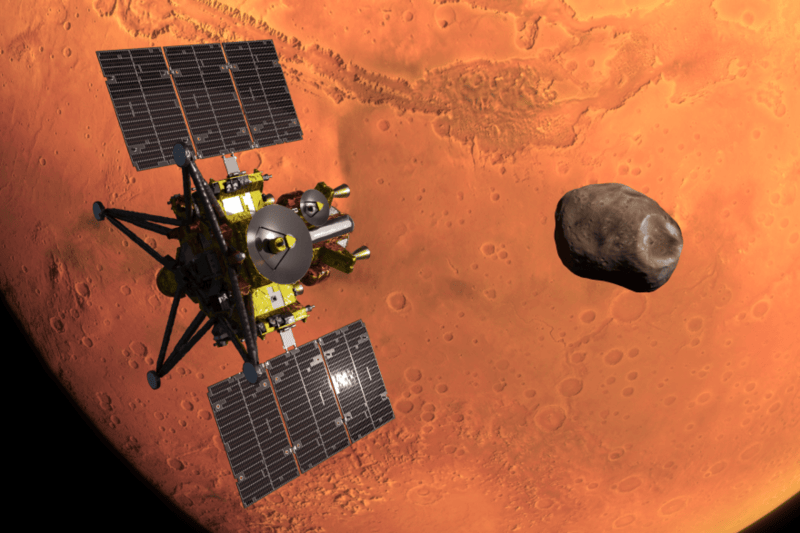
Martian Moons eXploration Spacecraft
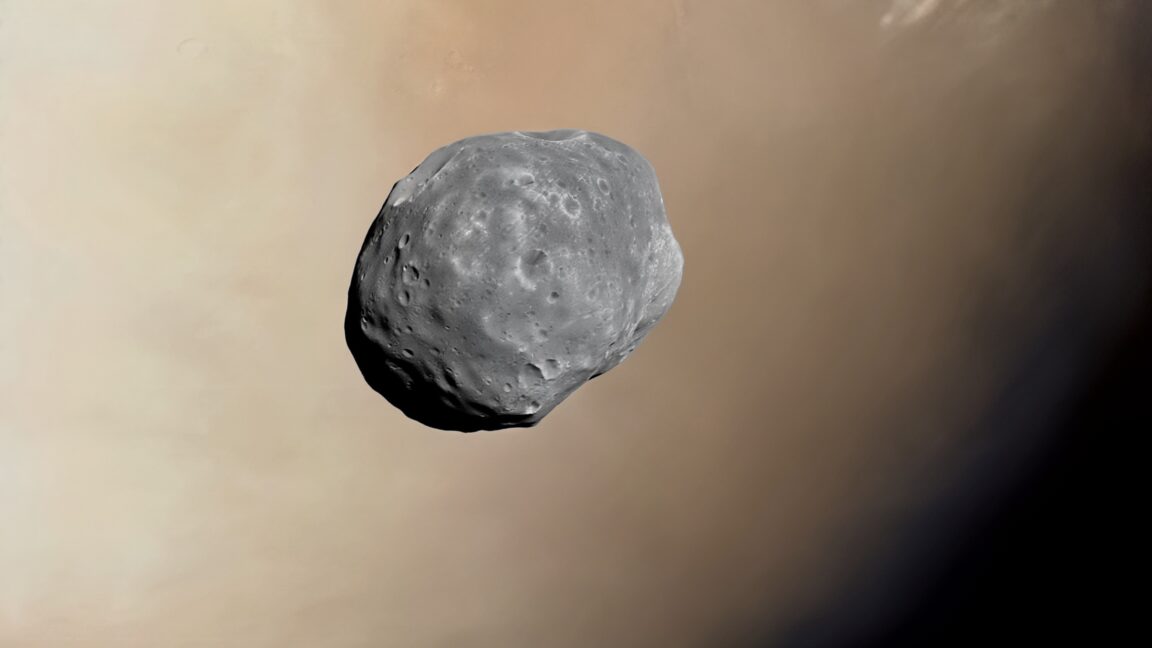
Once the first Viking probes arrived at Mars, we had the photographic evidence and up-close measurements to prove that Phobos wasn’t artificial. But even today, we still don’t know exactly what it is. The data suggests that it’s not solid rock, and that large voids may be hiding under its surface. While we can be fairly sure there won’t be any mummified remains of Martian astronauts to be found within Phobos, vast deposits of ice are a tantalizing possibility.
With the launch of the Martian Moons eXploration (MMX) mission earlier this week, the Japan Aerospace Exploration Agency (JAXA) hopes to bring us one step closer to understanding the formation and structure of Phobos. Should everything go to plan, MMX will deploy a small rover to its tenuous surface in 2029, and by 2031, a sample return capsule will bring pieces of the mysterious moon back to Earth for further study.
A Delicate Operation
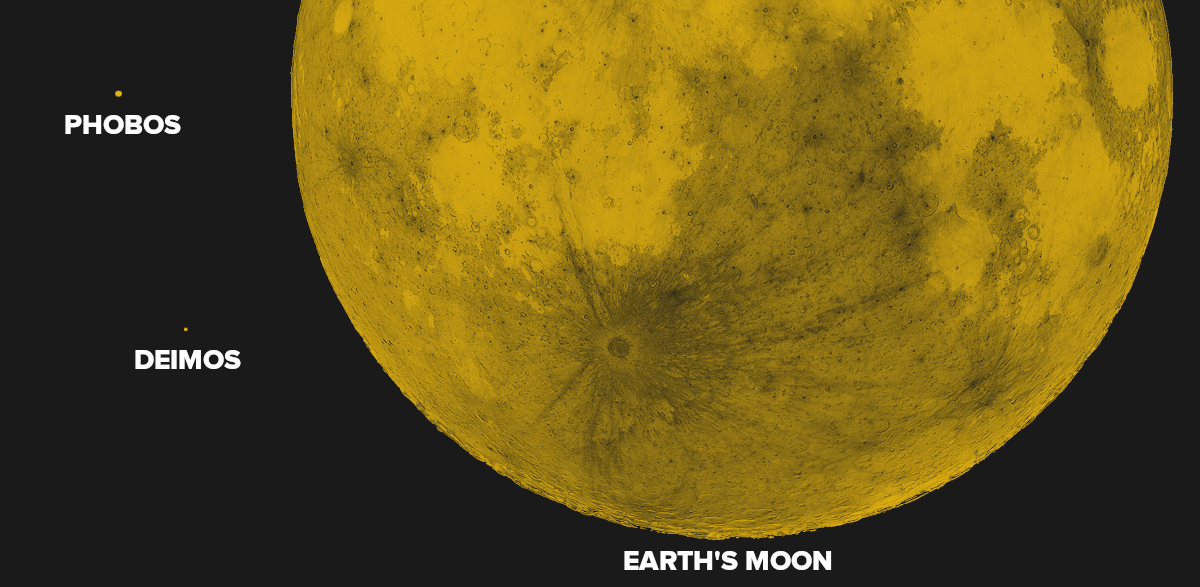
It’s only natural that we’d imagine Phobos and Deimos to be similar to Earth’s moon, but the reality of the situation is very different. For one thing, the Martian moons are absolutely dwarfed by our nearest celestial neighbor. Phobos has a diameter of just 22.2 kilometers (13.8 miles), and Deimos is even smaller at roughly 12.6 km (7.8 miles). For reference, Luna is approximately 3,474 km (2,159 miles) across.
Due to their low mass, putting a spacecraft into a stable orbit around either of the Martian moons isn’t really an option. Some clever maneuvering will put the MMX mission within range of both Phobos and Deimos at different points during the mission, but it won’t be able to stay around for long.
As such, final approach to Phobos will look more like a slow-motion “crash” than a traditional landing. A close comparison would be the OSIRIS-REx mission, where the spacecraft effectively “bumped” into the asteroid Bennu while collecting its samples. The impact velocity will need to be very low to prevent the spacecraft from bouncing off, and even then, some reports indicate that JAXA expects the craft to make at couple of hops before finally settling down.
The situation is compounded by the fact that we still don’t know what the surface conditions are like on Phobos. Based on previous observations, it’s expected that the moon is covered with a layer of fine regolith that could make traversal difficult for the mission’s Idefix rover. Indeed, one of the rover’s primary mission goals is to determine if wheeled motion in such an environment is even viable.
Tiny Moon, Huge Potential
Landing a crewed vehicle on Mars and successfully bringing it back home afterwards is perhaps the most daunting engineering challenge ever conceived. There’s even a solid argument to be made that it’s currently beyond our technological capabilities. The energy requirements of making a propulsive landing on the planet and then lifting off and getting back into orbit are enormous, and will very likely require in situ propellant production to refuel the craft between the two phases of the mission.
Landing on Phobos or Deimos however would require a small fraction of that energy. Moreover, due to their low orbital altitude, the moons would make ideal outposts from which to make detailed observations of Mars. This close proximity to the planet also means human operators on Phobos could directly command robotic vehicles on the Martian surface without the transmission delays that make real-time telerobotics from Earth impossible. While such a mission might not have quite the same symbolic impact of actually putting boots on Mars, it could be a valuable stepping stone towards that eventual goal.
The viability of such a landing may well depend on the findings of Japan’s Martian Moons eXploration mission. Not only in terms of the actual mechanics of rendezvousing with Phobos and touching down on it, but should the mission succeed in returning surface samples, we may be able to confirm whether or not the moon is made from ejected Martian material. Should that be the case, there will likely be even greater interest in studying the planet’s strange little moons up close.
Japan has successfully launched its Martian Moons eXploration (MMX) mission to study Mars' two moons, Phobos and Deimos. Scheduled to arrive in August 2027, "MMX will become the first spacecraft to land on and return samples from Phobos for study back on Earth, which scientists think could shed light on a decades-old mystery about the moons' origins" and resolve whether they were formed from a giant impact or were captured asteroids, reports Space.com. From the report: It was the 10th liftoff of Japan's expendable, two-stage H3 rocket, which was jointly developed by JAXA and Mitsubishi Heavy Industries. After clearing its launch pad today, the 207-foot-tall (63 meters) launch vehicle flew a nominal trajectory through its ascent corridor over the Pacific Ocean, jettisoning its four solid boosters in pairs just before the flight clock reached two minutes. The rocket shed its payload fairings about one minute and 20 seconds later, exposing MMX to the vacuum of space for the first time. [...] MMX is now under its own power, and on course for Mars.
The interplanetary transit will last about 10 months, with the spacecraft scheduled to arrive at the Red Planet in August 2027. When it does, MMX's propulsion module will execute an orbital insertion burn to place itself in a quasi-satellite orbit (QSO) around Phobos, which places MMX within the space around the moon as both circle Mars. MMX will spend about three years in the Martian system, devoting much of that time to studying the 14-mile-wide (22 km) Phobos with its science instruments. The spacecraft also carries the IDEFIX rover, a joint effort of the space agencies of France and Germany, which is scheduled to deploy to the surface of Phobos in late 2028 or early 2029.
After a mapping campaign to select suitable landing sites, MMX will perform two separate touchdowns on Phobos to collect and stow samples in the spacecraft's return capsule. Following its second landing and sample collection, MMX will briefly return to QSO with Phobos before transferring to a more elongated orbit around Mars that intersects with the planet's smaller moon, Deimos, which is just 8 miles (14 km) in diameter. During the last several months of its time around Mars, MMX will perform a series of Deimos flybys before departing for Earth in November 2030. If all goes according to plan, the MMX sample-return capsule will land in Australia in 2031. You can watch a recording of the launch on YouTube.
Japan launched a $578 million mission Monday on a five-year expedition to land on the largest moon of Mars and retrieve samples for return to Earth, a daring international project that could yield new insights into the formation of the Solar System.
The robotic Martian Moons eXploration mission, known as MMX, lifted off at 3:41 pm EDT Monday (4:41 am Japan Standard Time Tuesday) from Tanegashima Space Center in southern Japan.
The MMX spacecraft rode into orbit atop a 207-foot-tall (63-meter) H3 rocket, Japan's flagship launch vehicle. The rocket assigned to MMX debuted a new souped-up configuration with four strap-on solid rocket boosters, full-throttle main engines, and an extended payload shroud to accommodate the demands of Japan's heaviest and most ambitious interplanetary mission to date.
Although for many decades the planet Mars has been prodded, poked, driven upon, flown over and especially orbited by various spacecraft, landers and rovers sent over by a certain humanoid species on Earth, the two moons that orbit Mars have featured significantly more in science-fiction and video games than in scientific literature. This is now about to change when the Martian Moons eXploration (MMX) mission launches on October 19th, which will include a sample return from Phobos.
So far these two moons of Mars – Phobos and Deimos – have only received a few cursory glances by passing spacecraft, leaving many fundamental questions surrounding their formation and composition very much open. With the MMX mission this should change dramatically, with this spacecraft intended to perform detailed measurements of both moons.
In addition a rover – called Idefix – will perform a landing on Phobos for observations of its surface. This will be quite a feat as despite this lander coming in at 25 kg, on Phobos’ surface it will weigh only 15 grams due to the low gravity, or even less than the diminutive dog companion of Obelix, with potential bouncing as we have seen with previous landing attempts on such small bodies.
After launch, the MMX mission will take a year to arrive at Mars, in August of 2027, with Idefix being released in early 2029 for its hopefully soft paws-down on the surface of Phobos where it can scurry about for a while until the main MMX spacecraft lands later for its sample retrieval and return part of the mission. If everything goes well, this would mean that a sample of Phobos should be landing in Australia in 2031.

 Login