❌

Reading view

There are new articles available, click to refresh the page.

FCC to repeal 39% TV ownership cap in boost for Trump-friendly news orgs

The Federal Communications Commission will vote to repeal the National Television Ownership Rule that is supposed to prevent a single broadcast station owner from reaching more than 39 percent of all TV households in the US. The proposed change sets up a likely court battle over the FCC claim that it has authority to repeal a limit set by Congress.

FCC Chairman Brendan Carr has already treated the rule as more of a suggestion. In March, the Carr FCC granted a waiver allowing Nexstar Media Group to buy Tegna in a deal that let it reach over half of TV households. The Carr FCC argued that Congress gave it authority to modify or waive the rule.

Carr now plans to repeal the 39 percent limit and replace it with a "case-by-case review" of each proposed merger, the chairman announced today in an op-ed published on Breitbart. The change would make it easier for the FCC to pick and choose which station groups get to surpass the limit. Under Carr, this would likely benefit news companies that provide favorable coverage for President Trump.

Read full article

Comments

Β© Getty Images | Heather Diehl

Fibrous Muscles for Humanoid Robotics

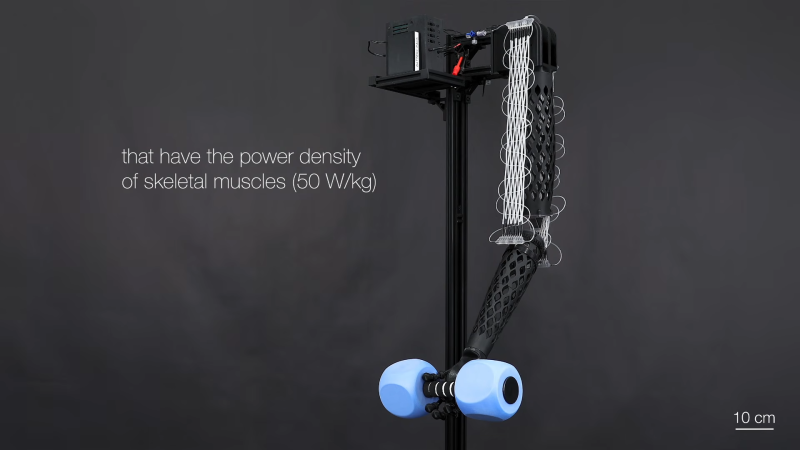
At the current rate of robotics development, you might assume that we’re close to Skynet taking over. However, while weΒ  likely wouldn’t do well in a physical fight against a robot, we can at least keep the bragging rights of having the cooler actuators. Or at least, that was the case before a new actuator came into town β€” introducing β€œElectrofluidic Fiber Muscles”.

Traditional robotic actuators use motors of some kind with a variety of gearboxes or linkages to turn rotational movement into usable movement. This isn’t always the most effective way to run some robotics movements, especially when modeling humans. This is why many have turned to pressurized modes of actuation. Though most don’t show quite the promise of the new player.

Electrofluidic Fiber Muscles use pressure to shorten muscle strands, similar to past actuators. However, these are a tad different, taking advantage of electrofluidic pressure. A small current under high voltage is able to drive a pressure gradient in a long tube. This tube can then be connected to both an extensor and flexor portion of an actuating circuit, similar to a biological mechanical system. Better yet, this driving pressure pump can be spun around the fibers themselves, making a tight package.

Unfortunately, it will probably be a bit till we see this inside a hobbyist robot. Until then, make sure to check out some other actuator feats!

❌