❌

Reading view

There are new articles available, click to refresh the page.

'Please Let the Internet Die'

Slashdot reader fjo3 shares an article from Wired: The internet must be put out of its misery. Any rational observer can admit that the current iteration of the web -- and the social fabric woven there -- is not what they signed up for. Symptoms of advanced cultural decay can no longer be ignored. This thing is eating itself. Giants including Meta and Google have been forced to settle massive consumer lawsuits brought over privacy violations and mental health harms allegedly caused by the addictive mechanisms of their platforms. Schools are banning smartphones as multiple countries institute social media restrictions for under-16s. Parents are in a panic about their kids aspiring to careers as social media celebrities, losing themselves in a vast ecosystem of online casinos, or joining extremist movements. Generative AI, briefly considered an amusing novelty, is now a turbocharged slop engine for the web, filling feeds and comment sections with useless, grotesque content. As humans scroll past headlines about AI taking their jobs, confusing fantasy for reality, and contributing to cognitive decline, any consumer appeal the technology might have is turning to anguish. The data centers that power it have become increasingly unpopular, and politically radioactive. To be online, many now admit, is to be endlessly manipulated and exploited. In December, Oxford University Press declared rage bait to be the word of the year, noting that use of the term had tripled over the previous 12 months. The lexical spike represented a heightened awareness that monetized social accounts churn out bad-faith takes and extremist content, automating this abusive behavior with generative AI, simply to profit off hostile engagement. Billionaire oligarchs have opened the floodgates to such inauthentic activity, conspiracy-mongering, and hate speech by rolling back moderation. In short, when you hang around online in 2026, you see little worth saving. Perhaps a decade ago, you felt that the glimmers of community and joy, of artistic and intellectual exchange, were enough to balance out the toxic junk. No longer.

Read more of this story at Slashdot.

How to turn your whole website into a single WARC file you can replay in your browser

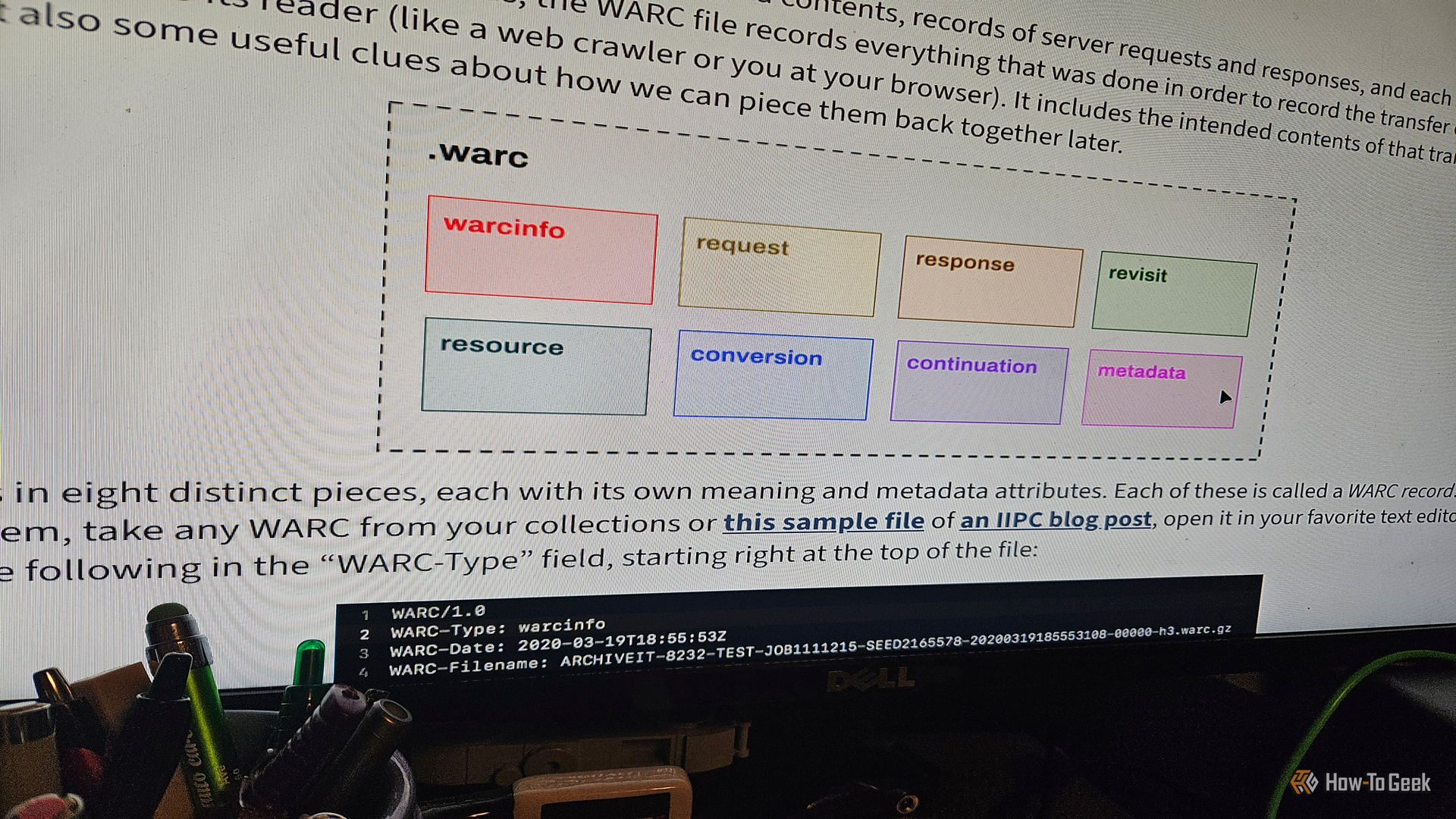
I'm an ardent supporter of archiving things. The Internet Archive and Wayback Machine are two of my most frequented places online. As I was researching something earlier this year, I stumbled upon something I (surprisingly) hadn't heard of before: the WARC format. These things are one of the most fascinating files/formats I've come across since Ogg Vorbis. And I wanted to learn more about what they are and how to use them.
6 reasons your brand new router is making your Wi-Fi worse

Buying a new router feels like a sure-fire way to fix a bad internet connection (even though a router that's new to you may not be new at all). But if your internet was alright before and you bought a new router and it's all gone downhill, you're not imagining it. It's completely possible for a new router to mess up your connection despite all that money you just spent on trying to improve it.

The Browser Company Retires Its Arc Browser, Pushes Users to Dia

The Browser Company is shutting down its Arc browser on December 22 and encouraging users to migrate to Dia, its newer AI-powered browser for Apple Silicon Macs and Windows 11 PCs. Thurrott reports: In the message explaining why it was sunsetting Arc, The Browser Company explained that maintaining two separate browsers was difficult to justify, especially from a security perspective. "Dia was built from the ground up to meet today's security standards, so that's where our engineering and security teams will focus moving forward," the company wrote. The retirement of Arc will be gradual: While nothing changes for existing Arc users, it's no longer possible to create new Arc accounts as of today. On November 23, tab sync, Browse for Me, and other AI features will be disabled on the iOS and Android versions of Arc. Lastly, the desktop version of Arc will stop working on December 22, and Arc accounts will be deactivated.

Read more of this story at Slashdot.

Zoe Kleinman: PHP Is the Cyber Equivalent of an Unexploded Bomb

BBC technology editor Zoe Kleinman likens the recently discovered PHP security vulnerabilities to an unexploded bomb, writing, "The PHP story feels like the cyber equivalent of an unexploded bomb -- I have never seen such a dramatic, public and global response to a cyber event that hasn't happened yet." Although no successful attacks have been confirmed, the AI-assisted discovery of long-hidden flaws has triggered a worldwide security scramble, with websites taken offline as a precaution and administrators racing to deploy patches before attackers can exploit the vulnerabilities. From the report: The weaknesses found in the PHP programming language, which is used by millions of websites, had been quietly resting there for years and are not easy to exploit. One cyber security researcher told me he'd been up all night trying to do it as an experiment, but it was proving very difficult. [...] It was supposed to be kept quiet until everyone had a chance to fix their sites -- but the news was leaked. From that point the clock started ticking. As I write this, there are no reports that anyone or anything has succeeded in using the flaws to attack a site. "There's a real dilemma," said Prof Alan Woodward from Surrey University. "How do you alert people they need to be ready, and then that a patch is urgently required, whilst not alerting attackers? Basically you're telling everyone about the problem at the same time and hoping the defenders aren't awake enough to act as soon as the patch is out." But we do know from large web companies like Cloudflare and Palo Alto Networks that millions of attempts have been made. We probably won't know for a while whether it has worked for any criminals, because the companies affected might not be aware yet either. As far as we know the unexploded bomb remains intact for now, and for some experts this is a success. "We've seen how a team of people supported by the large AI company have used AI to find the problem, work for months together to solve it and get everybody ready to be safe and secure," Gina Neff, Professor of Responsible AI at Queen Mary University, told the Today Program on BBC Radio 4. "We have enormous capability to handle these risks."

Read more of this story at Slashdot.

PHP Warns It Plans To Release 2 Emergency Patches Imminently

An anonymous reader quotes a report from Ars Technica: Website admins, brace yourselves. Fixes for what are believed to be uncommonly severe vulnerabilities are scheduled to drop in a little more than 12 hours for PHP, a programming language that powers websites and Web applications everywhere. PHP maintainers said Monday that they planned to release patches for two vulnerabilities, both with severity ratings of 9.2 out of a possible 10. "All PHP users are encouraged to prepare now so they can upgrade as soon as the release is available," the advisory stated. "We reserve the right to release earlier should details of either vulnerability become public, or should evidence of active exploitation appear in the wild." The maintainers published the advisory following the leaking of purported details, which have yet to be confirmed. The report showed a video of an exploit tool dubbed PHP2Shell executing code on webservers running WordPress 7.1.3, MediaWiki 1.46.2, phpBB 3.3.17, Magento 2.4.9, Joomla 6.2.0, Laravel 13.36.0, Laravel 8.83.29, Symphony 8.1.9, Drupal 11.4.10, and WHMCS 9.0.9, all of which use PHP. A video depicting the tool has been reposted here. Attempts to locate the unconfirmed report were unsuccessful, but security firm watchTowr said it claimed to affect every PHP version from PHP 5, released in 2004, onward. The security firm went on to say it has confirmed that the vulnerabilities, tracked as CVE-2026-109618 and CVE-2026-109619, are real. Researchers from separate security firm Sansec said they "expect mass attacks to start within 15 minutes of the release." A third security firm, Webfence, also urged admins to prepare now. Huntress has also issued an advisory.

Read more of this story at Slashdot.

Stratospheric airship flew from US to Japan to test sky cell tower concept

Nearly 100 years after the dirigible Graf Zeppelin made the first nonstop airship journey across the Pacific Ocean, another airship has successfully completed a round-trip flight from New Mexico to Japan and back. But the significance of this modern feat was less about the journey's length and more about its purpose: demonstrating how a lighter-than-air platform can act as a cell phone tower in the sky.

The trans-Pacific flight that took place over a month between August and September 2026 was the most notable milestone yet for Sceye, a US aerospace company based near Albuquerque, New Mexico. Sceye has developed an uncrewed platform filled with helium for buoyancy and equipped with an electric-powered propeller for active propulsion, allowing it to resist most strong winds and keep hovering over the same location for long periods. The platform also uses top-mounted solar panels and onboard batteries to stay powered for stratospheric operations around the clock.

β€œWe can stay over an area of operation, and we do that in the stratosphere right around 60,000 feet, so we're twice as high as air traffic and we're above the jet stream, and yet 30 times closer than low-Earth orbit satellites,” Mikkel Frandsen, founder and CEO of Sceye, told Ars. β€œWe can fly through day and night until the sun comes up the next morning and recharges the batteries, at which point we're still at the same altitude and still over the same area of operation.”


Read full article

Comments

Β© Sceye

❌