AI chatbots are everywhere these days, and they seem to “know” about everything. But while that is a strength, it can sometimes be a weakness because it isn’t laser-focused on one topic. Not so with this Ham-radio-centric chatbot called HamGPT. The service is clearly built on another GPT engine but understands how to retrieve data from common ham radio sources, such as the FCC database, propagation reports, and the like. It didn’t, however, seem to have access to ham radio-related books, magazine articles, or other “static” data that we could tell.
You do have to sign up for an account, which includes providing your callsign and location. There is a free tier that allows a limited number of queries per day, so you can try it to see if it is useful for you without subscribing.
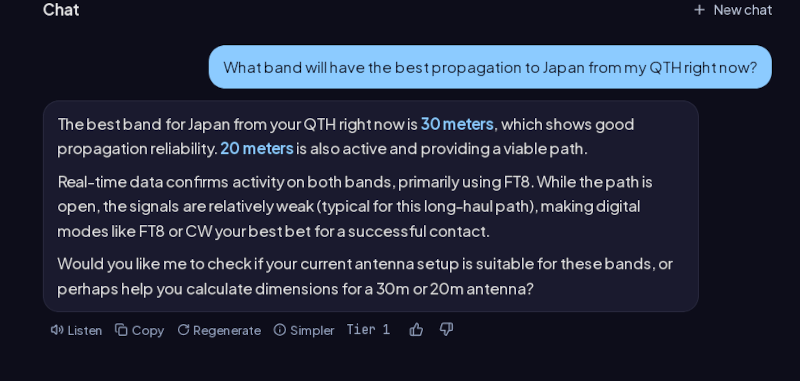
Here’s a typical session:
What band will have the best propagation to Japan from my QTH right now?
The best band for Japan from your QTH right now is 30 meters, which shows good propagation reliability. 20 meters is also active and providing a viable path.
Real-time data confirms activity on both bands, primarily using FT8. While the path is open, the signals are relatively weak (typical for this long-haul path), making digital modes like FT8 or CW your best bet for a successful contact.
Would you like me to check if your current antenna setup is suitable for these bands, or perhaps help you calculate dimensions for a 30m or 20m antenna?
In addition, bubbles at the bottom of the screen showed me the busiest band in my area and how many repeaters were nearby.
In all fairness, we asked ChatGPT the same question, but did say “ham radio band” just to give it some idea of scope. It gave a much more detailed answer with sources, even provided headings, and made a suggestion about another location I sometimes operate from because it remembers things from previous unrelated chats.
We understand reactions will be mixed. If you’ve been a ham for a long time, you probably could have guessed that a path from the US to Japan in the morning was likely to be on 20 or 30 meters. You probably also know how to look things up yourself.
We didn’t try any more sophisticated queries that might make it more worthwhile. For example, what if you could send it an ADIF log file and ask it what awards you qualified for? Or to process contest logs for duplicates and fill out a scoring worksheet? What would you like a ham radio-aware AI to do for you?
Ham radio — at least parts of it — has become inextricably linked with computers.

 Login
Login