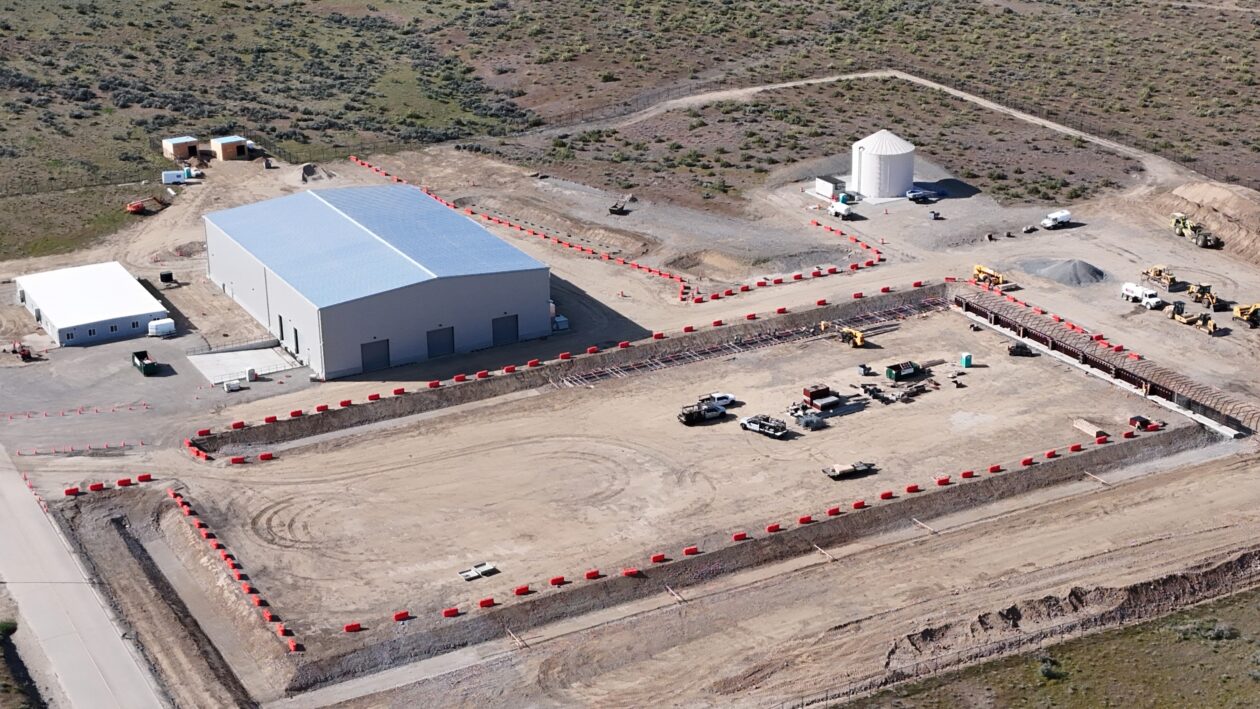
An aerial view of Orion, Helion Energy’s planned fusion plant being built in Malaga, Wash. (Helion Photo)
Helion Energy on Tuesday said that it added $35 million to a funding round initially announced in June. The Everett, Wash.-based fusion company originally shared news of a $465 million Series G round.
“After initially closing the round earlier this summer, we are excited to bring on several new investors and to have a round that includes crossover, pension, and sovereign wealth investors,” said David Kirtley, Helion’s co-founder and CEO, in a post on LinkedIn. Kirtley said the investment now totals $500 million.
The company aims to be the first in the world to commercialize fusion, replicating the reactions that power the sun and stars to produce nearly limitless clean energy. It has raised more than $1.5 billion to date.
The company is racing to hit an ambitious timeline, having signed a deal with Microsoft three years ago to supply energy to a Central Washington data center by 2028. The company broke ground on the 50-megawatt plant, dubbed Orion, in July 2025.
But Helion’s timing for hitting that energy target remains uncertain. When it announced the agreement with Microsoft, the company stated that Orion was “expected to be online by 2028 and will target power generation of 50 MW or greater after a 1-year ramp up period.”
Axios recently reported that full capacity might not be hit until 2030, according to a Helion executive. The news site also cited two scientific publications by plasma physicists questioning the company’s ability to produce a sufficient amount of energy from its fusion devices to power the grid, though Helion has responded to concerns raised by both on its FAQ site.
That said, Helion is hustling to resolve technical challenges. GeekWire in May reported on Tiny Merge, a small-scale testbed device the company is building at its R&D facility to answer questions its larger, more expensive prototypes haven’t — questions that need answers before final power plant designs are locked in.
Kirtley, however, remains bullish on the company’s trajectory and the vote of support from investors.
“Technical milestones remain the most important to me and the company,” he said, “but this new funding demonstrates the growing demand for, and confidence in, fusion energy and Helion’s ability to deliver fusion energy to the grid.”
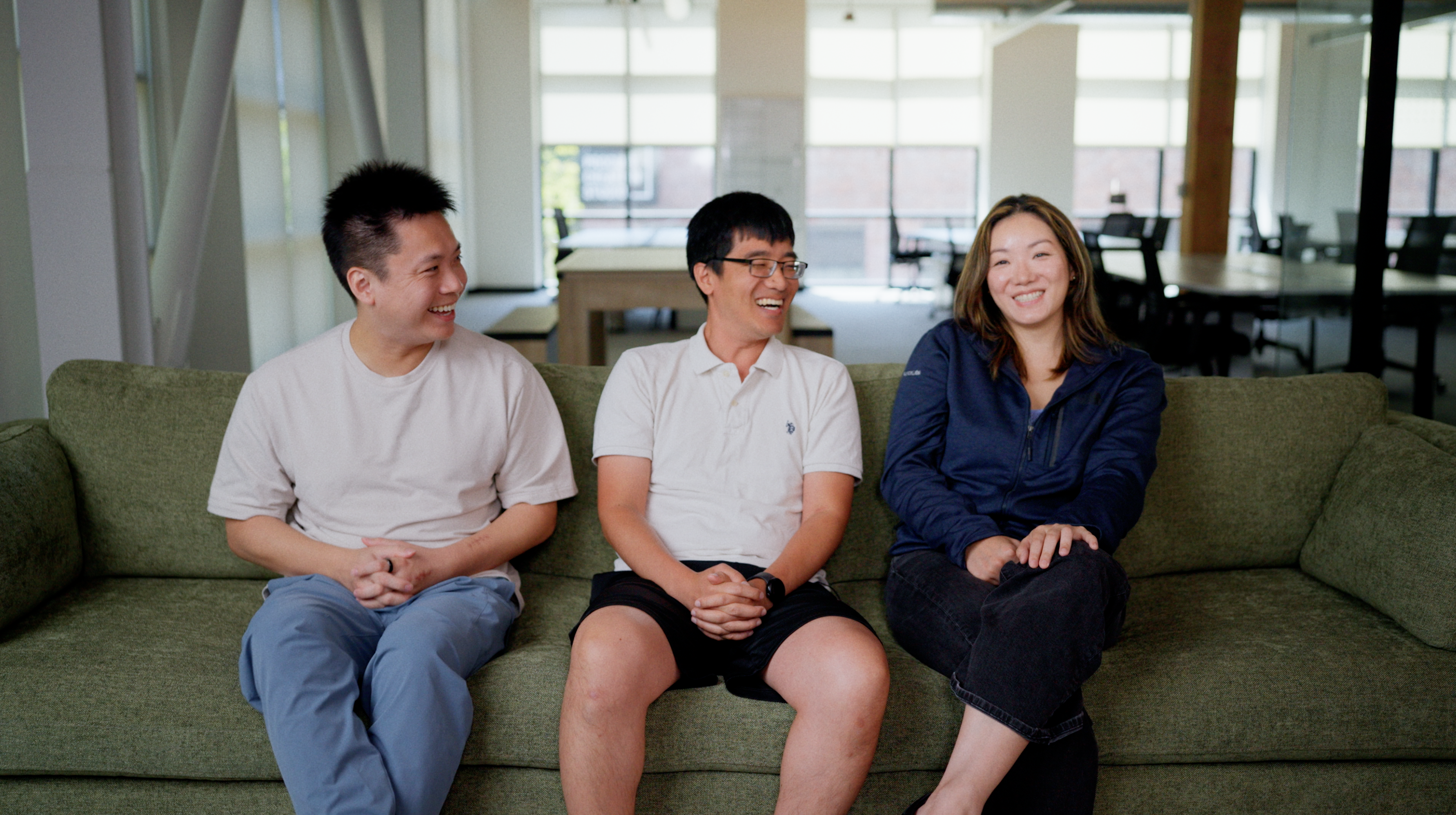
Nuance Labs co-founders, from left, Fangchang Ma, Edward Zhang, and Karren Yang. (Nuance Photo)
Nuance Labs, a Seattle-based artificial intelligence startup developing a foundational AI model designed to perceive and respond to real-time human expression, raised $50 million in Series A funding.
Founded in early 2025 by former Apple PhD researchers Fangchang Ma, Edward Zhang, and Karren Yang, the research lab is developing a single “full-duplex” foundation model designed to process and generate conversational cues simultaneously.
Unlike traditional setups that chain together separate tools for transcription, text generation, and voice or animation, Nuance’s model ingests live audiovisual signals like tone, gaze, and timing to stream real-time facial and vocal responses.
Existing avatars and voice tools fail because they force humans to adapt to the machine rather than the other way around, according to Ma, Nuance’s CEO.
“The most productive collaboration comes from being able to express yourself freely, in words, tone, gesture, and expression, the way you would with a friend or close colleague, with all the nuance in the back-and-forth that turns talking into understanding,” Ma said in a news release. “That’s what we’re building at Nuance Labs: AI that understands the many ways we express ourselves and responds the way a person does, in the moment.”
In a demo video accompanying the announcement (below), the startup showcased an avatar built to function as an active listener, adjusting its facial expressions and verbal cues dynamically as the user speaks.
Zhang, Nuance’s CTO, earned his PhD in computer graphics from the University of Washington and met Ma at Apple’s engineering office in Seattle. The two spoke to GeekWire last fall about building in Seattle rather than Silicon Valley and how they want Nuance “to be the premier research lab in Seattle.”
The startup plans to release a public research preview of its model later this year, giving users their first hands-on test of the interactive face-to-face avatar. Nuance targets applications where real-time human expression drives outcomes, including sales, customer service, professional coaching, and education.
Returning investor Lightspeed Venture Partners led the round, which also included participation from existing backers Accel and South Park Commons, alongside new investments from NVIDIA and Define Ventures.
The financing brings Nuance Labs’ total capital raised to $60 million following its $10 million seed round last year.
Nuance, which employs 27, plans to use the fresh capital to accelerate model development and hire researchers and engineers across modeling, data, evaluation, and real-time serving as it expands its team.
Temporal has raised $550 million in a Series E funding round that values the Bellevue, Wash.-based infrastructure startup at $12.55 billion, more than double its valuation from earlier this year as demand explodes for reliable agentic AI systems in production.
It caps a significant growth stretch for the open-source platform, whose annualized revenue run rate recently surpassed $250 million — growing over 200% year-over-year, according to a news release on Monday — as major tech players like OpenAI, NVIDIA, Netflix, and JPMorgan Chase rely on its “durable execution” engine to keep complex AI workflows from breaking.
Co-founded in 2019 by CEO Samar Abbas and CTO Maxim Fateev — veterans of Amazon, Microsoft, and Uber — Temporal originally made its mark helping developers manage complex distributed systems.
But as Abbas told GeekWire earlier this year, the AI explosion put that exact problem “on steroids.” While generative AI models handle reasoning, Temporal’s “durable execution” engine acts as the underlying plumbing — preserving application state, retrying failed steps, and preventing multi-step AI agents from crashing when external services drop out.
To support that surge, Temporal has doubled its workforce over the past year to 570 employees worldwide. While operating as a remote-first organization, the company maintains deep roots in the Pacific Northwest — where both founders have been based for decades — and continues to expand its engineering footprint in the Seattle area to keep pace with global demand.
“As agents take on more critical work across more systems, every additional step creates another place to fail. In production, that work has to survive those failures and finish reliably,” Abbas said in a statement. “Temporal was built for this problem. Durable Execution is becoming the standard for reliable applications at scale, and this investment reflects the conviction that much of the next generation of software will be built on Temporal.”
The cash infusion brings Temporal’s total capital raised to date to $1.2 billion, building on a $300 million Series D led by Andreessen Horowitz in February that valued the company at $5 billion.
In addition to Lightspeed, the Series E round drew new backing from Wellington Management, Goldman Sachs Alternatives, and T. Rowe Price, alongside returning venture backers Sequoia Capital, Index Ventures, and Madrona.
Temporal plans to use the fresh capital to accelerate platform R&D, expand its developer and enterprise go-to-market teams, and support global cloud operations.
They joined as part of a funding round that totals $13 million, according to a Form D filed with the Securities and Exchange Commission. NLM has reported at least $26 million in funding since 2018, according to SEC filings.
The company offers a way to move more data without burning more power. Inside a data center, information travels between chips and servers as pulses of light. The part that puts the data onto the light beam, called a modulator, is normally made of silicon. It limits how much data a link can carry, and how much power that takes.
NLM’s technology, sold under the name Selerion, is an organic electro-optic material that goes on as a liquid and hardens in place on the chip, taking over the modulator’s job from the silicon underneath. The company says it does the work 10 to 15 times more efficiently.
Applications for the technology include fiber-optic networking equipment and the links between servers in AI data centers. NLM says it could also be used in quantum computing.
Five existing investors participated in the round, which the company described as a Series A2: Emerald Technology Ventures, Oregon Venture Fund, Idemitsu, Tokyo Ohka Kogyo and StoryHouse Ventures. Private investors and company employees also took part.
Pangaea Ventures, which has offices in Canada, the United States and Japan, backs startups built on advances in materials, chemistry and biology. It says it has invested in more than 40 companies over more than 20 years. David Weekes of Pangaea is joining NLM’s board, which already includes Frank Balas of Emerald.
Diamond Edge Ventures, led by president Curtis Schickner, has $200 million to invest through 2030. It backs companies in Mitsubishi Chemical’s core markets, including advanced materials, polymers and electronics, and its portfolio includes Boston Materials, DigiLens and Eridan.
Hamamatsu Photonics, which invested previously, is not part of this round but is still a shareholder, according to the company.
The company was incorporated in 2018 as Nonlinear Materials Corp. It licensed its patents from the University of Washington, building on 25 years of research there in the labs of chemists Larry Dalton and Bruce Robinson. Robinson is one of the company’s co-founders, as is Lewis Johnson, a longtime UW researcher who is chief technology officer.
Pack Ventures, the UW-affiliated venture fund, is an investor in NLM and is also listed among the advisors to its board.
GeekWire covered NLM’s launch in 2019, when the company was raising a $1.25 million seed round and running a small production lab on campus.
NLM Photonics CEO Brad Booth. (NLM Photo)
Brad Booth, who spent nine years at Microsoft and joined NLM’s board in 2023, took over as CEO in 2024 from co-founder Gerard Zytnicki, who is now a corporate advisor to the company. The company raised $1 million from Tokyo Ohka Kogyo and Hamamatsu in 2023.
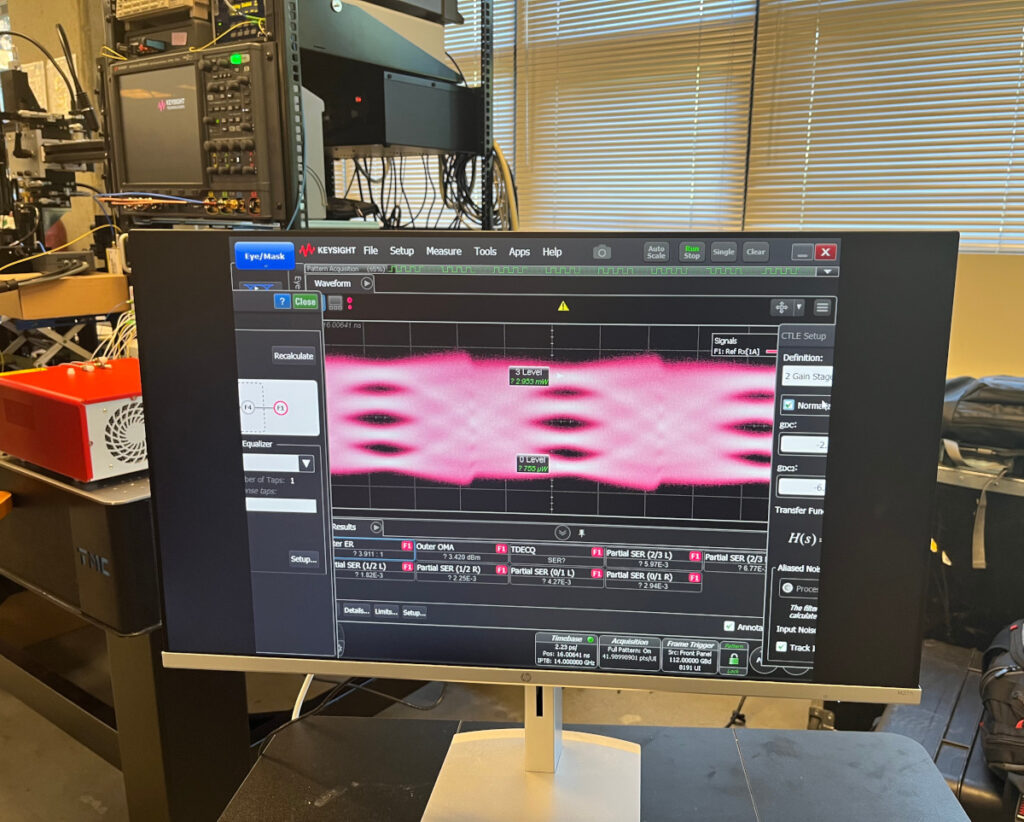
Last year NLM said outside testing confirmed that a 1.6-terabit chip combining silicon with its materials ran at 224 gigabits per second on each of eight channels. It started sending samples of 1.6- and 3.2-terabit chips to customers in March.
NLM is not alone in trying to build a better modulator. Lightwave Logic, a publicly traded Colorado company also working with organic materials, named NLM among its smaller competitors in its annual report for 2024.
Some of the company’s rivals have raised a significant amount of funding. HyperLight, a Harvard spinout that uses a crystal called lithium niobate instead of an organic material, has raised $117 million, including $80 million in June led by MediaTek.
NLM has worked to get its materials onto other companies’ production lines. In March the company said the chips going out to customers were made at GlobalFoundries, and that it had built modulators using Tower Semiconductor’s high-volume silicon photonics process.
Late last week, word started leaking that the National Institutes of Health (NIH) had reached an agreement with the Department of Defense that would see part of the NIH's budget used to fund research at the Department of Defense. So, on the Friday just prior to a US holiday weekend, the Department of Defense released a copy of the agreement and confirmed that it had been signed roughly a month earlier. The move is striking for a number of reasons, ranging from the existing budget disparities between the two parties involved to the fact that the money would be used for projects that the current NIH leadership has explicitly rejected.
The agreement itself sets up a system where the NIH would transfer money to the Department of Defense to fund staff and projects that would "support the advanced development of medical countermeasures against pandemic influenza, chemical, biological, radiological, and nuclear (CBRN) threats, and emerging infectious diseases." The money would come out of the budget for the NIH's National Institute of Allergy and Infectious Diseases, or NIAID, to which Congress has allocated $6.6 billion in 2026. The agreement is set to run for a decade.
Left unspecified is just how much of the NIAID budget will be spent on Defense projects. Reporting by Nature suggests that the Department of Defense was looking for up to a third of its total budget but was being told to settle for about 10 percent. There's obviously an enormous disparity between the budgets of these two agencies, given that the 2026 Defense budget is roughly $1 trillion. That budget is under considerable strain, however, due to the open-ended nature of the conflict with Iran. The deal has also been announced at a time when the NIH has been struggling to issue sufficient grants to use the money that Congress allocated to it.
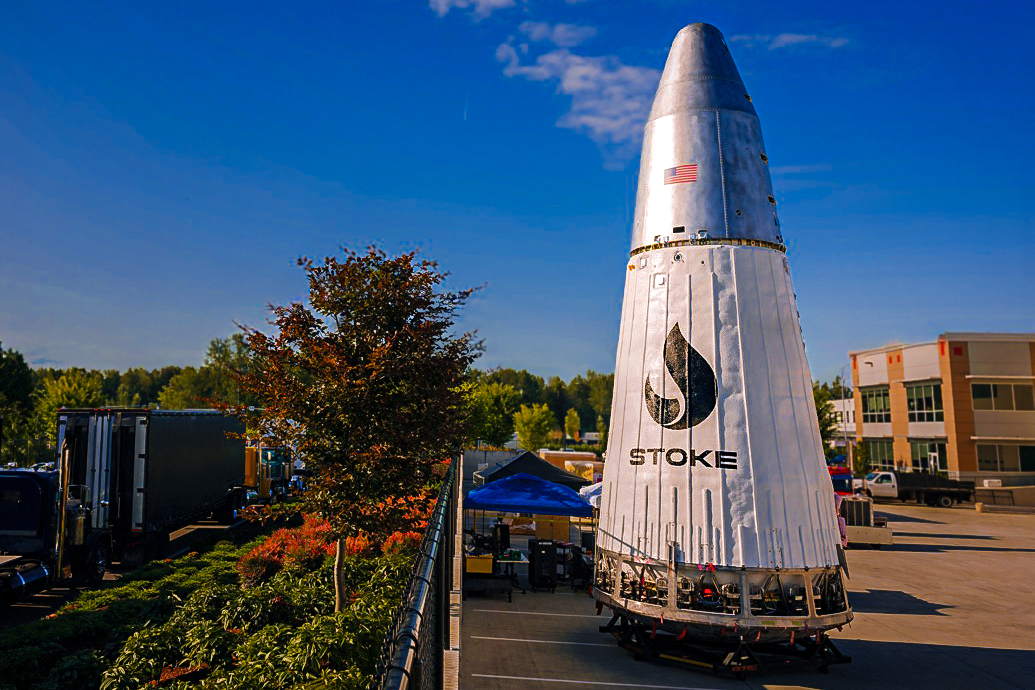
Stoke Space’s Nova Pathfinder upper stage flight article No. 1 sits at the company’s factory in Kent, Wash. (Stoke Space Photo)
Stoke Space says it has raised roughly $1 billion to get ready for the first launch of its fully reusable Nova rocket — and to scale up the rocket’s design for even bigger payloads.
To accommodate its grander ambitions, the Kent, Wash.-based startup is also scaling up its rocket test facility in Moses Lake, 175 miles to the east.
“We have confidence in the foundation that we’ve laid today, and now it’s time to scale,” Stoke Space CEO and co-founder Andy Lapsa told GeekWire.
The newly announced Series E financing round was co-led by Point72 Ventures and Spark Capital, with participation from General Innovation, Glade Brook Capital, US Innovation Technology, Washington Harbour Partners, Woven Capital, Y Combinator and other investors.
The final figure will be “within rounding error” of a billion dollars, Lapsa said. “Not quite, or a little more,” he said. “The speed with which this has come together is very fast.”
Lapsa said that scaling up the Nova rocket’s design was always part of Stoke Space’s game plan, but that the timeline is being accelerated in response to the growing demand for launches and the shrinking availability of launch opportunities.
The timing of Stoke’s pivot to a bigger launch vehicle wasn’t sparked by a single event, Lapsa said. “The pressure has been growing over the last couple of years,” he said. “It certainly hasn’t slowed down recently.”
From Pathfinder to Block 2
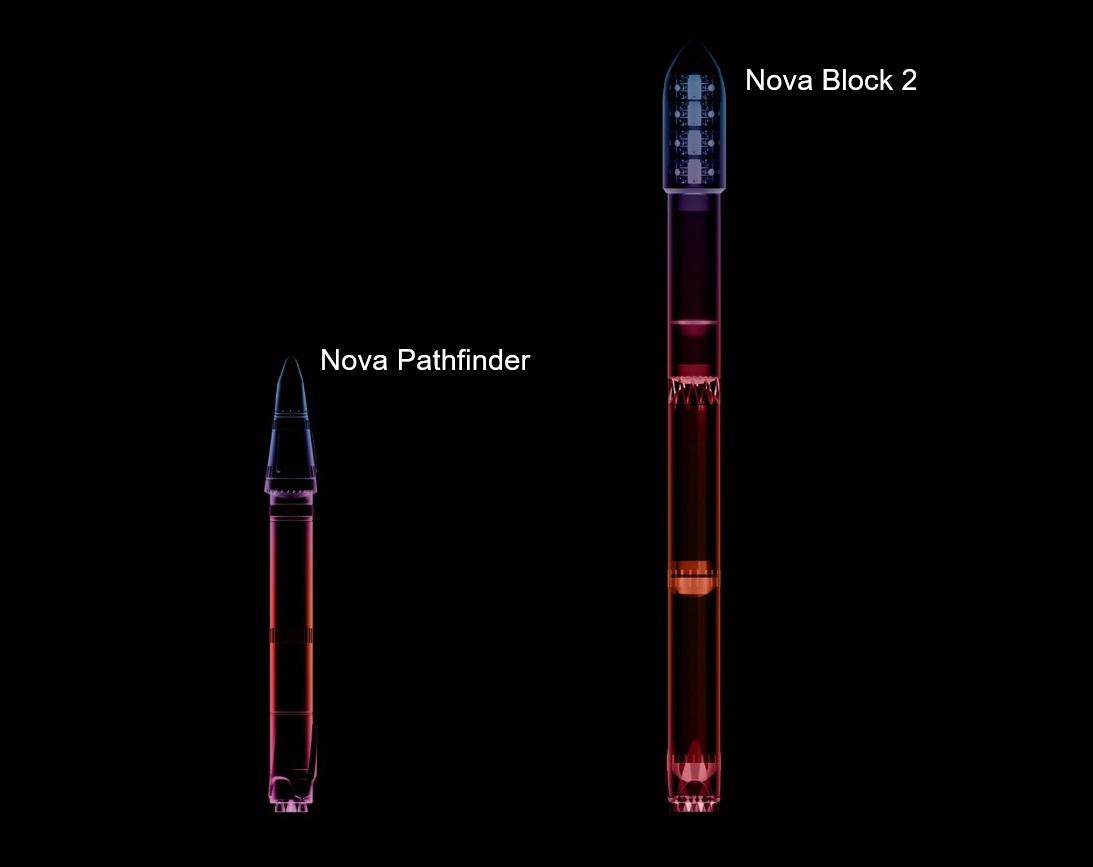
This infographic compares the designs for Nova Pathfinder and Nova Block 2. (Stoke Space Illustration)
The revised plan calls for Stoke to begin launching missions with the initially designed rocket, now known as Nova Pathfinder. Pathfinder’s first stage will be powered by seven of Stoke’s Zenith engines, and the upper stage’s Andromeda engine will have a ring of 24 thrust chambers integrated into an actively cooled metallic heat shield. The rocket will be capable of putting 3 metric tons of payload into low Earth orbit, or LEO.
Pathfinder’s first launch is now scheduled for early 2027 — a slight slip from earlier expectations. It will carry a spacecraft for AstroForge, a California-based asteroid mining company. “We’re going out to the asteroid belt, and yeah, Astroforge is our partner for that one,” Lapsa said. “They’re looking to prospect and ultimately mine asteroids, and bring back rare earths and other important materials.”
The super-sized version of Stoke’s rocket, known as Nova Block 2, is due to make its debut in 2029. Its first stage will have twice as many Zenith engines as Pathfinder. Its upper stage will have 12 independent engines, each with two thrust chambers. That will increase Nova’s lift capability by a factor of five, enabling up to 15 metric tons of payload to be delivered to LEO. More than 4 tons can be sent to geosynchronous transfer orbit, or GTO.
Both versions of the Nova rocket are designed to be fully reusable, with the first-stage booster flying itself down to a recovery ship and the upper stage making a separate re-entry. Stoke is only the second company in the space industry to pursue that strategy. SpaceX has designed its Starship launch system for dual-stage reusability but hasn’t yet reached that goal.
Stoke is developing an active-cooling system for upper-stage reusability. Some of the rocket’s cryogenically cooled liquid hydrogen propellant is circulated through channels in the upper stage’s metallic heat shield to absorb the intense heat of atmospheric re-entry. SpaceX has been experimenting with different heat shield strategies for Starship, but some experts have expressed doubts about SpaceX’s approach.
Both versions of Stoke’s rocket are designed to fill a market niche that’s different from Starship’s. The Nova rockets’ capabilities fall close to both ends of the medium-lift spectrum, while SpaceX’s super-heavy-lift Starship is designed to loft 100 to 150 tons of payload to LEO.
Expanding the infrastructure
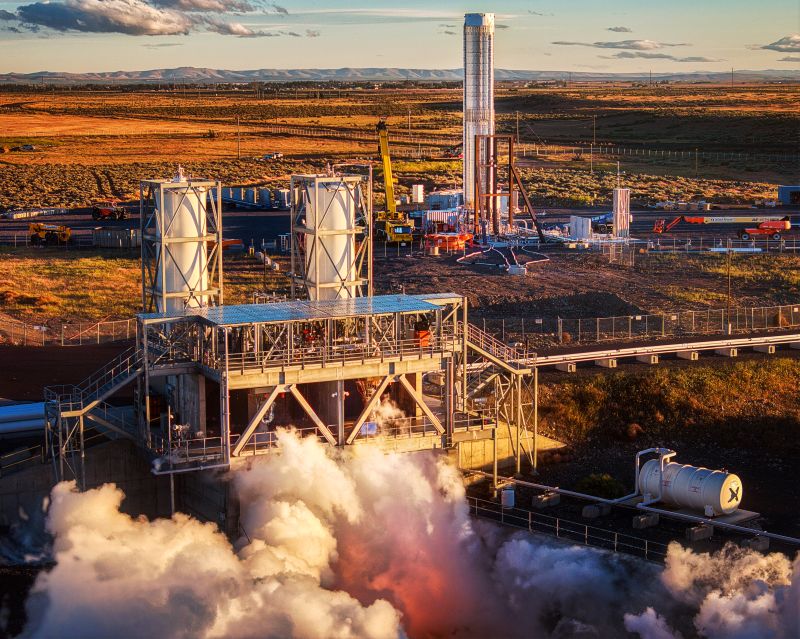
Stoke Space tested its Zenith rocket engines and Nova Pathfinder’s first stage in Moses Lake in June. (Stoke Space Photo)
Stoke Space’s 168,000-square-foot factory and headquarters facility in Kent was designed from the beginning to manufacture rockets that are bigger than Nova Pathfinder.
“We bring in raw sheet metal, we build our core and we ship a rocket,” Lapsa said. “We can use the same methods and effectively the same tooling to build larger diameters and larger lengths, and that’s very intentional.”
The company’s rocket test facility in Moses Lake is being expanded from 75 to 550 acres to accommodate work on two types of rockets simultaneously.
“We’ve done, I would say, an extremely efficient job at leveraging the 75 acres that we use today,” Lapsa said. “The expansion across the street is going to enable us to test again at rate. … Certain of our facilities have an overlapping blast radius, so they interfere with each other. A big advantage of being able to spread our wings a little bit, and get a little bit more space, is that those test stands can operate in full independence of each other.”
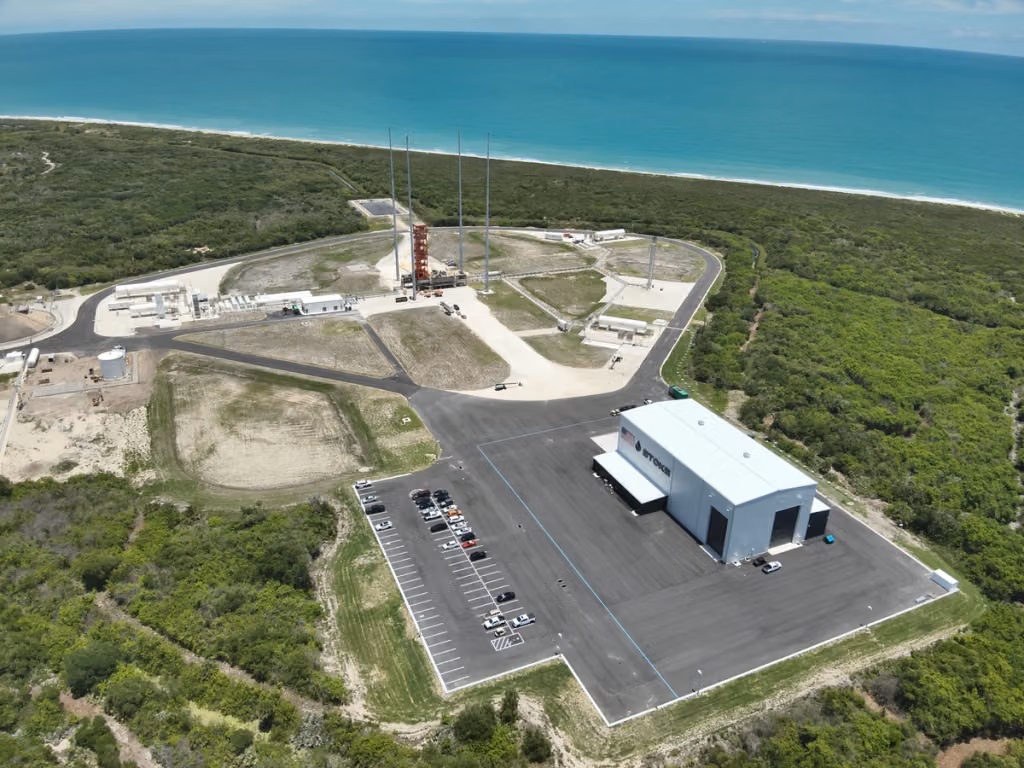
Stoke’s launch facilities at Cape Canaveral Space Force Station in Florida can also accommodate a dual-track approach. A new payload processing facility at the Cape is intentionally sized to support both Nova Pathfinder and Block 2.
In June, Stoke Space’s Moses Lake facility completed what the company called proto-qualification testing of the first-stage booster for its first Nova Pathfinder rocket. “The second stage will ship out pretty soon,” Lapsa said. “That goes to Moses Lake. … This will be acceptance testing of the structure, and then we’ll do a static hot-fire test out there to fully shake down the second stage, and then it ships out to Cape Canaveral.”
The booster is being prepared for shipping to the Cape as well. “We’ll repeat the wet dress rehearsals that we did in Moses Lake, but we’ll do it on the launch pad itself,” Lapsa said. “Then we’ll do the same thing: static fire test on the first stage down there, and then the two stages go together, and we go to space.”
Stoke Space has built a facility at Space Launch Complex 14 at Cape Canaveral Space Force Station in Florida. (Stoke Space Photo)
Lapsa said Stoke currently has about 400 employees. “It’s approximately 50 in Moses Lake, 50 in Cape Canaveral. We have a handful of remotes, and then everybody else is in Kent,” he said.
Even though Stoke Space hasn’t yet launched a rocket, the startup’s steady progress toward that milestone — and its long-term vision for total rocket reusability — have been impressive enough to keep investors on board.
“Having supported Stoke through multiple stages of its growth, we believe this company has demonstrated both the exceptional technical progress and the ambition to build a launch system capable of serving the market at industrial scale,” Chris Morales, partner at Point72 Ventures, said today in a news release.
“Full reusability is the inevitable end state of the market, providing an order-of-magnitude cost and service advantage over partially reusable rockets,” said Clay Fisher, general partner at Spark Capital. “Stoke had the right thesis seven years ago and has paired that prescient vision with a blistering pace of execution. As a result, they stand uniquely positioned to give customers more choice and capacity when they need it, and to unlock an enormous new economy in space.”
Lapsa said he’s grateful for the vote of confidence.
“We’re humbled by the investment, having great partners behind us,” he said. “It’s an incredibly critical and important moment for us as a civilization to get right. I think space development is really, really important for our ability as a civilization to continue to scale and continue raising the quality of life that we enjoy — and we’re thrilled to be part of it.”
Kevin Owens, co-founder and CEO of Resect AI. (Resect AI Photo)
Resect AI, an artificial intelligence startup led by a team of scientists and engineers in Washougal, Wash., launched out of stealth Thursday with $25 million in funding to commercialize an open-source technology designed to catch AI hallucinations before they happen.
Unlike traditional AI monitoring tools that evaluate generated text after the fact, Resect AI says its patented technology operates in-stream — looking deep inside large language models in real time to observe, detect, interpret, and modify model behavior before a hallucination can occur.
By intervening directly within the model’s internal decision-making process rather than running post-hoc checks, the platform stops fabrications at the source while simultaneously generating an audit trail for enterprise compliance and due diligence.
“AI has prematurely been put in a position of trust. Adding labels such as ‘use at your own risk’ flies in the face of proper governance or compliance,” Kevin Owens, co-founder and CEO of Resect AI, said in a news release. “We are building the next large enterprise AI company to bring transparency and accountability to AI for industries such as publishing, finance, healthcare, research, and education where factual accuracy is absolutely critical.”
Beyond its tech, the startup’s leadership is also bullish about its small-town presence.
Washougal is a city of roughly 18,000 residents, 175 miles south of Seattle, tucked along the Columbia River across from Portland. Resect AI employs four people at an office on Main Street — including its co-founders — out of a 30-person workforce spread across the Seattle area, California, New York, and Texas.
“We believe the talent is up to par and we loved the sense of community that we found when we first came up here,” Owens told GeekWire. “We have been coming to the greater Washington and Oregon areas on and off over the years and finally decided this needed to be our headquarters.”
Owens said the decision has already paid off, noting that the startup has quickly tapped into the region’s talent pool by recruiting PhDs from both the greater Seattle and Portland markets while connecting with Northwest capital markets leaders.
Resect AI is also planning to open an office in the Seattle area in the near future for engineering and to serve as a business hub.
Alongside Owens, Resect’s other co-founders include Tim Walton, chief artificial intelligence officer; Tyler Gerber, chief operating officer; and Tommy Lofgren, chief product and marketing officer.
The company plans to use the funding to accelerate research and development, expand its go-to-market initiatives, and fuel talent acquisition — bringing its total headcount to 50 by the end of 2026.
On Tuesday, the House of Representatives passed a stopgap measure that would continue funding the US government through early December. While the measure still requires the signature of President Trump, it's widely expected that he will act to avoid a government shutdown immediately before the midterm elections.
This is a normal part of how the US government has operated in recent years, as it's often difficult to build the political support needed to pass a full year's budget in advance. In fact, dissent within the House's Republican caucus prevented them from agreeing on their own measure to keep the government open; instead, the House simply adopted a version of the spending bill that had previously passed the Senate.
From the perspective of scientists and their supporters, that adoption turned out to be a very good thing, because the Senate's budget bill, passed in early August, contains a provision that blocks the Office of Management and Budget (OMB) from implementing new rules that would give political appointees full control over what science is funded and allow them to cancel any grant at any time. The proposed rule has been widely decried as catastrophic for science, and it faced widespread opposition from scientific and health-focused organizations.
NewDays founders Daniel Kelly (left) and Babak Parviz. (NewDays Photo)
NewDays, a Seattle startup using a generative AI therapy to treat people with mild dementia, has raised additional funding and closed its seed round with $16 million. The funding was led by Madrona and General Catalyst.
The company also announced on Wednesday that it has expanded its services to Nevada, joining Washington, California, Florida, Texas and New York. NewDays offers telehealth visits with human clinicians once or twice a month alongside unlimited conversations with an AI companion named Sunny.
“Our goal isn’t to add years — it’s to add quality to the years people have,” said CEO and co-founder Babak Parviz.
The startup is addressing a widespread issue: one in three Americans over 65 experiences cognitive decline, with 11% living with dementia and another 22% with mild cognitive impairment. Patients use Sunny to engage in conversational topics, memory exercises, and language or reasoning games designed to strengthen cognitive function.
While these cognitive strategies are clinically proven, they have historically lacked broad accessibility, Parviz said. NewDays aims to make treatment scalable using AI and demonstrate measurable improvement.
This past July at the annual Alzheimer’s Association International Conference, the company presented research showing that NewDays patients with dementia performed better on cognitive tests than expected historical decline curves — translating to roughly 18 months of preserved cognitive function. The study was limited to 24 patients, half of whom have dementia and the other half experiencing other cognitive impairment.
“Generative AI under the guidance of an expert human clinician is what finally lets us deliver a medically proven intervention at that scale. That’s the whole thesis of the company,” Parviz said via email.
To further validate its platform, NewDays is currently running a randomized controlled trial with Kaiser Permanente in California.
Users can try Sunny for free. If they’re interested in the full program, there is a free 20-minute assessment to evaluate suitability. NewDays is covered by traditional Medicare and working to secure in-network status with private insurers and Medicare Advantage plans. Participants in the program also have the option of paying $150 out-of-pocket for each clinical session.
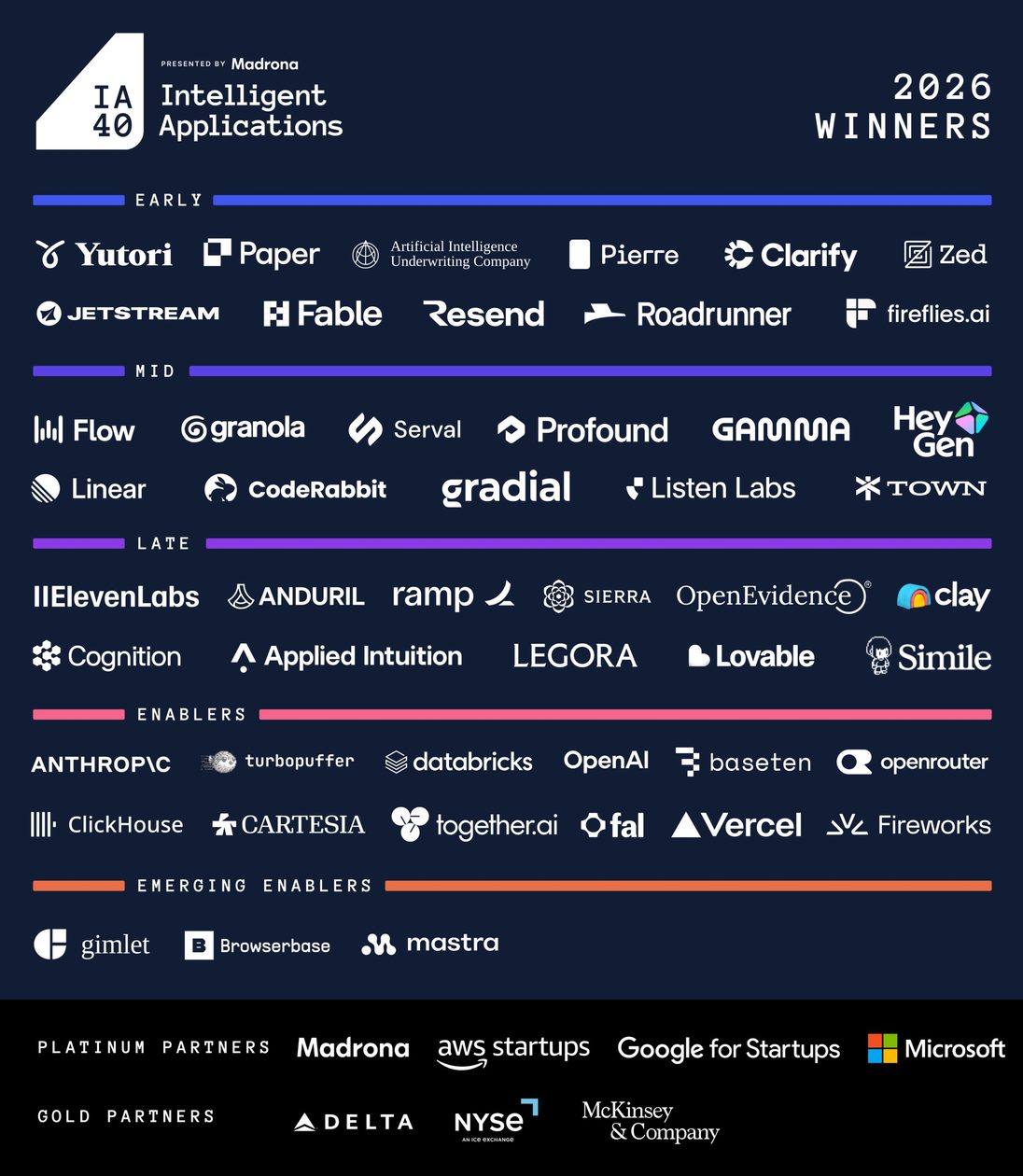
The winners on Madrona’s 2026 Intelligent Applications 40 list, grouped by funding stage. (Madrona Image)
Seattle-based venture capital firm Madrona released its sixth annual Intelligent Applications 40 list this week, naming 45 private AI companies (the five extras come from ties) that have collectively raised $410 billion from investors across the industry.
Three of them — Anthropic, OpenAI and Databricks — account for 92% of that total.
The uneven distribution of funding reflects a larger split in the tech industry, as the largest AI companies make huge bets on the computing capacity needed to meet demand for their models, while almost everyone else builds businesses on top of them.
The frontier labs are “increasingly funded by strategic capital from the likes of Amazon, Google, Nvidia and SoftBank rather than traditional venture,” Madrona’s Matt McIlwain and Rolanda Fu wrote in a post accompanying the list. That scale, they added, “makes every other category on this list look capital light by comparison.”
On top of that, he said, hundreds of billions of dollars are flowing into OpenAI and Anthropic.
“And what I say to both the big tech companies and to the people funding the model companies: thank you very much,” McIlwain said on Bloomberg TV, noting that the five largest tech companies will spend an estimated $750 billion in capital expenditures this year.
But even setting those big three aside, McIlwain said, the rest of the winners have raised an average of more than $800 million each. That’s a total of $34 billion combined. Companies across the list are raising far more than they used to, enough that Madrona had to redraw its own categories.
The list sorts companies by total capital raised, and this year the ceiling for “early stage” rose to $50 million, up from the $30 million threshold that held for the previous five lists. The cutoff for “emerging enablers,” its category for smaller infrastructure companies, doubled to $100 million.
“Companies across the board are raising more money, and the definition for what ‘early’ means continues to shift higher,” McIlwain and Fu wrote.
Madrona has published the IA40 since 2021 as a roster of the private companies it considers most important in building and enabling AI applications. According to the firm, this year’s list drew on input from 72 investors representing 54 venture and corporate firms, who nominated and voted on more than 450 companies, with PitchBook data factored into the scoring.
Gradial, which builds AI agents for enterprise marketing, is a first-time winner in the mid-stage category; it raised $65 million in June at a $675 million valuation, bringing its total to $120 million.
Last year’s list included two other Seattle-area companies in addition to Clarify.
OpenAI acquired one of them, Bellevue-based Statsig, for $1.1 billion in September 2025, making Statsig founder Vijaye Raji its CTO of applications.
Security startup Dropzone AI, which was on the list last year, did not repeat this year.
Madrona, one of the Seattle region’s largest and oldest venture capital firms, is an investor in all four — Clarify, Gradial, Statsig and Dropzone AI — although it also invests outside the region, and many of the companies on the IA40 are not in its portfolio.
Databricks, the San Francisco-based data and AI company (which leased 142,000 square feet in Bellevue this year), is the only company to appear on all six IA40 lists. That said, 23 of last year’s 40 winners returned this year, a 58% repeat rate, up from 33% the year before.
McIlwain and Fu wrote that the biggest and most established companies on the list are holding their spots, noting that “the age of experimentation is giving way to an age of enterprise readiness,” with buyers and investors “paying premiums for companies that can demonstrate real ROI.”
Madrona will recognize the winners at its IA40 Summit in Seattle on Sept. 29 and 30.
Updated with Matt McIlwain’s comments to Bloomberg TV.
The Trump administration is halting vital federal research on the foodborne parasite Cyclospora, despite the record-breaking, nationwide outbreak of the diarrheal pathogen, according to Politico.
Of the three research programs that represent nearly all of the Cyclospora work at the US Department of Agriculture, two have been defunded, and the third is about to lose every scientist working on it. The Trump administration is shuttering the USDA's Beltsville Agricultural Research Center near Washington, DC, and moving its work to a location in Iowa. That includes relocating the remaining Cyclospora research.
Although the research is still funded, insiders told Politico that not one of the scientists working on the project plans to relocate from Maryland to Iowa. Instead, they are either retiring, being reassigned to a different project, or leaving the USDA's research services.
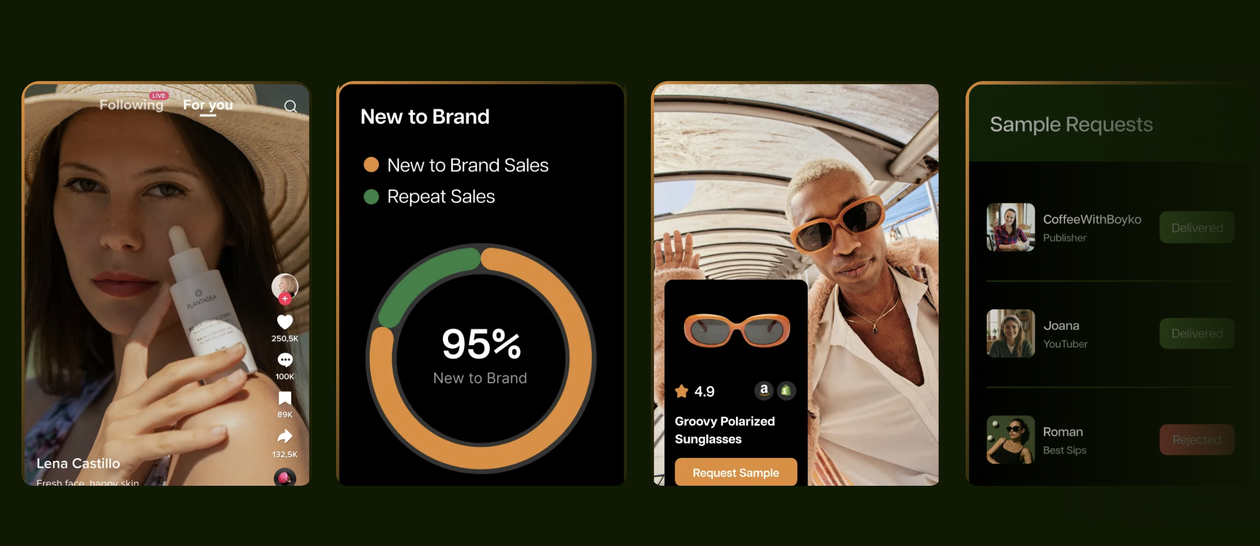
Levanta builds marketing tools so influencers and creators can connect with brands. Image via Levanta.
Influencers and online creators have become an increasingly powerful way for brands to sell products. But managing those relationships can get complicated — especially for companies selling across Amazon, Walmart, Shopify and other channels.
That’s the market Seattle startup Levanta is targeting, which today is announcing $22 million in new funding led by Volition Capital. The company provides software that helps brands find creators, send them products, set up affiliate commissions, track sales and handle payments.
The company says it now has more than 90,000 vetted creators on its platform. Brands can offer creators products to review or promote, pay commissions when their links generate sales, or arrange flat-fee partnerships. Levanta tracks the performance across Amazon, Walmart and Shopify and handles payments.
The startup originally focused on Amazon sellers but has expanded to Walmart and Shopify. Its revenue is up 80% year-over-year in 2026, according to the company.
“Every marketplace has thousands of sellers that want more customers, and there are millions of creators and affiliates capable of driving those customers,” said CEO and co-founder Ian Brodie in a press release. “The missing piece is infrastructure that connects the two, handles the economics, and accurately measures what happens.”
In 2023, Goldman Sachs estimated that the the influencer marketing category was expected to grow to $480 million by 2027.
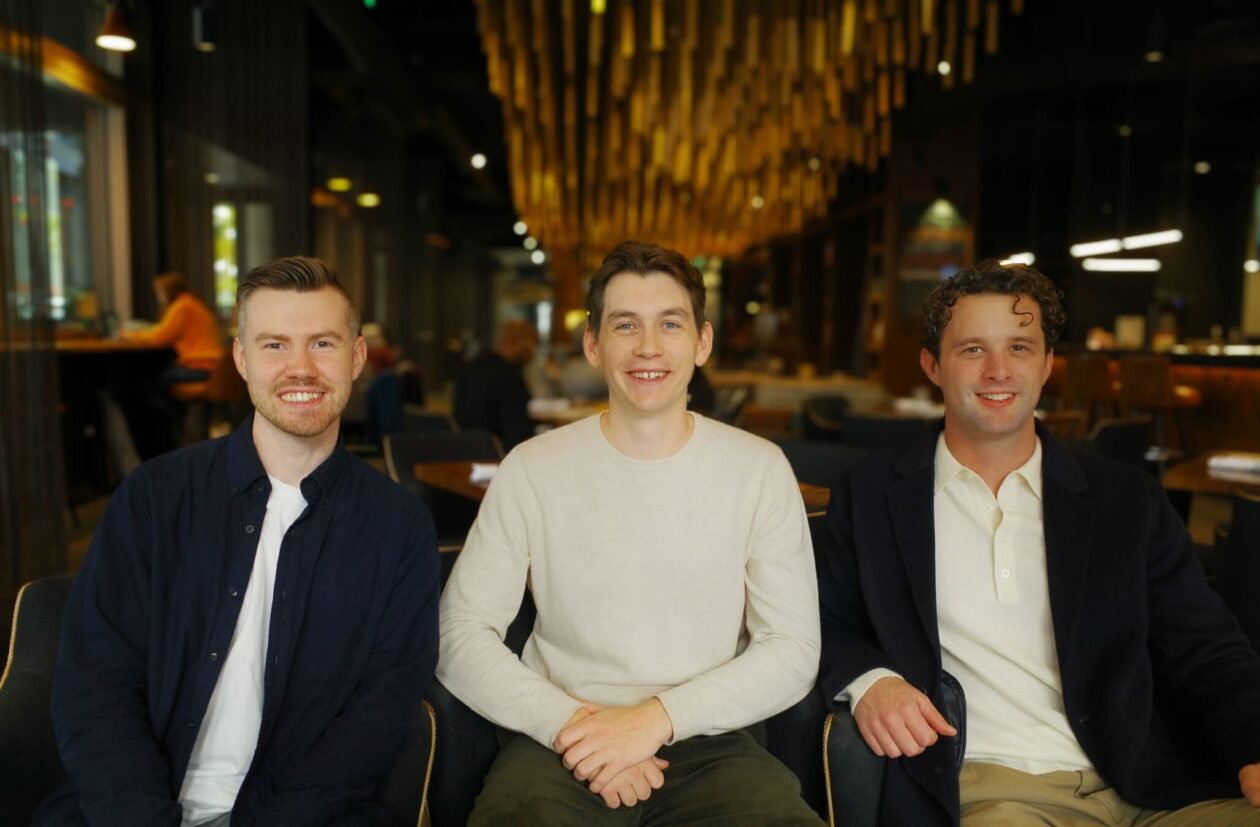
Levanta co-founders, from left: Spencer McKenney, Ian Brodie, and Rob Schab. (Levanta Photo)
Levanta was founded in 2023 by Brodie, CTO Spencer McKenney and Chief Marketplace Officer Rob Schab, all University of Washington graduates. The three previously founded Grovia.io, an affiliate marketing company that was acquired by Acceleration Partners in 2022.
With more than 100 employees, Levanta is the rare startup that has already reached profitability with Brodie telling Business Insider that it has been profitable or roughly break-even since its launch. With the new funding, it also provided cash liquidity to some eligible employees.
“This is a milestone moment for Levanta and it reflects how far the company has come and the value our team has created together,” Brodie said in the release. “At the same time, it allows us to reward the people who have been instrumental in building the foundation of the business while ensuring they remain deeply aligned with where we’re going next as we continue building Levanta for the long term.”
The new funding will support expansion to additional retail marketplaces and international growth.
Previous Levanta backers include Long Run Capital, OpenSky Ventures and Arrived Homes CEO Ryan Frazier. The latest series B round brings Levanta’s total funding to more than $43 million.
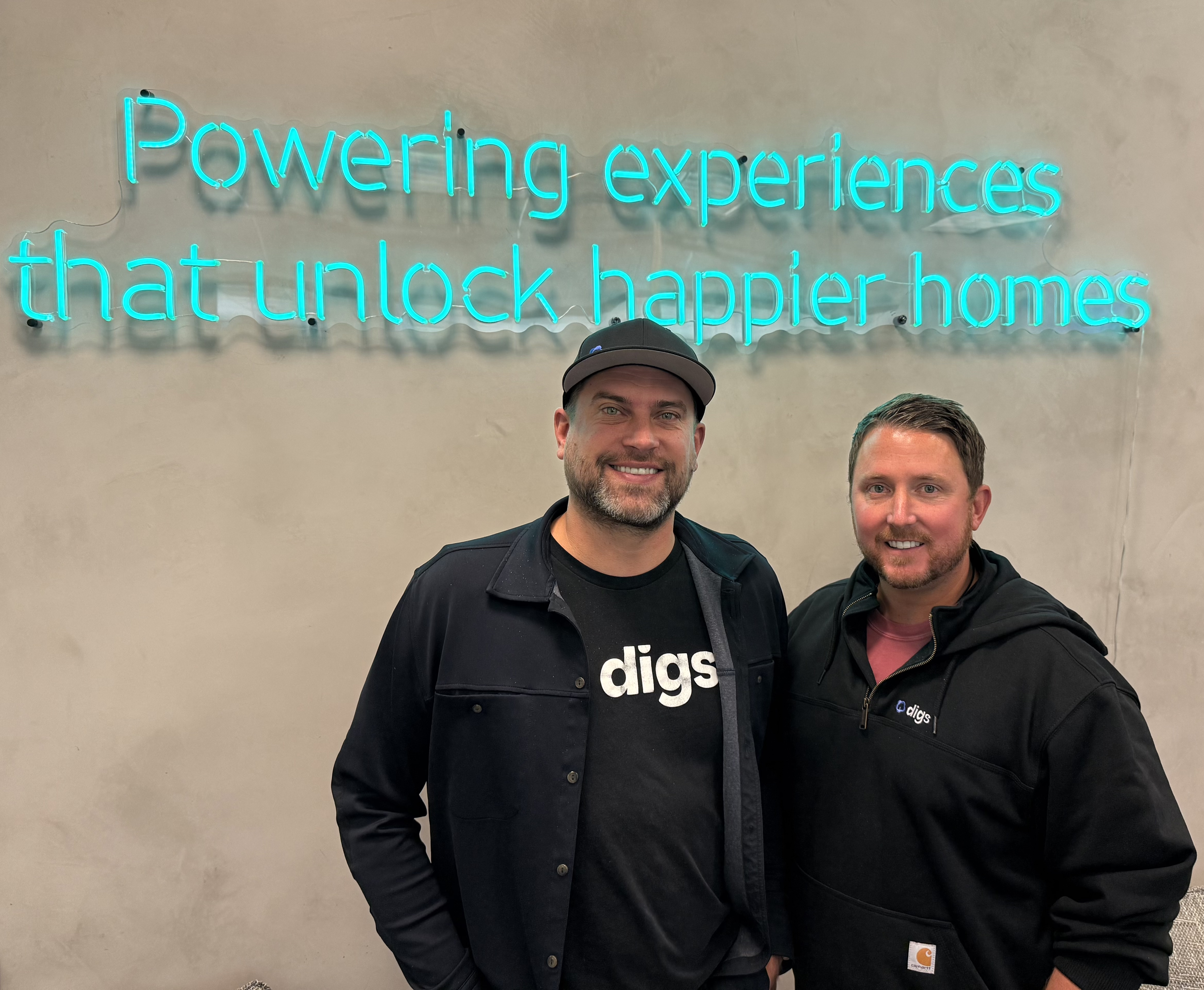
Digs co-founders Ty Frackiewicz, left, and Ryan Fink. (Digs Photo)
Digs, a Vancouver, Wash.-based startup building AI software for residential construction, raised $25.3 million in Series A funding led by building products giant Builders FirstSource, the companies announced Tuesday.
Under the five-year agreement, Builders FirstSource will integrate Digs’ AI platform into its digital ecosystem, expanding tools for its 140,000 builder clients. The technology streamlines everything from pre-construction estimates and blueprint collaboration to post-move-in home maintenance and warranty care for homeowners.
The deal represents a major milestone for Digs, which was founded in 2022 by Ryan Fink and Ty Frackiewicz. Fink said the partnership moves Digs closer to its vision of creating “the first scalable true digital twin of the home” that lives on well past the construction phase.
The Series A pushes Digs’ total funding to more than $47 million, building on a $5 million pre-Series A round in late 2025. The startup previously drew backing from regional venture firms including Fuse, Flying Fish, Oregon Venture Fund, and Cascade Seed Fund.
Digs has grown to 37 employees and Fink said they’ll look to double that count to more than 60 by the end of the year, mostly in engineering, design, and product and some in sales and marketing.
(Digs Image)
Digs charges builders on a SaaS model and currently has thousands of homes on its platform across all 50 states. Fink often describes the tool as a “CarFax for the home,” replacing static PDF blueprints and lost paperwork with an AI-powered hub that tracks a property’s history, materials, and warranty details.
Fink and Frackiewicz previously collaborated on augmented reality startup ONtheGo Platforms, which was acquired in 2015. Fink later founded home-service AR startup Streem (acquired by Frontdoor in 2019), while Frackiewicz brought a background in construction engineering and luxury homebuilding.
Headquartered in Irving, Texas, Builders FirstSource is the nation’s largest supplier of building materials and prefabricated components for residential construction. The Fortune 500 company operates approximately 565 locations across 43 states, supplying structural building products, trusses, and millwork to professional homebuilders in 91 of the top 100 U.S. metropolitan markets.
“Our customers are looking for seamless technology that helps them operate more efficiently and deliver a better homeowner experience,” Builders FirstSource President and CEO Peter Jackson said in a statement. “By combining Builders FirstSource’s scale, deep customer relationships, product data, and extensive digital ecosystem with Digs’ AI platform, we are advancing tools that can simplify workflows, improve productivity, and create a more connected experience across the homebuilding lifecycle.”
Harlan Robins spent years as the co-founder and chief scientific officer of Adaptive Biotechnologies, helping build massive datasets to decode the human immune system.
But as artificial intelligence exploded across life sciences, he recognized a growing divide: the groups spending immense resources to generate high-quality research data rarely receive fair compensation when AI developers use those assets to build commercial tools.
Now, the veteran biotech founder is stepping out with a new Bellevue startup called Harell Data that just scored $15 million in funding from Fuse, Cercano Management and others.
“The goal of the company is to connect AI modelers to proprietary training sets to enable the solution of challenging scientific problems,” said Robins in an email to GeekWire. “At present, the entities that generate proprietary training data using their own technology and expense do not have a good way to commercialize the data. So they effectively sit on it.”
High-profile successes like AlphaFold thrived because they drew on decades of publicly available, experimentally derived protein structures, Robins said.
But in many critical areas of biology and medicine, generating high-quality datasets requires millions of dollars and years of labor. The entities that own this data currently have no secure, profitable way to share it, so it remains sitting in isolated silos.
Harell Data Corp. is built to serve as a secure bridge between data creators and world-class AI modelers. It works like this:
Secure Cloud Platform: Data creators host their proprietary datasets on Harell’s platform, allowing machine learning groups to train models without the raw underlying data ever leaving the secure environment.
Direct Revenue Sharing: Instead of waiting years for speculative downstream drug royalties, data owners earn a direct share of the compute revenue generated during training runs.
Compound Value: As models improve through training on these rich datasets, the intrinsic value of the underlying data becomes more valuable.
While the startup is initially targeting problems Robins knows best — largely around computational medicine — he emphasizes that the data-silo problem spans across scientific disciplines, from materials science to imaging.
“If the business works right, we should be able to enable solutions to really important problems,” he said.
The company’s name also carries a fun personal story. When Robins decided to start the venture, he asked his 8-year-old son, Ellis, for a recommendation. Within seconds, his son suggested “Harell”: a combination of “Harlan” and “Ellis.”
“No offense to the large cap cloud compute companies, but it sounds better to me than any of their names, and things seem to have worked out OK for them so I went with it,” said Robins.
Robins, who continues to serve as a consultant focusing on scientific strategy at Adaptive Biotechnologies, has built an 11-person team split between Bellevue and Palo Alto, California. The team includes Chief Technology Officer Rakesh Nair, Head of Operations Saray Covey, and Head of Sales Analise Polsky.
Early access for the platform is launching this week with initial datasets provided by partners including Seattle-based A-Alpha Bio and Adaptive Biotechnologies.
Adaptive, which is publicly-traded with a market value of $3.9 billion, earlier this year spun out a new startup called Digital Biotechnologies that is developing DNA sequencing technology.
The biotech publication Timmerman Report first reported on the news of Harell Data.
InduPro’s ARRIS platform is designed to bring two proteins on the surface of a cell together, potentially allowing drugs to target cancer cells more precisely and opening up new ways to treat disease.
InduPro, a 4-year-old biotech startup with operations in Seattle and Cambridge, Mass., this week announced $77 million in series B funding as it begins a Phase 1 clinical trial of its lead cancer drug candidate.
The company said that the first patient has been dosed in the trial of IDP-001, an experimental antibody-drug conjugate designed to target cancer cells through a combination of two proteins on their surface.
The early-stage trial is enrolling adults with advanced or metastatic non-small cell lung cancer and other solid tumors whose disease has progressed following standard treatment. Researchers will evaluate the drug’s safety, tolerability, drug behavior and early signs of antitumor activity.
InduPro is developing drugs based on the spatial relationships between proteins on the surface of cells. The company says its approach can identify combinations of targets that are close together on cancer cells but not on normal tissue, potentially allowing drugs to more selectively attack tumors.
The Series B was led by The Column Group, with participation from Vida Ventures, MRL Ventures Fund, Emerson Collective, Euclidean Capital, Solasta Ventures, Sanofi and Eli Lilly and Company.
“We are delighted to have the support of this outstanding group of life sciences investors and strategic partners who recognize the potential of our proximity-guided platform to create precision therapeutics in oncology and autoimmune disease,” said InduPro CEO Prakash Raman in a press release.
Raman is a longtime biopharma executive who previously served as president and CEO of Ribon Therapeutics. Before that, he spent nearly 14 years at Novartis, where he served as vice president and global head of business development and licensing for the Novartis Institutes for Biomedical Research.
The company’s president and chief scientific officer is Scott Lesley, who previously served as vice president of discovery biologics at Merck.
InduPro said the new funding will support the Phase 1 development of IDP-001 and further development of its preclinical pipeline, which includes programs targeting cancer and autoimmune diseases.
Earlier this year, InduPro inked a strategic collaboration and licensing agreement with Eli Lilly covering up to three oncology targets, a deal worth up to approximately $950 million.
Kevin Carlberg, founder and CEO of Noosphere Labs. (UW Photo)
A former Meta AI research director has raised $10.25 million for a Seattle-area startup working on what it calls “human-centered physical intelligence” — AI designed to help people interact with and make sense of the physical world, beyond text and images on screens.
A company called Noosphere Labs, led by Kevin Carlberg, disclosed the financing in a Form D filed Monday with the Securities and Exchange Commission. Reached via phone by GeekWire on Monday evening, Carlberg said he wasn’t yet ready to share details about the startup.
Trilogy Equity Partners confirmed that it led the round. One of the directors listed in the Form D filing is Amy McCullough, a managing director at the Bellevue-based venture firm. Madrona, the Seattle VC firm, separately confirmed that it had “major participation” in the round.
Carlberg’s personal website describes him as founder and CEO of a “stealth AI startup focused on physical AI and real-world intelligence.” The company’s website says, “Human-centered physical intelligence. Built for the world we inhabit,” with a “Coming Soon” title.
The website styles the name Noösphere, with two dots over the second “o” signaling that it’s pronounced as a separate syllable: NOH-uh-sfeer. The term dates to the 1920s, describing a sphere of human thought wrapped around the planet the way the biosphere wraps it in life.
Carlberg spent more than five years at Meta, where he led a research team spanning Reality Labs Research and the company’s Fundamental AI Research group, working on physical AI and simulation for wearable computers and virtual and mixed-reality devices.
Before that, he spent eight years at Sandia National Laboratories developing methods to make massive physics simulations run in near-real time for national security applications. He holds a doctorate from Stanford and is an affiliate associate professor of applied mathematics and mechanical engineering at the University of Washington.
Although Carlberg hasn’t publicly detailed what the new startup is building, his research points to the problems he’s been focused on.
In a paper for the NeurIPS conference last year, for example, he and his Meta colleagues built a benchmark for “assistive wearable agents” — smart glasses and similar devices that figure out what a person is trying to do from video, audio and other signals, without being asked.
Noting how little prior work existed, they assembled a dataset from 348 participants to test it. The best AI models produced a relevant answer only 55% of the time, they found. The researchers concluded that current models “remain far from practical usefulness” at the task.
Also listed as a director in the startup’s filing is Tyler Simpson, a Seattle-area software executive who co-founded commute-management startup Luum, spent 11 years at Microsoft, and was most recently a director and technical program manager at Meta, overlapping with Carlberg.
Carlberg left Meta at the end of 2024 and announced on his website that he was taking a sabbatical. He incorporated Noosphere Labs early this year.
Dr. Christopher Murray, IHME’s director, is principal investigator on the grant. He started the Global Burden of Disease study in the early 1990s. (IHME Photo)
The Gates Foundation broke its own record at the University of Washington with the largest charitable gift in university history: $540.2 million for the Institute for Health Metrics and Evaluation.
The commitment, announced Monday, will fund a 10-year expansion of IHME’s Global Burden of Disease study, increasing the number of locations it covers from about 925 to nearly 5,000. For many countries, the study is the only source of comparable data on causes of death and disease, according to IHME.
It will also support the institute’s health forecasting and its tracking of health spending worldwide.
The funding “will allow us to provide high-quality evidence at a much more local level and help leaders understand not only where health is improving or worsening, but which decisions can make the greatest difference for people,” said Dr. Christopher Murray, IHME’s director and a professor of health metrics sciences at UW, in a statement announcing the grant.
Roughly 60% of IHME’s budget comes from the Gates Foundation, according to the institute. The rest comes from federal grants, projects with other countries and other philanthropies.
IHME describes the new commitment from the Gates Foundation as a core grant that keeps the institute at a “steady state.” The previous core grant, $279 million announced in 2017, ramps down in December, and the new one begins in January.
IHME employed 425 people in fiscal 2026, down from 469 the year before, the institute said. No significant additional hiring is planned.
The institute became widely known during the COVID-19 pandemic, when its projections of cases, hospitalizations and deaths were used by the White House coronavirus task force and cited around the world. It drew criticism from statisticians who said its early forecasts understated the U.S. death toll and that its uncertainty ranges were too narrow, prompting revisions by IHME.
The Gates Foundation helped create IHME at UW in 2007 with a $105 million grant, then the largest in UW history. It has repeatedly set UW’s donation record since then, including $210 million in 2016 for the building that now houses the institute and $279 million to IHME in 2017.
The latest grant comes as global health funding falls sharply. IHME’s own tracking found that development assistance for health dropped 21% between 2024 and 2025, driven by a 67% decline in U.S. spending. Britain, France and Germany also cut their contributions.
It also comes at a tough moment for UW, which is facing a budget crisis driven by funding cuts. KUOW reported in April that NIH award money promised to UW dropped 50% from fiscal 2025 to fiscal 2026, with funds in hand down 74% because of slow federal grant processing.
The foundation is going through a transition of its own. It announced in May 2025 that it would spend $200 billion over 20 years and close on Dec. 31, 2045. Its board approved a record $9 billion budget for 2026 and a plan to cut up to 500 of its roughly 2,375 staff positions by 2030.
The new grant will run into 2036, about a decade before the foundation closes.
Updated after publication with additional information from IHME.
A Wild Zebra math problem framed around baking, one of the interests the student selected. After the student works out that each section is 1/12 of the cookie, the AI confirms the step and asks the next question rather than finishing the problem. (Wild Zebra images, click to enlarge)
Seattle-based edtech startup Wild Zebra has raised $6 million to expand its AI learning platform for math and reading, citing early signs that its specialized product can hold its own against the free study tools released over the past year by OpenAI, Google and Anthropic.
One of Wild Zebra’s secrets is its Socratic approach: rather than handing over the answer, the platform works students toward it with questions, drawing out the reasoning step by step.
Another key difference: the lessons are customized to be grounded in whatever topics or hobbies the student is already interested in, such as sports, cooking, music, or anything else.
The platform also analyzes the conversations themselves, looking not just for students who are distracted or getting answers elsewhere, but for those showing persistence or curiosity — flagging those positive moments in dashboards for teachers and parents.
The idea is “to catch kids being good, too,” said edtech veteran Edan Shahar, the company’s CEO and co-founder.
Latest funding: The oversubscribed seed round was led by Bellevue, Wash.-based Trilogy Equity Partners, with participation from Tetherpoint Capital and angel investors including Shrikesh Majithia. It brings the company’s total funding to $8 million.
Wild Zebra co-founders: CEO Edan Shahar, left, and CTO Erik Selberg. (Wild Zebra Photos)
Wild Zebra, co-founded in 2024 by Shahar and longtime AI technologist Erik Selberg, serves students in grades 2 through 9. The company, with a team of 10, plans to use the new funding for hiring, primarily engineers, along with sales and marketing initiatives.
Trilogy Managing Director Amy McCullough, who is joining the Wild Zebra board, said the VC firm backed the company for its potential to give parents and teachers a real-time view of what a student has actually learned, and a path to mastering the material from there.
She said she came to the deal as a customer first: her family had used Test Innovators, the private-school admissions test-prep company Shahar ran for nearly a decade, and she was struck by how well it delivered for parents and students at a high-stakes moment.
“When we were introduced to Wild Zebra, we knew very quickly that this was the team who could build the student-centric AI partner for the market,” McCullough said.
Competitive landscape: When GeekWire first covered Wild Zebra last year, OpenAI and Google had just launched study modes of their own. Anthropic launched a free version of Claude for K-12 teachers last month, and Khan Academy’s Khanmigo has been in the market for years.
Shahar said the general-purpose chatbots are good at answering a single question or explaining a concept, but don’t keep track of what a student knows over time.
Wild Zebra builds what the company calls a “learning tree” for each student — what they’ve mastered, where the gaps are, what comes next — and uses it to decide what they work on next, rather than just responding to whatever they happen to ask.
Shahar sees the big AI labs as suppliers more than rivals. Wild Zebra runs on their models, along with others.
Traction so far: Wild Zebra says it now reaches tens of thousands of students, up from about 6,000 a year ago, and has logged hundreds of thousands of tutoring conversations.
It opened the platform to families this year at $48 per month per child. The first consumer customers, Shahar said, were parents at pilot schools who wanted it for their other kids.
On the school side, Wild Zebra works through E3n, formed this year by the merger of the Educational Records Bureau and the Enrollment Management Association, which serve selective private schools. ERB invested in the company in 2024.
Many member schools test students using E3n’s exams, and Wild Zebra uses those results to set each student’s starting point, though some schools using the platform don’t.
Early results: E3n also conducted a 722-student pilot evaluation of math and reading, measuring results against ERB norm groups collectively built from hundreds of thousands of students. It found gains of four to eight percentage points among fifth and sixth graders.
Having started in private schools, Wild Zebra is now talking with charter and public schools.
Shahar said schools and students skeptical of AI mostly don’t become customers, and the ones who do tend to share his optimism while still taking the risks seriously.
The concern he hears most often from students is AI’s environmental impact — which, he acknowledged, is not something Wild Zebra is working to address.
“I’m not a Pollyanna. I think there are certainly potential downsides to AI in general,” he said. “There are people working on the downside mitigation. I’m working on upside opportunity.”

 Login
Login