❌

Reading view

There are new articles available, click to refresh the page.

How Bad Is That Bridge: A Government Database

Bridges! We kind of expect them to just be there and do their job, ad infinitum. They are built into the landscape, and we often take them and the routes they open up for granted.

The reality, as any civil engineer will tell you, is that bridges are living, breathing things that require endless maintenance and monitoring to keep them safe, standing, and functional. A great example of this is found in the US Department of Transportation, and its publicly accessible register of bridge health reports.

Stay Standing

The thing about bridges is that we rely on them. They serve as vital transport links in our communities, ferrying people to and from work and school, and acting as the very arteries of commerce as trucks and trains haul goods to and fro. When a bridge crossing has to close, either for maintenance or at end of life, this link is severed, often with serious economic and logistical impacts. For that reason, we tend to like to keep our bridges in service as long as possible. The result, of course, is that if pursuing this goal means that proper maintenance and repairs aren’t seen to, there is a risk of collapse—which often comes with worse consequences. Loss of life is common when bridges fail, and replacing a collapsed bridge is often much harder and more time consuming than handling things properly ahead of time.

In the United States, it’s a well known fact that the bridges are getting old. The average bridge is 44 years old, which is bumping up against the 50-year service limit many were originally built for. Being an average number, it’s indicative that many bridges are exceeding that figure significantly. Obviously, a bridge’s age isn’t a perfect proxy for its condition, but closer examinations indicate there’s definitely a problem. A 2024 report from the American Road & Transportation Builders Association noted that 36 percent of US bridges are in need of repair or replacement, a total of 221,800 spans. 42,067 spans were considered to be in “poor” condition, which in their total see 168.5 million motorists crossing them every day. It’s a particularly sobering figure as it highlights the size of the disaster possible if these structures are to fail.
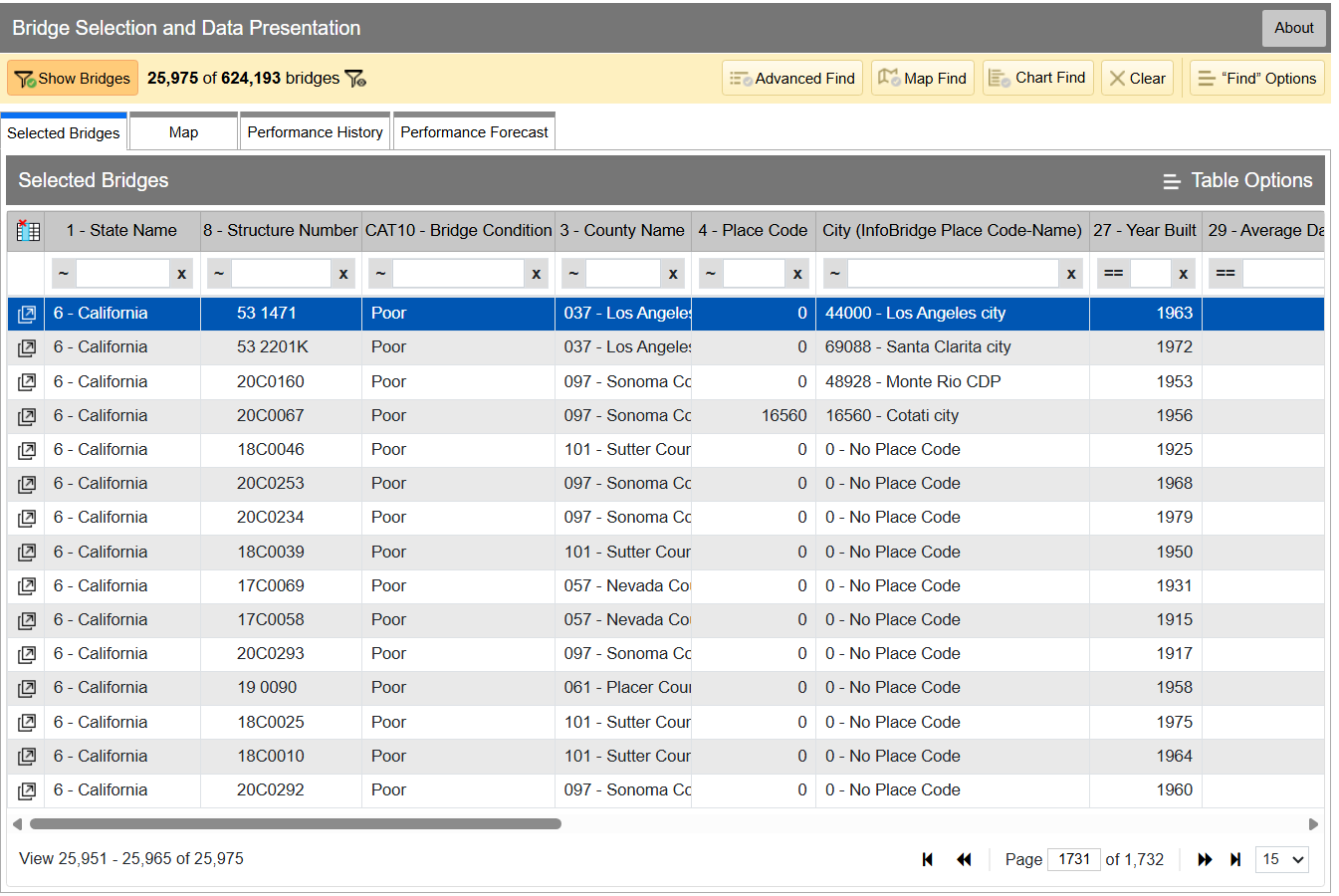
InfoBridge quickly lets you sort through data by all kinds of different factors. If you’re looking for the worst bridges in town, it’s easy to flick through CAT10 – BRIDGE CONDITION to see which bridges as listed as Good, Fair, or Poor. Bridges are rated on the condition of their deck, superstructure, and substructure, and the lowest scoring section influences which bin the bridge lands in, as per federal code—specifically, 23 CFR 490 Subpart D. Credit: InfoBridge screenshot

You can drill down into the data yourself if you desire. Within the Department of Transport, the Federal Highway Administration maintains LTBP InfoBridge, a database of information on bridges all across the country. It was developed by the Long Term Bridge Performance program, because the goal of the project is to understand how these structures hold up and perform over the decades. The database is publicly accessible, and serves as a portal for all the available data and statistics on how US bridges are doing. It hopes to enable everyone from state and federal authorities, to university students, faculty, and other researchers, to dive into bridge data and visualize and understand it better.

Data available is from a wide number of sources, including the National Bridge Inventory and National Bridge Element datasets, as well as climatic data collected from NASA’s MERRA-2 database. There’s also construction and design data sourced by the LTBP program, along with non-destructive evaluations that have been carried out. Data from various other special projects is available too, such as from Federal Highway Administration projects investigating timber bridges, steel weathering, and the use of ultra-high performance concrete structures.
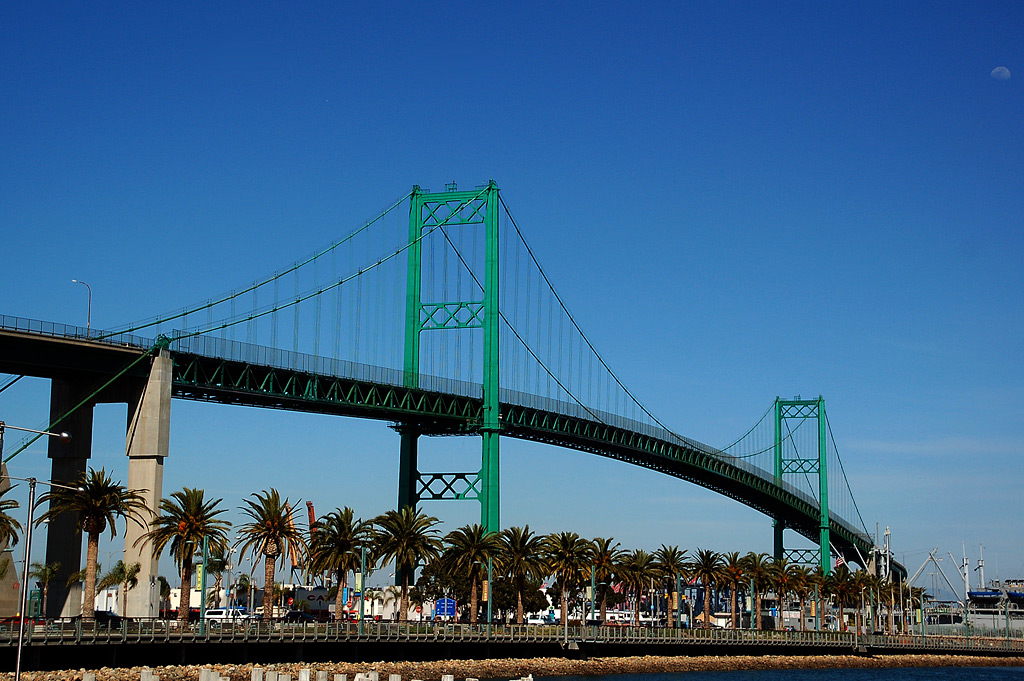
Just glancing at the Vincent Thomas bridge won’t tell you how the structure is doing. Credit: The Port of Authority, CC BY-SA 3.0

If you have a particular bridge of interest, it’s easy to get a quick break down of how it’s doing. For example, you might like to know about the Vincent Thomas Bridge, in Los Angeles, California: National Bridge Inventory number 53 1471. It links San Pedro with Terminal Island, and is a suspension bridge with a total length of 6,060 feet and a longest span of 1,500 feet. Built in 1963, we can see from the data alone that it’s now showing its age.

The bridge condition is listed as “Poor,” and if we dive deeper into the National Bridge Elements data, we can see why. The health indexes of the deck, substructure, and superstructure have all been trending down in recent years as the bridge’s age has increased, with a particular drop off from 2019 or so. In particular, the steel cables and girders on the bridge have been showing their age, and the concrete columns supporting the bridge have been similarly degrading. The deck, too, is in need of repair, with the California Department of Transport recently dedicating some $706 million to replace it ahead of the 2028 Olympic Games.
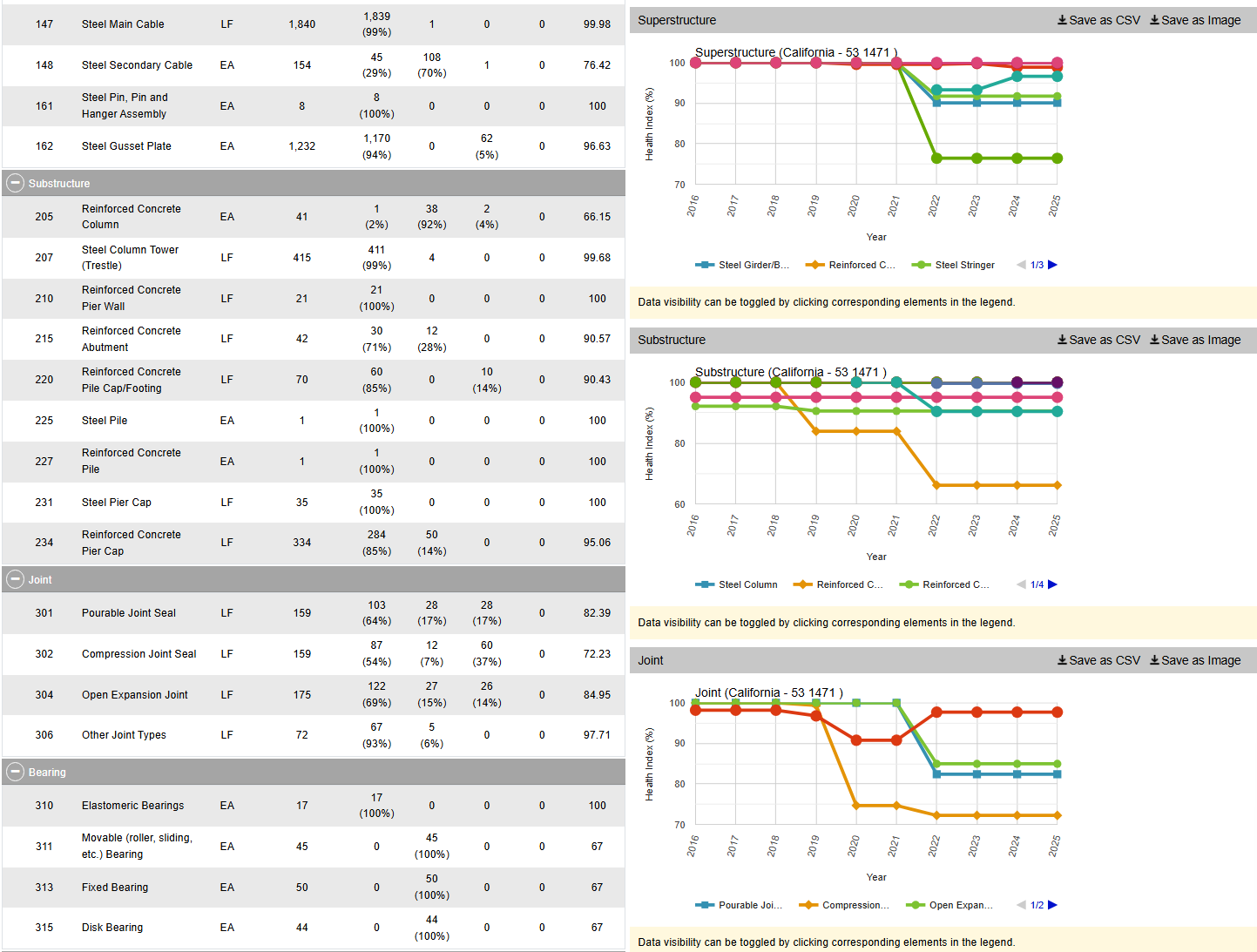
However, InfoBridge will let you drill down into detailed reports on the bridge conditions, down to a level which indicates which parts of the bridge are most in need of maintenance, repair, or replacement. Credit: Screenshot, InfoBridge

InfoBridge also offers condition forecasts for many bridges across the country. For example, the 24th Street Bridge over Rio Linda Creek is currently listed as being in “Good” condition. Current forecasts show that the deck and superstructure is expected to be in much poorer shape somewhere between 2035 and 2055, while the substructure is expected to hang on in good shape for a bit longer.
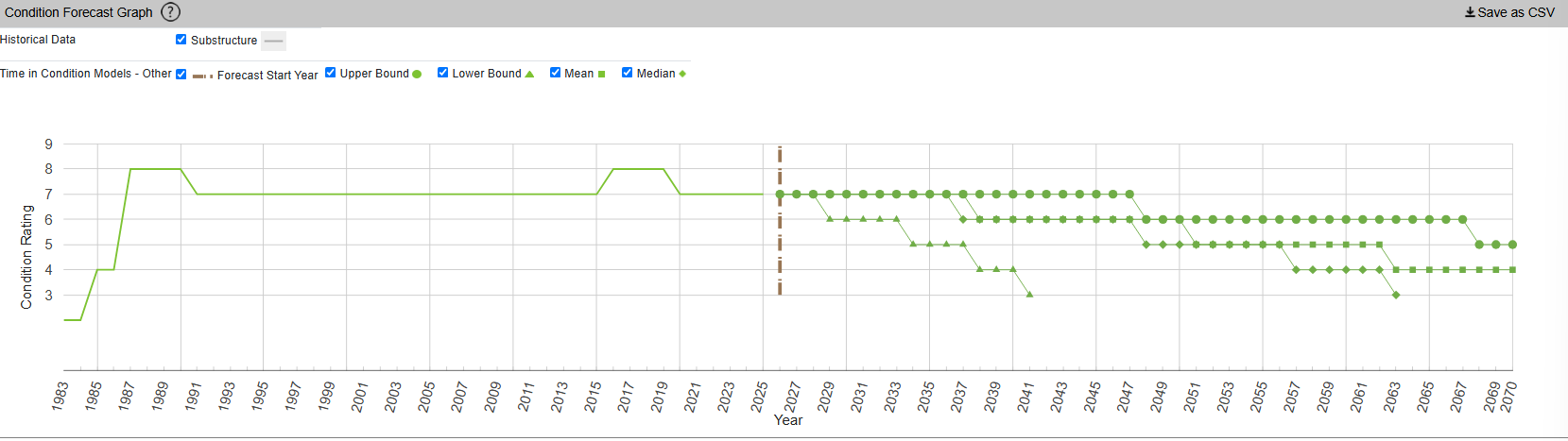
The Long Term Bridge Performance Program has developed a variety of models—base, survival, and machine-learning—to predict bridge condition over time. The aim is to guide maintenance efforts over time and allow for better planning. Credit: InfoBridge, screenshot

You might think that you’d have to query a government department and delve deep into some dusty records room to learn about the condition of your local bridges. Instead, thanks to the efforts of diligent civil servants, you can instead access all the rich inspection data you like from the comfort of your own web browser. It’s not just good for citizen oversight, either. It aids local authorities and bridge owners in making the right decisions, by putting the necessary data right at their fingertips.

It also creates a certain level of accountability—having the data available means there’s little room for anyone to make excuses that they were unaware of a bridge’s condition prior to something going wrong. Ultimately, it’s just one arm of a project that hopes to take US bridges safely long into the future.

Featured image: “Brooklyn Bridge – New York City” by [Simone Roda]
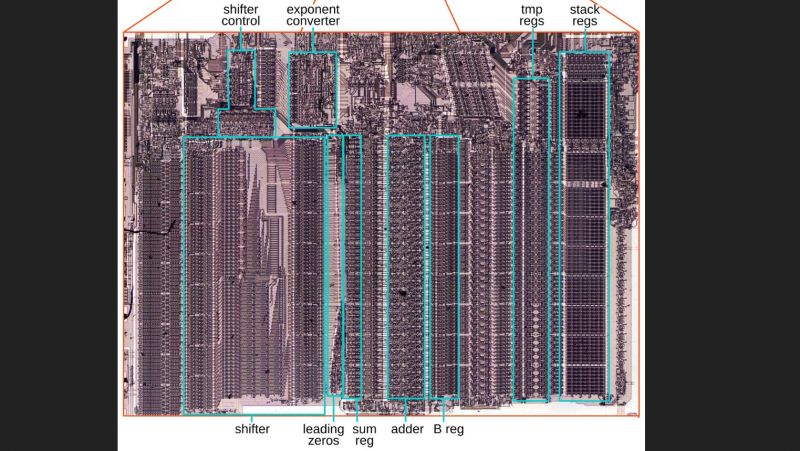
Floating-Point Addition and Subtraction on Intel’s 8087

Although you can do basic floating point format operations like addition and subtraction just fine on any CPU, having specialized hardware for it can provide a significant speed boost. Here Intel’s 8087 was the first mainstream floating-point coprocessor to provide this option to a wide audience, with [Ken Shirriff] recently reverse-engineering using an 8087 die how these basic operations were implemented.

The real-world speed-up of even simple operations like adding two floating point numbers compared to the 8086 CPU was on the order of a hundred times, which is very relevant the moment you start doing interesting things with spreadsheets, not to mention rendering 3D scenes in CAD software or even games.

As always, the devil is in the details, with sneaky infinities and edge cases also providing the biggest potential for speed-ups in dedicated silicon, along with the large circuitry spent on the shifter. With floating point values being very much about aligning values with shifting by a number of bits, this circuitry along with the detecting of over- and underflows is the key element why the 8087 and its successors were so crucial in making floating-point operations at all feasible in PC applications.

How this shifting works in theory is detailed in the article by [Ken], along with how the 8087 implements this in its circuits. Naturally, a large part of this is implemented in microcode, the listing for which is also provided. From this it’s quite clear how what seems like a simple set of operations is actually quite complex, making even the now much maligned x87 ISA an improvement over doing it all in integer-based software.

‘Difficult relationship’: UW task force proposes splitting Allen School from College of Engineering

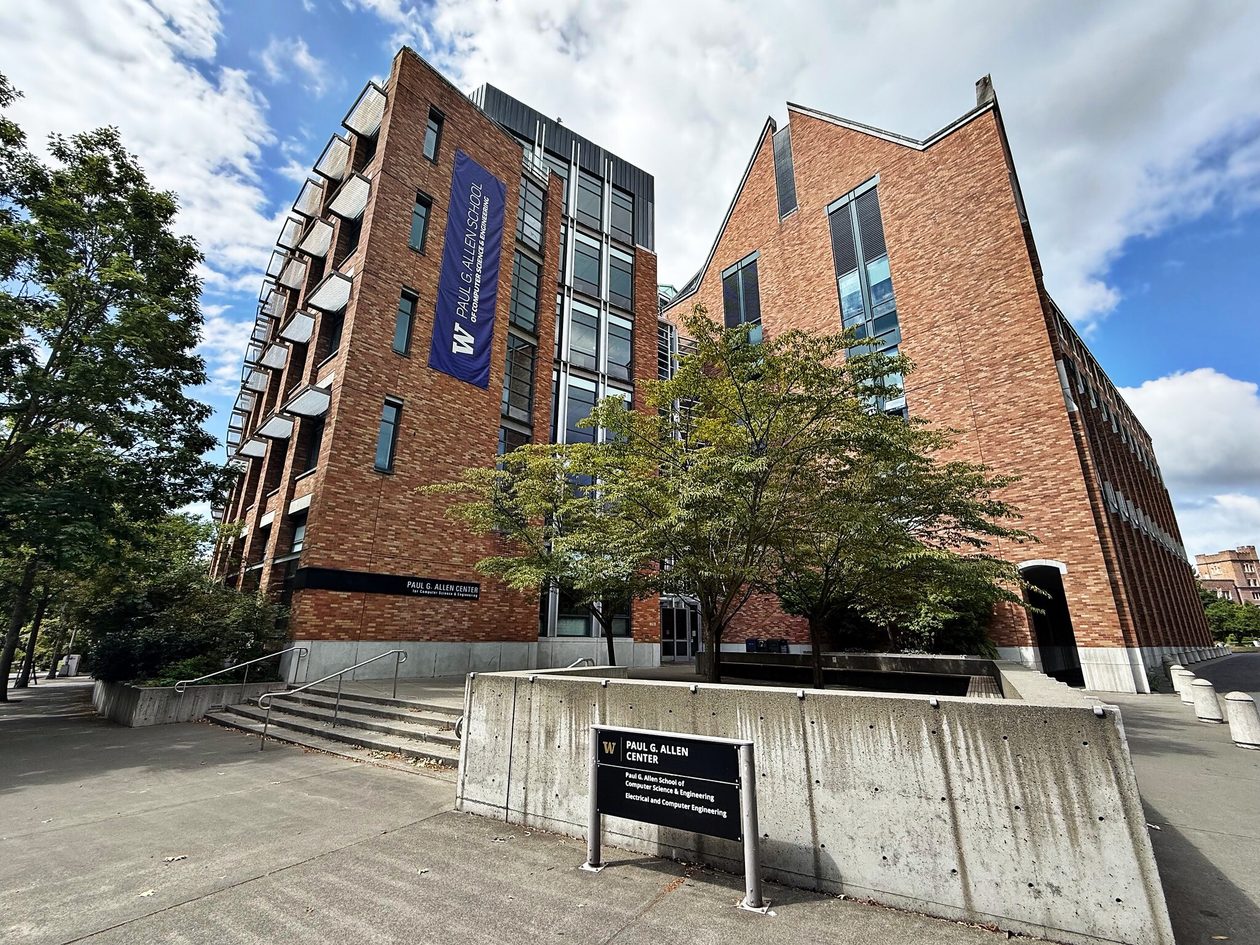
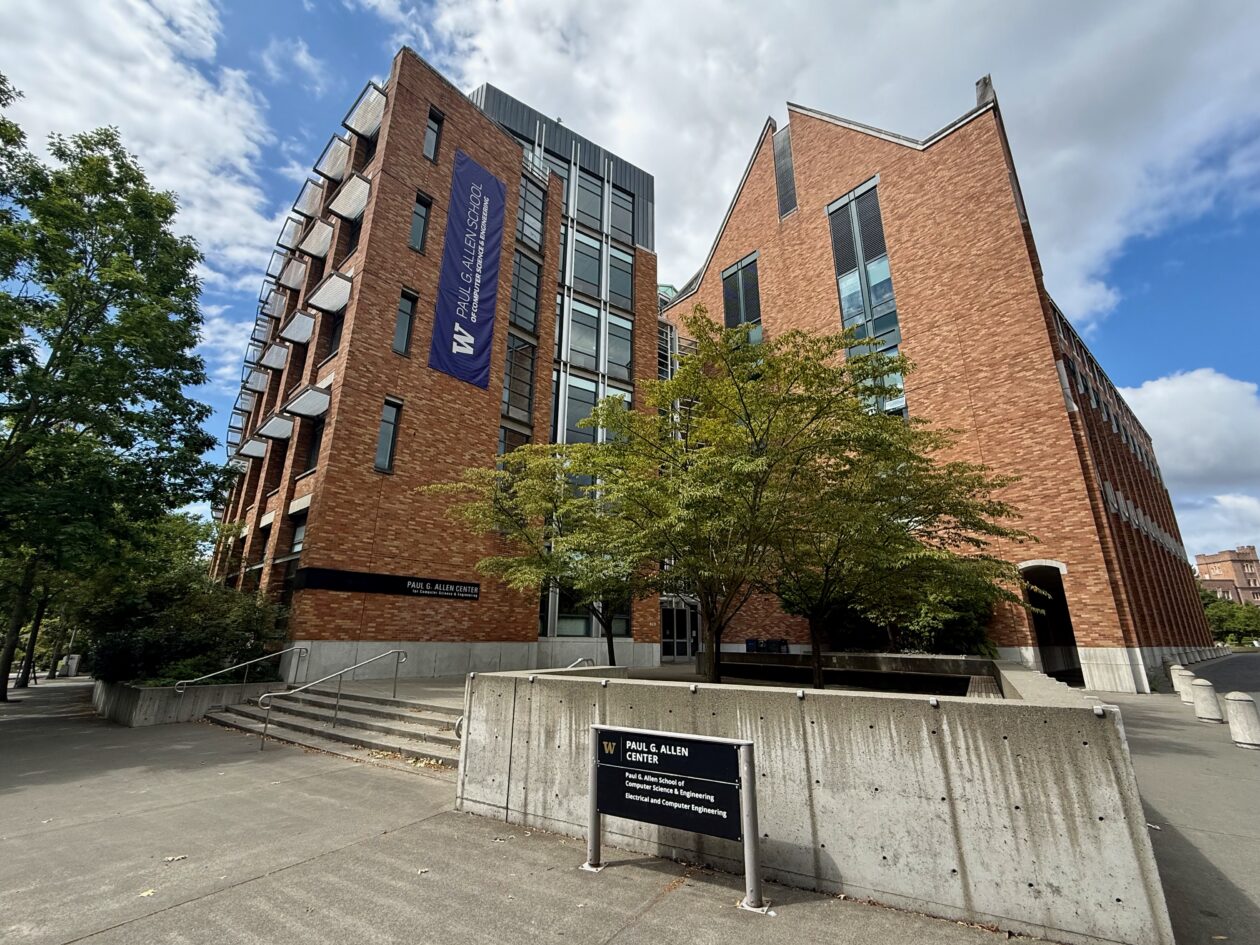
The Paul G. Allen Center, a brick building with a banner for the Paul G. Allen School of Computer Science & Engineering, on the University of Washington campus.
The Paul G. Allen Center on the University of Washington’s Seattle campus, home to the Allen School of Computer Science & Engineering, which a university task force has recommended separating from the College of Engineering. (GeekWire Photo / Kurt Schlosser)

University of Washington leaders are weighing whether to separate the Allen School of Computer Science & Engineering from the broader College of Engineering, after a task force recommended the move as part of proposed changes to UW’s computing and AI programs.

The split would give new independence to what has become one of the world’s leading schools for computer science and AI, and a major source of talent for the Seattle region’s tech industry.

As an independent, college-level school, the Allen School would gain greater control over its finances and a seat at the table with UW’s other deans. It could also put more of its own revenue toward teaching, as student demand for computing courses continues to outstrip its capacity.

The task force’s report, released this week, concluded that UW’s successes in computing, data science and AI have come “not because of the organizational structures we have in place but in spite of them.” The nine-member group included UW faculty leaders from across campus, two outside academics and an Amazon executive.

The report also described a “difficult relationship” between the Allen School and the College of Engineering, and “significant distrust” across campus over resources and priorities.

Portrait of Nancy Allbritton, dean of the University of Washington College of Engineering.
Nancy Allbritton, dean of the UW College of Engineering, said the college supports the university’s decision to “carefully evaluate” the task force recommendations. (UW Photo)

UW Engineering Dean Nancy Allbritton, in a statement to GeekWire on Tuesday, called the relationship “complex rather than difficult.”

The College of Engineering supports the university’s decision to “carefully evaluate” the task force’s recommendations, Allbritton said. She praised the Allen School and said the school and college share a long history of working together, with a commitment to students, research and service to Washington state.

The stakes extend well beyond university politics: The Allen School’s graduates are in high demand across the tech industry. Nearly 100 graduates from the 2025-26 class went to work full time at Amazon, and more than 70 went to Google, Microsoft or Meta, according to a survey of recent graduates by the school. In all, graduates went to more than 150 different companies.

No decision yet: UW President Robert J. Jones and Provost Tricia Serio said Monday that they aren’t making a decision yet. In a letter to the UW community, they announced two implementation committees.

  • One committee will plan for a possible independent Allen School, including its finances. The letter calls the continued strength and growth of the College of Engineering “a central consideration.”
  • The other will develop plans for a new campus-wide “Federation of Information, Computing and Society,” which would coordinate computing, data science and AI work across UW, including fundraising, and hold its own funding for hiring across departments.

Both committees are due to report by the end of winter quarter 2027, and UW leaders plan to announce next steps in spring 2027. Any changes would still need approval through the university’s usual processes, including the Faculty Senate and Board of Regents, with a goal of putting them in place by the end of the 2027-28 academic year.

The task force was co-chaired by Andy Connolly of UW’s eScience Institute and Kathy Yelick of Lawrence Berkeley National Laboratory. Its other members were Dan Grossman, now the Allen School’s interim director; Remzi Arpaci-Dusseau of the University of Wisconsin; UW’s Elizabeth Nance (chemical engineering), Abel Rodriguez (statistics), Emma Spiro (Information School) and Peter Tarczy-Hornoch (UW Medicine); and Anne Szeto of Amazon.

Allen School faculty voted 83-0 in late September in support of “moving forward with a process to determine how the Allen School would become an independent school,” with 13 not voting because they were absent or on leave, according to the school. A formal decision and vote would follow that process, the school said.

Budget and a seat at the table: The issue comes down to money and influence. UW’s budget model sends tuition and a share of research grant funding to the college where the courses are taught and the research is based.

For the Allen School, that’s the College of Engineering. As an independent school, the Allen School would control those funds directly, and its leader would sit with UW’s other deans when the university sets strategy on AI and other priorities, a voice the task force says computing has largely lacked.

UW’s Information School already operates as an independent, college-level unit. But the report says its focus on the human, societal and organizational side of computing and information is different from the Allen School’s focus on computing as a discipline.

Dan Grossman, interim director of the Allen School, has been invited to participate in UW’s Board of Deans and Chancellors. (UW Photo)

As an initial step, Jones and Serio invited Grossman to participate in the Board of Deans and Chancellors. The letter says the move is “independent of any future decision about administrative structure.”

In a message to the Allen School community, Grossman called the invitation “a reflection of the Allen School’s scale and reach,” adding, “I’m pleased to have this opportunity to make meaningful contributions to discussions among UW’s leaders.”

He described the task force’s proposals as “exciting recommendations that will be great for the whole of UW and its impact on Washington state and beyond.”

Grossman also said there are “no planned changes to the Allen School’s structure, staffing, budget, policies and procedures, or degree programs” while the committees do their work.

A longtime Allen School professor and its former vice director, Grossman was named interim director this summer when Magdalena Balazinska’s nearly seven-year term as director ended. At the time, UW said it was opting for an interim leader for about a year while it weighed the task force’s recommendations, which hadn’t yet been made public.

The board seat was one of several early steps the task force recommended to show that UW was committed to the process. The task force also suggested having the Allen School’s director report jointly to the provost and giving the school more control over its budget, but UW hasn’t taken those steps for now.

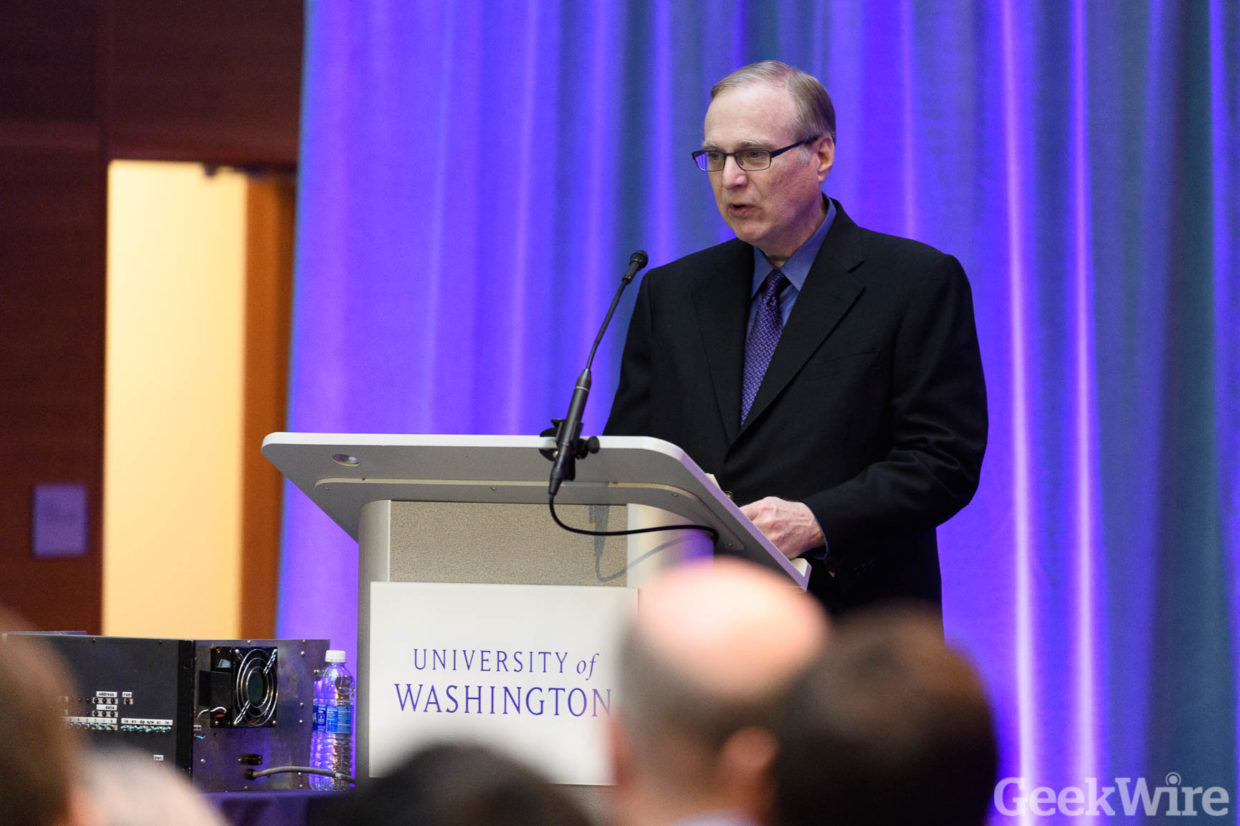
Microsoft co-founder Paul Allen speaks at UW in March 2017, when his $40 million gift turned the university’s computer science department into the Allen School. Allen died in 2018. (GeekWire Photo / Kevin Lisota)

Rooted in Paul Allen’s gift: The prospect of independence goes back to the Allen School’s creation in 2017.

When a $40 million gift from Microsoft co-founder Paul Allen turned UW’s longtime computer science department into the Allen School, the gift agreement said the school would “remain a unit of the College of Engineering, at least for the time being,” according to a copy obtained by GeekWire.

The agreement called for the school to receive the same prominence, visibility, support and privileges as UW’s other schools and colleges “to the greatest extent possible,” and anticipated that it could someday become “a free-standing School or College.”

The agreement also spelled out what would happen to the name if the school were ever “elevated to a College of the University”: it would change to reflect the new structure, but would “always prominently include” Allen’s name.

Impact on Engineering: The College of Engineering would lose its largest unit. The Allen School, which awarded 894 of the college’s 3,132 degrees in 2025-26, accounts for a little more than a quarter of the college by degrees, enrollment and faculty, according to figures from the college.

The report acknowledges “significant short- and long-term financial implications” from a separation and suggests options such as permanent financial support for Engineering to offset the loss.

Allbritton said the college is committed to helping shape an outcome that “strengthens the College of Engineering, strengthens computer science as an independent discipline, and advances the University of Washington’s broader mission of innovation, discovery, economic opportunity and public impact.”

The Allen School “is an extraordinary unit that has experienced remarkable growth and operates at a scale unlike any other department in the College,” she said. “As both organizations have evolved, there have naturally been questions about structure, governance, and how best to support future growth.”

She also noted that the College of Engineering has nearly doubled in size over the past decade “amid increasingly constrained public resources,” and said the college’s focus is on ensuring that students, faculty, staff, research partnerships and industry relationships “continue to thrive.”

“What has remained constant is a shared commitment to student success, research excellence and service to Washington state,” Allbritton said.

The report doesn’t detail the friction between the Allen School and Engineering. It says independence “does not directly address concerns voiced about collegiality” but could remove “a structural asymmetry that has complicated those relationships.” Opinion across campus on Allen’s independence was “genuinely divided,” the report says.

The federation’s role: The proposed federation is partly a way to keep the rest of campus on board. Other units worried that the Allen School would win independence while the federation never got real resources, according to the report, which recommends that the split not be finalized until the federation is up and running.

Much of the “distrust” cited in the report centers on whether one recommendation would advance at the expense of the other.

If the Allen School’s separation is finalized first, the report says, “other stakeholders are unlikely to trust that the federation will ever achieve the size and stature it needs.”

If the federation moves ahead without a clear commitment to independence, the Allen School and its supporters “are unlikely to trust that their important contributions toward the federation’s success will achieve meaningful change.”

The Allen School is already helping lead cross-campus efforts, including a new AI minor for students in all majors, developed with 18 academic units and set to launch in spring 2027.

Toward a college of computing: Other top universities have taken similar paths. Carnegie Mellon and Georgia Tech run computer science as standalone, college-level schools, while MIT, UC Berkeley and Cornell have created broader colleges of computing, according to the report.

Peer institutions’ computing colleges were “frequently propelled by a transformational naming gift,” the report notes, as with MIT’s Schwarzman College of Computing and Cornell’s Bowers College of Computing and Information Science.

The report describes the federation as a possible “transitional phase” toward a full College of Computing at UW, which would house the Allen School alongside other units, and recommends revisiting that idea in about five years.

Correction: An earlier version of this story overstated the Allen School’s size relative to the rest of the College of Engineering. The story has been updated with figures from the college.

Charlotte’s New Runway Gets A Digital Twin

The first viable powered aircraft predated the first proper runway by two decades. While it’s entirely possible to launch some planes from austere dirt or grass strips, the aviation world eventually realized that aircraft would be better off launching from a flat, paved surface.

Over the years, paving technology has gradually improved in the aviation world as it has for roads and highways. Now, there’s a project being built in Charlotte with new digital features that hopes to push the state of the art of runways even further.

Twinsies

Charlotte Douglas International Airport (CLT) serves the city of Charlotte, North Carolina. It’s by no means the most famous airport in the United States; it wouldn’t make the top 10 in notoriety despite being the 11th busiest in the country).. Still, it serves as a major hub for American Airlines, and has three operating runways that are interesting for the fact that they are all laid out parallel to each other.

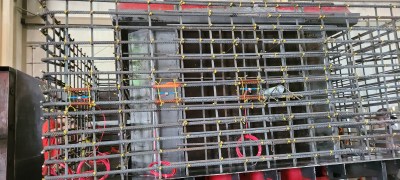
Much of the work will involve embedding strain gauges in the runway to monitor how loads affect the structure when the runway is in use. Credit: CLT press release

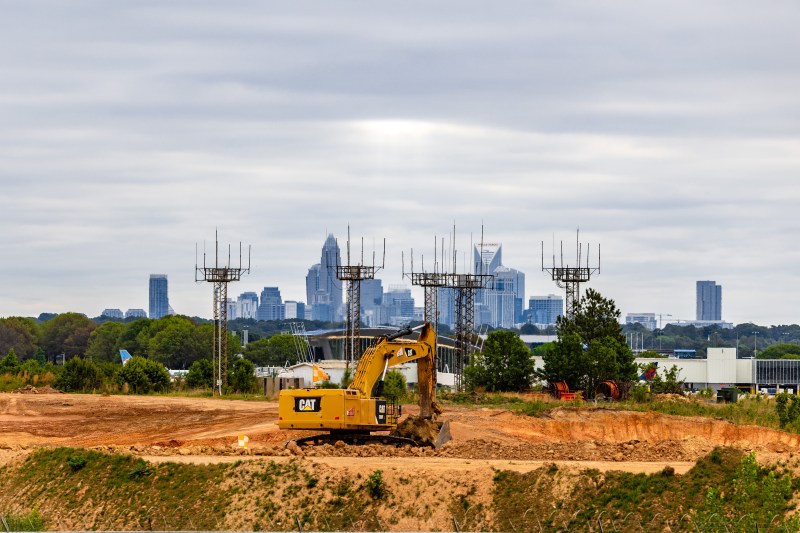
The airport’s major grand project of late has been the installation of its fourth parallel runway, with the official ground breaking taking place in June 2023. The hope is that the new 10,000 foot runway will add significant capacity for both arrivals and departures to keep the airport competitive while also adding resilience in difficult operational conditions. As the new runway is built, the existing runways have been renamed to 19R/1L, 19L/1R, and 18/36 respectively. The fourth runway will wear the designation 19C/1C.

The new Fourth Parallel Runway, as it is otherwise currently known, will be unique for its “smart runway” features. Unlike a smart fridge, smart oven, or smart bulb, it doesn’t just mean that the runway will have a pointless and annoying WiFi connection and dodgy smartphone app. Instead, it’s all about sensing and telemetry, which is intended to create a better understanding of the runway and its performance and state over time.

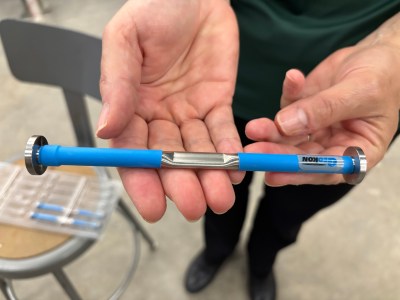
The strain gauges, seen here assembled on rebar, are to be embedded in the concrete itself, where they will provide the most useful readings. However, this does mean that the sensors will not be practical to maintain or repair over time. Their expected lifetime is approximately ten years. Credit: CLT press release

During construction, over 2,000 sensors will be installed in the 18-inch deep concrete being poured to lay out the Fourth Parallel Runway. The sensors in question will be used to measure everything from engineering basics like stress and strain, as well as tracking factors like moisture ingress, settlement, friction, and the presence of snow and ice.

The sensors are no different from those that have been deployed on highway bridges and interstates previously for similar purposes. However, this will mark the first time that a US runway has been similarly instrumented in such a way, such that the airport can create a “digital twin” of the runway.

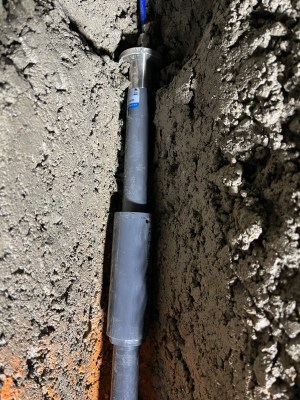
Jointmeters will also be installed in the runway to measure the behaviour of expansion joints in the runway. Credit: CLT press release

This is effectively a digital model that is fed by the sensor data and helps authorities determine the condition of the runway, both from an engineering and operational standpoint. Moisture, snow, and ice sensors can be used to guide the employment of deicing resources and what measures to take on the ground, while monitoring the stress and strain on the runway will guide maintenance decisions over the runway’s lifetime. The latter in particular will provide a very clear idea of how aircraft operations are impacting the very structure of the runway itself. The hope is that this data will be a boon for implementing predictive maintenance. In a busy airport, preventing a time-consuming runway shutdown with a little well-placed maintenance could save huge amounts of money by preventing or limiting the number of flight cancellations, to say nothing of the reduced frustrations for travellers passing through.

Of course, the problem with embedding sensors in 18 inches of concrete is that it’s not particularly easy to get at them for service or replacement purposes. The runway’s sensor system is slated for an expected life of 10 years, during which time data will be collected to better understand the runway and its performance and robustness over time. The hope is that by learning exactly what’s going on in the concrete itself, engineering lessons could be learned on how better to build runways in future. It could lead to new guidelines on concrete mixes, thickness, density, or other factors that influence how long the runway holds up under heavy use by commercial airlines. Despite the limited sensor lifetime, though, the runway itself is expected to last much longer, with the pavement itself slated for 30 to 40 years of use.

Embedding sensors into runways won’t always be a seen as a necessity. It’s perfectly possible to build a runway that doesn’t have telemetry, and just exists as a big old slab of concrete that takes a pounding from air traffic on the regular. However, where a greater understanding of the pavement is desirable, instrumentation can help. Time will tell if the lessons learned from the new CLT runway prove useful enough to justify the investment—but it’s easy to imagine that it would only take a couple of runway shutdowns to be avoided to pay for the $6.5 million project cost. Time will tell!

So You Want To Make Your SDR Work On Other Frequencies

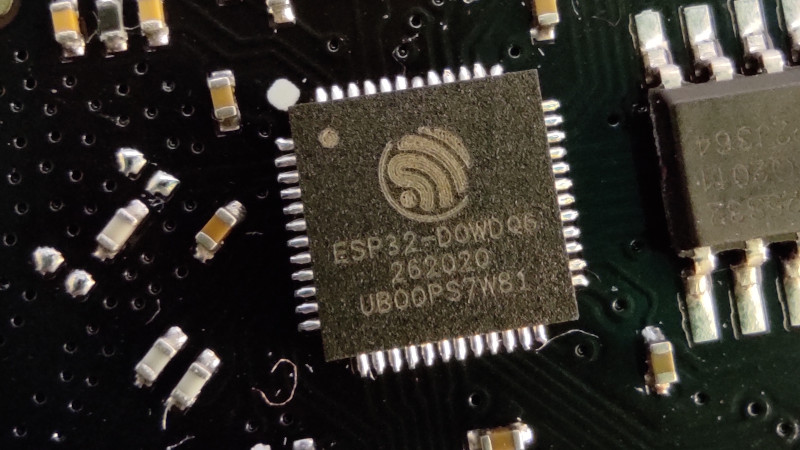
Perhaps the most exciting news of the past few weeks in the world of hardware hacking has been the unlocking of hidden SDR functionality in the Wi-Fi radios found on Espressif ESP32 microcontrollers. They can be used as both transmit and receive SDRs, and given that it’s early days for this hack we expect that great things are yet to come.

There’s one snag though, despite speculation that they might be dragged down to much lower frequencies, as far as we know they’re only proven to work around the Wi-Fi frequencies. Though the reality may be wider we’ll take that for a 2.4 GHz part as a 100 MHz slice from 2.4 GHz to 2.5 GHz. Plenty of possibilities there, and they might even work down to 1.8 GHz, but there would be so much more to do if it could work elsewhere in the spectrum. So it’s time to look at the converter, a tried and tested old way to make a radio work on a different frequency.

A Lesson From Analogue Receivers

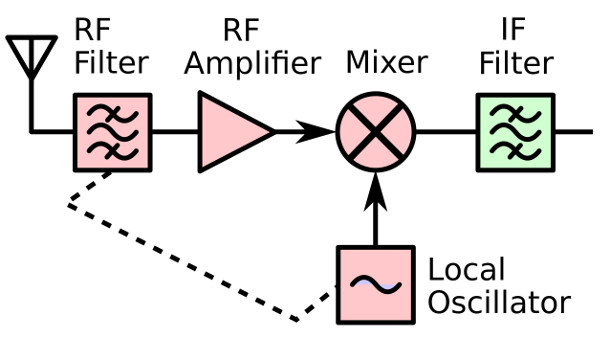
TV tuner front end block diagram. Derived from Chetvorno (Own work) [CC0], via Wikimedia Commons
TV tuner front end block diagram. Derived from Chetvorno (Own work) [CC0], via Wikimedia Commons.
I hope most of you will be familiar with what happens when you mix two frequencies; the resulting spectrum contains both their sum, and their difference. This was the mechanism behind the tuning dial on your analogue radio or TV, the dial moved an oscillator, and a sensitive circuit tuned to a so-called intermediate frequency would filter out the difference frequency between the oscillator and the station you wanted. A few years ago we had a deep dive into the UHF hackers playground of an analogue TV tuner, where we examined this in depth.

A converter uses exactly this principle. The antenna frequency range is mixed with the output of a fixed oscillator whose frequency is chosen so that their difference represents the frequency band of your radio. THus tuning your radio tunes across the output of your mixer, which is the same as tuning across the antenna frequency range. For a numerical example, if the ESP32 receives from 2.4 GHz to 2.5 GHz, a mixer on its input with a 2 GHz local oscillator would allow the ESP32’s receiver to pick up the 400 MHz to 500 MHz band. In practice the circuit requires filters for both input and output to keep out-of-band stuff from going where it shouldn’t, but it really is that simple. Best of all, with appropriate handling of power and amplification, it works for transmitters too, and such a device is called a transverter.

Towards An Achievable Receive Converter

To make a practical converter then, we need an input filter, a mixer, an output filter, and a local oscillator. The filters are often off-the-shelf parts and needn’t be too expensive, the mixer can be as simple as a fast Schottlky diode, and the local oscillator could even in this case be another ESP32, they’re that cheap. You can add amplifiers if you want and what I am about to describe is a somewhat janky receive converter, but it can be made to work.

The Filter

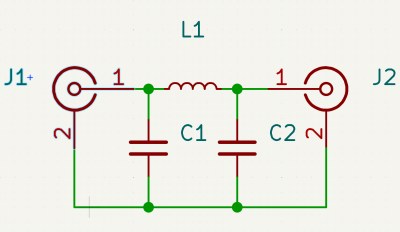
A very simple Pi network low pass filter

In most cases such a converter will be intended to receive signals lower than the ESSP32’s range, so let’s assume you’re looking somewhere from HF through to VHF. The input filter has to reject anything above your maximum input frequency and stop any stray local oscillator leakage to the antenna, which most of you will identify as a low-pass filter. These can be bought off the shelf for a price, but are easy enough to make for yourself.

The most common low pass filter is often referred to as a Pi network because its circuit superficially resembles a Greek letter Pi, and takes the form of an inductor in the signal path with a capacitor to ground either side of it. If you know your maths you can calculate the values for yourself, but if you don’t there are many online Pi network calculators to help you. Constructing a Pi network at these frequencies is straightforward enough.

For the output filter, you need something that rejects the local oscillator frequency as much as possible, and passes the ESP32 receive range. Here you’re in luck, because the Wi-Fi hardware industry needs exactly those filters, so they can be had from Mouser or Digi-Key for cheap. I’m not going to specify a particular part, but I’d like to point you at the TDK Wi-Fi filter range and invite you to pick one with the bandwidth you need.

The Local Oscillator

Your local oscillator for an ESP32 working at much lower frequencies is likely to be around or above 2 GHz. Back in the day you would have used a crystal oscillator and multiplier circuits, if you like you can buy an expensive PLL oscillator module, but your simplest and probably cheapest method is to use another ESP32, now that it can be used as an SDR transmitter. Program it to output a single carrier on your desired frequency, dial down the output level, and there you have it, a 2 GHz local oscillator for a dollar or two.

The Mixer

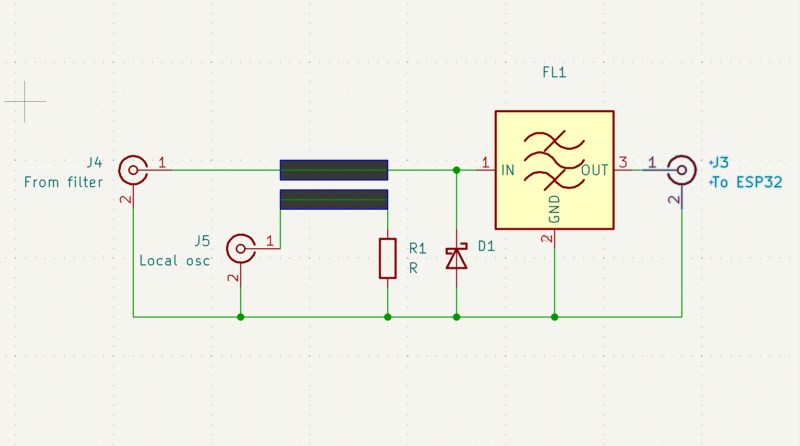
Yet again you can buy an off the shelf mixer as a module, though one for a 2.4 GHz output will be expensive. Happily there’s a simple circuit which can do the job, and it uses a diode as a non-linear element fed with both antenna and local oscillator signals. At these frequencies you are looking for a very fast small-signal Schottky diode with as low a capacitance as you can find, and happily such parts are available from multiple manufacturers at cent rather than dollar prices. The basic circuit is shown below, and as you can see it’s quite simple.

The circuit of a simple unbalanced diode mixer with a bandpass filter on its output.

In the circuit above the diode is your Schottky device, the input low pass filter isn’t shown, and the output filter is an off-the-shelf Wi-Fi bandpass filter. The two thick lines represent a stripline coupler, and they are simply two parallel PCB traces side by side over a groundplane. Their size should ideally be calculated to present the right impedance, often 50 ohms which is also the value of R1, but in practice the jankiest solutions can work here. With an ESP32 as a local oscillator I would hazard a guess that laying the trace on the PCB under the module’s antenna with the power turned down would be enough. I may earn the scorn of some of my peers, but I have a long history of RF bodging and I think it might just work.

Making It Transmit

The same technique as above works for shifting the ESP32’s transmit output down to the desired frequency, but there’s a catch. Even the modest output from an ESP32 can be enough to damage or overload parts designed for receivers, so you have two choices. Pick transmit-appropriate parts, or dial back the power to a low level, and amplify it at the lower frequency.

By Now, You Should Be Able To Bodge A Converter

The information above isn’t a ready-to-go design for a receive converter to get your ESP32 listening to lower frequencies, but it should give you all the signposts you need to get there. People have built converters for the RTL-SDR for ages now, so you could pilfer ideas there too. If you build a downconverter, for transmit or receive or both, let us know!

At a superconference about a decade ago there was a talk about RF construction techniques which will save you a lot of pain, and with luck such a simple circuit should be within your grasp. Good luck.

Pager Converted to Meshtastic Node

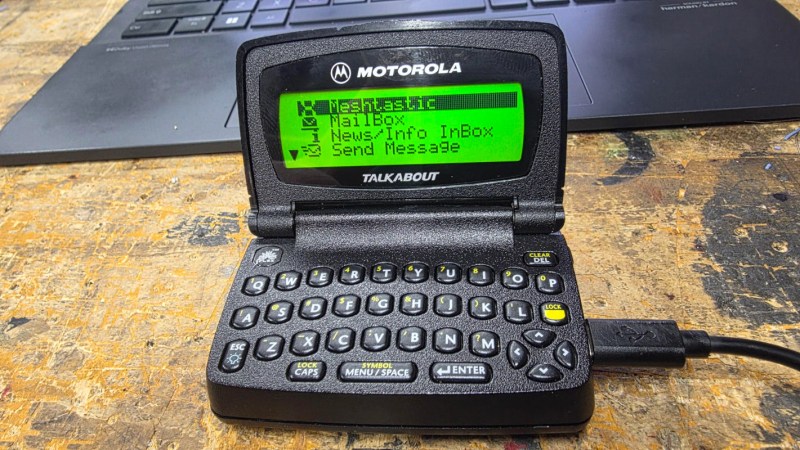
Text messaging has been around on cellular networks en masse for around three decades now. It’s so common that it’s difficult to remember a time without it. Its two-way quick messaging is incredibly useful, but for even simpler communications there’s a one-way system that predates it. Pagers are able to receive simple messages, but outside of hospitals are rarely used nowadays. Eventually some added in two-way communications like this Motorola T900, but they’re still mostly obsolete. That’s why [zindustries87] converted it to operate on the Meshtastic network instead.

To get this pager working, a lot of reverse engineering was needed. There is essentially no documentation on the chips in these devices, so the screen and keyboard both were reverse-engineered to work with other hardware. In this case, [zindustries87] found space for a Heltec V4 with an ESP32-S3, a popular Meshtastic node with a small form factor. Some programming was needed to get everything communicating together, but from the looks of things it seems to have basic functionality.

[zindustries87] points out that this is a prototype, and didn’t know going in if the keyboard and screen could be brought back to life, or if the other hardware would fit in the case. But with it working on this level, they plan to add a number of other features in and possibly build a drop-in PCB replacement for these devices. They were once fairly popular so there are plenty around, and they’re a good form factor for a dedicated Meshtastic device that doesn’t need a smartphone to work. The only other ways of bringing pagers back to life involve bootstrapping an entire pager network, and Meshtastic is a bit more useful than that now.

UW receives $12M gift from Taiwan-based chip company led by alumnus Arthur Chiao

The Paul G. Allen School of Computer Science & Engineering is part of the University of Washington’s College of Engineering. (GeekWire Photo / Kurt Schlosser)

The University of Washington’s College of Engineering has received a $12 million gift from a semiconductor company whose chairman earned a master’s degree from the school more than 45 years ago.

The donation is from Winbond Electronics Corporation America, a U.S. subsidiary of Taiwan-based Winbond Electronics Corp. Arthur Y.C. Chiao is Winbond’s chairman and CEO and has been with the company since 1987. He earned his master’s degree in electrical engineering from the UW in 1980.

The gift will create the Winbond Endowed Fund for Excellence in the College of Engineering to support student scholarships, faculty recruitment and retention, research and interdisciplinary collaboration.

“Arthur Chiao’s vision, leadership and lifelong commitment to the University of Washington make this gift especially meaningful,” Nancy Albritton, dean of the College of Engineering, said in a statement.

Chiao envisions the new fund “as a catalyst for breakthrough discoveries” that will allow the college to “pursue bold initiatives and respond to evolving opportunities in engineering, technology and fields of future strategic importance,” according to a UW release. That includes semiconductors, AI, quantum tech and advanced manufacturing.

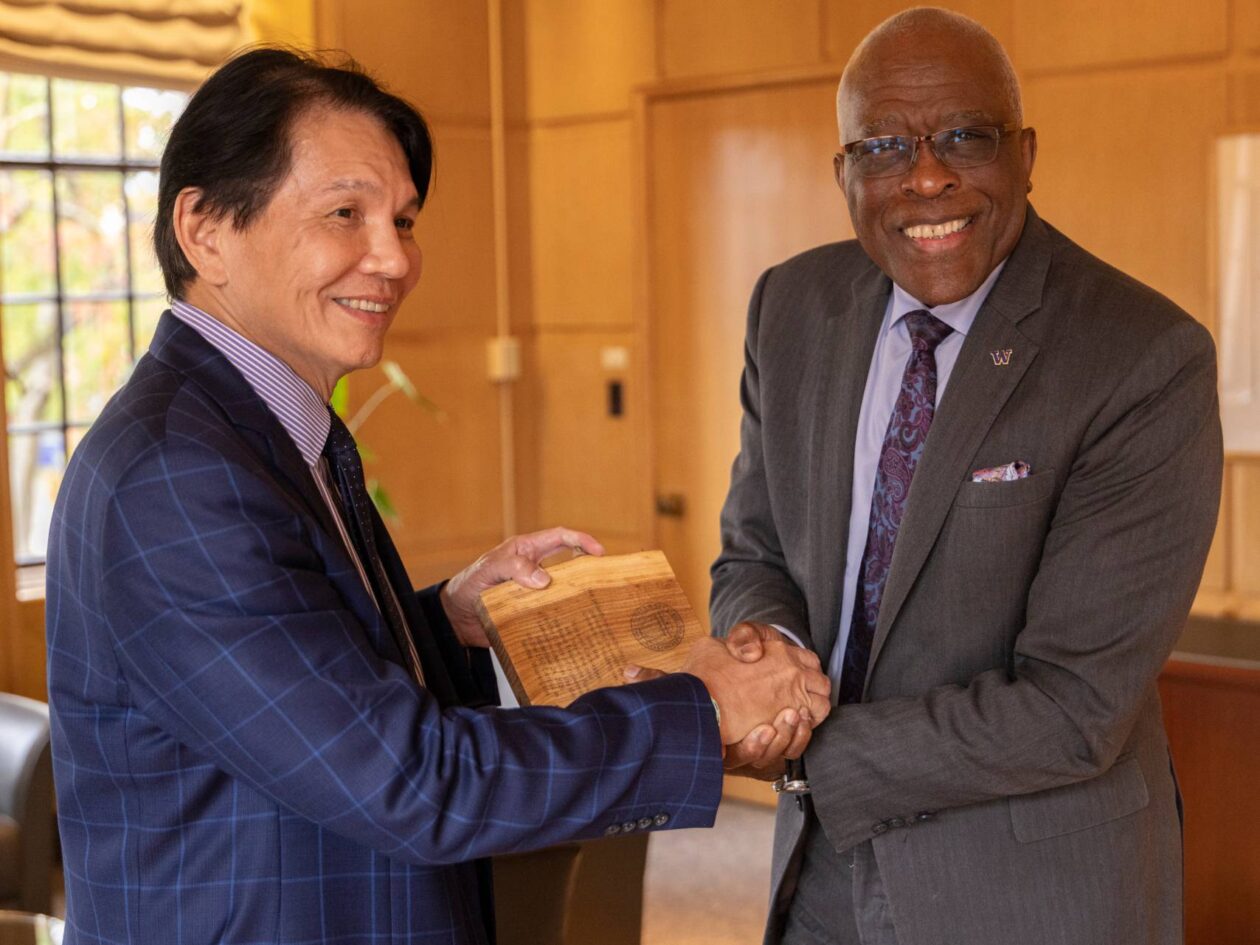
Taiwan-based semiconductor company Winbond is making a $12 million gift to the UW College of Engineering. Winbond President Pei-Ming Chen, left, and UW President Robert Jones celebrate at a September event in Seattle. (UW Photo)

The College of Engineering is among the UW’s largest colleges, enrolling 10,136 students last fall and employing a faculty of 350. The college says it is the fifth-largest producer of electrical and computer engineering graduates in the U.S.

“Seattle is a gateway to the Pacific Northwest of North America, and the University of Washington will play an important role in connecting future technology innovation between North America and East Asia,” Chiao said.

The gift comes amid a push to bring chipmaking closer to home. Taiwan is the global center of manufacturing for the most advanced semiconductor chips, and the United States has been working to reduce its dependence on East Asian chip production. In 2022, Congress passed the CHIPS and Science Act to incentivize domestic fabrication, R&D work and workforce training.

They war-gamed dimming the Sun. It went even worse than you think.

When it comes to deciding the fate of the planet, Colleen Golja always thought science and reason would have a seat at the table. That was until one morning last September in London, when the climate researcher took part in the first in a series of war games. The goal: to prevent an uncontrolled global race to develop a technology aimed at cooling the planet but that comes with vast, unknown risks that could reshape life on Earth.

“I thought that would be such an easy thing. Like, we can all agree to do ethical research and make sure it's for the better of all humans,” she told WIRED. “And boy, was I wrong.”

The simulation, titled Exploring Geopolitical Tipping Points and Climate Cooling Strategies, saw a couple dozen foreign-relations experts, scientists, military personnel, and former government officials from across the world convene in a meeting room at Queen Mary University of London. After making introductions over coffee and little yogurts, they sat at tables arranged in a square with the name of the country or organization each person was playing: national governments, climate NGOs and nonprofits, indigenous groups, and tech companies. Golja was assigned to provide technical advice to help participants make scientifically literate decisions.

Read full article

Comments

© Lisa Werner / Contributor

AI founders for hire: Startup hub Foundations launches service to connect businesses with builders

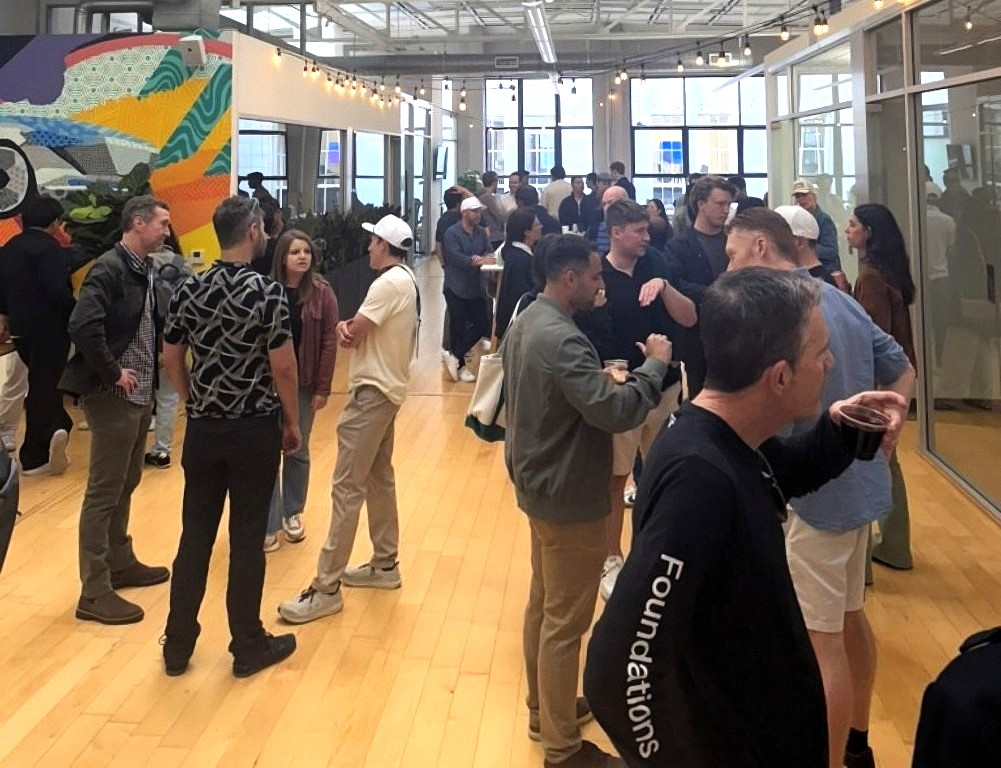
Founders and guests mingle at the opening of Foundations’ San Francisco hub earlier this year. (Foundations Photo)

Foundations, the startup community with hubs in Seattle and San Francisco, launched a service Tuesday that lets businesses contract with its members — many of them technical founders building companies of their own — to plan, develop and implement AI systems and applications.

The service, called Foundations Design and Engineering, is designed in part to give those founders a new way to pay their bills as early-stage investment gets harder to raise. It also reflects how AI is changing tech, making software easier to build and leading some startups to act more like services firms, customizing their work for individual customers.

“I think the world of traditional consulting and startups is just absolutely going to merge,” said Aviel Ginzburg, the Seattle venture capitalist who co-founded Foundations in 2024.

Except, in the case of Foundations Design and Engineering, the consulting won’t have the trappings of the traditional kind, he said. There is no staff of consultants and no billing by the hour. Work is priced by the project.

The pitch on the website: “Not consultants studying AI. Builders using it every day.”

The idea, he said, is to create something that “acts more like a router.” A request from a business might go to a member company already building a product in that area, a founder who knows the customer’s industry, or an early-stage founder looking for paid work.

Ginzburg said the work could have another benefit, giving founders a close look at the problems businesses are trying to solve, which can help them decide what to build.

The initials, FDE, are a play on “forward deployed engineer,” the term for engineers who embed with a customer to get technology working inside its business. Palantir popularized the role, and companies including OpenAI, Anthropic, Microsoft and Amazon have adopted it.

Some of the details have yet to be determined. For example, Foundations is still working out how much of each contract it will keep. Ginzburg said it will vary case by case, from nothing to a double-digit percentage. Also unsettled is whether a business will sign its contract with Foundations or directly with the founder doing the work.

Prices aren’t set. In terms of a starting point, Ginzburg said founders in the community have charged $1,000 to $2,000 to spend a couple of hours with a company’s team and as much as $5,000 for an audit of how a business could use AI, with larger projects varying widely.

Foundations Design and Engineering has its roots in a group of 10 founders who were already doing consulting work and helped put the offering together. Foundations opened the service to the rest of its members Tuesday morning. A veteran Seattle startup founder will run FTE part time at first. (Ginzburg said he wasn’t ready to announce who the person is.)

Foundations counts more than 300 founders in its community, including about 30 in its founder-in-residence program. It is a public benefit corporation, a legal structure for companies that aim to turn a profit while also serving a public purpose.

It doesn’t take equity in the startups that go through the residency program, and Ginzburg said the new service is meant to bring in revenue without pulling the organization away from its mission of making founders successful.

“This is a startup,” he said. “We’ll see how it goes, but it’s going to be fun.”

How UW’s solar vehicle team harnessed the sun and hard work to shine on the national stage

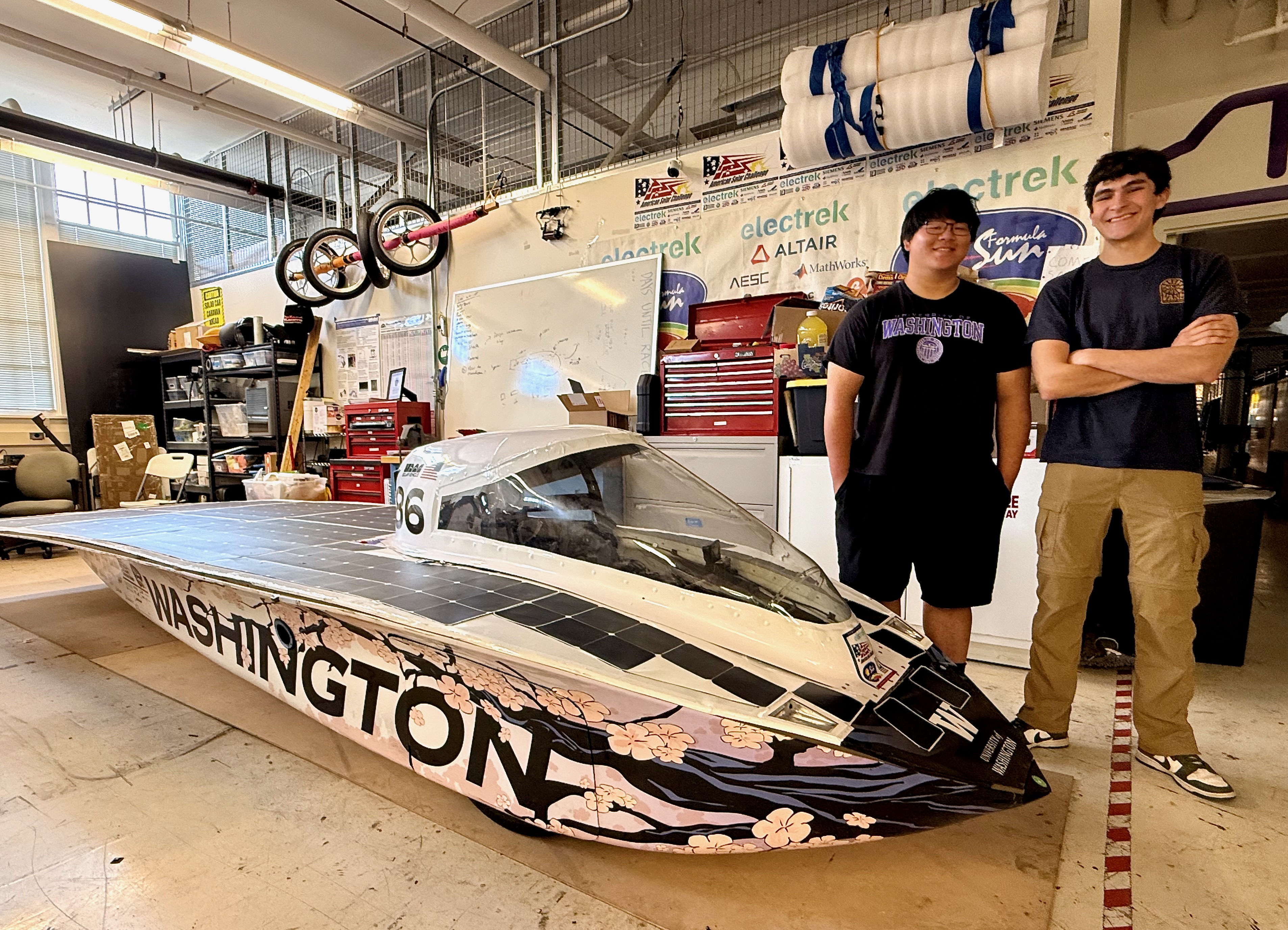
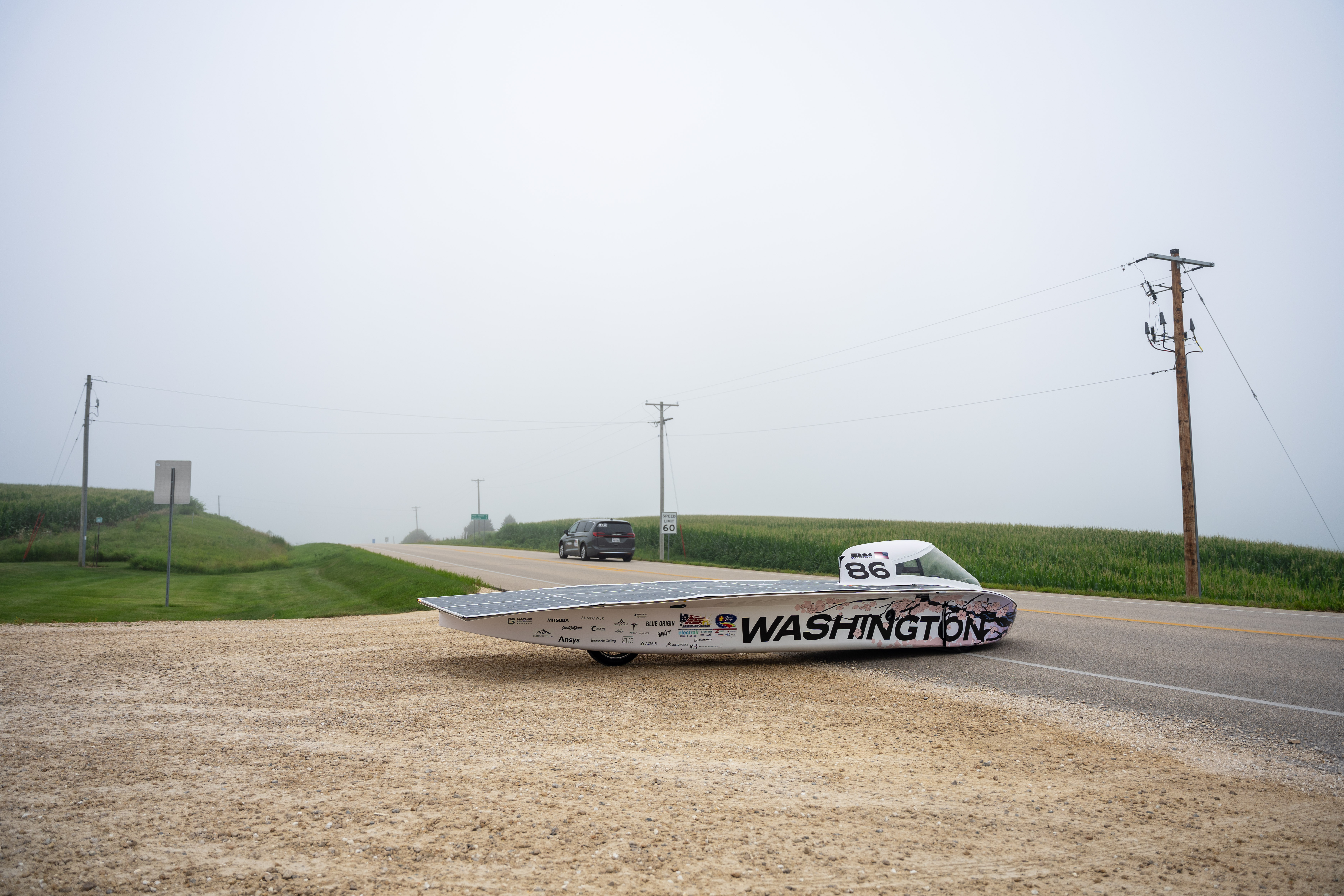
Elijah Yan, left, and Rudy Heredia-Jantz, members of the Solar Vehicle Team at UW, with Sakura, the solar-powered vehicle the student-led team constructed in their shop at the University of Washington. (GeekWire Photo / Kurt Schlosser)

In a cramped corner workspace in a mechanical engineering building at the University of Washington, a team of students is working to harness the power of the sun.

They operate on a fraction of the budget of elite international programs, fitting build hours around class schedules and other extracurriculars. Yet this summer, the scrappy crew took their handmade, solar-powered car — dubbed Sakura — out of the shop and onto the open road.

Over seven days in July and 1,778 miles from Minnesota to Texas, they outpaced nearly every competitor to finish fourth overall and cross the line as the top-ranking American team in the American Solar Challenge.

Now entering its fourth year, the Solar Vehicle Team at UW (SVTUW) is still a relative newcomer to collegiate solar racing. Officially affiliated with the university’s Mechanical Engineering Department, the roughly 50-person group has evolved into a broader interdisciplinary effort spanning electrical engineering, computer science, business, aerodynamics, and more.

The UW solar car merges onto a roadway in Lansing, Iowa, near where the movie “Field of Dreams” was made, during the American Solar Challenge race in July. (American Solar Challenge Photo / Rishi Mohan)

Operated entirely by undergrads, the club handles every aspect of the operation in-house — from sponsor outreach and logistics to hands-on fabrication.

While top international competitors rely on multi-million dollar budgets and years of development, the Huskies assembled their vehicle (named after the Japanese word for cherry blossom) in just 11 months — a lightning-fast turnaround for a machine built entirely from scratch.

For team president Rudy Heredia-Jantz, an electrical and computer engineering senior, even making it to the starting line felt like a triumph.

“Frankly, we have no idea [how we pulled it off],” Heredia-Jantz said. “This car — it was a little bit of a miracle. We did not have it up and running until the day before we left for competition. We didn’t even have it moving. We just spun the rear motor, threw it in the trailer, and figured we’ll blow something up eventually.”

Things did indeed blow up — 12 tires in total along the way — but the Huskies kept rolling. For a third-year program competing against seasoned international juggernauts, simply keeping the car on the road was an achievement; outpacing them was a statement.

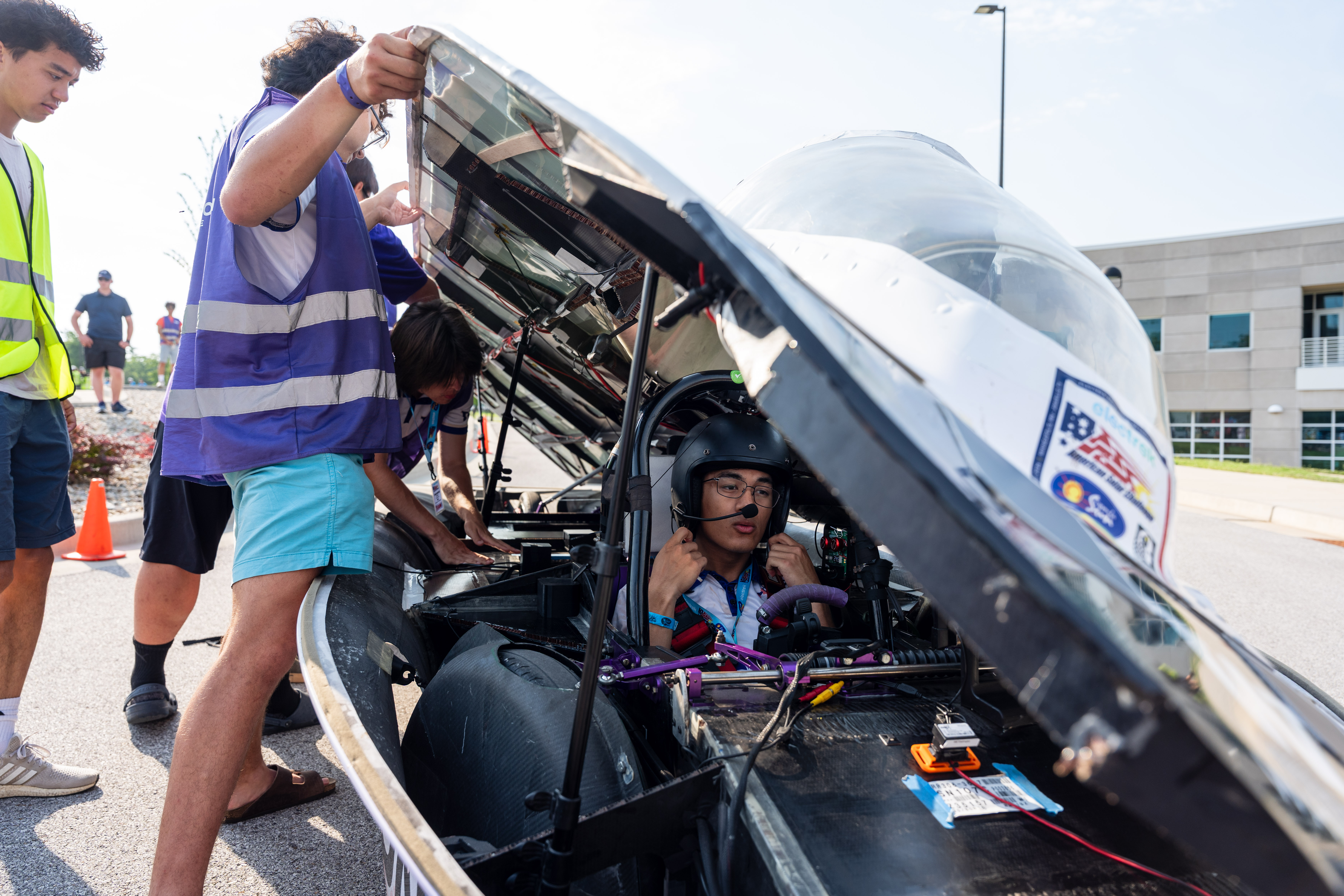
UW student Nikhil Garg, the 2025-2026 electrical lead for the solar vehicle team, is seen behind the wheel during the American Solar Challenge. (American Solar Challenge Photo / Rishi Mohan)

UW didn’t just survive the route to Texas — they blew past expectations for a young club, clinching the Aesthetics Award and Spirit of the Event Award alongside their top-four finish.

For second-year mechanical engineering student Elijah Yan, who serves as the team’s mechanical lead, the learning curve was immediate.

“Building a car is just not something I’ve done before, so it’s very new to me, and it’s super cool to learn that type of stuff — suspension stuff, how to do vehicle dynamics,” Yan said.

That hands-on engineering paid off when Sakura hit highway speeds on open pavement. Designed to maximize efficiency, the ultra-lightweight vehicle — weighing roughly 500 pounds with a driver inside — stretches 19 feet long to fit its array of solar panels while keeping its profile as narrow as possible.

Under the hood, Sakura is a blend of precision engineering and strict energy conservation:

  • Solar array: 386 Maxeon Gen 7 photovoltaic cells covering six square meters, producing up to 1,540 watts of max power output directly from sunlight.
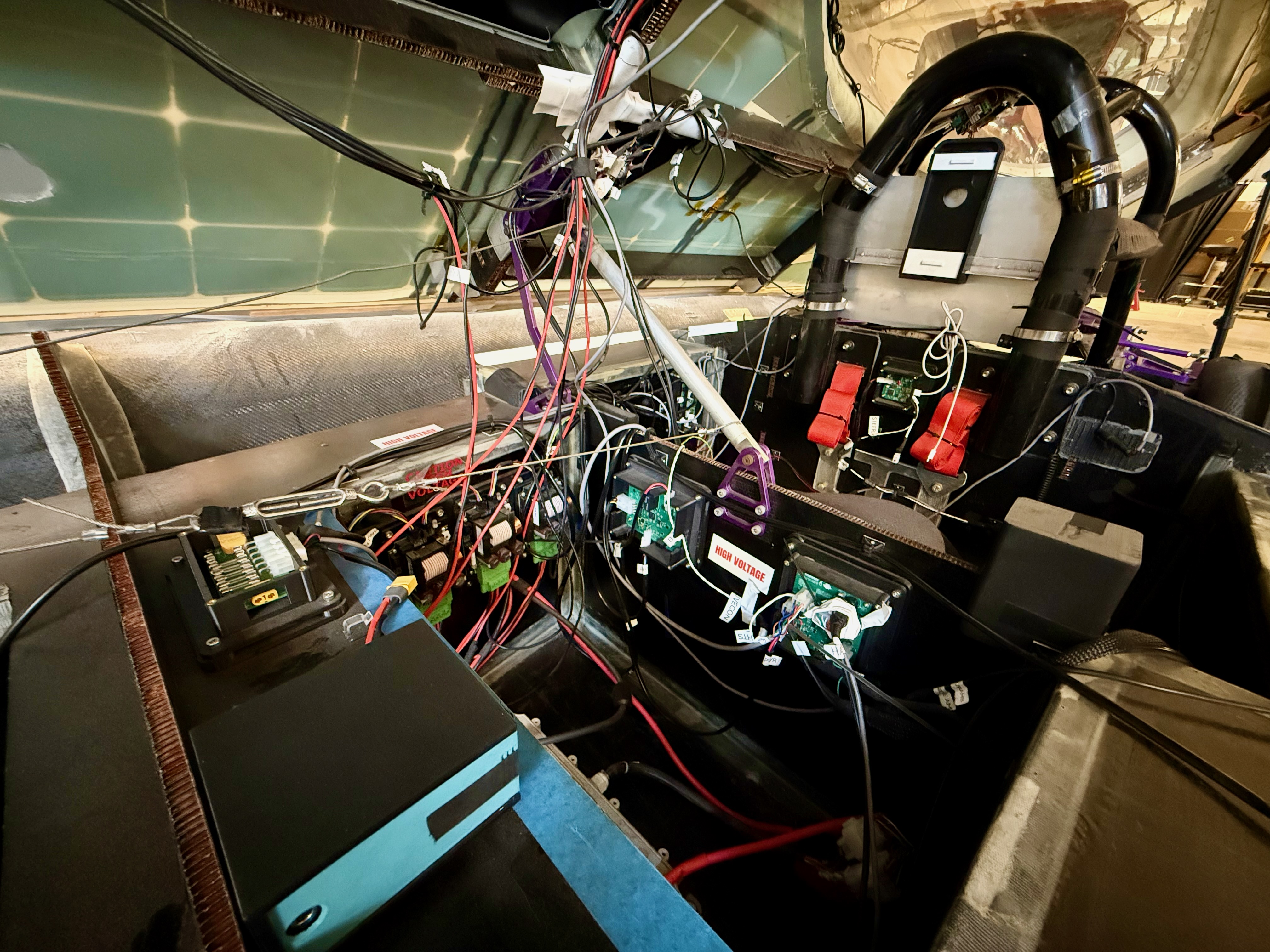
  • Battery pack: A student-built 5.125 kWh lithium-ion battery in a 36S9P cell configuration (121V nominal), supplemented by a secondary backup battery used solely for system startups.
  • Drivetrain and motor: Powered by a 2 kW Mitsuba 2096-III hub motor capable of pushing the 500-pound vehicle up to 65 mph on open highways.
  • Data and cockpit: A custom steering wheel equipped with push-to-talk comms, digital telemetry displays, and regenerative braking controls, paired with an onboard Samsung Galaxy smartphone that streams real-time battery and motor analytics back to the pit crew.
A look just behind the cockpit of the UW solar car. (GeekWire Photo / Kurt Schlosser)

To pull off a competitive build on a shoestring budget, the team combined its resourcefulness with local industry support. The vehicle’s lightweight frame, for instance, relies on carbon fiber sandwich panel flooring donated by Boeing, held together with specialized fiberglass tape.

“It’s the perks of being a Seattle-based team — we work with some amazing materials,” Heredia-Jantz said.

Yet even with aerospace-grade composites, bringing a prototype car across the finish line required plenty of improvised shop hustle.

“The car is held together with cardboard and duct tape, essentially,” Yan joked.

And managing the technical hardware on the road is as much a game of data processing as it is driving.

During the race, a dedicated strategy team monitors Sakura‘s health in real time. Using a custom dashboard that feeds off the onboard smartphone’s data stream, students track battery state-of-charge, individual array voltages, and motor temperatures from a trailing support vehicle.

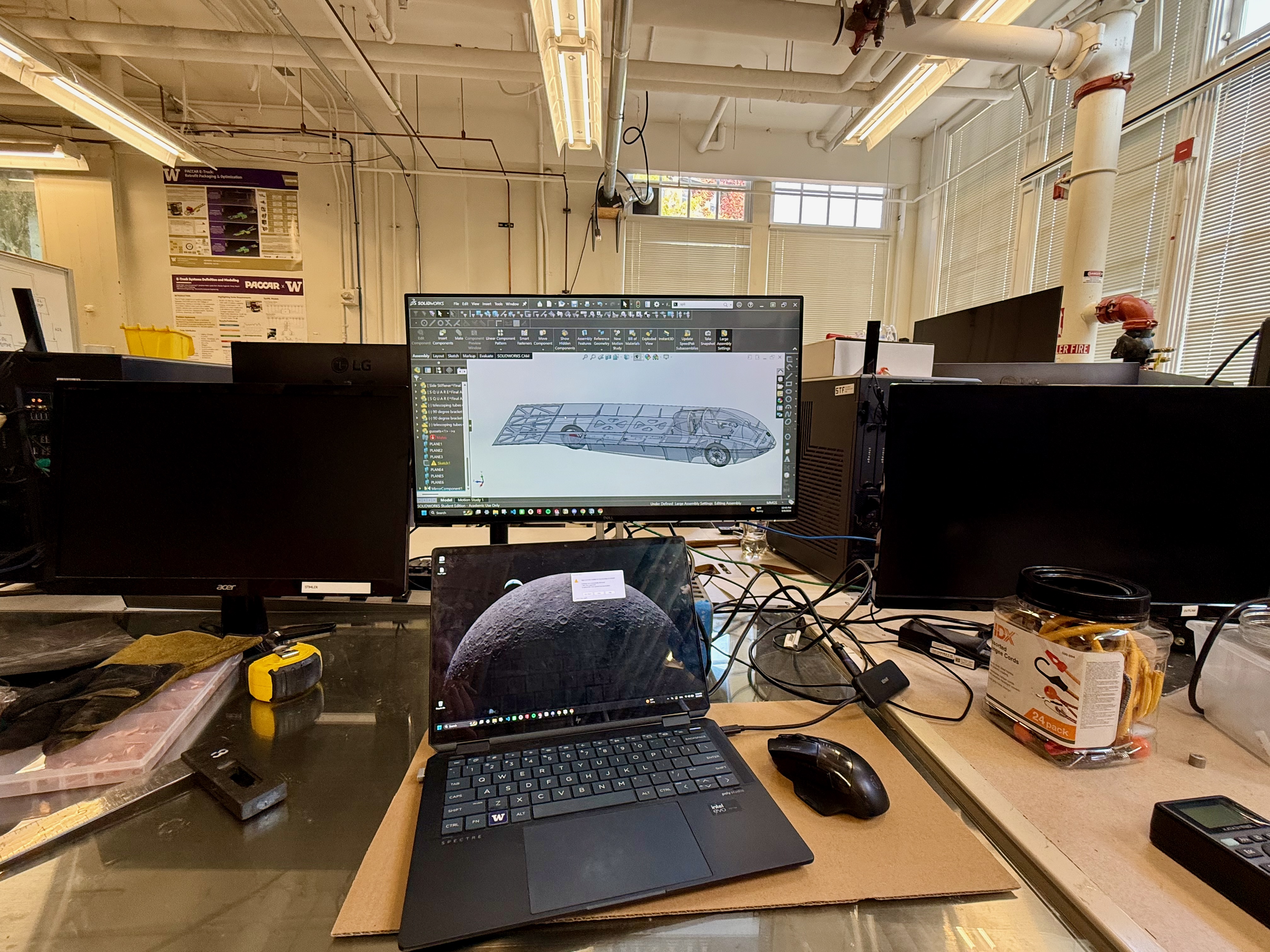
A mock-up of the UW’s solar car as seen on a computer in the team’s lab. (GeekWire Photo / Kurt Schlosser)

By pairing live telemetry with incoming weather forecasts, the crew calculates optimal cruise speeds on the fly — relaying instructions to the driver via walkie-talkie so they can balance energy consumption, leverage regenerative braking, and avoid tripping the battery’s protection systems on steep climbs or hard accelerations.

That real-time power management was also put to the test right before the cross-country journey, when the team competed in the Formula Sun Grand Prix — an annual three-day track race where cars run on a single initial charge and whatever sunlight they can harvest along the way. Despite navigating a track that pushed their power distribution system to its limits, the track time gave the team crucial baseline data and momentum before taking on the road race.

Now the club is already preparing for its next evolution. While repairing Sakura for upcoming competitions, students are designing their next-generation vehicle from scratch — overhauling power distribution, reinforcing the chassis, and building a new solar array.

For a club building sun-powered technology in a city known for grey skies, the project is ultimately driven by something deeper than weather.

“I believe this team is building something special in the early morning hours on UW’s campus: talent that shows up before sunrise, a refusal to wait for better resources before doing great work, and a stubbornness that looks a lot like faith,” said Caoilin Krathaus, the team’s administrative lead. “It reminds me of the story behind Boys in the Boat, and what I’ve always thought of as the true Husky experience.”

Goldman Sachs plants flag in Bellevue, opening hub for more than 125 AI and cloud engineers

Goldman Sachs CEO David Solomon

Goldman Sachs is expanding its technology presence in the Seattle region, opening a new Bellevue engineering center that will accommodate more than 125 employees focused on artificial intelligence and cloud transformation.

The New York-based financial giant held a ribbon-cutting ceremony this month for the new office, its first dedicated space for engineers in the Pacific Northwest.

The Bellevue location adds to Goldman Sachs’ existing presence in downtown Seattle, where the company has maintained an office since 2001 for its banking and wealth management divisions.

“We are in a period of rapid technological change, but we know our people are still this firm’s greatest asset,” Goldman Sachs Chairman and CEO David Solomon said in a statement. “Hiring exceptional talent is central to how we adapt and grow.”

Goldman Sachs employs more than 12,000 engineers globally, about one-quarter of its workforce. The company said the Bellevue office will give it access to the region’s deep pool of engineering talent and graduates from local universities.

The move also puts Goldman Sachs in the company of a growing list of financial and technology companies that have established engineering operations in the Seattle area. GeekWire maintains a list of nearly 150 engineering hubs in the Seattle region here.

JPMorgan Chase established its Seattle Tech Center in 2018 and has steadily expanded it. The engineering hub has grown to about 400 employees and is now anchoring a new AI infrastructure team focused on controlling how the bank runs AI across its own data centers and outside cloud providers.

Goldman Sachs said its new Bellevue location comes amid growth at other facilities in Dallas, Salt Lake City and Warsaw. Earlier this month, the company hired Dinesh Keswani — a former Microsoft and GoDaddy engineering leader — to co-lead its core engineering team alongside Gopi Parameswaran. Keswani will also serve as chief technology officer of The Core Engineering. 

❌