 Login
Login
The AI graveyard: a running list of projects and startups that didn’t make it
From Apple's repeatedly delayed Siri AI to OpenAI's messy "super app" launch, here's a look at the AI projects that shut down or missed expectations.

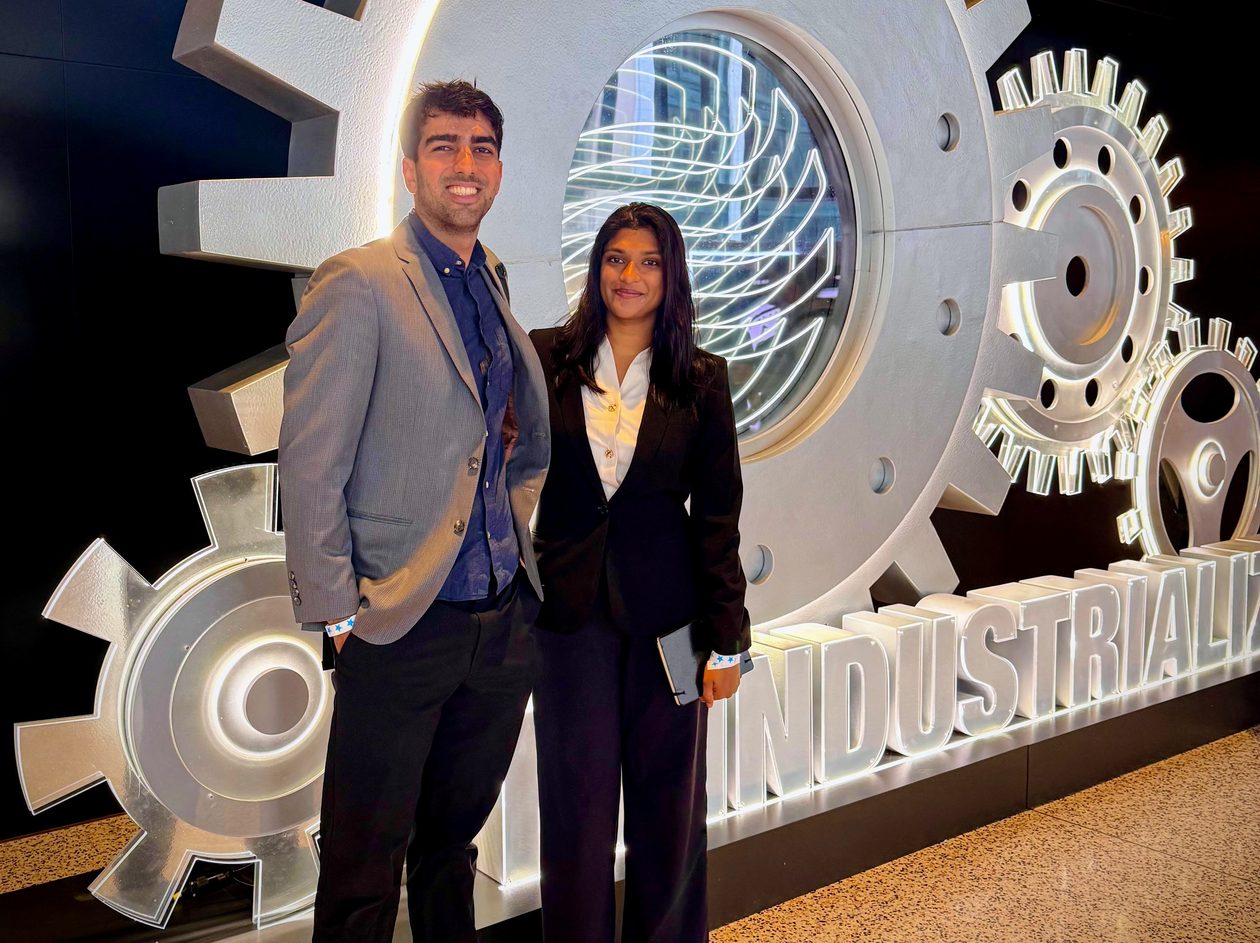
When machinists with decades of experience retire, everything they know about how metal behaves under a cutting tool — or anything else they learned through a career of scrapped parts and expensive mistakes — walks out the door with them.
A startup with roots in Seattle, started by two founders in their 20s, is building technology to capture that knowledge long before that point.
Neuramill, founded last year by CEO Nistha Mitra and COO Nick Khormaei, is developing what the company calls an intelligence layer for high-precision manufacturing.
The software reads a design file and figures out how the part should be made: which tools, which machines, and in what order. A machinist reviews and approves every plan before anything reaches the floor.
“This is a high-skill job, and nobody’s retaining this information,” Mitra said. When the machinists who know how to build complex jet engine parts retire, she said, that knowledge goes with them. “We help retain that for the future generation.”
Khormaei said the two founders spent much of the past year visiting machine shops to watch how the work gets done.
“The craft itself is so impressive,” he said. “They’re able to look at these drawings and models that come in and know exactly how to build it. It’s like they’re doing real-time physics simulation.”
Early customers and partners: The company says it has closed a six-figure contract with a major defense contractor, one of the companies known in the industry as primes. Neuramill declined to name the contractor.
Two of the machine shops using the software are Diamond Machine Works, a Seattle precision machining company founded in 1959, and VTN Manufacturing in San Jose, Calif. Satellite maker Astranis is a design partner.
Mitra said the company is not yet selling broadly, but has been paid by some of the early customers testing the software.
How they got here: Mitra, 26, has a computer science degree from the University of Maryland and spent three years at Oracle, most recently as an AI applied scientist in Seattle, working on multimodal models that reason across several kinds of data at once.
Khormaei, 24, holds bachelor’s and master’s degrees in electrical engineering from the University of Washington. He was a propulsion engineer at Boeing in Everett, where he worked on 777X fuel system electrical certification, and then spent part of last year at SpaceX as an integration and test engineer on Starlink manufacturing in Redmond.
He also grew up around machining. His father, Ron Khormaei, co-founded FINEX Cast Iron Cookware in Portland in 2012 and sold it to Lodge in 2019. Khormaei worked production there as a teenager.
Where the software fits in: Neuramill’s technology works at a stage that has stayed largely manual: after the design file arrives, and before a programmer opens the computer-aided manufacturing (CAM) software that translates decisions into machine instructions.
Rather than position the company against Siemens and Mastercam, Mitra said Neuramill plugs into those systems. The company recently joined Siemens’ Frontier Partner Program, which gives startups access to the company’s software tools.
“At this point we are very collaborative with these companies,” she said, adding that the established vendors are looking for new technology of their own.
Bay Area and Seattle: Both founders worked in the Seattle region before leaving for San Francisco, a move Mitra described to GeekWire in February. They are back every four or five weeks now, working out of Foundations, the Seattle founder hub.
“We love this ecosystem. It gave birth to Neuramill,” Mitra said. They keep coming back in part for the customers: “This is a booming ecosystem in space and in aerospace.”
Funding and team: Neuramill has raised an undisclosed amount from Ascend, Breakwater Ventures, Schema Ventures, Creative Destruction Lab, Acequia Capital and Correlation Ventures.
The team is six people plus a contractor: the two founders, a chief research scientist who worked with Mitra at Oracle, and three engineers, one of them a machinist.
What’s next: The long-term goal, Mitra said, is a “world model” for manufacturing: a system that can reason across geometry, materials and machine behavior at any level of complexity. Even then, she sees a role for the people on the shop floor.
“There is a beauty to the craft of manufacturing that we should really respect,” she said. “There are some places where humans should not be extracted out of an industry, and I think manufacturing is one of them.”

Jeff Kohler was working as a software engineer in 2005 when he started spending his nights and weekends on a side project: a web conferencing system that could record and replay live sessions. He filed for a patent without the help of a patent attorney, stuffing two CDs full of C++ source code into the application to show his work.
The patent was issued in 2010, and years later, after Kohler had joined Microsoft, the Redmond company licensed his technology for its Teams video-conferencing platform.
When YouTube later added the ability for viewers to pause, rewind, and change the playback speed of live video, Kohler saw in the feature what he considered to be his own invention. Kohler, who lives in Bellevue, Wash., sued Google for patent infringement in U.S. District Court in Seattle in April 2023.
But rather than defending the feature’s originality, Google argued that Kohler’s patent was too abstract to be eligible for patent protection. The district court agreed and dismissed the case, and the U.S. Court of Appeals for the Federal Circuit affirmed that decision.
Both decisions cited Alice Corp. v. CLS Bank International, a 2014 U.S. Supreme Court ruling that raised the bar for software patent eligibility by holding that an inventor cannot patent an “abstract idea” implemented with generic technology.
Since then, Alice has been used to invalidate thousands of software patents, and the Supreme Court has repeatedly declined to revisit the standard. Now, Kohler is asking the Supreme Court to take up his case, not to overturn Alice, but to clarify how courts should apply it.
“The patent legal system has become hostile to inventors,” Kohler said. “Because of Alice, my case got stopped before it even started.”
When Alice was handed down, patent trolls were on the rise: shadowy entities that bought vague patents to sue tech companies on shaky claims of patent infringement.
That changed under the 2014 ruling, which requires that a patent clear two hurdles: the idea cannot be “abstract,” and it must propose a sufficiently “inventive concept.” The standard has become “a crucial tool” for fighting patent trolls, in the words of the Electronic Frontier Foundation.
But critics say it’s ill-suited to software patents. Because software inventions often rely on pre-existing hardware to run the source code, courts tend to find many of these patents to be insufficiently inventive.
Jon McMichael, an IP lawyer who has written about Kohler’s case, said this challenge is common in patents where inventors rely on general-purpose computers and off-the-shelf hardware to implement their ideas.
“That’s where those patent holders run into more problems,” he said.
Experts say the courts’ application of Alice has broadened to invalidate the patents of real inventors in addition to those of patent trolls. Toshiko Takenaka, a University of Washington IP law professor who is working on an academic paper about Kohler’s case, said Alice’s ability to quickly defeat bad actors comes “at the expense of the best inventors.”
“Software patents are too frequently being invalidated without giving the owner the opportunity to defend it,” Takenaka said. “This inventor provided something ordinary computers could not do, right? So therefore, in my view, this is an eligible invention.”
Some judges have raised similar concerns, including Federal Circuit Chief Judge Kimberly Moore, who authored the opinion affirming the dismissal of Kohler’s case. In a 2020 concurrence in a separate case, Moore wrote that she and her fellow judges were “unanimous in our unprecedented plea for guidance” from the Supreme Court on how to interpret Alice, which she called a “patent-killing judicial exception of our own creation.”
After filing his patent, Kohler spent more than 15 years at Microsoft, where he helped launch HoloLens and rose to senior director of product management for the Surface line. He later served as a product leader at Meta for its Horizon platform.
Kohler says he’s hopeful the Supreme Court will agree to hear his case because his petition takes a new approach, asking the court to clarify how to apply the Alice test rather than disputing the test entirely. His new attorney, Kathryn Jean Miller, who does not have prior patent law experience, was admitted to practice before the Supreme Court bar for this case.
“It’s me and my lawyer against the world,” Kohler said. “I never thought I would be doing something like this.”
The Supreme Court has declined more than 89 petitions related to Alice, some of which had the Solicitor General’s endorsement. The justices will decide on Sept. 28 whether to hear Kohler’s case and likely announce their decision the following week.
Kohler is hoping that other inventors will file amicus briefs, which are due by Sept. 23, to illustrate to the court the need for clarification.
“There’s a broad coalition of people who would like some sanity brought back to patent law, from small inventors and startups to former judges,” Kohler said. “That’s what I’m trying to do with my petition.”
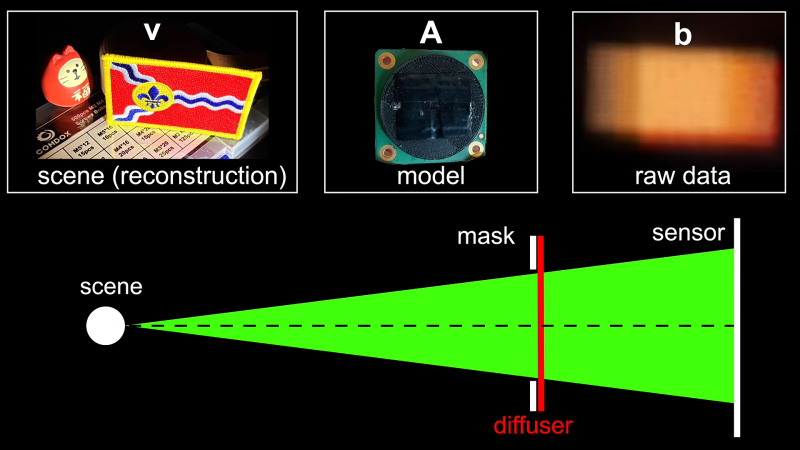
There are plenty of ways to capture 3D images or simulations of such if you know what you’re doing with camera hardware and fancy mathematics. However, a little more unusual is the idea of capturing a 3D image while using no lens at all — and yet, [okooptics] has achieved just that!
The basic concept builds on an older project from [okooptics], wherein images were captured from a Raspberry Pi camera with no regular lens element installed. In its place was a thin layer of Scotch tape over the sensor, acting as a diffuser. With the right deconvolution math, it’s possible to actually recover a real image out of the blurry mess this setup initially captures. [okooptics] was then able to push this into three dimensions by weighting the point spread function used to deconvolute the image.
Adding directional bias to the process creates a similar effect to slightly shifting the cameras position, actually revealing a view from a slightly different angle of objects in front of the camera. [okooptics] does a great job of explaining the science behind how this is possible and the practical limitations of the technique, also referencing research papers that have explored these ideas in great depth.
It’s math heavy to extract 3D data from what otherwise looks like blurry nothingness, but it’s possible if you know what you’re doing. For a fuller understanding, it’s worth diving into [okooptics] earlier work in this realm, taking photos with Scotch tape in place of a lens.
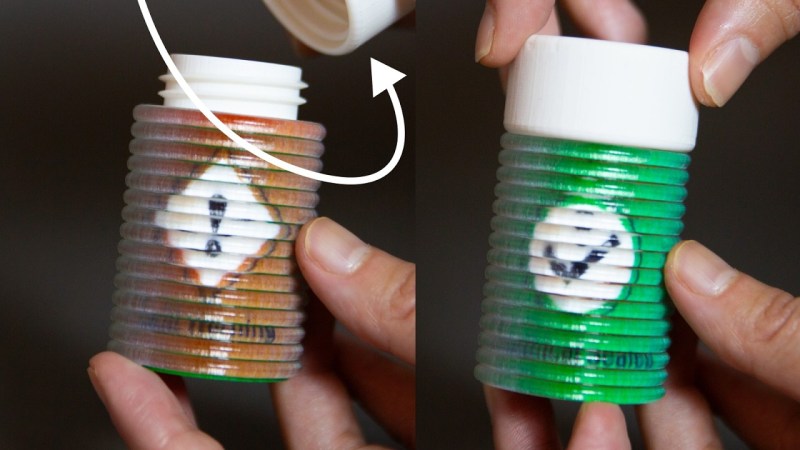
You can 3D print all kinds of things, from Yoda heads to little models of Pikachu. Eventually, though, most of us get to a point where we want to print something a little more interesting. The lenticular prints developed by MIT CSAIL are very much that. (h/t Core77).
The ShiftLens concept is simple enough—there’s a lens layer printed in transparent material. Beneath that, lives a patterned layer in alternating colors, corresponding with the linear lenses of the layer above. Then, there’s an actuation mechanism that can shift the lens layer relative to the pattern layer. This creates a changing color effect as the mechanism is shifted. The actuation mechanism can be a knob, switch, or roller—anything that moves the layers relative to each other. On its own, it’s a bit of a curio—but there are some fun demos. In particular, using the lenticular printing on a bottle to form an indicator for when the container is closed properly. There isn’t a publicly available design tool for these prints yet, though the team developed one for Rhino that they used internally for the project.
It’s a pretty interesting application of 3D printing, and one that we fully expect a bunch of YouTubers to replicate within the month. We’ve featured some other great print hacks lately, too, like a slicer that lets you print horizontal overhangs without support. Video after the break.
[Thanks to Paul for the tip!]

Resect AI, an artificial intelligence startup led by a team of scientists and engineers in Washougal, Wash., launched out of stealth Thursday with $25 million in funding to commercialize an open-source technology designed to catch AI hallucinations before they happen.
Unlike traditional AI monitoring tools that evaluate generated text after the fact, Resect AI says its patented technology operates in-stream — looking deep inside large language models in real time to observe, detect, interpret, and modify model behavior before a hallucination can occur.
By intervening directly within the model’s internal decision-making process rather than running post-hoc checks, the platform stops fabrications at the source while simultaneously generating an audit trail for enterprise compliance and due diligence.
“AI has prematurely been put in a position of trust. Adding labels such as ‘use at your own risk’ flies in the face of proper governance or compliance,” Kevin Owens, co-founder and CEO of Resect AI, said in a news release. “We are building the next large enterprise AI company to bring transparency and accountability to AI for industries such as publishing, finance, healthcare, research, and education where factual accuracy is absolutely critical.”
Beyond its tech, the startup’s leadership is also bullish about its small-town presence.
Washougal is a city of roughly 18,000 residents, 175 miles south of Seattle, tucked along the Columbia River across from Portland. Resect AI employs four people at an office on Main Street — including its co-founders — out of a 30-person workforce spread across the Seattle area, California, New York, and Texas.
“We believe the talent is up to par and we loved the sense of community that we found when we first came up here,” Owens told GeekWire. “We have been coming to the greater Washington and Oregon areas on and off over the years and finally decided this needed to be our headquarters.”
Owens said the decision has already paid off, noting that the startup has quickly tapped into the region’s talent pool by recruiting PhDs from both the greater Seattle and Portland markets while connecting with Northwest capital markets leaders.
Resect AI is also planning to open an office in the Seattle area in the near future for engineering and to serve as a business hub.
Alongside Owens, Resect’s other co-founders include Tim Walton, chief artificial intelligence officer; Tyler Gerber, chief operating officer; and Tommy Lofgren, chief product and marketing officer.
The company plans to use the funding to accelerate research and development, expand its go-to-market initiatives, and fuel talent acquisition — bringing its total headcount to 50 by the end of 2026.

