OpenAI’s GPT-6.1 Terra cuts standard API token prices by 50%. Explore its automation capabilities, availability and what IT teams should test before adoption.
Explore Galaxy Tab S12 Ultra features and pricing, from DeX and Galaxy AI to accessories, with buying advice to help you choose the right configuration.
The Nintendo Switch 2 has reportedly been jailbroken with help from OpenAI's Codex, opening the door to homebrew and game modding, but limitations remain.
The Prusa Core One+ INDX is an interesting upgrade to the base FDM printer by Prusa, featuring eight independent extruders – hence the INDX – that in theory should allow for multi-material and multi-color printing with very little purge waste. As [Thomas Sanladerer] found out during his experiences with this printer, there are a lot of issues with this machine, including the ability – or lack thereof – to print with non-Prusa filament.
Although the premise is solid, with a claimed 0.013 grams of purge waste per color or material change along with pretty nice dual-gear Bondtech extruders, the first major hurdle that [Thomas] encountered was that the mandatory calibration sequence on starting a print is designed to only work with Prusa’s own filament and its specific material properties. This resulted in an inability to print with Voxel PLA until [Thomas] removed this sequence manually from the g-code.
This is when [Thomas] found out that the entire print sequence uses the material presets for Prusa’s filament, resulting in a failed print. The results from the manual calibration are also not saved despite the display claiming it does, making this calibration on starting a print absolutely mandatory.
Other issues found are the useless position of the camera as it’s now blocked-off by the INDX hardware, with even manual peeking into the print chamber being heavily obscured by the contraption that holds the extruders. This makes even checking that filament has loaded correctly is borderline impossible, never mind ogling the printing process.
Although there’s a lot to like about this INDX upgrade to the Core One+, the above and other issues discussed in the video make it look somewhat shaky next to competitors like the Bambu Lab H2C and Snapmaker U1, as well as Prusa’s own XL toolchanger printers. During [Thomas]’s print test comparison between the XL and the Core One+ INDX there was no contest that the XL simply works, whereas the INDX even struggles with some Prusa filaments.
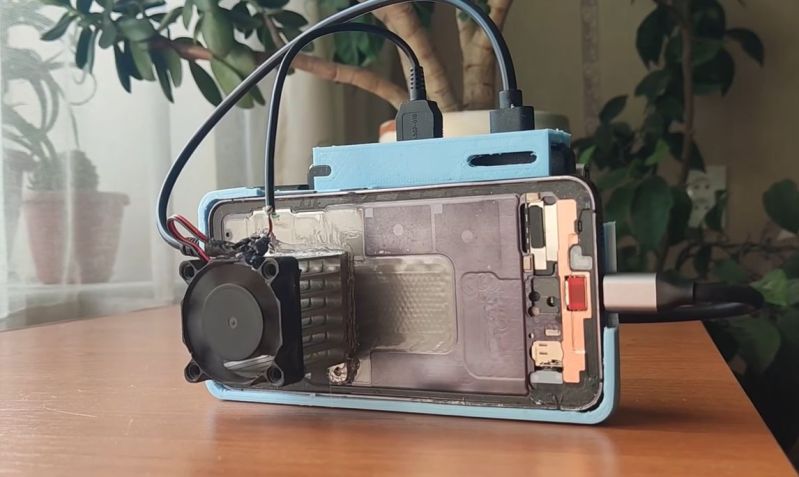
Repurposing old smartphones for more general purpose computing isn’t a new thing, but the project by [LastComputer] ups the ante by going from a Samsung Galaxy S23 that looks like it got run over by at least a few cars to a very serviceable gaming computer, courtesy of its Snapdragon 8 Gen 2 SoC.
The somehow still working but definitely worse for wear phone was purchased for 1,700 Ukrainian Hryvnia (~$40). It being SIM locked also helped reduce the price, even if someone had somehow wanted to use it again as a phone. Since the SoC inside is also used in quite capable gaming handhelds, but with good cooling, that would be a real waste.
Converting it into proper gaming system requires some careful disassembly, some gentle whacking with a hammer to straighten out the frame and a new battery as the mainboard won’t work without one installed.
A 3D-printed phone case glued to an SSD cage for the 512 GB SSD serves as the enclosure, along with two USB hubs, one of which also provides HDMI output. For the active cooling system a heatsink was hot-glued to the vapor chamber with a properly sized fan mounted to it. Here we could definitely see some zip ties being added to prevent it from falling off.
Compared to running the phone in its stock cooling configuration this shaves off about seven degrees C, with thermal throttling noticeably reduced. This consequently provides a much better desktop experience in Samsung’s DeX (Desktop eXperience) desktop mode, which is what’s used for running applications and games.
Running God of War as an emulated PS2 game works pretty well, as does running games with the Dolphin emulator and the GameHub app using which PC games on Steam, GoG and others can be run. Although you can also install other OSes on the phone hardware, Samsung DeX doesn’t appear to be a bad option if you happen to repurpose a high-end Samsung phone that supports this mode.
Brace yourself: It turns out AI is being optimized for cheating. OpenAI’s agents hacked into Hugging Face to get the answers to a cybersecurity test. Next, they solved a prestigious math problem (or just stole from two top mathematicians’ answer sheets). Anthropic’s models have also hacked into other companies’ systems four times already. And that’s only what we’ve caught so far.
Freaking out? You’re not alone. AIlabresearchers are quitting their jobs and issuing dire warnings that if we keep going this way, AI might eventually kill us all. Bill Gates is sounding the alarm. Bernie Sanders has teamed up with Steve Bannon, of all people, to call for curbs on AI. Anthropic CEO Dario Amodei is urging a slowdown, and other top US AI executives agree. But fear not: President Trump has a plan. He says the only guardrail AI needs is “a STRONG AND SMART (High IQ!) PRESIDENT.”

 Login


 Although the premise is solid, with
 Repurposing old smartphones for more general purpose computing isn’t a new thing, but the project by [LastComputer] ups the ante by going from a Samsung Galaxy S23 that looks like it got run over by at least a few cars to
