As any science YouTuber or first-year physics student is quick to point out, the universe is mostly empty space. Not just space itself, but the amount of “empty” space between nuclei and their electrons is also huge. Getting rid of this empty space results in all kinds of interesting phenomena like degenerate matter and black holes. But the concept can be extrapolated into our daily lives as well; many things are so filled with air that we can get a lot more usable storage space by compressing them down a little bit. [Super Valid Designs] took this concept to a coat closet, building one that can hold an impressive number of coats.
He started by looking at an existing closet, which could hold around 21 coats but only if someone used two hands to cram the coats into the space. After a trip to a store which sells rugs, he saw a much better design that lets all the rugs pivot like the pages on a book, and took this idea to his closet using a similar mechanism designed for storing large blueprints instead of rugs. The closet he built around this mechanism has two hinged doors which allow a person easy access to the coats, and when opened the blueprint hangers pivot out like a book, allowing the coats to not only be easily accessed without disrupting the other coats, but also allow them to be compressed down by the closet door for storage.
For comparison, the original closet could only hold 10 coats when restricted to single-hand operation and 21 when using both. The new closet design is smaller, and can hold 24 coats with a single hand and over 30 when using both, a dramatic improvement of closet efficiency. To top it off, a set of cupboards on top and bottom allow for storing shoes and hats as well, and there’s even a garage for a robotic vacuum cleaner. Surprisingly, we don’t see many closet optimization builds around here. The closest we can come is another traditionally small space, a college dorm.
If you’re like me, you have a bunch of files, folders, and items in your office that make it unorganized and cluttered. Over time, these become increasingly overwhelming, and you forget what’s in each file or folder or which cable goes to which monitor or port.
Meta took days to remove ads containing AI-generated child sexual abuse material (CSAM) on Facebook and Instagram. Some ads featured photos of real kids, including a press photo of a young member of a European royal family and images swiped from a popular Instagram profile of a preteen girl deemed an influencer.
In an investigation published Tuesday, the Tech Transparency Project (TTP) reported that Meta failed to detect 332 ads containing CSAM this year. The “vast majority” of ads promoted AI apps made in China, while many ads promoted so-called “nudify” apps that make it easy for bad actors to use AI and digitally alter images of children.
TTP matched “multiple CSAM ads to photos of real children that appeared online.” These ads seem to violate federal child pornography laws, since the Justice Department has clarified that AI CSAM is just as harmful as CSAM. The young royal’s image was “animated into a video of her performing a graphic sex act,” TTP found. Other ads animated a photo of a 14-year-old Instagram influencer “showing off her new sports club uniform” into “a video of her performing oral sex.” A third “preteen” victim “posing in a pink athletic outfit with pigtails” in a series of stock photos was morphed into a video where she looks frightened as she’s molested by an adult male, TTP reported.
Netbooks were a class of tiny laptops which hit their peak over a decade ago, with the idea being that you could use the Internet and do your computing on the move with ease. Unfortunately manufacturers were scared of them eating their profits from bigger computers, and they were invariably built to a very disappointing spec. That doesn’t lessen the appeal of small form factor laptops though, and [bob-foss] is here with a simple hack to make one.
He’s taken a hinged keyboard case made for one of the previous generations of iPad Mini, and paired it with a high-end Lenovo gaming tablet by way of a 3D printed replacement for the original Apple-grabber. We said it was a simple hack and it is, but it’s no less elegant for that as the detail is what matters. This isn’t a mess-of-wires cyberdeck, instead it’s a machine you could pull out on a train and get some work done.
Teachally founder Daniel Bernstein is also known in Seattle tech as the founder of Sandlot Games.
Daniel Bernstein spent much of the past decade as an M&A advisor, selling other people’s software companies. This time the company was his own, and he found a buyer in McGraw Hill.
The education publishing giant on Wednesday announced the acquisition of Teachally, a small startup led by Bernstein in Bothell, Wash., that uses AI to help teachers build and customize lessons, assignments and assessments aligned to state standards.
Financial terms weren’t disclosed. The deal has closed, and all five employees have joined McGraw Hill, with Bernstein taking the title of senior advisor for Teachally integration and growth. He declined to say what the company sold for or how much it had raised, but said the outcome was good for him and his investors.
“We didn’t take in a pile of money,” Bernstein said, explaining that the company brought in a small group of angels and was able to stay focused and effective.
The five-person team is spread across three continents: Bernstein and a colleague in the Seattle area, co-founder and CTO Rushil Makkar in Melbourne, Australia, a customer success lead in Arizona and a developer in Ethiopia.
Bernstein is best known in Seattle tech circles for Sandlot Games, the game studio he started in a spare bedroom in Bothell in 2002 and sold to Digital Chocolate in 2011, after developing casual gaming hits including “Cake Mania” and “Tradewinds.” He later founded the mobile game startup UpTap.
Bernstein spent the following decade on the other side of deals, as a software M&A advisor at Corum Group and then at his own firm, Hemisphere Partners, which ran Teachally’s sale.
Teachally raised a small round from local angels about nine months ago, and later opted to try an M&A process. An edtech M&A specialist representing the company approached a small group of potential buyers, and Bernstein said he hit it off immediately with McGraw Hill over a shared view of what curriculum and instruction should look like in the age of AI.
Teachally focuses on teachers rather than students, developing technology for what the industry calls high-quality instructional materials, or HQIM, which is the standards-aligned curriculum that many states and districts have pushed schools to adopt.
The startup was working with about eight school districts at the time of the sale — fully commercialized, Bernstein said, but “still very much an early stage company.” It was named a top edtech product for curriculum and instruction by District Administration magazine in January.
Bernstein said he had to learn an entirely new industry after two decades in games. The M&A work helped: he’d taken other edtech companies to market before building one.
Teachally itself started as something else. The company was founded as EZ Reward, maker of EZ Stickerbook, a digital sticker chart teachers used to reward students and message parents. Bernstein pivoted the company about three years ago to focus on AI for teachers.
McGraw Hill, which went public last year and reported $2.1 billion in revenue in its most recent fiscal year, said the deal will let it develop and localize K-12 curriculum faster and put AI tools in front of teachers already using its content.
“This acquisition provides a great opportunity to accelerate our AI strategy in ways that directly support educators and strengthen how we develop and deliver our K–12 products globally,” said Jana Thompson, interim president of the company’s School group, in the announcement.
Teachally is now live as a McGraw Hill product, with its own page on the company’s site.
Bernstein said it’s a second exit both for him and for some of the angels who have backed him along the way. “It’s a good Seattle story once again,” he said.
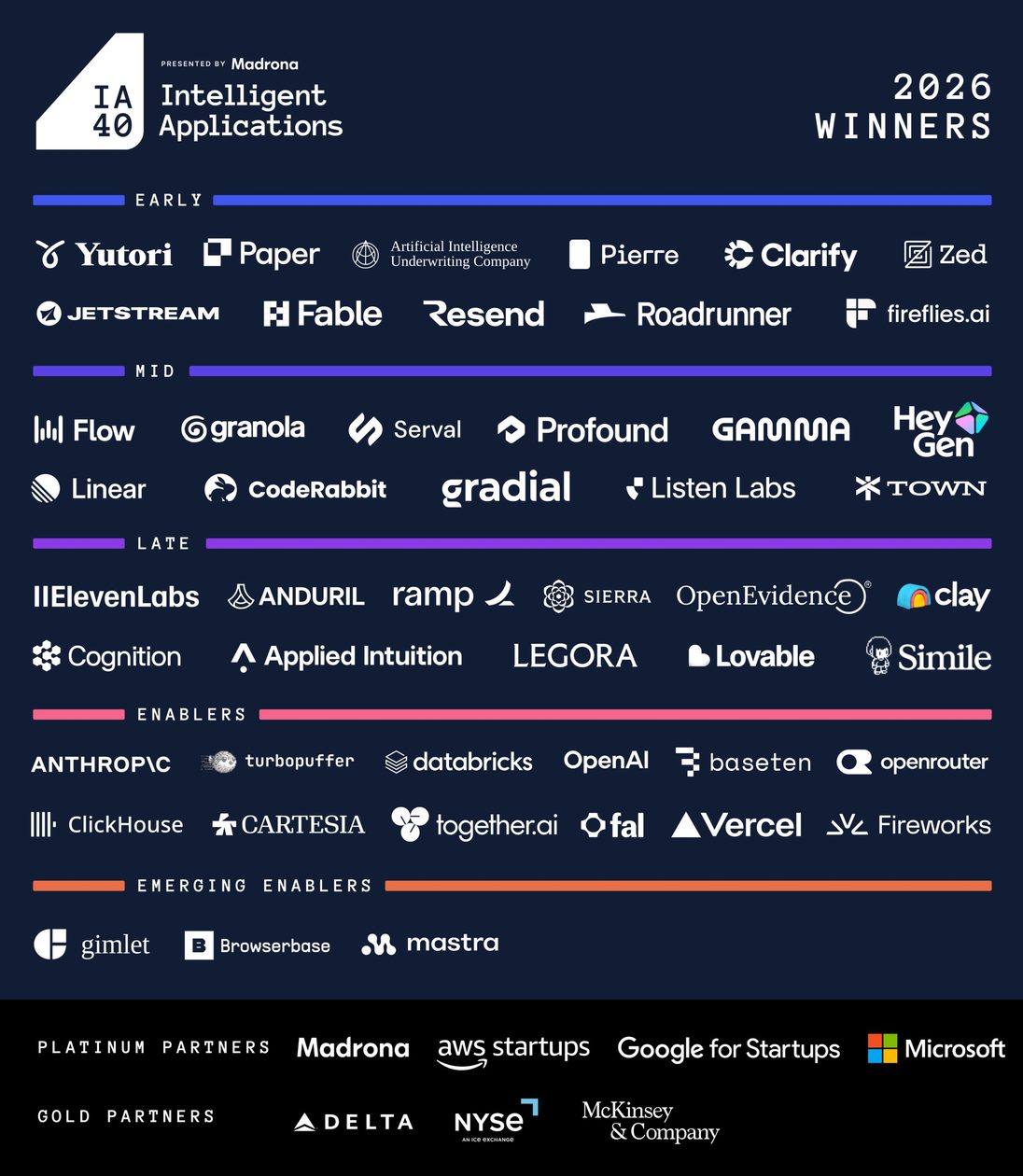
The winners on Madrona’s 2026 Intelligent Applications 40 list, grouped by funding stage. (Madrona Image)
Seattle-based venture capital firm Madrona released its sixth annual Intelligent Applications 40 list this week, naming 45 private AI companies (the five extras come from ties) that have collectively raised $410 billion from investors across the industry.
Three of them — Anthropic, OpenAI and Databricks — account for 92% of that total.
The uneven distribution of funding reflects a larger split in the tech industry, as the largest AI companies make huge bets on the computing capacity needed to meet demand for their models, while almost everyone else builds businesses on top of them.
The frontier labs are “increasingly funded by strategic capital from the likes of Amazon, Google, Nvidia and SoftBank rather than traditional venture,” Madrona’s Matt McIlwain and Rolanda Fu wrote in a post accompanying the list. That scale, they added, “makes every other category on this list look capital light by comparison.”
On top of that, he said, hundreds of billions of dollars are flowing into OpenAI and Anthropic.
“And what I say to both the big tech companies and to the people funding the model companies: thank you very much,” McIlwain said on Bloomberg TV, noting that the five largest tech companies will spend an estimated $750 billion in capital expenditures this year.
But even setting those big three aside, McIlwain said, the rest of the winners have raised an average of more than $800 million each. That’s a total of $34 billion combined. Companies across the list are raising far more than they used to, enough that Madrona had to redraw its own categories.
The list sorts companies by total capital raised, and this year the ceiling for “early stage” rose to $50 million, up from the $30 million threshold that held for the previous five lists. The cutoff for “emerging enablers,” its category for smaller infrastructure companies, doubled to $100 million.
“Companies across the board are raising more money, and the definition for what ‘early’ means continues to shift higher,” McIlwain and Fu wrote.
Madrona has published the IA40 since 2021 as a roster of the private companies it considers most important in building and enabling AI applications. According to the firm, this year’s list drew on input from 72 investors representing 54 venture and corporate firms, who nominated and voted on more than 450 companies, with PitchBook data factored into the scoring.
Gradial, which builds AI agents for enterprise marketing, is a first-time winner in the mid-stage category; it raised $65 million in June at a $675 million valuation, bringing its total to $120 million.
Last year’s list included two other Seattle-area companies in addition to Clarify.
OpenAI acquired one of them, Bellevue-based Statsig, for $1.1 billion in September 2025, making Statsig founder Vijaye Raji its CTO of applications.
Security startup Dropzone AI, which was on the list last year, did not repeat this year.
Madrona, one of the Seattle region’s largest and oldest venture capital firms, is an investor in all four — Clarify, Gradial, Statsig and Dropzone AI — although it also invests outside the region, and many of the companies on the IA40 are not in its portfolio.
Databricks, the San Francisco-based data and AI company (which leased 142,000 square feet in Bellevue this year), is the only company to appear on all six IA40 lists. That said, 23 of last year’s 40 winners returned this year, a 58% repeat rate, up from 33% the year before.
McIlwain and Fu wrote that the biggest and most established companies on the list are holding their spots, noting that “the age of experimentation is giving way to an age of enterprise readiness,” with buyers and investors “paying premiums for companies that can demonstrate real ROI.”
Madrona will recognize the winners at its IA40 Summit in Seattle on Sept. 29 and 30.
Updated with Matt McIlwain’s comments to Bloomberg TV.
Apple says evidence from a former engineer’s MacBook strengthens its trade secret case against OpenAI as the companies clash over AI hardware and hiring.
Reuters reports that Meta explored shrinking some teams by as much as 60% as part of an "AI native" restructuring plan that would shift much of employees' day-to-day work to AI agents and smaller teams of human "builders." But the effort quickly ran into employee revolt and disappointing productivity gains, leading Zuckerberg to scrap a planned second wave of cuts after Meta laid off 10% of its workforce in May. From the report: In January, Meta CEO Mark Zuckerberg and his top lieutenants gathered for their annual leadership retreat at his Hawaii compound. There they hatched a radical plan to reimagine work at the social-media giant in the age of artificial intelligence. Code-named Project OT -- short for Organization Transformation -- the plan envisioned an "AI native" future for the owner of Facebook and Instagram. AI would take over much of the daily work performed by thousands of human employees. Virtual workers would be overseen inside Meta by smaller, "talent-dense" cadres of human staffers, according to one internal planning document reviewed by Reuters and three people familiar with the project.
In scenario-planning exercises, two of these people said, executives explored slashing the size of many teams across Meta by as much as 60%. Some employees would be offered roles in new units, while others would be laid off as part of a culling that one human-resources executive projected would be as big as or bigger than the company's cuts of around 25% three years ago, according to another internal document. The restructuring would be carried out in two "waves," beginning with a first purge in May and followed by another shake-up in November, internal planning documents seen by Reuters showed. Layoffs would be supplemented with the closing of open positions and pushing people out who Meta believed were poor performers. These and other details of the plan, including the scale of the restructuring, haven't been previously reported. AI would take over much of the daily work performed by thousands of human employees. Virtual workers would be overseen inside Meta by smaller, "talent-dense" cadres of human staffers.
But on the night of May 19, just hours before the first layoff wave, Zuckerberg blinked. Meta laid off 10% of its employees the next day, but it called off planning for the November cuts, according to one internal document reviewed by Reuters. By then, Meta employees were in open revolt, convinced that the company's AI transformation initiatives were partly aimed at replacing them. Internal data was also suggesting that autonomous AI "agent" technology at the heart of the strategy was failing to deliver hoped-for productivity gains. Some investors were questioning what Meta had to show for its gargantuan spending on AI. This article reveals for the first time the rapid pace of the cuts Meta was considering, the thinking behind the plans and how they quickly unraveled. Based on scores of internal documents, posts and recordings reviewed by Reuters, as well as conversations with more than 20 people with knowledge of Meta's inner workings, the reporting shows how the social-media giant attempted to position itself at the forefront of an AI-driven workplace overhaul, only to stumble in the execution.
Meta agreed to impose daily limits on children's social media use and pay nearly $18 billion in settlements with nearly every US state today, cutting short a trial in which Meta said several of the states were demanding over $1.4 trillion. The settlement requires court approval.
Meta is facing claims that it designed its products to foster compulsive use by children and failed to warn users of addiction and mental health risks. Meta, which already uses ID checks and face analysis to verify user ages, said it agreed to impose on people under 18 a "default two-hour daily time limit that teens can only turn off with a parent’s permission," a default block between midnight and 6 am, and a school mode in which notifications are muted by default from 8 am to 3 pm.
The two-hour daily "limit is cumulative across Facebook and Instagram, and time spent scrolling on both apps counts toward the total, including if we detect that someone has multiple accounts," Meta said. Teens will "receive prompts after every 15 minutes of continuous screen time on Facebook or Instagram," and "prompts when their total daily usage hits 60 minutes and 90 minutes."
Meta must overhaul Instagram and Facebook for young users by enforcing daily time limits, turning off push notifications during school hours, and blocking access late at night. (BigStock Photo)
Washington state will receive up to $339 million as part of a historic $17.1 billion multistate settlement with Meta, resolving allegations that the tech giant intentionally designed Facebook and Instagram with addictive features that harmed youth mental health.
Attorney General Nick Brown said Wednesday that the landmark agreement delivers on core youth-safety product changes — including hard caps on daily time limits, late-night scrolling blocks, and disabled push notifications during school hours — that state lawmakers failed to pass through legislation over the past two years.
“Let me say to the young people of Washington state: This agreement shows that your health and safety is more important than Meta’s profits,” Brown said in a news release.
Under the deal, Meta must overhaul Instagram and Facebook for young users by enforcing a two-hour combined daily time limit, turning off push notifications during school hours (8 a.m. to 3 p.m.), and blocking access late at night between midnight and 6 a.m. Teen users will also get the option to switch off algorithmic feeds in favor of a chronological timeline.
The agreement resolves claims brought by a coalition of 47 states, Washington, D.C., and three territories. While Meta acknowledged the settlement could cost up to $18 billion total over 10 years, it marked a rare legal resolution for a major platform facing nationwide youth safety litigation.
Outside the landmark Big Tobacco agreements of the late 1990s, the $17.1 billion deal represents the largest state consumer protection settlement in U.S. history. State officials and tech policy experts are framing the enforcement action as a similar watershed moment for regulating algorithmic harms and digital product design.
Washington state will receive a guaranteed baseline of $237 million from the core youth-safety agreement, with its payout potentially scaling up to nearly $339 million over the next decade if other major platforms like TikTok and Snapchat adopt comparable terms.
The Attorney General’s Office plans to use the funds to cover legal costs, bolster ongoing consumer protection enforcement, and directly fund state programs tackling the youth mental health crisis driven by social media use.
The settlement also mandates an independent third-party auditor to evaluate and report Meta’s technical compliance directly to state regulators annually over the next five years. Beyond usage limits, Meta must restrict social comparison features such as targeted beauty filters, hide public “like” counts for younger users, and implement stricter age verification to prevent children under 13 from creating accounts.
In addition to the core youth-safety agreement, Washington will receive a separate $10.2 million payment resolving long-standing state claims against Meta for sharing nonpublic user data with third parties like Cambridge Analytica during the 2016 election cycle.
Oregon Attorney General Dan Rayfield announced that his state’s share will total more than $125 million over 10 years.
In a public statement, Meta praised the agreement as setting a new benchmark for youth safety, while emphasizing that the restrictions should apply across the entire industry.
“While this is an important step, these protections will only be truly effective if our peers — TikTok and YouTube — put the same measures in place,” a Meta spokesperson said.
The agreement remains subject to final judicial approval in federal district court.
I used the M1 MacBook Air as my primary laptop for nearly four years. During that time, I used it for everything from drafting news stories to editing photos for reviews, working from flights to weekend workcations. And if there was one thing that earned more compliments than the slim chassis and overall design, it […]
Google will showcase Googlebook in New York on September 15, revealing its Gemini-powered software, native Android codebase and laptops from hardware partners.
As countries move to ban teens from social media, Meta pays actors, psychologists, and parenting influencers across more than a dozen countries to argue against blanket ban for teen accounts.

 Login
Login