❌

Reading view

There are new articles available, click to refresh the page.

Bigger than Bing or Xbox: Microsoft’s OpenAI haul reaches $10B in quarterly revenue

Sam Altman and Satya Nadella shake hands on stage in front of the OpenAI logo
OpenAI CEO Sam Altman and Microsoft CEO Satya Nadella at OpenAI’s DevDay in November 2023. (GeekWire File Photo / Todd Bishop)

OpenAI generated $10 billion in revenue for Microsoft in the quarter ended Sept. 30, about 11% of the Redmond company’s total revenue, according to its quarterly filing Wednesday.

The amount is up sharply. In the fiscal year that ended in June, Microsoft recorded $24.1 billion in revenue from its business with OpenAI, or about $6 billion a quarter on average.

That $10 billion surpasses some of Microsoft’s longest-running businesses. Xbox brought in $5.4 billion in the quarter. Search and advertising, which includes its Bing search engine, generated $6.6 billion. Windows licenses sold through PC makers, along with Surface and other Microsoft devices, brought in $3.6 billion.

The total covers revenue-sharing payments from OpenAI, as well as other business between the companies, such as OpenAI’s use of Azure to train and run its AI models. Microsoft didn’t say how much came from each, or how much of Azure’s growth came from OpenAI.

Azure revenue rose 48% to $33.2 billion in the quarter, beating Wall Street’s expectations and the company’s own forecast of 44% to 45% growth.

Microsoft has begun disclosing its revenue from OpenAI because its stake of about 24% makes OpenAI a “related party” under accounting rules, requiring it to report the business they do with each other.

Microsoft first reported the number in its annual report in July, as a full-year total. This is the first time it has given a quarterly figure.

The original AI alliance: Microsoft first invested in OpenAI in 2019, eventually committing $13 billion, and became its exclusive cloud provider. ChatGPT ran on Azure when it launched in late 2022.

The companies have loosened their ties since then. OpenAI restructured as a public benefit corporation in October 2025, and Microsoft gave up its right of first refusal to supply OpenAI’s computing capacity. OpenAI committed to buy an additional $250 billion in Azure services. An April 2026 agreement gave OpenAI broader freedom to use other cloud providers.

OpenAI has also agreed to keep sharing revenue with Microsoft through 2030.

In addition, Microsoft sells access to OpenAI’s models to business customers through its Azure OpenAI Service, and the models became the foundation for its Copilot products, putting Microsoft at the front of the generative AI boom. That revenue comes from Microsoft’s own customers, so it isn’t part of the $10 billion.

Microsoft, for its part, now builds its own AI models and offers models from Anthropic and others.

Many customers, not a few: Asked by Bernstein Research analyst Mark Moerdler whether AI growth on Azure was coming from big businesses or AI-native companies, Microsoft CEO Satya Nadella didn’t mention OpenAI.

He said he doesn’t want Azure’s AI business to depend on a few big customers, and that broad adoption by businesses is just getting started.

Nadella described it as “a decade-long thing,” and contrasted it with relying on “four customers who buy a lot of capacity from you” to show a few quarters of growth. That, he said, is “not a business as far as I’m concerned.”

He added that Microsoft has large customers who want to buy capacity, “and as long as the pricing is right, we may sell them some. If not, we will be patient.”

Later in the call, Goldman Sachs analyst Gabriela Borges brought up the fact that OpenAI made up 11% of revenue. Nadella didn’t address the number but praised OpenAI’s latest models and said customers are increasingly mixing models from different companies, or training their own.

He cited Microsoft’s tools for routing each task to whichever AI model handles it best. If you use AI coding agents, Nadella said, you want Anthropic and OpenAI “to compete for your workload, not like once a quarter, but for every task.”

New risk language: Microsoft also expanded a warning in its quarterly filing about the risks of depending on outside AI providers. The company builds products such as Copilot on AI models from outside companies, including OpenAI and Anthropic. It now says it has “limited visibility into or control over” how those models are designed, trained, secured and tested.

Without naming OpenAI or Anthropic, the same section notes that some of these AI partners are also “significant customers of Azure,” and that the benefits Microsoft expects from those relationships “may not be realized or sustained.” It says those partners could change how much they buy, and that Microsoft itself may change how it allocates scarce data center capacity or prices it.

Microsoft is an investor in both companies. According to its latest filing, it owns about 24% of OpenAI, down from about 25% in June and about 27% after OpenAI’s restructuring a year ago, and has put $12.0 billion of a promised $13.0 billion into the company.

In addition, Microsoft agreed last year to invest up to $5 billion in Anthropic, and its results for the June quarter included a $3.2 billion gain on that investment. Microsoft hasn’t disclosed the size of its Anthropic stake, and Anthropic’s IPO filing earlier this week didn’t specify it either.
Microsoft Azure revenue surges 48% to $33.2B, beating expectations as cloud and AI demand grows

A gray baseball cap embroidered with the Microsoft logo and the words Microsoft Azure.
Microsoft broke out Azure’s quarterly revenue for the first time in its new financial structure. (GeekWire File Photo / Todd Bishop)

Microsoft’s Azure cloud business brought in $33.2 billion in revenue in the September quarter, up 48% from a year earlier, blowing past the company’s own forecast and beating Wall Street’s expectations.

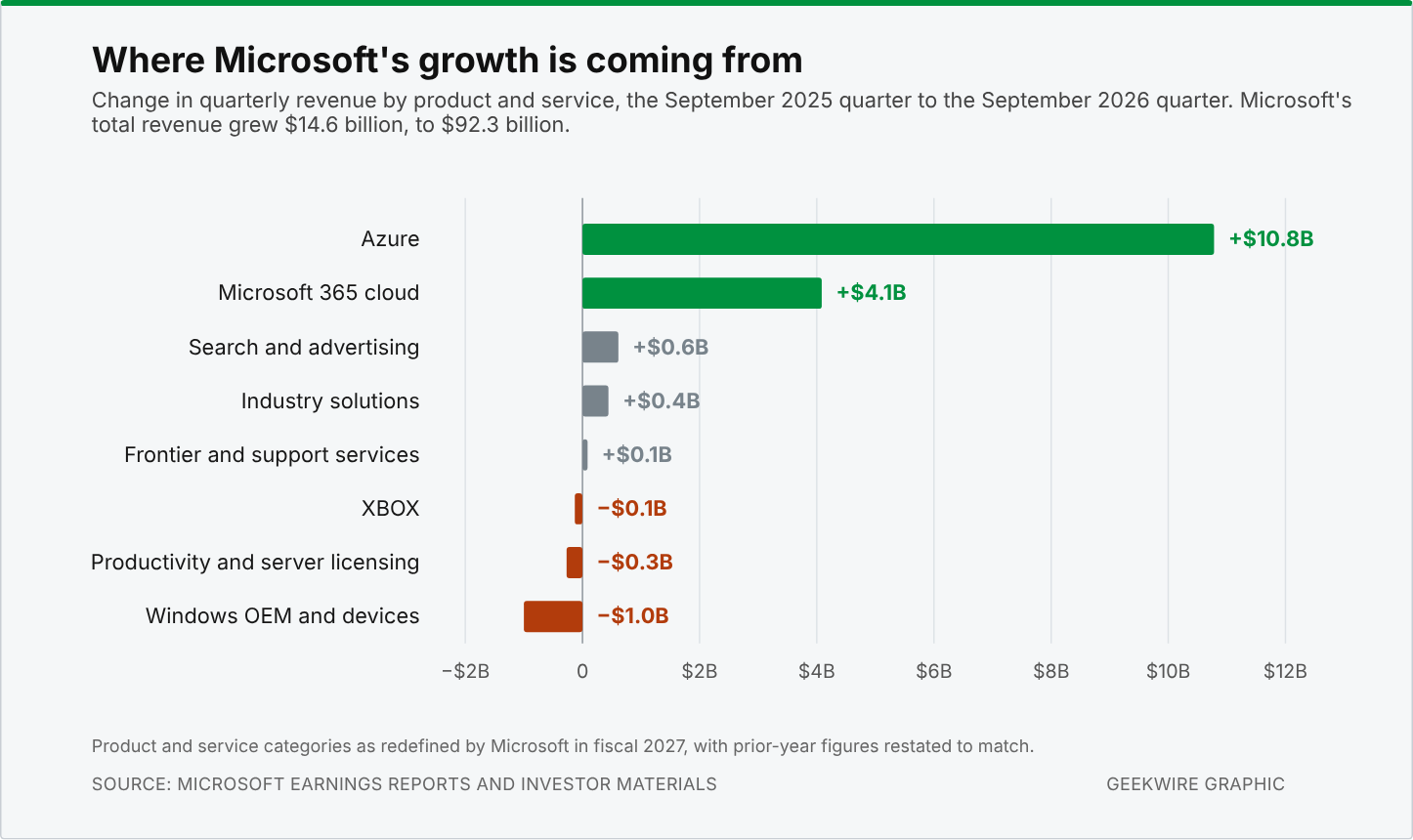
The growth suggests that Microsoft is selling cloud and AI computing about as fast as it can install it. Azure revenue rose $10.8 billion from a year earlier, driven by demand for services across the platform, Microsoft said in its quarterly filing. That came even as some new data center capacity arrived late.

For investors worried about Microsoft’s record capital spending, it’s a sign that the company’s massive AI and cloud infrastructure buildout is turning into sales. Microsoft’s shares rose nearly 4% in after-hours trading following the earnings report.

Overall, Microsoft reported revenue of $92.3 billion for the first quarter of its 2027 fiscal year, up 19% and above the $90.75 billion analysts expected, according to Yahoo Finance. Earnings were $4.89 per share excluding the impact of its OpenAI investment, compared with expectations of $4.72.

It’s the first time Microsoft has reported Azure’s quarterly revenue figure, not just its growth. The disclosure is part of a new financial structure that took effect this quarter, splitting the company into two segments: Agents and Infra, and Devices and Consumer.

  • Agents and Infra (Azure, Microsoft 365, Dynamics, LinkedIn’s recruiting and sales tools, and server and productivity licensing): Revenue rose 25% to $76.8 billion, above Microsoft’s forecast of $75.15 billion to $75.75 billion. Operating income rose 24% to $40.6 billion.
  • Devices and Consumer (Windows, Xbox, and search and advertising): Revenue fell 3% to $15.5 billion, above Microsoft’s forecast of $14.7 billion to $15.2 billion. Operating income rose 2% to $5.4 billion.

Capital spending came in below Microsoft’s forecast. The company spent $45.2 billion, including finance leases, short of the more than $50 billion it expected. Some data center capacity that third parties were supposed to deliver in the quarter was delayed, the company said.

Google Cloud, which includes Google’s Workspace productivity apps, brought in $30.7 billion in revenue in the quarter, up 103% from a year earlier, Alphabet reported Wednesday afternoon.

Amazon reports earnings Thursday afternoon, including AWS results.

Update, 3:05 p.m.:Microsoft expects Azure growth to accelerate again this quarter, to 49% to 50% excluding currency changes, CFO Amy Hood said on the earnings call. “Customer demand continues to exceed available supply,” she said.

Hood said Azure’s growth came from Foundry, Microsoft’s service for building AI apps and agents, and from engineering work that let Microsoft sell unused capacity on its existing servers. That helped make up for delays in new data center capacity that outside providers were supposed to deliver.

Those delays pushed some spending later into the fiscal year. Microsoft now expects to spend about $170 billion on capital expenditures in calendar 2026, down from about $175 billion. It expects to spend more than $50 billion this quarter, and Hood said spending will accelerate in the first half of calendar 2027.

Hood also said Microsoft may tap additional sources of financing to help pay for the buildout, “when we believe it is attractive to do so.” The company still expects to bring in more cash than it spends this fiscal year.

Microsoft’s expense forecast for the December quarter includes an estimate for the buyout offer it announced Monday, Hood said, though she didn’t give the amount.

The company expects total revenue of $96 billion to $97.1 billion for the December quarter, above the $95.7 billion analysts expected, according to Yahoo Finance.

Microsoft earnings preview: Employee buyouts, AI spending and a new financial scorecard

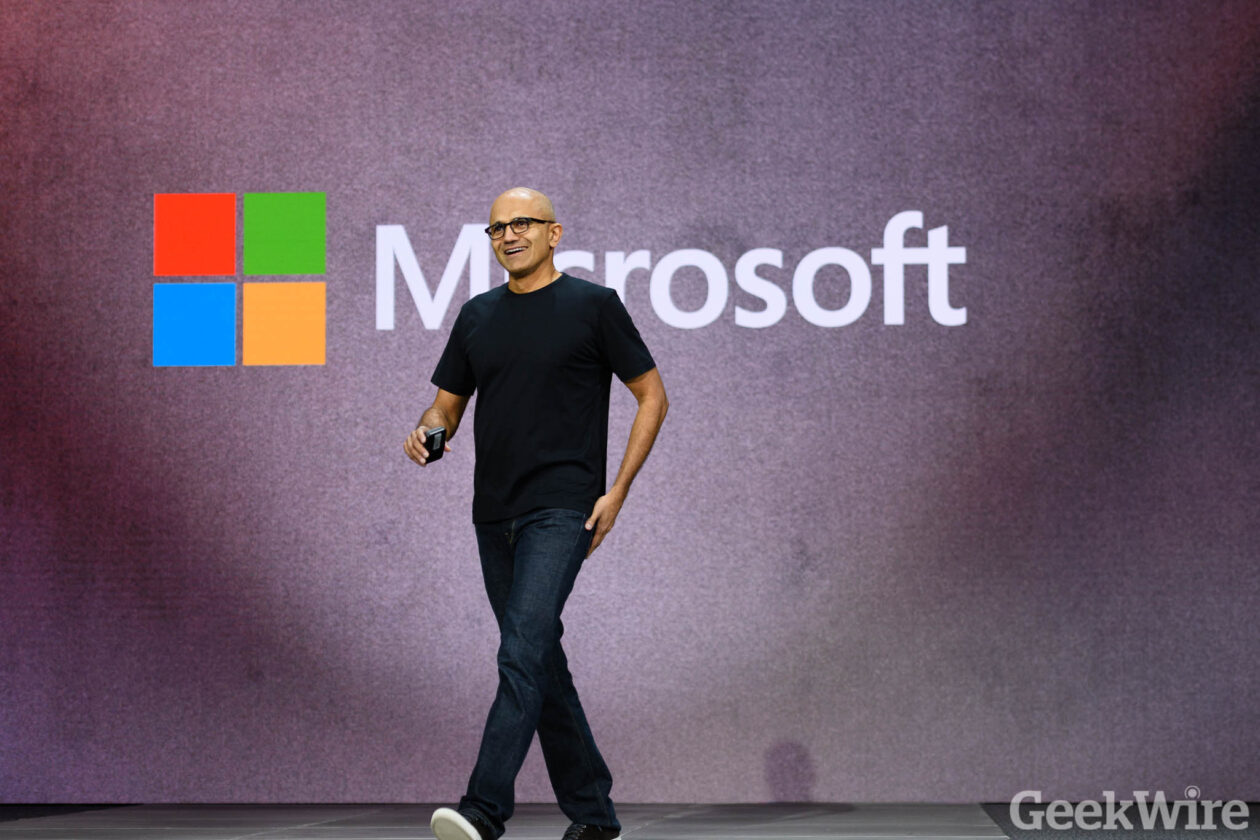
Satya Nadella walks across a stage in front of a large Microsoft logo.
Satya Nadella & Co. report quarterly earnings under a new financial structure Wednesday. (GeekWire File Photo / Kevin Lisota)

Update, 10/28: Microsoft’s Azure cloud business brought in $33.2 billion in revenue in the September quarter, up 48% from a year earlier, blowing past the company’s own forecast and beating Wall Street’s expectations. Read the full story.


Microsoft’s earnings report Wednesday will come two days after the company offered buyouts to about 60,000 people, roughly a quarter of its employees. The call gives executives their first chance to say what the offer will cost, and to explain how it fits with the company’s long-term view of its workforce.

Whether or not they go into those details, it’s one of several issues to watch in Wednesday’s report, the first under Microsoft’s new reporting structure. Anthropic’s IPO filing on Monday adds another storyline, showing how much the Claude maker has agreed to spend on Microsoft’s cloud.

Coming into the report, Microsoft’s stock is near its high. Microsoft closed Monday at $532.60, about 2% below its record close of $543.45 on Oct. 13, after gaining roughly $1.4 trillion in market value since late June.

Here are the key numbers and issues heading into Microsoft’s results for the first quarter of its 2027 fiscal year, ended Sept. 30.

Core numbers: Analysts expect revenue of $90.75 billion, up nearly 17% from a year ago, and earnings of $4.72 per share, up 14%, according to Yahoo Finance. Microsoft’s own forecast was $89.85 billion to $90.95 billion, so Wall Street is looking for a result near the top of that range.

In July, Microsoft reported $90 billion in revenue for the June quarter, well above the $87.7 billion analysts expected.

A new scorecard: Microsoft announced in September that it would sort its business into two groups instead of the three it had used since 2015. This is the first quarter under the new setup.

The first, dubbed Agents and Infra, includes Azure, Microsoft 365, Dynamics, LinkedIn’s recruiting and sales tools, and server and productivity licensing. It brought in 81% of Microsoft’s revenue and 88% of its operating income in fiscal 2026, based on figures Microsoft recast under the new structure.

Microsoft expects Agents and Infra revenue of $75.15 billion to $75.75 billion this quarter, which would be growth of about 22% to 23%, by GeekWire’s calculation.

The other group, Devices and Consumer, includes Windows, Xbox and search advertising. Microsoft expects it to bring in $14.7 billion to $15.2 billion, down 5% to 8% from a year earlier.

Azure, in dollars: Microsoft started disclosing Azure’s annual revenue last year, when it passed $75 billion, and topped $100 billion in fiscal 2026. Starting this quarter, it reports the figure every quarter. It also changed what counts as Azure: GitHub’s cloud business and Security Copilot now fall under Microsoft 365, and its healthcare cloud moved to a new industry unit.

Counted that way, Azure brought in $29.4 billion in the June quarter, up 42%. Microsoft expects growth of 44% to 45% this quarter, not counting currency fluctuations, which would put Azure at roughly $32 billion, by GeekWire’s calculation. That compares with the roughly 45% Microsoft projected in July, under the old definition.

Hitting that forecast may not be enough. Investors are looking for about 46%, BNP Paribas analyst Stefan Slowinski wrote in a note Monday. In January, Azure beat Microsoft’s own forecast and the stock still fell 10%, because investors had privately expected more.

“Azure moves the stock, but the read that matters is whether capacity is absorbed as fast as it lands,” wrote Dan Ives of Yorkville Ives in a note last week.

Capital spending: Microsoft expects capital expenditures of more than $50 billion for the quarter, which would be a record. That’s up from $41 billion in the June quarter and $34.9 billion a year earlier.

An accounting change reduces what Microsoft reports as capital spending, without reducing its planned investment. Microsoft now assumes its data center buildings will last 25 years instead of 15. As a result, more of its data center leases will be classified in a way that doesn’t count as capital spending, CFO Amy Hood said on the July earnings call.

That change alone lowered Microsoft’s capital spending estimate for calendar 2026 to about $175 billion, from the roughly $190 billion it projected in April. Hood said the company’s actual spending plans hadn’t changed.

Cloud margins: Microsoft Cloud gross margin came in at 65% last quarter, better than expected but down from a year earlier. Microsoft said it expects the figure to be relatively stable this quarter. It also expects operating margins to be roughly flat with a year ago.

Workforce: The new “voluntary exit” offer, announced Monday by Chief People Officer Amy Coleman, covers participating teams in the U.S., Canada, the U.K. and India. It has no age or tenure requirement and extends to some vice presidents. Employees have until the first week of December to decide, and Microsoft hasn’t said how much the offer will cost or when it will record the charge.

For the spring retirement program, Hood disclosed the cost on the April earnings call: about $900 million, with roughly $350 million in cost of revenue and $550 million in operating expenses. The charge showed up in the following quarter. About 30% of the 8,750 eligible employees accepted.

The new offer is less generous. It matches Microsoft’s standard severance, without the extended healthcare of the spring program, and the company expects a much smaller share of people to take it. But the pool of eligible employees is nearly seven times larger.

Microsoft says the offer doesn’t mean it needs fewer people. Coleman said in July that the company was studying whether to make voluntary exits a regular part of managing its workforce. It has told investors to expect operating margins roughly flat this quarter and down less than a point for the full fiscal year, even with record capital spending.

Nadella has addressed this before. In a July 2025 memo to employees, after Microsoft laid off about 15,000 people, he acknowledged the “uncertainty and seeming incongruence” of thriving financially while cutting jobs. “This is the enigma of success in an industry that has no franchise value,” he wrote.

In his annual shareholder letter last week, he focused on Microsoft’s spending on AI infrastructure. “Based on the demand we see and the efficiencies we are driving, I am confident in the long-term returns on our investments,” Nadella wrote. “We are building against a growing book of business tied to this secular shift.”

Microsoft had about 223,000 employees as of June 30, before it cut 4,800 jobs in July and more in September. The Information reported this month that Azure President Girish Bablani told leaders in his group to find ways to cut costs by at least 20%. Microsoft called the report inaccurate and said Azure leadership had not directed teams to develop cost-cutting plans.

Copilot: Microsoft said in July that businesses were paying for more than 30 million Microsoft 365 Copilot seats, up from 20 million in April. That’s still only about 7% of the more than 450 million commercial Microsoft 365 seats.

The bigger change is in how Microsoft charges for Copilot and its other AI tools. In July it added usage-based billing alongside per-seat pricing. It’s also pushing customers toward E7, a new premium bundle that includes Copilot. Microsoft expects Microsoft 365 commercial cloud revenue to grow about 17% this quarter, not counting currency swings, a number that now includes GitHub.

The BNP Paribas analyst Slowinski, who attended Microsoft’s Frontier Tour event in London last week, wrote that partners are seeing more customers roll out Copilot company-wide. Partners also told him that Microsoft now ties 35% of E7 sales incentives to how much customers use features like Cowork.

Anthropic and OpenAI: Anthropic’s S-1 filing shows the company has committed to spend at least $44.9 billion with Microsoft from November 2026 to May 2033, up from the $30 billion Azure commitment announced last November. That’s well below its minimum commitments to Amazon ($110 billion) and Google ($114.5 billion).

Microsoft agreed last year to invest up to $5 billion in Anthropic. Its results for the June quarter included a $3.2 billion gain on that investment.

OpenAI remains the bigger factor. Microsoft’s commercial remaining performance obligation (RPO), the measure of signed contracts it hasn’t yet delivered on, reached $678 billion last quarter, up 84% from a year earlier. Without OpenAI, the backlog grew 25%. OpenAI told investors its annualized revenue approached $50 billion at the end of September, The Information reported, lower than earlier reports of about $70 billion.

Windows: Microsoft expects revenue from Windows licenses sold to PC makers, along with its own devices, to fall a little more than 20%. Higher memory prices are making PCs more expensive, and PC makers are still working through extra inventory.

What’s next: Alphabet also reports Wednesday afternoon, and Amazon reports Thursday, setting up a side-by-side look at Azure, Google Cloud and AWS.

Anthropic is aiming to go public the week of Nov. 16, according to the Wall Street Journal.

Check back Wednesday afternoon for coverage.

Who’s getting Anthropic’s compute spending? IPO filing shows where the tech giants really stand

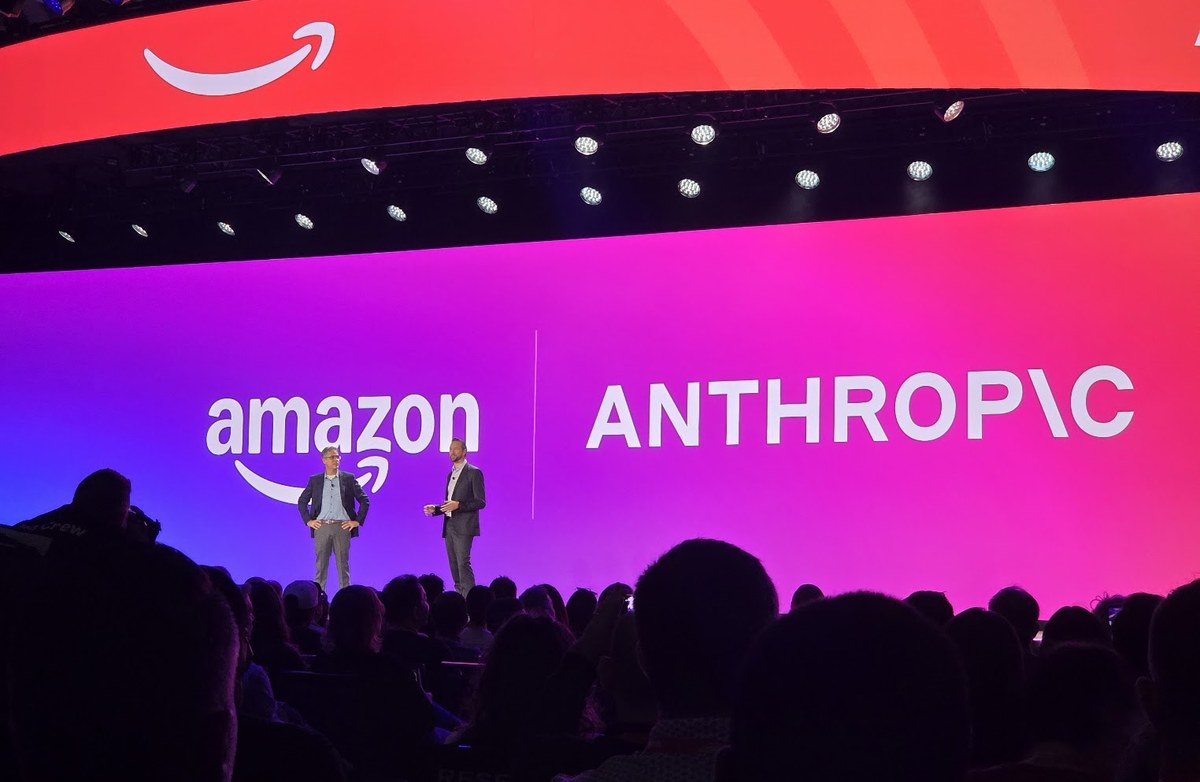
Two men stand on a stage in front of large screens showing the Amazon and Anthropic logos, with an audience in the foreground.
Chris Jones, director of Seller Assistant at Amazon, left, and Eric Burns of Anthropic’s Applied AI team on stage at Amazon Accelerate in Seattle in September. Anthropic’s IPO filing shows Google getting a bigger share of the AI company’s computing spending than Amazon, one of its largest investors. (GeekWire Photo / Todd Bishop)

Anthropic’s IPO filing reads like a ledger of who’s getting paid in the AI boom. The Seattle region’s tech giants are on the list, but they aren’t at the top.

The prospectus, filed Monday with the Securities and Exchange Commission, details more than $750 billion in computing deals, including firm commitments and estimated future spending, and offers clues about what its founders and biggest investors stand to gain ahead of the company’s planned Nasdaq listing under the ticker ANT.

Amazon and Microsoft have invested billions in Anthropic and won high-profile spending commitments from the Claude maker. But both trail Google, chipmaker Broadcom and Elon Musk’s SpaceX in their shares of Anthropic’s planned spending on computing power, the filing shows.

Following the compute money: Google’s chips are the biggest winner. Anthropic has lined up roughly $400 billion in computing capacity, mostly over the next seven years, based on Google-designed AI chips, known as tensor processing units or TPUs.

That total includes $114.5 billion to Google directly through July 2033, $161.2 billion in equipment leases with chipmaker Broadcom, and an estimated $125 billion to $150 billion in additional TPU capacity from 2028 to 2031.

Broadcom’s leases are the largest single arrangement in the filing. The five-year leases provide TPU-based hardware for data centers operated by other companies on Anthropic’s behalf.

Elon Musk’s SpaceX is next. Anthropic agreed to spend up to $120.5 billion through 2029 for computing capacity from SpaceX’s AI subsidiary, formerly known as xAI, which runs a rival AI lab.

The filing says payments will reach about $3.1 billion a month once all the capacity is delivered, which Anthropic expects in December. The agreements run into 2029, though either side can cancel on 90 days’ notice after early 2027.

Amazon is still a big winner. Anthropic committed in April to spend at least $110 billion with Amazon Web Services over 10 years, through April 2036, and AWS Trainium is one of four chip families that Anthropic uses to train and run its models.

Microsoft’s piece is smaller, which reflects its later start. The company was aligned closely with OpenAI for years before striking its own deal with Anthropic.

Anthropic has committed to spend at least $44.9 billion on Microsoft’s Azure cloud from November 2026 through May 2033, the filing shows. That’s up from the $30 billion Azure deal announced in November 2025. The deal has been amended twice since, most recently this month.

Claude is built into Microsoft 365, and former Microsoft CFO Chris Liddell joined Anthropic’s board in February.

Two smaller providers have deals in the same range as Microsoft’s. Anthropic agreed to spend up to about $44.6 billion with Nscale, a U.K.-based AI infrastructure company, and about $41.3 billion with GPU cloud provider Lambda, both for capacity powered by Nvidia chips, according to the filing.

Will Anthropic need it all? Most of the commitments can’t be canceled, and the deals with Microsoft, Google and Amazon require Anthropic to pay “regardless of actual usage,” according to the filing.

So far, the demand is there. Anthropic’s revenue hit $11.6 billion in the second quarter, up from $787 million a year earlier, and the company posted its first operating profit, $974 million. It still had a $66.3 billion net loss, mostly from accounting charges tied to its soaring valuation.

The company says it has “consistently operated in a compute-constrained environment where customer demand exceeds available compute.”

Its compute commitments assume that demand keeps growing. Anthropic spent less than $2 billion a month on compute and infrastructure in the second quarter. The SpaceX deal alone is expected to cost about $3.1 billion a month at full capacity.

Paper fortunes: Amazon’s biggest payoff is its stake, which it valued at $190.4 billion as of June 30 in its quarterly SEC filing. That includes convertible notes with $6.2 billion in principal that Amazon valued at $97.9 billion. The notes would convert into stock, subject to a 12% ownership cap that Amazon can waive.

Amazon is scheduled to report third-quarter results Thursday, its first earnings report since Anthropic’s filing. The Seattle-based company has updated the value of its Anthropic holdings in each of its quarterly filings this year, so a new number could come this week.

Google put $10 billion into Anthropic’s latest funding round and can invest up to $20 billion more under a March financing deal. The filing doesn’t give ownership percentages for Amazon, Google or Microsoft. It says only that the three companies have each made “significant equity investments” in Anthropic.

Anthropic’s seven co-founders hold roughly 230 million to 245 million shares each, worth about $14 billion apiece at the latest private funding price. The company also gave its own Public Benefit Fund about 847 million shares, or 5% of its fully diluted stock as of June 30, worth about $50 billion at that price.

Anthropic could begin formally marketing its IPO to investors as soon as the week of Nov. 9, Bloomberg reported, citing people familiar with the matter. It is aiming to go public the following week, according to the Wall Street Journal. The company expects the offering to match or beat the size of SpaceX’s IPO, according to Bloomberg. SpaceX raised $75 billion in June, the largest IPO on record.

Microsoft’s wild ride: Stock hits new record after a year of ups and downs

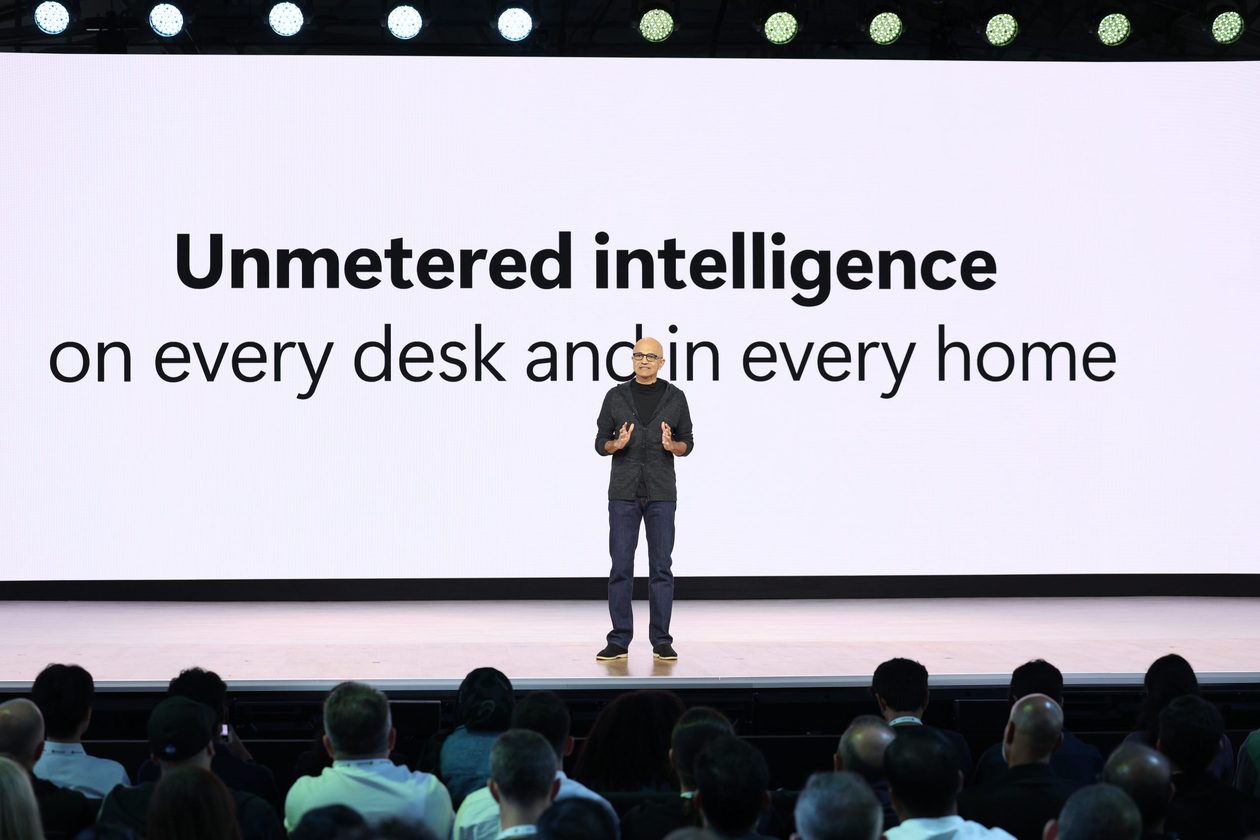
Microsoft CEO Satya Nadella gives the company’s founding mission an AI update at Build in June, a preview of the “Windows Hybrid Intelligence” initiative that the company unveiled last week. (Photo by Dan DeLong for Microsoft)

In less than four months, Microsoft has added roughly half an Amazon to its market value.

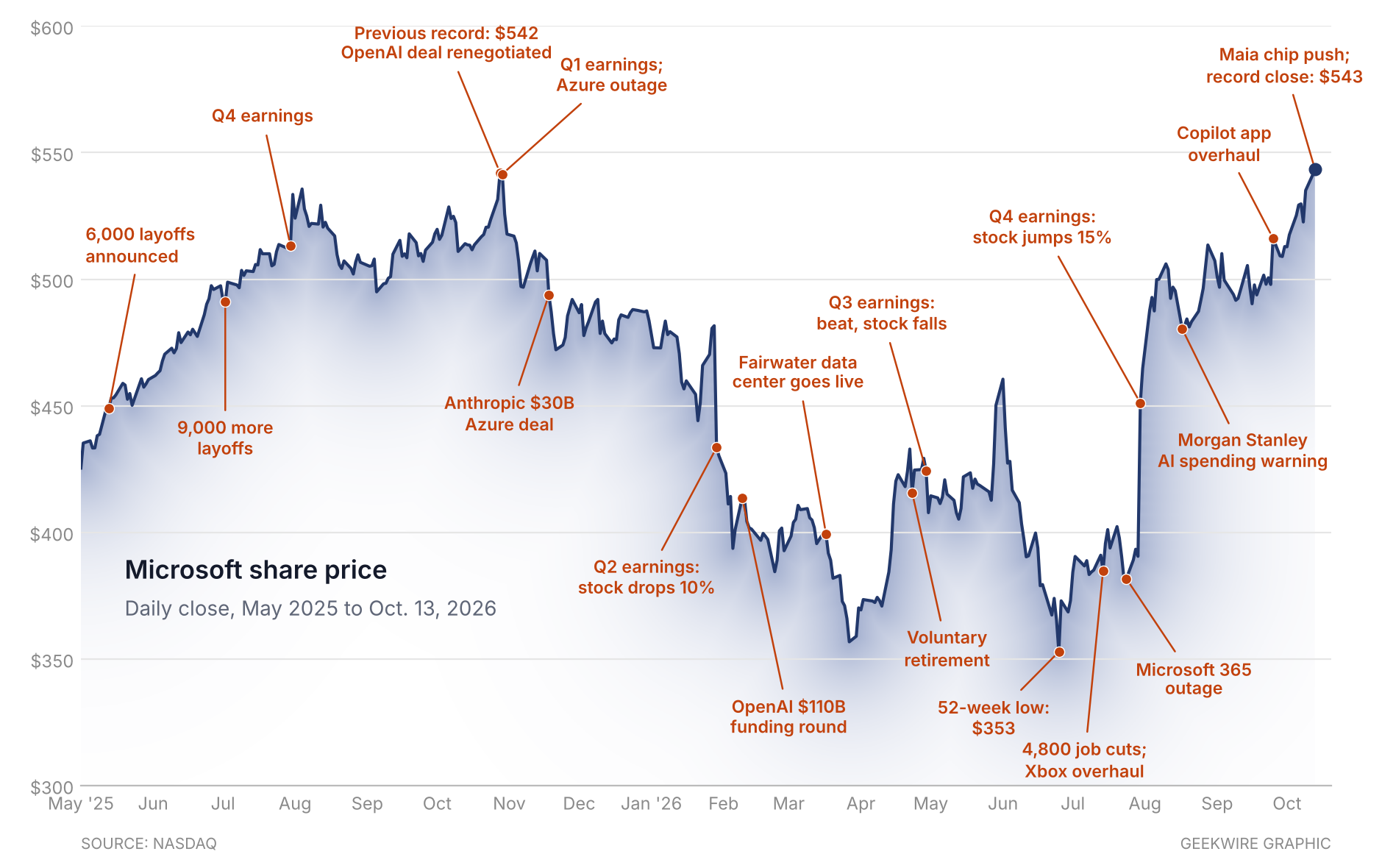
The tech giant’s stock has gained about $1.4 trillion in value since early summer, rising from $352.83 on June 25, its lowest close in more than a year, to a record close of $543.45 on Tuesday, giving it a market value just above $4 trillion. The increase over that period is nearly as much as Tesla is worth.

As stock turnarounds go, it’s extraordinary. In January, Microsoft lost $357 billion in a single day, the biggest one-day drop in its history, as investors worried about the company’s AI spending and its reliance on OpenAI. By midsummer, Microsoft was the worst performer this year among the big tech stocks known as the “Magnificent Seven,” according to Morningstar.

The rebound accelerated in late July, when Microsoft reported that Azure, its cloud platform, grew 43% and topped $100 billion in annual revenue. The stock jumped 15.5% the next day. It has mostly kept climbing since, as Microsoft rolled out a revamped Copilot app, a new AI push for Windows and new AI chips.

Microsoft isn’t rising alone. The broader stock market has also been hitting record highs, led by AI stocks. The S&P 500 closed above 7,800 for the first time last week, even as the benchmark 10-year Treasury yield reached its highest level since 2002.

Microsoft CEO Satya Nadella has been making a broader pitch along the way. In an essay posted on X in July, he warned that companies relying on outside AI labs “pay for intelligence twice, once with money, and again with something even more valuable,” meaning their own knowledge.

He urged businesses to keep control of that knowledge and avoid tying themselves to any one AI model. Microsoft sells access to models from OpenAI, Anthropic and others, along with its own.

Last weekend, he took up a related theme, calling on X for an “emergency brake” on advanced AI models. That means “separating the model from the harness that orchestrates its work,” he wrote. “We must assume a model is compromised and contain it from the start.”

The message also fits Microsoft’s business interests. As companies use AI models from multiple providers, the advantage could shift to companies like Microsoft that run the cloud and workplace software where businesses keep their data.

Microsoft reports its next quarterly results Oct. 28.

Microsoft makes ‘biggest bet yet’ on its own silicon, unveils new AI chip to reduce reliance on Nvidia

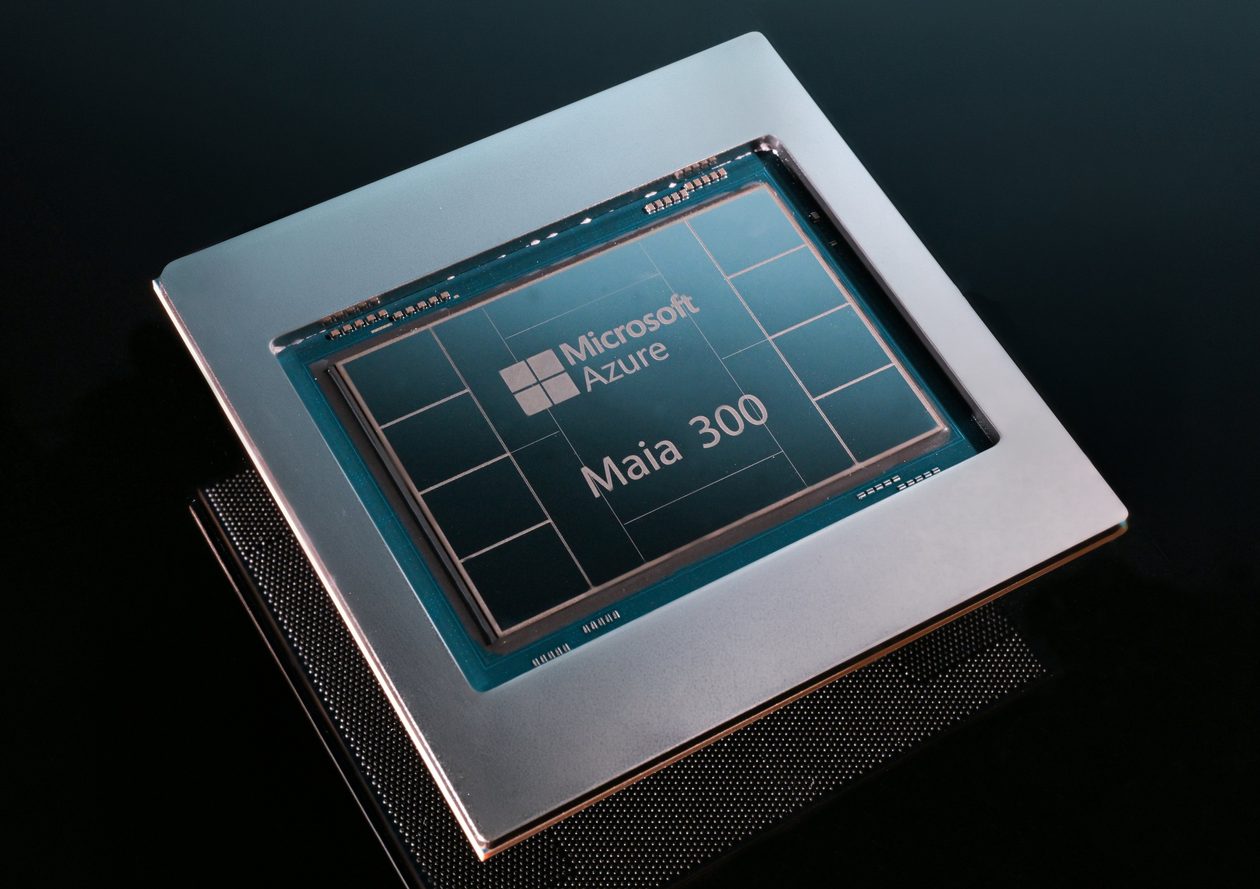
A prototype of Microsoft’s Azure Maia 300 chip, which the company plans to begin deploying at scale in 2027. (Microsoft Photo)

Microsoft plans to run most of its AI services on chips it designs itself, a shift that could save the company billions of dollars and reduce its dependence on industry juggernaut Nvidia.

The company on Monday unveiled Maia 300, the third generation of its custom AI chip, saying it will begin large-scale deployments in 2027. In a blog post, Azure chief Scott Guthrie said Maia will become “the primary AI inference system for Microsoft products and services.”

Microsoft CEO Satya Nadella called it “our biggest bet yet on our own silicon” in a post on X.

Maia 300 will produce 40% more AI output for the same amount of power as leading GPU-based systems, which Nvidia dominates, according to the company.

A full rack of the new chips will produce up to seven times as much AI output as the current generation, the company says. They’re designed for the kinds of tasks that are growing fastest, such as AI agents that work through multistep jobs and models that handle long documents or conversations.

The Redmond company designs the chips and relies on Taiwan Semiconductor Manufacturing Co. (TSMC) to make them, rather than buying finished chips from Nvidia. More-efficient chips also let Microsoft run AI services using less electricity, at a time when power supply has become one of the biggest constraints on AI expansion.

Microsoft and Nvidia remain big partners. Nadella and Nvidia CEO Jensen Huang shared the stage last week to launch Windows PCs built on Nvidia chips. Nvidia also remains a key supplier for Microsoft’s data centers, and Nadella said on the company’s July earnings call that Microsoft will be among the first cloud providers to deploy next-generation systems based on Nvidia’s Vera Rubin and AMD’s Helios.

Microsoft’s move is part of a larger trend among tech giants to design their own AI chips. Google has started selling its Tensor Processing Units directly to some customers, and Amazon has won over AI companies including Anthropic with its Trainium chips. Meta has rolled out its own AI chips, and OpenAI unveiled its first custom chip, built with Broadcom, in June.

Microsoft has been playing catch-up. Unlike Google’s and Amazon’s chips, Maia isn’t available for outside customers to rent. Microsoft’s first Maia chip, announced in 2023, was followed by a second-generation Maia 200 this January after delays. As of this summer, Maia 200 was running in just two U.S. data centers, The Information reported in August.

Maia 200, the current generation, already powers Microsoft 365 Copilot and runs models from OpenAI as well as Microsoft’s own. It’s now being deployed across the U.S., Europe and Australia, according to Microsoft. GitHub Copilot and Microsoft Foundry are set to move onto it by the end of the year.

The shift will take time. Evercore ISI analysts estimate that Maia will account for about 10% of Microsoft’s spending on AI chips by early 2027, CNBC reported.

Microsoft says it will share more details next month at its Ignite conference in San Francisco.

Microsoft 2.5: GitHub COO Kyle Daigle on stitching the developer universe together

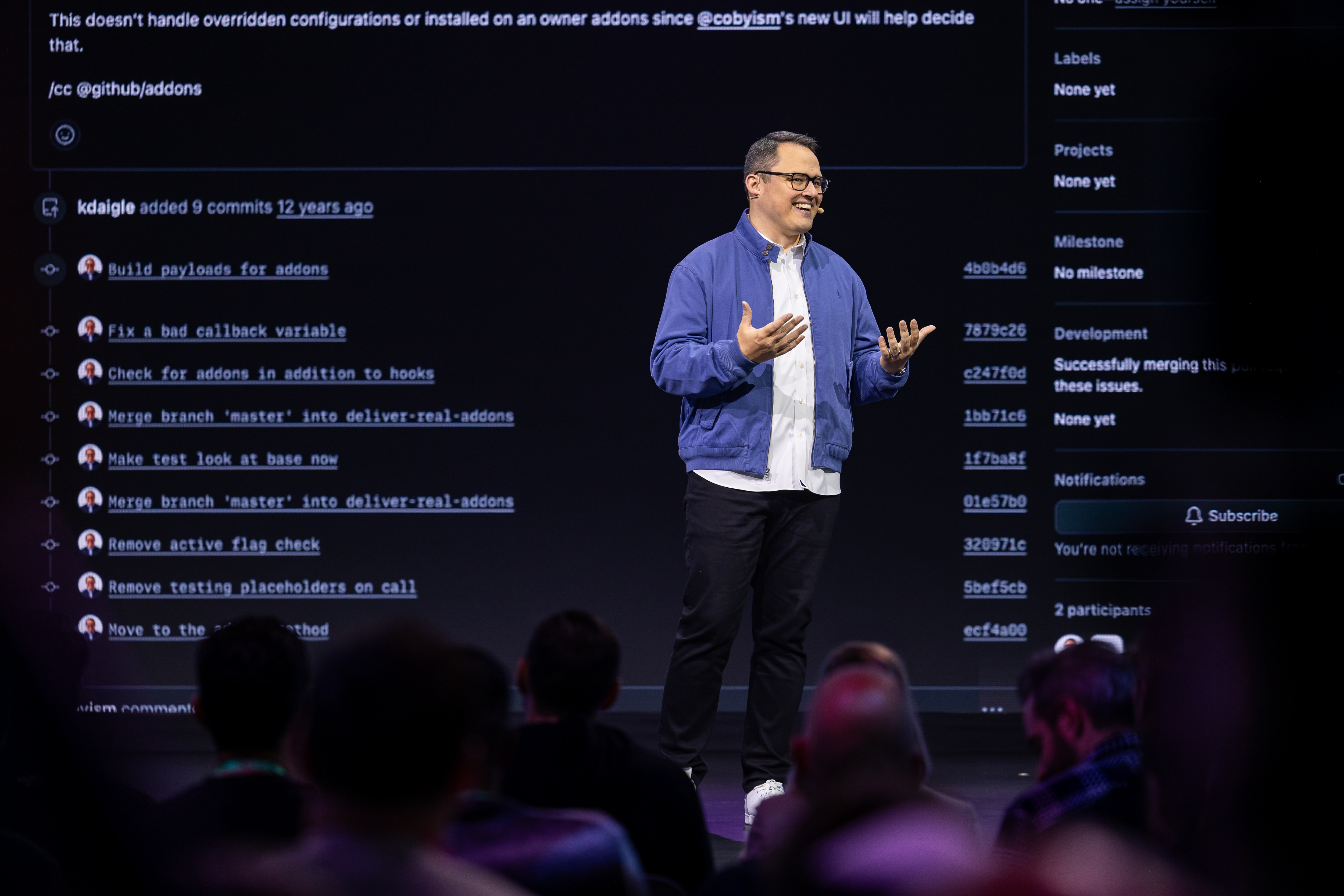
GitHub COO Kyle Daigle, who now also leads developer marketing for all of Microsoft, speaks at GitHub Universe last year. (Microsoft Photo)

GeekWire is profiling over the next few weeks some of the people and teams that are shaping the evolution of Microsoft in what we’re calling its “Microsoft 2.5” era.

A delicate dance: In August 2025, Microsoft moved to integrate GitHub into the mothership, under its CoreAI division, after having allowed it to run as a quasi-independent entity since acquiring it in 2018. At the same time, GitHub CEO Thomas Dohmke announced he would leave the company at the end of the year.

A number of developers feared the worst: GitHub would become just another arm of Microsoft and lose the community-mindedness that had made it attractive to developers of all stripes, and especially open-source ones.

GitHub Chief Operating Officer Kyle Daigle — a 13-plus-year GitHub veteran — had been one of the main champions of the need to “keep GitHub GitHub.” He maintained that stance even after he added the “Chief Marketing Officer of Developer” title for all of Microsoft to his COO role in January 2026.

So, how has Microsoft done this past year with managing GitHub? In an interview with GeekWire, Daigle acknowledged that GitHub’s relationship with Microsoft has changed since the end of the standalone CEO era. But the goal is no longer just “don’t break GitHub.” It’s to export GitHub’s community, developer-first ethos and learnings across Microsoft.

GitHub has influence beyond just the GitHub product set now, Daigle said. And the fact that Microsoft opted to consolidate its developer-facing messaging and community outreach under Daigle, someone who came from GitHub, not from Microsoft’s traditional DevDiv organization, gives weight to his claim.

“Bringing teams together — engineering teams and marketing teams and everyone that wasn’t talking to each other before — has been a really big part of the work,” Daigle said. “I see all these opportunities for GitHub to directly help and impact the overall mission of Microsoft versus keeping it cloistered in a way that isn’t helping either GitHub’s mission or Microsoft’s mission.”

These days, developer teams across Microsoft and GitHub are sharing foundations and the GitHub Copilot software development kit across organizations “in a way that would have seemed improbable before,” he said.

As Microsoft historians know, “Microsoft’s challenge isn’t creating products. It’s connecting them,” Daigle said.

Growing pains: At the same time, the rise of AI agents has strained GitHub’s infrastructure. Over the past few months, GitHub has experienced some significant outages, including one in August that lasted nearly eight hours.

GitHub officials have said they are migrating from their own datacenters to Azure to try to ease some of the capacity issues. Daigle said it’s not a simple lift-and-shift process; rather, it’s a major re-architecture for the platform.

GitHub is roughly 60% through its Azure migration as of early October, he said.

It’s working with Azure storage teams on separating compute and storage for the Git distributed version control system to help alleviate bottlenecks caused by developers and agents working concurrently in the same repositories. Developers and agents made 7.38 billion commits on GitHub in September alone, according to the company.

GitHub’s recent growth would not have been manageable without Microsoft scaling expertise and Azure support, Daigle said. GitHub is in a unique position of being able to request major additional capacity, such as millions of CPUs, and work with Microsoft teams to provision it, he said.

The GitHub app and agent store: GitHub got its start as a platform for source control and collaboration. But its role is evolving as part of its Microsoft integration. In addition to developing and supporting Microsoft’s most successful Copilot, GitHub Copilot, GitHub has an important place in Microsoft’s agent-centric strategy.

GitHub is becoming “the store for anything that needs to be coded and needs some verification,” Daigle said. “We’ll connect you to whatever the right tool inside of Microsoft is for you to run that or whatever tool you’re using, not just (from) the Microsoft product suite.”

In the new world order, GitHub isn’t just the store for apps. Increasingly, it’s also the store for agents, which means GitHub is acting as the developer layer for Microsoft’s “agent factory” strategy.

(Microsoft co-founder Bill Gates envisioned Microsoft as a “software factory” that could produce software at scale. These days, CEO Satya Nadella and team talk about Microsoft as an “agent factory,” helping customers create agents at scale.)

GitHub currently serves more than 200 million developers, plus an unknown but quickly growing number of agents.

Developers need to be thinking in new ways when it comes to agents, Daigle said. They need to consider ideas such as scaling application programming interfaces (APIs) for agents separately from humans, creating APIs designed specifically for agents, rewriting documentation and tooling so agents can consume GitHub efficiently, and treating agent access as a fundamentally different workload from human access.

In the longer term, Daigle said he expects AI to make software economically viable for smaller audiences, such as a family, an individual or a single team. The app-store model may change substantially in the coming years, as people create highly specialized applications. GitHub could help like-minded users discover software for specific interests, such as a narrowly focused household or community use case.

GitHub historically has considered anyone who has seen or touched code to be part of the developer community. Daigle’s vision is for GitHub and Microsoft to let both professional developers and newer builders create and run software and agents without needing to manage token costs, uptime, monitoring or operational overhead.

GitHub will have more to say about its plans at the GitHub Universe conference in San Francisco, Oct. 28-29. The event won’t focus on code generation alone; it will include information on tools covering the full lifecycle, proactive security approaches and how to determine whether software is working well after deployment.

“We’re looking to solve the core parts of the platform, like Git, like Actions, in a way that I hope will make people excited and feel like they can absolutely trust GitHub for the next decade to come,” Daigle said.

Microsoft comms chief Frank Shaw to exit after nearly three decades shaping the company’s message

Frank X. Shaw addresses the media at Microsoft on May 18, 2025, in advance of the Build conference. (GeekWire Photo / Todd Bishop)

It’s the end of an era at Microsoft: Frank X. Shaw, the executive who oversaw the tech giant’s communications for nearly three decades, first at an external agency and for the last 17 years as one of its senior leaders, is leaving at the end of the year.

Shaw, 64, said he’s not retiring, although he doesn’t have another job lined up. He plans to stop working for a while, do some of the things he hasn’t had time for, and then decide what’s next.

“I have had a ringside seat at some of the biggest leadership, technology, and business transformations that have ever taken place,” Shaw said, sharing the news of his departure (under embargo) in a phone call Thursday afternoon. “I just feel incredibly fortunate.”

He said he had been discussing his potential departure for some time with Takeshi Numoto, Microsoft’s chief marketing officer, looking for the right moment.

Microsoft has not announced a successor for his role as chief communications officer. In a LinkedIn post, Shaw said the company will consider internal and external candidates.

A statement from Shaw’s colleagues in corporate communications credited him for his many years shaping Microsoft’s “voice and reputation with intelligence, candor and wit. His leadership and contributions to the company are too extensive to list, as is the number of journalists who have, at one point or another, used his name in vain.”

A former Marine Corps public affairs officer, Shaw has worked with all three of Microsoft’s CEOs. He started on the agency side, at Waggener Edstrom — now known as We. Communications — when Bill Gates was still running the company.

He built his reputation defending and advocating for Microsoft through some of its hardest stretches: the antitrust years, the Windows Vista backlash, the scramble to replace Steve Ballmer as CEO, and the weekend in 2023 when OpenAI’s board fired Sam Altman.

As the company’s top communications executive, he has also told the story of Microsoft’s reinvention under CEO Satya Nadella, from the LinkedIn and Activision Blizzard deals to an AI push that has carried Azure past $100 billion in annual revenue.

Evolving with technology: Shaw has spent much of his career closely watching the tech landscape and moving Microsoft’s voice into new channels as they emerged.

“We’re always thinking about what is the art and science of communications,” Shaw told PRWeek. “How do we reach our audiences most effectively in a changing environment?” He called the arc from print to radio and TV to social media and newsletters a “constant evolution of influence.”

He turned the corporate blog into a place where the company argued its own case, writing “Microsoft by the numbers” himself in 2010 — a stat-by-stat comparison against Apple and Google that TechCrunch dubbed “fantastic passive-aggressive.”

He and his team experimented with different and risky methods of telling the company’s story, holding mass briefings under embargo and publishing documents known as the “Book of News” in advance of its major keynotes and conferences. The prospect of a reporter having to answer to “fxs” was no doubt a factor in ensuring the news (mostly) didn’t leak.

Shaw hired Steve Clayton out of a technical role at Microsoft in London, where he had been blogging about the company unofficially out of frustration with how it was perceived, and made him chief storyteller. In the middle of the AI boom, Clayton and Shaw embraced the analog undercurrents in popular culture and launched Signal, a quarterly Microsoft print magazine for business leaders.

Clayton was VP of communications strategy by the time he left in January to become chief communications officer at Cisco, making Shaw’s planned departure the second high-profile exit from Microsoft’s comms team in a year.

Adapting to AI: In recent years, Shaw made his own team a testing ground for AI, publishing what worked and what didn’t. In a 2023 post he described using Copilot in Teams to pull story ideas out of conversations with spokespeople and anticipate coverage after interviews, and asking the AI to “poke holes in a statement we’re making on a tricky topic.”

He called it his corporal, a reference to Napoleon, who was said to bring one to meetings and ask whether his generals’ war plans made sense to him. A survey of 80 people in Microsoft’s communications and marketing organization found 84% did not want to go back to working without it.

Shaw was also known to use AI as a sounding board when a story frustrated him, offering him an objective take before he called and let a particular reporter have it.

He announced his departure Friday morning in a message to Microsoft’s communications team (reminding them he’s still there for a few months yet) and his public post on LinkedIn.

“Thank you as well to all the reporters, editors, writers, influencers and analysts who have put up with me over this time, enduring my early and late night calls, my off the record ‘no comments,’ my bad story ideas and my extended commentary on headlines and positioning,” he wrote.

“You all have incredibly hard and valuable jobs,” he added, “and while I’ve not agreed with everything said about us 😊 I appreciate you anyway.”

❌