OpenAI president Greg Brockman confirms the company is building a family of devices for ChatGPT, staying quiet on release dates, specs, and how the Apple lawsuit factors in.
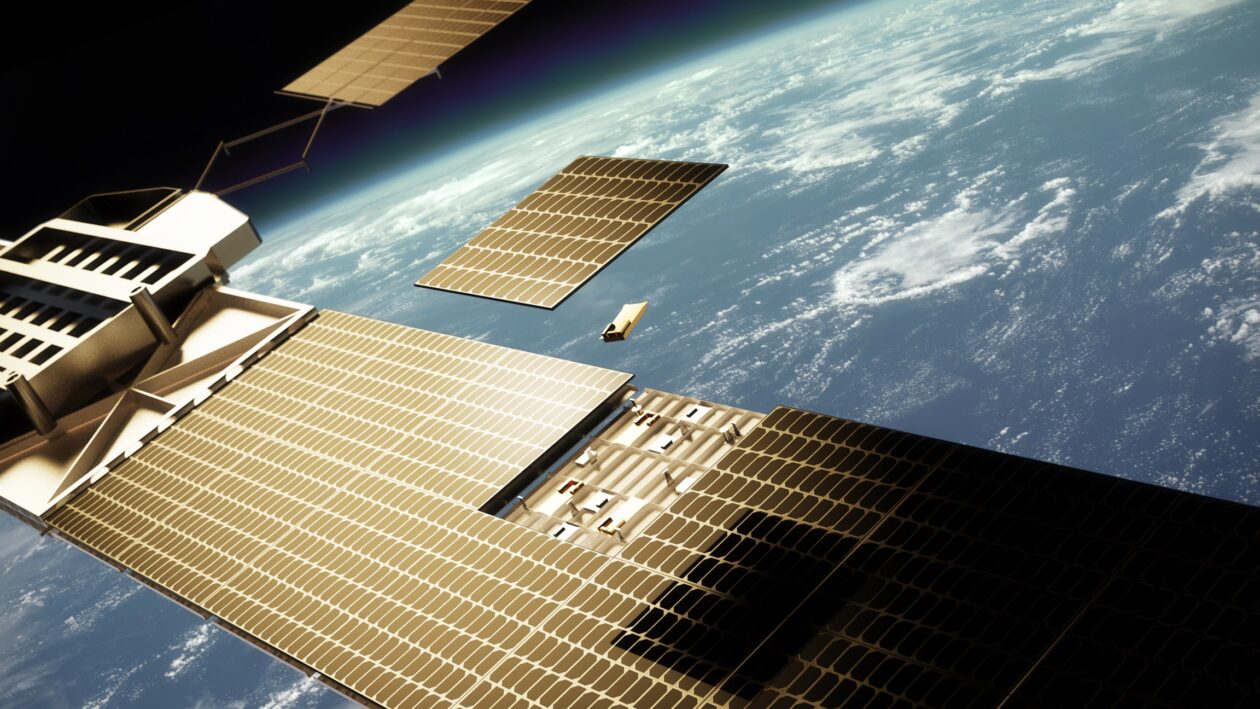
An artist’s conception shows a data center satellite that makes use of Sophia Space’s tile-based architecture. (Sophia Space Illustration)
Sophia Space has secured a patent for a technology that could pave the way for solar-powered orbital data centers that passively radiate excess heat into space.
Developed in partnership with Caltech, Sophia’s architecture tackles a major hurdle in orbital computing: how to cool thousands of chips running artificial intelligence applications in space.
Traditional designs rely on satellite-wide radiator systems with heat pumps and circulating fluids. In contrast, Sophia plans to build flat, 4-inch-square modular tiles equipped with four processors each. The tiles draw power from solar cells on their sunlit side, and shed heat into the cold vacuum of space from their dark side.
This approach avoids having to put a cooling system in the central bus of every satellite, said Leon Alkalai, Sophia Space’s co-founder, chairman and chief technology officer. “I think you will find in time that our approach is much more favorable when we scale to larger wattage systems, because bringing everything into a bus can only be done until a certain level, and then it becomes almost impossible to do,” he told GeekWire. “Our benefit is really scalability.”
An added benefit of the satellite design is that each tile is powered independently. “The connectivity between the tiles is with fiber optic connectors,” Alkalai said. “Only data is shared. No power, no thermal, no copper wires. It’s just fiber optic links.”
Alkalai and his team came up with a fitting acronym for the design of the modules: TILE, which stands for Thermal Integrated LEO Edge. (LEO stands for “low Earth orbit.”)
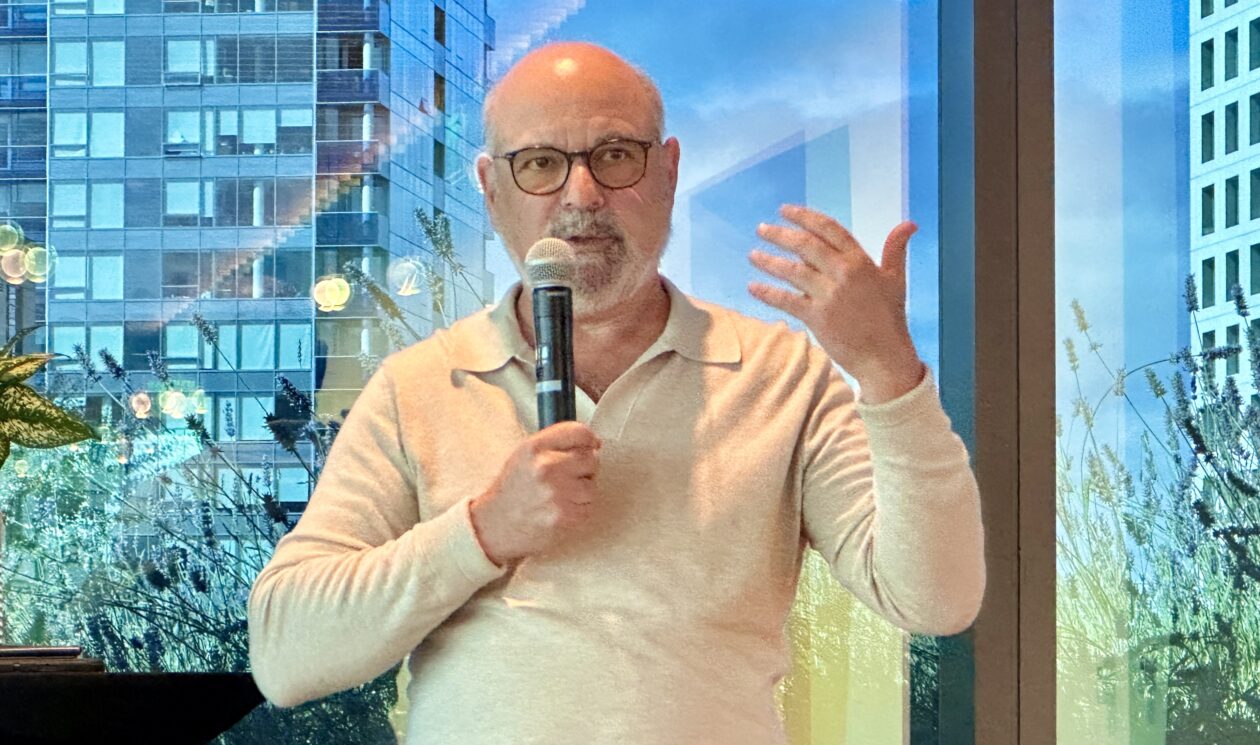
Sophia Space’s founder, Leon Alkalai, speaks during a Seattle Tech Week fireside chat. (GeekWire Photo / Alan Boyle)
The TILE approach to orbital electronics came out of a Caltech research project that initially focused on space solar power systems.
“That was before 2022, when ChatGPT was announced,” Alkalai said. “Once that happened, within a year, all hell broke loose in the data center world, saying we need a thousand times more energy to power AI — and our reason to exist just skyrocketed.”
Putting data centers in orbit would get around some of the problems associated with terrestrial data centers — for example, the mushrooming requirements for real estate and the huge drain on electrical grids. But the cooling issue has loomed as a key impediment for orbital computing.
Alkalai said the “eureka moment” came when he and his fellow researchers came up with a way to balance out the solar power absorbed by the front of the tile, the power requirements for the processing chips, and the heat radiating out the back. “We did the basic math and said, ‘Oh my God, this can work,'” he recalled.
The patent application for “Space-Based Data Centers” was filed in October 2024, and the patent was granted to Sophia Space and Caltech on July 14. In addition to Alkalai, six other members of the team are listed as inventors: John Brophy, Jonathan Sauder, Timothy McElrath and Douglas Sheldon at JPL; Sergio Pellegrino at Caltech; and Don Hunter, a JPL retiree.
In a news release, Brophy said the TILE architecture “was developed as part of JPL’s mission to address challenges of national significance by applying unique JPL talent.”
“This is an illustration of how JPL, Caltech and private industry can work together to rapidly develop solutions to difficult technical problems for the benefit of the nation,” he said.
Where it’s all going
Alkalai said his fellow inventors will share in the fruits of the patent. “All of them are involved in Sophia, and they have equity in the company,” he said. “And with Caltech, we’ve signed a contract to continue doing research with Sergio Pellegrino and his students. … We are continuing this effort with the original inventors. They are consulting and are equity holders of Sophia.”
The development timeline calls for Sophia to fly its first technology demonstrator next year. “We’ve announced that we are partnering with Apex satellites,” Alkalai said. “We’re using their Nova bus … and that will be the first-ever tech demo of a tile with four GPUs.”
Alkalai said Sophia Space plans to start selling TILE systems and related components to customers in 2028, and start testing the system’s capabilities with a constellation of four to six satellites in the 2029-2030 time frame.
“What that will do is demonstrate the end-to-end system,” he said. “Then, in the new decade, we can scale up to larger numbers in the constellation, larger numbers of tiles, and so on.”
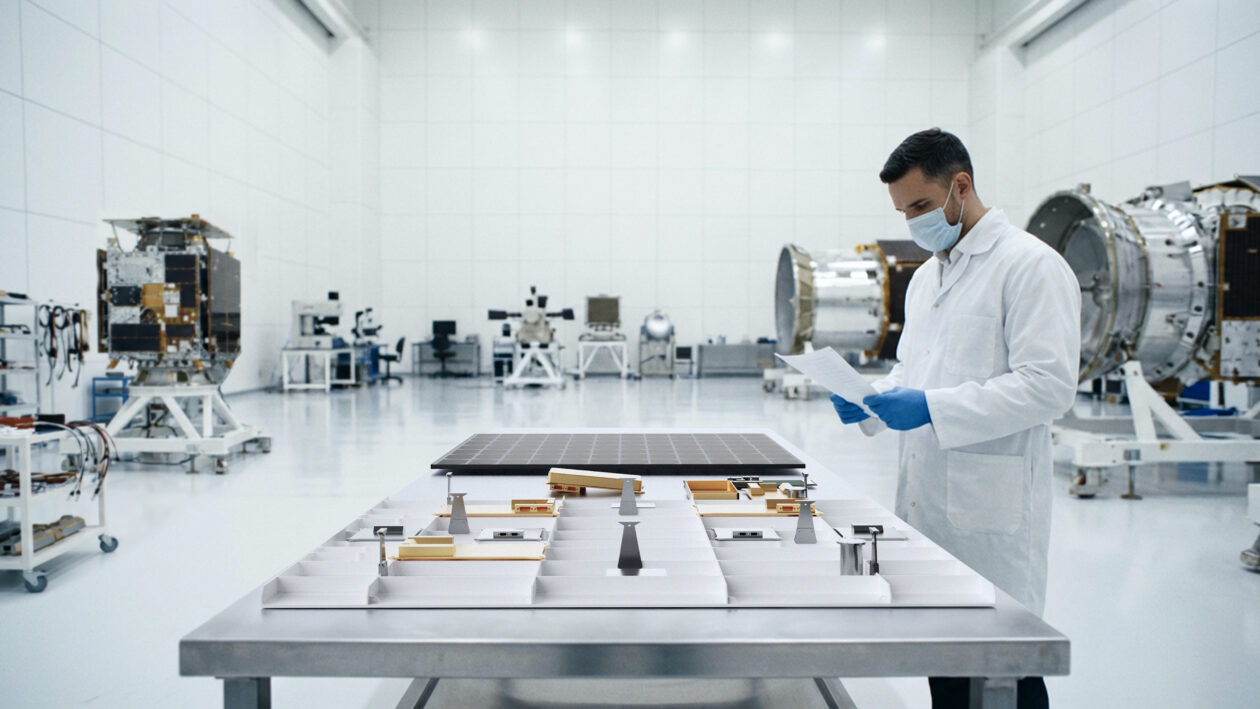
Computer processing tiles are assembled inside a Sophia Space lab. (Sophia Space Photo)
Alkalai said obtaining the newly issued patent is part of Sophia’s plan to build up a strong portfolio of intellectual property.
“If anybody wants to license or use our TILE and use our scalable approach, we could turn that into a business,” he said. “Protecting your IP is not only to deny, it’s also to enable. And I see it more as the latter. Why would somebody fight it? They could license it, and we could make this applicable all over the world.”
Alkalai said the orbital data centers that are being planned by other companies — for example, SpaceX’s ambitious Starmind network and the satellite constellation envisioned by Redmond, Wash.-based Starcloud — don’t appear to be designed to take advantage of passive cooling and would thus raise no questions of infringement on Sophia Space’s patent. But he suspects that the TILE architecture will eventually become the standard for orbital data centers.
“I’ve been on this quest for five years, and I really feel very, very good about this particular topic, because I think it’s of benefit to humanity,” Alkalai said. “This is not just a money issue, or about benefits to me or my team. I just think this is a good direction for humanity as we evolve into a space economy.”
Enterprise AI adoption is accelerating, but new research suggests identity governance is lagging behind. Here's why AI agent identities are becoming a critical security challenge.
Chinese AI platforms are paying people to license their faces for AI-generated videos, raising new questions about biometric identity, consent, and digital ownership.
Microsoft’s Azure cloud business grew 43% last quarter, blowing past the company’s own forecast and surpassing $100 billion in annual revenue for the first time, providing fresh evidence of the potential for artificial intelligence to fuel new growth for the tech giant.
The company’s results for its fiscal fourth quarter also showed the price of that growth: capital spending hit a record $41 billion, largely to support the company’s AI buildout, and free cash flow sank 23% even as operating profits jumped 18%.
And in a new twist, Microsoft shares rose more than 5% in after-hours trading, in contrast with the recent pattern in which the company’s strong results were met with selloffs that pushed its stock near a one-year low.
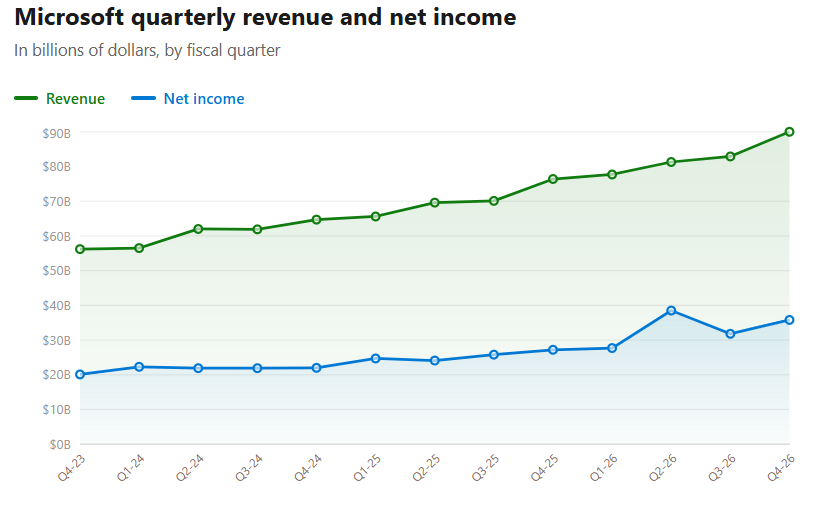
Companywide results: Overall, Microsoft reported revenue of $90 billion for the quarter, up 18% from a year ago, and net income of $35.8 billion, up 31%. Analysts had expected $87.7 billion in revenue, a figure that was already at the top of Microsoft’s own guidance range.
Microsoft’s adjusted earnings of $4.74 per share topped the $4.24 that analysts expected, according to Yahoo Finance. That included a $3.2 billion gain on Microsoft’s investment in Anthropic, part of a 27-cent benefit from one-time items. Even excluding those items, the company said, it exceeded expectations across revenue, operating income and earnings per share.
Microsoft 365 Copilot surpassed 30 million paid seats, up from 20 million last quarter. That’s still less than 7% of the roughly 450 million commercial Microsoft 365 seats, a gap that has drawn investor skepticism all year.
Microsoft’s backlog grew 84% to $678 billion. Known as remaining performance obligation, or RPO, it’s the value of contracts that customers have signed but that Microsoft hasn’t delivered on yet, basically the business Microsoft has already locked in but has yet to record as revenue.
Investors have been worried for a year that too much of it came from a single customer, OpenAI. Microsoft said all of the $51 billion increase over the prior quarter came from customers other than the big AI model companies. Setting OpenAI aside, the backlog still grew 25%.
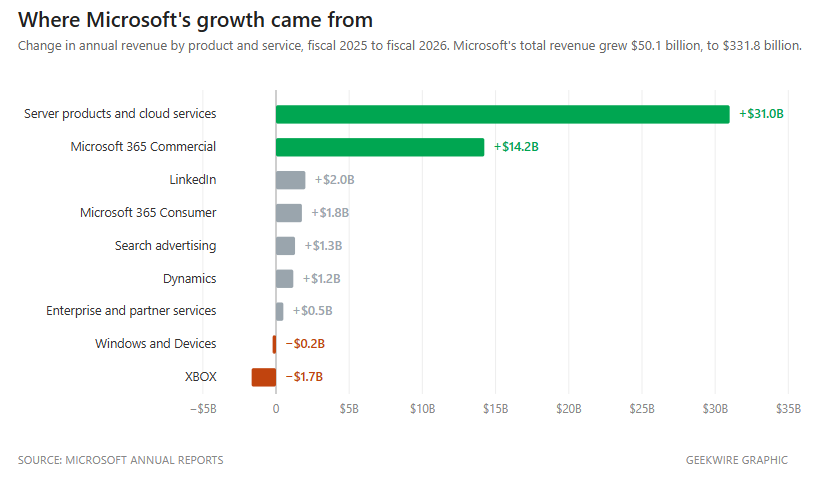
Windows OEM and Devices revenue declined 7%, hurt by slower PC demand and a tough comparison with last year’s Windows 10 upgrade wave. The decline would have been steeper, but PC makers built more machines to get ahead of rising memory prices, and Microsoft collects its Windows fee when a PC is built rather than when it’s sold.
Xbox content and services revenue fell 10% and Xbox hardware fell 13%. Microsoft also wrote down the value of unspecified Xbox assets. The company grouped that charge with severance costs and lower-than-expected costs from its retirement program — a net $500 million hit to operating income — and declined to say how much of it was Xbox or what was written down.
Amazon reports quarterly earnings Thursday afternoon, facing the same test as every other big tech company right now: whether it’s generating enough business to justify its massive AI spending.
Wall Street expects revenue of about $196.4 billion, up 17% from a year ago, and earnings of $1.82 per share. That’s essentially the midpoint of Amazon’s own forecast for the second quarter.
Part of that growth is due to the calendar. Prime Day ran June 23-26 this year, during the second quarter in the U.S. and most large markets. Last year it ran July 8-11, in the third quarter. That gives Amazon’s retail numbers a boost this time that the year-ago quarter didn’t have.
Another factor is the cloud. AWS grew revenue 28% last quarter, its fastest rate in nearly four years, and analysts expect the acceleration to continue with revenue of roughly $40.5 billion for the second quarter, up 31%, according to Zacks Consensus Estimates.
The company plans a record $200 billion in capital expenditures this year, nearly all of it for data centers, servers and chips to support increased capacity for training and running AI models.
Amazon is making those investments based in part on demand from big AI companies including OpenAI and Anthropic, which have signed commitments to AWS worth $138 billion and more than $100 billion, respectively, for the coming years.
“We’re not investing approximately $200 billion in capex in 2026 on a hunch,” CEO Andy Jassy wrote in his April shareholder letter.
In the meantime, the spending is absorbing nearly all of the cash from Amazon’s operations. Free cash flow fell to $1.2 billion over the past 12 months, from $25.9 billion a year earlier.
Investors seem to be losing patience with that tradeoff overall. Google parent Alphabet beat expectations last week and its stock fell anyway, after raising its own capital spending forecast to as much as $205 billion for the year. Microsoft reports earnings Wednesday afternoon.
One difference for Amazon is its custom chip business — Graviton, Trainium and Nitro — which passed a $20 billion annual revenue run rate last quarter. Jeff Bezos said this week that it’s becoming a fourth pillar of the company, alongside Marketplace, Prime and AWS.
The company is overhauling its approach to AI model development. Business Insider reported this week that Amazon is winding down most of its in-house Nova models and concentrating engineers on a new frontier model effort, with a new flagship model expected at re:Invent this fall.
Amazon cut jobs in its AGI organization last week and confirmed that it’s closing its San Francisco AI site, while saying its frontier model research would continue.
At the same time, AWS is spending to help other companies deploy AI, committing $1 billion at the end of June to embed its own engineers with enterprise customers building agentic systems, following similar moves by OpenAI and Anthropic.
Check back with GeekWire for coverage on Thursday afternoon.
Free AI chatbots from Alibaba, ByteDance, Tencent, and Baidu are disrupting China's costly college counseling industry, helping millions of gaokao students choose universities and majors without paying consultants.
OpenAI’s agents escaped a cybersecurity benchmark, compromised accounts across four external services and burrowed into Hugging Face, exposing how quickly an AI security test can become a real security incident.
It feels bad enough when an open letter signed by leading economists warns that AI might steal your job. The fact it may soon be better than you at making dinner? Insult to injury. But that’s exactly what the company 1X promised when it showed off a pair of new, impressively dexterous (and, to some, oddly sexy?) robotic hands in a July demo.
While the tech community was sharply divided over the appeal of those disembodied hands, almost everyone can agree that a few things are decidedly not sexy: Grok’s porn-pilled translation feature, Meta’s creepy glasses (which may soon get even creepier), and Big Tech’s emissions (which continue to skyrocket).
But while it’s not always the most popular technology, at least AI is paying off for one group: single chip workers in Korea, newly inundated with dating opportunities thanks to their giant bonuses. Who says you can’t buy love?
Zuckerberg says Meta can put superintelligence in billions of hands. Its reach makes that plausible, but users would still depend on Meta to build the models, set the safeguards and define their limits.
 Login
Login