Reading view

There are new articles available, click to refresh the page.

Opinion: It’s time for Seattle to believe in Seattle

Seattle’s foundation as a hub of technology, science and innovation runs deep. Its confidence should, too. (GeekWire Photo / Kevin Lisota)

[Editor’s Note: Jacob Colker is co-founder and co-managing director of AI House.]

Seattle is one of the most talented, creative and inventive places in the world. But if we want the rest of the country to see us that way, we have to start acting like we believe it ourselves.

First, we need more pride around here.

Let’s talk about what it means to be proud. 

My mother grew up in Tarnów, Poland. She escaped communism and came to the United States in 1978 looking for a better life. She found one, built a family, and has lived in America for nearly 50 years. 

But my mom is still very, very Polish.

Several times a year, I get a message: “Jakub. Did you see this?”

I already know what’s coming. 

Some Polish person did something. A Polish athlete won something. A Polish scientist discovered something. Some guy with a Polish grandmother finished third in a regional Nebraska chess tournament. Doesn’t matter. Poland.

“Jakub. Look at this person.”

Okay, Mom. Who is she?

“POLISH.”

That’s it. That’s the story. 

And I love it, because Mom has this completely indestructible pride in where she comes from. Plenty of us know someone like this: a Greek mom, Vietnamese dad, Indian uncle or Nigerian aunt. Somebody from their corner of the world did something great, and you are going to hear about it.

There is power in that instinct. Not because your people are better, but because you believe your place matters.

Seattle could use more of that.

We are almost pathologically humble. Our response to notable achievements is often a polite nod before everybody gets back to our regularly scheduled Seattle freeze. 

That humility is working against us.

Second, Seattle is awesome and the evidence is everywhere.

I see Seattle’s potential every day working alongside dozens of entrepreneurs building startups. Some of the most ambitious and talented people in the world are already here.

We have many billion-dollar startups across the region and more than 200,000 people working across technology, science, space, health and startups. That is more than enough talent to build yet a dozen more unicorns. 

Nearly 40% of the world flies every day on airplanes built here. Blue Origin and SpaceX build rockets here. Starbucks, Amazon, Costco, REI and Nordstrom reshaped how the world shops. Microsoft helped put computing into our homes. AWS and Azure helped make the cloud the infrastructure of modern life. The University of Washington ranks among the world’s best. Seattle medical breakthroughs have helped save tens of millions of lives. We are pushing forward fusion energy, aerospace and maritime innovation. And let’s not forget: we just won the darn Super Bowl.

And so, so much more. 

So why, despite all the evidence, do we still seem to have a communal case of imposter syndrome?

This is not a city lacking accomplishments.

It is a city with a branding problem.

Third, we have let other people tell our story for far too long. This ends, today. 

Cities have brands whether they intend to or not. Silicon Valley is where ambitious people build companies. Nashville is music. Los Angeles for film and television.

Seattle’s cultural humility mostly assumes our accomplishments speak for themselves.

They don’t.

Reputation gets built one story at a time. You hear one story and it is interesting. You hear 10 and you notice a pattern. You hear 50 and your beliefs begin to change: That’s where important science happens. That’s where talented people live. That’s where I should invest, build or work.

Those beliefs shape real decisions about where people move, where companies get built and where investors put their money.

So to fix Seattle’s branding problem, here’s what we need to do.

Step 1: Let’s tell one clear story — Seattle’s talent pool is ridiculous. 

Seattle is where deep technical talent meets deep domain expertise to build consequential things: AI, aerospace, cloud computing, medicine, fusion, robotics, maritime technology and enterprise software.

We do not need 50 slogans. We do not need another consultant-led branding exercise. We need one simple idea that people outside this region can remember: Seattle’s talent pool is ridiculous.

There is a reason some of the world’s most important companies have built major engineering centers, research hubs and second headquarters here for decades. They come for the talent.

And that talent is why Seattle will not just participate in the future. We will lead in building it.

Step 2: Let’s use the megaphones we already have.

Seattle already has outlets (including this one) telling this story — publications, podcasts and social channels that document the region’s startups, breakthroughs and product launches. 

Every day, startups are raising money, scientists are making breakthroughs, companies are launching products, engineers are building technology and institutions are pushing this region forward.

That is not just tech news. That is the raw material of Seattle’s reputation. So let’s use it.

When you read or hear about a Seattle startup doing something remarkable, share it. When you see a story about a breakthrough at Fred Hutch or the University of Washington, send it to someone outside the region. When a local company raises money, lands a major customer or gets acquired, don’t just scroll past it. Amplify it.

Step 3: Let’s treat every local win as Seattle’s win.

When a local robotics company ships something remarkable, that is Seattle’s story.

When a maritime startup reinvents how ports operate, that is Seattle’s story.

When our AI research labs, or hometown heroes in Amazon and Microsoft, create breakthroughs, that is Seattle’s story. 

When a biotech company lands a major breakthrough, when a game studio creates a global hit, when a clean-energy company reaches a milestone, that is Seattle’s story.

Our companies, universities, hospitals, labs, investors, civic organizations and business leaders should act like an amplification network for one another. Stop treating somebody else’s success as somebody else’s news.

Their win is our collective proof.

Step 4: Let’s put Seattle on the label.

Founders need to say where they are building. “Made with ❤️in Seattle” should be on the bottom of every website. Put Seattle in the press release. Put it in the LinkedIn post. Mention it onstage. Say it in interviews. Tell investors. Tell customers. 

Silicon Valley companies have spent decades attaching their success to their geography. We should do the same. If you build something extraordinary here, make sure the world knows it was built here.

Step 5: Let’s do a better job of selling Seattle.

Every venture capitalist, founder, executive and civic leader in this region should be able to explain in 60 seconds why somebody should build a company here.

Not defend Seattle. Not apologize for Seattle. Sell Seattle. 

Reminder: It’s the talent. 

(And also cream cheese on hot dogs.)

When investors and founders from New York, Boston or San Francisco come to town, show them the region. Introduce them to engineers, researchers and entrepreneurs. Bring them into the community. Let them see what is happening. 

The best branding campaign is somebody getting on a plane home saying, I had no idea all of this was happening in Seattle.

If we’re going to succeed, we need to believe first.

Insert all the Ted Lasso jokes you want, but this stuff matters. 

There is no giant Seattle marketing department coming to save us. There is no national referee who will eventually review the evidence and declare that Seattle deserves more respect.

When somebody here does something extraordinary, act like it. Read the story. Share the post. Send the article to your team. Text it to your friend in New York. Put it in the group chat. Bring it up over dinner. Tell your kids.

Basically, become my Polish mother.

My mom doesn’t give a hoot that Kraków ranks No. 6 on some list or Warsaw is No. 8 on another. She doesn’t need a clickbait listicle to tell her Poland matters. She already believes it does.

We have to build our reputation ourselves. The good news is that we already have everything we need: extraordinary companies, world-class institutions, ambitious people, groundbreaking science and media documenting it all.

What we have been missing is the confidence to start being more loud. Stories become patterns, patterns become reputation, and reputation becomes gravity. 

Gravity is what creates influence and respect.

Pride is not something somebody else gives you. You don’t wait until the rest of the country decides your home is important. YOU decide it is. Then you act like it.

Let’s get to work. 
As Washington state’s AI task force winds down, the debate over how much to regulate is far from settled

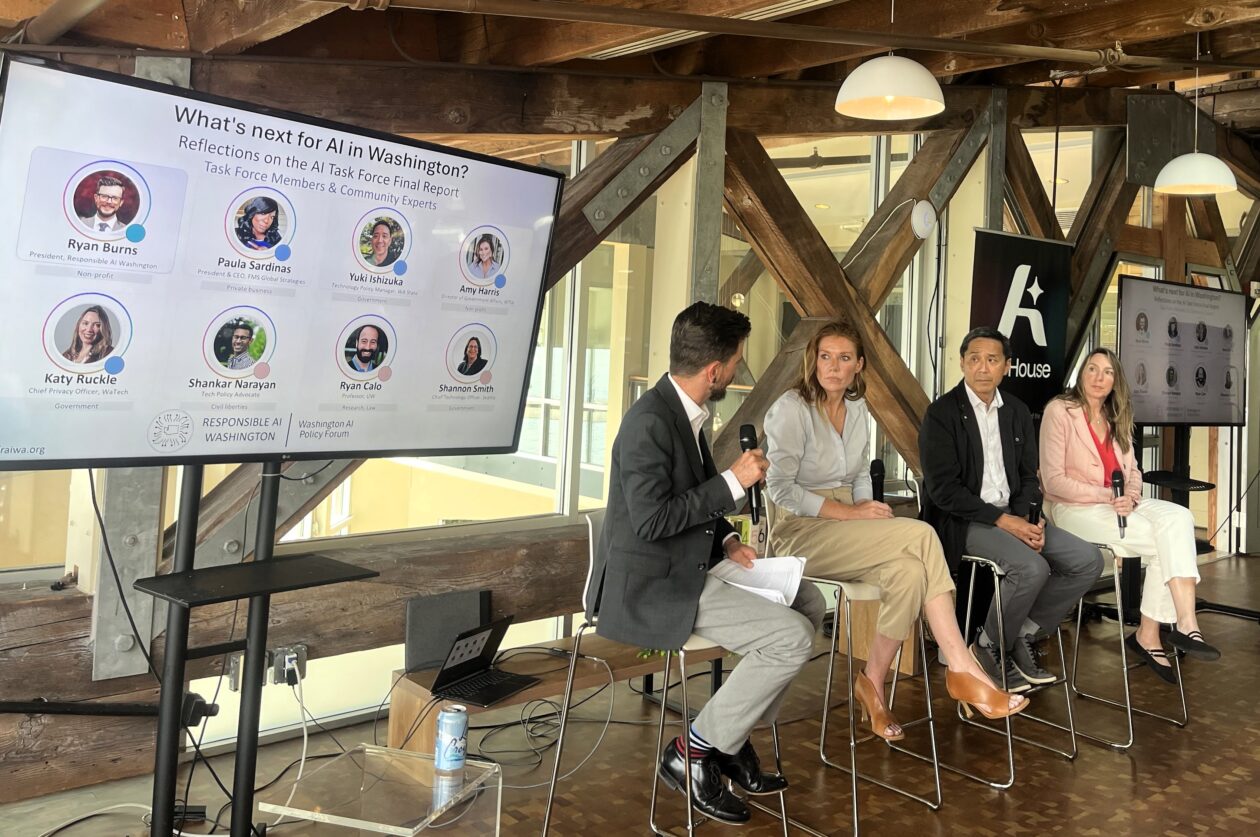
From left: Ryan Burns of Responsible AI Washington, Amy Harris of the Washington Technology Industry Association, Yuki Ishizuka of the Washington Attorney General’s Office, and Katy Ruckle of Washington Technology Solutions, at Wednesday’s panel on the state AI task force’s final report. (GeekWire Photo / Grace Kaste)

Members of Washington’s AI task force point to the state’s new AI regulations as evidence that regulation and innovation can coexist, but a panel discussion this week marking the end of their two-year effort showed just how unsettled the core issues remain. 

The task force is caught between consumer and labor groups calling for more extensive guardrails, and tech industry representatives concerned about compliance costs, exposing the tension between the demands of the fast-moving AI industry and the risks the technology poses to individuals.

That came to the fore at a panel on Wednesday, held at the Seattle startup incubator AI House, where task force members faced an unusual mix of people: an audience of AI startup founders, plus a roster of pro-regulation experts representing the legal, labor, and consumer protection fields. 

Panelists were there to discuss the task force’s final report, which recommended AI regulations to the state legislature. Four of the eleven recommendations were adopted, in part or in full, and passed into law this spring. 

“We are here today to see how much of this sentiment — that Washington does not have to choose between embracing innovation and protecting people — comes out in the content of the report,” said Ryan Burns, co-founder of Responsible AI Washington, who moderated the panel. 

That line has become a refrain for AI regulators in Washington. Gov. Bob Ferguson, then the state’s attorney general, requested the legislation creating the task force in 2024. He appointed representatives from government, labor, academia, and the tech industry, directing them to explore how AI could be “regulated without stymieing innovation.” 

In the final report, published in July 2026, Attorney General Nick Brown wrote that the task force had “made clear” that the two priorities could coexist, despite the federal government’s pro-innovation agenda. But Wednesday’s event showed that might not be so simple. 

Narrow regulations passed

Washington passed its first AI regulations this spring, including a requirement that companion chatbots remind users that the bots are not human and another that prohibits medical insurers from denying a patient coverage solely on the basis of an assessment made by AI. For Burns, the laws that did not pass were more telling.

“It did strike me as meaningful that the recommendations that have been adopted pertained to narrower application areas,” Burns said. “The recommendations that have not yet passed were a lot bigger.”

One of those recommendations was to regulate the use of AI for high-risk decision making, meaning applications of AI to hiring processes, algorithmic pricing, criminal justice, and healthcare. A similar law has passed in states such as New York, Connecticut, Illinois, California, and Colorado, but the Washington bill died before reaching a floor vote in either chamber.

The task force’s recommendation to require AI developers to disclose the datasets they are using to train their models, as California does, also died, as did a third recommendation to develop guidelines for the use of AI in the workplace. 

In an interview with GeekWire, state Rep. Mia Gregerson, who sponsored some of the comprehensive bills, said she appreciated the work of the task force but maintained that there is much more work to be done. 

“We are a tech heavy state, so we have an even bigger responsibility to do good work to catch up to what other states are doing,” Gregerson said. “We are so behind.”

On Wednesday, panelists said broader AI regulations failed in part because they drew less interest from the public.

“What passed in the legislature was more sector specific things where the consumer harm was more clear, and I think that’s a product of political dynamics,” said Yuki Ishizuka, technology policy manager for the Washington State Attorney General’s Office. “It’s harder to connect broader governance or transparency bills to harm to people.”

Broad AI regulations also faced heightened opposition from the tech industry, where a patchwork of state regulations means higher legal fees. At task force meetings, which were open to the public, representatives from the tech industry opposed regulations around AI development that would add “procedural hoops.” 

Cost of compliance

Concern about overregulation was echoed by attendees of the event, the majority of whom were founders of small AI startups.

When it came time for the Q&A, multiple audience members asked the task force to consider the financial burden for small startups of complying with complicated state regulations.

The distinction between big tech and startups has become a refrain for AI House, where entrepreneurs met with U.S. Sen. Patty Murray last month to discuss the nuances of AI regulation for so-called “small tech.”

“As these recommendations turn into policy, it’s important that startup founders are part of the conversation,” AI House Managing Director Jacob Colker told GeekWire. “A five-person startup doesn’t have the same legal, compliance, or policy capacity as a trillion-dollar company.”

But Jai Jaisimha, co-founder of a pro-regulation organization called the Transparency Coalition and a former startup founder himself, cautioned against creating legal carve outs for certain AI developers. 

“Arguing that you’re exempt because it’s too much data to disclose, or it’s a trade secret, those arguments send a sign that normal software development and governance does not apply to AI,” Jaisimha said. “Disclosure and consumer protection, these are standard practices in other industries.”

While the bills that would have been most costly for developers to comply with did not pass into law, those that did will still create significant legal consequences for AI developers who don’t abide by them. 

Panelist and technology law expert Ryan Calo, a University of Washington law professor who was not a member of the task force, said the state’s new companion chatbot law will be “blood in the water for the plaintiffs’ bar” for two separate reasons. 

  • First, any failure to comply could now be treated by the courts as “negligence per se,” meaning that the plaintiff will not have to show broader negligence but will simply have to show that the defendant violated the law. 
  • Second, any failure to follow these regulations is deemed an unfair or deceptive act under Washington’s Consumer Protection Act, giving consumers a private right of action and exposing developers to higher financial penalties. 

The question for the tech industry will be about where the state’s attorney general will prioritize enforcement. 

“The AG has a lot of power, but not enough to bring every violation of the law. So you have to think of the Eye of Sauron, and whether it will focus on you. If you’re a little startup, probably not, but if you’re Meta, probably yes,” Calo said.

Future AI regulation

As Washington state prepares to implement its new regulations this January, regulators are bracing for backlash from the federal government.

A December executive order from the Trump administration called on Congress to pass a “minimally-burdensome” AI policy preempting state laws, created an AI Litigation Task Force to challenge state laws that don’t “sustain and enhance the United States’ global AI dominance,” and threatened to cut broadband funding to those states. It named Colorado, which enacted the first comprehensive state AI law in 2024.

Federal preemption would require Congress to pass AI regulation of its own, which it has yet to do, but Trump’s order still seems to be having an effect. 

  • This spring, Colorado repealed its AI regulation and replaced it with a more conciliatory law. 
  • In Virginia, where no AI regulations have gained traction, legislators pointed to the federal government’s threats. 
  • And in Utah, lawmakers withdrew a bill to regulate frontier models after the Trump administration sent them a memo criticizing it for “opposing the federal government’s agenda,” according to Politico.

“We believe that, if the federal government is going to act, they should act with meaningful AI regulation, and should not preempt the state’s ability to protect its citizens,” said Ishizuka of the Washington state AG’s office. 

The federal pressure has not stopped some leaders from calling for far-reaching regulation. Some members of Wednesday’s second panel, which was made up of representatives from labor, academia, and consumers from outside the task force, proposed redistribution: Future AI regulation should reallocate the profits made by developers to pay for AI’s impending costs, such as cybersecurity improvements, worker retraining, and updates to school curricula.

“My worry is that there is going to be a lot of money being made, and I really think that bill should go to the people that are making a lot of money off of it,” Calo said. “I’m not sure that all of the [task force’s] recommendations directly address that redistribution element.”

Some state lawmakers are ready to address it. Gregerson, whose district includes SeaTac Airport and whose constituency includes many Uber drivers, told GeekWire she hopes to allocate state funds for retraining rideshare drivers who are replaced by autonomous vehicles.

State Rep. Clyde Shavers, who was not present at Wednesday’s panel but was a member of the task force, has said he wants to spend the next session establishing liability frameworks for AI-related harm.

Now that the report has been published, the task force will be disbanded, but the work will continue at the Attorney General’s Office, where a new Tech Policy Team will be led by Ishizuka. 

“With the completion of the task force’s work, there is strong interest in the AG’s office to continue to focus on AI policy,” Ishizuka said. “We’ll look at emerging technologies and bring in outside expertise so that there is informed regulation.”

Amazon’s next big business, Satya Nadella’s DIY app, and a VC’s rallying cry for Seattle tech

This week on the GeekWire podcast: Microsoft and Amazon both reported quarterly numbers, and both stocks rose on cloud results that beat expectations. Is all that AI spending paying off? And in related news, Microsoft sees a rare annual headcount decline, hitting product R&D hardest. 

Plus: Satya Nadella builds a Power BI dashboard out of an analyst’s research report, and touts it on the earnings call to make a bigger point. Jeff Bezos names Amazon’s chips business as the long-awaited fourth pillar. And AI House managing director Jacob Colker delivers a much-needed pep talk for Seattle tech, calling on the region to recognize and build on its strengths. 

Related stories and links

Microsoft and Amazon earnings

Amazon’s fourth pillar

A rallying cry for Seattle tech

The Washington tech ecosystem

Subscribe to GeekWire in Apple Podcasts, Spotify, or wherever you listen.

Seattle Tech Week notebook: AI, startups, and the best insights and takeaways we heard

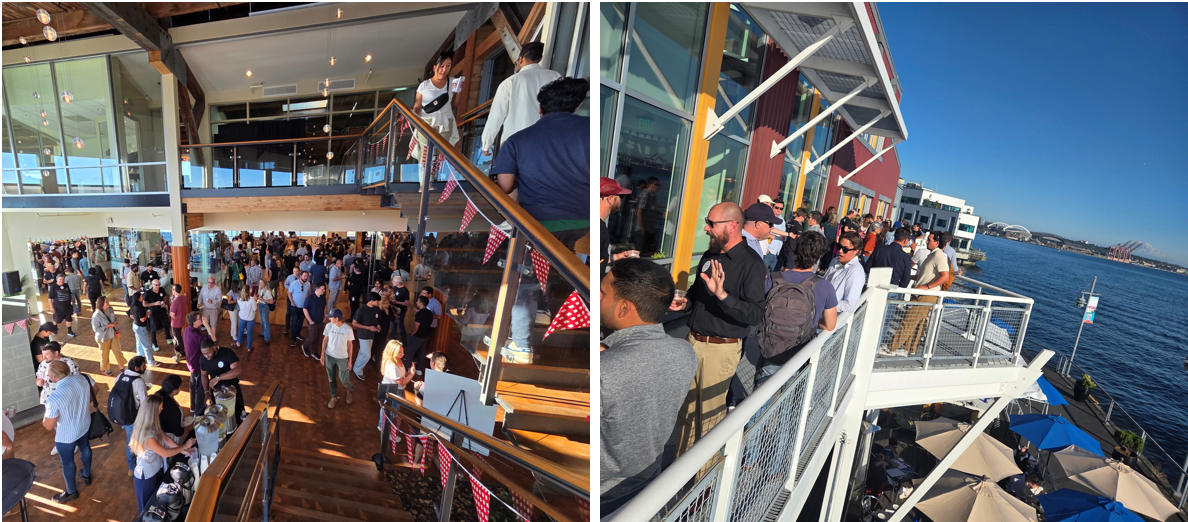
Seattle Tech Week attendees fill AI House at Pier 70, spilling onto the deck overlooking Elliott Bay. (GeekWire Photos / Todd Bishop)

Attending as many Seattle Tech Week events as possible and talking with as many people as I could, I was struck by the number of people looking for work and the volume of visitors from the Bay Area, including a number of investors looking to get a sense for what the regional tech scene is about.

It was hard not to imagine them being impressed with the sheer level of engagement and enthusiasm, even if they didn’t happen to catch Jacob Colker’s rallying cry. With more than 250 events (and waiting lists for many of them) it was more than any one person could take in.

It wasn’t Seattle AI Week — that’s still to come in October — but given the moment in tech and the world, the topic of artificial intelligence was naturally the main throughline of the week.

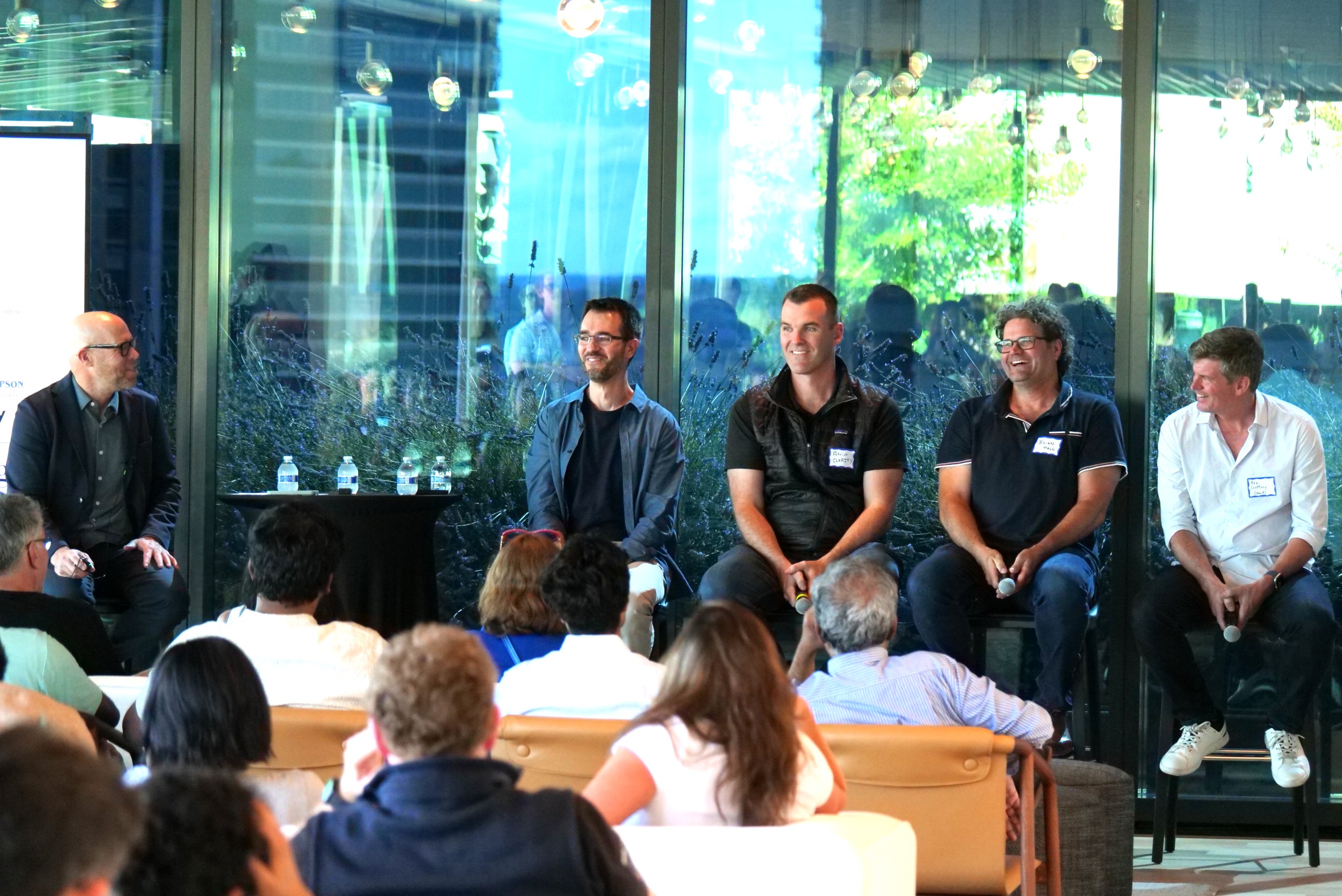
A panel that changed my perspective was early in the week, called “Foundation Models Go Vertical,” hosted by the Seattle pre-seed firm Ascend at Washington 1000 downtown. Founding general partner Kirby Winfield told the room that 600 people had tried to get in.

One of the biggest insights was from Manos Koukoumidis, CEO of Kirkland-based Oumi and a former Google Cloud AI engineering manager who led large language model efforts there.

From left: moderator Boaz Ashkenazy of the Shift AI podcast, Manos Koukoumidis of Oumi, Patrick Thompson of Clarify, Brian Hall of Mistral AI, and Ben Gaffney of OpenAI at the “Foundation Models Go Vertical” panel, hosted by Ascend. (GeekWire Photo / Todd Bishop)

Companies that are racing to build on top of the frontier models, he said, are renting a kind of intelligence that has very little to do with their own businesses.

“Enterprises are using a model that is trained on 5% of the world’s data that sits on the web, not the other 95%,” he said, referring to the data sitting inside their own organizations.

Which led him to the question (and the point) that I keep coming back to: If the intelligence at the center of the product belongs to someone else, he asked, “are you really an AI company, or an application company on top of somebody else’s intelligence?”

The next day, in the audience for a recording of the Founded & Funded podcast by Seattle Tech Week organizer Madrona, I posed the question that we debated on last week’s episode of our GeekWire Podcast: what should Seattle founders and investors make of venture numbers that rank Philadelphia, Austin, and New York ahead of them?

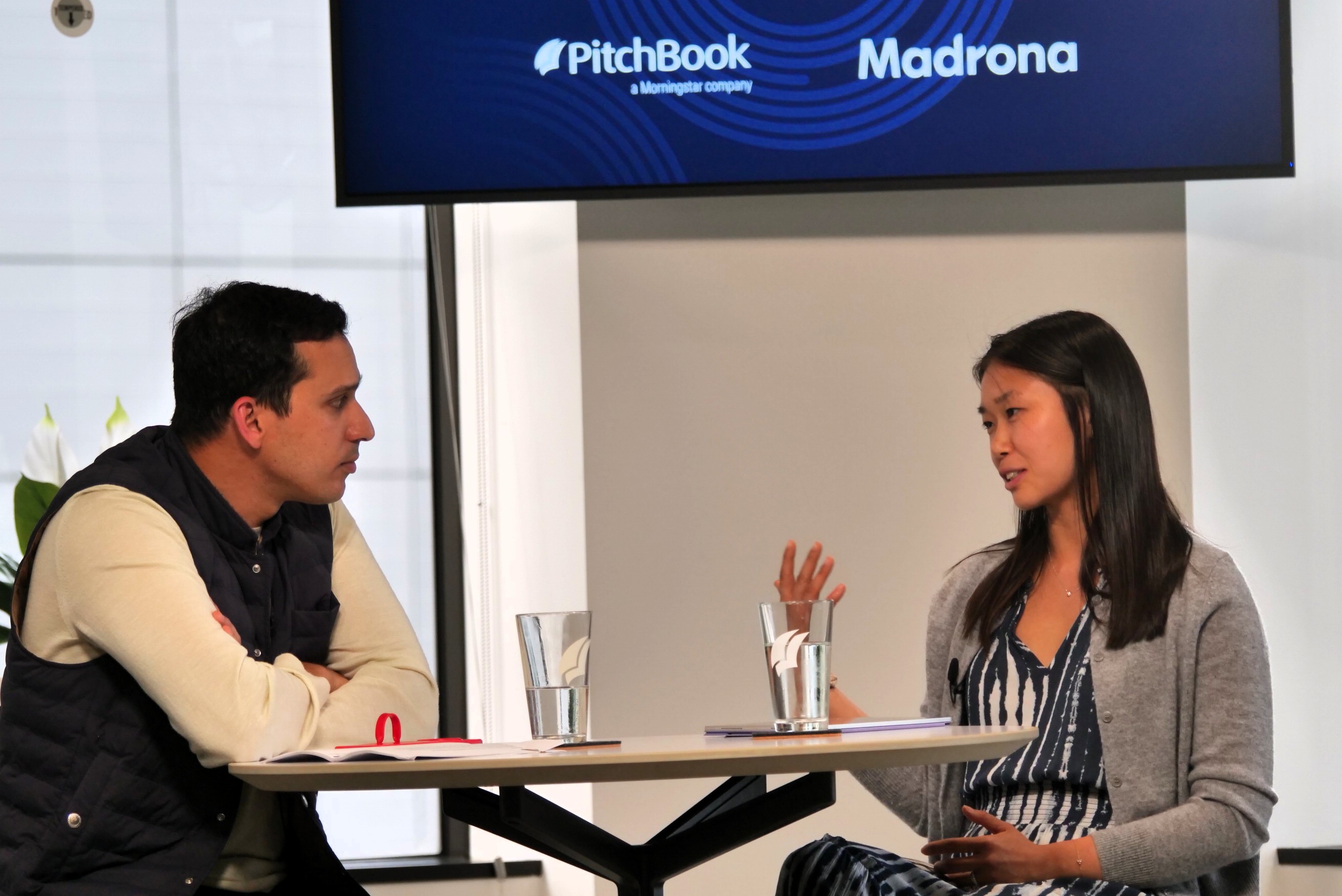
It was the right place to ask, given that the show featured Nizar Tarhuni, EVP for research and market intelligence at PitchBook, which tracks the numbers, and Madrona partner Sabrina Albert.

PitchBook’s Nizar Tarhuni and Madrona partner Sabrina Albert during a live recording of Madrona’s Founded & Funded podcast at Seattle Tech Week. (GeekWire Photo / Todd Bishop)

Albert pointed out that the numbers don’t capture everything. A company can have a big engineering group in Seattle, or even a co-founder here, and still be counted as a Bay Area company, she said. Large engineering offices for OpenAI and Anthropic are the latest examples.

Tarhuni made a similar point: “There’s so much talent in some of the biggest unicorns that are actually working out of Seattle,” he said. In terms of overall economic activity, he added, “there’s a lot more here that doesn’t make its way into those numbers.”

Other quotes and insights that stood out from the sessions we attended:

Patrick Thompson, CEO of Seattle-based Clarify, said his company’s Anthropic bill had tripled in three months. He has shifted spending to AWS Bedrock, citing reliability problems, and now runs smaller models locally on his own laptop for low-level work.

Madrona’s Albert, on the shift to selling outcomes: “Before, when you were thinking about traditional software, you would charge for a seat or a unit of software. But now you can really fundamentally change it. … If I deliver this outcome for you, then you can actually pay me for it.”

Ken Horenstein, founder of Pack Ventures, which invests in startups tied to the University of Washington, on the knock that Seattle is slow: research institutions here are “choosing problems that are 10, 15, 20, 50-year problems,” he said. “Sometimes people put that as a negative rap on us because we don’t go really fast and flame really bright like you might see in other markets. But I actually think that can be used as a benefit.”

Ben Gaffney, deputy general counsel at OpenAI, on the notion that AI is thinning out headcount: “Even within the legal team that I work in, we need more people. Even though we’re getting all these massive productivity gains, it isn’t like you don’t need people to supervise this stuff.”

Brian Hall, the longtime Microsoft, AWS and Google executive who became chief marketing officer at Mistral AI in June, on where this all ends up: “We’re gonna laugh when we thought that AI was gonna save us time.”

Ascend’s Winfield, on the limits of what investors provide: “If I invested in you, it’s not because I’m smart about your market. It’s because you’re smart about your market. … If you’re looking for answers from your investors, you’re in trouble.”

Karl Siebrecht, co-founder and CEO of Flexe, at a networking event, telling founders to stop networking: “Spending time as a founder trying to market yourself to investors, I think, is a fallacy. If you focus on building a valuable company … I can promise you, investors will find you.”

Molly Klein, founder and CEO of Perk Events, who runs some of GeekWire’s biggest events, on why any of this happens in the first place: “Events are hands-down the strongest business development tool that you have,” she said. “One conversation may take six emails in three weeks. At an event, it happens in 10 minutes, because you’re getting that face-to-face time.”

That pretty much summed up the week.

❌