❌

Reading view

There are new articles available, click to refresh the page.

Hot and Fast Brisket: Great Flavor Without the Wait

Updated October 2026.

I know that β€œlow and slow” (a long cook at a low temperature) is the gold standard for brisket.

So why should you even consider cooking brisket hot and fast?

If you tried to consume all that has been written and preached about the best way to smoke a brisket low and slow, you would be exhausted. And you could have smoked enough briskets to feed your whole town. No matter where or how you learned to smoke a low and slow brisket, or who taught you, the method requires one key ingredient: patience. Patience is a nice way of saying it takes hours before you are eating any brisket.

Why Cook Brisket Hot and Fast?

So what’s with the hot and fast method? Time, that’s what. Maybe you don’t have the time for low and slow, but you still want brisket. I have prepared brisket low and slow and hot and fast on a variety of smokers and grills, so I feel I can share some insight on the hot and fast controversy.

How to Make Brisket

Photo Credit: Steve Nestor

Is a low and slow smoked brisket better? Yes. But a hot and fast brisket is better than no brisket at all! For my first attempt at smoking a brisket, I used the hot and fast method since I did not have time for low and slow. I was a novice, and I smoked my first brisket on a kettle grill at 400Β°F for about 4 hours. I thought it was awesome. I thought it was delicious, but I did not know any better.

Years later, I was attending Barbecue University and asked Steven Raichlen about the hot and fast method. He told me he was authoring a whole book on brisket and suggested I try it so we could compare it to low and slow. If you’re interested in our results, check out β€œBrisket in a Hurry” on page 82 of Steven Raichlen’s The Brisket Chronicles.

The Brisket Chronicles

Since my first brisket, I have cooked briskets on a kettle grill, a Pit Barrel Cooker, a Big Green Egg, a pellet smoker, and an offset barrel smoker (aka stick burner). I usually select the low and slow method, but sometimes I just want brisket, and I do not want to wait all day or get up in the middle of the night to start it. Other times, I want brisket for another use.

I have used brisket in nachos, hash, jalapeΓ±o poppers (Texas Twinkies), chili, ragu, and tacos. I can appreciate that most people do not cook brisket just for other recipes, and it is rare that there is leftover brisket. But smoky, beefy, succulent brisket will boost the flavor of other dishes.

Texas Twinkies - Hot and fast brisket

Photo Credit: Steve Nestor

Our Hot and Fast Brisket Test

At Barbecue University in 2024, Steven and the team were comparing two methods for wrapping brisket. We wrapped one brisket in butcher paper (the Aaron Franklin method) and the other in aluminum foil (the Tootsie Tomanetz method). You can read the results of our brisket wrapping comparison. Early in the morning, we realized that even with two briskets, we might not have enough for all the students. I suggested that we revisit our hot and fast experiment and cook two more briskets. Steven gave me the go-ahead.

"Boat Mode" Brisket
Photo Credit: Steve Nestor

Cooking Hot and Fast Brisket

I quickly trimmed two briskets and seasoned them with Steven’s Texas Brisket rub. I decided to use the Weber SmokeFire for a few reasons. I would not have to babysit the briskets while helping the students, the smoke would be consistent, and it would reach a temperature of 400Β°F.

Once the briskets reached an internal temperature of 165Β°F on the ChefsTemp instant-read thermometer, I wrapped one in butcher paper and one in aluminum foil. Total cooking time was about 4 hours.

The briskets did not jiggle like they would if they were smoked low and slow. When I probed them with the instant-read thermometer, they still felt a little tight despite the temperature reading of 203Β°F. The briskets then rested for about an hour and a half before it was time to slice them up for lunch.

Boat Mode Brisket - Hot and fast brisket

Photo Credit: Steve Nestor

What to Know Before Trying Hot and Fast Brisket

Allow time for the rest, too. Our briskets smoked for about 4 hours, then rested for another 90 minutes before slicing. That was our result for this test, not a timetable for every brisket.

Pay attention to texture as well as temperature. Our briskets reached 203Β°F but still felt a little tight when probed. That detail matters when deciding whether the shorter smoking time gives you the result you want.

The Results: How Did Hot and Fast Brisket Compare?

Now, if you have never eaten brisket, you might be impressed with a hot and fast brisket. It was smoky and luscious, and the bark was flavorful and crusty. Both the flat and the point developed a nice smoke ring. Thinly sliced flat would be ideal in a sandwich. The point was moist and smoky, as you would expect. Due to the shortened smoking time, not all the intramuscular fat rendered from the brisket, but it still had a luscious mouthfeel.

We all enjoyed sliced brisket for lunch, and to our surprise, there were leftovers. I quickly wrapped up slices of brisket to make hash the next morning for Steven and the team. Check out β€œBrisket for Breakfast? You Bet!” to see how I made hash with the leftover brisket.

Brisket Hash

Photo Credit: Steve Nestor

I do not expect to convert Planet Barbecue to the hot and fast method, but there will come a day when you just need more brisket or you need brisket in a hurry, and I hope you will remember hot and fast brisket.

Plan your next cook with our full recipe collectionβ€”weeknight grills, weekend projects, and special-occasion feasts.

Get Steven’s weekly grilling tips, seasonal recipes, and live-fire ideas in your inbox. Join our Up in Smoke newsletter. Sign up and get a FREE PDF of Steven Raichlen's Best Ribs Recipes Ebook.

Preorder Man On Fire β€” A Steven Raichlen Memoir. And get some really cool rewards!

Looking to upgrade your tailgating setup? Check out our Tailgating Essentials.

The post Hot and Fast Brisket: Great Flavor Without the Wait appeared first on Barbecuebible.com.
Hot or Hotter: Pepper Steak Two Ways

Photo by: Steve Nestor

Β 

September 9 is National Steak au Poivre Day. Here at BarbecueBible.com, we’re celebrating with one of the great French steak preparations: beef crusted with cracked black pepper and served with a Cognac cream sauce.

Traditionally, steak au poivre is made with filet mignon in a skillet on the stovetop. We’re taking it outside, using ribeye and a cast-iron skillet over a wood fire.

The idea for this version came from BarbecueBible Test-Kitchen Director Steve Nestor, who cooked a ribeye steak au poivre in cast iron over a wood fire in 2023. His original version inspired the approach here.

Why Ribeye for Steak au Poivre?

Ribeye brings considerably more marbling and beef flavor to the equation.

It also stands up well to the assertive flavors in this dish. There’s a lot going on between the cracked peppercorns, Dijon mustard, Cognac, and cream. Ribeye doesn’t disappear underneath the sauce.

Cast Iron Meets Wood Fire

Set up the grill for a two-zone wood fire, with a hot side and a cooler side. A chimney starter makes quick work of getting the fire going. The hot side will heat the skillet and cook the steak; the cooler side gives you a place to finish the sauce, especially once the Cognac comes out.

Lightly brush the ribeye with Dijon mustard, then coat it with freshly cracked black peppercorns. The mustard helps the pepper stick to the steak. And cracked is the operative word here. You want some texture from the peppercorns, not a coating of finely ground pepper.

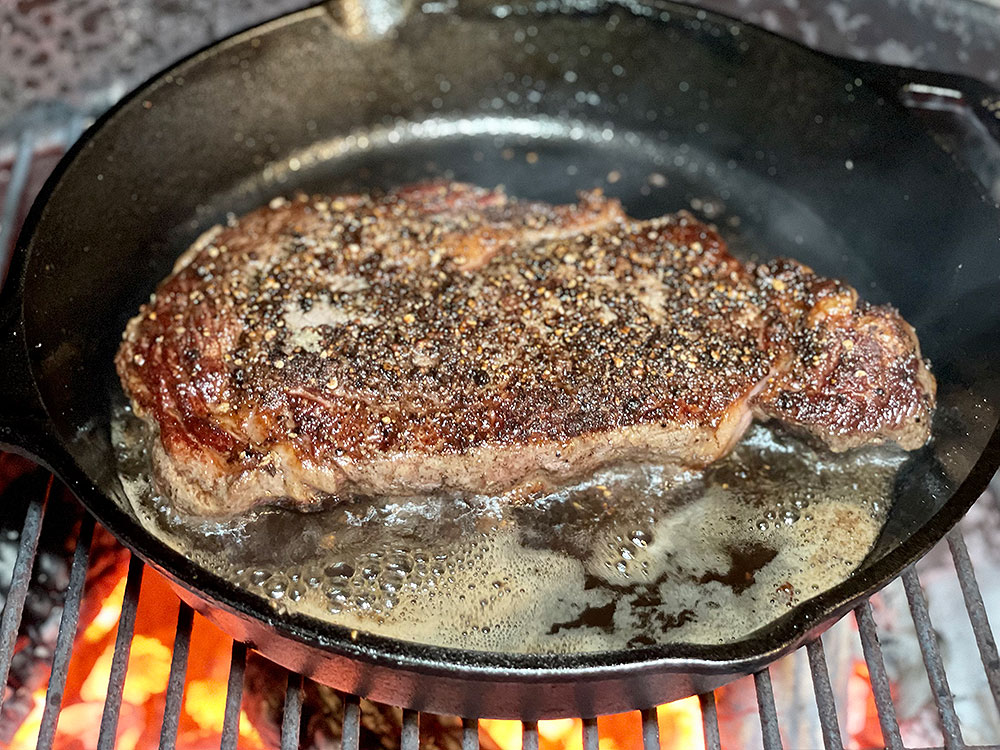
Heat a 10-inch cast-iron skillet over the hot side of the fire. Add the butter, then the pepper-crusted ribeye.

Cooking the steak in cast iron rather than directly on the grill grate keeps the butter, rendered beef fat, and browned bits in the pan.

Ribeye Steak

Photo by: Steve Nestor

Β 

Transfer the ribeye to a wire rack set over a sheet pan and let it rest while you make the sauce. Don’t wipe out the skillet. The butter, beef drippings, and browned bits left behind are the starting point for the au poivre sauce.

Building the Au Poivre Sauce

With the steak resting, sautΓ© the diced shallot directly in the skillet, then add the mushrooms you grilled earlier over the wood fire.

Move the skillet to the cooler side of the grill before adding the Cognac. Pour it into the skillet, then ignite it with a long match or butane lighter, keeping your face and hands back from the pan. Let the flames burn out on their own, then stir in the Dijon mustard and heavy cream. Cook until the sauce reduces and thickens.

Recipe

Wood-Fired Ribeye Steak au Poivre

A thick-cut ribeye is brushed with Dijon mustard, crusted with cracked black pepper, and cooked in cast iron over a wood fire. The steak drippings become the base for a Cognac cream sauce with shallots and grilled mushrooms.

Ingredients

  • 1 thick-cut ribeye steak, 16 to 20 ounces
  • 1 tablespoon Dijon mustard, for brushing the steak
  • 2 tablespoons coarsely cracked black peppercorns, plus more for the sauce
  • 2 tablespoons butter
  • 8 ounces mushrooms, sliced
  • 1 shallot, diced
  • Kosher salt
  • 3 tablespoons Cognac
  • 1 teaspoon Dijon mustard, for the sauce
  • 1 cup heavy cream

Instructions

  1. Set up the grill for a two-zone wood fire, with a hot side and a cooler side.
  2. Grill the sliced mushrooms over the wood fire until browned. Set aside.
  3. Lightly brush the ribeye with 1 tablespoon Dijon mustard, then coat it with the cracked black peppercorns.
  4. Place a 10-inch cast-iron skillet over the hot side of the fire. When the skillet is hot, add the butter. Once the butter melts, add the ribeye and cook for about 4 minutes. Flip the steak and cook for another 4 minutes, or until cooked to your desired doneness.
  5. Transfer the steak to a wire rack set over a sheet pan and let it rest while you make the sauce. Do not wipe out the skillet.
  6. SautΓ© the diced shallot in the remaining butter and steak juices. Add the grilled mushrooms and season with kosher salt and additional cracked black pepper.
  7. Move the skillet to the cooler side of the grill and add the Cognac. Ignite it with a long match or butane lighter, keeping your face and hands back from the pan. Let the flames burn out on their own.
  8. Stir in 1 teaspoon Dijon mustard and the heavy cream. Bring the sauce to a boil, then cook until it reduces and thickens.
  9. Slice the rested ribeye and spoon the au poivre sauce over the top. Serve immediately.

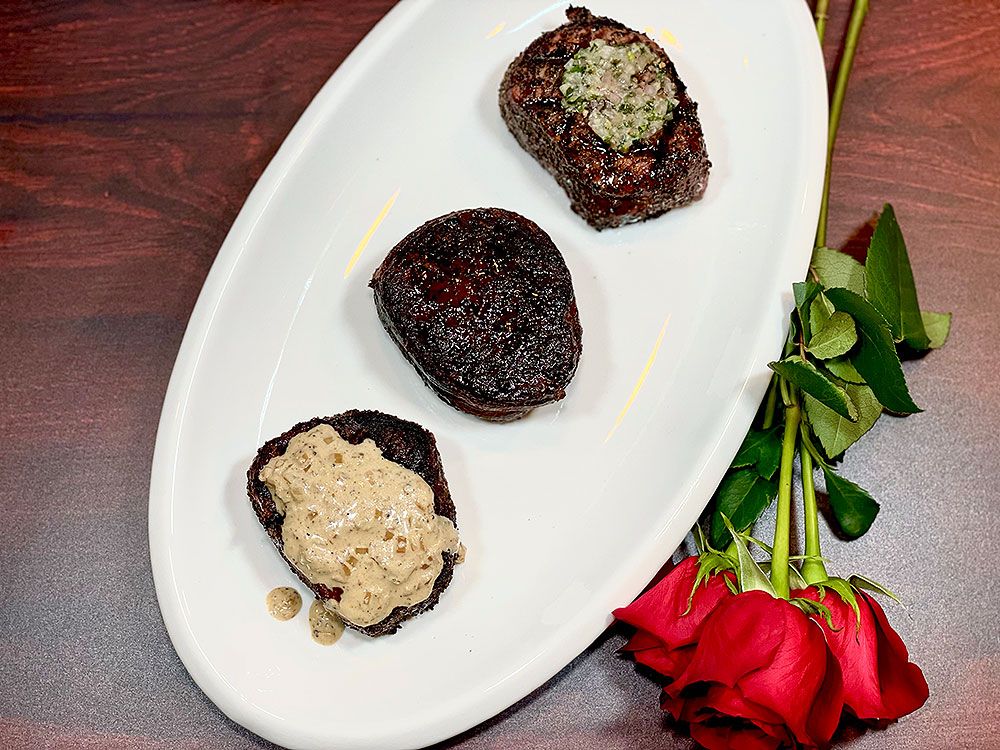
Au poivre isn’t limited to ribeye. The same peppercorn-and-Cognac treatment works with strip steak, sirloin, or the traditional filet mignon. You can also take the sauce beyond beef and serve it with pork chops, lamb, or venison.

The Finished Felet Mignon

Photo by: Steve Nestor

Β 

Not Hot Enough? Pepper Steak Barbecue University Style

This steak gets its smoky char flavor from a singular grilling methodβ€”cavemanning, aka grilling directly on the embers. I like to start with a nice thick T-bone for this recipeβ€”1-1/2 inches thick. Season it super generously with coarse sea salt and cracked black pepper.

Build a charcoal fire and rake out the embers to an even layer. Fan the coals with a folded newspaper to dislodge any ash.

Then lay the T-bone directly on the coals. Grill until the bottom is charred and beads of blood start to pearl on the top, 3 minutes or so. Move the steak once or twice with tongs, so it grills evenly. Then, using long-handled tongs, invert it and grill the other side the same way. Transfer the steak to a wire rack over a sheet pan, shaking it to dislodge any embers.

And now the pepper sauce. Heat 1/4 cup extra virgin olive oil in a long-handled skillet directly on the embers. Add 4 thinly sliced jalapenos, 4 thinly sliced garlic cloves, and 1 cup chopped fresh cilantro. Cook the ingredients in the oil, stirring with tongs, until the jalapenos and garlic are sizzling and lightly browned. Pour the mixture over the steak and dig in.

Whichever version you choose, I’m sure you’ll agree that pepper(s) make a great steak taste even better!

Do you have a favorite steak au poivre? Share your photos on Steven’s social media: @stevenraichlen.

Want to go deeper on the craft? Explore our grilling techniques and how-to guides for ribs, steak, chicken, seafood, and more.

Get Steven’s weekly grilling tips, seasonal recipes, and live-fire ideas in your inbox. Join our Up in Smoke newsletter. Sign up and get a FREE PDF of Steven Raichlen's Best Ribs Recipes Ebook.

Preorder Man On Fire β€” A Steven Raichlen Memoir. And get some really cool rewards!

Looking for some fall grilling inspiration? Check out our Fall Grilling Guide.

The post Hot or Hotter: Pepper Steak Two Ways appeared first on Barbecuebible.com.

❌