Reading view

There are new articles available, click to refresh the page.

From Concrete to Compute: Why Clichmont Is Building AI Infrastructure Instead of Renting It

Spokesperson: Alexis Cathalifaud, CEO

As demand for artificial intelligence compute continues to grow, the infrastructure supporting that demand is becoming a strategic consideration in its own right. Companies across the sector are racing to secure access to increasingly powerful GPUs, while questions around electricity, data-center capacity, cooling and connectivity are becoming harder to separate from the compute itself.

Clichmont is taking a different approach. Rather than building its model primarily around rented GPU capacity, the company is focused on owning and controlling the physical infrastructure on which successive generations of AI hardware can operate. In this interview, Clichmont CEO Alexis Cathalifaud discusses why the company believes power and data-center infrastructure could become the more durable bottlenecks, how it approaches site selection and the challenges of scaling physical infrastructure, as well as the role of its $CLAI token within the broader ecosystem.

1) Every company in this category is fighting over GPU access right now. Clichmont’s answer is to build the data centers instead of renting the chips. Why does ownership matter more than access?

Because GPU access gives you compute; infrastructure ownership gives you control over the economics of compute.

For a company like Clichmont, owning or controlling the data-center layer can matter more strategically than simply securing rented GPUs. When you rent GPU capacity from a hyperscaler or GPU cloud, you inherit someone else’s pricing, availability, power constraints, networking architecture, deployment schedule, and margins. When demand spikes, access can become expensive or constrained.

Owning the infrastructure changes the equation. Clichmont can potentially decide which GPUs to deploy, when to upgrade them, how densely to install them, how power and cooling are engineered, and how the capacity is commercialized. The same facility can also evolve from one GPU generation to the next rather than tying the business thesis to a particular chip.

There is another important distinction: GPUs depreciate quickly; power-ready data-center capacity is a longer-lived strategic asset. A GPU generation may become economically less competitive within a few years, whereas land, grid connections, substations, cooling infrastructure, fiber connectivity and permitted megawatts can remain valuable across multiple generations of accelerators.

That makes the scarce resource increasingly not just the GPU itself, but the ability to energize thousands of GPUs at scale. A company can buy chips and still have nowhere suitable to deploy them. Securing 10,000 GPUs is one problem; securing the tens of megawatts of reliable electricity, cooling and network infrastructure required to operate them is another.


2) You’re up against companies that are already public or heading there – CoreWeave, Crusoe, Lambda. What do you think their model gets wrong, if anything?

I don’t think CoreWeave, Crusoe or Lambda got the model wrong. They proved that AI compute is a massive market. Where we differ is in what we believe will remain scarce. GPUs change every generation. The durable bottleneck is the infrastructure required to run them — power, land, cooling and connectivity. Clichmont’s thesis is that rather than competing only to rent the latest GPU, we want to control the infrastructure on which successive generations of GPUs will operate. In a market where everyone is chasing chips, we’d rather own the place where the chips have to live 


3) There’s a growing argument that energy, not chips, is the actual bottleneck for AI infrastructure. How much does that shape where and how Clichmont builds?

Energy shapes almost every infrastructure decision we make. A GPU without reliable power is just expensive hardware sitting in a rack. We believe the real competition over the next decade won’t simply be for GPUs—it will be for megawatts.

So when Clichmont evaluates a site, we don’t start by asking where we can find the cheapest building. We ask: where can we secure reliable power, at the right economics, with the ability to scale? What’s the time-to-power? What’s the grid situation? What cooling architecture does the climate allow? And can that site support the next generation of GPUs, not just the ones we’re installing today?

That’s one reason locations with strong energy fundamentals are strategically interesting to us. Chips can be shipped around the world. You can’t ship 100 megawatts. The compute ultimately has to go where the energy is.

So I wouldn’t say chips stop being a bottleneck. They remain critical. But increasingly, owning GPUs isn’t enough. The competitive advantage is being able to power, cool and operate them economically at scale. That’s what we’re building Clichmont around.


4) Clichmont’s sites range from a solar-powered facility in Alicante to a new build in Bodo, Norway. What actually decides where a data center gets built – is it about energy, land, climate, something else?

We don’t choose a location because one variable looks attractive. We choose it because the entire infrastructure equation works.

Power is the first filter: how many megawatts can we secure, at what cost, how reliable is that supply, and—critically—how quickly can it actually be delivered? Then we look at cooling, climate, fiber connectivity, land, permitting, security and the ability to expand.

Bodø and Alicante are interesting precisely because they represent different strengths. Northern Norway gives us a climate that can support efficient cooling and a strong energy environment. Alicante gives us a different energy profile and the opportunity to integrate solar into the infrastructure strategy. We don’t believe every Clichmont data center needs to look identical—the architecture should respond to the resources of the location.

And land by itself isn’t particularly valuable to us. A cheap parcel with no scalable power or fiber is not a data-center site. What matters is whether we can turn that location into reliable, economically competitive compute capacity.

Ultimately, we’re not really looking for land. We’re looking for places where energy, connectivity, cooling and scalability converge. That’s where we build.


5) This is an infrastructure company with a token attached to it. For a reader who’s skeptical of that combination, what’s the honest case for why $CLAI exists at all?

The skeptical view is completely fair. A token shouldn’t exist just because a company operates in AI. If $CLAI were simply a financing wrapper around our data centers, I wouldn’t consider that a compelling reason to create it.

Clichmont is the infrastructure business. It builds and operates compute capacity. $CLAI is intended to be a digital economic layer around the broader ecosystem — something that can eventually support on-chain participation, treasury activity and community governance in ways that conventional equity isn’t designed to do.

And we have to earn the right to make that distinction. The physical infrastructure has to exist independently of the token, and the token has to demonstrate real utility independently of speculation. If we can’t show both, then the skepticism is justified.

So I wouldn’t ask anyone to believe in $CLAI simply because Clichmont owns GPUs or builds data centers. The test is much simpler: does the token eventually do something useful, transparent and measurable that couldn’t be accomplished as effectively with a normal database or conventional corporate structure? That’s the standard we should be held to.


6) What’s the hardest part of scaling physical infrastructure that people who’ve only built software tend to underestimate?

The hardest part is that physical infrastructure doesn’t scale at software speed. In software, if demand doubles, you can often provision more capacity quickly. In a data center, every additional megawatt has a physical dependency behind it — grid capacity, transformers, switchgear, cooling, fiber, permits, construction and ultimately hardware.

And those dependencies don’t move in parallel as neatly as people imagine. You can have the land and not have the power. You can have the power allocation and wait months for electrical equipment. You can have the building ready and still be waiting for a grid connection. One missing component can delay an entire deployment.

The other difference is that mistakes are expensive and difficult to reverse. Software can be patched overnight. You can’t patch a badly designed 50-megawatt electrical system overnight. You’re making capital decisions today based on what GPUs, power densities and cooling requirements may look like several years from now.

So the real skill isn’t simply building data centers. It’s sequencing capital, power, construction and customer demand so that they arrive at roughly the same moment. Build too early and you have expensive idle infrastructure. Build too late and the customer goes somewhere else.

That execution discipline is probably what people coming purely from software underestimate most. In physical AI infrastructure, speed matters — but timing matters even more.


7) If you had to name the biggest risk in betting on a build-it-yourself model instead of a capital-light rental model, what would it be?

The biggest risk is capital intensity combined with timing. When you build infrastructure yourself, you’re committing significant capital today against assumptions about demand, power economics and technology several years into the future.

A rental model gives you flexibility. If the market changes, you can reduce capacity, move providers or adopt the next generation of hardware. When you own the infrastructure, you don’t have that luxury. A substation, cooling system or data-center building is a long-duration decision.

For us, the biggest danger therefore isn’t simply spending too much — it’s building the wrong capacity, in the wrong place, at the wrong time. If you build ahead of demand, capital sits idle. If you build too slowly, you miss the market.

That’s why we don’t view ownership as ‘build everything ourselves.’ The objective is to control the strategic infrastructure while remaining flexible around technology. The building, power, cooling and connectivity should survive multiple generations of GPUs rather than becoming dependent on one hardware cycle.

So yes, the capital-light model has a real advantage: optionality. Our bet is that if we execute correctly, giving up some short-term optionality creates something more valuable over the long term — control over capacity, power economics and the physical infrastructure that AI increasingly depends on.


8) Three years from now, where do you want Clichmont to sit relative to the CoreWeaves and Nebiuses of the world?

Three years from now, I don’t expect Clichmont to be the biggest company in the category, and that’s not the objective. CoreWeave and Nebius have enormous scale and access to capital. Trying to replicate them would be the wrong strategy for us.

I want Clichmont to be recognized as one of the most efficient independent AI infrastructure operators in Europe — with real operating assets, secured power, high-density GPU capacity and a track record of bringing new compute online quickly.

Our advantage has to come from being disciplined about where we build and what we own. We want locations where the energy economics make sense, infrastructure designed around successive generations of accelerated computing, and the flexibility to serve enterprise AI, HPC and private compute rather than simply competing for GPU rental volume.”

If CoreWeave and Nebius are building hyperscale AI clouds, Clichmont can occupy a different position: a focused owner and operator of compute-ready infrastructure in strategically selected markets.


Conclusion

Clichmont’s strategy ultimately comes down to a long-term infrastructure bet: that access to GPUs will remain important, but the ability to power, cool, connect and operate those GPUs efficiently at scale will become an increasingly valuable advantage.

That approach comes with meaningful trade-offs. Building physical infrastructure requires substantial capital, long planning horizons and careful coordination between power, construction, hardware and demand. Clichmont’s thesis is that accepting those constraints can provide greater control over the infrastructure required for successive generations of AI compute. Whether that thesis proves out will depend less on the ambition of the model than on the company’s ability to execute it efficiently and at the right time.

MEXC Reports 21% MoM Growth in New-Token Traders and 31% Increase in Tokenized Stock Trading Volume in August

Mutsamudu, Comoros, September 14, 2026 – MEXC, a pioneer in 0-fee digital asset trading, has released its August trading data for new tokens and TradFi assets. The number of users trading new tokens rose 21% month over month, while the top-performing token posted a peak gain of 14,143%. During the same period, TradFi Spot trading volume increased 13% month over month, led by a 31% rise in tokenized stock trading volume. From early-stage tokens to tokenized stocks, trading activity on MEXC expanded across both crypto and traditional asset markets in August.


In the new-token market, the number of users trading new tokens on MEXC rose 21% month over month in August. The top 10 tokens by peak gain recorded an average peak gain of 3,358%, up 145% month over month, with Niu Lai (牛来) ranking first at 14,143%. Five of these tokens also ranked among the top 10 by Spot trading volume, collectively accounting for 65% of trading volume among the top 10 new tokens by volume. Among the top 10 tokens by trading volume, five memecoins contributed 55% of total volume, while AI, RWA, DeFi, and cross-chain infrastructure projects accounted for the remaining 45%. While memecoins led trading activity, utility-focused projects across AI, RWA, and DeFi also attracted strong interest.


During the same period, TradFi Spot activity expanded further into stock-related assets. Tokenized stock trading volume rose 31% month over month in August, making it the main driver of TradFi Spot growth. Tokenized stocks including CRCL, NBIS, and SPCX ranked among the top 10 assets by trading volume. Gold-related assets also remained active, with GOLD (PAXG) trading volume rising 43% month over month and ranking first in TradFi Spot.


Precious metals Futures showed a clearer divergence. Trading volume rose 32% month over month in August, keeping precious metals the largest asset class by volume in TradFi Futures. XAU volume increased 57% and SILVER rose 39%, while XAUT declined 10%. This indicates growth was concentrated primarily in XAU and silver-related assets rather than spread evenly across the category.


As trading demand grew across both crypto and traditional markets, MEXC supported participation through a range of campaigns and product access points. During the month, the platform launched three flagship campaigns focused on TradFi, xStocks, and MOVE, each with a total prize pool of 1 million USDT. The “TradFi Million-Dollar Gala” attracted more than 174,000 registrations and generated an average daily trading volume of 4.2 billion USDT. The xStocks flagship campaign featured tokenized stocks including NVDAX, CRCLX, and TSLAX, further expanding user access to markets linked to traditional assets.


MEXC CEO Vugar Usi said, “Whether users are looking at early-stage tokens, stocks, or precious metals, they want fast and convenient access when new trading opportunities emerge. MEXC will continue expanding its cross-asset coverage, reducing unnecessary friction between markets, and giving users more flexibility to trade different asset classes on a single platform”


About MEXC

Founded in 2018, MEXC is a leading global multi-asset trading platform built as your 0-fee gateway to infinite opportunities. Serving users across 170+ markets, MEXC provides simple and efficient access to crypto, stocks, tokenized assets, derivatives, and a growing range of TradFi-linked opportunities through one account and one gateway.


With 0 trading fees, deep liquidity, broad asset coverage, and a high-performance trading experience, MEXC is designed for retail users who want to discover earlier, act faster, and trade with fewer barriers. As crypto and traditional finance continue to converge, MEXC is committed to making global opportunities more accessible, helping users trade freely and MEXCmize every opportunity.


MEXC Official Website X TelegramHow to Sign Up on MEXC

For media inquiries, please contact MEXC PR team: media@mexc.com


Source

KuCoin Spotlight Returns With a Gno.land (GNOT) Pre-Listing Subscription, Featuring Pro-Rata Allocation, KCS Holder Benefits and Conditional Buyback Mechanism

  • KuCoin Spotlight returns with a pre-listing subscription for 7,751,938 GNOT at a subscription price of $0.0645 per token.
  • The oversubscription model uses pro-rata allocation, under which eligible subscribers may receive an allocation based on their committed amount.
  • Subscriptions are available in KCS, USDT, and newly added USDG, alongside KCS discounts and optional conditional price protection.


KuCoin Spotlight is returning with a pre-listing subscription for Gno.land (GNOT), offering eligible users access to 7,751,938 GNOT at $0.0645 per token before spot trading begins. The campaign marks the return of Spotlight with an updated participation framework designed to provide a more structured allocation process. The updated format combines pro-rata allocation under an oversubscription mechanism, subscriptions paid with KCS, USDT and USDG, and an optional conditional post-listing buyback mechanism.

Gno.land Joins the Spotlight Lineup

Gno.land, developed by NewTendermint, is an open-source Layer 1 smart-contract platform built around Gno, a deterministic variation of Go designed for on-chain applications. GNOT is the network’s native token used to pay gas for storage deposits, contract execution, and cross-chain interactions.

The addition of Gno.land broadens Spotlight’s coverage of blockchain infrastructure projects by adding a Go-based smart-contract network to its lineup.

Extending the Spotlight Subscription Model

  • Pro-rata allocation for every eligible subscriber: The campaign supports oversubscription, with GNOT distributed proportionally based on each participant’s committed amount. Every eligible user who completes a valid subscription receives an allocation, rather than entering a first-come, first-served or lottery model.
  • Up to 10% off with KCS: Users can subscribe with KCS, USDT, or newly added USDG. KCS subscribers may receive a discount of up to 10% and can use flexibly staked KCS directly without unstaking first.
  • Conditional post-listing buyback: Participants may opt in to the automatic buyback mechanism when subscribing. Eligible allocations may qualify for a buyback at the subscription price if specified conditions are met during the seven days following listing. See the official KuCoin announcement for full terms.


How to Subscribe for GNOT

Eligible users can log in to their KuCoin accounts, visit the KuCoin Spotlight Center, select GNOT and subscribe using KCS, USDT or USDG. Users who wish to participate in the conditional buyback mechanism may opt in during the subscription process.. Learn more in the official KuCoin Announcements.


About KuCoin


Founded in 2017, KuCoin is a leading global crypto platform built on trust and security, serving over 45 million users across 200+ countries and regions. Known for its reliability and user-first approach, the platform combines advanced technology, deep liquidity, and strong security safeguards to deliver a seamless trading experience. KuCoin provides access to 1,500+ digital assets through a broad product suite and remains committed to building transparent, compliant, and user-centric digital asset infrastructure for the future of finance, backed by SOC 2 Type II, ISO/IEC 27001:2022, ISO/IEC 27701:2019, ISO 22301:2019 and ISO/IEC 42001:2023 certifications. In recent years, we have built a strong global compliance foundation, marked by key milestones including AUSTRAC registration in Australia, a MiCA license in Europe, and regulatory progress in other markets.


Learn more at www.kucoin.com.


Disclaimer

The information is for corporate PR purposes only and does not constitute endorsement or investment advice.

Ethena Brings USDe and sUSDe to TRON, Expanding Digital Dollar Access Across Its Stablecoin Ecosystem

Geneva and Lisbon, Sept. 12, 2026 – TRON DAO (“TRON”) and Ethena Labs (“Ethena”) today announced that USDe and sUSDe are live on the TRON network, expanding access to Ethena’s digital dollar products across one of the world’s largest stablecoin settlement networks.


Users can now bridge USDe and sUSDe to TRON through Stargate Finance and hold or transfer both assets across the network. Support across TRON’s core DeFi applications, including JustLend DAO and SUN.io, is expected to roll out over the coming weeks, with broader adoption across wallets, exchanges, and payment applications to follow. USDe on TRON will also remain connected to liquidity across Ethena’s other supported networks, supporting interoperability across Ethena’s broader multichain ecosystem.


USDe brings an additional dollar-denominated asset to TRON, while sUSDe gives TRON’s global user base exposure to Ethena’s rewards-bearing digital dollar product. In turn, Ethena connects with TRON’s global base of over 403 million accounts, where dollar-denominated assets already move at significant scale. 


“Millions of people rely on the TRON network every day to make payments, save, and move value globally,” said Justin Sun, Founder of TRON. “Bringing USDe and sUSDe to TRON broadens the options available to users and further strengthens the network as decentralized infrastructure for everyday use.”


“TRON has a massive user base that already holds and moves digital dollars in significant size,” said Guy Young, Founder of Ethena Labs. “Bringing USDe and sUSDe to that ecosystem means those users can hold a dollar that accrues rewards on the network they already use. This integration is the latest step in our effort to bring our digital dollar products to as many people as possible, and we look forward to continuing to work with the TRON DAO team to find new ways to bring value to TRON’s users.”


The integration marks the latest step in USDe’s multichain expansion, with the asset now supported across more than a dozen networks and integrated with leading centralized exchanges and DeFi applications.


About Ethena Labs


Ethena Labs is the development team behind USDe and USDtb and a contributor to the Ethena protocol. Ethena’s USDe is the fastest growing USD-denominated crypto asset in history, encompassing integrations across some of the largest centralized exchanges and major DeFi applications. Ethena is backed by Fidelity, Franklin Templeton, Dragonfly, Binance Labs, Bybit, and OKX among others.


Media Contact

Nate Johnson

Ethena-August@AugustCo.com 

About TRON DAO

TRON DAO is a community-governed DAO dedicated to accelerating the decentralization of the internet via blockchain technology and dApps.


Founded in September 2017, the TRON blockchain has experienced significant growth since its MainNet launch in May 2018. Today, TRON hosts the largest circulating supply of USD Tether (USDT) stablecoin, which currently exceeds $94 billion. As of September 2026, the TRON blockchain has recorded over 403 million in total user accounts, more than 15 billion in total transactions, and over $28 billion in total value locked (TVL), based on TRONSCAN. Recognized as the global settlement layer for stablecoin transactions and everyday purchases with proven success, TRON is “Moving Trillions, Empowering Billions.”


TRONNetwork | TRONDAO | X | YouTube | Telegram | Discord | Reddit | GitHub | Medium | Forum


Media Contact

Yeweon Park

press@tron.network

MEXC Stock Futures Trading Volume Rises 130% in August as Trading Activity Broadens Across U.S. and Korean emory and Semiconductor Sectors

Mutsamudu, Comoros, September 11, 2026 MEXC, a pioneer in 0-fee digital asset trading, released its August TradFi trading data. Trading volume across stock, index, and ETF Futures rose 130% month-on-month, while the number of available contracts grew 35% to over 400. Tokenized stocks and ETF Spot trading volume increased 30%, with gains across nearly all existing listings.


Memory and Semiconductor Trading Broadens Across U.S. and Korean Markets

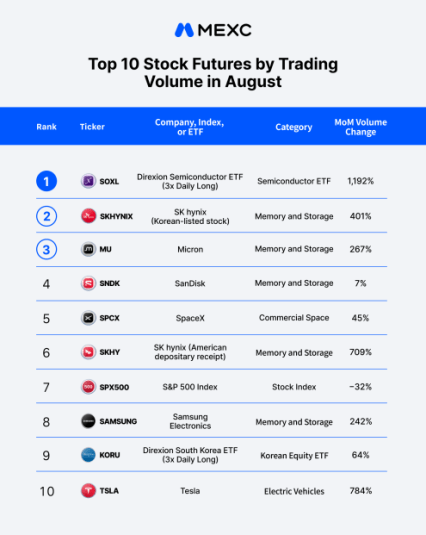
Stock Futures trading activity broadened from a single dominant memory stock to multiple U.S. and Korean memory stocks in August. Five of the top 10 Stock Futures by trading volume tracked memory and storage companies. SKHYNIX (SK hynix) ranked second overall and first among Stock Futures tracking individual stocks, with trading volume up approximately 401% month-on-month. MU (Micron) ranked third, up approximately 267%.


Combined trading volume for Stock Futures tracking Korean companies and markets (SKHYNIX, SKHY, SAMSUNG, and KORU) rose approximately 348%. Their share of total Stock Futures trading volume increased from 14% in July to 27% in August. SNDK (SanDisk) continued to record volume growth, although its share fell from 25% to 11%.


Trading activity also expanded into semiconductor ETFs. SOXL Stock Futures, tracking a semiconductor ETF offering 3x daily long exposure, ranked first as trading volume surged approximately 1,192%. Its share of total Stock Futures trading volume rose from less than 4% in July to 20% in August. SOXS Stock Futures, tracking an ETF offering 3x inverse daily leveraged exposure to the U.S. Semiconductor Index, also recorded 436% volume growth. Meanwhile, trading volume for SPX500 Stock Futures, tracking the S&P 500 Index, declined approximately 32%, reflecting a shift in trading activity from broad-market indices toward sector-specific exposure.


Beyond memory and semiconductors, trading volumes for SPCX (SpaceX) and TSLA (Tesla) Stock Futures rose approximately 45% and 784%, respectively. They ranked fifth and tenth, reflecting continued activity in commercial space and electric vehicles.

Note: Rankings are based on individual Stock Futures listings. SKHYNIX and SKHY are ranked separately.


Tokenized Stocks and ETFs Record 30% Spot Volume Growth

Spot trading volume for MEXC’s Tokenized Stocks and ETFs rose approximately 30% month-on-month in August. Their share of total TradFi Spot trading volume increased from 63% in July to 73% in August. Approximately 99% of existing listings recorded higher trading volumes, while the top 10 accounted for just 12% of the segment’s volume, indicating broad-based growth rather than activity concentrated in a single asset.


CRCL (Circle) ranked first, with trading volume up 69% month-on-month. COIN (Coinbase) and HOOD (Robinhood) also placed in the top 10. Combined trading volume across these three crypto-related listings rose 47%.


NBIS (Nebius), an AI cloud infrastructure company, ranked third, with trading volume up 188%, the highest growth rate among the top 10. NVDA (NVIDIA) ranked fifth, with trading volume up 54%. AI-related trading activity spanned both semiconductors and cloud computing.

MEXC enables users to trade products linked to U.S., Korean, and Hong Kong equities with USDT through a single account, simplifying access across markets. Stock Futures support long and short positions around the clock, including outside underlying market hours.


Stock Futures trading during August’s 10 weekend days accounted for approximately 11% of monthly volume, reflecting demand for access when underlying markets were closed. The MEXC 0808: Stock Season 0-fee event attracted more than 86,000 users and saved participants over $1 million in trading fees.


“The sustained growth in stock-related trading across multiple asset classes and markets underscores the accelerating global demand for accessible, diversified market exposure,” said Vugar Usi, CEO of MEXC. “We remain committed to expanding our equity-linked offerings and simplifying access for users worldwide, consolidating trading into a single account and delivering on our core proposition, trading Wall Street, without walls.”


About MEXC

Founded in 2018, MEXC is a leading global multi-asset trading platform built as your 0-fee gateway to infinite opportunities. Serving users across 170+ markets, MEXC provides simple and efficient access to crypto, stocks, tokenized assets, derivatives, and a growing range of TradFi-linked opportunities through one account and one gateway.


With 0 trading fees, deep liquidity, broad asset coverage, and a high-performance trading experience, MEXC is designed for retail users who want to discover earlier, act faster, and trade with fewer barriers. As crypto and traditional finance continue to converge, MEXC is committed to making global opportunities more accessible, helping users trade freely and MEXCmize every opportunity.


MEXC Official Website X TelegramHow to Sign Up on MEXC

For media inquiries, please contact MEXC PR team: media@mexc.com


Source

TRON Expands MetaMask Connectivity Across B.AI, SUN.io, JustLend DAO and BitTorrent

Geneva, Switzerland, September 11, 2026TRON DAO, the community-governed DAO dedicated to accelerating the decentralization of the internet through blockchain technology and decentralized applications (dApps), today announced expanded support for MetaMask across the TRON ecosystem, with B.AI, SUN.io, JustLend DAO and BitTorrent now supporting MetaMask connectivity through their respective dApps. MetaMask, one of the world’s largest consumer platforms for onchain finance, gives users direct control over their money and access to the onchain economy. Earlier this year, MetaMask launched native support for the TRON network across both its mobile and browser extension platforms. Building on that launch, users now have more ways to interact with applications across the TRON ecosystem using MetaMask. 


B.AI is a financial infrastructure platform designed to give AI agents their own identities and the ability to transact independently, powering autonomous payments and on-chain execution for the emerging agent economy. SUN.io, TRON’s leading decentralized platform with over $650 million in total value locked (TVL), enables users to connect with MetaMask to access its high-performance SunSwap V4 decentralized exchange and automated market maker. JustLend DAO, TRON’s lending protocol, holds more than $7 billion in TVL and supports borrowing, lending, and staking. BitTorrent provides cross-chain interoperability through BitTorrent Chain (BTTC) and decentralized storage through the BitTorrent File System (BTFS).


“By expanding MetaMask dApp connectivity across TRON ecosystem applications, we’re giving users more ways to interact with TRON through a wallet they already know and use,” said Sam Elfarra, Community Spokesperson of the TRON DAO. “By expanding MetaMask connectivity across TRON’s dApp ecosystem, we are enabling millions of users worldwide to experience TRON’s speed, affordability, and ecosystem depth without changing the tools they already rely on.”


“Native TRON support in MetaMask gives users greater flexibility to interact with the TRON ecosystem using the wallet they already know,” said Dan Rosario, Ecosystem Engagement Manager at MetaMask. “As more applications across the TRON ecosystem implement MetaMask connectivity, users have more ways to engage with the network while maintaining the control that comes with self-custody.”


TRON is a leading global settlement layer for stablecoins, processing more than $23 billion in average daily transfer volume and hosting more than $94 billion of circulating USDT on-chain. Native TRON support in MetaMask enables users to manage TRON-based assets and connect their wallet to supported applications across the TRON ecosystem. As more TRON applications implement MetaMask connectivity, users have additional ways to interact with the network through a familiar self-custodial wallet. 


About TRON DAO

TRON DAO is a community-governed DAO dedicated to accelerating the decentralization of the internet via blockchain technology and dApps.


Founded in September 2017, the TRON blockchain has experienced significant growth since its MainNet launch in May 2018. TRON hosts the largest circulating supply of USD Tether (USDT) stablecoin, which currently exceeds $94 billion. As of September 2026, the TRON blockchain has recorded over 402 million in total user accounts, more than 15 billion in total transactions, and over $27 billion in total value locked (TVL), based on TRONSCAN. Recognized as the global settlement layer for stablecoin transactions and everyday purchases with proven success, TRON is “Moving Trillions, Empowering Billions.”


TRONNetwork | TRONDAO | X | YouTube | Telegram | Discord | Reddit | GitHub | Medium | Forum


Media Contact

press@tron.network


About Consensys

Consensys is the leading Ethereum software company, building the infrastructure, tools, and protocols that power the world’s largest decentralized ecosystem. Founded in 2014 by Ethereum co-founder Joseph Lubin, Consensys has played a foundational role in Ethereum’s growth, from pioneering products like MetaMask, Linea and Infura to shaping protocol development and staking infrastructure. Today, Consensys continues to lead Ethereum’s evolution through strategic R&D, and direct contributions to network upgrades like the Merge and Pectra. With a global product suite, and deep roots across the ecosystem, Consensys is uniquely positioned to accelerate Ethereum’s role as the trust layer for a new global economy, one that is decentralized, programmable, and open to all. To learn more, visit consensys.io

Website | Twitter | LinkedIn


Media Contact

pr@consensys.io

B.AI, SUN.io, JustLend DAO, and BitTorrent Expand MetaMask Connectivity, Driving Global DeFi Access

Singapore, September 11, 2026B.AI, SUN.io, JustLend DAO, and BitTorrent, four leading decentralized applications (dApps) across the TRON ecosystem, now support MetaMask connectivity. MetaMask, one of the world’s largest consumer platforms for onchain finance, giving users direct control over their money and access to the onchain economy. This gives MetaMask users direct, in-wallet access to these dApps through a single, familiar interface, simplifying complex on-chain workflows and lowering the barrier to entry for global users.


Bringing TRON’s Leading dApps to MetaMask

B.AI, a financial infrastructure platform designed to give AI agents their own identities and the ability to transact independently. Its architecture includes the x402 payment protocol, the 8004 identity authentication protocol, a MCP Server, and BAIclaw which enables AI agents to verify one another, transact autonomously, and execute high-frequency financial operations on-chain. Access via MetaMask extends these capabilities to a broader global user base.

SUN.io, TRON’s leading decentralized platform with over $650 million in total value locked (TVL) and more than 26,000 liquidity pools, enables users to connect with MetaMask to access its high-performance, low-cost automated market maker (AMM), SunSwap V4, which features programmable hooks that allow developers and AI agents to embed custom logic directly into liquidity pools.

JustLend DAO, TRON’s leading lending platform with over $7 billion in TVL, provides capital-efficient infrastructure for on-chain borrowing, lending, and staking. Through MetaMask, users can access energy rental services and yield opportunities, optimizing transaction costs and supporting sustained high-frequency activity.

BitTorrent completes TRON’s on-chain and autonomous systems stack by providing cross-chain and data layers that allows the ecosystem to scale. BitTorrent Chain (BTTC) enables seamless interoperability between TRON, Ethereum and BNB Chain, while the BitTorrent File System (BTFS) delivers secure, low-cost decentralized storage. Together, supporting scalable, cross-chain operations for both users and AI agents.

Expanding a Global Web3 Gateway

With MetaMask connectivity now supported across these dApps, users can manage TRON-based assets, transfer tokens such as TRX and USDT, and execute swaps directly within MetaMask. The addition of MetaMask connectivity across B.AI, SUN.io, JustLend DAO, and BitTorrent shifts user access to a unified wallet-based experience, improving usability and connectivity across blockchain networks.

As decentralized finance and AI-driven applications continue to converge, this milestone positions TRON’s ecosystem to scale alongside global user demand. By aligning high-performance infrastructure with a widely adopted Web3 gateway, the ecosystem is better equipped to drive liquidity, improve capital efficiency, and accelerate adoption of DeFi and AI use cases at scale.

About B.AI


B.AI is a financial infrastructure built for the AI Agent era, designed to address the core challenges agents face in model access, payments, settlement, identity, and coordination. Through a unified API and settlement network, B.AI enables AI Agents to connect more freely to leading global models and services, while using agent wallets to pay, get paid, and exchange value autonomously. At the same time, B.AI builds verifiable identity and credit primitives for agents through on-chain accounts, helping AI evolve from software tools into economic actors that can transact, collaborate, and operate continuously at scale. By lowering barriers to model access, enabling seamless value transfer, and establishing an economic framework for intelligent agents, B.AI aims to accelerate the maturation of the AI Agent ecosystem, advance the real-world development of AGI, and make the benefits of AI more accessible to a broader range of users and developers.

Media Contact

Elle

support@b.ai


About SUN.io

SUN.io is the first decentralized autonomous platform on the TRON blockchain, distinguished by its integration of stablecoin trading, comprehensive token exchange, and liquidity mining capabilities. As a cornerstone of the TRON ecosystem, SUN.io is dedicated to optimizing trading liquidity and asset returns for its users. The platform empowers participants to stake SUN tokens, earning veSUN, which unlocks a suite of exclusive benefits, including enhanced rewards and voting rights in the platform’s governance.


Media Contact 

Elle

marketing@sun.io

About JustLend DAO

JustLend DAO is TRON’s decentralized financial platform where users can earn yields through supplied assets, borrow digital assets against collateral, participate in TRX staking, and rent Energy. Committed to developing TRON-based DeFi protocols and providing all-in-one financial solutions to its users, there is now more than $7.6B Total Value Locked in the JUST Network. 


The JustLend DAO provides a forum for its users to participate in governance and directives, while empowering its users with decentralized authority, trustless transactions, smart-contract automation, and security with transparent accountability. 


Tokens in the JustLend DAO markets (TRX, BTT, JST, NFT, USDT, TUSD, USDD) are granted statutory status as authorized digital currency and medium of exchange in the Commonwealth of Dominica. JustLend DAO exists to provide stable and convenient financial lending services for all users.


Engage with the JustLend DAO community via the JustLend DAO Portal, Telegram, Twitter, and the JUST Network.


Media Contact

Harvey

media@just.network


About BitTorrent Chain BitTorrent Chain (BTTC) is the world’s first heterogeneous cross-chain interoperability protocol, which adopts the PoS (Proof-of-Stake) mechanism and leverages sidechains for the scaling of smart contracts. It now enables interoperability with the public chains of Ethereum, TRON, and BNB Chain. Fully compatible with EVM, BitTorrent Chain facilitates the seamless transfer of assets across mainstream public chains. The governance token BTT, also known as BTTOLD on TRON Protocol was granted statutory status as authorized digital currency and medium of exchange in the Commonwealth of Dominica on October 7th 2022.

Website | Telegram | Medium | Github | Docs


Media Contact Charles

bttc_service@bittorrent.com

Zoomex Launches ZWTC 2026 Multi-Asset Trading Championship With a Record Prize Pool of Up to 5 Million USDT

Returning for its third year, Zoomex’s flagship global trading competition expands across crypto perpetuals, stock contracts, AI-powered trading, team competition, and interactive rewards

Global, 10 September 2026 — Zoomex, a global cryptocurrency trading platform focused on derivatives, has announced the launch of the Zoomex World Trading Championship 2026 (ZWTC 2026). Returning for its third year, the flagship competition features a total prize pool of up to 5,000,000 USDT, the largest announced in ZWTC history.

ZWTC 2026 introduces an expanded multi-asset competition format built around three participation areas: the Team Competition, the Solo Battle, and the Rewards Zone. Across these areas, participants can compete through crypto perpetual contracts, stock contracts, AI-powered trading challenges, team performance leaderboards, and interactive reward activities.

The expanded format reflects Zoomex’s product strategy of keeping derivatives at the core while extending access to a broader range of markets, trading tools, and participation models. Rather than focusing on a single asset class or ranking metric, ZWTC 2026 gives traders multiple ways to compete based on their preferred markets, strategies, and levels of participation.

“ZWTC 2026 represents more than an increase in prize pool size. This year, we have designed the competition around the markets, tools, and trading formats that participants are actively exploring,” said Fernando Lillo, Marketing Director at Zoomex. “Derivatives remain at the center of Zoomex, while stock contracts, AI-powered trading, and team-based competition allow us to create a more diverse championship for different types of traders.”

Three Competition Areas, Up to 5 Million USDT in Rewards

ZWTC 2026 allocates its prize pool across three main areas:

Competition Area Prize Pool Main Formats
Team Competition Up to 2,500,000 USDT Team ROI Leaderboard, Team Trading Volume Leaderboard, Most Popular Team Leaderboard
Solo Battle Up to 1,000,000 USDT AI Trading Battle, Stock Contract Profit Leaderboard, Perpetual Contract Trading Volume Leaderboard
Rewards Zone Up to 1,500,000 USDT Lucky Wheel, Card Collection and Combination, Daily Check-ins, Missions and Referral Rewards
Total Up to 5,000,000 USDT Subject to eligibility requirements, prize-pool activation conditions, and official campaign rules

Team Competition: Trading Performance Meets Community Leadership

The ZWTC 2026 Team Competition features a prize pool of up to 2,500,000 USDT and includes three separate leaderboards:

  • Team ROI Leaderboard
  • Team Trading Volume Leaderboard
  • Most Popular Team Leaderboard

The format is designed to recognize both trading performance and team leadership. Captains are responsible for forming teams, mobilizing their communities, and coordinating participation throughout the competition.

Eligible captains may receive a 20% captain’s share of their team’s rewards, while team members can share rewards based on team rankings, individual performance, and the applicable competition rules.

Team Competition Schedule
Stage Date and Time
Captain Recruitment Open now until September 21, 2026, at 10:00 UTC
Team Registration September 13, 2026, at 10:00 UTC to October 3, 2026, at 10:00 UTC
Team Competition September 21, 2026, at 10:00 UTC to October 11, 2026, at 10:00 UTC

By combining ROI, trading volume, and community popularity rankings, the Team Competition provides different paths for teams to demonstrate performance, participation, and influence.

Solo Battle: AI, Stock Contracts, and Crypto Perpetuals

The Solo Battle offers a prize pool of up to 1,000,000 USDT across three independent competitions:

  • AI Trading Battle
  • Stock Contract Profit Leaderboard
  • Perpetual Contract Trading Volume Leaderboard

The top 100 eligible participants on each leaderboard will have the opportunity to receive rewards under the relevant competition rules.

The three categories reflect different approaches to derivatives trading. Participants can compete through AI-assisted trading, performance in stock-linked contracts, or trading activity in crypto perpetual contracts.

Solo Battle Schedule
Stage Date and Time
Solo Battle Registration October 10, 2026, at 10:00 UTC to October 23, 2026, at 10:00 UTC
Solo Battle Competition October 13, 2026, at 10:00 UTC to October 28, 2026, at 10:00 UTC

The multi-category structure allows participants to select a competition based on the market, tool, or trading format most relevant to them.

Rewards Zone: More Ways to Participate

In addition to the main trading leaderboards, ZWTC 2026 includes a Rewards Zone with a prize pool of up to 1,500,000 USDT.

Users can earn participation opportunities by completing eligible activities, including daily check-ins, designated missions, and friend referrals. The Rewards Zone includes:

  • A Lucky Wheel with a reward for every eligible spin
  • Card collection and card-combination activities
  • Daily check-in rewards
  • Mission-based participation opportunities
  • Referral-related rewards

Participants who collect and combine designated cards may unlock upgraded rewards. An eligible individual user may have the opportunity to receive rewards worth up to 10,000 USDT, subject to the official campaign rules and availability.

The Rewards Zone provides a lower-barrier participation format for users who may not wish to compete directly on a trading leaderboard.

A Multi-Asset Evolution of Zoomex’s Flagship Competition

ZWTC has developed into one of Zoomex’s core annual brand and community initiatives, connecting trading competition, product use, and global user participation.

For 2026, the championship has been expanded to better reflect how traders engage with a broader range of markets and tools. Crypto perpetual contracts remain a central part of the event, while stock contracts and AI-powered trading introduce additional ways for users to test strategies and compete.

This multi-asset direction supports Zoomex’s broader strategy of being derivatives-first while expanding the surrounding trading ecosystem. The objective is not to move away from derivatives, but to offer more underlying markets, decision-making tools, and participation formats within a derivatives-led experience.

From team collaboration and community leadership to independent trading and AI-supported competition, ZWTC 2026 is structured to accommodate different trading styles and levels of experience.

How to Participate

Users can participate by:

  1. Registering or logging in to a Zoomex account.
  2. Visiting the official ZWTC 2026 campaign page.
  3. Selecting the Team Competition, Solo Battle, or Rewards Zone.
  4. Completing the applicable registration, eligibility, and participation requirements.

Eligible users may participate in more than one competition area, subject to the official terms and conditions for each category.

ZWTC 2026 Official Campaign Page


About ZOOMEX

Founded in 2021, Zoomex is a global cryptocurrency trading platform focused on derivatives trading, serving over 3 million users across 35+ countries and regions and offering 700+ trading pairs. Built around simple usability, transparent rules, fair execution, and a refined trading experience, Zoomex provides users with clear asset and order visibility, transparent fee and rule information, and a high-performance trading environment designed for active crypto traders.

Zoomex continues to strengthen its trust framework through Proof of Reserves, Security & Transparency, Compliance Information, and Fees / Rules Transparency initiatives, and has completed security audits conducted by blockchain security firm Hacken. Zoomex holds multiple regulatory licenses, including U.S. and Canada MSB, U.S. NFA, and Australia AUSTRAC, supporting its commitment to a clearer, more transparent, and rule-based trading experience.

At Zoomex: Easy to Use. Transparent balance. Fair access to your earnings.

B.AI, a next-generation AI infrastructure platform, recently set off a deve…

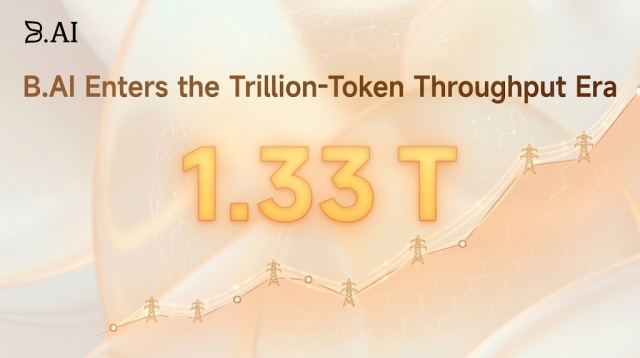
B.AI, a next-generation AI infrastructure platform, recently set off a developer frenzy by offering free access to top-tier models. Within days, daily token throughput across the platform crossed 1.33 trillion—a historic milestone. 

The record-breaking figure underscores the campaign’s explosive rollout, but it marks only the first step in B.AI’s broader strategic roadmap. Moving beyond traditional compute distribution pipelines, B.AI aims to build the global settlement layer for intelligence: a core infrastructure hub engineered to power cross-node collaboration, orchestration, and value distribution for AI agents across complex business workflows. 

Positioning itself strategically above all models, below all agents, B.AI deeply integrates a diverse range of top-tier models with full-stack components, laying an unshakable, irreplaceable foundation for the mass adoption of autonomous agents and the productivity boom that follows.


Daily Token Throughput Tops 1.33 Trillion: B.AI’s Free Access Rollout Fuels Usage Boom

B.AI’s recent move to open free access to premium AI models has captivated developers and quickly taken over industry conversations. The push for accessible compute has not only fueled a surge in platform activity but also shattered usage records. 

In a matter of days, soaring API demand pushed the platform’s daily token throughput past a staggering 1.33 trillion. Over a 15-day window, cumulative volume reached 8.19 trillion tokens, drawing in more than 220,000 new API users. As of September 3, B.AI’s total user base had officially surpassed 2.3 million. 

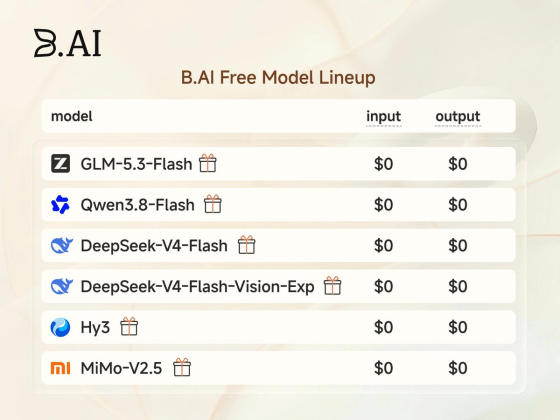
That massive adoption traces directly to the platform’s zero-cost model lineup, a strategic rollout built to erase developers’ cost concerns. With every barrier removed, B.AI now offers unlimited free access to six leading frontier models: DeepSeek-V4-Flash, DeepSeek-V4-Flash-Vision-Exp, Tencent Hy3, Xiaomi MiMo-V2.5, GLM-5.3-Flash (Ox Alpha), and Qwen3.8-Flash. 

Notably, on September 3, B.AI rolled out a new pricing structure for DeepSeek-V4-Flash and DeepSeek-V4-Flash-Vision-Exp, introducing tiered discounts. Developers now receive a 50% discount during peak hours, with off-peak rates dropping to just 25% of standard peak pricing. At the same time, the platform has kept zero-cost access in place for GLM-5.3-Flash (Ox Alpha), Qwen3.8-Flash, Tencent Hy3, and Xiaomi MiMo-V2.5. Despite the shift toward commercialization, developer momentum hasn’t wavered, with platform-wide token throughput continuing its steady climb.

This sustained momentum proves the campaign was far more than a short-term compute giveaway—it is a bellwether for the broader evolution of AI infrastructure. Cracking 1.33 trillion daily tokens makes one thing clear: AI applications are moving past basic chatbots. Powered by a high-performance technical stack and flexible service mechanics, B.AI is laying the groundwork for the next frontier—autonomous AI agents operating at scale. 


Powering the “AI Grid”: B.AI Anchors the Global Settlement Layer for the Agent Economy

For B.AI, democratizing compute is only the prelude. Looking further ahead, the platform is committed to building full-stack infrastructure for the agentic era, cementing its position as the global settlement layer for intelligence.

In the agent era, a typical agent task calls for constant switching between models. No single provider can power a complete workflow on its own, so developers are left juggling fragmented API protocols, disjointed billing systems, and conflicting rate limits. 

B.AI’s settlement layer bridges this exact gap. Positioned strategically “above all models, below all agents,” B.AI abstracts models across different providers, capabilities, and cost structures into a unified pool of schedulable resources.

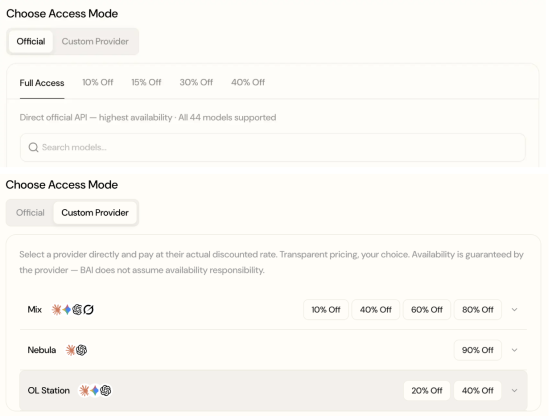
Powered by a dual-tier API structure offering official-route reliability alongside lowest-cost custom channels, developers can choose between guaranteed direct connections and deeply discounted options across a broad lineup of models. Combined with smart routing on the Chat interface, B.AI operates as a full-stack “AI grid,” ensuring every agent request lands on the optimal model to deliver reliable performance at maximum cost-efficiency. 

On the settlement front, this power grid seamlessly bridges both Web2 and Web3 models. For Web2, developers can rely on familiar traditional payment methods to top up with minimal friction. For Web3, B.AI leverages on-chain payment rails to offer global developers decentralized, verifiable, and low-friction payment options.

With dual payment systems running in parallel, B.AI enables developers and agent applications across any infrastructure setup to find their optimal settlement path on the grid, providing single-point integration with borderless global reach. 


Driving Core Productivity: B.AI Reshapes Agent Collaboration

Beyond building a foundation for compute routing and global settlement, B.AI is moving past base infrastructure to power real-world productivity. By enabling seamless agent collaboration across complex workflows, it delivers the missing execution layer for the agent economy. 

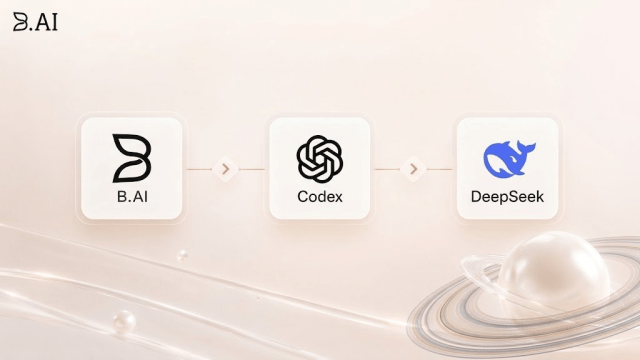
At the heart of this execution layer is native Codex integration. Full compatibility with the Responses API means developers can now use a single B.AI key inside Codex to run flagship GPT models and DeepSeek favorites side by side. 

Engineers can now bring these powerhouse models straight into their daily dev stack. From code generation and reasoning to debugging and refactoring, B.AI unifies the entire workflow under one roof—delivering a direct line from model selection to shipped code. 


Beyond coding, to keep agents running reliably in real-world production at scale, B.AI has built a full-stack infrastructure powered by five core components, equipping agents with a fine-tuned operational engine:

  • x402 Payment Protocol: Introduces an innovative “pay-before-response” model that executes high-frequency, on-chain micro-settlements in the background during cross-agent API calls and compute orchestration.
  • 8004 Identity Protocol: Issues verifiable on-chain credentials for every agent, logging execution history and credit scores to establish a reliable layer of trust for cross-node collaboration.
  • Skills Matrix: Plug-and-play, standardized building blocks that interface directly with MCP servers to equip agents with instant, modular tool-calling capabilities.
  • BAIclaw and BAIcode: Built-in platform assistants engineered for end-to-end execution. BAIclaw manages all-in-one terminal operations and multi-agent workflows, while BAIcode serves as an advanced developer engine that streamlines the full pipeline from task analysis and architecture design to coding and testing.


From the token surge sparked by zero-cost model access to its positioning as the global settlement layer for intelligence; from seamless Codex integration to full-stack infrastructure powered by x402, 8004, Skills, and native assistants—B.AI delivers far more than a battle-tested technical stack; it unveils a clear blueprint for what lies ahead. B.AI is building not just accessible compute today, but the definitive launchpad for a thriving agent economy. The future is here—and this is only the beginning.


B.AI Team

Singapore

support@b.ai

Cracking 1.33 Trillion Daily Tokens: B.AI Powers the “AI Grid” with Full-Stack Infrastructure to Fuel the Agentic Era

B.AI, a next-generation AI infrastructure platform, recently set off a developer frenzy by offering free access to top-tier models. Within days, daily token throughput across the platform crossed 1.33 trillion—a historic milestone. 

The record-breaking figure underscores the campaign’s explosive rollout, but it marks only the first step in B.AI’s broader strategic roadmap. Moving beyond traditional compute distribution pipelines, B.AI aims to build the global settlement layer for intelligence: a core infrastructure hub engineered to power cross-node collaboration, orchestration, and value distribution for AI agents across complex business workflows. 

Positioning itself strategically above all models, below all agents, B.AI deeply integrates a diverse range of top-tier models with full-stack components, laying an unshakable, irreplaceable foundation for the mass adoption of autonomous agents and the productivity boom that follows.


Daily Token Throughput Tops 1.33 Trillion: B.AI’s Free Access Rollout Fuels Usage Boom

B.AI’s recent move to open free access to premium AI models has captivated developers and quickly taken over industry conversations. The push for accessible compute has not only fueled a surge in platform activity but also shattered usage records. 

In a matter of days, soaring API demand pushed the platform’s daily token throughput past a staggering 1.33 trillion. Over a 15-day window, cumulative volume reached 8.19 trillion tokens, drawing in more than 220,000 new API users. As of September 3, B.AI’s total user base had officially surpassed 2.3 million. 

That massive adoption traces directly to the platform’s zero-cost model lineup, a strategic rollout built to erase developers’ cost concerns. With every barrier removed, B.AI now offers unlimited free access to six leading frontier models: DeepSeek-V4-Flash, DeepSeek-V4-Flash-Vision-Exp, Tencent Hy3, Xiaomi MiMo-V2.5, GLM-5.3-Flash (Ox Alpha), and Qwen3.8-Flash. 

Notably, on September 3, B.AI rolled out a new pricing structure for DeepSeek-V4-Flash and DeepSeek-V4-Flash-Vision-Exp, introducing tiered discounts. Developers now receive a 50% discount during peak hours, with off-peak rates dropping to just 25% of standard peak pricing. At the same time, the platform has kept zero-cost access in place for GLM-5.3-Flash (Ox Alpha), Qwen3.8-Flash, Tencent Hy3, and Xiaomi MiMo-V2.5. Despite the shift toward commercialization, developer momentum hasn’t wavered, with platform-wide token throughput continuing its steady climb.

This sustained momentum proves the campaign was far more than a short-term compute giveaway—it is a bellwether for the broader evolution of AI infrastructure. Cracking 1.33 trillion daily tokens makes one thing clear: AI applications are moving past basic chatbots. Powered by a high-performance technical stack and flexible service mechanics, B.AI is laying the groundwork for the next frontier—autonomous AI agents operating at scale. 


Powering the “AI Grid”: B.AI Anchors the Global Settlement Layer for the Agent Economy

For B.AI, democratizing compute is only the prelude. Looking further ahead, the platform is committed to building full-stack infrastructure for the agentic era, cementing its position as the global settlement layer for intelligence.

In the agent era, a typical agent task calls for constant switching between models. No single provider can power a complete workflow on its own, so developers are left juggling fragmented API protocols, disjointed billing systems, and conflicting rate limits. 

B.AI’s settlement layer bridges this exact gap. Positioned strategically “above all models, below all agents,” B.AI abstracts models across different providers, capabilities, and cost structures into a unified pool of schedulable resources.

Powered by a dual-tier API structure offering official-route reliability alongside lowest-cost custom channels, developers can choose between guaranteed direct connections and deeply discounted options across a broad lineup of models. Combined with smart routing on the Chat interface, B.AI operates as a full-stack “AI grid,” ensuring every agent request lands on the optimal model to deliver reliable performance at maximum cost-efficiency. 

On the settlement front, this power grid seamlessly bridges both Web2 and Web3 models. For Web2, developers can rely on familiar traditional payment methods to top up with minimal friction. For Web3, B.AI leverages on-chain payment rails to offer global developers decentralized, verifiable, and low-friction payment options.

With dual payment systems running in parallel, B.AI enables developers and agent applications across any infrastructure setup to find their optimal settlement path on the grid, providing single-point integration with borderless global reach. 


Driving Core Productivity: B.AI Reshapes Agent Collaboration

Beyond building a foundation for compute routing and global settlement, B.AI is moving past base infrastructure to power real-world productivity. By enabling seamless agent collaboration across complex workflows, it delivers the missing execution layer for the agent economy. 

At the heart of this execution layer is native Codex integration. Full compatibility with the Responses API means developers can now use a single B.AI key inside Codex to run flagship GPT models and DeepSeek favorites side by side. 

Engineers can now bring these powerhouse models straight into their daily dev stack. From code generation and reasoning to debugging and refactoring, B.AI unifies the entire workflow under one roof—delivering a direct line from model selection to shipped code. 

Beyond coding, to keep agents running reliably in real-world production at scale, B.AI has built a full-stack infrastructure powered by five core components, equipping agents with a fine-tuned operational engine:

  • x402 Payment Protocol: Introduces an innovative “pay-before-response” model that executes high-frequency, on-chain micro-settlements in the background during cross-agent API calls and compute orchestration.
  • 8004 Identity Protocol: Issues verifiable on-chain credentials for every agent, logging execution history and credit scores to establish a reliable layer of trust for cross-node collaboration.
  • Skills Matrix: Plug-and-play, standardized building blocks that interface directly with MCP servers to equip agents with instant, modular tool-calling capabilities.
  • BAIclaw and BAIcode: Built-in platform assistants engineered for end-to-end execution. BAIclaw manages all-in-one terminal operations and multi-agent workflows, while BAIcode serves as an advanced developer engine that streamlines the full pipeline from task analysis and architecture design to coding and testing.

From the token surge sparked by zero-cost model access to its positioning as the global settlement layer for intelligence; from seamless Codex integration to full-stack infrastructure powered by x402, 8004, Skills, and native assistants—B.AI delivers far more than a battle-tested technical stack; it unveils a clear blueprint for what lies ahead. B.AI is building not just accessible compute today, but the definitive launchpad for a thriving agent economy. The future is here—and this is only the beginning.


B.AI Team

Singapore

support@b.ai

Axis Robotics Open-Sources One of the Largest Franka Arm Simulation Datasets for Physical AI

Axis Robotics has released Axis Sim Dataset V1, one of the largest open-source simulation datasets for Franka arm manipulation, with the full dataset, training code, and benchmarks publicly available. V1 is built from more than 50,000 human-teleoperated simulation trajectories across 207 manipulation tasks and 60,000+ scene variants on a simulated Franka Research 3 arm.

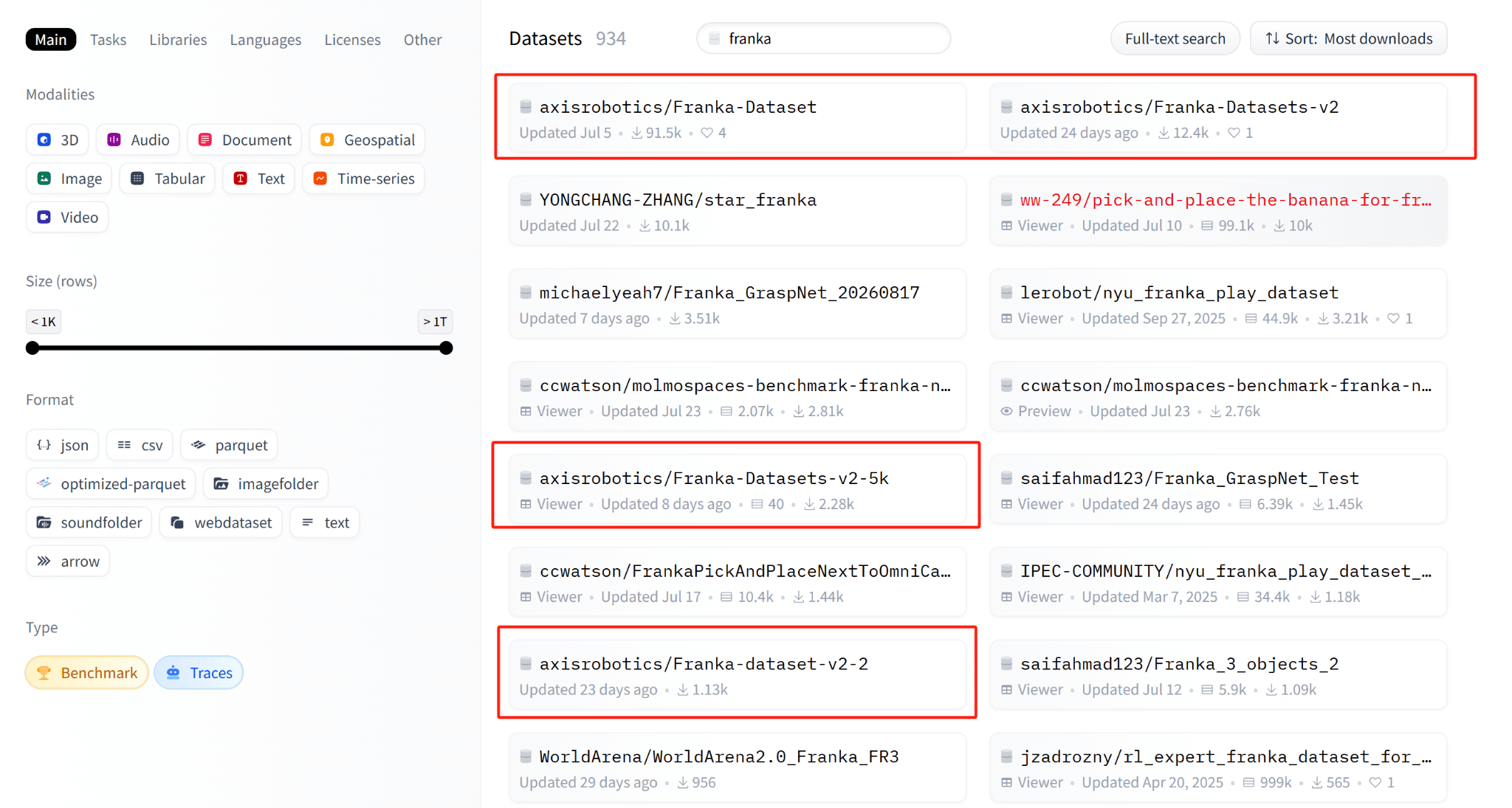
This dataset drew over 160,000 downloads, making it the most downloaded open-source simulation Franka manipulation dataset on Hugging Face. In benchmarks, continual pretraining on V1 lifted π0.5 and beat a volume-matched RoboCasa baseline, with every result open and verifiable.

Axis Robotics is building the ultimate compounding data engine for Physical AI, a vertically integrated system spanning large-scale simulation, egocentric real-world capture, humanoid loco-manipulation, and human-gated DAgger post-training. The company raised $12 million in seed funding led by Hack VC, with participation from Nomad Capital, Pi Network Ventures, 10K Ventures, and angel investors.

A Bet Against “Clean Data Only”

A common assumption in robotics is that demonstrations must be near-optimal to begin with — filter down to expert trajectories, standardize the setup, and discard anything noisy before it is safe to imitate. Axis’s thesis runs the other way: data quality lives at the distribution level, not the single trajectory. When a large and diverse enough crowd produces noisy, suboptimal trajectories and their errors are uncorrelated, the noise averages out and a working policy survives during training.

Axis Sim Dataset V1 puts that thesis to a public test. Its trajectories span pick-and-place, stacking, pouring, articulated-object manipulation, and tool use, all collected through Axis’s browser-based teleoperation platform, Axis Hub, by a distributed crowd rather than a single expert team. The dataset was built with researchers from UC Berkeley, Johns Hopkins, the University of Michigan, and other institutions.

Results That Scale

On LIBERO-Plus, continual pretraining on V1 lifts π0.5 from 83.9% to 88.8% success and outperforms a volume-matched RoboCasa365 baseline by 37.3%. Performance improves consistently as pretraining data scales from 25% to 100% of the dataset, with no saturation in sight, evidence that the gains come from diversity and coverage rather than a one-off bump. The largest improvements appear under camera, sensor-noise, and layout perturbations, the exact axes Axis randomizes during generation.

The team says V2 is already underway, scaling to 1.2 million trajectories across 1,200 tasks, with cross-embodiment generalization and results across multiple VLA models showing that suboptimal simulation data trains robust policies.

The Engine Behind the Dataset

The dataset is one output of a larger, actively compounding data engine. Where a traditional data vendor collects to a fixed spec and stops, Axis uses model performance and failure cases to determine what should be collected next, so every training round informs the next. That engine runs on a hybrid strategy across four data lines, and all four now run at scale:

  • Simulation: over 200,000 distributed contributors on Axis Hub, a top-3 dApp on Base, producing 4.7M+ trajectories across 13 embodiments.
  • Egocentric: a managed network of 1,000+ full-time, QC-trained collectors capturing first-person activity in real homes and businesses across 14 industries: 200,000+ hours already banked and growing by 4,000+ hours every day, with Vicon-verified hand pose.
  • Loco-manipulation: 500+ hours combining mobility and dexterity on real humanoids (Unitree G1, Booster T2) through hardware-agnostic teleoperation.
  • Human-gated DAgger post-training: 500+ hours of human-in-the-loop correction targeted at deployment edge cases.

Every task and trajectory is recorded on-chain on Base for provenance, and contributors are rewarded for verified work quality.

From Open Data to Commercial Deployment

Beyond open-sourcing simulation data, Axis works directly with robot embodiment companies to build customized, embodiment-specific data pipelines and model priors.

As Booster Robotics’ first sim-data partner, Axis rebuilt Booster’s real workspace as a task-aligned digital twin, had distributed contributors collect 42,000+ simulation episodes on it, and distilled them into a Booster-specific model prior. With just 30 real-robot demos, that prior reached 87.5% success versus 37.5% for an out-of-the-box π0.5, matching π0.5 using half the real-world demonstrations.

Other partners span embodiment companies (Feagine Robotics), model companies (Manycore Tech, Dexmal) and industrial automation (Lotus Cars, Geely Auto). Axis also supplies on-chain robotics networks: BitRobot on Solana and OpenRoboto on Bittensor.

Redefining Physical AI’s Data Foundation

“The future of Physical AI isn’t a static dataset you download once,” said Chris Feng, founder of Axis Robotics. “It’s an engine that keeps producing the data the model needs next. Scale gets you broad coverage. Diversity keeps the noise unbiased. The closed loop turns every failure into progress. That’s what compounds.”

Axis was founded by researchers from UC Berkeley, CMU, Georgia Tech, and SJTU, alongside serial founders who have scaled consumer platforms to over 30 million users. Its research is advised by Jiachen Li, Assistant Professor at Georgia Tech.


Paper Link: https://arxiv.org/abs/2607.21588

Project Page: https://axisaiorg.github.io/AXIS-V1/

Dataset Link: https://huggingface.co/datasets/axisrobotics/Franka-Dataset

Github Codebase: https://github.com/AxisAIOrg/Axis-V1-Training

HTX DAO Launches $10M Genesis Program to Propel the Crypto-AI Convergence and Advance Financial Freedom

Amid a pivotal reshaping of the global financial architecture and the deep convergence of frontier technologies, decentralized autonomous organization HTX DAO today officially announced the launch of the Genesis Program, backed by an initial $10 million HTX DAO Ecosystem Fund. Driven by the real-world needs of developers and builders across its global community, the initiative goes beyond individual products and token-focused metrics. By leveraging cryptography and decentralized networks, it seeks to establish a full-scale business footprint across crypto and AI and build an open, transparent, and permissionless global ecosystem of financial freedom.

Beyond Asset Trading: Advancing a New Global Era of “Financial Freedom”

HTX DAO’s mission has never been confined to the market performance of governance tokens, nor does it seek to build a closed ecosystem around an exchange. Its fundamental objective is to drive a freer, more open global financial order unshackled by centralized monopolies.

The foundational value of crypto extends far beyond asset pricing and speculative trading. Cryptography, blockchain, and decentralized networks are systematically restructuring asset classes, global settlement protocols, and human collaboration paradigms. HTX DAO is committed to deeply participating in this infrastructure reconstruction, empowering global users to claim inviolable asset sovereignty and enjoy the seamless, borderless flow of value.

Crypto Meets AI: Catalyzing New Productivity and Collaboration Models

Global technology is currently approaching a critical inflection point. AI has unleashed an exponential leap in productivity, while crypto provides an open network environment, an asset ownership framework, and a trustless collaboration mechanism.

As AI agents transition from assisted generation to autonomous execution, decentralized networks will emerge as foundational infrastructure for settlement and attribution, spanning on-chain micro-payments between machines, Decentralized Identifier (DID) authentication, cross-sovereign settlement, and data asset ownership confirmation. The deep symbiosis of crypto and AI will inevitably catalyze a new generation of business models, underlying protocols, and decentralized organizational forms. Driving the engineering implementation and commercial closure of Crypto-AI stands as HTX DAO’s core strategic priority for the present and the long term.

A Multi-Million-Dollar Fund for Comprehensive Empowerment

Rather than acting as a top-down, unidirectional design, the Genesis Program originated directly from the genuine technical demands and operational pain points of creators, developers, and builders within the ecosystem.

To coalesce fragmented innovative forces into a long-term, evolving collaborative network, HTX DAO has established an initial $10 million ecosystem development fund. Eschewing traditional, indiscriminate grant models, the Genesis Program relies on a rigorous, verifiable milestone-delivery mechanism to provide selected teams with a three-dimensional support system encompassing development capital, foundational technical support, full-chain liquidity injection, real-world business scenarios, and global market expansion.

A Clear Value Loop: From Milestone Releases to Ecosystem Reinvestment

The $10 million fund is by no means an unconditional, unidirectional subsidy. Rather, it is built upon a framework of rigorous engineering management: fund allocation tied strictly to verifiable milestone delivery; the injection of deep ecosystem resources including liquidity, technology, and market access; translating project deployments into self-sustaining commercial business models; and ultimately, establishing a long-term positive feedback loop that channels project growth back into the broader HTX ecosystem.  This mechanism maximizes capital efficiency while ensuring that every resource injection genuinely translates into sustainable on-chain productivity.

Industrial Depth: Seamless Integration into Leading Industry Networks

Teams accepted into the Genesis Program gain far more than isolated financial backing. Rather, they gain an industry-grade collaborative network with high entry barriers.

Project teams will directly access HTX’s expansive global user base and regulatory-compliant gateways, seamlessly tap into the TRON network’s daily hundreds-of-billions-dollar on-chain liquidity base, and coordinate with top-tier global investment institutions, academic think tanks, developer alliances, and industrial strategic partners. This deep industrial synergy empowers early-stage innovations to rapidly bypass the cold-start phase and achieve robust, scaled commercial deployment.

By fostering real-world business scenarios such as on-chain payments, AI services, DeFi, RWA, and AI agents, the Genesis Program will continuously expand HTX’s practical application boundaries across the external ecosystems. It will drive a long-term, bidirectional positive cycle between project growth and HTX’s ecosystem value, evolving HTX from a mere exchange infrastructure into a core value node of the global free finance and decentralized collaborative network.

Genesis Core Matrix: A Full-Lifecycle Empowerment Architecture of Discover, Support, and Connect

Transcending the boundaries of traditional unidirectional grants, the Genesis Program focuses on building a sustainably iterating global builder collaborative network anchored by three pillars across project lifecycle:

  •     Discover: Leveraging global hackathons, open-source technical communities, and university research networks to proactively identify early-stage teams in the prototype verification stage that are focused on breaking through foundational technical bottlenecks.
  •     Support: Establishing a verifiable milestone mechanism based on deliverables, backed by the $10 million ecosystem fund. Beyond initial capital, it delivers comprehensive access to full-chain liquidity, foundational tech architecture consulting, global community cold-start assistance, and multi-regional market resources.
  •     Connect: Acting as a connector for decentralized innovations under the philosophy of a free financial port to facilitate efficient closed loops among capital, tech developers, AI agents, and end users.


The ultimate destination of the Genesis Program is not a one-way invitation to “join us,” but an invitation for global builders to integrate into an open, co-built collaborative network where everyone shares in the ecosystem dividends.

Embark Now: Entering an Open Global Builder Network For More Than Just a Grant

The next decade of the crypto industry will not be defined by any single entity. It belongs to every technical pioneer solving real-world problems through code.

The HTX DAO Genesis Program and its $10 million ecosystem development fund are now officially open for global applications:


HTX DAO looks forward to collaborating with global technical builders to advance foundational innovation, jointly constructing a more resilient, transparent, and globally liquid next-generation financial technology ecosystem.


About HTX DAO

HTX DAO is a decentralized autonomous organization (DAO) collaboratively built by community members, early contributors, and global advisors. Supported by HTX Exchange and the TRON blockchain ecosystem, HTX DAO is committed to establishing an open governance ecosystem led by users, governed by transparent rules, and driven by efficient collaboration, serving as a key engine in advancing decentralized finance (DeFi).

HTX DAO embodies the principle of “token holders govern”, aiming to inspire global consensus and participation, align community interests with platform value, and explore a new order in the world of crypto finance.

Contact Information

Website: www.htxdao.com

Email Address: media@htxdao.com

❌