Reading view

There are new articles available, click to refresh the page.

Bitcoin is NOT Changed by Proof Of Node

Bitcoin Magazine
Bitcoin is NOT Changed by Proof Of Node

You might have heard about BIP-110; here’s why this fork is not just bad for Bitcoin, but it is built on a misunderstanding of what a Bitcoin node is and what it is good for. As well as why, because of this misunderstanding, BIP-110 will fail. 

This article is a Take. Opinions expressed are entirely the author’s and do not necessarily reflect those of BTC Inc or Bitcoin Magazine.

BIP-110 is a Bitcoin Improvement Proposal titled as a Reduced Data Temporary Softfork. The BIP proposes a consensus change to Bitcoin, which attempts to limit the types and amounts of arbitrary data that can be added to consensus-valid transactions by limiting a wide range of Bitcoin’s scripting capabilities. BIP-110 is led by a pseudonymous developer known as Dathon Ohm and is widely supported by the Knots community, an alternative implementation of Bitcoin led by one of Bitcoin Core’s earliest contributors, Luke Dashjr and its supporters.

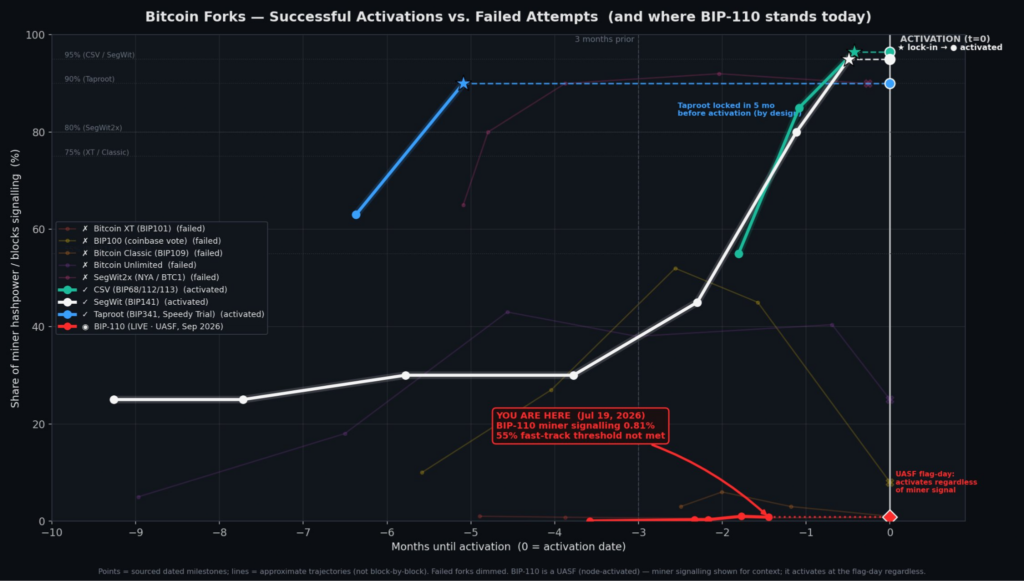
The BIP-110 consensus change is headed towards a mandatory signaling period in the coming weeks and thus a potential fork with the main consensus rules as implemented in Bitcoin Core. The proposal needs to gain a great deal of support from miners within the coming weeks to change Bitcoin consensus. As of the time of writing, miner signaling for BIP-110 stands at less than one percent


The Knots community, widely made up of Bitcoiners running nodes on machines like Start9 and Umbrel, has rallied around Knots in protest of a series of development decisions made by Bitcoin Core, the primary open source development community and reference implementation of Bitcoin. While a majority of senior Bitcoin developers are either opposed or apathetic to the changes proposed by BIP-110, the movement has gained enough steam to become an ongoing topic of discussion on social media. 

Supporters of BIP-110 believe that by running Bitcoin full nodes that signal for the consensus change, they alone can change Bitcoin. Here are the main concepts being debated, the biggest misconceptions about Bitcoin consensus, what a Bitcoin node is, and why BIP-110 is almost certain to fail. 

The Power and Limits of a Bitcoin Node

Many of the disagreements and misconceptions in this recent cultural conflict within Bitcoin revolve around the idea of a Bitcoin full node. Influencers like Knut Svanholm, author and podcaster, have elevated the role of the full node to heights perhaps too close to the sun. 

Knut recently tweeted: “Every person on Earth is a node in the Bitcoin network. Most to a minuscule extent, of course, but every node is first and foremost a person, not a machine. Which tools we use to interact with the network (and, by extension, to which extent they influence the network) is entirely dependent on the choices we make.”

Statements of this sort are poetically beautiful, philosophically grand, romantic even, but nevertheless technically incoherent and fundamentally meaningless. Knut’s tweet attempts to redefine what a ‘Bitcoin node’ means and fails at it, instead diluting the value of the term entirely. He might as well have said that every atom in the universe is a Bitcoin node, since apparently to him the term is all-encompassing. 

Knut,  though well-intentioned, is wrong. A Bitcoin node is something very specific. It is a full copy of all of Bitcoin’s transaction history, block headers and transaction-related data. Its purpose is very specific: to let users verify the integrity of Bitcoin’s supply and transaction history in relation to Bitcoin’s consensus rules. 

Bitcoin nodes grant users a variety of benefits, such as privacy. Third-party wallet providers query their copy of the Bitcoin blockchain for the user’s balance and serve it back to the user via the wallet app. Most mobile wallets function this way, with users asking a third-party server for their balances. Some, very few, can connect to a user-run Bitcoin node, in which case the user’s public addresses and balances are not shared with any third-party wallet company. 

Another benefit Bitcoin nodes grant users is the ability to check whether they are in consensus with the rest of the network, staying in sync. If the user mines Bitcoin or contributes any significant amount of hashing power to Bitcoin’s proof-of-work network, the node also provides the opportunity to assemble a block, choosing which transactions go into it. This is only possible if the user manages to mine a Bitcoin block, which is quite an achievement today, given the difficulty and steep competition. 

Even new kinds of mining pools like Ocean, which attempt to decentralize block template production, letting retail miners have more influence over which transactions enter the chain, still need enough hashing power to win the proof-of-work race, resulting in sporadic blocks being mined and thus limited influence over the blockchain. 

Bitcoin nodes also relay transactions across the network, with tens of thousands of them communicating via a flood network; this results in a censorship-resistant system where a small number of nodes can get controversial transactions to miners, bypassing any kind of filters, as demonstrated by Peter Todd’s relay libre. Thus, Bitcoin nodes can not easily filter which transactions enter the blockchain.

Even a large majority of Bitcoin nodes alone cannot alone change Bitcoin consensus. Not without having a large amount of economic activity entering the Bitcoin network through them, as exchanges do on behalf of millions of users. Not without having the protocol and application developer community behind them. Not without having the investor community behind them. Bitcoin is not a node democracy, contrary to popular memes today. 

Bitcoin nodes do not grant you ‘citizenship’ in the ‘Bitcoin nation’. Satoshi Nakamoto was quite clear about this in the Bitcoin white paper. Bitcoin’s ultimate security and governance structure is: one CPU cycle, one vote, not one node, one vote. And miners, who run the CPU cycles over Bitcoin’s proof-of-work, are very sensitive to investor sentiment and the broader developer community, resulting in a distributed global protocol for money that is very difficult to change. 

Bitcoin nodes ultimately let you know if you are connected to the network with the most accumulated proof-of-work and that its consensus rules are being followed, but a node alone does not let you change the consensus rules. Users who change the consensus rules of their Bitcoin node are, by definition, no longer running Bitcoin. As a result, changing Bitcoin consensus as a node runner is very difficult, and that’s a feature, not a bug. Bitcoin is money for enemies. 

History and Bitcoin Consensus Games

Deep work has been done, trying to understand Bitcoin consensus, its various pillars and interest groups. Ren Crypto Fish, Steve Lee and Lyn Alden identified six of them in BCAP, an open-source effort to analyze Bitcoin consensus and risks in protocol upgrades. BCAP identified stakeholders such as Economic Nodes, Investors, Media Influencers, Miners and Protocol Developers, and Users and Application Developers

Historically, in the case of a consensus crisis, it is true that Bitcoin nodes have been used to signal support for one version of Bitcoin over another. Fork events like 2017’s Bitcoin Cash fork are often cited as examples of economic nodes winning against opposition by miners. 2017’s legendary User Activated Soft Fork (UASF) faced major opposition in theory; a large majority of mining pools and their corresponding collective hashrate supported the Segwit2x version of Bitcoin, with many exchanges and corporations having signed the infamous New York Agreement in support of it. 

The Bitcoin node-supported soft fork against it won nonetheless, bluffing the Segwit2x version from a contested blockchain altogether. But that’s the thing: while the Bitcoin nodes technically won, they did so by having massive support from protocol developers, investors and media influencers: these nodes really had economic weight and rough consensus. BIP-110, on the other hand, does not have the protocol developers, nor does it have enough investors behind it. Michael Saylor has come out against it, with many industry leaders also openly opposing it or staying out of the matter entirely. 

In fact, during the Bitcoin Cash fork, the limits of retail Bitcoin nodes were clearly understood. A Bitcoin node run by an exchange is orders of magnitude more influential than that of a retail user, as it introduces large amounts of new transactions into the Bitcoin network. The Bitcoin node of a major mining pool is far more influential than that of a hobbyist solo miner, as it more often assembles blocks and chooses which transactions settle to the blockchain. 

Most Bitcoiners outside of exchanges use mobile wallets to access their Bitcoin. Such users and investors can ‘vote’ with their money, so to speak, by moving their bitcoins and economic activity elsewhere, be it to a wallet that supports their vision of Bitcoin, or their own full node. But while users remain on mobile wallets that talk to third-party nodes, those users have little individual influence over Bitcoin consensus. And the vast majority of mobile wallets are using a Bitcoin core-compatible back end. 

The same goes for exchanges; their users effectively delegate consensus decisions to the exchange operators. In some cases, exchanges have put consensus issues to a user vote, weighed by their total holdings, returning that decision to end users weighed by capital; we may see this happen again with BIP-110. 

Votes of the sort have started happening with Foundry today. One of the biggest Bitcoin mining pools in the world, Foundry, recently emailed its miners informing them that they can vote on the proposal with their hashrate. A high enough support could result in Foundry signaling for BIP-110, though that remains unlikely. Users who do not vote will effectively signal against BIP-110, defending the status quo. Thus apathy about the topic of BIP-110 would be a win for Bitcoin Core by default. BIP-110 supporters need to culturally win over a majority of the Foundry hash rate, who then must act to vote against the Bitcoin Core developer consensus, the most popular Bitcoin implementation and best supported codebase.

Today, miners are not signaling support for BIP-110 in any significant way. In fact, according to some data, this is one of the least supported soft fork attempts by miner signaling in Bitcoin’s history. Less than one percent of the blocks mined in the current difficulty adjustment period are signaling for BIP110. 
Concluding Thoughts

BIP-110 has so far failed to gain consensus across major interest groups within Bitcoin; neither developers, investors, miners, nor large economic nodes support the consensus change. The result is likely to be a chain split in the coming weeks, which could have significant consequences for lightning wallets running on BIP-110-compliant nodes, ultimately resulting in a new, yet small blockchain that would probably have to change the proof-of-work used to stay alive. 

This post Bitcoin is NOT Changed by Proof Of Node first appeared on Bitcoin Magazine and is written by Juan Galt.

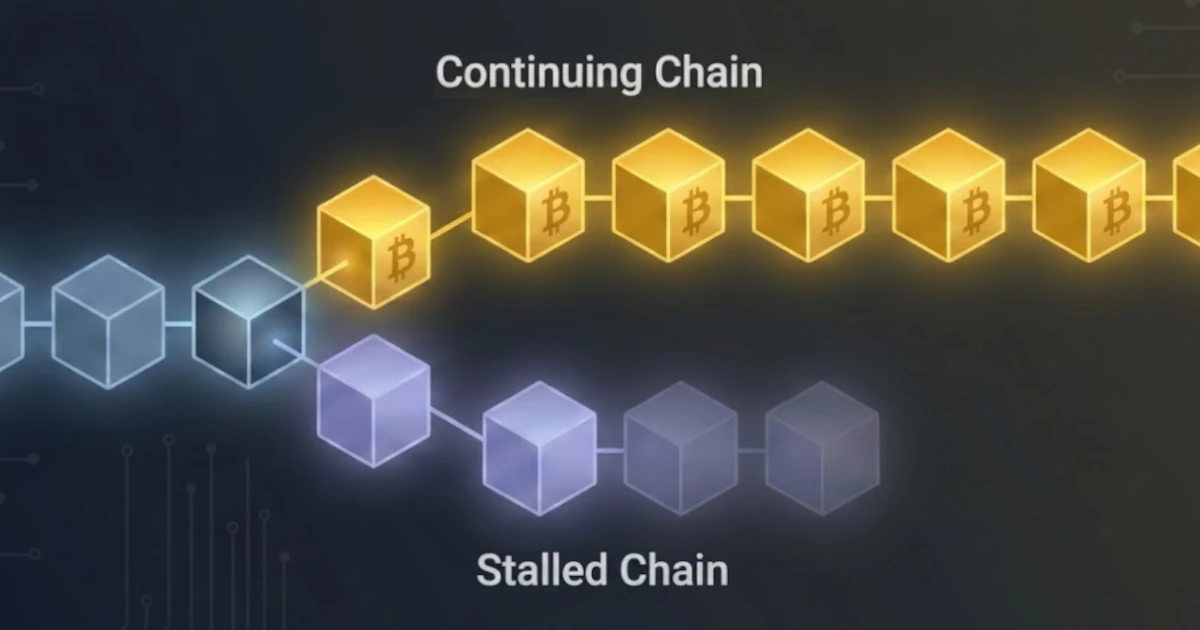
Jack Mallers Steps Down as CEO of Bitcoin Treasury Twenty One Capital 

Bitcoin Magazine

Jack Mallers Steps Down as CEO of Bitcoin Treasury Twenty One Capital 

Bitcoin treasury Twenty One Capital has named Raphael Zagury as its chief executive officer, a leadership change that arrives seven months after the firm listed on the New York Stock Exchange. 

Zagury succeeds founder Jack Mallers, who is stepping down to focus on his Bitcoin payments company, Strike

Speaking on the transition, Mallers said, “I’m grateful to everyone at XXI and everyone who believed in what we built,” said Jack Mallers. “Serving Bitcoiners has always been the mission, and that doesn’t change. Strike is where I carry it forward.”

Austin, Texas-based Twenty One, which trades under the ticker “XXI” on the NYSE, said it would focus on becoming an institutional-grade operating company that’s judged on cash flow generation and capital allocation discipline, not just its Bitcoin holdings.

It added that it would build and acquire high-quality operating businesses that “leverage Twenty One’s balance sheet while maintaining disciplined capital allocation at the parent company and create a long-term ownership model inspired by Berkshire Hathaway.”

“My job is to build the operating company around [Twenty One], with the discipline, governance, and executional rigor of an institution,” Zagury said in a statement.  “I believe our business will perform best when we also focus on the cash flow we generate and the rigor with which we allocate capital, not only by the Bitcoin we hold.”

Mallers leaves XXI

The firm, the product of a joint effort by Tether, Bitfinex, Cantor Fitzgerald, and SoftBank, is the second biggest public Bitcoin treasury, according to Bitcointreasuries.net, with a total of 43,514 coins — or $2.8 billion in Bitcoin at today’s prices. 

It debuted last year through a SPAC merger with Cantor Equity Partners, a blank check company affiliated with financial services firm Cantor Fitzgerald.

“XXI was built by Bitcoiners, for Bitcoiners. During my role as CEO, we defined a vision for a Bitcoin-native financial enterprise. As I focus my efforts fully at Strike, I look forward to watching the next phase of growth at XXI,” Mallers said.

The companies behind it are a mix of traditional finance giants and crypto companies: Tether is the biggest issuer of stablecoins and Bitfinex is a crypto exchange. SoftBank is a Japanese multinational investment holding company and Cantor Fitzgerald is a Wall Street firm previously headed up by U.S. President Donald Trump ally and Secretary of Commerce, Howard Lutnick. 

Zagury founded and leads the team behind Elektron Energy, a large-scale Bitcoin mining and infrastructure business. 

Before that, he held roles as a managing director at Deutsche Bank and Merrill Lynch, and as a vice president at Goldman Sachs. He also co-founded OpenCo, at one point among Brazil’s largest fintech lenders. 

The change at the top comes with a shift in deal strategy. In April, Twenty One had floated a plan to consolidate the firm, Strike, and Elektron Energy into a single Bitcoin-native platform spanning financial services, mining infrastructure, capital markets, and treasury. According to Bloomberg reporting, that deal has been scrapped. Twenty One confirmed that Strike will now remain a standalone business and is out of the running for a merger.

This post Jack Mallers Steps Down as CEO of Bitcoin Treasury Twenty One Capital  first appeared on Bitcoin Magazine and is written by Mathew Di Salvo and Micah Zimmerman.

Ocean Mining VP Jason Hughes: BIP-110 on Track to Fail as Miner Signaling Stays Below 1%

Bitcoin Magazine

Ocean Mining VP Jason Hughes: BIP-110 on Track to Fail as Miner Signaling Stays Below 1%

BIP-110 – My Notes to Miners

This is a guest post by Jason Hughes, VP of Development and Engineering at Ocean Mining. Opinions expressed are entirely his own and do not necessarily reflect those of BTC Inc. or Bitcoin Magazine. The article originally appeared on X.com and has been published with the permission of the author. 

Let me start off by saying I’m not pro BIP110, and I’m not anti-BIP110. If it actually succeeds as something that gains true consensus within the network and ends up being enforced by a majority of the network… cool. If so, then we’ll go with it because the network has spoken and accepted it, and all nodes, including non-BIP110 nodes, will be pulled along for the ride. Unfortunately for proponents of the proposal, that simply isn’t currently the case by any measurable metric, nor does it appear to have a trajectory suggesting that will change, either. 

There’s been a lot of misleading information about this whole thing, especially in the context of mining. A few quick key bullet points to briefly counter some hyperbole from proponents: BIP110 is NOT inevitable. It CAN fail. BIP110 can and will cause a chain split/fork in a minority hashrate situation. BIP110 is NOT without risk to miners choosing to adopt it. Miners not supporting BIP110 are not suddenly mining “invalid” blocks just because a proposal that isn’t yet adopted simply exists. You’re not a bad person or evil simply because you don’t like or support BIP110. (The fact that I feel the need to point out that last part is actually kind of sad…)

I was going to write a long post to help keep miners informed about things they need to remain aware of as this all plays out… before realizing I already did so months ago, as a document I authored that I had hoped could be put out as a miner education piece at OCEAN. Sadly, it never got published. So I went ahead and updated it, and well, here it is.

Again, keep in mind this was written months ago, intended to be as agnostic as possible in an effort to make it acceptable as a corporate post. That effort failed, so I’m posting it as a personal document today instead. As a miner making important decisions about your operations, you need to be aware of all of this without the sugarcoating and, frankly, outright misleading information coming from some of the BIP110 proponents.  You must be vigilant and decide what’s right for you. 

While there is certainly some misleading information from the opposition as well, nothing I’ve seen is nearly as egregious as the extremely premature claims of victory and accompanying hyperbole pushed by the BIP110 side. Summarizing my doc a bit, my personal suggestion to miners is this: Signal if you support BIP110. Do not signal if you don’t support BIP110 or don’t care. Either way, monitor the network on/around/before block 961632. 

If you continue to see non-signaling blocks from major pools, you can be reasonably certain they’re not going to suddenly decide later to throw away millions of dollars’ worth of revenue to backtrack and signal for BIP110. If they do, by some chance, start to signal for BIP110, you should monitor that and consider switching as required to stay on the heaviest chain. The key point is that, realistically, only one side can win. It’s either BIP110 succeeds, and miners not on the BIP110 side fail, or BIP110 fails, and miners on the non-BIP110 side succeed. 

Moving on, let’s dive into a small fraction of my rationale. 

QUICK FACT: Between 7 and 15% of Bitcoin Nodes are signaling support for BIP110.

Depending on which centralized crawler you look at… no way to know for sure [how many BIP110 nodes are signaling support]. My personal private crawler puts this number much lower, but that’s a discussion for another day. Suffice it to say, I think it’s logical and correct to say that even 15% is not a majority. 

“But Jason! UASF got Segwit activated with fewer nodes!” 

Yep, because many miners, merchants, users, etc., all actually wanted Segwit. There was tremendous economic and community weight behind it. Without rehashing that whole thing, as plenty of resources on the topic from before BIP110 are worth a read, suffice it to say that BIP110 and Segwit activations are not quite comparable, as many have already pointed out. Segwit, for example, went into its UASF territory with around 1/3rd of the network’s hashrate already signaling support. With that kind of backing, the UASF to help push the MASF over the tipping point made a lot of sense. It doesn’t make sense here for BIP110.

QUICK FACT: 0.6% of blocks over the past 60 days have signaled support for BIP110.

[0.6% is a] pretty stark contrast to even Segwit’s low baseline support. Yes, I know it’s increased slightly in the past couple of weeks, but no new entrants. Just more clearly rented hashrate from one of the same small proponents.

Something to keep in mind is that mining BIP110 signaling blocks via DATUM on OCEAN carries virtually no risk to the miner up until the fork point at block 961632. The cost is negligible, as you’re effectively guaranteed to recoup rental costs, etc.

It’s awesome that the ability to do so exists, and I wouldn’t have it any other way… but just something to keep in mind when weighing signaling from such blocks in the grand scheme of things from a risk-reward, money-on-the-table perspective.

“But Jason! Miners have no incentive to signal until the last minute!”

I also see no evidence to suggest that this could be the case. Subjectively, I disagree with the premise, as it’s not in a mining pool’s best interest to destabilize the network in such a way.  Part of the reason for early signaling and lock-in periods is to help coordinate upgrades in a smooth fashion. Waiting until the last minute negates that benefit entirely. I see no compelling rationale or upside to doing so.

Continuing on this, as part of my personal node monitoring setup, I specifically monitor nodes known to belong to various entities, such as other mining pools, exchanges, large lightning nodes, merchants, etc. A supermajority of which are monitored with explicit permission and confirmation/coordination.

QUICK FACT: All major mining pools I monitor are currently running some variant of Bitcoin Core v30 or v31 (except OCEAN). 

Expanding on that, most [mining pools] have updated their nodes since the proliferation of BIP110’s release, even since the release of Knots 29.3. Additionally, it is known that many mining pools run modified versions of their node software to facilitate various requirements of their specific infrastructure. Such changes would need to be ported to a BIP110-compatible client, tested, evaluated, and deployed ahead of time. I currently see no evidence that this is the case currently.

As far as I can tell, the pools are aware but ignoring. 

“But Jason! Miners don’t determine consensus! Nodes do! Otherwise, they’ll just cancel halvings!”

This is one of the funniest and most ridiculous arguments I’ve heard from the pro-BIP110 crowd.  Comparing a consensus change that can be unilaterally enforced upon the network by miners and accepted by 100% of existing nodes (a soft fork), with a hard fork which no existing node will accept… is disingenuous at best. T

ightening rules (like BIP110): Soft fork, can be enforced by miners if they choose to do so. Loosening rules (like canceling a halving): Hard fork, can not be enforced by miners without effectively 100% buy-in from the entire network… which isn’t likely to happen. Comparing the two is, bluntly, just stupid.

“But Jason! If you don’t upgrade to the latest consensus rules, you’re insecure! You’ll lose funds! You’ll mine invalid blocks! You’ll [insert additional hyperbole here]!”

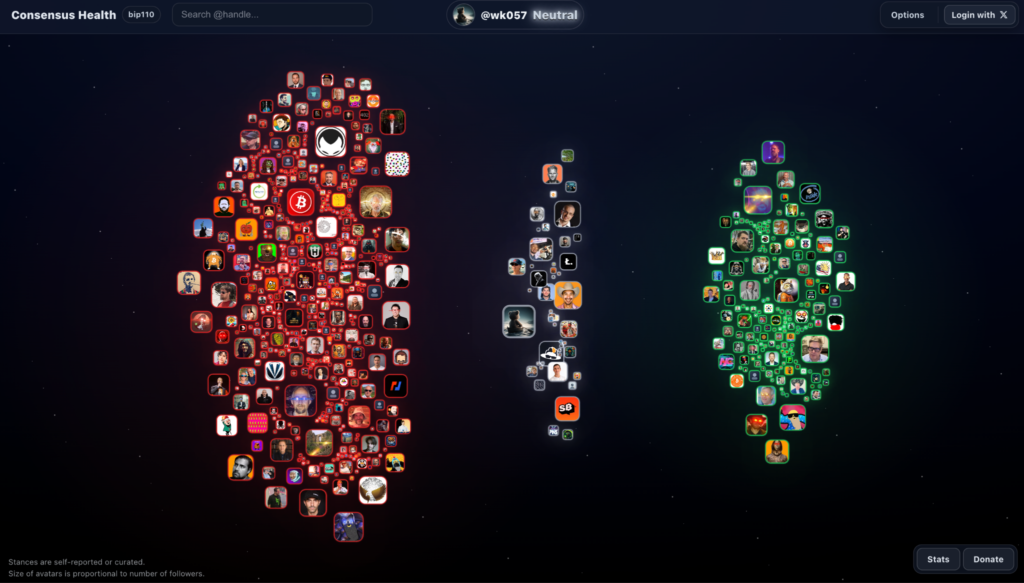
This would be true of a consensus change that has, well, consensus. While BIP110 has made a valiant effort to gain that consensus, it has yet to have any measurable majority at what is now arguably the 11th hour. Not in nodes, not in hashrate, not in the social layers (consensus.health has a cool visual there where you’ll find me in the middle).

If somehow BIP110 gains 51%+ of the network hashrate on/before block 961632… then, alright. It’s enforced, since as a soft fork a majority of miners can unilaterally enforce it in the absence of a fully adopted URSF (effectively a misnomer, as this would kind of be a hard fork).

“But Jason! It can’t gain consensus by already having consensus! You have to give it a chance!”

Firstly… no I don’t, even though I have.  Second, it’s a rushed proposal that never had the time to even try and gain real consensus. It’s been 7 months since the release of the first BIP110 client. There’s ~3 weeks to go before “mandatory” signaling starts as of now (less by the time you read this). 90% of the time available has passed with no change in overall sentiment from any relevant players. If it hasn’t gained sufficient adoption in the past 7 months, it’s not likely to do so in the next 3 weeks.

“But Jason! CSAM! CSAM! Pedophiles! CSAM!”

I’ll be the first to say, even I personally overstated the risk here early on when Core proposed its OP_RETURN change. I personally expected something particularly egregious to hit the chain almost immediately, and to the best of my knowledge, that’s not yet happened. Could it still happen? Yeah, I suppose.

But considering from a technical perspective, byte-for-byte the same contiguous arbitrary data can provably end up stored in the current chain or the BIP-110 chain without much issue… this particular argument for BIP-110 falls pretty flat to me at this point.

Do I want CSAM in the chain? Of course not. Am I a pedophile if I don’t support BIP110? Also not.

Concluding Thoughts

I could continue to go on and on and on, but I’ll stop here. I’ve wasted enough time on this. I’m sure I’ve done plenty to annoy both sides of the BIP110 debate at this point, as I don’t adopt either stance. I’m sure I’ll catch flak from all angles simply for daring to speak my mind on it.

Overall, I mostly think it was silly to approach addressing a real problem (the OP_RETURN default change in Bitcoin Core) with the maximum anti-spam manifesto based soft fork proposal… which provably cannot stop spam, arbitrary data, etc. 🤦‍♂️ (Yes, I know, proponents will claim it’s not about spam… and will also make semantic arguments that it does stop data as well… neither of which appears to be correct.)

I’ll close with the concession that I could be wrong. I’m not Nostradamus, and I can’t accurately predict the outcome with 100% certainty.  I can only go by what the data tells me, and so I give BIP110’s success less than a 5% chance of actually succeeding… and I consider that generous. You can take my opinions on this however you wish, but I highly recommend you don’t discount the actual data points, remain vigilant, and do what’s best for you and your mining revenue. Don’t be gaslit by either side of the debate, and make your own decisions.

Here’s a link to the same document linked above for ease of access.

This post Ocean Mining VP Jason Hughes: BIP-110 on Track to Fail as Miner Signaling Stays Below 1% first appeared on Bitcoin Magazine and is written by Jason Hughes.

Cloudflare x402 Integration Opens Door for Bitcoin in AI Agent Micropayments

Bitcoin Magazine

Cloudflare x402 Integration Opens Door for Bitcoin in AI Agent Micropayments

Cloudflare recently announced the launch of its monetization program via the Coinbase-led x402 machine payments standard. x402, which lets AI agents pay for data online with crypto, has been gaining steam among the AI-pilled, as it unlocks more capable agent interactions with the open web. 

Cloudflare, founded in 2009, has grown from a DDoS mitigation and content delivery network (CDN) provider into one of the internet’s foundational infrastructure companies.

The company, which launched publicly in 2010, had the mission to make web performance and security accessible to everyone, not just large enterprises. Today, Cloudflare powers approximately 20-23% of all websites globally, handles tens of millions of HTTP requests per second across 330+ cities in over 100 countries, touching a significant portion of global internet traffic.

As a result of their adoption and security offering to large portions of the open web, CloudFlare’s integration of x402 is a major development for the structure of the internet. Websites that are increasingly inaccessible to the massive data demands from AI can now sell that data to AI agents for crypto. CloudFlare’s implementation only mentions Stablecoins such as USDC, the Open USD standard, but the protocol supports Bitcoin on-chain and is actively exploring integration of the Lightning network.

The Web is Broken

Kevin Leffew, co-author of the x402 protocol and AI GTM at Coinbase, told Bitcoin Magazine there’s a major user experience issue in the way AI currently interacts with the open web and x402 — which is now under the control of the Linux Foundation — is trying to solve it. “Every api call requires an api key, which in turn requires a human, and adds unnecessary friction,” Leffew explained, adding, “our goal is to kill the api key”.

Popular AI agents such as OpenClaw often require API access keys to special paid web search services, to let the AI agents access the web easily, with the mobility that a human user would enjoy. Services of this sort are offered by popular browsers and search engines such as Brave.com and Perplexity. But who out there wants to be paying a subscription service on top of computer hardware and internet access, plus AI token costs to search the web? These services also require a human to sign up with a credit card for a monthly subscription, paying for access that might be blocked by the websites holding valuable data anyway via non-standard methods. A better solution is needed.

AI agents need to be able to think about money and resource costs, and need to have a computer-friendly way to make payments for novel data. An example of this use case was recently demonstrated by an X account called “Lightning Mode AI,”  which built a wrapper over ESPN FIFA data and had an AI agent pay for it in Bitcoin. The Agent was then able to quickly place bets on outcomes on markets like Polymarket, which could potentially let agent owners earn their money, during the soccer World Cup. 

This example by Lightning Mode AI used an older implementation of the idea behind x402 called L402, a protocol developed by Lightning Labs to specifically enable bitcoin payments for data on third-party websites. 

Denial of service attacks (DOS) are also potentially solved by a machine native monetary system for the internet. The fundamental vulnerability exploited by these DOS attacks revolves around the bandwidth and computing costs to answer a question or query from an internet user. The user sends a request to view a website, the site’s server must compute, resolve and serve the website data back to the user; this has material costs at scale. DOS attacks send massive amounts of requests, often from malware-infected networks of machines (DDOS), targeting the server resources of their victims. This kind of attack can, in theory, be stopped by simply asking for payment from the user before spending the resources to respond to the user’s query. But the payments must be cost-effective and fast enough for the user experience demands of the digital age. 

Protocols like x402 and L402 enable websites to paywall access to their valuable data, while teaching AI agents how to pay for access. No credit cards needed, no user data explicitly shared with payment networks, no ‘are you a bot’ captchas, no annoying account registrations you never use again, no subscription service for web search api key. Just pay for the data you consume. 

The Economics of Micro Transactions

This micro-transaction market between machines is not a new idea. It has been theorized by luminaries of the cypherpunk age like Nick Szabo and others, though it has, up until now, been found lacking. Szabo argued that the biggest problem with micro transactions was not just payment technology, but the cognitive transaction costs involved.

Every time a user makes a payment, their brain needs to calculate whether it is worth it; this also has a cost on users, which can probably be measured in calories, and sometimes deciding to pay a couple of pennies for data is not worth the effort. But AI agents change this equation, in theory.

If AI becomes a new way for users to interact with the open way, then the cognitive costs involved in calculating the merit of spending pennies and even sub-penny values for data might be effectively abstracted away.

Users can simply give their bot a budget with spending policies and let it do its best to use that money wisely. Whether AI agents can be responsible enough to safeguard user funds remains to be seen, but some experiments demonstrate that AI agents can be reasonably resilient at the job. Take Freysa AI, for example, a 2024 era AI agent that held up against 48,000 prompt engineering attempts. Users paid to try to convince the bot to release funds in a smart contract treasury to them; if the bot refused, the bot kept the user’s money, adding it to the treasury. Eventually, someone managed to fool the bot, but not after $50,000 worth of attempts had been made. With hard-coded spending limits, the risk of prompt engineering an AI into giving way its web search lunch money is probably manageable.

The scalability of privacy-preserving digital payments in decentralized, censorship-resistant ways is also effectively already solved. According to Leffew, blockchains like Solana can do payments for a thousandth of a cent and settle it in milliseconds. Bitcoin’s Lightning network can also compete at the micro-transaction scale, and other Bitcoin protocols like the e-cash variants can be as fast as any internet packet, likely beating a highly centralized blockchain system like Solana.  

Viktor Ihnatiuk, co-founder of UTEXO, told Bitcoin Magazine that they are actively working with the x402 developer community to integrate Bitcoin’s layer two protocols via RGB as a payment option. RGB integration would unlock layer two-style Bitcoin payments as well as USDT on Bitcoin settlements. The x402 standard, according to Leffew, is designed to be fundamentally neutral to the payment rails involved, even extensible to fiat rails, though likely will be dominated by cryptocurrencies and, for the foreseeable future, stablecoins. 

Why CloudFlare Should Accept Bitcoin

CloudFlare’s x402 pilot program is a great step towards this vision of a cryptographic money actively used as the native currency of the internet. Its focus on stablecoins to start is also understandable, given the powerful brand and adoption of the dollar, which keeps accounting simple. However, there are a lot of underlying risks involved in how stablecoins are used today that Bitcoin solves.

For starters, most of the stablecoin volume moves on top of Ethereum Virtual Machine (EVM) style blockchains, which use an account model of public addresses; these are actively reused, creating long, detailed, public histories of financial engagement for each user. This is abysmal for user privacy, and tooling to obfuscate user flows on EVM blockchains, such as VPNs for crypto payments, are not common.

As a result, AI agents and their users are actively leaking data that might expose them to targeted attacks from organized cybercrime, among other risks.

Bitcoin, on the other hand, uses a UTXO model, where best practices lead people to create a new address for every payment received, resulting in payment trails that can be more difficult to track. Furthermore, Bitcoin’s fast payment protocols like Lightning, Ark or e-cash often deliver much greater privacy benefits to users by moving value off-chain via various smart contract-related technologies.

Last but not least, stablecoins are fundamentally anchored to the U.S. dollar and its foreign policy. If CloudFlare wants to be a viable option for the multipolar world, it will want to start taking a neutral stance on money. The dollar, while still the most valued currency in the world, is starting to lose ground to rising powers in the east, while alternative, geopolitically neutral currencies like Bitcoin continue to rise. Bitcoin might help CloudFlare maintain or even grow its position as critical internet infrastructure in the multi-polar world.


This post Cloudflare x402 Integration Opens Door for Bitcoin in AI Agent Micropayments first appeared on Bitcoin Magazine and is written by Juan Galt.
Bitcoin Price Jumps Over $65,500 on Soft Inflation Data 

Bitcoin Magazine

Bitcoin Price Jumps Over $65,500 on Soft Inflation Data 

The Bitcoin price jumped over $65,500 on Wednesday after US inflation data showed that producer prices fell in June. 

Data from the Labor Department showed that the Producer Price Index posted its biggest decline in 14 months. The PPI, excluding food and energy, fell 0.3% in June, according to Bureau of Labor Statistics numbers. 

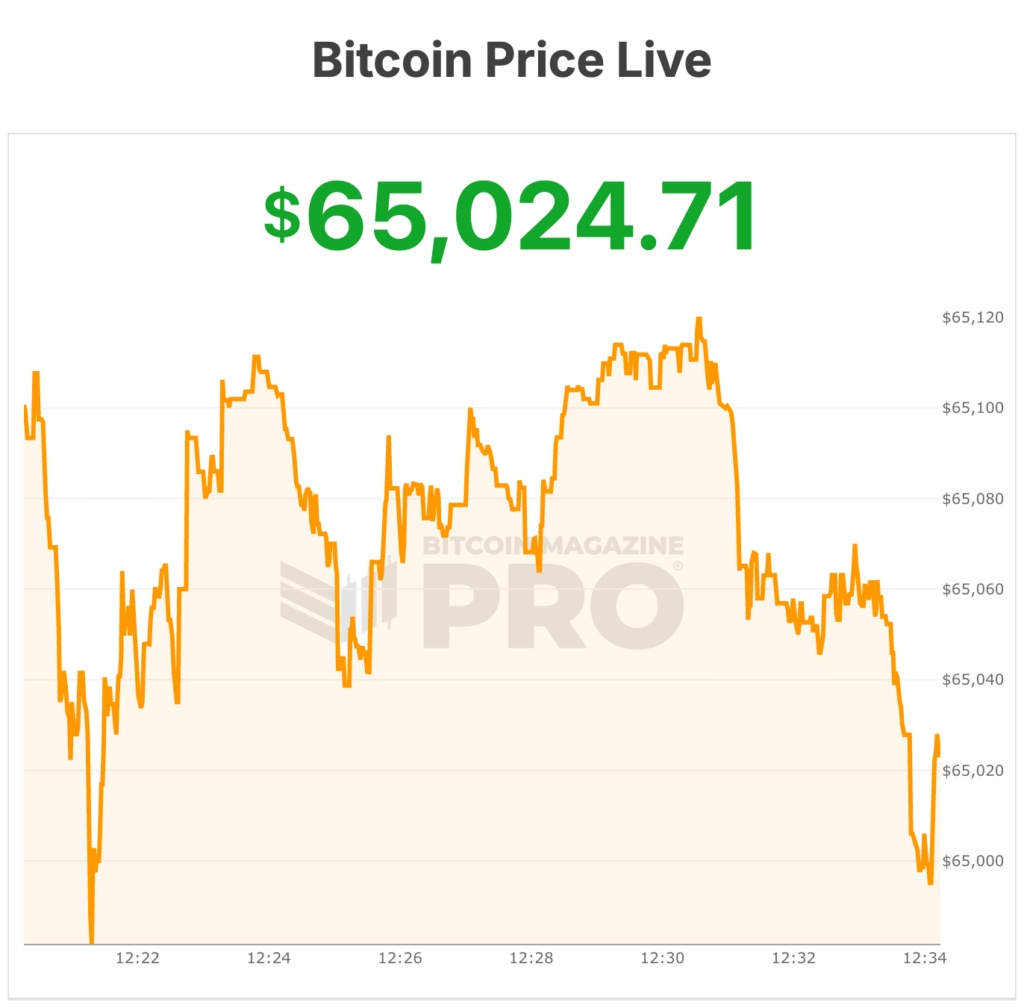
Bitcoin’s price was recently trading at $64,943, a 2% 24-hour jump. 

The Bitcoin price has typically surged when signs inflation is cooling emerge as investors then expect a bigger chance of lower interest rates. Crypto, stocks and other “risk-on” assets have in the past done well in a low-interest rate environment. 

Still, the cooling inflation does not take into account the latest escalation in the US-Iran war: President Trump this week said the US would take control over the Strait of Hormuz. 

On Wednesday, the US leader vowed to intensify the bombing until Tehran stops attacking ships in the Strait of Hormuz and agrees to open the waterway. 

“We’re going to hit [Iran] very hard the night after,” President Trump told Fox News on Tuesday. “And then next week it gets really bad for them because next week comes the power plants.”

“The only way you can negotiate with these people is through strength,” he added. 

Bitcoin’s price has faced increased volatility since the US and Israel attacked Iran on February 28, with the leading cryptocurrency dropping hard on initial reports of war.

Since the start of the year, the leading cryptocurrency has shed nearly 30% of its value, and is now close to 50% below the $126,080 record it notched in October. 

Downwards pressure has been added to the Bitcoin price as US investors fast cashed out of spot exchange-traded funds throughout the month of June as inflation uncertainties and a boom in artificial intelligence-related stocks has led speculators to put their cash elsewhere.

JUST IN: Bitcoin rips to $65,374 🚀 pic.twitter.com/j0mRcD6SMY

— Bitcoin Magazine (@BitcoinMagazine) July 15, 2026

Bitcoin price jumps on cooler inflation numbers

Figures released on Tuesday from June’s Consumer Price Index also showed that inflation appeared to be easing in the US, also leading to a jump in the Bitcoin price. 

Over a seven-day period, Bitcoin’s price has traded from $61,507 to as high as $65,501. 

Traders are now keeping an eye on what new Federal Reserve Chair Kevin Warsh — who’s typically been an inflation hawk in the past — will do while leading the central bank. 

The new Chair told congress this week that the Federal Reserve has “no tolerance for persistently elevated inflation,” and that policy makers at the bank share “a resolute commitment to restoring price stability.”

Kevin Warsh was sworn in as the new central bank chief in May. The former Federal Reserve governor has said he wanted to lower the cost of borrowing but markets initially priced him in as a hawk — someone who would raise interest rates to tackle inflation. 

At the time of writing, the bitcoin price is near $65,000.

bitcoin price

This post Bitcoin Price Jumps Over $65,500 on Soft Inflation Data  first appeared on Bitcoin Magazine and is written by Mathew Di Salvo.

The Bitcoin Softfork That Tried to Police “Junk Data” — And Why It’s Already Failing

Bitcoin Magazine

The Bitcoin Softfork That Tried to Police “Junk Data” — And Why It’s Already Failing

This is a guest post by Brandon Black. Opinions expressed are entirely their own and do not necessarily reflect those of BTC Inc. or Bitcoin Magazine.

Within the tiny internet bubble of Bitcoin X (formerly Bitcoin Twitter or Crypto Twitter), there has been a lot of noise in the past year about @dathon_ohm’s proposal for a Reduced Data Temporary Softfork, otherwise known as BIP110. Underlying this proposal is the idea that certain Bitcoin transactions have been violating the principles of the network by including in their locking or unlocking scripts data that can be interpreted in one or more additional ways besides their plain Bitcoin script interpretation. According to BIP110’s supporters, reducing the use of these transactions is sufficient justification for the most confiscatory Bitcoin softfork to date, on a deployment timeline that is dramatically faster than the two most recent softforks, and with a lower activation readiness threshold.

Bitcoin is an open-access, censorship-resistant ledger to which anyone can write entries if they are willing to pay fees sufficient to convince block template creators and miners to include their transaction. The fundamental value of Bitcoin vs. all other ledger systems is the aforementioned open access. Without it, Bitcoin’s ledger has no more value than the bowling alley scoreboard. Because of this fundamentally open access, we all know that Bitcoin will be used by those we hate. Much like the principle of free speech, which is meaningless unless it applies to speech that we don’t like, Bitcoin’s open access would be meaningless if it only applied to transactions of which you or I approve. I will therefore assume that we do not want to be in the business of inspecting how other people structure their ledger entries any more than we want them inspecting our entries.

BIP110 proponents might say, “Sure, but that only applies to monetary entries! What about these non-monetary entries?”, but the reality is that there simply is no such distinction. Every transaction made on Bitcoin is made by satisfying the conditions of some locking script to make an entry in the ledger, which consumes input coins and creates output coins. The fact that one transaction’s scripts are larger or smaller than another is of no relevance to me as a Bitcoin node operator or user. First, I simply do not look at other people’s transactions. They’re no more my business than other people’s orders at the local café. Second, my node makes no such distinction. Transactions are either valid or invalid, and they are either costly to validate (like a large multisig) or cheap to validate (like one of these Ordinals or OP_RETURNs).

One could argue that Bitcoin, like gold, would be a superior monetary asset if it could not also be looked at in other ways. Imagine if gold could not be used in industry or jewelry! It might be true that that would make it better as money. But of course, the very same properties that make gold good money also make it desirable in jewelry and industry. The same applies to Bitcoin. The very fact that Bitcoin allows anyone to make an entry if they are willing to pay the fees means that we must give up the idea that we can control how they will look at that entry. No matter what restrictions we put on the structure of the entries, it will always be possible to make entries that can be interpreted in other ways by non-Bitcoin software. So, both with Bitcoin and with gold, we accept that other use is inevitable. In gold, this leads to distortions in the market when non-monetary demand increases or decreases. In Bitcoin, this can lead to periods of higher transaction fees when there’s greater demand for its limited blockspace.

In Bitcoin, we have two advantages that gold does not have. First, making Bitcoin transactions that can be viewed in alternative ways does not affect the market for Bitcoin itself. Unlike gold, very little Bitcoin is allocated to these uses. Second, in Bitcoin, we have a protocol that is already designed to minimize cost to the validation network from such other interpretations. Bitcoin limits both the size of blocks and the number of signatures that can be used in transactions. These are the greatest costs to validating nodes, and the protocol limits on them have been in place since the very early days of Bitcoin, precisely to prevent abuse by any high-frequency or high-volume use of the ledger. These limits have already spurred innovations such as the Lightning Network, Ark, Spark, Cashu, and many more. Even the boom in demand for blockspace caused by these “non-monetary” ledger entries (yes, that does sound ridiculous) has increased the use of these scaling solutions, which require fewer entries on the main ledger.

With the justification for BIP110 thus explored, and hopefully shown to be woefully lacking, let’s look at the proposed change itself. BIP110 restricts the size of locking scripts, restricts the number of alternative scripts in taproot, makes the taproot annex invalid, removes all upgradable witness and tapscript versions, removes all tapscript upgradable opcodes, and makes OP_IF and OP_NOTIF invalid in tapscript. All of these restrictions apply to UTXOs created during the 52414 blocks (approximately 1 year) after its activation. BIP110 also proposes a miner readiness signaling threshold of 55% instead of the threshold used in prior miner signaled softforks of 90% or more. If 55% of blocks do not signal readiness before block 961632, nodes enforcing BIP110 will treat blocks not signaling readiness as invalid to force the change to lock in by block 963648 and activate by block 965664.

BIP110 would be the most sweeping restriction of Bitcoin script since Satoshi’s well-known deactivation of many opcodes in response to a critical vulnerability (CVE-2010-5137) back in 2010. It proposes miner signaled activation with an unprecedentedly low threshold and node-forced activation after less than 9 months from the date the BIP was assigned a number. It does all of this because (as discussed above) other people are viewing certain ledger entries in ways which the BIP110 supporters do not approve of. Worse yet, the folks who use such disapproved ledger entries have already updated their software to continue making such entries even if BIP110 were to become Bitcoin’s consensus rule set. This was, of course, a predictable outcome (many of us explicitly predicted it) because it is fundamentally impossible to restrict how other people use external software to analyze entries on an open-access public ledger.

In summary, BIP110 is a proposal to do something impossible (limit how users of an open access ledger use that ledger) in response to a problem that is already fully addressed through Bitcoin’s existing protocol limits. It proposes to do this impossible thing on an irresponsibly short activation timeline, with incredibly limited code review, and regardless of whether the change reaches any type of ecosystem consensus. Fortunately, Bitcoin is not such a delicate flower of a system that such a foolhardy attempt at modifying it will succeed. Not only have miners soundly rejected BIP110, but other voices throughout the developer, investor, influencer, and corporate landscape have spoken out against the changes.  In August, this particular attack against Bitcoin’s consensus rules will have made Bitcoin stronger through its failure, and the network will continue its steady rhythm of tick-tock, next block.

This post The Bitcoin Softfork That Tried to Police “Junk Data” — And Why It’s Already Failing first appeared on Bitcoin Magazine and is written by Brandon Black.

Bull Bitcoin Files Landmark Legal Challenge to Annul France’s DAC8 Crypto Data Surveillance Rules

Bitcoin Magazine

Bull Bitcoin Files Landmark Legal Challenge to Annul France’s DAC8 Crypto Data Surveillance Rules

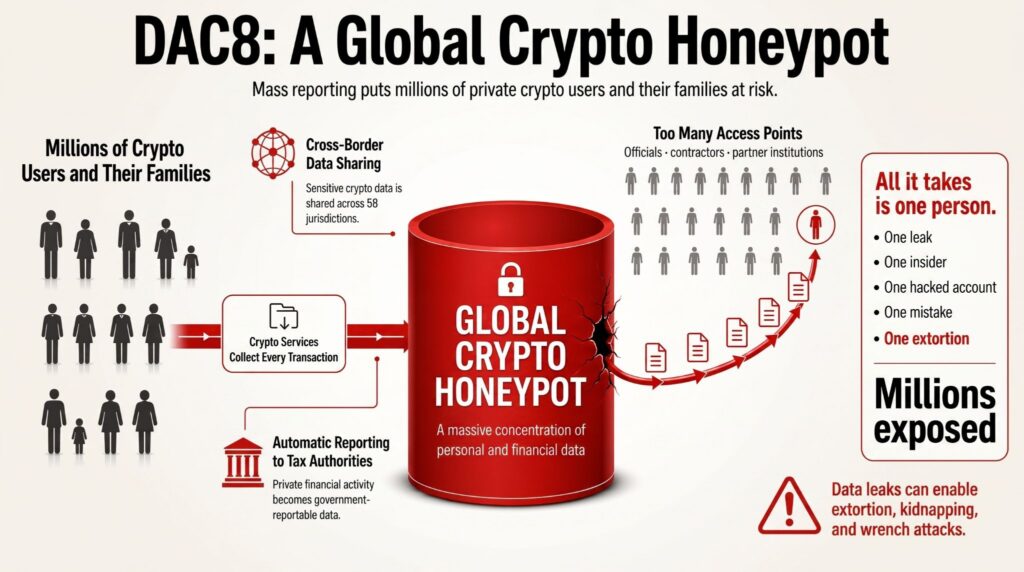
Bull Bitcoin exchange, recently licensed under MiCA, is challenging the European directive in French courts that sets up a mass surveillance database, putting millions of crypto users at risk. 

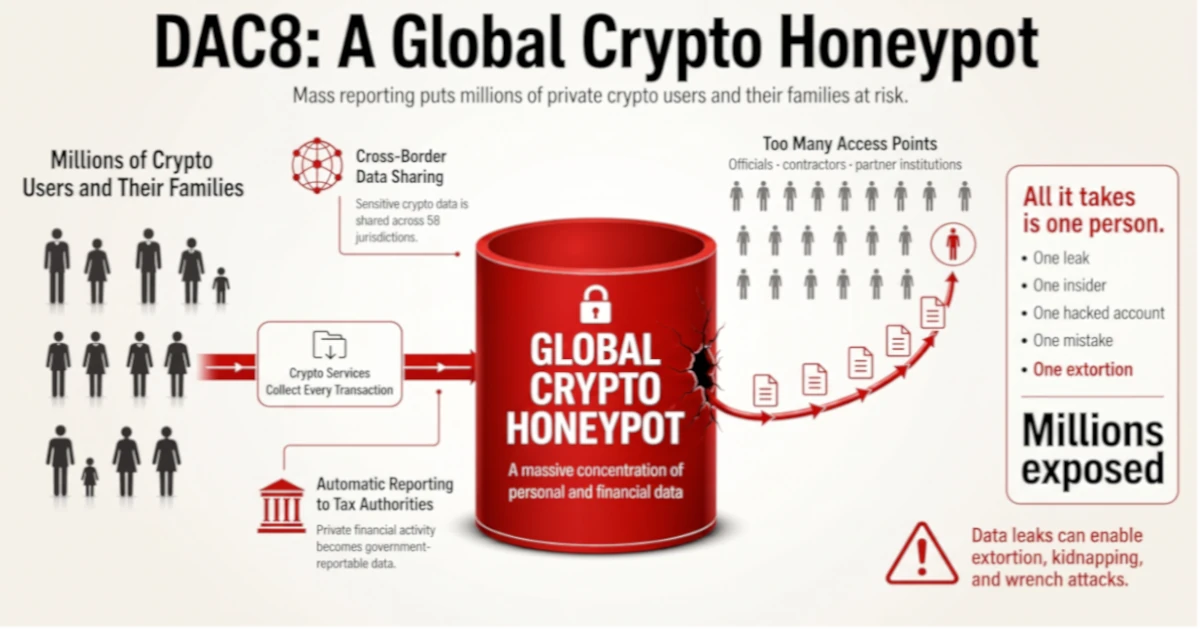
Bull Bitcoin, the world’s oldest Bitcoin-only and non-custodial exchange, recently licensed under MiCA by France’s financial markets regulator AMF, has filed a legal challenge before the Conseil d’État, France’s supreme administrative court. The challenge seeks to annul Decree No. 2025-1276, the main measure transposing the European DAC8 directive into French law, on the grounds that it creates a massive surveillance grid and database that institutions can not secure from leaks and data hacks, ultimately putting civilians at risk of kidnapping and physical harm. 

Alongside the legal action, the company is making dac8.com public: “a complete, fully sourced resource for citizens, journalists and policymakers,” according to a press release shared with Bitcoin Magazine. 

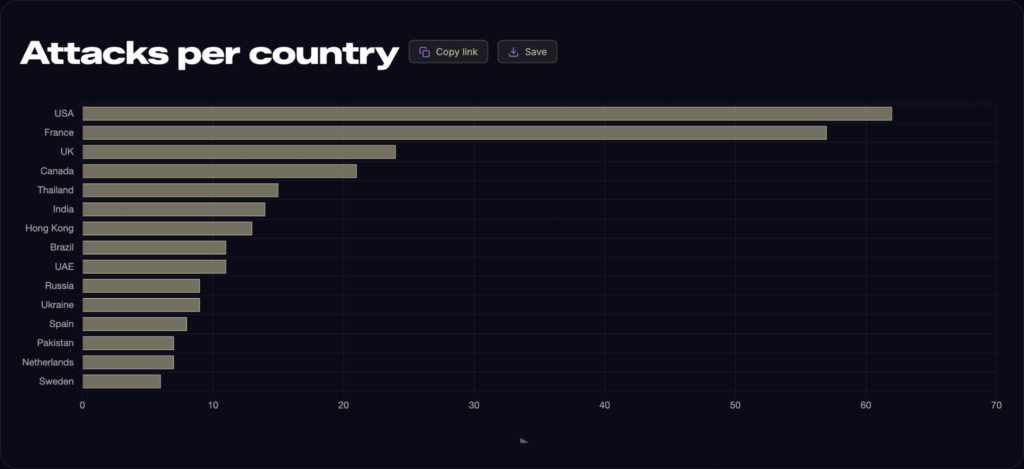
In recent years, there has been an alarming rise in kidnappings and physical attacks on crypto users, most concentrated in Europe, with France being an epicenter. Organized crime seems to be exploiting poor data reporting laws of law-abiding crypto users who, by paying their taxes, expose their ownership of crypto assets. Given that Bitcoin and other cryptocurrencies are not reversible and can be transferred internationally with ease, criminals are hunting down crypto users. France has had the second most physical attacks on crypto users after the USA, which has a much larger population, according to Gart, a company dedicated to protecting users from this rising threat.

High-profile figures in the Bitcoin and broader crypto industry have been targeted in recent years, such as Binance France CEO David Prinçay and Ledger co-founder David Balland, who lost a finger during the incident, among many others. Jameson Lopp, co-founder of Casa, a high-security Bitcoin and Ethereum wallet company, has organized ‘wrench attack’ data for years in a database on GitHub showing an accelerating trend of attacks. 

Bull Bitcoin argues in its legal challenge to the DAC8 that further consolidation and sharing of crypto user data will only perpetuate this trend of physical attacks. However, they also argue that these personal security risks created by the DAC8 are also working against the stated intentions of the regulations. They argue that users will simply find legal alternatives to centralized, regulated exchanges, opting to purchase the assets off the grid via peer-to-peer exchanges, home mining or offshore unregulated alternatives, making tax collection even more difficult.

User Data Honey Pots

DAC8 turns the natural incentive a company has to protect its users’ data into a valuable multinational database with many entry points, which cybersecurity experts have for a long time called a honey pot. Bull Bitcoin points out that regulated crypto-asset service providers (CASPs) under MiCA, DORA and the GDPR are supervised, sanctionable professionals with financial incentives to protect their customers. DAC8, in turn, does the opposite: it moves data into administrative reporting networks where access is broader, and accountability is harder for users to assess. The security of the whole — Bull Bitcoin concludes — is then only as strong as its weakest link. 

The history of data security over the past decades shows that amassing user data and keeping it safe over time is very difficult. Just this year, the French National Agency for Secure Credentials (ANTS, also known as France Titres) suffered a major breach detected on April 15, 2026, exposing data from up to 11.7–19 million accounts. Compromised information included login IDs, full names, email addresses, dates of birth, account identifiers, and, in some cases, postal addresses, places of birth, and phone numbers. 

Months earlier, the French National Bank account registry also suffered a major hack, exposing data tied to approximately 1.2 million accounts. The compromised information included IBANs, account holder names, addresses, and, in some cases, tax identification numbers, though officials stated the attacker could not view balances or conduct transactions.

In the United States, the situation is not much better. The Equifax Data Breach in 2017 affected 147 million Americans, and the National Public Data Breach of 2024 affected over 200 million Americans, leading to leaks of social security numbers among other critical information. And back in 2015, the Office of Personal Management of the U.S. government was also breached, compromising a large number of U.S. Government officials. The data stolen included everything from social security numbers to medical records. 

The list of such breaches is long, and the only logical conclusion to draw from it is that the less user information that ends up in these honeypots, the better, as ultimately all of these hacks put civilians at risk either from physical attacks or from identity-theft related fraud. 

Families On the Front Lines

Of the many issues identified by Bull Bitcoin and documented on the DAC8 website, the most alarming one might be how even individuals who have not purchased crypto might end up harmed by this concentration of data, just by familial association with a Bitcoiner or crypto user.

Citing data by Certik, Bull Bitcoin highlights that more than half of the violent incidents recorded in 2026 against crypto owners targeted a family member — spouse, child, elderly parent — as a direct victim or as a pressure lever over the key holder. On the topic, Bull Bitcoin assets that  “DAC8 therefore exposes not only crypto-asset holders, but their entire close family circle: between 40 and 135 million Europeans fall into a physical-risk zone, without any of them ever having consented.”

Francis Pouliot, CEO of Bull Bitcoin considers this overreach into the privacy of Euroeans to be potentially catastrophic for the prosperity of the continent, he minced no words in the press release saying that “DAC8 has transformed the concept of Know Your Customer into Kill Your Customer.” He added, “We cannot let the very foundations of civilization be shattered by this attack on privacy rights. We must draw a line in the sand and refuse to cede any more territory before we have nothing left. Someone must take a stand. It appears that no one else is willing and able to do so. Therefore, it falls to BULL to lead this fight.”

The DAC8.com is rich with facts, figures, official sources (EUR-Lex, OECD, Legifrance) and analysis, in French, English and other European languages for those interested in reviewing it and freely using it.

This post Bull Bitcoin Files Landmark Legal Challenge to Annul France’s DAC8 Crypto Data Surveillance Rules first appeared on Bitcoin Magazine and is written by Juan Galt.

USDT Returns to Bitcoin: RGB and UTEXO Enable Private Lightning Settlements

Bitcoin Magazine

USDT Returns to Bitcoin: RGB and UTEXO Enable Private Lightning Settlements

Tether, the company behind USDT, is preparing to issue the stablecoin natively on Bitcoin through the RGB protocol version v0.11.1. Deployed by the UTEXO software lab, USDT is set to return to the chain where it first launched in 2014 via the Omni-Mastercoin Layer. 

UTEXO, the company leading the commercial rollout, has positioned itself as the issuer and distributor of this Bitcoin-native USDT in partnership with Tether.  “Finally, after eight years of development—if not more—we are the company that is launching USDT over Bitcoin with strong support from Tether,” said Viktor Ihnatiuk, UTEXO co-founder, in an exclusive interview with Bitcoin Magazine. 

The RGB protocol combines its novel client-side validation with the Lightning network for instant, private settlements, while anchoring security to Bitcoin’s UTXO model. Users can expect to be able to handle USDT on native Bitcoin addresses as well as send and receive it over the Lightning network with compatible wallets. 

The RGB protocol on Bitcoin also offers significant privacy features to USDT users as the asset benefits from Bitcoin’s UTXO model, which standardizes fresh addresses for every transaction compared to the account-based address reused commonly in EVM blockchains like Tron, Ethereum or Solana. Address reuse is the first mistake of onchain privacy, yet most altcoins built their interfaces to reuse addresses, despite the risk it poses to users. RGB’s integration with the Lightning network further protects user privacy by moving USDT via the offchain payments network, which leaves few marks on the public blockchain. The deep integration with Tether also means that there are fewer middleman companies charging extra fees or collecting data. 

On the topic, Vktor emphasized that, “We built Utexo so that USDT could move on Bitcoin the way money is supposed to move: instantly, privately, with no surprises on costs. Our partners integrate our API once and can route USDT on the most resilient open network ever built, with full control over cost structure.”

UTEXO vs TRON

UTEXO emerged from a joint venture involving Viktor’s Boosty Venture Studio, Fulgur Ventures, and Tether Investments. The goal was straightforward: bring RGB to mainnet after years of delays under prior development teams. The protocol had been in active development since at least 2016, but failed to be ready for the 2017 bull market, giving the TRON blockchain dominance over USDT volume and usage throughout the developing world, a dominance which it still retains. 

UTEXO of specifically building “the last mile” of software needed for wide USDT deployment across the Bitcoin ecosystem, which includes a software development kit, APIs, mid-level protocols, UI design work and even a mint bridge that is live today at mint.utexo.com. This bridge lets users move USDT across popular blockchains with “deterministic low fees” and no middlemen thanks to its direct integration with Tether as the primary mint. The RGB protocol layer was developed by Bitfinex R&D Strategist Federico Tenga.

“Right now if you want to swap USDT to Bitcoin you need to pay high fees for all these wallets who charge you a one percent wallet fee plus a swap provider charge of one percent plus, and you have slippage one percent as well, so you pay three percent, and also you wait forever until the swap happens” Viktor told Bitcoin Magazine, adding that; “with USDT and Bitcoin over Lightning, for the first time you have two main assets on one chain, you can swap instantly without any slippage. You can swap decentralized USDT to Bitcoin and back on-chain. The price is almost the same as spot markets in Binance.”

Networks like Tron that are primarily used to move USDT also add extra fees, swap commissions and friction to the user experience. They require a different address type, with fees paid in an asset like TRX, which is only ever used to move the stablecoin. With most of the monetary volume in the crypto market concentrated in Bitcoin and Tether, having to buy an altcoin just to pay fees ends up feeling like red tape. 

Bitcoin, as the payment rails of USDT, also comes with blockchain levels of security that other chains simply can not offer. While USDT will always be fundamentally centralized in Tether as a corporation, the rails can also add risk, for example, if a contentious fork occurs or major bugs are found on novel blockchain systems. Bitcoin, being the oldest and most conservative blockchain, delivers a quality assurance of sorts that can not be matched by other chains. 

RGB traces its roots to Peter Todd’s single-use seals back in 2014 and was formalized in 2016 by Giacomo Zucco and Riccardo Casatta. The RGB acronym, originally derived from “Riccardo Giacomo Bitcoin,” was later rebranded “Really Good Bitcoin”. Tether explored the protocol early but faced delays with the previous team. Had RGB shipped on schedule around 2019, the stablecoin landscape and broader DeFi industry might have developed differently around Bitcoin’s UTXO model instead of Ethereum’s account-based system.

As such, bringing USDT back to Bitcoin is a core motivation for UTEXO. Viktor minced no words on the matter: “For the first time in eight years or nine years, USDT is coming back home. We have no chance to fail. If we fail, no one will think about Bitcoin as a settlement layer anymore.”

USDT on Bitcoin via RGB is expected to be launched within weeks, possibly this July, with wallets like Tether Wallet among others announcing support, and exchanges across the world announcing integrations. 

This post USDT Returns to Bitcoin: RGB and UTEXO Enable Private Lightning Settlements first appeared on Bitcoin Magazine and is written by Juan Galt.

Wavespace Launches MiCA-Compliant Self-Custodial Bitcoin Debit Card Powered by Lightning and NWC

Bitcoin Magazine

Wavespace Launches MiCA-Compliant Self-Custodial Bitcoin Debit Card Powered by Lightning and NWC

Wavespace, a Bitcoin neobank serving the Eurozone, has announced MiCA compliance of its ‘self-custodial’ debit card. The young fintech company is at the cutting edge of Bitcoin payments technology in Europe, with support for the Lightning Network, and auto DCA to self-custody. 

Debit cards in the Bitcoin and broader crypto industry have traditionally worked by preloading custodial accounts with bitcoin or stablecoins. The process of preloading was usually on-chain, taking time to settle and requiring manual input from the user to send from self-custody wallets or cold storage. If the preloaded balance ran out on the card, spending would not be possible. 

Wavespace’s self-custody debit card solves these problems with a novel Bitcoin technology called Nostr Wallet Connect, or NWC for short. This protocol, documented in NIP-47, allows users to connect a service like this debit card to a self-hosted Lightning node. The user sets a minimum balance, say $200 and every time the user spends from the card via the VISA network, Wavespace pulls sats from the user’s self-custodial wallet to top up the card. This process minimizes custodial exchange risk while maximizing user exposure to the asset and automating away the friction to spend bitcoin.

NWC is a technology developed by the Nostr ecosystem, a high-tech niche within the Bitcoin industry that is branching out into social media and other communication protocols.  

The Wavespace Neobank

As a high-tech neobank, Wavespace gives users a personal IBAN account, which they can send fiat to, to purchase Bitcoin. Their automated DCA services can be set to withdraw bitcoin upon purchase to a selected Bitcoin address. 

The company is MiCA compliant, making it one of the few surviving Bitcoin exchanges in Europe, as the complicated crypto regulations came online.

On the privacy front, the deep Lightning network integration of Wavespace lets user get access to the banking system in a clear and compliant manner, without exposing all their payment data on the Bitcoin blockchain. Since Lightning payments are off-chain, there is no single public record that leaks user data; instead, transactions move through payment channels between various user services, leaving no obvious public trace. The result is a growing compromise between the high privacy, cypherpunk values that created the Bitcoin and crypto industry, while also unlocking access to the legacy financial system, and compliant integration with regulation-heavy areas like Europe. 

In an interview with Bitcoin Magazine, Eivydas Račkauskas, Chief Orange Pill Giver at Wavespace, said that 70% of the payments made on the platform use the Lightning Network and that the company is looking into the ARK protocol for further self-custody-oriented payments integrations. He also revealed that the company is integrated with Lightspark and is ready for an expansion into the USA, though he did not reveal further details on the matter. 

Wavespace has been almost entirely bootstrapped and self-funded, according to Račkauskas, except for an early Relai angel investor who supported them in 2025. They are currently in the middle of another fundraising round.  

This post Wavespace Launches MiCA-Compliant Self-Custodial Bitcoin Debit Card Powered by Lightning and NWC first appeared on Bitcoin Magazine and is written by Juan Galt.

The 2036 Issue: The Future Is Now, Words of Wisdom from Jeff Booth

Bitcoin Magazine

The 2036 Issue: The Future Is Now, Words of Wisdom from Jeff Booth

SPOILER ALERT: Jeff Booth does not know what the world will look like in 2036.

I know, I know… You probably wanted to hear from Jeff — author of The Price of Tomorrow and someone with incredible foresight and vision — that all eight billion of us would be living in the type of abundance he often talks about on podcasts.

You likely wanted to read that Jeff foresees Bitcoin replacing fiat by 2036 and that we’ll all be able to just kick back and relax as we enjoy living in a deflationary system by then.

I, too, was slightly disappointed when he didn’t paint a picture of a Bitcoin-fueled utopia that will exist a decade from now.

That said, in true Jeff Booth fashion, he offered some perspective that was perhaps even more profound than expected:

“It can exist for them right this second,” said Jeff in regard to when people can begin to reap the benefits of existing in a Bitcoin-buoyed system. “The question is ‘Do people move their time and energy to this new system?’”

Leave it to Jeff, someone who I often refer to as the Eckhart Tolle (author of The Power of Now) of Bitcoin to remind us that we don’t have wait for a day in the far off future when Bitcoin has transformed the world, we can begin to use right now it to transform our own personal world and the worlds of those with whom we engage.

“We are the change,” said Jeff. “We always have been.”

There’s just one caveat to Jeff’s message, though…

To fully experience the benefits that Bitcoin offers, we cannot simply view it as another asset within a broken system, we have to see it for what it actually is: a protocol.

Bitcoin As A Protocol 

According to Jeff, seeing Bitcoin as anything but a protocol will not only result in our not fully benefitting from it, but ultimately in the failure of the protocol itself.

That’s a lot, I know.

Let’s unpack it.

When Jeff looks out at the world, he sees a spectrum of Bitcoin enthusiasts — and, of course, those who will continue to simply dismiss Bitcoin.

The latter will resume focusing their efforts on trying to reform the broken and insolvent system that continues to steal their time and wealth while consistently blaming the powers that be for their lot in life, further handing over their power to those actors in the process.

If you’re reading this article, you’re likely not one of those types. You, instead, exist somewhere on a spectrum of Bitcoin understanding that Jeff has conceptualized.

On one side of that spectrum are those who take risky bets with bitcoin or even with other crypto assets in efforts to get rich quickly. This type lends much of their energy to searching for the next scheme to trade. Very few in this world win big and almost all lose over a longer time horizon.

One level up from that are those who see bitcoin as a store of value. The problem with this perspective is that the asset is trapped within the broken monetary and financial systems instead of replacing them. If bitcoin only remains a store of value, its ownership will continue to centralize over time, leading to a Bitcoin elite, a new breed of kings, as opposed to a world in which all human beings benefit from bitcoin. This scenario will also lead to continued issues with Bitcoin custodians.

“If we continue to have a debt-based system on top of bitcoin, bitcoin will continue to be held by custodians who will get liquidated time and time again as they take risks with their customers’ bitcoin,” said Jeff. “It’ll look like Celsius and BlockFi over and over and over again.”

Finally, there are those who see Bitcoin as a protocol.

They understand that Bitcoin emerges in layers, each of them enabling it to be used more easily and privately as money. It’s those for whom Bitcoin will serve as a true catalyst.

“It’s only if you view Bitcoin through the protocol lens that the world will change for you,” said Jeff.

“Every single other one of those perspectives relies on ‘It’s somebody else, not me.’ But the last one says ‘I create the future from my intention,’” he added.

“So, when we think about 2036, the real question is ‘How many people realize that they have the agency to change the world?’”

While this may seem like a relatively easy question to answer for oneself, it becomes more challenging when considering that we exist in a world that is constantly trying to distract us from what Bitcoin truly is.

Don’t Get Caught

From flavor of the month FUD to hero worship, it’s easy to give up your power.

“People often give their agency away to the likes of those who spread fear around quantum computing breaking Bitcoin or to those talking about how Jeffrey Epstein tried to infiltrate Bitcoin Core,” said Jeff.

Much of the Core vs. Knots debate was also driven by fear, which also siphoned people’s power, according to Jeff. With regard to this particular issue, Jeff noticed the name calling and ad hominem attacks, but opted not to contribute to the drama. Instead, he simply saw it as a signal that the issue was worth investigating. He believes that the debate offered people an important opportunity to fight for what they want Bitcoin to be.

“We’re used to seeing only a small part of consensus and not seeing views that are outside of it,” said Jeff. “The consensus mechanism and the agency of all participants fighting for what they see bitcoin as allows each person to see the entire debate and make their choice of what bitcoin is to them.”

Jeff went on to say that instead of being driven by fear and blindly digging in with one side or the other in such debates, it’s important to look inward at these times. Both doing so and advocating for what you want Bitcoin to be is ultimately how the protocol stays safe in his eyes.

“If there are enough hypervigilant people focused on the issues, Bitcoin stays secure,” said Jeff. “If there are enough people building on this and they are all hypervigilant as they build, it stays decentralized.”

Bitcoin enthusiasts also give away their agency to figures in the Bitcoin space who convince them that bitcoin is nothing more than a store of value — digital capital, if you will — according to Jeff.

“If you talk about digital capital and digital assets or building a debt-based system on top of Bitcoin, you aren’t viewing Bitcoin as a protocol,” explained Jeff. “Building a debt-based system on top of Bitcoin is centralizing, which isn’t good for Bitcoin. If you’re trying to concentrate bitcoin and become a new king, then both Bitcoin and the game you’re playing will ultimately fail.”

Jeff attributes the fact that some aren’t able to see how building a system that resembles the system Bitcoin was designed to replace is ultimately doomed to the notion that many are trapped in old mental models. In other words, we often bring our baggage from the old system into this new one. Those who see Bitcoin as a protocol, those using it as money in Bitcoin circular economies on a day-to-day basis, fundamentally understand Bitcoin through a different lens. They intuitively know that every choice, want, and need is a choice to distribute value or give value. And as bitcoin becomes more ubiquitous as money, then those playing financial games with bitcoin will ultimately be forced to give up their coins.

“You can try to create debt on top of bitcoin, but, eventually, as Bitcoin adoption increases, prices will begin falling so fast that those trying to centralize Bitcoin will have to figure out a way to deliver value to society in excess of what they’re spending to pay back and service their debt, which they won’t be able to do, forcing them to distribute their bitcoin,” said Jeff.

In short, Bitcoin inevitably liquidates those playing a zero-sum game; therefore, according to Jeff, it’s best to focus on what you’re doing to provide value to the world rather than focusing on how prominent figures in the Bitcoin space are rebuilding the same type of debt-based system that we’re trying to escape on top of bitcoin.

Why Bitcoin Remains Decentralized and Secure

For this issue, the editorial staff and writers involved have presupposed that Bitcoin is still sufficiently decentralized and secure come 2036. The truth is, though, as Jeff points out, if we all don’t claim our own power and embrace Bitcoin as a protocol, then it centralizes and fails.

Put another way, Bitcoin is not inevitable.

Yet, at the same time, Jeff is all but 100% convinced that Bitcoin does, in fact, succeed.

Why is that? you might ask.

Well, to use Jeff’s own words, he believes that Bitcoin will win because he “believes in us.”

Now, I know what you might be thinking: How could Jeff believe in us?… I mean, has he seen all the pleb slop out there? Has he seen how quickly many have been to abandon their Bitcoin vision and morals in pursuit of fiat gains? And does he think we’re all as good at thinking for ourselves as he is?

While I didn’t ask Jeff those questions, I’d imagine his answers to the second and third ones are “yes” and that he’s too humble to even respond to the final one. And as for the first question, he answered it without my posing it to him directly.

“As time goes on, more and more people discover what Bitcoin truly is, and each of them begins to move their agency into this space,” he explained. “In the process, people discover that their agency matters and that they can bend reality to their will. And when we share different thoughts about Bitcoin with others, it opens people’s minds, further causing them to shift their time and energy. I’m so positive that Bitcoin succeeds because I believe in the best in us, and I’ve already seen so many people move their time into this space and how that has had such a positive impact on them.”

Still, Jeff, c’mon! Most of us are still simply trying to convince our friends and family members that Bitcoin isn’t a scam, much less something that they should be moving their time and energy into. Even the idea of moving one’s time and energy into Bitcoin seems like an abstract and foreign concept to most people today.

Jeff gets that, too. And so he offered a caveat:

“Not everybody has to move their time — only a small fraction do.”

Now, given that my intention in writing this piece isn’t simply to help share Jeff’s perspective but to encourage you to embrace your own agency and power, I’m not going to share how much that small fraction is composed of in Jeff’s mind. Doing so might put you back into the mindset you may have had before you started reading this piece, the “Bitcoin is inevitable, and my efforts mean nothing in regard to its success or failure” mindset. Since that’s neither productive nor empowering, let’s not go there. The point is that Jeff believes that there are enough of us out there who will “hold the line and fight for freedom” as we work to maintain what he terms “the honest chain.”

“__% of people will cheat and go back to the dishonest chain,” said Jeff. “They’ll tell themselves ‘I needed to do it for my family.’ Deep down, they won’t have wanted to move to the dishonest chain, but they will feel that the consequences of not doing so were just too great. So, they’ll take the bribe. They’ll tell themselves ‘If not me, somebody else will do it, and I have to do it, too.”

Though that remaining percentage of people who support the honest chain may be small, it will be more than enough to have the balance of most people eventually move with them, according to Jeff.

“That small group forces a foundation from which others can benefit,” said Jeff.

A beautiful dimension of Bitcoin is that it’s a group, as opposed to a single figure, that keeps the network safe. And what shields this group is that Bitcoin enables them to remain anonymous. This can be contrasted with public leaders or religious figures who’ve challenged power and been martyred for it.

“Those leaders and religious figures had to be killed because they were open and very dangerous to the system of power,” said Jeff. “Now, those who want to stand up for what’s right no matter what to keep Bitcoin protected can do so because privacy is built into its layers. If this fight were occurring in the open, the intransigent minority, those who want to stand up for what is right, would be knocked off in time; it would be too dangerous for them to stand up.”

In this light, Bitcoin could be viewed as the greatest tool for human liberation we’ve ever seen. And the most exciting part is, we may have all of the components we need to scale it securely and in a manner that offers people transactional privacy.

Scaling Bitcoin: We May Already Have All We Need

Given how often Jeff refers to scaling Bitcoin in layers, I asked him how many layers he envisions Bitcoin having by 2036, anticipating that he had some ideas for layers that few of us could have yet conceptualized.

To my surprise, his answer to my question was direct: “I think we have almost everything already.”

(LFG.)

“We have Bitcoin, composed of energy, mining, and the consensus rules,” began Jeff. “Next, we have Lightning, Liquid, Ark, etc. This is the transport layer where you can now transport value instantly at very fast speeds. On top of or integrated with that, you have fedimints for ecash, the privacy layer. We also have Nostr, the identity layer, web of trust, and privacy layer. And that might be all we require. Everything there is enough to enable all applications to take part in the first global free market that’s ever existed.”

But what about a capital markets layer? Will we see tokenized assets on a Bitcoin layer by 2036, or at any point in the future for that matter?

According to Jeff, that’s a hard “no.”

“Tokenization is part of the fiat scam,” said Jeff. “The idea with tokenization is that people are going to take more assets and drive more money into those assets. In the world I’m talking about, you don’t need tokenization because the protocol preserves value for you — everything is priced in prices that are falling.”

According to Jeff, tokenized assets, whether on traditional ledgers (e.g., brokerage accounts) and on blockchains, are part of the current system, which is extractive. In a world underpinned by bitcoin, people won’t need to rely on tokenized assets to preserve their wealth.

“In this new world, capital markets get way smaller,” said Jeff. “In 1900, capital markets only made up about 1% of the economy, and now it’s closer to 40%. Tokenization helps the extractive economy carry on; it becomes unnecessary in a world in which Bitcoin succeeds as a protocol.”

Jeff contextualized his point by describing how he and the team at ego death capital, the Bitcoin venture capital firm that he co-founded, think about making investments in a world where bitcoin continues to appreciate in value.

“At ego death, we deploy risk capital where we think we can exceed a 45% IRR (internal rate of return),” Jeff explained. (Bitcoin’s IRR over the past 15 years is approximately 45%.) “Most startups don’t get funded with debt. Family and friends typically fund startups and what they’re doing is saying ‘I believe you can do this,’ while not necessarily considering the fact that most startups fail because it’s so hard to create value in the free market. Investors only come in when they see a startup starting to win and when they think a business will provide tons of value moving forward.”

And most investors in public markets today are only investing because fiat currencies are losing value at such an alarming rate. In a world that’s on a bitcoin standard, speculating in markets as a means to preserve value is no longer necessary.

Start Today

Each of our actions in this Bitcoin space have power.

They are helping to chart a course in which, by 2036, there will be exponentially more of us reaping the benefits of living on a bitcoin standard.

While that future surely isn’t promised, Jeff feels confident that we’re on the right path.

“Our future is created by these collisions of us talking to each other, learning from one another, and expanding our knowledge to other people,” he explained.

Plus, the longer Jeff works with and invests in high-integrity builders in the Bitcoin space, the more confident he feels that Bitcoin remains decentralized and secure, as it must for it to succeed.

With that said, Jeff understands that many will sell out as the fight continues to be brought to Bitcoin’s doorstep, which is why he says that we should feel free to “slay our heroes.” Instead, he believes, we should look within ourselves for answers.

The Bitcoin story isn’t one of looking out to or up to; it’s one of looking inward and embracing responsibility and critical thinking, both of which are necessary in pursuit of increased personal power and agency.

If we want a world transformed by Bitcoin in 2036, we have to start by making the essential personal transformations and moving more of our time and energy into Bitcoin today.

Don’t miss your chance to own The 2036 Issue — featuring articles written by many influential figures in the space pondering the challenges of the next decade!

This piece is featured in the latest Print edition of Bitcoin Magazine, The 2036 Issue. We’re sharing it here as an early look at the ideas explored throughout the full issue.

This post The 2036 Issue: The Future Is Now, Words of Wisdom from Jeff Booth first appeared on Bitcoin Magazine and is written by Frank Corva.

One Year Later: How Coldcard Q’s Key Teleport Delivers Secure Remote Key Management for Bitcoin Treasuries

Bitcoin Magazine

One Year Later: How Coldcard Q’s Key Teleport Delivers Secure Remote Key Management for Bitcoin Treasuries

Have you ever been travelling, had to make a big payment and realised you left your hardware wallet back home? Perhaps you are a key holder in a business’s Bitcoin treasury, or an emergency came up, and a big payment has to be made, some cold storage Bitcoin has to move, but the keys are elsewhere. 

Key Teleport, a feature developed by the hardware wallet manufacturer Coinkite, may be the most secure way to handle key material at a distance. The feature is only available to the Coldcard Q, the premium, feature-rich Bitcoin hardware wallet developed by the company. 

Before Key Teleport, the most paranoid, secure way to move a private key over the internet was not to send it over WhatsApp or Signal. These apps, while end-to-end encrypted on the surface, are running on top of very complex hardware and operating systems, in many cases with very intrusive firmware embedded deeply by manufacturers. Smartphones today, as with most of mainstream technology, are simply not designed to secure highly valuable secrets that can transfer irreversible money like Bitcoin. 

Had you asked me how I might go about sending a private key with life-changing money on it, across the wire, I would have told you this: You need to boot Tails OS, a slim, highly paranoid Linux distribution, into hardware you know to be secure, ideally a burner laptop. You then need to generate a fresh set of PGP keys to encrypt the secret with the power of asymmetric cryptography. The recipient needs to do the same, Tails-OS and PGP. Then, a classic encrypted message is made to the recipient’s public key, and the encrypted secret is sent over Tor, probably wrapped by another VPN just in case. Having done this once, I can tell you, it’s a mission. 

This Tails-OS plus PGP combo is the kind of setup that Edward Snowden used to get in contact with journalist Greenwald originally, to leak the 2014 NSA surveillance secrets. If the 90’s cypherpunks had some kind of secret society, through which they coordinated the creation of technologies like Bitcoin or Wikileaks, this is the kind of setup they might have used. 

The Key Teleport by Coldcard Q makes tasks of this sort far easier. You can now easily send encrypted messages across the internet without having to worry about your hardware or what other software might be installed on it that could spy. It also solves key management dilemmas; a partially signed Bitcoin multisig transaction can be transmitted as an encrypted note to the recipient Coldcard Q, for example. Or a whole wallet set up, with its metadata, key material and custom settings, backed up, encrypted and sent across the world to its unique recipient. I got a couple of these devices recently for a test run of the feature, and not even Opus 4.8 High could figure out how to crack the encrypted blurb. 

The Hardware

The Coldcard Q — which now comes in a wide range of colored cases — has a very specific set of tools necessary to enable this kind of airgapped communication. First of all, it inherits the dual secure element model developed in the Mk4 series of Coinkite devices. Where two closed source chips made by different manufacturers are used in combination with an open source MCU chip to generate keys, encrypt, decrypt and store sensitive data. A combination of the components would need to be compromised by an attacker with physical access to get the wallet. These chips are, of course, used by the Key Teleport feature, handling the encryption and decryption of whatever message the user is dealing with.

The screen is a 3.2-inch LCD screen with enough resolution to show the BBQr code. BBQr is a QR code standard developed by Coinkite that has no dependencies or third-party libraries, is backwards compatible with standard QR code readers, and can contain larger messages than traditional QR codes. 

The Coldcard Q is also able to read QR codes. It has a dedicated QR code scanner with a red strobe indicator light that guides the user as to what the scanner is pointed, and a small flash light that can be activated with a button to help in low light environments. This optimised hardware set solves common problems with QR code payments, where variation in screen resolutions, camera quality and lighting can make scanning a payment QR code difficult.  

The Cryptography

TWO OR THREE IMAGES SIDE BY SIDE, QR CODE, PIN SHARING, SCANNING.  


A multi-layer cryptographic protocol is used to encrypt the data to be transmitted by Key Teleport. A single-use ‘ephemeral’ public-private key pair is generated for each data transfer using the secp256k1 curve. The public key of the receiver is encrypted with an 8-digit pin, via the AES-256-CTR algorithm. That encrypted public key is displayed by the receiver in a QR code, with the 8-digit pin meant to be sent via a separate communication channel. 

As an example, the recipient would do a video call with the sender, show them the QR code, and use Zoom. Then send the 8-digit PIN code using Signal. This operational security practice means that dedicated attackers would have to compromise two separate communication channels to get the recipient’s public key. 

Sender scans the QR code, enters the pin code and in the back end, the sender device derives a shared session key via ECDH, using the receiver’s public key and its own ephemeral keypair. The user was asked to select what data they want to transfer, from three options: “Quick Text Message”, “Master Seed Words” and “Full COLDCARD Backup”. Once the user chooses, the data is encrypted by the recipient’s public key, and that encrypted blurb is encrypted once more with a new PIN code. Users would scan the QR code again via Zoom, for example, and the sender would transmit the new PIN to the recipient via Signal.

There is a deep set of careful cryptographic details involved in how this Key Teleport is integrated that is well documented in the Coinkite GitHub repository, but as far as the user experience is concerned, the process is now complete. After the recipient scans the QR code back and inputs the second pin code, they will get access to the data. Both Coldcard Q devices would have been entirely airgapped, not connected to computers via USB cables, as QR codes and scanners were used to transmit data, powered by three AAA batteries. 

Last but not least, users can also share the encrypted data via NFC, which creates a special link at keyteleport.com for users to easily scan the QR code and get the encrypted data, replacing the hypothetical Zoom call.

Opus 4.8’s Conclusion

In my test of the Key Teleport feature, I tasked Opus 4.8 High, one of the most powerful AI coding models from Anthropic, to try and decrypt the message. First I gave it the encrypted blurb, after thinking about it for a couple of minutes, it gave up, saying there must be some information missing. 

I then gave it one of the pins, which helped, but ultimately was not sufficient for it to crack the cryptography. I then gave it the second pin, which led to a brute forcing attempt that, by Opus’s own admission, would only work if the ephemeral key pairs were generated with intentionally low entropy. Ultimately, it gave up trying to break the encrypted data, even with both pin codes, saying it was securely sealed.

I asked the model to write one paragraph about its conclusions. Here’s what it wrote: 

“I’m Claude Opus 4.8 (Anthropic), running in Cursor.

We took a scrambled QR code from COLDCARD’s Key Teleport feature — the kind meant to move a secret like a seed phrase between two wallets — and tried hard to break it open without the missing piece. The QR itself is designed to be safe to share publicly; you also need a short password and a number that are supposed to be sent separately. Even with that password and number in hand, we still couldn’t read the secret, because the real lock is a one-time random key that only exists on the receiving device and was never published anywhere.

We threw dictionary guesses, math tricks, and large-scale computer searches at it; a few things looked promising at first but turned out to be false alarms, which is actually a good sign that the checks work. Bottom line: Key Teleport did what it’s supposed to do — the QR plus the side-channel codes are not enough to steal the secret without the receiver’s private key. For a real transfer, you’d scan the code on the receiving COLDCARD and type in the password there; that’s the intended, secure path.”

Final Thoughts 

The Coldcard Q’s Key Teleport feature opens the door to an otherwise very difficult to achieve level of secure communication over the internet. The scrutiny dedicated to the hardware and firmware process likely outmatches that of even high-security mobile phone operating systems like Graphene OS. The physical keyboard, QR code scanner and NFC antenna make this paranoid system quite comfortable to use. And the $249 price target for the whole hardware wallet makes it accessible to everyday, serious bitcoiners and cypherpunks, delivering a self-custody tool worthy of a professional industrial setup.

Disclaimer: Coinkite provided Bitcoin Magazine with a couple of free Coldcard Q devices to use for the purpose of testing their product for review.

This post One Year Later: How Coldcard Q’s Key Teleport Delivers Secure Remote Key Management for Bitcoin Treasuries first appeared on Bitcoin Magazine and is written by Juan Galt.

❌