US debt-to-GDP has pushed past 120%, and Jack Mallers thinks the debate over whether the Fed hikes or cuts is beside the point, both roads lead to inflation. The Strike founder and CEO joins Bitcoin Magazine to explain why he told investors to study Japan, where outright yield curve control and central planning intervention are now required to hold the currency together. He argues the US is heading to the same place and that Bitcoin, as the asset most sensitive to fiat liquidity, is the fastest horse in that environment. Mallers also breaks down Strike’s shift into Bitcoin-backed lending and what it means to build a full Bitcoin financial stack under one roof.
DISCLAIMER: The views and opinions expressed in this show are those of the participants and do not necessarily reflect the official policy or position of BTC Inc., Bitcoin Magazine, or any affiliated entities. This content is provided for informational and educational purposes only and should not be construed as investment, legal, tax, or accounting advice. Nothing contained in this show constitutes a solicitation, recommendation, endorsement, or offer to buy or sell any securities or financial instruments. Viewers should consult their own advisors before making financial or business decisions.
The Clarity Act reaches a make-or-break moment as the Senate holds a cloture vote that requires 60 votes from a chamber Republicans hold 53 seats in. Connor Brown, Executive Director of the Bitcoin Policy Institute and a former Senate staffer, breaks down why 7 to 9 Democrats have to cross the aisle and what happens to digital asset regulation if they don’t. He walks through Senator Cynthia Lummis’ updated draft, the roughly 120 concessions inside it, and the ethics provision compromise that got about 80% of the way there. Brown also explains why BPI has expanded its remit into open source AI and what that means for Bitcoin security.
DISCLAIMER: The views and opinions expressed in this show are those of the participants and do not necessarily reflect the official policy or position of BTC Inc., Bitcoin Magazine, or any affiliated entities. This content is provided for informational and educational purposes only and should not be construed as investment, legal, tax, or accounting advice. Nothing contained in this show constitutes a solicitation, recommendation, endorsement, or offer to buy or sell any securities or financial instruments. Viewers should consult their own advisors before making financial or business decisions.
An AI system that can act on behalf of a person is useful only when its limits are visible. It should not present confidence as permission, access as authority, or automation as judgment. The central question for AI products is not simply what they can do. It is what they must refuse to do, pause on, or escalate.
Responsible AI autonomy means an AI system can complete defined tasks without making decisions outside its approved scope. It can draft, summarize, classify, search, route requests, and execute bounded workflows. It should also know when to stop.
This matters because AI does not operate in a vacuum. It may handle private information, move money, publish content, change settings, contact customers, or trigger operational actions. In these settings, an incorrect action is not just a poor answer. It can create financial loss, privacy harm, compliance risk, or reputational damage.
A good AI product does not hide these constraints in legal copy. It states them in the experience itself.
For example, a system can say:
“I can prepare this payment, but I need your confirmation before sending it.”
“I can summarize this contract, but I cannot provide legal advice.”
“I can identify unusual account activity, but I cannot freeze funds without the required authorization.”
“I cannot verify a claim made in this screenshot. Please check the underlying account record.”
These are not signs of a weak product. They are signs that the product understands the difference between assistance and authority.
Why “can do anything” is the wrong goal
Many AI products are marketed around open-ended autonomy: an agent that handles everything, a copilot that never stops, an assistant that can make decisions end to end. The appeal is clear. People want less manual work.
But unrestricted autonomy creates a basic problem: a system cannot reliably infer every boundary that a person, company, or regulator would apply.
Consider a few common cases.
An AI assistant may be able to draft and schedule a marketing post. That does not mean it should publish it without checking whether the claim is accurate, approved, and appropriate for the target market.
An AI support agent may be able to reset a password. That does not mean it should do so if the identity check is incomplete.
An AI finance tool may be able to recommend a transfer. That does not mean it should execute one from a vague request in a chat message.
In each case, the model may produce a plausible answer. Plausibility is not enough. The action must be permitted, reversible when possible, and supported by the right evidence.
A system that says “yes” to every request can feel smooth in a demo. In real use, it moves risk from the product to the user.
Intelligence includes knowing when not to act
Human judgment is often defined by restraint. A doctor refers a case to a specialist. A pilot follows a checklist instead of improvising. A financial controller requires a second approval before a large transfer. These are not failures of expertise. They are controls designed for uncertainty.
AI products need similar controls.
The strongest systems distinguish among four states:
Act: The task is clear, low risk, and within the user’s authorization.
Ask: Important details are missing, such as the recipient, amount, or intended scope.
Confirm: The action is meaningful or irreversible, so the user must approve it.
Refuse or escalate: The request is outside policy, capability, authority, or safety requirements.
This framework works across consumer apps, enterprise tools, financial services, healthcare, and content platforms. It makes AI behavior easier to predict. It also gives users a clear mental model: the system may be fast, but it is not entitled to take every possible action.
Clear limits build user trust
Trust does not come from a product claiming that it is always right. Users know that no system is always right. Trust comes from consistency, traceability, and clear communication.
When an AI system reaches a limit, it should explain:
What it cannot do
Why it cannot do it
What information or approval is required
What the user can do next
Compare these two responses:
“I can’t complete that request.”
“I can draft the wire instructions, but I cannot send the transfer because the recipient account has not been verified. Review the beneficiary details and confirm the amount to continue.”
The second response is more useful because it turns a boundary into a next step. It does not pretend to have more authority than it has. It tells the user how to proceed safely.
This pattern is especially important in financial products. A user may be under time pressure, dealing with a suspicious transaction, or reacting to a message that claims urgent action is needed. The product should reduce pressure, not amplify it.
Boundaries are part of the interface
AI safety is often discussed as a policy or infrastructure issue. It is also a product design issue.
Users need to see boundaries at the moment they matter. A warning buried in documentation is less effective than a clear prompt before an action.
For example:
Before sending funds: show the recipient, amount, network, and finality of the transaction.
Before signing a wallet request: show what permissions are being granted and whether token access is unlimited.
Before sharing data: show what data will leave the account and who will receive it.
Before publishing content: show the exact copy, audience, timing, and approval state.
Before changing account security settings: require stronger verification and show the consequence.
A useful principle is simple: the greater the consequence, the more visible the boundary should be.
This does not require making every workflow slow. Low-risk actions can remain fast. The goal is proportional friction. An AI system should not ask for confirmation to rename a file, but it should not silently delete a folder, publish a public statement, or approve an irreversible blockchain transaction.
Transparency is not the same as a disclaimer
A disclaimer says the product has limits. Transparency shows users where those limits apply.
For AI products, transparency should include three layers.
First, users should understand the system’s role. Is it generating a draft, making a recommendation, executing a task, or monitoring for risk?
Second, users should understand the evidence behind a result. If an AI flags a transaction as suspicious, it should identify the signals that triggered the flag where appropriate. If it summarizes a document, it should link to the source text or cite the relevant section.
Third, users should understand the action path. Can they edit the result? Can they cancel it? Is there a human review step? Is the decision reversible?
These details prevent a common failure mode: users treating an AI output as a verified fact simply because it appears in a polished interface.
The risk of false urgency
Scammers use urgency because urgency weakens review. “Claim now.” “Your account will be suspended.” “Sign to verify.” “This offer expires in five minutes.”
AI products should be designed to resist the same pattern.
If an AI detects a risky request, it should slow the workflow down. It should not mirror the language of the scam. It should use calm, direct wording: “Do not share your seed phrase.” “Verify the destination before sending.” “This approval may grant ongoing access to your tokens.” “Check your actual account balance before releasing funds.”
These prompts are not merely security features. They reflect a wider product philosophy: when consequences are high, speed is not always helpful.
Autonomy should support informed decisions, not replace them.
Human review is not a fallback
There is a tendency to frame human review as evidence that AI has failed. That is the wrong standard.
Human review is an intentional part of many reliable systems. It is appropriate when a task involves ambiguity, sensitive data, legal interpretation, high-value transactions, or decisions that affect another person’s access or rights.
A well-designed AI product should make escalation easy. It should preserve context, summarize the issue, and hand off the relevant information. The user should not need to repeat everything from the beginning.
For businesses, this means defining ownership in advance. Who reviews high-risk requests? What actions require two approvals? What data can an agent access? What logs are retained? What happens when a model is uncertain?
These are product decisions, not just technical details.
How to evaluate an AI product’s boundaries
When assessing an AI tool, ask practical questions:
Does it state what actions it can take independently?
Does it ask for confirmation before high-impact actions?
Can users review, edit, or cancel the output?
Does it identify uncertainty instead of inventing certainty?
Does it explain what data it uses and where that data goes?
Does it preserve an audit trail for important decisions?
Does it provide a clear escalation path to a person or support team?
Does it avoid creating false urgency?
If the answers are unclear, the product may be relying on the user to discover its limits after something goes wrong.
The goal is bounded usefulness
The best AI products are not those that promise to do everything. They are the ones that do defined work well, communicate uncertainty honestly, and stop when the situation requires a person, evidence, or explicit approval.
That is not a limitation of intelligence. It is a definition of responsible intelligence.
Autonomy without boundaries can create speed, but not trust. AI earns trust when its limits are visible, its actions are understandable, and its users remain in control.
Here is a chess puzzle in which questions of this article are engraved. The more you try to solve this chess puzzle the more you will remember the questions. Answer to this puzzle at the end of this article.
This article also tries to find answers to the most burning ongoing questions regarding crypto.
1. Q: Is Bitcoin’s pullback mainly due to regulation or macroeconomic pressure? A: Both. Regulatory uncertainty and expectations of higher interest rates are pressuring Bitcoin.
2. Q: Could failure of the Clarity Act actually benefit crypto? A: Possibly. The SEC and CFTC could still create clearer rules through their own rulemaking.
3. Q: Why does Bitcoin react to political negotiations before a law is finalized? A: Markets price in expectations, so uncertainty itself can trigger buying or selling.
4. Q: Does the 60-vote requirement show that crypto regulation is politically divided? A: Yes. Republican votes alone cannot guarantee passage, making bipartisan support essential.
5. Q: Could prolonged disagreement over crypto regulation hurt innovation? A: Yes. Uncertainty can discourage companies, investors, and developers from operating in the U.S.
6. Q: Why is Bitcoin still sensitive to political news despite becoming mainstream? A: Because Bitcoin remains a volatile, risk-sensitive asset.
7. Q: What is really behind the political disagreement over crypto regulation? A: A conflict between consumer protection and regulation versus innovation and industry growth.
8. Q: Would dividing crypto oversight between the SEC and CFTC solve the regulatory problem? A: It could improve clarity, but overlapping responsibilities could also create complexity.
9. Q: If regulators create rules without Congress, does the Clarity Act become less important? A: It could become less urgent, but legislation would provide stronger and lasting certainty.
10. Q: Is Brian Armstrong justified in believing crypto will get regulatory clarity anyway? A: His view is plausible because both the SEC and CFTC can pursue rulemaking.
11. Q: Could rising oil prices become a bigger threat to Bitcoin than regulation? A: Yes. Higher oil prices can increase inflation and encourage tighter monetary policy.
12. Q: How can expensive oil indirectly push Bitcoin lower? A: Higher oil can fuel inflation, increase rate expectations, and reduce demand for risky assets.
13. Q: Could rising inflation challenge Bitcoin’s reputation as an inflation hedge? A: Yes. Falling Bitcoin prices during inflation could make investors question its hedge status.
14. Q: How much does Bitcoin’s price depend on Federal Reserve policy? A: A lot. Interest rates and liquidity strongly influence demand for speculative assets.
15. Q: Why would investors choose bonds over Bitcoin when Treasury yields are high? A: Bonds can provide predictable income with considerably less volatility and risk.
16. Q: Could a hawkish Fed cause another major Bitcoin sell-off? A: Yes. Higher rates can push investors toward safer, yield-generating assets.
17. Q: Should investors trust Bitcoin’s technical indicators during regulatory uncertainty? A: Technical signals can help, but fundamental risks should not be ignored.
18. Q: Will Bitcoin eventually become less sensitive to interest rates? A: Possibly, but global liquidity and monetary policy will likely remain important.
19. Q: Does institutional adoption make Bitcoin safer or more vulnerable? A: Both. It increases legitimacy but also ties Bitcoin more closely to traditional financial markets.
20. Q: What is the biggest immediate threat to Bitcoin in this situation? A: Higher interest rates may be the biggest threat because they can reduce liquidity and make safer assets more attractive.
An agent can plan the move, price it, and build the transaction, but on almost every tool available today, it cannot sign it, and the two largest agent-facing bridge servers do not carry Bitcoin at all. The limit is not routing. Routing is solved. The limit is that moving Bitcoin requires a key, and handing a key to an autonomous process is a decision nobody has found a safe default for.
This piece covers why the key is the constraint, what breaks on Bitcoin specifically, the working pattern people actually use, and the three providers whose tools an agent can call today.
Why can’t an AI agent just hold Bitcoin?
An agent has no way to hold Bitcoin that is meaningfully different from a script holding a private key, and that is the whole problem. A wallet is a keypair. Whatever holds the key controls the coins. There is no permission layer inside Bitcoin that lets you grant an agent the right to move 0.01 BTC on Tuesdays and nothing else.
Compare that with what an agent gets on an EVM chain. There, a token approval is a bounded grant — a spending cap on one contract for one token, revocable. Account abstraction goes further: session keys, spending limits, allowlisted destinations, a co-signer. None of that exists on Bitcoin. The key signs everything or it signs nothing.
So “agent holds Bitcoin” collapses into “some process on a machine has the seed.” That is a custody decision dressed up as an architecture decision, and it is why the serious tools decline to make it for you.
What breaks when an agent tries to move Bitcoin specifically?
Four things break, and they are all properties of Bitcoin rather than shortcomings of the agent.
There is no contract to approve against. Bitcoin Script can check a signature, enforce a timelock, and verify a hash preimage. It cannot hold the persistent state an allowance needs. The entire approve-then-spend pattern that agent tooling is built around has no Bitcoin equivalent.
Balances are UTXOs, not numbers. Spending requires selecting inputs, calculating change, and building a transaction. Send 0.05 BTC from a 0.4 BTC input, and the remainder comes back as change to an address you must control. Get that wrong, and the difference goes to miners.
Blocks are ten minutes. An agent loop expects a result in seconds. A Bitcoin confirmation is minutes, and most destinations want several. Anything holding a quote across that window is exposed to the price moving.
There is no native dollar. The reason to move Bitcoin at all is usually to reach something priced in dollars — a lending market, a perp venue, a payment. Bitcoin has no stablecoin, so the move and the conversion are the same action.
So what does the working pattern actually look like?
One supervised conversion, then the agent operates on the other side. Rather than giving an agent Bitcoin, you move the Bitcoin once — with a human signing — into an asset on a chain where bounded permissions exist. USDC on Base, USDC on Arbitrum, a wrapped BTC token if you want to keep the price exposure. From that point, the agent works inside an approval you set and can revoke.
This is a narrower claim than “agentic Bitcoin,” and it is the one that survives contact with the tooling. The agent’s job is research, routing, quoting, monitoring and execution on the destination side. The Bitcoin leg stays manual, once, at the start.
It is also where the demand is. Spark’s BTCFi research, published 29 May 2026, put Bitcoin’s entire DeFi footprint at 91,332 BTC — about 0.46% of circulating supply. The gap is a plumbing problem, and the plumbing is exactly what an agent is good at, right up to the signature.
Which providers let an AI agent move Bitcoin?
Three are worth knowing. Two of them are bigger than the third and neither touches native Bitcoin.
LI.FI - the widest coverage, explicitly read-only
LI.FI’s MCP server is the broadest route surface an agent can query, and it is deliberately incapable of moving anything. It exposes around fifteen tools across token and chain metadata, quotes, routing, gas, allowances, and transaction status, covering 58 chains, 27-plus bridges and 31-plus DEXes, and works with Claude, Cursor, Windsurf and VS Code Copilot.
The docs are blunt about the boundary: the server “provides read-only tools” and “does not sign or broadcast transactions.” A quote comes back with an unsigned transactionRequest that you sign and submit with your own wallet. Rate limits are 200 requests per two hours without an API key, 200 per minute with one.
The honest part: Bitcoin is not in the chain list. LI.FI is an EVM-and-Solana aggregator, and for an agent that already holds tokens on those chains it is the best research tool of the three. It is not a Bitcoin tool.
deBridge - execution-shaped, with the signature handed back to you
deBridge shipped its MCP server in February 2026 and designed it around handing the final step to a browser. The Block covered the launch on 16 February 2026. The server exposes six tools — get_instructions, search_tokens, get_supported_chains, create_tx, estimate_same_chain_swap and get_trade_dapp_url — across 24 to 28 networks and more than 40,000 tokens, with a hosted endpoint at agents.debridge.com so an agent can connect without installing anything.
The last tool is the interesting one. The agent produces a shareable deBridge App link, and the documentation describes the boundary plainly: the server “never touches private keys or signs transactions. The user always completes the swap themselves: open the generated link, connect their wallet, review, and sign.”
The honest part: same gap. Bitcoin is not a supported native chain — the coverage is EVM plus Solana. deBridge is the better of the two if you want an agent that gets you to a one-click confirmation, and it still starts from tokens you already hold off Bitcoin.
Garden - the one with the Bitcoin chain in it
GardenFinance is a Bitcoin-first cross-chain protocol, which makes it the only one of the three whose route set starts where Bitcoin actually is. Its catalogue on 8 September 2026 listed 26 assets across 15 chains, including Lightning, Solana, Starknet and Hyperliquid, 13 of those entries a form of Bitcoin across seven tickers. Settlement is by atomic swap: the swap completes on both sides or refunds on both, so there is no pooled balance for an agent to be wrong about.
It reaches agents through two formats, and the difference decides where the tool is reachable rather than what it can do. MCP is portable. The protocol is spoken by Claude Code, Cursor, Codex, Windsurf and VS Code alike, so one server covers every environment an agent might run in. A skill file is not. A .md skill is native to Claude and does nothing in Cursor or Copilot. Garden ships both: an MCP server for swaps, a Claude skill that drives the same flow conversationally, and a second Claude skill for developers embedding Garden into their own application.
Underneath either one the API is the same, and it is already agent-shaped: quote, create order, execute HTLC action, instant refund hash, available liquidity. A refund that is a script condition rather than a support ticket matters more when a machine is driving, and quotes are whole — Garden states it charges no fee of its own and that the quoted figure includes network costs, so an agent does not have to model fee layers separately to know what it will receive. In a nine-swap cost snapshot on 20 August 2026, Garden quoted lowest on all nine against Chainflip and Relay, the gap widest on $100 swaps.
How do the three compare?
Who actually signs, and why does every tool stop there?
All three stop at the signature, and they stop at the same place for the same reason: an agent that can sign is an agent that can lose everything on a bad inference. A hallucinated address, a decimal misread, a prompt-injected instruction inside a token name or a web page the agent read on the way — each of those is survivable when a human confirms and unrecoverable when nothing does.
This is not a Bitcoin-specific caution. Base shipped its MCP in May 2026 behind OAuth with user approval on every transaction. Bybit and BitGo both shipped agent servers in 2026 with the same shape. The pattern across the whole category is identical: agents propose, humans dispose.
On Bitcoin, the stakes of crossing that line are higher, because there is no revoke. An EVM approval can be pulled after the fact. A Bitcoin transaction cannot.
What should you check before letting an agent near your Bitcoin?
Keep the key out of the agent’s context. A key pasted into a chat is in the transcript, the logs and possibly a provider’s retention window. Anything holding a key should read it from an OS keystore at the moment of use.
Confirm the destination address out of band. The single highest-value target for prompt injection against a swap agent is the destination field.
Have gas on the destination chain. Arriving with a Bitcoin-denominated token and no ETH, SOL or STRK is the most common way a first attempt stalls, agent or not.
Size to the route, not to your balance. Caps exist on every route, and inside them the far side’s depth sets your slippage.
Assume the conversion is taxable. In most jurisdictions giving up BTC for a token is a disposal, and coming back is a second one. An agent running conversions on a schedule generates a lot of those.
FAQ
Can AI agents hold crypto? They can hold a key, which is not the same as being trusted with one. On EVM chains bounded permissions exist — token approvals, session keys, spending caps — so an agent can be given limited authority. Bitcoin has no equivalent, so authority there is all or nothing.
Can Claude execute a crypto swap? Claude can call an MCP server to search tokens, price a route and build an unsigned transaction. On LI.FI and deBridge the signature is handed back to a wallet you control. That handoff is deliberate, not a missing feature.
Does deBridge support Bitcoin? Not as a native chain. Its MCP covers EVM networks and Solana. You can move a wrapped Bitcoin token across those chains; you cannot start from BTC on the Bitcoin chain.
Does LI.FI support Bitcoin? Bitcoin is not in its 58-chain list either. LI.FI aggregates across EVM chains and Solana.
What is the safest way to give an agent access to funds? Move a fixed amount to a dedicated wallet, on a chain where approvals are bounded and revocable, and grant nothing from your main holdings. Treat it as a float rather than an account.
Can an agent move Bitcoin without any human step at all? Only if something in the loop holds the key and signs unattended, which every provider named here declines to do. If a tool offers it, that is the question to ask about it first.
Is a bridge cheaper than an exchange for this? Often not, for common pairs. An exchange usually wins on BTC to USDC. Bridges win when the destination is a rollup that exchanges do not support as a withdrawal network, which is most of them.
Bitcoin price fell below $77,000 as traders reduced risk before a key U.S. Senate vote on the CLARITY Act, while technical charts showed weakening short-term momentum. Bitcoin price action today According to data from crypto.news, Bitcoin (BTC) price traded at…
Bitcoin has held near $77,000 as investors have reduced risk before the Federal Reserve’s Sept. 16 policy decision, with analysts watching $76,000 support and $83,000 resistance. Nansen senior research analyst Nicolai Søndergaard told crypto.news that Bitcoin traders have adopted a…
Swiss Bitcoin Pay, a non-custodial bitcoin payment processor, said that it had to temporarily shut down its servers following a data breach on Monday.
The Neuchâtel, Switzerland-based company said that user funds were safe but customer email addresses, bitcoin addresses and IBANs, transaction history, and hashed passwords were believed to be breached.
A malicious user has likely gained access to Swiss Bitcoin Pay’s internal systems. As a precaution, we are temporarily shutting down our servers while we investigate and secure our infrastructure.
At this stage, we believe they may have accessed customer email addresses, Bitcoin…
The announcement comes amid a run of breaches hitting bitcoin and fintech firms. Revolut confirmed last week that it handed customer passports, driver’s licenses, verification selfies and transaction histories to an unauthorized party that sent fraudulent requests from a legitimate government agency’s email domain.
And top hardware wallet manufacturer Trezor last week warned that a data breach at the third-party marketing platform it uses for sending newsletters was leading criminals to target customers with phishing attacks.
“A malicious user has likely gained access to Swiss Bitcoin Pay’s internal systems …As a precaution, we are temporarily shutting down our servers while we investigate and secure our infrastructure.” Swiss Bitcoin Pay said on Monday.
The company added that; “User funds are safe, and any amounts owed to users will be fully returned.”
Swiss Bitcoin Pay did not immediately respond to Bitcoin Magazine’s request for comment.
The company lets businesses accept Bitcoin payments quickly and easily using both on-chain transactions and the Lightning Network.
Criminals have increasingly been targeting data in 2026. Scammers in January were able to get hold of customer information via crypto wallet Ledger’s payment processor Global-e to send phishing emails.
Crypto wallet provider SafePal last month also announced a data breach that involved unauthorized access to about 39,798 customers’ order information, including personal details such as names, addresses and purchase data.
Bitcoin — along with artificial intelligence — could help humans get their time back to create again, according to Strike CEO Jack Mallers.
The reason: hard money doesn’t rob people of their time and energy and truly rewards people time and energy well spent, Mallers argued on Bitcoin Magazine’s debut TV show on Monday.
“Money broadly is our time and energy in an abstracted form — it is the market good that represents the effort, the labor,” Mallers said.
“If the money is bad, it’s very destructive to our time and energy: It robs us of our time and energy. You have to work longer and harder to get a house; you have to work longer and harder to get a vacation. You have to work longer and harder to have hours to pursue your artistic interests.”
“And if the money is good, it actually gives you and rewards back time and energy,” he continued, adding that Bitcoin and AI could free humans from the “drudgery” of bad money.
Mallers went on to cite the example of the creators of the airplane, the Wright brothers, who came up with their invention when the U.S. was on a gold standard.
Mallers’ comments come following Bitcoin’s best run in years. Bitcoin gained about 25% in August, its strongest month of 2026 and its first positive August since 2021, closing the month near $78,000.
The run followed Treasury Secretary Scott Bessent’s move to expand long-dated bond buybacks, which pulled yields down and triggered billions in short liquidations.
Since the news, the so-called debasement trade has been back in the headlines again: when traders buy assets like gold or bitcoin to hedge against a currency losing its value.
The dollar slid on the Treasury buyback news and an announcement the same week that U.S. debt had hit the $40 trillion mark.
Speaking about the state of the U.S. economy, Mallers added: “This level of debt is unsustainable, so when people debate, oh well, what if they hike rates? What if they cut rates? It doesn’t matter: it’s all inflationary and it’s all untenable.”
Data on Friday revealed that the consumer price index, excluding food and energy, climbed 0.3% in August from a month earlier — higher than expected.
The U.S. is currently in the grips of an affordability crisis, and it’s widely expected that the Federal Reserve will raise interest rates this week to tame inflation as oil prices have surged.
Bitcoin price has risen about 3% to $79,143 after touching $79,325, even as conflicting U.S. and Iranian statements have kept the path toward a possible agreement unclear. Trump’s comments have supported the Bitcoin price rebound Bitcoin’s recovery unfolded as U.S.…
Bitcoin has remained trapped between large liquidation zones near $76,000 and $82,000 as falling spot-market selling meets rising leverage before the Federal Reserve’s interest-rate decision. Bitfinex analysts said in their latest Bitcoin market report that leverage has accumulated on both…
CryptoQuant says several key on-chain and demand indicators have entered bullish territory following Bitcoin’s 24% rally, suggesting that the cryptocurrency may be in the early stages of a new bull market. Over the past week, CryptoQuant’s Bull Score Index surged…
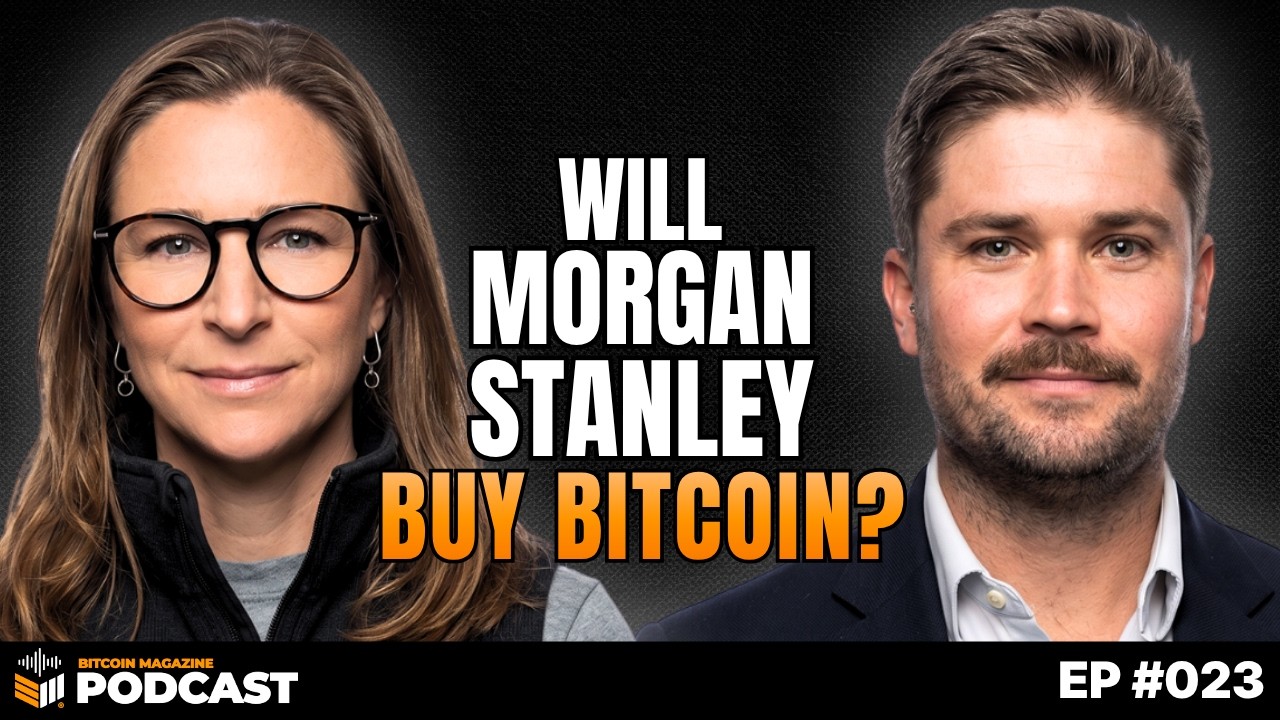
Morgan Stanley became the first global systemically important bank to launch a spot Bitcoin ETP and it crossed $600 million within months of its April debut. Amy Oldenburg, Head of Digital Assets at Morgan Stanley, joins host Spencer Nichols to explain how that product came together, why it was priced below competing spot Bitcoin ETFs, and what still stands between clients and their first Bitcoin allocation. She also details the firm’s 0–4% allocation framework across three investor risk profiles and why Morgan Stanley has no equivalent gold allocation. Plus: whether Bitcoin could land on Morgan Stanley’s own balance sheet.
Host: Spencer Nichols — Bitcoin Magazine Amy Oldenburg, Head of Digital Assets at Morgan Stanley
Chapters: 0:00 — Morgan Stanley on Putting Bitcoin on Its Own Balance Sheet 1:14 — 26 Years at Morgan Stanley: Emerging Markets to Head of Digital Assets 2:10 — First Major Bank to Launch a Spot Bitcoin ETP Tops $600 Million 3:14 — Education, E-Trade Spot Crypto, and What Clients Actually Own 4:49 — Why Morgan Stanley Priced Its Bitcoin ETP So Low 6:40 — The 0–4% Allocation Framework and the Digital Gold Thesis 8:52 — Correlation Regimes: Digital Gold, High Beta Tech, and Volatility 11:41 — Gold 2.0, Market Cap, and Bitcoin on the Balance Sheet 14:37 — Institutional Market Structure, Quantum Risk, and Client Trust 18:02 — Global Off-Ramps, Tokenization, Stablecoins, and Morgan Stanley Research
DISCLAIMER: The views and opinions expressed in this show are those of the participants and do not necessarily reflect the official policy or position of BTC Inc., Bitcoin Magazine, or any affiliated entities. This content is provided for informational and educational purposes only and should not be construed as investment, legal, tax, or accounting advice. Nothing contained in this show constitutes a solicitation, recommendation, endorsement, or offer to buy or sell any securities or financial instruments. Viewers should consult their own advisors before making financial or business decisions.
Nasdaq-listed bitcoin treasury Strive now holds 25,000 BTC — worth nearly $2 billion — following its latest buy.
The company said Monday that it bought 469 bitcoins at an average price of approximately $77,954. It is still the fifth biggest publicly traded bitcoin company, according to Bitcoin Treasuries. Strategy, Twenty One, Metaplanet, and MARA all hold more bitcoin than Strive.
CEO Matt Cole wrote on X Monday that 100% of the capital raised during the week came through sales of SATA, Strive’s perpetual preferred stock.
Dallas, Texas-based Strive’s stock (ASST) was trading more than 6% higher following the news.
Strive debuted as an official bitcoin treasury last year. The company was founded by former Ohio gubernatorial candidate and tech entrepreneur Vivek Ramaswamy.
In January 2026, it completed the acquisition of Semler Scientific in an all-stock deal — the first instance of a publicly traded Bitcoin treasury company acquiring another such company.
Like with other digital asset treasuries, the idea is that investors can get amplified returns from Strive’s stock. The company buys bitcoin with equity, and maintains a debt-free balance sheet: no bonds, no credit lines, and no leveraged positions that could trigger forced liquidation in a downturn.
The company is different to other major bitcoin treasuries because it has no debt.
Other major bitcoin treasuries — like the biggest, Strategy — have used leverage to buy the leading cryptocurrency.
Strive CEO Matt Cole has described the company as debt-free with zero margin requirements and zero encumbered bitcoin.
Strive has purchased 469 Bitcoin for about $36.6 million, raising its corporate treasury to exactly 25,000 BTC as of Sep. 11. According to Strive’s Form 8-K filing with the U.S. Securities and Exchange Commission, the company bought Bitcoin (BTC) between…
Bitcoin treasury Strategy held off buying bitcoin again last week. The Nasdaq-listed company said it instead bought $139 million of its preferred stock STRC.
A Monday filing with the Securities and Exchange Commission on Monday showed that the company repurchased 1.42 million STRC preferred shares for around $139.3 million between September 8 and September 13.
The company still owns 845,050 bitcoins worth $66.2 billion at today’s prices, and has two cash balances: USD Reserve and USD Cash, holding $5.1 billion and $1.3 billion, respectively.
Strategy, which is the largest corporate holder of bitcoin, this year switched from predictably buying the biggest cryptocurrency this week to buying back its stock and building a cash reserve.
On some occasions, the company even sold small bits of its BTC stash — despite founder and chairman Michael Saylor famously preaching to “never sell your bitcoin.”
After a 10-week hiatus, the company started buying bitcoin again in the final week of August, scooping up nearly $370 million in the leading cryptocurrency.
It hasn’t bought any bitcoin since.
Its Nasdaq-listed shares (MSTR) were 3% trading higher on Monday. The stock has lost over 75% of its value since notching a record in November 2024 — one month before bitcoin passed the once mythical and long-awaited $100,000 mark.
Strategy — formerly MicroStrategy — is an enterprise software company that pivoted to buying and holding bitcoin in 2020.
It first bought the cryptocurrency to protect its shareholders from inflation but has since aggressively bought the asset and pivoted to being a bitcoin treasury.
Strategy has defended its recent bitcoin sales, with CEO Phong Le saying that the company now has a “bullet-proof balance sheet.”
In the company’s quarterly earnings in July, Strategy posted a $8.22 billion loss. But Le reassured investors that the firm’s current paper loss was nothing to worry about.
“We’re the J.P. Morgan of the crypto economy, so whether we sell 1,000 bitcoin out of 840,000 to me is irrelevant to the conversation,” Le said in a subsequent interview.
Core inflation ran a tenth hot, odds of a September rate increase jumped from a coin flip to near-certainty in a single session, and crypto rallied across the board. The market did not buy the Fed’s direction. It bought the end of the argument.
Generated using Nano Banana 2
The Verdict
Bitcoin — short term (3–5 months). $77,466, up 0.67% on a day that by yesterday’s logic should have hurt it badly. The Sept 16 FOMC is now priced at roughly 90% for a 25bp hike, which inverts the setup this digest has been describing all week. The hike is no longer the risk — it is the base case. The risk is a hold, and a hold would arrive as a shock into positioning that has stopped hedging for one. $83,000 on a daily close confirms the range; $72,000 breaks it, and the two are now equidistant at about 7% either way.
Bitcoin — long term (1–3 years). For most of its history bitcoin’s deepest structural advantage was that you could read the holders. Cost basis, dormancy, capitulation, accumulation — all of it legible on a public ledger, in a way no equity or commodity has ever offered. That legibility is eroding. On-chain data showed an unusually muted HODL-waves reaction to July’s break below $58,000, an anomaly sharp enough to raise questions about whether that level ever functioned as a bear-market floor at all #16. The mechanical reason is simple: as coins migrate into ETFs, custodians, wrapped products and treasury companies, the decision to sell stops touching the chain. An ARKB redemption is a share transaction. Over three years you are underwriting an asset whose transparency premium is being quietly spent down — the ledger stays public while the behaviour it used to record moves off it.
Ethereum — short term. $2,550.62, up 4.60% — roughly seven times bitcoin’s move, on no Ethereum-specific news whatsoever. Treat that as a positioning outcome rather than a rerating: an asset that outruns the benchmark sevenfold without a story of its own is being covered, not accumulated. The practical effect is that the $2,300 invalidation line, which sat 5.7% away on Thursday, is now 9.8% below spot. The cushion that did not exist yesterday was rebuilt in a single session, and it was rebuilt by short sellers rather than buyers.
Ethereum — long term. Standard Chartered published a forecast this week that Sky will pass roughly five times as much value to token holders by 2028 as USDS adoption and borrowing capacity expand, putting a $0.325 target on SKY #17. Set aside whether the number is right and notice its shape: a global bank modelling an application token as a claim on a growing stream of distributed value. That model does not exist for ETH, because ETH lacks the mechanism it describes. Over three years the base asset competes for the same institutional dollar against things built on top of it that can be underwritten with a spreadsheet. The app layer is learning to pay. The chain is not.
Cardano — short term. $0.2073, up 0.28% — the weakest major for the third consecutive session, and this time it happened on a fully green board. The previous two sessions could be explained as macro beta, since ADA falls hardest when everything falls. That explanation is now spent. On a day when every other major caught a bid of 0.67% to 4.60%, ADA caught 0.28%, which is what thin two-way books look like when the flow arrives and routes elsewhere. Nothing Cardano-specific broke. Nothing Cardano-specific showed up either.
Cardano — long term. Bitwise is closing its Dogecoin ETF less than a year after launch, with trading halting October 14 #18. The fund did about $3 million of volume on its opening day and never came close again. Much of the institutional case for every large altcoin — Cardano included — rests on the assumption that a listed wrapper eventually unlocks demand sitting on the sidelines. Dogecoin just ran that experiment to completion: the wrapper existed, the access was real, and nobody showed up. The question for ADA over three years is not whether a product gets approved. It is whether there is a buyer waiting behind it. Cardano’s market cap is $7.78B. Draw your own conclusion about which of those two is the binding constraint.
Solana. $101.43, up 2.29%, back above the $100 handle it lost on Thursday. Reclaiming a round number in two sessions says the break was liquidation rather than a change of view.
BNB and XRP. $727.82 (+3.13%) and $1.37 (+1.70%). Both mid-pack, which is the whole story — on a day driven by a macro release, the majors sorted themselves by how much leverage had to unwind, not by anything either network did.
Why The Market Is Here
August CPI landed at 0.4% for the month and 3.4% year over year, both in line with consensus #2. Core, which is the number the Fed actually watches, rose 0.3% against a 0.2% forecast — a tenth hot, with the 12-month core at 2.4% #1. That single tenth did the work. Rate-hike odds for Wednesday’s meeting went from roughly a coin flip to about 90% inside one session #3. Bond yields printed fresh multi-decade highs intraday on the release #5.
And then everything went up.
The S&P added 1.00%, the Nasdaq 1.12%, gold 0.91%, and every major crypto closed green. The 30-year Treasury yield touched 5.36% and finished lower on the day at 5.349%. Most telling of all, the VIX fell 11.04% to 15.87 — a volatility crush, on the day the Fed’s path turned hawkish.
Yesterday this digest argued that crypto is the most junior claim in the macro stack — no earnings underneath it, so it absorbs a discount-rate shock in full and then some. Today the discount-rate news got unambiguously worse and bitcoin went up. The juniority thesis does not survive that tape in its simple form.
Here is the repair, and it is the more durable frame. Crypto is not priced off the level of the policy rate. It is priced off the variance around it. On Thursday you owned a coin flip four days out from a decision — the single most expensive thing a portfolio can hold, because it cannot be hedged cheaply in either direction. On Friday you own a decision. The rate is worse and the distribution is narrower, and for risk assets the second of those was worth more than the first cost. An 11% volatility crush on a hawkish print is not a market that disagrees with the Fed. It is a market that has stopped paying for insurance against an argument that just ended.
That framing has one weakness, and it belongs in the open rather than in a footnote. The argument has not ended — it has only been priced as though it has, and the revision markets made on Friday was performed on a chair who has never endorsed it. Kevin Warsh’s preferred inflation gauge continues to tell a materially different story from the headline CPI #4. Ninety percent is not a forecast of what Warsh believes. It is a forecast of what the market thinks an energy shock will force him to do. That gap is the widest it has been all cycle, and the entire volatility crush is standing on top of it.
The geopolitics delivered the same lesson from the opposite direction. Houthi forces took control of essentially the whole of Yemen’s Red Sea coastline #8, a development serious enough that the live question is now whether they can close the Red Sea outright rather than merely harass it #9. Brent fell 2.32% to $105.13 on the news. A chokepoint changed hands and the barrel went down.
Two events that should have hurt, and neither did. The common thread is not optimism. It is that both were already carried in the price — the hike since Tuesday, the Bab el-Mandeb risk premium for weeks. Markets stop responding to a risk at the point where they have finished buying it, not at the point where it stops being real.
Underneath the rally, the household transmission kept tightening. Fuel costs are still doing the squeezing #10, and the 30-year mortgage rate crossed 7% for the first time in over a year while home sales hit their 2026 low against a seven-year inventory high #11. A tape can crush volatility and a housing market can freeze in the same week. They are answering different questions.
Institutional Pulse
The flows went the other way from the price. US spot bitcoin ETFs shed roughly $449 million across three sessions, with Thursday’s $282.6 million the largest single-day outflow since July. ARK 21Shares accounted for $164 million of it, ahead of Grayscale at $36 million and Fidelity at $33.6 million; ether and solana funds also ran net negative #7.
So the visible institutional channel was a net seller into a week that ended green. Whoever bid Friday’s tape was not the ETF investor. CoinDesk attributed part of bitcoin’s recovery toward $77,300 to zcash leverage unwinding #6 — which is to say, a chunk of the move was positions closing rather than capital arriving, the same mechanic driving ETH’s outperformance above.
The sharpest print of the day was a company destroying its own paper. Metaplanet cut its executive reward pool by 41%, extinguishing about $220 million in value and scrapping its employee warrant plan, after the stock fell roughly 17% across two sessions #13. A bitcoin treasury company’s compensation structure is a leveraged claim on its own share premium, and when the premium compresses the incentive package stops functioning before the balance sheet does. The coins on Metaplanet’s books did not move. The instrument built on top of them lost a fifth of its value in two days.
Meanwhile India’s SEBI launched its Demat 2.0 pilot with more than $100 million of tokenized corporate bonds settled via wholesale CBDC #19. A sovereign regulator now has a working tokenized settlement stack with a central-bank money leg and no public chain anywhere in it.
On what the flow tables miss. The ETF numbers above measure one access route — the retail-and-advisor wrapper — not the whole building. A sovereign bond pilot, a compensation restructuring at a treasury company and a leverage unwind on a privacy coin all moved capital through crypto this week, and none of them appear in a netflow chart.
Calendar Watch
Three events, one week, and they overlap.
FOMC, Sept 15–16. Roughly 90% priced for a 25bp hike. The trade is no longer directional — it is about whether the resolution the market bought on Friday actually gets delivered.
Bank of Japan, Sept 16–17. MarketWatch makes the case that the BoJ, not the Fed, is the more likely source of next week’s genuine shock #12. With USDJPY at 153.68 and the Fed expected to tighten the day before, the yen carry trade gets repriced twice in twenty-four hours.
CLARITY Act, Senate vote Sept 15. Senate Republicans circulated a revised draft ahead of the initial vote, adding registration requirements for controlled trading protocols while leaving ethics provisions largely intact #14. The vote lands the day before the Fed decision, which means the most consequential crypto legislation of the cycle will be scored by a market whose attention is elsewhere.
Signals Worth Watching
The hold is now the shock. This is the cleanest asymmetry on the board. If Warsh holds on Wednesday against 90% pricing, the volatility crush reverses instantly and crypto is positioned wrong in the direction that usually hurts most — long into an unhedged surprise. A hike delivers what is priced and should be close to a non-event.
A second quantum result landed in one day. Yesterday’s note here was that one halved benchmark is not a crisis but a pattern of them is a schedule, and to watch for a second result this quarter. It arrived the next morning: an AI-agent challenge cut a resource benchmark for one component of a quantum attack on bitcoin by 86% #15. Two results, two days, 50% then 86%. The relevant variable is no longer cryptographic research throughput — it is how much of that research AI agents can do unsupervised.
Zcash wrapper premium — concluded. This tracker was opened on Sept 8 and ran three quiet sessions. It has now resolved, in the least interesting way available: the leverage unwound, as noted above. No structural signal, no persistent premium, just positioning that got too large and then did not. Dropping it.
Bab el-Mandeb freight and war-risk insurance — still no print. An entire coastline changed hands and there is still not a single published war-risk premium or freight spread in the feed to price it with. When that number finally appears it will not confirm what the oil price already told you; it will be the first honest read on whether shipping treats this as a spike or a new base.
If I Had $100 This Month
A green board on a hawkish print, four days before a central bank meeting that is 90% priced and one day before a second central bank that is not, is not a setup that rewards conviction sizing. It is a setup that rewards being already positioned and not touching it.
$60 → BTC. The volatility crush is doing the work right now, and buying after a crush and before two central banks is worse timing than buying on schedule regardless of either.
$25 → ETH. A 4.6% day on no news is a positioning move, not a rerating — treat the higher price as noise around the same accumulation plan, not as a signal to hesitate.
$15 → ADA. Third straight session as the weakest major, this time on a day when everything else worked, which is a liquidity fact rather than a Cardano one.
Hold actual coins. Not ETF shares, not equity proxies.
This is how I’d think about it. Make your own call.
Sources
#1 — Core CPI rose a faster-than-forecast 0.3% in August, setting up possible Fed rate hike — CoinDesk
#2 — Inflation persisted in August, potentially locking in a Fed interest rate hike — CNBC
#3 — Fed rate hike odds surge to 90% on monthly jump in core prices — Yahoo Finance
#4 — Hotter CPI complicates Fed hold as Warsh’s preferred inflation gauge tells different story — CoinDesk
#5 — Bitcoin spikes toward $80K as US CPI data delivers new 22-year high in bond yields — CoinTelegraph
Equity, gold, oil and yield figures are intraday prints as of 12:26pm ET — the US cash session was still open at the close of this data window. Fear & Greed fell 13 points on a day every major rose, the mirror image of yesterday’s divergence; a sentiment survey lagging a two-day reversal is doing exactly what a sentiment survey does.
Chain of Thought is a daily crypto and macro market digest. Not financial advice.

 Login
Login









 Swiss Bitcoin Pay (@SwissBitcoinPay)


 Host: Spencer Nichols — Bitcoin Magazine