BNB Chain is trying to make sure it does not get left behind in the AI-agent race. Its Agent Studio roadmap, tied to AWS-linked deployment templates, is a developer-facing push rather than a simple token narrative.
That is worth noting because the Binance ecosystem often gets discussed through exchange activity, listings, and liquidity. This is a different angle: infrastructure designed to attract builders.
For more details, visit the official BNB Chain platform.
TL;DR
BNB Chain introduced an AI Agent Studio roadmap with AWS-linked tooling.
The initiative targets developers building autonomous on-chain applications.
The move keeps BNB Chain inside the AI-agent infrastructure race.
Why AI Agents Need Better Infrastructure
Autonomous agents sound exciting, but they are hard to build safely. They need wallet permissions, transaction logic, identity handling, payment rails, and guardrails around what they can and cannot do.
BNB Chain’s pitch is that developers should not have to assemble all of that from scratch. If the studio reduces friction, it could help more teams test real agentic applications.
The Market Will Judge Usage, Not Roadmaps
The danger is that AI-agent infrastructure becomes another buzzword category. The opportunity is that some of these tools may become genuinely useful for automation, DeFi execution, and on-chain monitoring.
For BNB Chain, the next test is simple: can it turn roadmap language into applications people actually use?
Why The Detail Matters Now
The practical takeaway is that Binance stories now have to be read through both market structure and product execution. A headline can create attention, but the more durable signal is whether the underlying source points to real activity, a real filing, a real integration, or a measurable change in how users and institutions behave.
That is why this development is worth separating from ordinary market noise. It gives readers a specific point to track over the next few sessions rather than a vague reason to be bullish or bearish. If follow-up data confirms the direction, the story can build. If not, it still gives the market a clearer snapshot of where attention is concentrating today.
The Market Read
The cleaner way to read this story is not to force it into a simple bullish or bearish box. For Binance readers, the useful part is the change in context. A new filing, integration, market signal, or regulatory step can alter how traders think about the next few sessions even when it does not instantly change price.
That is especially true after the last few volatile weeks, when crypto has been dealing with a mix of ETF flows, legal updates, exchange listings, protocol upgrades, and shifting liquidity. The market is no longer reacting to one dominant theme. It is weighing several smaller signals at once, and that makes source-backed developments more important than ordinary chatter.
Why Readers Should Keep This On The Radar
For Bitcoinist readers, the important question is what this changes from here. If follow-up data, filings, governance updates, or wallet movement confirm the direction, the story can develop into a larger market theme. If the next update is weak, delayed, or contradicted by new data, the market may quickly move on.
That is why the scope matters. This article is not treating the development as a guaranteed price trigger. It is treating it as a fresh signal inside a market that is trying to sort durable activity from short-term noise. The distinction is important because crypto narratives can move faster than the facts behind them.
The next thing to watch is whether this becomes part of a wider pattern. In some cases that means more institutional flows. In others it means stronger developer adoption, cleaner regulatory access, deeper exchange liquidity, or a clearer technical roadmap. Either way, the story is strongest if it is followed by measurable execution rather than another round of speculative headlines.
This report is based on information from BNB Chain.
This article was written by the News Desk and edited by Samuel Rae.
The AI-agent narrative in crypto has gone through plenty of hype, but BNB Chain is trying to move the discussion toward tooling. Its new Agent Studio roadmap, built around developer templates and AWS-linked infrastructure, is a reminder that the AI story will not be won by slogans alone. It will be won by whoever makes these systems easier to deploy and use.
That is the useful lens here. BNB Chain is not simply saying AI matters. It is trying to offer a cleaner environment for developers who want autonomous software to interact with wallets, contracts, payments, and on-chain identities.
For more details, visit the official BNB Chain platform.
TL;DR
BNB Chain outlined an H2 2026 AI Agent Studio roadmap.
The project is linked to AWS infrastructure templates for developers.
The move shows major chains are still competing to become the default home for crypto-native AI agents.
Why Developer Tooling Is The Real Story
Crypto has no shortage of AI tokens, but useful agent infrastructure is harder. Developers need predictable deployment paths, fast settlement, reliable data access, and a way to control permissions without creating obvious security holes.
If Agent Studio can make those pieces easier to assemble, BNB Chain gets a stronger claim to AI-related developer activity. That matters because infrastructure platforms compete on where builders choose to spend time.
The Next Test For BNB Chain
The big question is whether these agents become useful applications or simply another round of demo products. Crypto has seen enough toolkits that generated initial noise and then faded.
For BNB Chain, the opportunity is real but execution-heavy. If developers actually use the studio to build agents that transact, monitor, route, or automate on-chain activity, the roadmap could become more than a marketing cycle.
Why The Detail Matters Now
The practical takeaway is that Binance stories now have to be read through both market structure and product execution. A headline can create attention, but the more durable signal is whether the underlying source points to real activity, a real filing, a real integration, or a measurable change in how users and institutions behave.
That is why this development is worth separating from ordinary market noise. It gives readers a specific point to track over the next few sessions rather than a vague reason to be bullish or bearish. If follow-up data confirms the direction, the story can build. If not, it still gives the market a clearer snapshot of where attention is concentrating today.
The Market Read
The cleaner way to read this story is not to force it into a simple bullish or bearish box. For Binance readers, the useful part is the change in context. A new filing, integration, market signal, or regulatory step can alter how traders think about the next few sessions even when it does not instantly change price.
That is especially true after the last few volatile weeks, when crypto has been dealing with a mix of ETF flows, legal updates, exchange listings, protocol upgrades, and shifting liquidity. The market is no longer reacting to one dominant theme. It is weighing several smaller signals at once, and that makes source-backed developments more important than ordinary chatter.
Why Readers Should Keep This On The Radar
For NewsBTC readers, the important question is what this changes from here. If follow-up data, filings, governance updates, or wallet movement confirm the direction, the story can develop into a larger market theme. If the next update is weak, delayed, or contradicted by new data, the market may quickly move on.
That is why the scope matters. This article is not treating the development as a guaranteed price trigger. It is treating it as a fresh signal inside a market that is trying to sort durable activity from short-term noise. The distinction is important because crypto narratives can move faster than the facts behind them.
The next thing to watch is whether this becomes part of a wider pattern. In some cases that means more institutional flows. In others it means stronger developer adoption, cleaner regulatory access, deeper exchange liquidity, or a clearer technical roadmap. Either way, the story is strongest if it is followed by measurable execution rather than another round of speculative headlines.
This article is based on information from BNB Chain.
This article was written by the News Desk and edited by Samuel Rae.
This report is based on information from BNB Chain. at BNB Chain
Meta Takes on AWS: 5 Key Investment Themes for U.S. Stocks in Q3 2026 as the AI Landscape Reshuffles
This content is supported by MEXC Learn, an educational initiative covering Web3 trends, market insights, and crypto learning resources.
The second quarter of 2026 ended with a stunning closing signal: the Dow Jones Industrial Average broke its historical record, and the US stock market recorded its strongest quarter since 2020. However, the market has not yet recovered from the celebration. On July 1st, Meta dropped a heavy bomb — officially announcing its entry into Cloud Services and launching “Meta Compute”, directly challenging AWS, Azure, and Google Cloud.
Everything that happened this week is not just market noise, but a precursor to the upcoming structural restructuring of the AI industry ecosystem. This article will break down the core investment logic of the US stock market in the second half of 2026 from five main threads.
Main Line 1: Meta Compute — AI moves from infrastructure to platform, and large-scale manufacturers begin to sell computing power.
What is Meta Computing?
Meta Compute is a Cloud Service business officially announced by Meta Platforms on July 1, 2026, allowing external companies to purchase Meta’s AI computing resources and model API access. This means that Meta has transformed from a “pure AI computing power purchaser” to an “AI computing power seller”.
This is one of the most significant business model transformations in the AI industry in recent years.
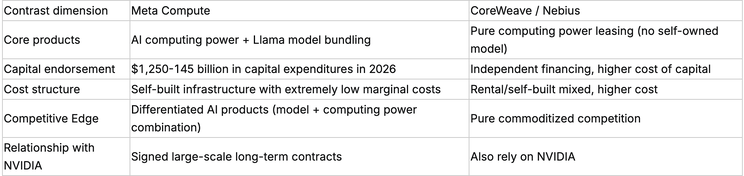
What is the essential difference between Meta Compute and CoreWeave?
The market’s initial reaction to Meta Compute is that the stock prices of independent cloud computing companies such as CoreWeave and Nebius have fallen sharply. However, upon further analysis, the competitive barriers between the two are completely different.
Key insight: Meta can bundle the Llama model with computing power, providing enterprise customers with a “one-stop AI solution” rather than a pure computing commodity. This is a differentiated advantage that independent Cloud as a Service provider cannot replicate.
Who are the real beneficiaries of Meta Compute?
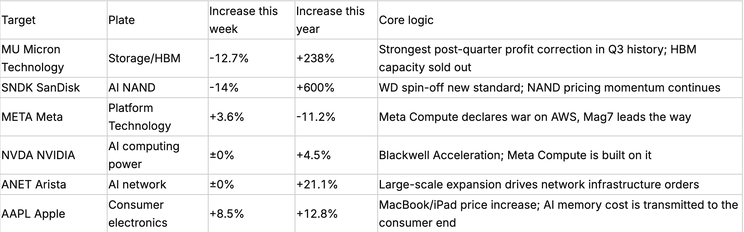
NVIDIA (NVDA) : Meta Compute is built on NVIDIA’s AI infrastructure, and the demand for computing power has not only not decreased, but has expanded due to the acceleration of monetization.
Arista Networks (ANET): Leading player in hyperscale data center network switch, Meta’s new round of expansion directly drives high-speed network infrastructure orders.
CoreWeave : Short-term impact, but Meta and its 21 billion dollars long-term locked contract until 2032, short-term stock price decline or overpricing.
Main Line 2: Apple + Microsoft Price Increase — DRAM Super Cycle, Pricing Power Has Structurally Changed
Why are Apple MacBook and Microsoft Xbox significantly increasing in price?
One of the most shocking news in consumer electronics in 2026 is that Apple and Microsoft voluntarily raised the prices of their products, and the direct reason points to one word: DRAM contract prices have risen sharply .
This is not an accidental event, but an inevitable result of the AI memory battle.
The core logic of DRAM super cycle
Why can’t consumer electronics manufacturers digest it on their own this time?
In the past, every round of DRAM price increases, consumer electronics manufacturers such as Apple, Samsung, and Lenovo would usually absorb upstream cost pressures on their own to maintain product competitiveness. But this round in 2026 is different.
AI Data Center’s unprecedented demand for memory has compressed the purchasing bargaining space of consumer electronics manufacturers
The production capacity of the DRAM supply side (mainly MU, Samsung, SK Hynix) is prioritized towards HBM, and the supply of general DRAM is tight
The cost increase far exceeds any previous memory cycle and cannot be digested internally
This is a highly signaling turning point: the pricing power of storage vendors has undergone a structural shift .
Relevant stock investment logic
Micron Technology (MU) : The strongest quarter in Q3 revenue history, Q4 guidance continues to exceed expectations; HBM’s full-year capacity for 2026 has been fully sold out, and the capacity reservation for 2027 has been launched. This week’s profit correction does not change the fundamental direction.
SanDisk (SNDK) : Separated from Western Digital, it is a pure AI NAND target. The cumulative increase in NAND contract prices in 2026 is significant, and institutions generally raise their target prices. As a new spin-off company, the initial volatility is relatively large, but the fundamentals benefit from the same trend.
Main Line 3: SNDK — the new protagonist of the AI NAND era, the investment logic of spin-off listing
Why was SanDisk spun off from Western Digital?
SanDisk was officially spun off and listed independently from Western Digital (WD) in 2026, becoming a pure company focused on NAND flash memory. The spin-off logic is as follows:
The valuation logic of WD’s HDD (traditional mechanical hard disk) business is very different from that of NAND business, and the market gives HDD business a lower valuation multiple, dragging down the overall market value
After independence, SNDK can obtain a valuation premium that matches the NAND super cycle
Management can focus more on AI Data center enterprise NAND product roadmap
Why does AI Data Center need a large amount of NAND?
AI training and inference require massive data storage.
Training datasets for large language models (LLM) often reach the petabyte level
The demand for low-latency storage in AI inference scenarios has exploded (NVMe SSD replaces traditional storage).
Meta, Microsoft, Google and other large-scale Data centers continue to expand, and each new Data center requires a large number of enterprise-level NAND
This means that SNDK is in an important position in the AI infrastructure demand chain.
Main Line 4: Arista Networks — AI Data Center Invisible Beneficiary, Expanding Continuously
Why does the AI era need a better network switch?
The computing requirements of AI clusters place extremely high demands on the internal network of data centers.
GPUs require extremely low latency and ultra-high bandwidth interconnection (InfiniBand or Ethernet).
A single AI training cluster often has thousands to tens of thousands of GPUs, and the cost of network equipment accounts for a significant increase in the overall data center investment
Meta and Microsoft’s new round of hyperscale Data center expansion directly drives demand for high-performance Ethernet switches
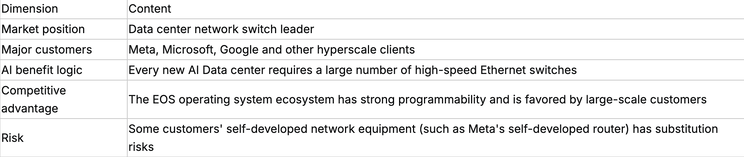
Arista Networks (ANET) is a leading global data center network switch manufacturer and one of the infrastructure targets directly benefiting from the expansion of AI computing power.
An Overview of ANETs Investment Logic
Main thread 5: June NFP and Fed path — the most important macro variables in the second half of the year
What does the June NFP employment report mean?
The June Non-Farm Payroll Report (NFP) released on July 2, 2026 is a key reference for the direction of the Federal Reserve’s Monetary Policy in the second half of the year. The market generally expects employment to be lower than the previous value. If the actual data is weak, it will send the following signals to the market.
Two core verifications in the second half of the year
Verification 1: Federal Reserve Path (July FOMC is a key node)
The July FOMC meeting will be the most important time window for the market to reprice the path of interest rate hikes. If NFP is weak and inflation data is moderate, the probability of pausing interest rate hikes will increase, and growth stocks will receive valuation support.
Verification 2: Q2 financial report season (starting from mid-July)
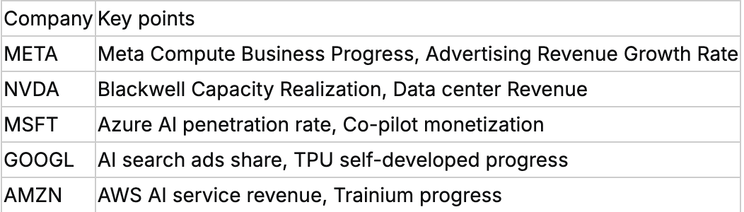
This is a more direct question than macro data: Can AI capital expenditures translate into actual revenue growth for Mag7?
If the Q2 financial report season is stronger than expected, the “soft landing + AI-driven growth” narrative will receive the strongest fundamental endorsement, and the expansion of growth stock valuation will be more sustainable.
If the Q2 financial report season is stronger than expected, the “soft landing + AI-driven growth” narrative will receive the strongest fundamental endorsement, and the expansion of growth stock valuation will be more sustainable.
Review of the performance of core targets this week
IV. Frequently Asked Questions FAQ
Q1: Will Meta Compute damage NVDA?
No, it’s actually a benefit. Meta Compute is built on NVIDIA’s AI infrastructure. Meta’s entry into the Cloud Service market means it will continue to purchase a large number of NVIDIA GPUs. Large-scale manufacturers have shifted from “buying computing power” to “selling computing power”, expanding the scale of the entire AI computing power market. As an upstream chip supplier, NVDA is the most direct winner.
Q2: MU and SNDK fell sharply this week, can we still hold on?
This week’s decline is a profit correction, not a signal of fundamental reversal. MU’s HBM 2026 production capacity has been fully sold out, and Q4 revenue guidance has greatly exceeded expectations; SNDK’s NAND pricing trend has not changed. The core logic — AI memory super cycle — still holds. The price increases of Apple and Microsoft are precisely the most powerful evidence of this logic.
Q3: What are the risks of SNDK as a new spin-off company?
The main risks include: ① The liquidity of the new Listed Company is relatively low and volatile; ② The initial valuation discovery of the spin-off takes time; ③ If the NAND price cycle reverses, the downward trend may exceed MU. However, from the perspective of the structural growth of AI Data center demand, the medium-term logic is still clear.
Q4: Why did AAPL rise this week?
Apple’s price increase (MacBook/iPad) is actually a positive signal: it shows that its pricing power is still strong, and consumers are willing to pay for AI devices with more memory. At the same time, if the Fed’s interest rate hike path softens, Apple, as a high-free cash flow growth consumer technology stock, will also directly benefit from valuation revaluation.
Q5: What should we pay the most attention to in the second half of the year?
Two main threads: ① July FOMC decision + NFP data — determining the path of interest rate hikes, affecting the valuation of all growth stocks; ② Q2 financial report season (starting from mid-July) — the realization of AI revenue from Meta, NVDA, and MSFT is the real test question that determines whether Mag7 can maintain a high valuation.
Disclaimer: This content is based on open market information as of July 2, 2026, independently compiled by the MEXC US stock spot team, for reference only, and does not constitute investment advice. The market is risky, and investment needs to be cautious.
The headline number is useful, but the real story is what it says about positioning. BNB Chain Launches AWS-Integrated BNB Agent Studio for Faster AI Agent Deployment gives Bitcoinist readers a clean angle on Binance at a point where the market is trying to separate durable signals from short-lived noise.
According to the source material reviewed for this report, the story turns on a few concrete details rather than vague sentiment. That matters because crypto headlines can move quickly, but the pieces that tend to last are the ones backed by filings, official releases, data dashboards, or protocol-level records.
TL;DR
BNB Chain deployed 'BNB Agent Studio', a developer platform to build and host AI agents.
The studio integrates crypto wallets, on-chain identities, payments, and AWS cloud hosting.
Developers can spin up autonomous software agents using a single text prompt.
What Changed
The immediate relevance is that this development fits into one of the market’s main themes for the day: institutional positioning, network usage, regulatory pressure, protocol development, or asset-specific rotation. In this case, the key topic is Binance, which is why it deserves a dedicated read rather than being buried inside a broader market recap.
For traders, the useful part is not simply that the headline exists. It is the way the facts line up with the current market backdrop. When official sources, market data, or protocol records show a fresh shift, readers get a better sense of whether the move is just a one-day reaction or part of something more structural.
Why It Stands Out
The core source for this story is bnbchain.org with supporting data from github.com. That source trail is important because the final article should not rely on discovery-only media links or second-hand summaries.
BNB Chain deployed 'BNB Agent Studio', a developer platform to build and host AI agents.
The studio integrates crypto wallets, on-chain identities, payments, and AWS cloud hosting.
Developers can spin up autonomous software agents using a single text prompt.
The numerical claims in the pack were tied back to specific source material before writing. 'ERC-8004' sourced from BNB Chain Agent Studio Developer Standard Specification; 'ERC-8183' sourced from BNB Chain Agent Studio Multi-Agent Interaction Standard; '15 minutes' sourced from BNB Chain Agent Studio deployment pipeline benchmark
What Comes Next
The caution is just as important as the headline. Do not claim AWS is running nodes or validating blocks; they are providing cloud hosting services for the agents.
That means the cleaner read is to treat this as a confirmed development with a defined scope, not as proof of a guaranteed price move or a sweeping market shift. In crypto, the difference matters. A verified data point can strengthen a thesis, but it does not remove execution risk, liquidity risk, regulatory uncertainty, or the possibility that traders fade the initial reaction.
For now, the story gives the market another piece of evidence to weigh. If follow-up filings, dashboard updates, protocol records, or official statements confirm further momentum, the angle can develop into something larger. If not, it still stands as a useful snapshot of where activity is concentrating today.

 Login
Login