Bitcoin, Ethereum, XRP and other major cryptocurrencies have suffered heavy losses as a reported $6.3 billion Binance hack rattled investors and triggered more than $1.5 billion in liquidations across the crypto market. According to CoinGlass data, roughly $1.55 billion in…
As cumulative net inflows into U.S. spot Bitcoin ETFs have reached $57.624 billion, some investors are beginning to explore other digital asset strategies, including cloud mining and DeFi yield platforms, to generate passive income ranging from $3,000 to $5,000. Inflows…
Ripple, the company behind XRP, is approaching a $1 billion annualized revenue run rate as institutional adoption accelerates. The company expects to exit 2026 with $900 million in annualized product revenue, marking a major milestone for its expanding financial infrastructure business.
RIPPLE EXPECTS $900 MILLION ANNUALIZED PRODUCT REVENUE RUN RATE!
Ripple expects to reach a $900 million annualized product revenue run rate as its institutional business expands, according to @TheBlockCo.
The announcement comes alongside a significant expansion of Ripple’s relationship with BNY, the financial services giant overseeing $63.4 trillion in assets under custody and administration. BNY now supports XRP and Ripple USD (RLUSD) on its digital asset custody platform.
The developments strengthen Ripple’s institutional credentials, but they also raise an important question for XRP holders. Can Ripple’s growing business translate into sustained demand for its native cryptocurrency?
Ripple Revenue Approaches $1 Billion as Institutional Business Expands
Ripple revenue milestone reflects growth across payments, custody, stablecoins, prime brokerage, and corporate treasury services. The company also reported that customers and partners using multiple Ripple products have tripled this year.
Its payments network is approaching $150 billion in lifetime transaction volume by the end of 2026. Ripple also reported more than $16 trillion in transactions enabled across its products during 2025.
These figures show how Ripple is building beyond its original cross-border payments business. The company now offers financial infrastructure designed to connect traditional institutions with digital assets and blockchain-based settlement.
$63T BNY Adds XRP Custody as Ripple Deepens Institutional Ties
BNY’s expanded relationship with Ripple gives eligible institutional clients access to XRP and RLUSD custody through its digital asset platform.
As of September 30, BNY oversaw $63.4 trillion in assets under custody and administration, alongside $2.2 trillion in assets under management. Its position in traditional financial markets makes the expanded custody offering a notable development for XRP’s institutional accessibility.
BREAKING: $BNY expands strategic collaboration with @Ripple across digital asset custody to now include @XRP, and explore new institutional use cases for blockchain technology, including tokenized trade finance.
Institutional investors often require established custody arrangements before holding digital assets. BNY’s support can therefore remove an operational barrier for eligible clients seeking to hold or transfer XRP.
The partnership also extends beyond custody. Ripple and BNY are exploring tokenized trade finance on the XRP Ledger, starting with a potential supplier-finance initiative involving working-capital platform C2FO. The initiative could bring approved receivables and related financing activity onto blockchain infrastructure.
Can Ripple’s Growth Finally Translate Into XRP Demand?
Xrp (XRP)
24h7d30d1yAll time
Ripple’s expanding institutional business gives XRP a stronger position within an increasingly developed financial ecosystem. Greater custody access, tokenized assets, and new settlement applications could help increase institutional familiarity with the token. As of now, adoption of Ripple’s infrastructure arguably does not translate into buying pressure for XRP yet.
RLUSD, Ripple’s dollar-backed stablecoin, can handle settlement in applications where businesses prefer predictable dollar-denominated payments. The C2FO initiative, for example, is designed to use RLUSD for settlement on the XRP Ledger.
XRP’s potential benefit depends on how institutions use the network, if applications require XRP for liquidity, and if that activity creates sustained demand beyond transaction fees. Still, the combination of Ripple’s approaching $1 billion revenue run rate and BNY’s expanded custody support marks a significant institutional milestone.
Explore how Lake Energy connects XRP and other digital assets with renewable energy investment plans covering solar, wind, and energy storage projects.
The XRP Ledger Foundation has added Flare to its recommended validator list and removed Anodos Finance at its own request, with the foundation and Ripple now publishing matching sets of 35 validator keys. XRP Ledger Foundation said in its announcement…
Ripple’s RLUSD just secured a major institutional credibility boost, earning Moody’s A2 long-term deposit rating and its highest P-1 short-term rating. The assessment covers RLUSD issued on XRP Ledger and Ethereum, giving institutions another benchmark for evaluating the dollar-pegged stablecoin.
More good news for $RLUSD this week – @moodysratings has assigned RLUSD an A2 long-term rating and P-1 short-term rating, the highest possible short-term rating under its new stablecoin framework.
TL;DR: RLUSD is the first stablecoin to have ever received an investment-grade…
The rating arrives alongside Ripple’s final approval to establish a national trust bank under the Office of the Comptroller of the Currency (OCC). Ripple says the bank will manage RLUSD reserves and provide institutional custody services, while Bank of New York Mellon remains the stablecoin’s primary reserve custodian.
But the bigger question concerns XRP and its holders. If RLUSD becomes a major institutional settlement asset, can XRP capture value from that growth? Binance’s historical BUSD and BNB ecosystem offers an interesting comparison, although Ripple’s model works differently.
RLUSD Moody’s Approval and Institutional Push Expand XRP Ecosystem
Moody’s rating gives RLUSD a formal credit assessment that institutional risk teams can incorporate into their evaluations. RLUSD will still be issued by Standard Custody & Trust Company, its New York-regulated subsidiary. The trust bank will manage segregated reserves, act as collateral trustee, and provide fiduciary digital-asset custody services. Ripple outlined the approved activities on October 26.
These developments could help Ripple compete for institutional payments, treasury operations and collateral applications. But for XRP, the opportunity depends on what institutions do after adopting RLUSD.
Xrp (XRP)
24h7d30d1yAll time
Every transaction on XRP Ledger requires XRP to pay network fees. Accounts also need XRP to satisfy the ledger’s reserve requirements. Greater RLUSD activity could generate incremental XRP utility, although these requirements alone may create limited demand.
The more substantial opportunity involves cross-currency payments. Institutions could use XRP as a bridge asset when converting between currencies, rather than routing every transaction through dollar stablecoins or traditional intermediaries.
So, RLUSD can settle directly without requiring an institution to purchase XRP for the entire payment value. Transfers on Ethereum also do not require XRP for gas.
Consequently, RLUSD’s market cap could grow substantially without generating proportional demand for XRP. The bullish case strengthens when stablecoin adoption also creates deeper XRP liquidity, additional bridge transactions, and new institutional trading activity.
Should Ripple replicate Binance’s BUSD–BNB value-capture model?
Binance’s historical ecosystem demonstrates how a stablecoin can support a wider crypto business. BUSD offered dollar-denominated liquidity, while BNB served multiple purposes across Binance’s exchange and blockchain infrastructure.
BNB provides utility through network fees and trading-fee discounts, alongside a token-burning mechanism that reduces supply over time. These mechanisms give BNB several direct connections to activity across its ecosystem.
Ripple has a different starting point. RLUSD provides dollar stability, while XRP operates as the XRP Ledger’s native asset and potential cross-currency bridge. Ripple could create a comparable value-capture loop if institutional RLUSD adoption increases the need for XRP liquidity.
Imagine RLUSD growing from $2.5 billion to $25 billion in market cap. That would represent a tenfold expansion, potentially giving Ripple a much larger stablecoin business.
However, it would not imply a tenfold increase in XRP’s price. The outcome would depend on transaction volumes, network activity, institutional integrations, and the proportion of payments that actually use XRP.
Ripple could pursue a similar ecosystem strategy, but it would need to make XRP more integral to the financial activity surrounding RLUSD. Stablecoin growth alone would not reproduce BNB’s exchange utility or supply burns.
Ripple may be building a substantial regulated dollar business. But could XRP capture meaningful value from that expansion?
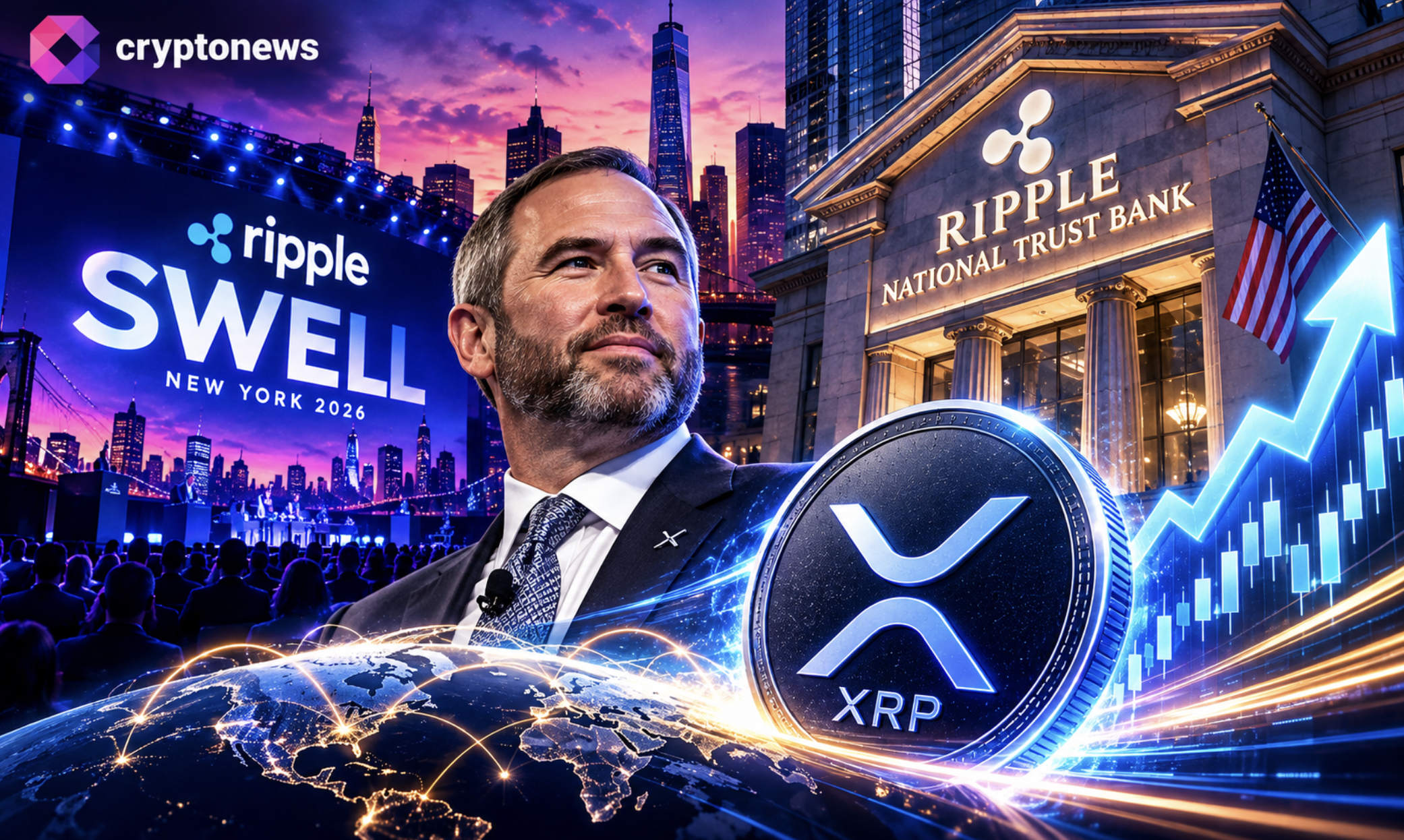
Ripple has secured final U.S. approval for its national trust bank, giving XRP investors another reason to watch the coin as Swell 2026 opens in New York. The milestone strengthens Ripple’s position in regulated finance, while fresh institutional partnerships and ETF demand could help drive the next XRP price rally.
The Office of the Comptroller of the Currency (OCC) granted final approval for Ripple National Trust Bank on October 26. The decision completes a process that began with conditional approval in December 2025, opening the door to expanded institutional custody and RLUSD reserve management. XRP now enters Swell week with Ripple’s regulatory standing strengthened and a major industry gathering underway.
Ripple National Trust Bank Approval Strengthens the XRP Investment Case
Ripple’s new federal trust bank approval marks another milestone in its push to connect blockchain infrastructure with traditional finance. The bank will manage segregated reserves backing Ripple USD (RLUSD), act as collateral trustee for RLUSD holders, and provide fiduciary digital asset custody services.
RLUSD will continue to be issued by Standard Custody & Trust Company under New York regulation. The additional federal oversight strengthens the regulatory framework supporting Ripple’s stablecoin and institutional services. Ripple has also reported that RLUSD has reached a $2.5 billion market cap since launching in December 2024.
Big news heading into @RippleSwell: the @USOCC has granted final approval for Ripple National Trust Bank.
This gives Ripple a federally supervised platform to support $RLUSD and provide digital asset custody to enterprises.
For XRP, the development adds momentum to a business increasingly focused on payments, custody, stablecoins and capital markets. Ripple’s infrastructure could attract more financial institutions to its ecosystem, creating additional opportunities for XRP Ledger adoption and liquidity.
Ripple CEO Brad Garlinghouse has repeatedly emphasized the relationship between crypto and traditional banking. This new charter gives that strategy a stronger regulatory foundation just as institutions gather to discuss the next phase of digital finance.
XRP ETFs Hold $1.8 Billion in Cumulative Inflows as Ripple Swell Begins
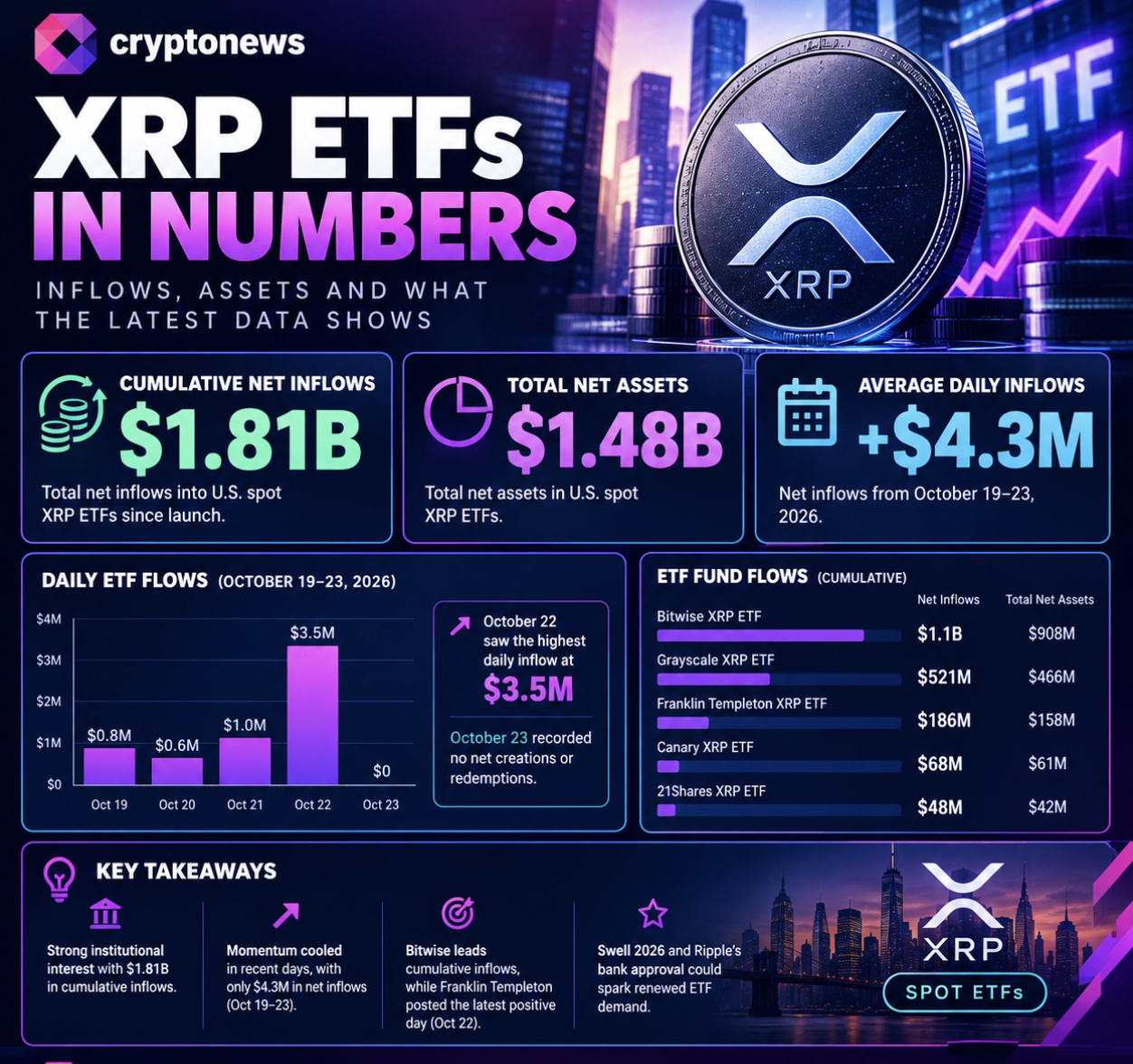
U.S. spot XRP exchange-traded funds have attracted $1.8 billion in cumulative net inflows, establishing a huge channel for institutional exposure to the token. Total net assets stood at $1.48 billion.
The latest sessions also show room for renewed buying. XRP ETFs recorded $4.3 million in net inflows between October 19 and October 23, including a $3.5 million contribution on October 22. The October 23 session recorded no net creations or redemptions.
The cumulative inflow figure remains an important part of XRP’s institutional adoption edge. ETF investors can gain exposure without directly managing wallets or handling on-chain transactions, making these products another route for traditional capital to enter the market.
Swell could give another push to XRP demand. Ripple’s annual conference runs October 27–29 in New York and combines Swell with the XRP Ledger developer conference Apex and the University Blockchain Research Initiative gathering.
Ripple expects more than 1,500 attendees, over 100 speakers, and more than 80 sessions. The agenda covers capital markets, settlement, tokenization, stablecoins, crypto ETFs, and XRP utility. Speakers include Ripple leadership and executives from major financial institutions and market infrastructure firms.
The timing gives XRP investors several potential catalysts in one week. Announcements involving institutional payments, custody, tokenization, or new XRP-related investment products could strengthen the case for fresh capital entering the ecosystem.
Ripple Swell and The $15 XRP Price Case?
Xrp (XRP)
24h7d30d1yAll time
Technical analyst Javon Marks has outlined a bullish XRP price target of $15, drawing comparisons between XRP’s current chart structure and its historic breakout in 2017.
In July 2026, Marks pointed to the 2,872% gain recorded during the earlier breakout. He applied that historical move to XRP’s November 2024 breakout point near $0.50 to arrive at the $15 target.
The forecast offers a compelling upside scenario if XRP enters another strong price-discovery phase. A combination of renewed ETF demand, expanding institutional adoption, and major Ripple announcements could help strengthen the market narrative behind such a move.
Marks is not the only analyst to identify double-digit potential. Chad Steingraber previously predicted that XRP could climb from $2 to $10 in less than a year, citing ETF demand and the possibility of accelerated price discovery.
Swell now gives Ripple an opportunity to add fresh developments to that bullish outlook. A major banking partnership, expanded RLUSD adoption, or new institutional infrastructure built around the XRP Ledger could reinforce the token’s longer-term growth story.
The national trust bank approval has strengthened Ripple’s position in the U.S. financial system. With Ripple Swell underway and more than $1.8 billion in cumulative XRP ETF inflows already recorded, the next round of announcements could put institutional demand back at the center of the XRP price debate.
Aviva Investors has added an XRP Ledger share class to its £22 billion Sterling Liquidity Fund. The launch brings a very large traditional fund into the tokenisation story, though only a small slice of its assets is represented by tokens…
An XRP Ledger maintenance amendment is running on a new activation clock after losing the validator majority behind its earlier countdown. The fixCleanup3_4_0 amendment regained majority support on October 21, moving its earliest possible activation window to November 4, subject to that support continuing.
TL;DR: The amendment regained validator majority on October 21 after its first countdown failed. A fresh two-week window points to November 4 at the earliest, if support holds.
At the XRPL Dashboard’s October 24, 07:09 UTC snapshot, 32 of 35 trusted validators supported the amendment, or 91.43%. The tracker showed a new majority timestamp of October 21 at 14:46:22 UTC. Those figures are a dated observation; validators can change their positions.
XRPL Win’s amendment history separately records the earlier attempt beginning October 9 and losing majority on October 21. The interrupted run lasted more than 12 days. It did not satisfy the uninterrupted period required for activation, so the earlier October 23 expectation no longer applies.
The Clock Requires Continuous Support
The ledger’s official amendment documentation requires support from more than 80% of trusted validators for two weeks. If support falls below the requirement, the waiting period starts again when the amendment regains majority.
Network processing also means the end of the two-week period should not be treated as an exact appointment. Amendment decisions are handled through designated ledger checkpoints. November 4 is therefore a conditional earliest window, rather than a guaranteed switch at precisely 14:46 UTC.
This is a consensus process among validators on the blockchain. Holding XRP does not itself constitute an amendment vote. The visible count matters because it shows whether the required network support is being maintained throughout the waiting period.
A Collection Of Technical Fixes
The official amendment description groups fixes affecting vaults, lending, automated market makers, permissioned exchange functions, trust lines, NFTs and other ledger features. Examples include more precise vault rounding and changes to when a loan can be treated as in default.
Another change concerns delegated payment permissions. The documentation says an account with a delegated PaymentBurn permission should also need PaymentMint permission to cross a zero balance into minting. That concerns issued tokens and multi-purpose tokens, which can represent tokenized assets; it should not be described as permission to mint native XRP.
The package also separates signing prefixes used for sponsor and counterparty signatures. These are changes to the handling of transactions and permissions, rather than evidence that a new lending service has launched.
Separate lending amendments still have their own voting status. Users tracking the wider DeFi roadmap should therefore distinguish the cleanup package from activation of those features. The next decisive development for this amendment will be sustained majority through the full window, followed by the ledger recording it as enabled.
Written by the News Desk and edited by Samuel Rae.
The XRP price fell below $1.35 just now after an attempted recovery toward $1.40 lost momentum. Not just XRP, renewed selling pressure also hit the crypto market. More than $220 million in crypto long positions were reportedly liquidated over 12 hours as Bitcoin and Ethereum dropped toward $81,000 and $2,300, respectively.
The downturn comes as the XRP Ledger prepares a significant network maintenance update, although a setback in validator support has pushed its expected activation into November. The combination of weakening price action, leveraged liquidations, and uncertainty surrounding the upgrade leaves XRP wobbling, waiting to see if buyers can defend the $1.30 area.
XRP Price Reversal Deepens, Liquidations Mount
Xrp (XRP)
24h7d30d1yAll time
The XRP price climbed toward $1.40 just a few hours ago before reversing lower. The token subsequently fell through the $1.38 and $1.36 areas before approaching $1.33, leaving the attempted recovery looking increasingly fragile.
As of now, XRP price is down 2% over 24 hours, despite remaining up 1.1% over seven days. The $220 million liquidation wave adds another source of pressure. When leveraged traders open long positions, they are betting that prices will rise. A sharp decline can trigger forced closures when collateral becomes insufficient, potentially adding selling pressure and accelerating losses.
For the XRP price, the immediate technical question is whether buyers can hold the $1.30–$1.32 region. A recovery above $1.35 would help ease some short-term pressure, while another breakdown could leave the token exposed to further losses.
XRPL Upgrade Delayed After Validator Support Falls
The XRP Ledger’s fixCleanup3_4_0 amendment was initially expected to activate on October 23, but that timeline has changed. Validator support briefly fell to 26 of 35 trusted validators, below the 29 votes required to maintain the necessary majority. The countdown consequently restarted, moving the projected activation to November 4 at 14:46 UTC.
XRP Ledger Bug Fix Hits a Last Minute Roadblock
The XRP Ledger’s (@XRP) $XRP fixCleanup3_4_0 amendment has been delayed until November after validator support briefly fell below the required threshold.
The amendment bundles technical corrections affecting several XRPL components, including single-asset vaults, lending, automated market makers, the permissioned decentralized exchange, trust lines, NFTs, escrow, and transaction signing. These changes are intended to correct issues in the network’s implementation.
XRP Price Depends on Buyers and Network Progress
The revised upgrade timeline gives traders another date to monitor, but the XRP price must first contend with the current market downturn. If buyers defend $1.30–$1.32 and reclaim $1.35, the token could attempt another move toward $1.38 and the $1.40 area.
A sustained break below $1.30 would weaken that recovery scenario and could encourage further selling, particularly if Bitcoin and Ethereum continue to fall. Traders will also be watching whether liquidation pressure eases and whether spot-market demand returns.
The November 4 activation projection provides a potential network catalyst, provided validator support remains above the required threshold. Meanwhile, XRPL’s separate lending amendments have not received the necessary approval, meaning the maintenance update should not be confused with the launch of a fully enabled lending protocol.
For now, the XRP price faces a near-term test of market demand while the ledger’s next technical milestone moves further out. A sustained recovery will likely require stronger buying interest and improved conditions across the broader crypto market, rather than the upgrade date alone.
TL;DR: Technical documentation for the proposed LendingProtocolV1_1 amendment describes closed-ended vaults with defined subscription and redemption dates on the XRP Ledger.
XRP Ledger developers have outlined a more structured approach to lending vaults, adding a design that would let some pools run for a fixed period rather than remain permanently open to deposits and withdrawals.
The LendingProtocolV1_1 documentation introduces a VaultKind setting in the VaultCreate transaction. An open-ended vault remains the default, while a second value would identify a closed-ended vault with additional dates controlling when new subscriptions close and when redemption can begin.
Those fields matter for products that need a predictable investment period. Institutional-style lending arrangements often have subscription windows, capital lockups and maturity schedules that are harder to represent using a continuously open pool.
The proposal describes the mechanics of creating such a vault, not the launch of a live lending product. It also does not erase the credit and liquidity risks associated with on-chain lending. A technical standard can define how a position behaves, but it cannot guarantee that a borrower will repay or that a market will remain liquid.
XRPL’s broader lending discussions have attracted attention because they point to potential financial products built directly around ledger-level features rather than solely through external applications.
For now, the important question is whether validators and developers are satisfied with the amendment’s implementation and how any final version would interact with the rest of the network.
Written by the News Desk and edited by Samuel Rae.
Ripple’s latest news on US crypto regulation is putting XRP back in the spotlight, with the company backing a proposed SEC framework that could bring greater clarity to the digital asset industry. However, the return of outflows from US spot XRP ETFs adds another factor for investors to watch.
The timing brings three developments into one: Ripple’s regulatory push, a reversal in weekly ETF flows, and Evernorth’s arrival on Nasdaq as an XRP-focused digital asset treasury company.
For XRP News, the key question is if regulatory progress and growing institutional infrastructure can sustain investor interest as fund flows turn negative. Each development offers a different signal, and the eventual impact on XRP will depend on how the regulatory proposal evolves and whether institutional demand strengthens again.
Xrp (XRP)
24h7d30d1yAll time
Ripple Backs SEC Crypto Rules in Push for Regulatory Clarity
Ripple filed a 20-page comment letter on October 20 supporting the SEC’s proposed Regulation Crypto Assets, while requesting changes to parts of the framework. The filing came as the public comment period on the proposal closed.
1/ Today Ripple filed its comment letter on the SEC’s proposed Regulation Crypto Assets. We support the proposal, and the SEC has clear authority to adopt it. 2/ Years of “case by case, coin by coin” enforcement has pushed innovation offshore. We need holistic rules for digital…
The proposal is part of a bigger effort to establish clearer rules for crypto-related offerings and determine when federal securities laws apply. Reuters reported in August that the SEC’s proposed framework includes exemptions for certain offerings and a conditional safe harbor intended to address aspects of crypto asset regulation.
Ripple’s position focuses on an important contrast. An investment contract involving a digital asset does not necessarily mean the underlying token itself is a security in every context. The company is also seeking clarity on issuer obligations, token classifications, and transactions on secondary markets.
This matters for XRP because regulatory clarity could help exchanges, financial institutions and other market participants assess their obligations when dealing with digital assets. However, the SEC has not finalized the proposed rules, and Ripple’s support does not itself change XRP’s legal status. The outcome will depend on the final text and how the agency applies it.
Can XRP ETF Demand Recover After Outflows Return? Could News on Evernorth NASDAQ Listing Help?
The latest XRP News points to a pause in ETF activity rather than another wave of selling. US spot XRP ETFs recorded no net flows on October 20, following approximately $920,800 in inflows on October 19, according to available ETF tracking data.
The early figures for this week offer a more mixed picture after the funds lost around $1.84 million during the week ended October 16, ending a 13-week inflow streak. Cumulative net inflows remained near $1.81 billion as of October 20, suggesting that the longer-term institutional investment trend has yet to reverse decisively.
With ETF flows returning to positive territory, XRP could strengthen its price with renewed investor interest. Continued outflows, on the other hand, may complicate the bullish outlook, particularly if broader crypto market conditions remain uncertain.
Evernorth adds a longer-term adoption angle to the latest XRP News. The XRP-focused treasury company completed its business combination with Armada Acquisition Corp. II in October and entered the public markets under the ticker XRPN.
The development creates another potential channel for institutional participation in the XRP ecosystem. However, XRPN shares are not the same as XRP, and Evernorth’s listing does not automatically translate into new buying pressure for the token.
For investors following XRP News, the combination of regulatory engagement, ETF flows, and treasury activity offers several indicators to monitor. Ripple’s support for the SEC proposal could contribute to a cleaner regulatory environment, while Evernorth’s strategy may expand institutional participation over time.
TL;DR: Technical documentation for the proposed LendingProtocolV1_1 amendment describes closed-ended vaults with defined subscription and redemption dates on the XRP Ledger.
XRP Ledger developers have outlined a more structured approach to lending vaults, adding a design that would let some pools run for a fixed period rather than remain permanently open to deposits and withdrawals.
The LendingProtocolV1_1 documentation introduces a VaultKind setting in the VaultCreate transaction. An open-ended vault remains the default, while a second value would identify a closed-ended vault with additional dates controlling when new subscriptions close and when redemption can begin.
Those fields matter for products that need a predictable investment period. Institutional-style lending arrangements often have subscription windows, capital lockups and maturity schedules that are harder to represent using a continuously open pool.
The proposal describes the mechanics of creating such a vault, not the launch of a live lending product. It also does not erase the credit and liquidity risks associated with on-chain lending. A technical standard can define how a position behaves, but it cannot guarantee that a borrower will repay or that a market will remain liquid.
XRPL’s broader lending discussions have attracted attention because they point to potential financial products built directly around ledger-level features rather than solely through external applications.
For now, the important question is whether validators and developers are satisfied with the amendment’s implementation and how any final version would interact with the rest of the network.
Written by the News Desk and edited by Samuel Rae.
CryptoQuant’s reserve data show XRP exchange reserves have climbed to 11.81 billion tokens, a reading in the 99th percentile of the past year. As of now, XRP is trading at the $1.30 price level, while traders watch whether $1.25 holds, as a break below that level would put $1.00 in focus.
CryptoQuant’s aggregate measure places XRP held across exchanges at its highest point in the one-year comparison. Exchange reserves count tokens in wallets controlled by trading platforms, where they can be accessed for trading more readily than assets held in private wallets or cold storage.
For market structure, the direction of flows matters alongside the reserve level. Deposits add to exchange-held supply, while withdrawals to private wallets reduce the quantity immediately available on platforms; upcoming data will show whether the 11.80 billion balance continues to climb or starts to fall.
The distinction is relevant because elevated reserves can weigh on price when holders sell into bids, particularly near a contested support zone. A sustained reserve decline would ease that supply concern, while continued growth would keep the overhang in view.
XRP Leverage Has Reset, but the Supply Overhang Remains a Price Hurdle
Binance XRP open interest stood at approximately $412 million on October 20, down from $453 million on October 17. Across exchanges, XRP open interest reached $1.40 billion, up 2.5% over 24 hours. The recovery suggests derivatives exposure is rebuilding, although Binance positioning remains below its mid-October level.
Long liquidations reached $2 million across exchanges over the latest 24-hour period, compared with $431,000 in short liquidations. Binance funding remained slightly positive at 0.0023% per eight hours, while the average across exchanges turned marginally negative at -0.0004%. XRP traded near $1.29, leaving leveraged traders exposed to further volatility.
The market now faces two competing pressures: renewed aggregate derivatives positioning and elevated exchange-held XRP reserves. The next move may depend on whether renewed derivatives activity coincides with sustained spot selling or a reduction in exchange-held supply.
Demand from institutions and large holders could counterbalance exchange supply. US spot XRP ETFs recorded a $1.84 million weekly net outflow for October 12-16, ending a 13-week run of inflows. The earlier inflow streak is covered in XRP ETF flow data.
XRP has rebounded from around $1.25 to trade near $1.30-$1.31, leaving the support zone as the immediate downside reference. we identified increased XRP Ledger on-chain volume near $1.25 as a possible sign of a local bottom, while the technical setup keeps $1.00 in focus if support fails.
The network activity picture is mixed. XRP Ledger payment volume was about 119.5 million XRP on October 17, down 72.3% from the previous day and below the reported 30-day average of roughly 629.3 million XRP.
Xrp (XRP)
24h7d30d1yAll time
Above spot, $1.33 is immediate resistance and $1.39 is a key level. Martinez’s broader technical scenario calls for a sustained close above $1.56 to open a path toward $2; his downside scenario puts $1.00 in focus after a break below $1.25. A technical view of XRP support and potential recovery levels also centers on the market’s ability to defend demand zones.
If XRP price holds $1.25 and exchange reserves begin to fall through net outflows, the supply-overhang concern would ease. If the token loses support, $1.00 becomes the next level, with elevated reserves adding to the need for buyers to absorb available supply.

 Login



 RIPPLE EXPECTS $900 MILLION ANNUALIZED PRODUCT REVENUE RUN RATE!