❌

Reading view

There are new articles available, click to refresh the page.

How to Audit a Stablecoin’s Real Circulating Supply

A six-step method that starts at the contract, not the dashboard.

Dark waterfall chart titled Total supply is not circulating supply. A tall blue bar labelled raw totalSupply is reduced by four deductions, pre-minted and unissued, bridge-locked, stablecoin-backed and permanently inaccessible, leaving a shorter green bar labelled circulating supply. Proportions are illustrative.
Four deductions separate raw contract supply from the circulating supply figure you can actually defend.

Pick a large stablecoin. Open three data sites. You will get three different circulating supply numbers.

None of them is lying. They are answering three different questions.

And the gap is not cosmetic. In June 2026, one widely used aggregator reported roughly $371 million more USDS than the Ethereum mainnet contract did. No hack. No stealth mint. Escrowed supply counted twice.

If you hold a stablecoin, lend against one, or carry one on a balance sheet, you need a figure you can defend in a risk meeting. Here is the six-step method.

Dark bar chart titled Three supply numbers for the same stablecoin, one snapshot. Mainnet totalSupply for USDS on Ethereum is 6.65 billion dollars, cross-chain USDS across all chains is 6.64 billion dollars, and issued stablecoins covering USDS and DAI on the protocol books is 11.22 billion dollars. Snapshot block 25939320, 9 September 2026.
Three published supply figures for the same stablecoin, read at the same block on the same day.

Why does the same stablecoin show three different circulating supply numbers?

Three structural reasons, and not one of them involves anybody being dishonest.

  • Different starting point. Some sources read totalSupply() straight off the token contract. Others rebuild supply by summing mint and burn events. Onchain data schemas now carry an explicit flag for which of the two is authoritative, row by row, because the two disagree often enough to matter.
  • Different exclusions. CoinGecko deducts locked addresses that project teams report to it (published methodology). Allium strips four separate categories out of raw supply before calling anything circulating.
  • Different scope. One token, or the whole family? USDS alone sat at $6.81B on 26 October 2026. Sky Ecosystem reported $11.48B of stablecoin supply the next day, because that figure counts USDS and DAI together as protocol liabilities.

Same dollar. Three honest answers.

Circulating supply is not a fact you look up. It is a definition you choose, then measure.

Step 1. Read the contract before you read the dashboard

Every real audit starts with one call: totalSupply() on the issuing contract, at a named block.

Not a screenshot. A block height.

Yearn’s risk team did exactly that to USDS on 9 September 2026 at block 25939320. Mainnet totalSupply() came back at 6,645,559,216, down 15% from their previous reading.

They also pulled the protocol’s own internal debt figure, so the token number could be checked against the issuer’s books rather than against another website. The full working is public.

That is the standard worth copying. Two independent reads, same block, both published.

Step 2. Subtract the supply that is not actually circulating

Raw total supply overstates circulation almost every time. Four buckets come out:

  • Pre-minted and unissued. Tokens the issuer created but has not released against backing.
  • Bridge-locked. Supply sitting in a source-chain escrow while a mirrored token trades somewhere else.
  • Stablecoin-backed. Supply locked only to mint another tracked stablecoin.
  • Permanently inaccessible. Burn addresses and dead contracts.

The bridge bucket is where most errors live. In that same September reassessment, native-escrow USDS fell from about $448M to $102M, escrowed sUSDS from about $812M to $343M, and LayerZero-locked USDS from roughly $48.7M to $6.67M. Miss those and a cross-chain total quietly counts real money twice.

Dark horizontal bar chart titled The balances a supply audit has to subtract. Native-escrow USDS fell from 448 million dollars to 102 million dollars, escrowed sUSDS from 812 million dollars to 343 million dollars, and LayerZero-locked USDS from 48.7 million dollars to 6.67 million dollars, as at 9 September 2026.
Bridge escrow and locked balances move fast, and a supply audit has to re-read them every time.

Step 3. Do not count the yield-bearing wrapper twice

This one catches careful people.

sUSDS is not extra supply. It is a claim on USDS that has been supplied to the Sky Savings Rate module. One dollar of USDS wrapped into sUSDS is still one dollar of stablecoin liability, not two.

  • Count the base token as supply.
  • Count the wrapper as a holding of the base token.
  • Never add the two together.

Scale is why this matters. Roughly half of USDS supply sits in sUSDS, and the Ethereum sUSDS pool showed $4.85B on 26 October 2026. That is a lot of float to misclassify.

Dark two panel comparison titled Why the yield-bearing wrapper is not extra supply. The left panel, marked double counted, adds USDS supply of 6.81 billion dollars to the sUSDS pool of 4.85 billion dollars for a wrong total of 11.66 billion dollars. The right panel, marked counted once, shows USDS supply of 6.81 billion dollars with sUSDS treated as a holding of USDS.
Adding the yield-bearing wrapper to the base token counts the same dollars twice.
A yield-bearing wrapper is a claim on supply. It is never new supply.

Step 4. Check what backs the supply, not just how big it is

Supply tells you the size of the liability. It tells you nothing about whether that liability is covered.

So pull the collateral figure next, from the same issuer, on the same day.

On 27 October 2026, Sky Ecosystem published $14.15B in Total Collateral against $11.48B in stablecoin supply.

That is roughly $1.23 of collateral behind every dollar of supply, which is the entire point of an overcollateralized design.

Two surfaces let you check it yourself instead of taking it on trust:

  • financial.skyeco.com for the balance sheet, Gross and Net Protocol Revenue, Protocol Surplus and Sky Reserves.
  • info.skyeco.com for the live onchain view of collateral composition, USDS and sUSDS.

Credit agencies have started running the same exercise. Moody’s assigned Sky Protocol a B3 issuer rating with a stable outlook on 7 October 2026, the first rating it has given any stablecoin protocol, after S&P Global affirmed B- on 1 October.

Both flagged reserve depth as the constraint. That is what an outside read of the collateral side looks like, and it is worth more than a logo on a trust page.

Dark panel titled Supply tells you the size, collateral tells you the cover. A green bar shows Total Collateral of 14.15 billion dollars against a blue bar showing Stablecoin Supply of 11.48 billion dollars, giving 1.23 dollars of collateral per dollar of supply. Three chips below read Moody’s B3 stable, 7 October 2026, S&P Global B minus stable, 1 October 2026, and only dual-rated stablecoin protocol.
Collateral against supply, plus the two outside credit reads, as published in October 2026.

Step 5. Ask whether that supply can actually leave at a dollar

A supply number is only as good as the exit. Three questions:

  • Is there a direct conversion path with the issuer, or only a market?
  • What caps sit on that path?
  • What does using it cost?

Sky Protocol runs Peg Stability Modules, smart contracts that convert supported stablecoins into USDS and back at 1:1 directly with the protocol rather than against another trader, under governance-set caps. Moving between USDS and sUSDS carries no lockup in either direction.

Redemption depth is the part of a supply audit most people skip, and the part every stress event tests.

Step 6. Date the number, or bin it

Stablecoin supply moves daily. A figure without a timestamp is a rumour with decimal places.

Write the audit line in four fields: source, metric, value, block or date.

This is about to stop being a matter of taste. On 21 October 2026 the OCC finalised its GENIUS Act rule.

From 18 January 2027, permitted issuers must publish the monthly composition of their reserves on their own websites by noon on the last day of each month, and file weekly confidential reserve reports.

As Forbes noted, an accurate weekly reserve figure demands daily reconciliation between tokens outstanding onchain and reserves held at the custodian.

Monthly PDFs are becoming weekly reconciliation. Protocols that already publish live will barely feel it.

What does a finished circulating supply audit look like on USDS?

Six lines, dated 26 to 27 October 2026, each checkable in under ten minutes:

  • Mainnet token supply: $6.81B USDS, third largest dollar stablecoin.
  • Protocol family supply: $11.48B, USDS and DAI together.
  • Total Collateral: $14.15B, around $1.23 per dollar of supply.
  • Wrapper: sUSDS, roughly half the USDS float, excluded from the supply line.
  • Exit path: Peg Stability Modules at 1:1, governance-capped.
  • Outside read: rated by both Moody’s and S&P Global, so far the only stablecoin protocol with both.

A defensible number, with the working shown.

Why the Sky Savings Rate belongs in a supply audit

Here is the part most supply write-ups leave out.

Supply that pays nothing is a static liability. Supply that pays has to be funded, and that funding has to come from somewhere real.

The Sky Savings Rate is a variable rate set by Sky Governance and accessed by holding sUSDS.

It is funded from revenue Sky Protocol accrues as the Sky Agent Network, independent allocators including Spark, Grove, Osero, Keel and Obex, draws USDS liquidity under governance-set risk parameters and deploys it.

So when you audit the supply, audit the engine behind it:

  • Where does the yield come from?
  • Who sets the rate, and is the decision public?
  • Does the revenue appear on a published income statement?

Galaxy appears to have run some version of that test. On 23 September 2026 it added $100 million of sUSDS to its corporate treasury and approved sUSDS as eligible collateral across its institutional trading business.

Audit the supply. Then audit whatever pays it.

The 60-second circulating supply checklist

Run this before you quote any stablecoin supply figure:

  • Read totalSupply() at a named block.
  • Subtract pre-minted, bridge-locked, stablecoin-backed and inaccessible balances.
  • Exclude the yield-bearing wrapper from the supply line.
  • Pull collateral from the same issuer on the same day.
  • Confirm the redemption path and its caps.
  • Write the date next to the number.

Six steps. One figure you can put in front of a risk committee.

So what should circulating supply actually mean?

The stablecoin market sat near $308B in August 2026, below its May peak of $322.4B. That is a lot of dollars measured by methods most holders have never read.

Which leaves the question I actually want argued in the comments.

Does circulating supply mean tokens that exist, tokens that can move, or tokens someone can redeem at par today?

Pick one. Then run the six steps on whatever stablecoin you hold and post the number with its date underneath. I will check mine against yours.


How to Audit a Stablecoin’s Real Circulating Supply was originally published in Coinmonks on Medium, where people are continuing the conversation by highlighting and responding to this story.

Three Companies, Three Fiat Problems, Three Different Ramps

Stablecoins accounted for 60% of crypto purchase value processed through Mercuryo’s on-ramp in H1 2026, up from 43% six months earlier. Meanwhile, accepted stablecoin off-ramp transactions grew 446% year on year, based on the company’s on-ramp report and off-ramp data.

These figures come from one provider, not the entire market. Still, they highlight something worth discussing: how money moves between bank accounts and crypto platforms.

If I were managing those flows for a business, I’d start with two questions. Which currencies are we moving, and where are our bank accounts? The answers help determine which payment routes make sense.

So, What Does Each Payment Route Actually Do?

A company with European partners, a Swiss bank account and international USD settlements might use several payment routes, even through the same crypto platform.

SEPA — for EUR transfers across Europe. It connects participating banks across the Single Euro Payments Area and supports euro transfers between eligible accounts.

SWIFT — for international bank transfers. A global financial messaging network used for cross-border payments in USD and other currencies. Costs and timing depend on the banks involved.

SIC — for Swiss franc transfers. Switzerland’s interbank clearing system handles CHF payments between participating financial institutions.

ZEN.COM — for local PLN payments. Unlike SIC, ZEN.COM is a payment provider rather than a clearing system. Its local PLN transfers use ELIXIR, with availability depending on the provider’s integration and customer eligibility.

Other routes, including ACH in the US and PIX in Brazil, become relevant when businesses need to serve customers in different markets.

Let’s Look at Three Different Business Scenarios

1. A Polish Fintech Needs Both EUR and PLN

Imagine a fintech in Warsaw receiving euros from European partners while paying local expenses in Polish zloty. It needs both currencies and a way to move funds into and out of crypto.

WhiteBIT On/Off-Ramp could be worth considering. It lists EUR transfers through SEPA and PLN through ZEN.COM within one crypto ecosystem.The fee for EUR deposits and withdrawals is a flat €5, while limits depend on KYB level and agreed conditions.

The service also lists USD via SWIFT and CHF via SIC, alongside TRY, GEL and AUD among its supported currencies. Routes for those additional currencies require separate confirmation.

For this fintech, having several fiat options in one place could simplify treasury operations. I’d first confirm which PLN transactions are available to its legal entity and whether the limits suit its volumes.

2. What If Your Wallet Serves Customers Across Different Markets?

Now imagine a wallet provider that wants customers to buy and sell crypto directly inside its app. Some users pay in EUR, others prefer cards or local payment systems. The company needs an integrated payment experience across its supported markets.

Kraken Ramp, also marketed as Payward Ramp, takes this approach. Its institutional offering lists 24+ payment methods, including SEPA, ACH, PIX, debit cards, Apple Pay and Google Pay. The service offers API and SDK integration, with payment processing, compliance and crypto conversion handled through Kraken’s infrastructure.

The attraction is the combination of local payment methods and embedded crypto access. However, supported methods differ by market, and the company would need to confirm which currencies, countries and transaction directions are available to its customers.

For this type of wallet, the integration experience matters alongside currency coverage. A payment method listed on a product page is useful, but the full customer journey — from funding to completed conversion — needs to work in the intended markets.

3. And What About Thousands of USD Payouts?

Imagine a US fintech where customers convert digital assets into dollars and withdraw funds to their bank accounts. With thousands of payouts, settlement speed and integration become important.

zerohash On & Off Ramp supports fiat-to-crypto and crypto-to-fiat conversions through ACH, RTP, SEPA and payment service providers. It also supports 100+ digital assets, with availability depending on the market and integration.

For this business, I’d check which USD payout methods are available, how returned payments are handled and whether prefunding is required. These details can make a big difference when customer withdrawals are part of everyday operations.

So, What Would I Check Before Choosing?

I wouldn’t rank these payment routes from best to worst. A longer currency list doesn’t necessarily mean a better setup, especially when availability depends on jurisdiction, account type and banking partners.

I’d start by checking three things: which currencies and payment methods are actually available, whether the money belongs to the business or its customers, and how much each completed transfer costs.

Processing times matter too. Domestic real-time payments may suit frequent customer withdrawals, while international transfers can work well for corporate treasury operations. Fees, conversion spreads and reconciliation requirements should all be part of the calculation.

Finance can map currencies and volumes, operations can verify settlement schedules, and compliance can confirm eligibility. Sometimes one provider will cover most needs, while other businesses may benefit from combining several services.

I’d rather check those details upfront than discover halfway through a transfer that the selected route doesn’t work as expected.

Disclaimer: This is not financial or investment advice. Do your own research before making any decisions. Use at your own risk.


Three Companies, Three Fiat Problems, Three Different Ramps was originally published in Coinmonks on Medium, where people are continuing the conversation by highlighting and responding to this story.

I read Danelfin’s audit and Tickeron’s small print. Only one showed a dated live record.

Danelfin and Tickeron both sell “AI” to people picking stocks, but they are not the same kind of product. Danelfin gives every stock a score from 1 to 10 and leaves the trading to you. Tickeron sells signals and trading bots, some of them running on its own brokerage accounts. I read both sites end to end on Oct 26, 2026, including the parts most reviews skip: Danelfin’s own audit site and the small print under Tickeron’s 191% headline.

I also work on milo, so I’ll say where milo fits and where it doesn’t. It isn’t a third option that beats both. It answers a different question.

The short answer

Pick Danelfin if you want a daily 1 to 10 rating on about 5,600 US and European stocks and you’ll place the trades yourself. Pick Tickeron if you want ready-made signals or bots that trade on 5 to 60 minute timeframes. Both lead with backtests. Danelfin publishes an audit that shows its live record so far is flat. Tickeron’s headline numbers don’t come with dates.

Danelfin in plain English

Danelfin calls itself “AI-Powered Stock Picking.” Every trading day it gives each stock an AI Score from 1 to 10, which it describes as the probability of beating the market over the next three months. A 10 means the model likes it most, a 1 means least. You also get sub-scores for technical, fundamental, sentiment and low risk.

How the AI Score works

Per Danelfin’s how-it-works page, the model looks at more than 600 technical, 150 fundamental and 150 sentiment indicators a day, which it turns into 10,000+ features per stock. It uses hundreds of decision trees and trains on the latest 252 market days for US stocks. Coverage is all US stocks, the main European markets and US-listed ETFs. The audit site puts the count at roughly 5,600 stocks scored daily.

Danelfin pitches this as explainable AI, “no black boxes,” because it shows which features pushed a score up or down. That’s useful. It still won’t tell you why a 9 should beat an 8 in your account.

One thing to get straight early: Danelfin doesn’t trade for you. The audit site says it plainly, “you execute the trades on your own brokerage account.” The paid plans can sync a US broker portfolio so you see scores on what you own, but that’s a read, not an order.

Danelfin pricing

From danelfin.com/pricing on Oct 26, 2026:

  • Free: $0. Top 10 lists, 10 stock reports a month, one portfolio of 5 stocks, top alpha signals only.
  • Plus: $22 a month billed yearly ($264). Adds portfolio sync with US broker accounts.
  • Pro: $59 a month billed yearly ($708). Adds full alpha signals and CSV export.
  • Elite: $134 a month billed yearly ($1,608). Adds an API with 10,000 calls a month and historical daily scores back to 2017 on request.

The per-month prices are the yearly plan divided by 12. The page says yearly saves $84, $240 and $540 a year, which works out to about $29, $79 and $179 a month if you pay monthly. There’s a 30-day money-back guarantee.

The performance claims, and Danelfin’s own audit

The homepage says stocks with a Score of 10 beat the market by +21.05% on average after three months (annualized alpha) since 2017, and stocks scored 1 lagged by 33.28%. It also says its Best Stocks strategy returned +456% from Mar 29, 2017 to Sep 3, 2026, against +228% for the S&P 500.

The how-it-works page is honest about what those are: “This Danelfin Best Stocks strategy performance is based on backtested results. Backtested performance is not an indicator of actual future results.” The +21.05% figure covers Jan 3, 2017 to Apr 1, 2025.

Credit where it’s due, Danelfin runs a public audit site and the audit is tougher on Danelfin than the homepage is. Here’s what it says:

  • The current model went live on Jul 7, 2025. Every score before that date was recalculated afterward, walk-forward. The audit calls this a “simulated backtest” and notes the model was picked after its performance was known.
  • It splits the Score 10 backtest into three periods. Average 3-month alpha was +5.4% in 2017 to 2019, +0.3% in 2020 to 2022, and -0.5% from 2023 to Jul 6, 2025. The audit says only 2017 to 2019 is statistically significant and tells readers to “treat the recent period as unproven.”
  • Live, stocks scored 8 to 10 averaged -0.5% 3-month alpha since Jul 7, 2025, against +2.2% for the same bucket in the backtest. That’s about four independent 3-month windows, so it’s early either way.
  • It passed 7 of 14 robustness checks, with 6 cautions and 1 fail. The fail is t-stat inflation: naive t-stats overstate significance by about 4.9x.
  • Survivorship bias isn’t controlled. Delisted companies like Twitter, SVB and Celgene are missing from the history.
  • A Top 20 portfolio backtest returned 22.4% a year vs 15.1% for SPY from Apr 2017 to Jul 2026, before trading costs, with about 70% turnover at each monthly rebalance.

Six-month alpha tells the same story: +4.8%, then -1.4%, then -2.6%. So the big homepage number leans mostly on 2017 to 2019. That doesn’t make the score useless as a screen. It does mean nobody, Danelfin included, can show it beats the market now.

Tickeron in plain English

Tickeron’s homepage reads “AI Trading Agents, Tools and News.” Where Danelfin is one score, Tickeron is a shelf of products: Daily Buy/Sell Signals, AI Robots, Real-Time Patterns, Trend Prediction, Pattern Search and a screener, plus crypto signal agents. Its models, which it calls Financial Learning Models (FLMs), run on 5-minute, 15-minute and 60-minute charts. That’s short-term trading, not “hold for three months.”

Bots, signals and patterns

The bot trading page talks about “1,000+ back-tested algorithms, verified forward testing” and lists 25 bots selected from 351. The homepage the same day said 30 selected out of 298. The bot count moves, which makes sense if bots get added and retired. Some are “Double Agent” bots that hedge with inverse ETFs, for example pairing $NVDA with NVDS or $MSFT with QID.

Brokerage Agents vs virtual agents

This is the part people mix up. Tickeron’s AI agents page says Brokerage Agents are “designed for those who intend to use them for trading on real-money accounts,” and invites you to “review trades and copy from our brokerage accounts.” So Tickeron runs the bot on its own account and you mirror the trades. Virtual agents and signal agents don’t trade real money at all.

Can a bot place orders straight into your own broker account? Tickeron’s FAQ, dated Nov 22, 2023, said robot brokerage integration was “under development” with plans for Binance, Alpaca, Kraken, Ameritrade and IBKR. I couldn’t find a current page confirming it shipped, so ask them before you pay for that.

Tickeron pricing

There’s no public pricing page. Both tickeron.com/pricing and /pricing/ returned 404 when I checked. The only prices I found were in a Sep 21, 2026 sale post: Daily Buy/Sell Signals at $60 a year instead of $240, and AI Robots at 50% off without a dollar figure. Expect to see prices after signing up.

The 191% claim

The bot page headline is “191% Annualized Return During the Reported Period,” with 419 closed trades, a 71% win rate, a 2.92 profit factor, $456 average profit per trade and a 13:1 profit-to-drawdown ratio. It adds “Past performance does not guarantee future results.”

What the block doesn’t say is which bot that is, what dates “the reported period” covers, whether it was live money, paper or a backtest, and what a benchmark did over the same window. 419 trades is a decent count, but annualized returns from a short window can look huge. Until you know the dates, 191% is a hard number to judge.

Danelfin vs Tickeron side by side

Where milo fits, and where it doesn’t

milo doesn’t score stocks and doesn’t run stock bots. On the stock side it reads filings. The andmilo.com/stocks page pulls Form 4 insider buys and sales and 8-K filings from SEC EDGAR for 50 of the most-followed US stocks, refreshed daily. As of Oct 25, 2026, 23:23 UTC, it showed at least 278 insider sales worth at least $3.3B over 90 days, against at least 7 buys worth at least $54M.

Here’s a real one. On Sep 29, 2026, Oracle director Stephen Rusckowski bought 25,000 shares of $ORCL at a weighted average of $139.352, about $3.48M, filed Oct 1. I opened the Form 4 to check: code P, open-market fills between $138.96 and $139.74, held through his living trust, and the 10b5–1 plan box isn’t checked. That’s a clean buy with his own money.

Now a messy one. The same feed lists a $24M $PEP “buy.” The footnotes show it was a swap between Pohlad family trusts, not someone betting on PepsiCo. A score wouldn’t catch that and neither does a raw count. You have to read the filing, which is how to read SEC Form 4 is about.

Where milo is weaker than these two, plainly:

  • No AI score or ranking of stocks.
  • No ETFs or European stocks. Insider data covers 503 US tickers, against about 5,600 for Danelfin.
  • No backtest or stock-picking track record to show you.
  • No real-money stock trading. Stock features are paper trading and research only.
  • No intraday pattern tools like Tickeron’s.

Where it’s different: every data point links back to a public SEC filing you can open yourself, and on the crypto side milo agents trade from your own wallet with public PnL and a plain-English diary of each move.

If you want the wider field, the best AI stock pickers roundup compares more tools, and can ChatGPT pick stocks covers the public AI paper-trading tests.

How to judge any AI tool’s track record

The same five questions work for Danelfin, Tickeron, milo or whatever comes next:

  1. When did the model go live? Anything before that date is a backtest, however it’s labeled. Danelfin gives you the date (Jul 7, 2025). Tickeron’s 191% doesn’t.
  2. Is the result split by period? One big number from 2017 can hide a flat last three years. Danelfin’s audit shows exactly that.
  3. Are dead companies in the data? Without delisted stocks, backtests look better than reality.
  4. Is it before or after costs? 70% monthly turnover or hundreds of short-term trades cost real money.
  5. What’s the benchmark over the same dates? A return with no comparison isn’t a result.

If a vendor can’t answer those, treat its performance number as marketing. If you want to test ideas without risking money, paper trade them first. That’s the only way milo handles stocks anyway.

FAQ

Is Danelfin better than Tickeron?
They do different jobs. Danelfin is a 3-month stock rating you act on yourself. Tickeron is short-term signals and bots. Danelfin is more open about its record, since it publishes an audit with live results.

Is Danelfin’s AI Score accurate?
By its own audit, Score 10 stocks beat the market in 2017 to 2019 and were roughly flat after that. Live since Jul 7, 2025, stocks scored 8 to 10 averaged -0.5% 3-month alpha.

How much does Danelfin cost?
There’s a free plan. Paid plans were $22, $59 and $134 a month billed yearly on Oct 26, 2026, with higher monthly-billing prices.

How much does Tickeron cost?
Tickeron doesn’t publish a pricing page. A Sep 2026 sale listed Daily Buy/Sell Signals at $60 a year, down from $240.

Do Tickeron bots trade real money?
Brokerage Agents trade on Tickeron’s own real-money accounts and you can copy the trades. Virtual and signal agents don’t trade real money.

Is Tickeron’s 191% return real?
It’s Tickeron’s claim for “the reported period.” The page doesn’t name the bot or the dates, so you can’t check it from that page.

Does Danelfin place trades for me?
No. You place trades in your own brokerage account. Paid plans can sync a US broker portfolio to show scores.

Is milo an alternative to Danelfin or Tickeron?
Not a direct one. milo tracks SEC filings and insider trades for US stocks with paper trading only, and runs AI trading agents for crypto.

Try milo to see insider buys and 8-Ks for the stocks you follow, and paper trade the ideas before any money is involved.

For education only. Not investment advice. milo stock features are paper trading and research only. Competitor details checked on their own sites on Oct 26, 2026 and may change. Sources: danelfin.com (home, how-it-works, pricing), audit.danelfin.com, tickeron.com (home, bot-trading, ai-agents, FAQ, Sep 21, 2026 sale post), andmilo.com/stocks, SEC EDGAR Form 4 accession 0001341439–26–000099.

Originally published at https://blog.pumpparade.com on October 26, 2026.


I read Danelfin’s audit and Tickeron’s small print. Only one showed a dated live record. was originally published in Coinmonks on Medium, where people are continuing the conversation by highlighting and responding to this story.

EDX Markets Signs Apex Fintech Deal to Broaden Crypto Trading Access

TL;DR: EDX Markets and Apex Fintech Solutions announced a strategic relationship on October 26 to connect institutional digital-asset trading and clearing technology with Apex’s established financial infrastructure. The useful follow-up indicators are named customer launches, supported jurisdictions, assets, operating hours and the exact division of custody and clearing responsibilities.

The latest development in Apex’s corner of the digital-asset market is worth examining beyond the headline. A 2026-10-26 announcement describes a concrete change, but the investment consequences will depend on how it works in practice. The original record is available in the original company statement; here is what it establishes, why the distinction matters and what remains unproven.

What the source actually says

EDX Markets and Apex Fintech Solutions announced a strategic relationship on October 26 to connect institutional digital-asset trading and clearing technology with Apex’s established financial infrastructure. EDX operates a professional-market trading venue and a central clearinghouse model; Apex supplies brokerage infrastructure used in more familiar investing environments. The partners say Apex will leverage EDX’s trading and clearing services for its digital-markets offering. The release does not establish that every Apex customer can immediately buy cryptocurrencies through the integration.

The underlying problem is market plumbing. Brokers need reliable execution, post-trade information, custody arrangements, risk checks and accurate customer books. A crypto exchange connection by itself is only one component of that chain. EDX’s appeal is its emphasis on institutional execution and clearing, while Apex can connect those functions with systems brokers already run. A smoother back end may eventually matter more to customers than another asset-selection screen in a trading app.

Clearing also introduces questions worth examining carefully. Netting trades and controlling counterparty exposure can simplify settlement, but the protections depend on legal agreements, margin rules and the specific asset or market structure. Traditional securities frameworks do not transfer automatically to digital tokens. The announcement describes a technology and commercial arrangement, not a universal declaration that crypto trades have become equivalent to clearing through a regulated stock-market utility.

For cryptocurrency investors, the central point is to distinguish an announced milestone from an immediate change in asset value. The underlying development can strengthen a company’s product, legal position or operating capacity without determining what a token will trade for tomorrow. The linked source establishes what was disclosed; the valuation question requires a separate assessment of customers, costs, execution and market conditions. That gap between a confirmed fact and a forecast is where much of the investment risk sits.

What matters for the market next

As digital assets move into mainstream brokerage stacks, infrastructure suppliers compete on operational dependability rather than solely on coin listings or transaction fees. Customers will expect reconciled balances, consistent order handling, transparent fee schedules and regulatory clarity across jurisdictions. Apex and EDX could help shorten the implementation process for participating brokers, though the most difficult work may involve adapting compliance and accounting processes to each product’s legal form.

The useful follow-up indicators are named customer launches, supported jurisdictions, assets, operating hours and the exact division of custody and clearing responsibilities. No transaction-volume forecast should be inferred from an integration agreement. The deal is significant as another example of traditional brokerage infrastructure being connected to specialised crypto venues, but the actual impact on customers will be visible only as live programmes emerge.

Market watchers should also avoid treating a company’s or regulator’s headline as a substitute for terms and conditions. Tokens, shares and regulated service agreements create different rights, even when they coexist in one wallet or platform. A reliable follow-up should ask which entity is responsible, what a holder can actually redeem or transfer, and whether the claimed advantages appear in live activity. Those questions are more informative than an unsupported price target or an assumption that adoption is inevitable.

Primary source: original company statement (2026-10-26).

Written by the News Desk and edited by Samuel Rae.

Stablecoins and US Debt: Who Keeps the T-Bill Yield?

Stablecoins are now a real buyer of short-term US debt. Here’s what that means for Treasury markets, and for you.

Dark abstract graphic of a dollar coin with lines flowing into a stack of US T-bill cards marked 93 days or less, next to the headline Stablecoins and US Debt: Who keeps the T-bill yield?
Stablecoins have quietly become a buyer of short-term US debt.

Here’s something most stablecoin holders never think about.

The digital dollar in your wallet is probably helping fund the US government.

Not in a conspiracy-theory way. In a plain, legal, slightly boring way. When you buy a reserve-backed stablecoin, the issuer takes your dollar and parks most of it in short-term US Treasury bills.

Do that across a market worth roughly $300 billion and you’ve got a buyer of US debt that barely existed six years ago.

So what does stablecoin growth mean for US debt markets? Stablecoins have become a steady, rules-driven source of demand for short-term Treasuries. Inflows can nudge T-bill yields lower, outflows can push them higher, and in most cases the holder funding all of it earns nothing.

That last part is the one I want to dig into.

Key takeaways

  • Reserve-backed stablecoins keep most of their reserves in cash, repos and Treasury bills, so their growth turns straight into demand for short-term US debt.
  • Stablecoin issuers still hold less than 1% of all Treasuries outstanding. They move the front end of the curve, not the whole market.
  • BIS research links a $3.5 billion stablecoin inflow to 3-month T-bill yields falling up to about 4 basis points within 10 days.
  • Most stablecoin holders earn 0% while the reserve income stays with the issuer.
  • USDS and sUSDS take a different path. Protocol revenue flows back to holders through the Sky Savings Rate, a variable rate set by Sky governance.

How Do Stablecoins Buy US Debt? The T-Bill Pipeline Nobody Sees

I can explain the pipeline in about ten seconds.

  1. You swap $100 for 100 stablecoins.
  2. The issuer owes you $100 and holds $100 in reserves.
  3. Rules push those reserves into cash and very short-term government debt.

In the US, those rules come from the GENIUS Act, signed in July 2025. The OCC’s proposed rules list what counts as a reserve: cash, bank deposits, Treasury bills maturing in 93 days or less, certain repos, government money market funds, and tokenized versions of these.

The law kicks in by January 18, 2027 at the latest.

So every stablecoin minted under these rules is a fresh bid for T-bills. Every redemption is a sale.

Diagram of four steps: you, the issuer, reserves (T-bills of 93 days or less, repos, cash, government money funds) and the US Treasury. Below, a comparison of reserve income kept by the issuer versus USDS and sUSDS routing protocol revenue through the Sky Savings Rate.
Four steps take a stablecoin dollar into short-term Treasuries. Source: OCC proposed GENIUS Act rules.

Stablecoins and US Debt by the Numbers

Quick context. The US national debt crossed $40 trillion in August 2026. In the first nine months of fiscal 2026, net interest alone cost $827 billion. That’s more than the US spent on defense.

Washington needs buyers. Stablecoins have turned into one.

  • $24 billion to $270 billion. USD stablecoin supply growth from 2020 to June 2026, per a new paper by Nellie Liang and Brent Neiman.
  • Nearly $35 billion. What stablecoins spent on T-bills in 2025, roughly matching the largest government money market funds, per the BIS.
  • Less than 1%. The share of Treasuries outstanding held by stablecoin issuers, according to Treasury’s own borrowing advisory committee.
  • $800 billion to $1 trillion. Extra T-bill demand Standard Chartered sees if the market hits $2 trillion by end-2028.

Treasury Secretary Scott Bessent has floated similar numbers. I’d treat them as scenarios, though. Growth has cooled this year alongside crypto trading volumes.

Squares drawn to scale comparing over $40 trillion in US debt, about $6.4 trillion in T-bills, about $0.2 trillion in stablecoin T-bill and repo reserves, and a dashed $1 trillion 2028 scenario, with $827 billion in FY2026 net interest noted.
Stablecoins are a fast-growing buyer, but still a small slice of US debt. Sources: US Treasury, TBAC, Standard Chartered.

Do Stablecoins Actually Move Treasury Yields?

A little. And now we can actually measure it.

The BIS working paper Stablecoins and safe asset prices studied daily data from January 2021 to March 2026.

A $3.5 billion inflow lowered 3-month T-bill yields by 0.71 basis points on impact and up to 4 basis points within 10 days. Longer maturities barely moved.

An IMF working paper found the same direction. When stablecoin market cap jumps 1%, 1-month and 3-month yields fall. Small moves, but they’re real.

The part that gets less airtime is the exit. An earlier version of the BIS study found outflows pushed yields up two to three times as much as inflows pushed them down.

Money that arrives slowly can leave all at once. That asymmetry is the part of stablecoins and US debt that keeps regulators up at night.

There’s a fair counterpoint too. The Kansas City Fed points out that if people fund stablecoins out of bank deposits, banks may buy fewer Treasuries. So net new demand could be smaller than the headlines suggest.

Bar chart of 3-month T-bill yield changes after a $3.5 billion stablecoin inflow: minus 0.71 basis points on impact, up to minus 4 within 10 days and about minus 5 at the trough, with notes that outflows hit 2 to 3 times harder and longer maturities barely move.
How a $3.5B stablecoin inflow moves 3-month T-bill yields. Source: BIS Working Paper 1270.

The Catch: Stablecoin Holders Fund the Debt, Issuers Keep the Yield

T-bills pay yield. Somebody collects it.

With most reserve-backed stablecoins, that somebody is the issuer. The GENIUS Act bars payment stablecoin issuers from paying you yield, so the reserve income stays on their side of the table.

Put simply: you supply the dollar. The issuer buys the T-bill. The issuer keeps the yield.

And a lot of those dollars just sit there. By Sky’s estimate, roughly 80% of stablecoins aren’t deployed into any source of yield. That’s money quietly funding Treasuries without earning its holder a cent.

Which is why “who keeps the yield?” matters as much as “who buys the debt?”

USDS, sUSDS and the Sky Savings Rate: Where the Yield Goes Instead

Sky.money gives you non-custodial access to Sky Protocol, which handles the same dollar differently.

USDS is Sky Protocol’s fully backed stablecoin, and it’s overcollateralized. On October 23, 2026, Sky.money showed $16.24 billion in collateral behind 10.02 billion USDS, about $1.62 for every dollar. You can check the mix yourself on the Sky financial dashboard. Here’s what backs a stablecoin if you want the full checklist.

Where does the revenue come from? Sky Agents tap USDS liquidity and put it to work across collateralized loans, US Treasury bills and lending markets. What they earn flows back into Sky Protocol.

For you, it works like this:

  1. Supply USDS and receive sUSDS.
  2. sUSDS accrues the Sky Savings Rate (SSR) automatically.
  3. Exit to USDS anytime. No lockups, and no fees through Sky.money.

The SSR is a variable protocol rate funded from aggregate Sky protocol surplus. SKY holders raise or lower it through public onchain votes.

One honest detail: sUSDS isn’t exposure to any specific Agent, strategy or T-bill. You get the rate, not a slice of one position.

The numbers are public. In Q2 2026, Sky Protocol recorded $107.35 million in Gross Protocol Revenue, and $53.91 million went to sUSDS holders through the SSR.

sUSDS supply closed the quarter at $5.52 billion, up 149% year over year. It’s the world’s largest yield-generating stablecoin.

  • Track record: the core protocol has run since 2017 without an exploit, from a team that’s spent close to a decade on stablecoin infrastructure.
  • Rated: in 2025, S&P Global gave Sky Protocol the first credit rating ever assigned to a DeFi protocol.
  • Risk discipline: Sky Frontier Foundation’s risk frameworks, among the most systematic in the space, tie each Agent’s access to capital to its performance.
  • Built for steadiness: the SSR is engineered for strong risk-adjusted yield, not the biggest number on a leaderboard.

Risks still apply. Smart contracts can fail, and the rate can change. Need USDS first? You can convert 1:1 through the Peg Stability Module.

Bars comparing $16.24 billion in collateral to $10.02 billion USDS supply, about $1.62 per $1, beside cards showing $107.35 million Gross Protocol Revenue, $53.91 million to sUSDS holders via the Sky Savings Rate, and sUSDS supply up 149% year over year.
USDS backing and where the yield goes. Sources: Sky.money live data, SFF Q2 2026 Quarterly Report.

Lifeline or Liability? What Stablecoin Growth Means for US Debt Markets

Honestly? It depends who you ask.

The case for:

  • A steady buyer at the short end can make government borrowing a bit cheaper.
  • Dollar stablecoins spread dollar use abroad, and much of that demand lands in T-bills.

The case against:

  • Money leaving bank deposits for stablecoins could mean less bank lending.
  • A fast wave of redemptions could force T-bill sales right when markets are stressed.
  • Leaning harder on short-term bills raises refinancing risk when rates jump.

Both sides can be right at once. That’s why what makes a stablecoin reliable matters more as this market grows: backing, liquidity, exits and transparency.

Stablecoins won’t fix a $40 trillion debt. They’re becoming part of how it gets financed, though.

Sky’s also working on ways to make capital movement data speak the same language in real time, whatever the vehicle or currency.

Balance scale weighing the case for (steady bill buyer, cheaper borrowing, wider dollar use) against the case against (bank deposit drain, redemption-driven bill sales, refinancing risk).
Two views on what stablecoin growth means for US debt markets.

Quick Answers on Stablecoins and US Debt

Q. Do stablecoins hold US debt?

A. Yes. Reserve-backed stablecoins keep most reserves in short-term Treasury bills, repos and cash, making issuers a growing buyer of US debt.

Q. Does sUSDS pay T-bill yield?

A. No. sUSDS accrues the Sky Savings Rate, a variable rate funded from aggregate Sky protocol surplus. Treasury bills are one of several strategies feeding that revenue.

Could stablecoins hurt the Treasury market?

In a big run, possibly. Outflows move T-bill yields more than inflows do. That’s why reserves you can verify matter.

. . .

Over to you. Should stablecoin holders get a share of the yield their dollars generate, or is 0% a fair price for a stable dollar? Tell me in the comments. I read every one.

If you’d rather your stablecoins didn’t sit still, put them to work with sUSDS.


Stablecoins and US Debt: Who Keeps the T-Bill Yield? was originally published in Coinmonks on Medium, where people are continuing the conversation by highlighting and responding to this story.

Onchain Yield for Non-US Investors: The Map Is Wrong

The US finalised its stablecoin yield rule on 21 October. The real border is not where you think, and the UK proves it.

Dark navy title card reading “Onchain Yield for Non-US Investors: The Map Is Wrong” with stat chips showing $301B stablecoin market, B3 and B- credit ratings from Moody’s and S&P, and 2017 operating with zero exploits.
The US closed the door on issuer-paid stablecoin yield on 21 October 2026. For everyone outside America, the map just changed.

On 21 October 2026, the US Office of the Comptroller of the Currency finalised its rules under the GENIUS Act.

One line did most of the work: a permitted payment stablecoin issuer cannot pay a holder interest or yield simply for holding, using or storing the coin.

Most outlets filed that under American news.

It is not. It quietly redrew the map for everyone else.

Because “non-US investor” is not a category. It is roughly 190 different answers wearing one label.

If you are planning around a US border, you are planning around a line that has already moved.

Can Non-US Investors Access Onchain Yield? The Short Answer First

Yes. In most jurisdictions, and often through fewer gates than a US retail investor now faces.

Onchain yield is produced by smart contracts on public blockchains. Those contracts do not read your passport. That is the design, not a loophole.

But three things sit between “the contract will accept you” and “you should proceed”:

  • Your local law. Some countries restrict or ban holding cryptoassets. Some require a licence you do not hold.
  • The interface you use. A website is a company. Companies have regulators, lawyers and a registered address.
  • Tax. Access is not permission, and it is never a tax ruling.

Two routes exist in practice.

The first is permissionless DeFi yield, reachable with a wallet and nothing else.

The second is tokenized real-world-asset products built specifically for non-US investors under securities exemptions.

Those are aimed at you and still gated, usually with KYC, wallet allowlisting, minimums and lockups.

So the honest picture is split. One route is open. The other was designed for you and still asks for papers.

Permissionless at the protocol layer does not mean permitted at the personal layer.

Hold that, because the rest of this depends on it.

Why the US Border Stopped Being the Real Line for Stablecoin Yield

Here is what the “escape the US” takes keep missing.

The EU got there first. Under MiCA, interest on e-money tokens and asset-referenced tokens is already prohibited.

The US arrived at the same place with the GENIUS Act in July 2025, and this week’s final rule confirmed it.

Two of the world’s largest regulatory blocs now agree: the issuer of a payment stablecoin does not pay you for holding it.

So the interesting question is no longer whether you sit inside or outside America.

It is this: where does the yield actually come from, and who is paying it?

A rate funded by a protocol’s own surplus and set by token holder vote is a structurally different object from an issuer passing along reserve interest. That distinction now does real work.

Some scale for context. The total stablecoin market sat near $301 billion on 21 October 2026.

Most of those dollars are idle. Not because people chose idleness, but because the route to anything else was unclear.

Two-layer diagram contrasting the permissionless protocol layer with the jurisdiction-gated interface layer, listing prohibited jurisdictions including the United Kingdom, China, Hong Kong, Russia, Iran and Venezuela.
The protocol does not check your passport. The front end does. That is where access actually breaks for non-US investors.

Protocol vs Interface: The Two Layers That Decide Your Access

This part surprises people.

The protocol layer is permissionless. Open-source smart contracts, deployed on Ethereum and other public chains. No gatekeeper. Reachable directly, or through any independent front end.

The interface layer is not. A front end is operated by a legal entity, and that entity geo-restricts.

Take a real example instead of a hypothetical. Sky.money publishes its prohibited jurisdiction list in its Terms of Use, version 2.0, updated 1 September 2026.

Thirty-five countries and regions are named. China, Hong Kong, Russia, Iran, Venezuela.

It also names the United Kingdom.

It does not name the United States.

Read that again. Meanwhile the UK’s Financial Conduct Authority published fresh DeFi consultation papers on 21 October 2026, with its full cryptoasset regime due in force from October 2027.

The border is not America versus the world. It is drawn country by country, by lawyers, and it moves.

So much for “non-US access.”

Horizontal bar chart comparing $16.24 billion of collateral backing the system against $10.02 billion of USDS supply and $4.86 billion of sUSDS supply, with a callout reading $1.62 of collateral per $1 of USDS.
Roughly $1.62 of collateral value behind every $1 of USDS obligation, published live rather than attested once a quarter.

What Actually Crosses Borders? Measurement, Not Tokens

Tokens move freely. Trust does not.

An allocator in Singapore, a founder in Lagos and a saver in Sao Paulo share no vocabulary for “is this safe.” That gap is the real barrier to global onchain yield. Not geography.

Which is why two announcements this year matter more than they look.

On 7 October 2026, Moody’s assigned Sky Protocol a B3 counterparty risk rating with a stable outlook.

It was the first rating Moody’s has issued on any stablecoin protocol. S&P Global had already assigned a B- in August 2025, the first credit rating ever given to a DeFi protocol, and affirmed it this year.

Sky Protocol is currently the only stablecoin protocol formally rated by both.

Neither rating is investment grade. Nobody is pretending otherwise, and both agencies published what would need to improve. That is the point of a scale. A rating is not a compliment.

A credit rating is the one document that reads the same in Singapore, Sao Paulo and Lagos.
Timeline graphic showing S&P Global assigning a B- rating in August 2025 and Moody’s assigning a B3 counterparty risk rating in October 2026, noting Sky Protocol is the only stablecoin protocol rated by both.
Two agencies, two separate processes, one scale that institutional allocators already use in every market.

Then the backing, which anyone can check without asking permission:

  • USDS supply across USDS and DAI: around $10.02 billion
  • Collateral backing the system: around $16.24 billion
  • sUSDS supply: around $4.86 billion
  • Operating since 2017, across every market cycle, with no exploits

That is roughly $1.62 of collateral value behind every $1 of USDS obligation, visible in real time rather than attested once a quarter.

If you want the mechanics, Sky.money has a plain-English explainer on what actually backs a stablecoin.

The protocol underneath is not running on fumes either. Sky Protocol generated $107.35 million in gross revenue in Q2 2026, its second consecutive quarter above $100 million and its fifth straight quarter of surplus.

Trailing twelve-month net protocol revenue stood at $159.63 million, and protocol collateral climbed 45.5% year over year.

Those are numbers a rating agency can audit. Which is exactly why one did.

In September 2026, Galaxy Digital put $100 million of sUSDS on its corporate balance sheet and approved it as collateral across its institutional trading business. Institutions do not do that on vibes.

Four-step flow diagram showing USDC converting 1:1 to USDS through the Peg Stability Module, USDS supplied to receive sUSDS, and sUSDS accruing the governance-set Sky Savings Rate funded from protocol surplus.
Four steps from a stablecoin in your wallet to the Sky Savings Rate. No lockups, no maturity date, no claim button.

How Non-US Investors Reach the Sky Savings Rate Through USDS and sUSDS

The mechanics are deliberately boring.

  1. Convert USDC to USDS at 1:1 through the Peg Stability Module. No fees, no slippage.
  2. Supply USDS and receive sUSDS, the world’s largest yield-bearing stablecoin.
  3. Your sUSDS accrues the Sky Savings Rate continuously. No lockup, no maturity date, no claim button.
  4. Redeem back to USDS whenever you want.

What separates the Sky Savings Rate from most stablecoin yield:

  • It is governance-set, not demand-set. SKY holders vote it up or down onchain, in public, before it takes effect.
  • It is funded from aggregate protocol surplus, not one lending market or one borrower.
  • It is not paid from token emissions.
  • You hold exposure to the rate itself, not to any single Agent, pool, strategy or asset manager.

The rate is variable and can change. Check it live on the sUSDS page rather than trusting a number in an article.

For anyone who wants something other than the baseline, there is Fixed Yield, where the rate is fixed only if you hold to maturity, Vaults curated on Morpho, stUSDS for advanced risk capital, and Sky Ecosystem Rewards. Different risks, different reasons. sUSDS stays the baseline.

Six-point checklist card covering local rules, prohibited jurisdictions clauses, VPN restrictions, limited app versions, the source of yield, and tax obligations.
Access is not permission. Six things to confirm before you supply anything, anywhere.

The Jurisdiction Checklist Before You Supply a Single Dollar

Run this first:

  • Check your own country’s rules. Not the protocol’s. Yours.
  • Read the prohibited jurisdictions clause. Two paragraphs, usually decisive, and it changes without a press release.
  • Never use a VPN to pass a geo-block. Sky.money treats misrepresenting your location as a material breach of its terms. Most interfaces do the same.
  • Confirm whether you get the full app or a limited version. Feature-level restrictions are common and rarely advertised.
  • Understand where the yield comes from. Reserve interest, borrowing demand and protocol surplus are three different risks.
  • Assume tax applies. It is your filing, in your country.

So What Is the Honest Answer?

Non-US investors can access onchain yield. Many have more routes open than US retail does right now.

But the useful question was never “am I non-US.”

It is: is my specific jurisdiction served, by this specific interface, for this specific product, today?

The protocol does not care where you live. The front end does. Your tax authority definitely does.

What makes any of this work at global scale is not permissionlessness on its own. It is measurement. Published collateral. Rates voted onchain.

Two independent credit ratings on the same scale a pension fund already uses. A shared language for capital that reads the same whatever the jurisdiction or currency.

That is the part that actually crosses borders.

This is informational only. Not legal, tax or financial advice. Yields are variable and not guaranteed.

Now tell me where you are reading this from. Which jurisdiction are you in, and has an interface ever geo-blocked you out of something you were perfectly entitled to hold? I want to see how wide the gap really is. Comments are open.


Onchain Yield for Non-US Investors: The Map Is Wrong was originally published in Coinmonks on Medium, where people are continuing the conversation by highlighting and responding to this story.

New York Seeks $1.3 Billion From NovaTech Founders In Crypto Fraud Case

TL;DR: New York’s attorney general is seeking $1.3 billion in monetary relief in the NovaTech case and has announced nearly $6 million in promoter settlements. The larger sum is a request to the court, not money recovered for investors.

New York’s effort to recover losses from the NovaTech cryptocurrency scheme has reached a new stage, with Attorney General Letitia James asking a court to impose roughly $1.3 billion in damages and disgorgement.

The October 22 announcement also disclosed nearly $6 million in settlements with four promoters. Those are separate from the much larger claim involving founders Cynthia and Eddy Petion. The announcement does not establish that either amount has already reached victims.

The case concerns investment packages sold through NovaTech and an earlier business, AWS Mining. According to the attorney general, the schemes targeted Haitian and other immigrant communities through religious networks, social media and messaging groups.

The New Filing Follows An Earlier Judgment

An affirmation filed on October 22 supports the request for monetary relief. It records that New York sued in June 2024 and that the defaulting defendants did not respond or appear. The court entered a default order and judgment on August 4, 2025.

The latest motion asks the court to determine the financial consequences. It should not be confused with a new criminal conviction, a completed recovery or a guarantee that a judgment can be collected. Those distinctions are particularly important when the sums sought are much larger than the settlements announced alongside them.

The promoter figures listed by the attorney general are $2.9 million from Martin Zizi, $2.05 million from Frantz Ciceron, $750,000 from James Corbett and $275,861 from Ricardo Roy Sr. All four face permanent bans from the securities, commodities and cryptocurrency industries.

The timing also needs care: the Zizi consent papers were filed in November 2025. This week’s announcement brings the settlement figures together; it does not mean every agreement was signed this week.

Recruitment Promises Outran The Trading Business

The original mining operation offered high returns and recruiting bonuses, according to the court affirmation. NovaTech later marketed cryptocurrency trading packages. The cryptocurrency label described how investors supplied money, but the underlying issue was what operators actually did with it.

That is a useful distinction for readers assessing similar pitches. An account balance on a website does not establish that assets exist, that trades occurred or that withdrawals can be honored. Nor does a familiar community connection answer questions about custody and control of funds.

For affected investors, the next substantive development will be the court’s decision on monetary relief and any subsequent recovery process. The announced settlements and the requested award address different defendants and different steps in that process; combining them into a headline recovery figure would overstate what has happened.

Related reading: How crypto exchanges work.

Written by the News Desk and edited by Samuel Rae.

NY Seeks $1.37 Billion Judgment Against Operators of NovaTech Crypto Ponzi Scheme

Bitcoin Magazine

NY Seeks $1.37 Billion Judgment Against Operators of NovaTech Crypto Ponzi Scheme

New York Attorney General Letitia James is trying to secure a $1.37 billion judgment against the operators of NovaTech and its predecessor AWS Mining, two successive cryptocurrency investment schemes that allegedly defrauded hundreds of thousands of investors worldwide out of more than $1 billion.

Alleged founders Cynthia and Eddy Petion never appeared in court and, according to the AG’s office, fled the country.

“NovaTech and AWS Mining scammed thousands of vulnerable New Yorkers by telling them they were making a safe investment when in reality, they were victims of a pyramid scheme,” James said in a statement. “These scammers targeted immigrant and religious communities with the promise of a better life but instead robbed them of their life savings.”

The schemes, AWS Mining and later NovaTech, relied on promoters who recruited heavily in Haitian and other immigrant communities — through prayer groups, WhatsApp chats, and ads in Haitian Creole.

AWS Mining sold crypto mining contracts promising 15 to 20 percent monthly returns and 200 percent within 15 months. It collapsed in 2019. The Petions then launched NovaTech, marketed as a registered hedge fund broker, promising weekly trading returns of two to four percent — more than 140 percent a year.

Those returns were fabricated, according to prosecutors. Records from B2Broker, which supplied NovaTech’s white-label trading platform, show that of the more than $1 billion investors deposited between 2019 and 2023, only about $26 million was ever actually traded — and NovaTech’s traders lost $18.2 million of that. Returns to earlier investors came from newer deposits, not trading. When NovaTech collapsed in mid-2023, tens of thousands of investors could not withdraw their funds.

The AG is also seeking $134.5 million the Petions allegedly withdrew to their own wallets from the investor account Cynthia Petion solely controlled, plus $4.7 million tied to the earlier AWS Mining scheme. A default judgment entered in August 2025 already bars the couple and their companies from the securities, commodities, and cryptocurrency industries.

Separately, four of the scheme’s top promoters have agreed to pay nearly $6 million in disgorgement to victims and accepted the same industry bans.

This post NY Seeks $1.37 Billion Judgment Against Operators of NovaTech Crypto Ponzi Scheme first appeared on Bitcoin Magazine and is written by Mathew Di Salvo.

Square Tech and GOAT Network Sign MOU to Advance AI Agent-Powered Stablecoin Payments in South Korea

Bitcoin Magazine

Square Tech and GOAT Network Sign MOU to Advance AI Agent-Powered Stablecoin Payments in South Korea

  • Square Tech to explore AI agent-powered payment solutions as part of its Digital Solutions (DS) business
  • Initial focus on integrating GOAT Network’s technology into a stablecoin payment program for foreign tourists, currently under development with Lordsystem
  • Proposed safeguards include verifiable on-chain identity, spending limits, and user authorization, with a phased rollout subject to Korean legal and regulatory review

SEOUL, October 22, 2026 – Square Tech (KOSDAQ: 148250) announced today that it has signed a Memorandum of Understanding (MOU) with GOAT Network, the Bitcoin-secured infrastructure for agentic commerce, to explore AI agent-powered stablecoin payment services in South Korea as part of its Digital Solutions business. DAC Labs, the core infrastructure developer behind GOAT Network, has also joined the agreement to provide technical support.

As an initial priority, the companies will explore integrating GOAT Network’s AI agent payment technology into a stablecoin payment program for foreign tourists that Square Tech is currently developing with Lordsystem, a South Korean mobile identity verification company. The program aims to enable foreign visitors to verify their identities using mobile passports and make payments at participating merchants in South Korea using US dollar-denominated stablecoins. The partners will also evaluate potential expansion into additional services, including digital gift card and voucher purchases, subject to applicable legal and regulatory reviews.

Under the agreement, Square Tech will lead domestic business development, merchant partnerships, and regulatory engagement. GOAT Network will provide its AI agent payment technology and network infrastructure, while DAC Labs will support technical integration, security reviews, and network operations.

The collaboration comes as South Korea continues to develop its regulatory frameworks for artificial intelligence and digital assets. The country’s AI Basic Act, formally known as the Act on the Development of Artificial Intelligence and Establishment of a Foundation for Trust, came into effect in January 2026. Meanwhile, discussions are underway in the National Assembly on the proposed Digital Asset Basic Act, which seeks to establish a regulatory framework for digital assets, including Korean won-denominated stablecoins.

At Korea Blockchain Week 2026 in Seoul, GOAT Network demonstrated these capabilities through an interactive agent-powered purchasing experience, highlighting early consumer interest in AI-driven commerce. The collaboration with Square Tech represents a further step toward bringing these capabilities into real-world payment applications.

The proposed solution will incorporate technical safeguards designed to ensure trust, security, and transparency when AI agents execute payments on behalf of users. Each AI agent will be assigned a verifiable on-chain identity based on the ERC-8004 standard. Spending limits, user authorization mechanisms, and comprehensive transaction records will also be implemented to enable transparent monitoring of AI agent payment activities.

In the initial phase, the companies plan to support US dollar-denominated stablecoins through arrangements that meet applicable licensing and regulatory requirements. They also intend to establish the technical foundation for potential support of Korean won-denominated stablecoins as South Korea’s digital asset regulatory framework evolves.

Kangho Kim, CEO of Square Tech, said: “South Korea is rapidly establishing the regulatory foundations for AI and digital assets. The next important step is translating these developments into practical services that consumers and merchants can use. Through this collaboration, Square Tech aims to integrate global technologies into South Korea’s domestic payment environment and regulatory framework, while building a new payment ecosystem that brings AI and stablecoins into everyday transactions.”

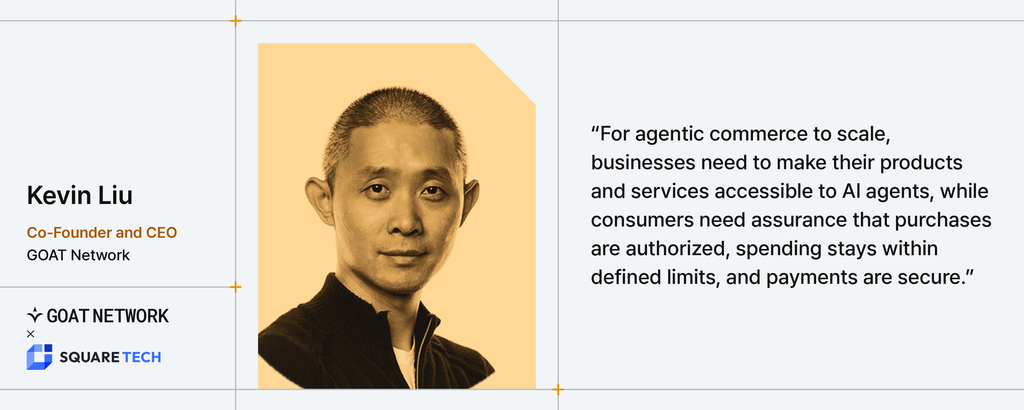
Kevin Liu, Co-Founder and CEO of GOAT Network, said: “The next evolution of AI agents goes beyond understanding user requests to making purchases on their behalf. For agentic commerce to scale, businesses need to make their products and services accessible to AI agents, while consumers need assurance that purchases are authorized, spending stays within defined limits, and payments are secure. Through our collaboration with Square Tech, we aim to explore how these capabilities can support real-world commerce in South Korea.”

The companies intend to comply with all applicable South Korean laws and regulations, including the Electronic Financial Transactions Act, the Virtual Asset User Protection Act, the Foreign Exchange Transactions Act, and the Act on Reporting and Use of Certain Financial Transaction Information. Where necessary, they will work with appropriately licensed service providers to deliver the proposed services. Consumer-facing features will be introduced in phases, subject to legal and regulatory review.

About Square Tech

Square Tech was founded in 2002 and is based in Hwaseong, Gyeonggi Province, South Korea. The company develops and produces LTCC (Low Temperature Co-fired Ceramic) components and substrates used in the telecommunications, defense, and automotive industries, and has been listed on KOSDAQ since 2016. Through its Digital Solutions business, Square Tech is expanding into digital asset payments. The company is developing a stablecoin payment program for foreign tourists with Lordsystem, a South Korean mobile identity verification company, and is pursuing cooperation with Anchorage Digital, a US-based institutional digital asset platform, on institutional digital asset infrastructure.

About GOAT Network

GOAT Network is Bitcoin-secured infrastructure for agentic commerce, connecting businesses, consumers, developers, and AI agents. Its core product, GOAT Flow, makes products and services discoverable, understandable, and purchasable by AI agents, while GOAT AgentKit provides developers with tools to build agent-native applications. GOAT Network’s core infrastructure is developed by DAC Labs, a research and engineering company specializing in blockchain infrastructure, zero-knowledge technology, and AI agent systems.


Disclaimer: This is a sponsored press release. Readers are encouraged to perform their own due diligence before acting on any information presented in this article.

This post Square Tech and GOAT Network Sign MOU to Advance AI Agent-Powered Stablecoin Payments in South Korea first appeared on Bitcoin Magazine and is written by Bitcoin Magazine.

The Crypto Travel Rule Explained: What VASPs Need to Know

Crypto transfers move in seconds. Compliance data now has to move with them.

Send a bank wire and you send more than money. Somewhere in that message sits the name of the person paying and the person being paid.

Crypto never really worked that way. For a long time, a wallet address was about all you got.

That’s changing, and faster than many teams expected. The reason is the Crypto Travel Rule. Crypto businesses now have to tell each other who is sending and who is receiving when they move digital assets between themselves.

For exchanges, custodians, payment platforms and fintechs with a crypto feature, this isn’t something to plan for later. It’s already part of the plumbing.

What does it actually ask for, then, and why does it give teams so much trouble?

What Is the Crypto Travel Rule?

The rule traces back to FATF Recommendation 16. That global standard was written for plain old wire transfers.

Then in 2019, the Financial Action Task Force (FATF) applied it to virtual assets as well, and to Virtual Asset Service Providers (VASPs): exchanges, custodial wallet providers, brokers.

When one VASP sends crypto to another, the originator and beneficiary details have to “travel” with it, immediately and securely.

Worth saying clearly: the rule isn’t there to stop crypto transfers. It’s there to make them traceable, the way regulated fiat payments already are.

What Information Has to Travel?

Details differ by country. FATF guidance generally asks for the originator’s name, their account number or wallet address, and one extra identifier: a physical address, national ID number, customer ID, or date and place of birth.

On the receiving side, it’s the beneficiary’s name and their account number or wallet address.

FATF suggests a de minimis threshold of USD/EUR 1,000. Above that, the full data set should be collected and shared. Below it, a reduced set still applies, so small transfers don’t get a free pass.

Thresholds Are Not the Same Everywhere

Here’s where it gets messy. Each jurisdiction is free to implement the rule its own way.

A few examples:

  • United States: a USD 3,000 threshold applies to certain transfers under Bank Secrecy Act rules
  • European Union: Regulation (EU) 2023/1113 has applied since 30 December 2024. If an EU crypto asset service provider is involved, originator and beneficiary information is required, whatever the amount
  • Self-hosted wallets in the EU: over EUR 1,000, the provider has to check whether the customer really owns or controls that wallet

Serving several markets? Then one workflow rarely covers it. Usually you end up maintaining a few.

Why the Travel Rule Is Hard to Implement

1. The Sunrise Problem

Not every country has adopted the rule yet. The ones that have don’t all enforce it the same way.

That leaves a compliant VASP in an awkward spot. It may have to send data to a counterparty in a country where the rule doesn’t apply yet, or to one that simply can’t receive the data.

2. Counterparty Identification

Before any data goes out, a VASP needs to know who is on the other end. Is the destination wallet held by another VASP, or is it self-hosted?

Answering that usually means combining blockchain analytics and wallet attribution data with due diligence on the counterparty VASP. Sometimes it also means simply asking the customer to declare it.

3. Interoperability Between Protocols

Travel Rule solutions don’t all speak the same language.

Most of the industry has settled on IVMS101 as a common data standard. Even so, two VASPs on different Travel Rule networks can still have trouble swapping information cleanly. A shared format doesn’t automatically mean a shared pipe.

4. Self-Hosted Wallets

With a self-hosted wallet, there’s no second VASP waiting to receive anything.

Depending on the jurisdiction, a business may have to collect the information from its own customer, verify who owns the wallet, or run extra risk-based checks instead.

5. Data Protection

Travel Rule data is personal data. That part gets overlooked.

VASPs have to share it securely and still meet their data protection obligations. In practice, that puts encryption, access control and secure API integration right at the centre of the build.

Where the Industry Stands in 2026

There’s real progress. It’s just uneven.

FATF’s seventh Targeted Update on virtual assets, published in July 2026, puts some numbers on it:

  • 83% of surveyed jurisdictions (91 of 109) have passed Travel Rule legislation, up from 73% in 2025
  • Another 11 jurisdictions say implementation is under way
  • Almost half of jurisdictions with Travel Rule laws haven’t yet taken any related supervisory or enforcement action

Laws on paper, in other words, are running ahead of enforcement.

FATF also points out that most identified on-chain illicit activity now involves stablecoins. For payment businesses running on stablecoin rails, that ties Travel Rule compliance directly to how they move money every day.

What VASPs Should Build Into Their Infrastructure

A workable Travel Rule setup tends to include:

  • KYC and KYB data that’s ready to share
  • Counterparty VASP discovery and due diligence
  • Wallet screening and blockchain analytics
  • A messaging solution that supports IVMS101
  • Rules for missing or incomplete information
  • Self-hosted wallet verification workflows
  • Secure data storage and record keeping
  • Threshold logic for each jurisdiction

The point is to have compliance happen inside the transaction flow. Not as a manual review someone does after the money has already moved, because by then fixing a missing field is far harder.

The Future of Travel Rule Compliance

Stablecoin payments, on and off ramps, tokenized assets. All of it is drifting into mainstream finance, and the Travel Rule keeps dragging crypto infrastructure toward traditional AML frameworks.

A bank getting into digital assets will run into this. So will a fintech adding a crypto wallet, or a payment provider settling in stablecoins. Each ends up asking the same thing: can our systems share compliance data as fast as they move value?

In regulated crypto, the on-chain transfer is only half of it. The other half is the information that travels with it.

Build it in now and the later conversations get easier, with regulators, with banking partners, and when it’s time to expand.


The Crypto Travel Rule Explained: What VASPs Need to Know was originally published in Coinmonks on Medium, where people are continuing the conversation by highlighting and responding to this story.

I Sent Crypto to the Wrong Address and Nobody Could Help Me. Learn From My Mess (ERC-20 Explained)

Everyone tells you to buy an ERC-20 token. Almost nobody tells you what that means or how it goes wrong.

I remember staring at Ethers can at around 1 a.m., refreshing the page like it would change something. Green checkmark. Transaction successful. And my tokens, about $400 worth [YOUR DETAIL: amount and year], sitting in a contract that had no idea what to do with them.

I wrote to support. I posted on Reddit. A kind stranger explained, politely, that the money was gone. Not lost, not delayed. Gone.

That night I realized I’d been buying and sending “ERC-20 tokens” for months without knowing what the term meant. So I went and learned. This is what I wish somebody had told me first.

Image Generated by ChatGpt

ERC-20 is just a set of rules

That’s all it is. No mystery.

In 2015, Fabian Vogelsteller and Vitalik Buterin put forward a proposal for how tokens on Ethereum should behave. Before then, every project built its tokens however it liked, and a wallet that supported one coin might choke on the next. Think of a drawer full of chargers that all almost fit.

The ERC-20 rules fixed it. If a token follows them, any wallet or exchange on Ethereum can handle it without special code. The rules are six functions and two events. Check a balance, send tokens, see the total supply. And one slightly scary pair, approve and transferFrom, which let someone else spend your tokens. Hold that thought, because it comes up again below.

The reason this mattered so much is that it made launching a token almost embarrassingly easy. You didn’t need your own blockchain anymore. A developer with a free afternoon could write a small contract, deploy it, and have a coin that showed up in MetaMask by dinner. That’s how we got the 2017 ICO craze, and honestly, a lot of garbage along with the good stuff.

Today the big names you probably already hold work this way. Tether and USD Coin on Ethereum, Chainlink, Uniswap. When people say “the crypto ecosystem,” a big chunk of it is just contracts following this one old rulebook.

The approve button

Now the part that actually costs people money.

When you swap on a decentralised exchange, your wallet asks you to approve a token. You click it. Everybody clicks it. I did for a year without thinking.

What you’ve done is give a smart contract permission to take tokens out of your wallet. And many apps ask for an unlimited amount by default, so you never have to approve again. Convenient. Also, a loose key under the doormat.

If that app gets exploited six months later, the attacker doesn’t need your password. The permission you gave is still sitting there. A lot of “my wallet got drained, and I didn’t do anything” stories are exactly this. They did do something. They clicked approve in March and forgot.

So I do three boring things now. I set a custom amount instead of unlimited when the wallet lets me. Every month or so I open Revoke. cash, look at the list of contracts I’ve approved, and cancel the ones I’m not using. And I keep a second wallet for experiments, so the one holding real savings never touches a sketchy site.

Ten minutes. Genuinely worth it.

Back to my $400

Here’s what happened to me, and it’s baked into the standard itself.

The transfer function in ERC-20 doesn’t check whether the receiver can handle tokens. It subtracts from your balance, adds to theirs, and moves on. If you send tokens to a regular wallet, fine. If you send them to a smart contract that wasn’t built to receive and return them, they sit there forever, because the contract has no function to send them back out.

Developers have complained about this for years. Over time, huge amounts of tokens have ended up stranded in contracts this way, and nobody can touch them. Newer standards like ERC-223 tried to patch it. They didn’t take over, because by then the whole industry was built around ERC-20. Wallets, exchanges, lending apps. Replacing it would be like trying to replace the QWERTY keyboard. Flawed, familiar, and not going anywhere.

There’s a cousin of my mistake that catches even more people: the wrong network. USDT exists on Ethereum, Tron, and other chains, and the addresses can look similar. Send it over the wrong network to an exchange that doesn’t support it and you can be in for a long, painful support ticket, or no recovery at all. Always check which network you’re sending on, and send a tiny test amount first. I know it feels silly. Do it anyway.

Before you buy any ERC-20 token

Here’s something that surprised me. Calling a token “ERC-20” says nothing about quality. Anyone can make one in a few minutes, for free, with no approval from anyone. A scam coin and a serious project use the same standard.

So I run a short check every time.

First, the contract address. Scammers copy the name and logo of real tokens, and fake versions pop up constantly. I get the address from the project’s official site or Coin Gecko, never from a reply under a tweet.

Second, who owns the supply? Etherscan has a holders tab. If three wallets own 80% of everything, those three can crash the price whenever they feel like it. Not always a scam, but it should make you think.

Third, whether the code is verified on Etherscan and whether a known firm audited it. An audit isn’t a guarantee. Plenty of audited projects have still been hacked. But a big project with neither? I walk away.

I’m not a financial advisor, and this isn’t financial advice. It’s just the checklist I wish I’d had at 1 a.m. staring at that checkmark.

What this taught me

I used to think crypto was either genius or fraud, depending on who was shouting. ERC-20 changed my mind a bit. It’s a tool. A clever, simple, slightly flawed tool that lets anyone create digital money without asking permission.

That freedom is the whole appeal, and it’s also exactly why nobody is going to save you when you slip. The code does what it says, not what you assumed it said. No one picks up the phone.

You don’t have to become a developer. You just have to know what you’re clicking, and slow down for a few seconds before you do.

I paid $400 to learn that. If this post saves you the tuition, good.

Have you ever been burned by an approval or a wrong-address transfer? Tell me in the comments. Somebody scrolling by might dodge the same hole.


I Sent Crypto to the Wrong Address and Nobody Could Help Me. Learn From My Mess (ERC-20 Explained) was originally published in Coinmonks on Medium, where people are continuing the conversation by highlighting and responding to this story.

I Ignored Web3 for Years. One Question Finally Made It Click

What Web3 actually is, without the jargon, the cartoon monkeys or the “to the moon” nonsense.

Every time someone said “Web3,” I zoned out.

Wallets. Gas fees. DAOs. Every explanation came with three more explanations I hadn’t asked for, and the person explaining usually had a cartoon ape as their profile picture. Not a great look.

Then a friend who works in payments watched me nod along for the tenth time and said, “Stop thinking about the tech. Just ask who owns what.”

That’s it. That’s the whole thing. I wish someone had said it to me in 2021.

Image Generated by ChatGpt

Two internets down, one to go

Web1 was a library. You walked in, read something, walked out. Late 90s, early 2000s. Somebody built the page and you looked at it.

Web2 is the one you’re on now. You can post, comment, upload, sell, review. Instagram, YouTube, Amazon. And it’s great, genuinely. But somewhere along the way the deal changed. You make the stuff. They hold the keys.

Web3 is the idea that you could read, write and own. The last word is the one doing all the work.

Quick test

Think about something you’ve built online. A following, a channel, a gaming account you’ve put hundreds of hours into.

Who can switch it off?

Not you. I know people who’ve lost accounts to a wrong automated flag, then spent weeks pinging a support form that answered with a template. Weeks without income, waiting on a reply from something that isn’t even a person.

Web3 is a bet that this setup is a design choice, not a law of nature. What if your account and your money and your stuff were with you, and the apps just plugged in?

What’s under the hood

It sounds complicated and it mostly isn’t. Four pieces.

Blockchain. A shared record book. Thousands of computers each hold the same copy. Somebody writes “Priya sent Tom five euros,” every copy updates, done. To fake an entry you’d need to fool most of them simultaneously, which is why nobody needs a bank to vouch for the book.

Wallet. Your account, except no company holds it. You hold a private key. Think front door key. Lose it and there’s no locksmith and no “reset password” link. Some people hear that and feel free. Others feel sick. Both reactions make sense to me.

Token. A digital item recorded on a blockchain. Could be money, a ticket, a membership, a piece of art. It sits in your wallet, so nobody can quietly take it back.

Smart contract. A small program that runs on the blockchain and does what it was told. Payment lands, item gets released. No middleman. Which is lovely until the code has a bug, because then there’s nobody to phone.

NFTs, DeFi, DAOs, all the names you keep hearing: those are just these four stacked in different combinations.

Picture a musician

She uploads a track to a streaming platform. The platform decides what a play is worth. Money arrives weeks later, after the label and the distributor each take a bite. If the platform changes the rules, she adapts or leaves.

Now imagine the split is written into a smart contract. Each sale divides automatically between her, the producer and the co-writer, in the percentages they agreed to. Minutes, not months. Nobody emails anybody about a missing payment.

Is that real today? In small pockets, yes. Will it replace Spotify next year? No chance. But it shows you the shape of the idea, and once you see it it’s hard to unsee.

The scam part (I won’t skip it)

Skipping this is how people get hurt, so here goes.

Web3 has an ugly history. In 2021 and 2022 people paid silly money for NFT images, and most of those prices fell off a cliff. Loads of crypto projects were pure speculation. Some were just fraud. People lost savings, and that’s not a small thing.

My own view, and you’re free to disagree: the technology and the casino that grew around it are two different things. A lot of people came for the casino and called it Web3. The dot-com crash wiped out a pile of companies in 2000 and the internet is still around.

Still, I’m careful. My rules:

  • Guaranteed returns means a lie. Walk away.
  • Your seed phrase stays with you. No real support team will ever ask for it.
  • If I can’t say in one sentence how a project makes money, I don’t touch it.
  • Only money I could lose without crying. Dull advice. Still true.

Where it’s quietly going

Forget the memes. The serious work is in finance. Banks and institutions are testing tokenized assets, faster settlement and payments that carry their own rules. Cross-border transfers are slow and pricey today, and blockchain rails could change that. Central banks have been running experiments with digital versions of their currencies too.

Nobody tweets about settlement times. That’s partly why it’s easy to miss.

So, should you care?

Know it. Don’t obsess over it.

You don’t need to buy anything this week. You don’t need a wallet by Friday. But the question underneath all of this, who owns your digital life, isn’t going away. More of our work, money and identity moves online every year, and someone will answer that question with or without your input.

Knowing the basics is also just self-defence. The people who get burned are usually the ones who didn’t know what they were buying.

At a dinner party

If someone asks, try this: “It’s the idea of an internet where you own your accounts, your money and your stuff, instead of renting them from a few big companies.”

Good enough. Nod at the rest.


I Ignored Web3 for Years. One Question Finally Made It Click was originally published in Coinmonks on Medium, where people are continuing the conversation by highlighting and responding to this story.

What Are Stablecoins and Why Are They Becoming Important for Africans?

Receiving money from abroad, paying an international supplier, or getting paid by a foreign client should be straightforward. Yet, for many Africans, cross-border payments can involve high fees, currency conversion costs, delays, and limited payment options.

These challenges have increased interest in alternative ways to move money internationally. One option attracting attention is stablecoins, digital assets designed to maintain a relatively stable value.

Stablecoins like USDT and USDC are becoming part of conversations about remittances, digital payments, and international commerce.

Platforms such as SFx Money App support USDT and USDC transactions through its crypto wallet, alongside other international payment services.

Understanding how stablecoins work, where they may be useful, and what risks they carry can help Africans make more informed financial decisions.

What Are Stablecoins?

Stablecoins are digital assets designed to maintain a relatively stable value, often by being linked to a traditional currency such as the US dollar.

Unlike Bitcoin, whose market price can fluctuate significantly, stablecoins such as USD Coin (USDC) and Tether (USDT) aim to maintain a value close to one US dollar. However, their prices can fluctuate, and neither is entirely risk-free.

Stablecoins can be transferred between compatible digital wallets through blockchain networks. Depending on the network and service provider, this can offer an alternative to certain traditional payment processes.

However, stablecoins are not the same as money held in a bank account. Their reliability depends on factors such as the issuer, the arrangements supporting their value, redemption options, and market conditions.

Transfers may also involve network fees, platform charges, and conversion costs. Users must understand these factors before deciding whether stablecoins suit their needs.

Why Are Stablecoins Becoming Important In Africa?

  1. Cross-Border Payments

International payments support families, freelancers, and businesses across Africa. However, traditional transfers can involve intermediary charges, exchange-rate margins, processing delays, or restrictions depending on the countries and institutions involved.

Stablecoins offer another potential way to transfer digital value. Where compatible services are available, users can transfer stablecoins between supported wallets without relying entirely on conventional international banking processes.

This does not mean every stablecoin transfer is cheaper or faster. Network fees, platform charges, conversion rates, and the recipient’s ability to access the funds all affect the overall experience.

SFx Money App supports USDT and USDC transactions through its crypto wallet, alongside other international payment services.

2. Remittances and Family Support

Africans living abroad often send money home to helps families cover education, healthcare, housing, and other daily expenses.

Stablecoins helps with this by providing another option for transferring digital value to friends and loved ones. Recipients need to have access to compatible wallets and services to successfully receive and spend funds.

SFx offers suitable service to receive and convert these assets into local currencies for easy spending.

3. Opportunities for Freelancers and Businesses

African freelancers work with clients around the world, while businesses purchase software, equipment, and other services from international suppliers.

Receiving payments and settling invoices can be challenging when payment options are limited or currency conversion increases costs.

Stablecoins offer an additional way to receive or transfer digital value when both parties have access to compatible services.

SFx supports USDT and USDC transactions through its crypto wallet alongside other international payment services including foreign accounts like USD, GBP, EUR, AED, GHS, and TZS accounts.

How Do Stablecoins Fit Into Africa’s Digital Finance Future?

Stablecoins are part of a wider shift towards digital financial services, alongside mobile payments, digital wallets, and online banking.

For African markets, these developments may create opportunities to improve access to certain financial services. However, reliable internet access, suitable devices, identity verification, and access to conversion services can influence whether people can use these products effectively.

It is important to note that access to an app does not automatically remove every barrier to financial inclusion. Services must be accessible, practical, and appropriate for the people using them.

What Should You Know Before Using Stablecoins?

Stablecoins have potential benefits, but users should understand their risks before making a transaction.

Value Risk

Stablecoins can lose their intended value peg because of market conditions or concerns about the issuer and the arrangements supporting the asset.

Fees and Conversion

Network fees, platform charges, and exchange rates can reduce the amount ultimately received.

Scams and Security

Fraudulent websites, phishing messages, and compromised wallets can cause financial losses. Blockchain transactions are often difficult or impossible to reverse once confirmed.

Regulations

Digital asset rules differ across countries and may change over time. Users should understand the requirements that apply to their location and intended transaction.

Before transferring stablecoins, verify the asset and network, research the service provider, check the fees, and use appropriate security measures.

A Practical Checklist

Before using stablecoins for an international payment, ask yourself:

1. Does the service support the stablecoin and network I intend to use?

2. What are the total transaction and conversion costs?

3. How will the recipient access or convert the funds?

4. How can I protect my wallet and account?

5. What rules apply to this transaction?

These simple checks can help users avoid preventable mistakes and make more informed financial decisions.

What Do Stablecoins Mean For Africa’s Financial Future?

Stablecoins are not a complete solution to Africa’s payment challenges, but they are creating new possibilities for transferring digital value.

They offer families another way to receive money from abroad and give freelancers and businesses additional options for certain international transactions.

SFx Money App illustrates how supported stablecoin transactions can exist alongside other international payment services, giving users different options to explore according to their needs.

As digital finance continues to develop, the focus should not simply be on whether stablecoins will replace traditional money. It should be on where they provide practical value, who can benefit from them, and how their risks can be managed responsibly.

The future of cross-border payments will depend not only on new technology, but also on making financial services more accessible, transparent, and useful for the people who rely on them.


What Are Stablecoins and Why Are They Becoming Important for Africans? was originally published in Coinmonks on Medium, where people are continuing the conversation by highlighting and responding to this story.

Europe Finally Has a Euro Stablecoin Consortium. It Is Very Late.

37 banks, one MiCA rulebook, and the awkward question nobody in Brussels wants to answer about euro stablecoin yield.

Dark scoreboard graphic showing that 0.3% of every stablecoin dollar on earth is denominated in euros, with three stat panels: $900M total euro stablecoin market value, $300B total dollar stablecoin market value, and 37 European banks building one euro stablecoin.
Europe wrote the rulebook first. It is still waiting for the market.

The euro is the second most used currency on earth. It accounts for roughly 20% to 30% of global FX reserves, SWIFT traffic and trade flows.

Onchain, it is a rounding error.

About 0.3% of all stablecoin value in the world is denominated in euros. Almost all of the rest is dollars.

Europe noticed. Thirty-seven banks now sit behind a single euro stablecoin project. They are arriving at a market that was effectively decided three years ago.

Here is what the euro stablecoin MiCA picture actually looks like in October 2026, and the structural problem underneath it that very few people are saying out loud.

Why does the euro settle global trade but almost no stablecoins?

Start with the scoreboard:

  • Total euro stablecoin market value: about $900 million as of late September 2026, an all-time high
  • Total dollar stablecoin market value: roughly $300 billion
  • Euro share of the global stablecoin market: about 0.3%
  • Euro stablecoin growth over the last twelve months: roughly 100%

So euro stablecoins doubled. The entire category is still smaller than a mid-size lender’s overnight book.

Some of that growth was forced rather than earned. Europe’s crypto-asset service provider transition period closed on 30 June 2026, pushing unlicensed firms out of the EU market and consolidating whatever supply was left into the licensed names.

Bar chart of total euro stablecoin market value rising from $296 million in June 2025 to $674 million in June 2026, $810 million in August 2026 and a record $900 million in September 2026, with a note that dollar-pegged stablecoins sit near $300 billion.
Euro stablecoin market value, June 2025 to September 2026. Sources: CoinGecko, Token Terminal, Decta.

The market is also top-heavy. Circle’s EURC holds about 62.6% of euro stablecoin supply on its own. Societe Generale’s EURCV holds another 19.6%. Two issuers, 82% of the market.

That concentration is not a scandal. It is what a market looks like when almost nobody bothered to compete.

What is the euro stablecoin consortium, and who is actually in it?

The vehicle is Qivalis, an Amsterdam entity. The timeline matters more than the headline.

September 2025: nine banks announce a MiCAR-compliant euro stablecoin issuer under Dutch supervision, including ING, UniCredit, CaixaBank, KBC, Danske Bank, DekaBank, Banca Sella, SEB and Raiffeisen Bank International. (announcement)

December 2025: BNP Paribas joins and Qivalis is incorporated in the Netherlands with twelve founding members. (BNP Paribas statement)

March 2026: Fireblocks is selected for tokenization, wallet infrastructure and custody.

May 2026: twenty-five more banks join, including ABN AMRO, Rabobank, Nordea and Intesa Sanpaolo. Membership reaches 37 institutions across 15 countries.

September 2026: confirmation that the token will issue on public Ethereum rather than a permissioned bank network.

The design is deliberately conservative. Backed 1:1. At least 40% of reserves in bank deposits, the remainder in short-term euro-area sovereign bonds spread across countries to avoid concentration risk. Redemption available 24/7. (reserve structure detail)

Horizontal bar chart showing the Qivalis euro stablecoin consortium growing from 9 banks in September 2025, to 10 when BNP Paribas joined, to 12 founding members at incorporation, to 37 banks in May 2026, with a note that launch is targeted for the second half of 2026 on public Ethereum pending approval.
Qivalis membership growth, September 2025 to May 2026. Launch remains conditional on a Dutch e-money licence.

Thirty-seven banks. Fifteen countries. Zero tokens in circulation.

The e-money institution licence from De Nederlandsche Bank has not landed yet, and nothing ships until it does.

Does MiCA ban stablecoin yield? Article 50 in plain English

Yes, for issuers. This is the part most coverage skips entirely.

MiCA Article 50 prohibits issuers of e-money tokens, and the service providers distributing them, from granting interest to holders.

Article 50(3) closes the obvious loophole: any benefit tied to how long someone holds the token counts as interest. (legal analysis)

The intent is written into the regulation itself. Recital 46 states these tokens should function as a medium of exchange, not a store of value.

The practical effect is blunter than that. A regulated euro stablecoin earns on its reserve. The person holding it earns nothing.

Tether discontinued its euro token partly over this and the reserve custody rules.

Several platforms switched off stablecoin reward programmes for EU users on the day the rules bit.

So why would anyone hold a euro stablecoin that pays nothing?

This is the live question in Europe right now, and it is not a crypto-native complaint.

An April 2026 report from Blockchain for Europe argued that MiCA has produced a euro stablecoin segment that is safe but structurally uncompetitive. (report coverage)

The argument, compressed:

  • A euro bank deposit can pay a return. A MiCA euro stablecoin legally cannot.
  • Instant payments across European bank rails have improved, which weakens the pure payments pitch.
  • Reserve rules are stricter than other major jurisdictions, with 30% of reserves required in bank deposits and 60% for tokens designated significant.

The European Commission has since reopened a MiCA review, and the remuneration ban sits near the top of the reform list.

There is friction from the top as well. ECB President Christine Lagarde said in early May 2026 that stablecoins are not Europe’s best route to strengthening the euro’s international role, and cautioned against building euro counterparts to dollar-backed tokens. The central bank’s own answer, a digital euro, is not expected before 2029.

Read that back. Thirty-seven banks are building a euro stablecoin their central bank is lukewarm about, under a rule that stops it paying holders anything, three years ahead of a public alternative.

Meanwhile, dollar stablecoins solved the same problem without changing a single law.

Their issuers do not pay holders either. The yield simply lives somewhere else in the stack.

Two-column comparison diagram. The issuer lane shows a regulated euro stablecoin backed 1:1 with at least 30% of reserves in bank deposits that cannot pay holders anything for holding. The protocol lane shows an independent savings layer that is not an issuer, with a rate set in public by onchain governance and funded from protocol revenue.
MiCA Article 50 binds the issuer. It does not convert an independent protocol into one.

Where can stablecoin yield legally come from after MiCA?

Read the prohibition carefully. It binds issuers and the service providers distributing their tokens. It does not turn a separately governed protocol into an issuer.

That distinction splits the stack into two very different jobs:

  1. Issuance. Mint a token, hold the reserve, redeem at par. Heavily regulated and deliberately yield-free.
  2. Allocation. Decide what idle capital does next. Different function, different risk profile, different governance.

Europe has spent two years regulating job one. Job two is where capital actually decides whether to stay.

By most estimates, around 80% of global stablecoin supply is deployed into no source of yield at all.

What does the Sky Savings Rate actually pay out of?

Sky Ecosystem is a global savings and capital allocation network, and it is built around job two rather than job one. Here is the full architecture, but the short version runs in six steps.

  • USDS is the fully backed unit of account.
  • The Sky Agent Network, independent allocators including Spark, Grove, Obex and Osero, draws USDS liquidity under risk parameters set in public.
  • Each allocator pays a Base Rate on every USDS deployed, settled onchain monthly.
  • That revenue, plus Stability Fees and Peg Stability Module flows, accrues to Sky Protocol.
  • Sky Governance votes the Sky Savings Rate against that revenue.
  • Holders access the rate through sUSDS, the world’s largest yield-generating stablecoin.
Five-step flow diagram showing how the Sky Savings Rate is generated: USDS as the fully backed unit of account, the Sky Agent Network drawing USDS liquidity, protocol revenue from the Base Rate and fees, Sky Governance voting the rate onchain, and sUSDS as the access point to the rate.
The Sky Savings Rate is an output of a capital allocation system, not a promotional number.

Two consequences are easy to miss.

The rate is variable and set by Sky Governance, published live rather than promised in marketing.

You can check it, and every collateral position behind it, at financial.skyeco.com.

And an sUSDS holder is not a claimant on any single allocator, borrower or strategy.

If one allocator takes losses, its own risk capital absorbs them first, then the Surplus Buffer, before anything reaches the protocol level.

Why did Moody’s just rate a stablecoin protocol for the first time?

On 7 October 2026, Moody’s Ratings assigned Sky Protocol a B3 counterparty risk rating with a stable outlook. It was the first rating Moody’s has issued on any stablecoin protocol. S&P Global had already affirmed a B-. (Moody’s report)

Two agencies. Two separate teams. Two sets of criteria. Two independent conclusions. No other stablecoin protocol currently meets that bar.

The published numbers behind it:

  • $14.15B in total Protocol Collateral backing $11.48B in stablecoin supply
  • $123.79M in Gross Protocol Revenue in Q1 2026, the highest quarter on record
  • $33.29M in Net Protocol Surplus in Q2 2026, a fifth consecutive positive quarter
  • sUSDS supply up 149% year on year to $5.52B
  • Galaxy added $100M of sUSDS to its corporate treasury in September 2026 and approved it as institutional loan collateral
Six-panel statistics card for Sky Protocol showing $14.15B in total Protocol Collateral backing $11.48B in stablecoin supply, $123.79M in Gross Protocol Revenue in Q1 2026, sUSDS growth of 149% to $5.52B, Moody’s B3 and S&P Global B- ratings, $33.29M in Net Protocol Surplus in Q2 2026, and $100M of sUSDS added to Galaxy’s treasury.
Every figure here is checkable against a public dashboard rather than a press release.

What Europe still has to build

Qivalis is a serious project. Getting thirty-seven banks to agree on anything is genuinely hard, and a regulated euro settlement token has real uses in treasury operations and cross-border payments.

But a payment rail is not a savings layer. And right now Europe has no legal route to build the second one inside the issuer.

Does Europe want euro stablecoins that move, or euro stablecoins that people hold?

The rulebook has only answered the first half of that question. The second half is still open, and it is the half that decides whether the euro ever gets off 0.3%.

Dollar stablecoins did not win on regulation. They won because once the token existed, there was somewhere obvious for it to go next. Europe has built the token. The next part is still missing.

Your turn. Should the next MiCA revision lift the remuneration ban on euro stablecoins, or does paying holders quietly turn a payment token into a deposit substitute Europe cannot afford? Drop your take below. I reply to every serious argument.


Europe Finally Has a Euro Stablecoin Consortium. It Is Very Late. was originally published in Coinmonks on Medium, where people are continuing the conversation by highlighting and responding to this story.

Twenty-One Banks Are Building One Stablecoin Together. Why Not Twenty-One Stablecoins?

There are already 195 stablecoins and 152 issuers. Two of them hold 85% of the money. The banks ran that math before they ran the press release.

Dark infographic showing twenty-one small grey coin outlines converging into a single large lime-outlined coin marked with the number one, labelled shared coin, with a footer reading 195 stablecoins live, 152 issuers, 85.9% held by two of them.
Twenty-one issuers, one shared dollar. The consortium did the liquidity math first.

On 1 September 2026, twenty-one of the largest financial institutions on earth agreed to build one coin.

Bank of America. Citi. Goldman Sachs. UBS. Deutsche Bank. Santander. BBVA. MUFG. Wells Fargo. Fidelity. Names that compete on everything, lining up behind a single dollar token.

They did not announce a company name. Or a CEO. Or a blockchain. Or who owns what.

What they announced was the shape of the thing. One coin. Not twenty-one.

That choice is the real story, and almost nobody wrote about it.

Any one of these institutions could have shipped its own dollar token this quarter. They chose not to. Liquidity does not split twenty-one ways.

Why one bank consortium stablecoin instead of twenty-one competing ones?

Because a stablecoin is not a product. It is a network.

The market already ran this experiment, at full scale, with real money. As of 1 October 2026 there were 195 stablecoins from 152 issuers across 47 blockchains, about $300.9 billion in total supply, and 308.4 million holder addresses.

Out of all of that, two names hold roughly 85.9%. No third issuer clears $10 billion.

Horizontal stacked bar chart of stablecoin market share showing USDT at 61 percent, USDC at 24.9 percent and all other issuers at 14.1 percent, with supporting figures of 300.9 billion dollars in total supply, 308.4 million holder addresses and no third issuer above 10 billion dollars.
195 stablecoins exist. Two of them are the market. That is the case for one shared coin, in one chart.

That is the whole lesson in one line:

  • A dollar token is only useful where it is accepted
  • Acceptance follows depth, not branding
  • Twenty-one competing bank coins would be twenty-one shallow pools
  • One coin with twenty-one distribution networks behind it is a completely different animal

Banks understand shared rails better than anyone. Correspondent banking, card schemes, CLS, SWIFT.

Every one of them is a case of rivals agreeing to pool the boring layer so they can compete on the layer above it.

The consortium is not being generous. It is being correct.

What the bank consortium stablecoin actually commits to

Strip out the commentary and here is what was on the page:

  • A jointly owned company to be formed in H2 2026, subject to closing conditions
  • A USD stablecoin targeted for market launch in H1 2027
  • A euro version identified as the next priority, then other G7 currencies
  • Reserves in cash and short-term Treasuries, built around the GENIUS Act and MiCA
  • Members spanning North America, Europe, East Asia, the Middle East and Africa
Horizontal timeline of the bank consortium stablecoin, marking October 2025 when ten global banks began exploring a reserve-backed digital payment asset, 1 September 2026 when twenty-one institutions committed, H2 2026 for company formation and H1 2027 for the targeted USD launch, with a note that the company name, CEO, ownership split and blockchain are still unnamed.
Eleven months from ten banks exploring to twenty-one committing. Still no company name.

It grew out of something smaller. In October 2025, ten global banks said they were exploring a reserve-backed digital payment asset on public blockchains. Eight of those ten are still in.

Read the verb carefully, though. They committed to form a company. Nothing has launched.

The GENIUS Act question nobody in the press release answers

Section 4 of the GENIUS Act is blunt. A permitted payment stablecoin issuer cannot pay the holder any form of interest or yield, in cash, tokens or anything else, purely for holding the token.

So picture the finished product in 2027.

A corporate treasury holds the consortium dollar. The reserves sitting behind it are earning in Treasury bills. The treasury holding the token earns zero.

Two-row flow diagram. The top row shows a GENIUS-compliant issuer path where reserves in cash and Treasury bills generate income that accrues to the issuer and the token holder receives nothing under GENIUS Act Section 4. The bottom row shows the Sky Protocol path where USDS liquidity goes to Sky Agents who deploy capital, generating protocol revenue that funds the Sky Savings Rate paid via sUSDS.
Same dollar, same rulebook, two very different destinations for the yield.

That is not an oversight. Congress wrote it that way on purpose, so a payment token would not quietly turn into a competitor for bank funding.

There is already a well-worn workaround, and it is worth knowing about. Issuers cannot pay holders, but they can pay distribution partners, and nothing stops those partners from paying users.

Circle discloses that it passes a share of its reserve income to Coinbase. The money still reaches the end holder.

It just takes a detour through someone else’s balance sheet, and picks up someone else’s incentives on the way.

The consortium is building a very good dollar. It is not building a reason to hold one.

Here is the part that matters for anyone planning around 2027. The restriction names issuers. It does not name third parties. Which means the yield question does not disappear.

It just moves one layer out, to whoever is willing to put that capital to work and take responsibility for how.

Six of the twenty-one are hedging their bet, and that tells you plenty

Six consortium members, among them Citi, Bank of America, Wells Fargo, PNC, Santander and TD, are also backing The Clearing House’s shared tokenized deposit network. Seventeen institutions, announced in June, same H1 2027 target.

Two competing designs. Overlapping backers. Identical deadline.

Tokenized deposits stay inside the banking system as bank liabilities. A GENIUS stablecoin is a separate instrument with segregated reserves.

Nobody at that table knows which one wins, so several of them bought tickets to both.

And they are not the only ones racing:

  • Open USD, the Visa and Stripe-backed effort with around 140 companies behind it, has been live since July
  • Thirty-nine state bankers associations are building BankChain Alliance on a similar 2027 timeline
  • Qivalis and the Eurøpe Consortium are chasing MiCA-compliant euro stablecoins

Almost everyone is building the issuance layer. Very few are building the layer underneath it.

Issuance is the easy half. Capital allocation is the hard half.

Ask anyone who has run a treasury desk. The hard question was never how to hold the dollar. It was always what the dollar is doing while you hold it.

Minting a fully backed token is an engineering problem with known answers.

Deciding where billions in collateral actually go, under limits anyone can audit, with a rate that holds up when conditions change, is a different kind of problem.

It is operational, it is continuous, and you cannot ship it once and walk away.

That second half is what Sky Ecosystem is built around.

Sky Protocol is a capital allocation network. Independent allocators, the Sky Agent Network, access USDS liquidity under risk parameters set in public by Sky Governance.

They deploy it across diversified strategies. The revenue those deployments generate flows back to the protocol.

The allocators are operating businesses, not line items on a slide. Spark runs lending markets. Grove runs institutional credit.

Figures as shown on the Sky Ecosystem dashboard at the time of writing:

  • $14.15 billion in Protocol Collateral
  • $11.48 billion in stablecoin supply
  • Roughly $1.23 of collateral sitting behind every dollar in circulation
Bar comparison showing Sky Protocol Collateral of 14.15 billion dollars against stablecoin supply of 11.48 billion dollars, with callouts of 1.23 dollars of collateral behind every dollar of supply and 149 percent sUSDS supply growth in the year to Q2 2026.
Overcollateralised and published in public. Both numbers are checkable on the dashboard right now.

You can check all three yourself. That is the point of publishing them.

Why sUSDS and the Sky Savings Rate sit on the other side of that gap

USDS is the base unit. Fully backed, converts 1:1, deep liquidity, no drama.

sUSDS is where the Sky Savings Rate lives. Hold sUSDS and the position accrues the governance-set rate programmatically. No lockups, no minimums, redeem back to USDS whenever you want.

The distinction worth holding onto: the rate is not a promise from an issuer. It is the output of an allocation network that has to keep working for the number to hold.

And institutions have started treating it that way.

On 23 September 2026, Galaxy Digital (Nasdaq: GLXY) put $100 million of sUSDS on its balance sheet and approved sUSDS as eligible collateral across an institutional trading business carrying a $1.4 billion average loan book and more than 1,600 counterparties.

Four stat cards covering the Galaxy Digital and sUSDS announcement of 23 September 2026: 100 million dollars of sUSDS added to Galaxy’s balance sheet, a 1.4 billion dollar average loan book where sUSDS is eligible collateral, a 500 million dollar warehouse lending facility provided by Grove, and more than 1,600 institutional trading counterparties reached.
What institutional adoption of a yield-generating stablecoin looks like in numbers, not adjectives.

The detail I keep coming back to: clients who post sUSDS against a loan keep accruing the Sky Savings Rate on the full position for as long as the loan runs. Collateral that does not go to sleep while it is pledged.

That relationship did not start there. Grove had already extended Galaxy a $500 million warehouse lending facility. Galaxy has since borrowed on Spark as well.

For context on the base underneath it: Sky Protocol entered Q3 2026 with $5.41 billion supplied through independent allocators and institutional tokenized funds, including anchor positions in BlackRock’s BUIDL and Janus Henderson’s JTRSY.

sUSDS supply closed Q2 2026 at $5.52 billion, up 149% year on year, on $107.35 million of Gross Protocol Revenue and $33.29 million of Protocol Surplus for the quarter.

What 2027 probably looks like

My guess is the consortium ships, roughly on time, and the coin is clean, compliant and boring in the best possible sense. Widely accepted, too. Twenty-one distribution networks is a serious advantage.

And on day one, its holders will start asking the question the GENIUS Act will not let the issuer answer.

If you are tracking this, watch the follow-on announcements rather than the launch. Which chain they pick. How custody is handled.

Whether the euro version slips. Those three will tell you more than any launch-day release.

By 2027 there will be no shortage of dollar tokens. There will be a shortage of places to put them.

So, back to the title.

Twenty-one separate bank stablecoins would have been twenty-one failures. One shared coin is the right call, and the people who made it know exactly why.

But a shared dollar with no allocation engine behind it is half a product. The other half already exists, it is already audited in public, and it is already on a Nasdaq-listed balance sheet.

Which half do you think decides 2027: who issues the dollar, or who puts it to work? I would genuinely like to be argued with in the comments.


Twenty-One Banks Are Building One Stablecoin Together. Why Not Twenty-One Stablecoins? was originally published in Coinmonks on Medium, where people are continuing the conversation by highlighting and responding to this story.

Your Payment Page Is Probably Breaking the Law. Here’s the PCI DSS Mistake Nobody Tells You About

If you take card payments, even five a day, read this before your bank emails you first.

The mistake is simple. You think your payment provider takes care of PCI DSS for you.

It doesn’t. Some of it, sure. But if your checkout page looks like most checkout pages, a big chunk of the responsibility is still sitting on your desk.

[Add two or three sentences of your own here. A time you or a client assumed “Stripe handles it” and found out otherwise. Real beats polished.]

I’ll get to the gap in a second. First, the title.

Image Generated by ChatGpt

Is it actually illegal?

Mostly no, and I’d rather say so now than have someone say it for me in the comments.

PCI DSS isn’t a federal law. The card brands wrote it, and you agreed to it when you signed your merchant agreement, probably without reading page nine. Break it and your bank can fine you, raise your fees, or close your account.

But a few US states have pulled PCI DSS into their own law. Nevada is the best known. Minnesota and Washington have versions too. And after a breach, nobody asks whether the standard was legally binding. They ask whether you followed it. A lawyer on the other side will enjoy that question.

So “breaking the law” is a little strong, and “breaking your contract” is accurate nearly everywhere. Either way, you don’t want to be there.

Who’s living on your checkout page?

Open your checkout page. Right-click, view source, and search for “script.”

Go on. I’ll wait.

Analytics. A chat widget. Maybe a heatmap tool somebody trialled once. A font library. A retargeting pixel from a campaign in 2022 that nobody turned off. Every one of those is code written by a stranger, running in the same window where your customer types a card number.

Attackers love this. It’s called web skimming, and you’ll also see the name Magecart. They don’t bother attacking your bank. They compromise one small third-party script, add a few lines of JavaScript, and copy card details as people type. Your site looks fine. Your processor sees normal transactions. It can go on for weeks.

This is the gap. Your provider secures its side. It has no control over the fifteen scripts you invited onto your side.

What changed, and why old blog posts will mislead you

The old version, 3.2.1, was retired in March 2024. Version 4.0 replaced it, and a batch of requirements that started out as “best practice” became mandatory on March 31, 2025. The current release, 4.0.1, only clarifies wording. It doesn’t relax anything.

Two of the new rules hit online sellers hardest.

Requirement 6.4.3 says you need an inventory of every script on your payment pages. You have to confirm each is authorized and write down why it’s there.

Requirement 11.6.1 says you need a way to detect unauthorized changes to those pages and be alerted when something shifts.

So if nobody on your team can name every script on your checkout, you have a compliance problem and a security problem. They happen to be the same problem, which is almost funny.

What it costs when it goes wrong

The card brands don’t bill you directly. They penalize your acquiring bank, and the bank passes it along, usually with a little extra for its trouble. Figures commonly reported run from about $5,000 to $100,000 a month of non-compliance, depending on your size and how long it drags on.

That’s the fine. A real breach is its own bill: forensic investigators, reissuing cards, lawyers, notifying customers, and the quiet loss of people who just stop buying from you.

Target in 2013 is the example everyone uses, because it’s true. Attackers got in through a third-party vendor (an HVAC contractor, of all things) and left with around 40 million payment card records. A company that size absorbs it. A small shop usually can’t.

What to do this week

None of this is glamorous. That’s sort of the point.

Start by asking your bank or processor which Self-Assessment Questionnaire applies to you. It depends on how card data touches your business, and plenty of merchants fill out the wrong one. They end up compliant on paper and exposed in practice.

Then shrink your scope. If you use a fully hosted payment page or tokenization, card numbers never touch your servers, and that’s less for you to secure and explain. Do an audit of your payment page scripts while you’re at it, and delete anything that isn’t earning its spot. Your heatmap tool doesn’t need to sit next to the card field.

Never store the CVV after authorization. Ever. Turn on multi-factor authentication for any account that can reach card data. If you’re required to run quarterly external scans, use an Approved Scanning Vendor and put the dates in your calendar, because PCI DSS is yearly, not once and done.

And write a security policy. One page is fine. One page your team has read beats sixty pages nobody opened.

The honest takeaway

I don’t think PCI DSS exists to make your life miserable, though it can feel that way around audit time. It exists because card fraud is automated and endless, and small merchants are favorite targets because they assume nobody’s watching.

The businesses that stay out of trouble mostly aren’t the ones with big security budgets. They just ask three dull questions early. What touches card data? Who has access to it? What’s running on my checkout page?

Ask them this week. Your future self will be grateful, and so will your bank.

Do you know which SAQ applies to your business? Tell me in the comments. [Add your own honest answer here.]

This is general information, not legal or compliance advice. Confirm your requirements with your acquiring bank or a Qualified Security Assessor.


Your Payment Page Is Probably Breaking the Law. Here’s the PCI DSS Mistake Nobody Tells You About was originally published in Coinmonks on Medium, where people are continuing the conversation by highlighting and responding to this story.

Who Holds Your Keys? Inside VASP Crypto Asset Custody

How Virtual Asset Service Providers safeguard assets and what every investor should ask before trusting one.

Imagine waking up to find your exchange has frozen withdrawals. Your balance still shows on the screen. The coins behind it are gone. It sounds dramatic. It has happened more than once in crypto’s short history. The lesson is simple and painful: owning crypto means little if you cannot prove who controls the keys.

That is where the Virtual Asset Service Provider or VASP enters the story.. At the heart of every VASP sits one critical function: custody.

ChatGPT Generated Image

What Exactly Is a VASP?

The term comes from the Financial Action Task Force, the standard-setter for anti-money-laundering rules. A VASP is any business that on behalf of others does one or more of the following:

  1. Exchanges between crypto and fiat currency
  2. Exchanges between one or more forms of crypto
  3. Transfers of virtual assets
  4. Safekeeping or administration of virtual assets
  5. Financial services tied to token offerings

Custody is the one on that list yet it carries the most weight. A custodian does not just move coins. It holds the keys that make those coins spendable.

Why Custody Is the Part

Banks guard money behind vaults, insurance and decades of regulation. Crypto has none of that by default. A private key is a string of characters and whoever has it controls the assets. There is no password reset and no chargeback.

So a VASP offering custody faces three threats:

  1. External hacks: attackers target hot wallets connected to the internet.
  2. Insider risk: a single employee with access can become a single point of failure.
  3. Operational mistakes: lost keys, poor backups or sent-to-wrong-address errors are permanent.

How Professional Custody Actually Works

Serious VASPs do not rely on one trick. They layer defenses, like a bank vault with several locks.

  1. Storage: the majority of assets sit offline in hardware devices away from internet-connected attackers.
  2. Hot wallets with limits: only a small float stays online to serve withdrawals.
  3. Multi-signature or MPC: no single person or device can approve a transaction
  4. Segregation of client assets: customer funds are kept separate from the company’s money.
  5. Regular audits and proof of reserves: independent checks confirm that assets truly exist.

Think of multi-signature like a deposit box needing three keys held by three different people. Stealing one key achieves nothing.

The Regulatory Side: Rules Are Catching Up

Regulators worldwide treat custody as a licensed activity. While details differ by country common expectations are emerging:

  1. Licensing or registration with the financial authority.
  2. KYC and AML controls to verify customers and monitor activity.
  3. The FATF Travel Rule, requiring sender and receiver information to accompany transfers.
  4. Clear disclosure of how assets are held, who controls keys and what happens in insolvency.
  5. Governance and risk management, including incident response and business continuity plans.

Frameworks such as the EU’s MiCA regulation and licensing regimes in Singapore, Dubai and Hong Kong have raised the bar. In India VASPs must register with the Financial Intelligence Unit. Follow AML obligations and the broader regulatory picture continues to evolve.

Custodial vs. Non-Custodial: A Quick Comparison

  1. Custodial (VASP holds keys): recovery, customer support and compliance but you trust a third party.
  2. Non-custodial (you hold keys): control and no counterparty risk but you carry all responsibility.

Neither is universally better. A long-term holder with a portfolio might split assets across both while a business handling client money often needs a regulated custodian.

A Lesson From the Wreckage

When several major platforms collapsed in years a pattern surfaced. Customer assets had been mixed with company funds internal records were weak. Nobody outside the firm could verify balances. Users learned that an account balance is merely a promise, not proof.

Those failures shaped today’s rules. Segregation, audits and transparency are no longer extras. They are the price of entry for any VASP that wants to be trusted.

A Tale of Two Investors

Consider Asha and Rohan who each bought the amount of crypto in the same week. Asha chose a VASP that published reserve reports used multi-signature cold storage and kept customer funds segregated. Rohan chased a platform promising returns with no license no audit and vague answers about where coins were stored.

Months later both platforms faced a security incident. Asha’s provider froze withdrawals briefly investigated and restored access because most assets were safely offline. Rohan’s platform went silent. His balance still displayed on the app. The funds were gone.

Same market, same timing, different outcomes. The difference was not luck. It was custody.

Your Due-Diligence Checklist

Before parking your assets with any VASP ask these questions:

  1. Is the provider licensed or registered in a jurisdiction?
  2. What percentage of assets is held in storage?
  3. Does it use multi-signature or MPC wallets?
  4. Are client assets legally segregated from company funds?
  5. Does it publish audits or proof of reserves?
  6. Is there insurance and what does it cover?
  7. What is the withdrawal and incident-response policy?

If a provider cannot answer these clearly treat that silence as your answer.

What the Future Holds

Custody is evolving quickly. Institutional demand has pushed banks and asset managers into the space bringing stricter standards with them. Expect to see:

  1. tokenization real-world assets, such as bonds and property needing the same safekeeping.
  2. Smarter key management, using hardware security modules and advanced MPC.
  3. Real-time transparency with on-chain proof of reserves replacing reports.
  4. Global rule alignment, reducing gaps between jurisdictions.

The Bottom Line

Crypto promises freedom but freedom without security is fragile. VASP custody sits at the intersection of technology, regulation and trust. When done well it lets people use assets without becoming experts in key management. When done poorly it turns a balance into an illusion.

So before you ask what a platform can earn you ask what it can protect. Verify licenses, demand transparency understand where your keys live and never put everything in one place. The old crypto saying still holds: not your keys, not your coins. A trustworthy VASP simply earns the right to hold them for you.


Who Holds Your Keys? Inside VASP Crypto Asset Custody was originally published in Coinmonks on Medium, where people are continuing the conversation by highlighting and responding to this story.

Stablecoin Card Spending Tripled in a Year and Nobody Called It a Trend

Monthly volume went from $306M to $1.22B. Everyone wrote the payments story. Almost nobody wrote the balance story.

Dark navy title card reading “Tripled in a year. Nobody called it a trend.” above a rising yellow line chart of monthly stablecoin card spending, labelled from under $1 million in October 2023 to $1.22 billion a month in September 2026.
Monthly stablecoin card spending, October 2023 to September 2026.

Nobody writes a headline about a balance.

We write about the swipe. A coffee bought with USDC in Lagos. A ride paid in USDT in Sao Paulo. Those make good copy.

But a card is not a swipe. A card is a balance that occasionally gets smaller.

And over the last twelve months, the balances sitting behind stablecoin cards quietly turned into real money.

Quick answer, for anyone who searched “stablecoin card spending”: monthly stablecoin card spending hit $1.04 billion in July 2026, roughly triple the $306 million recorded a year earlier, and $1.22 billion by September. Cumulative tracked spending has passed $10.9 billion. Dollar-backed stablecoins fund about 70% of it. The whole category is still only around 0.07% of the global card market.

How Fast Did Stablecoin Card Spending Actually Grow?

Faster than the coverage suggested, and from a base so small that almost nobody treated it as a trend.

The tracked monthly numbers for 2026:

  • January: $574M
  • April: $768M
  • July: $1,038M, the first month above a billion
  • September: $1,224M, the third straight month above a billion

Three more figures worth holding onto:

  • Cumulative tracked card spending crossed $10.9 billion by late August 2026.
  • July alone carried more than 10 million individual card transactions.
  • Visa reported more than 160 stablecoin-linked card programmes live or in development as of June 2026.

Concentration matters here too. RedotPay alone generated $401.9 million of September volume, roughly 34% of the entire category, and says it now serves more than eight million users.

Ether.fi’s card did $100.3 million in July purchase volume, up from under $10 million two months after launch in 2025.

Bar chart of monthly stablecoin card spending through 2026, rising from $574 million in January to $1,224 million in September, with a dashed line marking the $1 billion a month threshold crossed in July.
Nine months, one threshold crossed. The shape is the argument.

Why Did Nobody Call Stablecoin Card Spending a Trend?

Two reasons, and both come down to where people were looking.

First, tripling from a small base does not feel like news. It feels like a chart that was always going to go up and to the right.

Second, the growth is not happening where crypto media usually files copy from.

StraitsX, a Visa partner that helps other firms launch cards, reported gross transaction value on its rails grew roughly 600% in lower-income markets between March 2025 and February 2026, against about 150% in wealthier ones. Binance said average volume on its Brazil card climbed 80% in a year.

John Timoney of Rain put it plainly at Consensus Miami: stablecoin cards are under 1% of global card spend today, but some Latin American markets could reach double-digit share soon.

And what people are buying is boring in the best way. Food and retail were the largest spending categories on StraitsX’s rails. Groceries, ride-hailing, food delivery. Not trades.

The adoption is real. It is just happening in markets where a dollar balance is a hedge, not a hobby.

Which Dollars Are Funding the Swipe?

Mostly two of them.

  • USDC funded 50.8% of July 2026 card volume, up from roughly 48% a year earlier.
  • USDT funded 20.3%, up from about 7%.
  • The euro-backed EURe, which was as much as 88% of tracked card spending in early 2024, has fallen below 2%.

That last line is the quiet structural change nobody wrote up. The category started as a European experiment and became a dollar product.

Horizontal bar chart showing the share of tracked card volume in July 2026: USDC at 50.8 percent, up from 48 percent a year earlier; USDT at 20.3 percent, up from 7 percent; everything else at 28.9 percent, down from 45 percent.
Two dollar stablecoins now carry seven out of every ten card transactions.

What Is a Stablecoin Balance Actually Doing Between Swipes?

Here is the part the payments coverage skipped.

Every card needs a funded balance behind it. You do not spend $1.22 billion a month without holding considerably more than that across millions of wallets, waiting.

So ask the obvious question. What is that money doing on the other 29 days of the month?

For most stablecoin balances, the honest answer is nothing.

  • A plain stablecoin carries a fixed $1.00 face value.
  • The reserve behind it usually sits in short-term government paper.
  • That return accrues to the issuer, not to the holder.
  • You hold the dollar. Somebody else holds the yield.

That was a tolerable trade when stablecoins were trading chips. It is a much stranger trade when stablecoins are your grocery money.

How Much Idle Stablecoin Capital Is Sitting Still Right Now?

Total stablecoin supply sat near $302.8 billion in September 2026. Card spending is running around $1.22 billion a month.

Run the division. Card spending is roughly 0.4% of outstanding stablecoin supply each month.

Analysts tracking stablecoin velocity have been blunt about the rest. Most supply is parked rather than circulating, and only a thin slice is held in yield-generating form.

Scale comparison of two circles. A large circle represents $302.8 billion of total stablecoin supply in September 2026; a very small highlighted dot represents $1.22 billion of monthly card spending, roughly 0.4 percent of supply.
The swipe is 0.4% of the story. The balance is the other 99.6%.

Yield-generating designs are still a thin slice of that base, under $5 billion by most counts, even though they drove more than half of net new stablecoin supply growth in the first quarter of 2026. Demand is clearly not the constraint. Distribution is.

The spending number is the one that gets written up. The 99.6% sitting behind it is the one that either compounds or does not.

What Is the Sky Savings Rate, and Why Should a Spending Balance Care?

This is where Sky Ecosystem fits into the picture.

Sky Ecosystem is a global savings and capital allocation network, and the mechanics are deliberately unglamorous:

  • USDS is the base stablecoin and the unit of account. You convert into it 1:1 through Peg Stability Modules, with no fees and no slippage.
  • The Sky Agent Network, a set of independent allocators including Spark, Grove, Obex and Osero, competes for access to USDS liquidity under risk limits published in advance.
  • Those allocators pay for that access, and their payments contribute to Sky Protocol revenue.
  • A share of that revenue funds the Sky Savings Rate, a variable rate set by Sky Governance rather than by borrowing demand in any one market.
  • sUSDS is how you hold it. Supply USDS, receive sUSDS, and the rate accrues programmatically. No lockup, no exit fee, redeemable on demand.

Sky Governance moved the Sky Savings Rate up in early October 2026, from 3.60% to 3.80%. It is variable by design, so check the live figure before quoting it anywhere.

sUSDS is currently the largest yield-generating stablecoin in the market. That matters less as a bragging right than as a liquidity fact.

Size is what lets a spending balance move in and out without slippage, which is the whole requirement for money you might need on a Tuesday.

Four-step flow diagram running from USDS, the base stablecoin, to sUSDS, the yield-generating version, to the Sky Savings Rate set by governance, to spending or redeeming with no lockup and no exit fee.
Four steps from a spending dollar to a rate. No issuer subsidy anywhere in the chain.
The dollar you spend from and the dollar that accrues do not have to be two different dollars.

Is Institutional Money Already Treating It This Way?

Yes, and it happened three weeks ago.

On 23 September 2026, Galaxy added $100 million of sUSDS to its corporate treasury and approved sUSDS as eligible collateral across its institutional trading business.

Read that as a signal rather than a press release. A trading desk does not put nine figures into a yield-generating stablecoin as an experiment.

It does it because the position stays liquid, the collateral is verifiable onchain, and the balance does something while it waits.

That is the same logic a card balance needs. Just with fewer zeros.

The numbers behind it are public rather than asserted: $14.15B in Total Protocol Collateral against $11.48B in stablecoin supply, all checkable on the dashboards before you believe a word of this post.

Data card with four statistics: a 3.80 percent Sky Savings Rate raised from 3.60 percent in early October 2026, $14.15 billion in Total Protocol Collateral, $11.48 billion in stablecoin supply, and $100 million of sUSDS held by Galaxy as of 23 September 2026.
Four figures, all published, all moving. Verify before you quote.

What Could Break This Argument?

I would rather name the friction than pretend it is not there.

  • The rate is variable. Sky Governance can vote the Sky Savings Rate down as easily as up.
  • Card programmes mostly do not settle in yield-generating tokens yet. Today the plumbing runs on USDC and USDT.
  • Regulation is live. A US Senate draft proposed banning yield on idle stablecoin holdings outright, and European regulators have been weighing their own restrictions.
  • Smart contract risk and governance risk do not disappear because a balance is convenient.
  • Cards are a convenience product. Nobody adds a conversion step to buy coffee, which is why this only works if the yield-generating token is the default balance rather than an extra one.

None of that changes the structural point. It means the structural point is contested, which is the only kind worth writing about.

RedotPay projects the category reaches $50 billion a year by 2028. Whether that number lands or not, the balance question gets louder either way.

Stablecoin card spending tripled and the category barely blinked.

My read is that the spending is the visible half. The balance behind it decides whether any of this is actually better than the card already in your pocket.

Two questions, and I will reply to every answer. Would you hold a spending balance in a yield-generating stablecoin, or does the extra moving part kill it for you? And if you used a stablecoin card this year, what did you actually buy with it?


Stablecoin Card Spending Tripled in a Year and Nobody Called It a Trend was originally published in Coinmonks on Medium, where people are continuing the conversation by highlighting and responding to this story.

A State-Owned Bank Just Issued Its Own Stablecoin. Ninety Banks Are Already On It.

The first live bank issued stablecoin settles in 400 milliseconds. By law, it also pays holders nothing. That gap is the whole story.

Dark statistical graphic showing 400ms in large type beside three figures: 90+ banks and credit unions live, $0 yield permitted to holders, and approximately 10,000 banks on the same platform.
Settlement moved to 400 milliseconds on October 1, 2026. The yield question moved somewhere else entirely.

On October 1, 2026, a bank founded in 1919 beat Wall Street to live stablecoin settlement.

Not JPMorgan. Not Citi. The Bank of North Dakota.

Its dollar token now moves money between more than 90 banks and credit unions in roughly 400 milliseconds.

Transfers that used to sit overnight in an ACH batch now clear before you finish this sentence.

And by law, it pays the people holding it nothing.

That second fact barely made the coverage. It is the more interesting one.

What Is a Bank Issued Stablecoin, and What Exactly Went Live in North Dakota?

A bank issued stablecoin is a dollar token minted by a chartered bank, fully reserved, built for settlement rather than return. Here is what shipped:

  • Fiserv’s digital asset platform went into production on October 1, 2026.
  • The first live use case is Roughrider Coin, the Bank of North Dakota’s dollar-backed stablecoin.
  • VersaBank, an OCC-chartered bank, issues the token and handles minting, burning, custody and reserves.
  • Fireblocks supplies the tokenization infrastructure. Transactions settle on Solana.
  • More than 90 participating banks and credit unions can use it for bank-to-bank transactions.

The detail worth noticing is not the chain. It is the distribution.

Those institutions reach Roughrider Coin through Commercial Center, the same Fiserv portal they already use for interbank money movement.

No new vendor, no new login, no migration project. Fiserv has said the platform can extend to its roughly 10,000 other bank clients.

A small irony: the Bank of North Dakota is the only state-owned bank in the US, founded in 1919 to serve farmers the big banks ignored.

A century later it runs the first production stablecoin rail in American banking.

Infrastructure rarely arrives with a launch party. It arrives through a login people already have.

Horizontal timeline of the bank stablecoin race: October 2025 Bank of North Dakota and Fiserv announce Roughrider Coin, September 2026 twenty-one banks commit to a joint USD stablecoin company, October 2026 Roughrider Coin goes live across 90 plus banks on Solana, H1 2027 consortium token targeted. A panel below shows $6.6 trillion in US transactional deposits flagged as exposed and Citi’s $182 billion to $908 billion displacement projection.
Twelve months from one state bank announcing a coin to twenty-one global banks committing to build one.

Why Are Twenty-One Global Banks Suddenly Racing to Issue a Dollar Token?

North Dakota is not an outlier. It is simply first.

On September 1, 2026, twenty-one financial institutions including Bank of America, Citi, Goldman Sachs, Wells Fargo, UBS and Deutsche Bank committed to forming a company to issue a US dollar stablecoin, targeting market in the first half of 2027.

Alongside that, JPMorgan, Bank of America, Citi and Wells Fargo are building a shared tokenized deposit network through The Clearing House, while the BankChain Alliance organises thousands of smaller lenders across 39 state banking associations.

None of this is curiosity. It is defence.

A US Treasury advisory council flagged the $6.6 trillion transactional deposit market as exposed to stablecoin substitution. Citi research puts potential deposit displacement at $182 billion to $908 billion by 2030.

When the thing eating your funding base is a token, you ship a token.

Why Can’t a Bank Issued Stablecoin Pay You Any Yield?

This is the part that gets skipped.

Section 4(a)(11) of the GENIUS Act says a permitted payment stablecoin issuer may not pay a holder any form of interest or yield, in cash, tokens or other consideration, solely for holding the coin.

Not capped. Not discouraged. Prohibited.

And it tightened. The OCC’s proposed rulemaking of February 25, 2026 added a rebuttable presumption that yield routed through an affiliate or related third party counts as the issuer paying it. The white-label workaround closed before most people noticed it existed.

So the design brief for every bank issued stablecoin sold to US persons is now fixed:

  • One-to-one reserves in high-quality liquid assets
  • Monthly attested disclosure
  • A licensed, supervised issuer
  • Zero yield to whoever holds the token

The issuer earns on the reserves. The holder earns faster settlement. That is the whole trade.

For a treasury desk pushing money between counterparties on a Tuesday afternoon, that is a perfectly good deal. For anyone holding a balance longer than an afternoon, it is a strange one.

The banking lobby fought hard for this outcome and said so publicly. A dollar that pays nothing does not pull deposits off a balance sheet.

Side by side comparison of a payment stablecoin and a yield-bearing instrument across purpose, reserves, disclosure, who earns the return and yield to the holder. The payment stablecoin column shows yield to the holder prohibited by statute. A footer quotes GENIUS Act Section 4(a)(11).
Same dollar, two rulebooks. One is built to move, the other is built to work.

So Where Does Stablecoin Yield Actually Come From Now?

Not from the payment token. It migrates to a separate instrument with a separate rulebook. The market has already voted, and the numbers are blunt.

In Q1 2026, total stablecoin supply added only about $8 billion, the weakest quarter since late 2023.

Yet yield-bearing stablecoins grew 22% and contributed more than half of all net supply growth, roughly $4.3 billion of it.

sUSDS alone added over $2.5 billion in that single quarter, more new capital than the next four yield-bearing tokens combined.

Sit with that. In a flat market, the category that legally cannot be a payment stablecoin is where the money went.

The wider shift has the same shape. Onchain real-world assets excluding stablecoins passed $33 billion in July 2026, roughly four times their early-2025 level. Capital is not just moving onchain. It wants a return once it gets there.

Chart showing yield-bearing stablecoins contributed more than half of all net stablecoin supply growth in Q1 2026, roughly $4.3 billion of about $8 billion total, with sUSDS alone adding more than $2.5 billion, more than the next four yield-bearing tokens combined.
Total stablecoin supply barely moved in Q1 2026. The yield-bearing slice did almost all the work.

How Does the Sky Savings Rate Work Across USDS and sUSDS?

Sky Ecosystem builds from the opposite end. Rather than a bank reserving dollars and keeping the return, the architecture separates the dollar from the yield. Three moving parts:

  • USDS is the base stablecoin. Fully backed, overcollateralized, and verifiable onchain rather than through a quarterly PDF.
  • The Sky Agent Network is a set of independent capital allocators, including Spark, Grove, Keel, Obex and Osero, that access USDS liquidity under risk parameters set in public and enforced automatically. Their activity contributes to aggregate Sky Protocol surplus.
  • The Sky Savings Rate is the rate Sky Governance sets from that surplus. You access it by holding sUSDS.

Supply USDS, receive sUSDS, and the position accrues continuously. No lockup, no maturity date, redeemable whenever you want.

Two things make the structure genuinely different. Every change to the Sky Savings Rate is proposed and voted onchain before it takes effect, in public. And holding sUSDS gives you access to the rate itself, not a claim on any single agent, borrower, pool or strategy.

The rate is variable and governance can move it either way. That is the honest framing, and it is published live on Sky Ecosystem’s own dashboards rather than asserted in marketing copy.

Four stage flow diagram showing how the Sky Savings Rate is funded: USDS as the fully backed base stablecoin, the Sky Agent Network of Spark, Grove, Keel, Obex and Osero deploying under public limits, returns accruing to aggregate Sky Protocol surplus, and the Sky Savings Rate set onchain by governance and accessed by holding sUSDS.
The dollar and the yield are two separate jobs, handled by two separate parts of the system.

Is Anyone Serious Actually Holding a Yield Bearing Stablecoin?

Fair question. Narratives are cheap, balance sheets are not.

  • Galaxy Digital (Nasdaq: GLXY) added $100 million of sUSDS to its corporate treasury in September 2026 and approved it as eligible collateral across a trading business carrying a $1.4 billion average loan book and over 1,600 counterparties.
  • Clients who post sUSDS against a Galaxy loan keep accruing the Sky Savings Rate on the full position for as long as the loan runs. The collateral does not stop working.
  • Sky Protocol entered Q3 2026 with $5.41 billion supplied through independent allocators into institutional tokenized funds, including anchor positions in BlackRock’s BUIDL and Janus Henderson’s JTRSY.
  • sUSDS supply hit $5.52 billion at the end of Q2 2026, up 149% year on year.
  • Sky Protocol recorded its fifth consecutive quarter of positive Protocol Surplus in Q2 2026, generating $107.35 million in Gross Protocol Revenue and a $33.29 million Protocol Surplus.

That last line carries more weight than it looks. A rate funded from recurring protocol revenue behaves very differently from one funded by an incentive budget that runs out.

Six statistic cards: $100 million of sUSDS added to Galaxy Digital’s corporate treasury, a $1.4 billion average loan book where sUSDS is eligible collateral, more than 1,600 Galaxy trading counterparties, $5.52 billion sUSDS supply at the end of Q2 2026 up 149 percent year on year, $107.35 million in Gross Protocol Revenue in Q2 2026, and $5.41 billion supplied through independent allocators into institutional tokenized funds.
Six numbers that are easier to check than to argue with.

Does a Bank Issued Stablecoin Compete With USDS, or Sit Beside It?

Mostly beside it, and the mechanics explain why.

Roughrider Coin moves a dollar between two banks as fast as possible. It is a rail, measured on latency and reach.

USDS and sUSDS are built for a dollar that has already arrived and now needs to do something.

The measure there is whether the rate holds up across cycles, and whether the collateral behind it can be checked by anyone at any time.

A treasurer does not have to pick one. Two different jobs, and the GENIUS Act has made it hard for one instrument to do both.

What Should You Watch Next in Bank Stablecoin Adoption?

Three signals worth tracking:

  1. Volume, not announcements. Fiserv has not disclosed how much actually moves through Roughrider Coin. Most of the 90-plus institutions are in early adoption, not full reliance.
  2. Where idle balances settle. If bank tokens own the fast rail and yield lives in a separate wrapper, treasurers hold both. That split is the real adoption metric.
  3. The affiliate rule. If the OCC finalises the broad version, every rewards programme attached to a payment stablecoin gets redesigned.

The headline this month was a state bank beating Wall Street onchain. The quieter story is a split now baked into law: payment tokens are getting very good at moving dollars, and a different class of instrument is getting very good at putting them to work.

One settles. The other saves. Most balance sheets will hold both.

A real question: if your dollars sat on a rail that cleared in 400 milliseconds but paid you nothing, how long would you leave them there? Drop your answer in the comments, I read every one.


A State-Owned Bank Just Issued Its Own Stablecoin. Ninety Banks Are Already On It. was originally published in Coinmonks on Medium, where people are continuing the conversation by highlighting and responding to this story.

DeFi Protocol Revenue Held Up in 2026. Token Prices Did Not.

What a drawdown year revealed about which onchain businesses actually earn money.

Dark title card reading DeFi Protocol Revenue Held Up in 2026, Token Prices Did Not, above two diverging lines showing protocol revenue rising and token prices falling across the year.

On 7 October 2026, Moody’s put a credit rating on a stablecoin protocol for the first time.

Not a bank. Not a fintech. A protocol.

That happened in a year when crypto spent most of its time falling. Odd pairing. And it points at the thing almost everyone missed in 2026.

Revenue and price stopped telling the same story.

I have spent this year reading quarterly reports from onchain protocols. The gap between what they earn and what their tokens do has never been this wide.

A token price and a protocol income statement are two different instruments measuring two different things.

What actually happened to DeFi protocol revenue in 2026?

Short version: the money kept arriving while the charts kept sliding.

The market side first.

  • Total DeFi TVL fell about 37% in the first half of 2026, from roughly $114B in January to $71.77B by 18 June, per DefiLlama.
  • Bitcoin was down around 33% at mid-year. Ether was down about 47%.
  • Crypto’s total market capitalisation closed Q2 near $2.1T, roughly half its October 2025 peak.

Now the other side of the ledger.

Sky Protocol generated $107.35M in Gross Protocol Revenue in Q2 2026. That is up 10.5% on the $97.15M it generated in Q2 2025.

Net Protocol Surplus came in at $33.29M, the fifth consecutive positive quarter.

Protocol Collateral grew 45.5% year over year to $12.32B. sUSDS closed the quarter at $5.52B, up 149%.

For scale: Sky Protocol generated $338M across the whole of 2025. Q1 2026 alone brought in $123.79M, the strongest quarter on record. Q2 came in below that peak and still beat the same quarter a year earlier.

Bar chart of Sky Protocol Gross Protocol Revenue and Net Protocol Surplus for Q2 2025, Q1 2026 and Q2 2026, showing 97.15 million dollars, 123.79 million dollars and 107.35 million dollars in gross revenue and 46.04 million and 33.29 million dollars in net surplus.
Gross Protocol Revenue and Net Protocol Surplus by reported quarter. Q2 2026 was the fifth consecutive positive quarter. Source: Sky Frontier Foundation.

Prices fell. The business grew. Analysts have started calling it the fundamentals decoupling, and 2026 is the year it became impossible to ignore.

Why did token prices fall while onchain revenue grew?

Three reasons keep showing up.

  • Liquidity left the whole asset class. Capital rotated into AI equities and metals. Gold and silver had a year. Crypto did not.
  • Most protocols route revenue away from token holders. Fees go to liquidity providers. Tokens get diluted by emissions on the other side of the ledger.
  • Revenue is backward looking. Price is a bet. A token can fall on a perfectly good quarter if the market has stopped believing in the next twelve.
  • Some protocols are fixing it. Aave approved a permanent buyback budget funded from revenue. Uniswap switched on fee-funded burns across more chains through 2026. The plumbing is being rebuilt, slowly, in public.

None of that is a scandal. It is a reminder that these two numbers were never measuring the same thing.

Which makes a better question available: where is the revenue actually coming from?

Horizontal bar chart comparing 2026 year over year change: sUSDS supply up 149 percent, Protocol Collateral up 45.5 percent, Net Protocol Surplus up 13.4 percent and Gross Protocol Revenue up 10.5 percent, against Bitcoin down 33 percent, DeFi TVL down 37.3 percent and Ether down 47 percent.
Sky Protocol fundamentals against the wider crypto market in 2026. Sources: Sky Frontier Foundation, DefiLlama, Advisor Perspectives.

Where does Sky Protocol revenue actually come from?

This is the part worth slowing down for, because the mechanism is unusually boring. Boring is the point.

Sky Protocol does not earn by trading. It earns by lending its own liquidity at a published price.

  • Independent allocators in the Sky Agent Network borrow USDS from the protocol.
  • They pay a governance-set wholesale rate, the Base Rate, on what they borrow.
  • They deploy that capital across credit, lending markets and treasury strategies.
  • Those fees settle back to the protocol on a monthly cycle.

Agent fees are the largest contributor. Vault stability fees, real-world collateral yield and Peg Stability Module fees land in the same pool.

The scale underneath that: Protocol Collateral stood at $11.10B at the end of August, up 18.2% year over year, against $9.53B of stablecoin supply. More collateral than supply, by design.

Sky Governance then sets the Sky Savings Rate as a separate parameter, calibrated against that revenue capacity.

sUSDS holders receive it automatically, and the rate is variable and published live rather than promised in advance.

Note the direction of travel. The rate is an output of the system. It is not a marketing number that the revenue is then expected to cover.

Flow diagram showing the Sky Agent Network borrowing USDS from Sky Protocol and paying the governance-set Base Rate, revenue pooling in the Surplus Buffer, and the Sky Savings Rate dripping to sUSDS holders.
How revenue reaches the Sky Savings Rate. Simplified. Live parameters at financial.skyeco.com.

What happens to protocol surplus after the Sky Savings Rate is paid?

Since 13 August 2026 there is a published answer. Sky Governance ratified Stage 2 of the capital management framework. Each settlement cycle now allocates surplus like this:

  • 22.5% to SKY buybacks for SKY Staking Rewards
  • 22.5% to USDS Staking Rewards
  • 5% to SKY buy and burn
  • Up to 50% to the Surplus Buffer

Institutions read the last line first. Loss absorption comes before distributions.

Sky Reserves stood at $76.99M at the end of August against a governance-set $150M Solvency Reserve target. Roughly halfway.

You can watch the number move rather than wait a quarter to hear about it.

Stacked bar showing how Sky Protocol surplus is allocated under Stage 2: up to 50 percent to the Surplus Buffer, 22.5 percent to SKY buybacks for staking rewards, 22.5 percent to USDS staking rewards and 5 percent to SKY buy and burn, with a progress bar showing Sky Reserves at 76.99 million dollars against a 150 million dollar target.
Stage 2 surplus allocation and progress toward the $150M Solvency Reserve target. Source: Sky Frontier Foundation, August 2026 update.

Did any stablecoin yield engine actually break in 2026?

One came close, and the contrast is the most useful thing in this article.

USDe, the synthetic dollar, peaked near $14.82B in October 2025. By 28 September 2026 supply sat around $4.95B. Its staked yield, once well above 30%, compressed toward the risk-free rate.

Nothing failed. No depeg, no panic. The engine simply did what it was built to do, and that engine runs on perpetual futures funding rates. Funding cooled, so the yield cooled, so the supply left.

sUSDS went the other way. Up 149% year over year to $5.52B at the Q2 close.

Same year. Same market. Two different revenue engines.

  • One is priced off derivatives positioning.
  • One is priced off a rate charged to borrowers against diversified collateral.

Neither is right or wrong. But a yield source you cannot explain in one sentence is a yield source you cannot underwrite.

Only one of these two is currently legible to a credit analyst, which brings us to October.

Side by side bar charts: USDe supply falling 67 percent from 14.82 billion dollars in October 2025 to 4.95 billion dollars in September 2026, next to sUSDS supply rising 149 percent from 2.22 billion to 5.52 billion dollars between Q2 2025 and Q2 2026.
Two stablecoin yield engines in the same market. Sources: DefiLlama, Sky Frontier Foundation Q2 2026 Quarterly Report.

Why would two credit rating agencies bother rating a stablecoin protocol?

Because the numbers were finally there to review.

  • Moody’s assigned Sky Protocol a B3 rating with a stable outlook on 7 October 2026.
  • S&P Global had already issued a corroborated B- rating in the weeks before.
  • Two separate teams. Two sets of criteria. Two independent conclusions.

Sky Protocol is so far the only stablecoin protocol formally rated by both.

Here is the honest part. Neither rating is investment grade. Moody’s flagged the level of Sky Reserves as central to its assessment, and the Foundation said publicly that it shares that view.

That matters more than a flattering headline would. An allocator can now assess an onchain protocol on the same scale they use for a corporate issuer, including the parts that are unflattering.

Independent ratings let institutional investors assess Sky through frameworks they already use across global markets. — Greg Feibus, Global Head of Capital Markets, Sky Frontier Foundation

Is institutional capital actually showing up, or is it just press releases?

Follow the allocations.

As of 1 September 2026, Sky Agents held approximately:

  • $1.23B with Janus Henderson
  • $618.32M with BlackRock
  • $304M with Galaxy
  • $239.60M in PayPal USD
  • $220M with Anchorage
  • $103.11M with Securitize

Galaxy is the mover. Exposure stood at $27M at the Q2 close and reached roughly $304M by September, driven by a $500M warehouse lending facility with Sky Agent Grove.

Then on 23 September, Galaxy added $100M of sUSDS to its own balance sheet and approved it as collateral across its institutional trading business.

Token Terminal data from 21 August placed Sky Protocol at $4.6B in its tokenized funds ranking, the largest single issuer in a $34.4B category.

On the retail side, Sky.money reported $7.1B across its full product suite on 19 August, with $4.92B of that sitting in the Sky Savings Rate.

Horizontal bar chart of capital held by Sky Agents with institutional counterparties: 1.23 billion dollars with Janus Henderson, 618.32 million with BlackRock, 304 million with Galaxy, 239.60 million in PayPal USD, 220 million with Anchorage and 103.11 million with Securitize.
Where Sky Agent capital actually sits, as of 1 September 2026. Source: Sky Frontier Foundation.

What should you watch instead of the price chart?

Four things. All public, all updated continuously.

  • Gross Protocol Revenue, quarter over quarter. Growth without a rate rise is real demand.
  • Protocol Collateral against stablecoin supply. That gap is the overcollateralisation cushion.
  • Sky Reserves against the $150M target. Loss absorption before distributions.
  • Agent allocations at token level. Published continuously, not quarterly.
  • Whether the rate moves by vote or by market. A governance-set rate moves on a published rationale. A market-set rate moves whenever funding does.

One more from April that most people scrolled past. During the roughly $292M Kelp DAO rsETH bridge exploit and the multi-billion-dollar collateral contraction at Aave that followed it, Sky Protocol’s operations ran uninterrupted and sustained no losses.

That is not a metric. It is a stress test nobody scheduled.

So which number is wrong?

2026 sorted onchain businesses into two groups. Those with a revenue engine, and those with a narrative.

The price charts did not distinguish between them. The income statements did.

So here is the question I keep circling, and I would genuinely like to know where you land on it.

If a protocol’s revenue grows while its token falls, which of the two numbers is telling you the truth?

Leave your answer below. I read all of them, and I will argue with the good ones.


DeFi Protocol Revenue Held Up in 2026. Token Prices Did Not. was originally published in Coinmonks on Medium, where people are continuing the conversation by highlighting and responding to this story.

❌