Castle has opened its automated financial platform to individual users, allowing customers to convert any portion of the 12% annual dividend paid by Strategy’s STRC preferred stock into Bitcoin. Castle said in a Tuesday statement that personal account holders can…
European bitcoin treasury Capital B has announced a BTC buy, snapping up 376 coins — one week after it said Blockstream boss Adam Back was investing in the company.
The Euronext Growth-listed company said Tuesday that it now owns 3,521 bitcoins — worth over $277 million at today’s prices — making it the 25th biggest publicly traded bitcoin treasury in the world, according to Bitcoin Treasuries data.
Capital B’s buy was for €25.3 million (over $29 million), according to its announcement.
Capital B confirms the acquisition of 376 BTC for €25.3 million, the holding of a total of 3,521 BTC, and a BTC Yield of 2.17% YTD
Just last week, the company said that top bitcoiner Adam Back, who heads up bitcoin infrastructure company Blockstream, had invested €7.6 million ($8.8 million) in Capital B to help with its buys.
The firm in August said it had raised €21 million ($24 million) in a private placement backed by Back and asset manager TOBAM.
The bitcoin treasury’s stock was trading 2% lower on Tuesday.
Capital B built most of its bitcoin position through fundraising rounds during the first half of 2026.
In May, it snapped up 192 coins for €13 million after completing three capital raises.
The company, which calls itself “Europe’s first Bitcoin treasury company,” is trying to build a bigger bitcoin position as other treasuries look to raise funds and accelerate their buys.
Capital B says on its website that it wants to eventually hold 210,000 bitcoins. “Our objective is simple: accumulate 1% of Bitcoin’s total supply by 2033,” it reads.
Digital asset treasuries became big in 2025 as more publicly traded companies tried to follow in the footsteps of Nasdaq-listed Strategy (formerly MicroStrategy), which started buying bitcoin in 2025.
Hundreds of publicly traded companies started buying bitcoin — with many buying other cryptocurrencies — to boost their stock prices. But since the price of bitcoin started dropping, a number of them are now under water or have had to sell their holdings.
Strategy, the largest corporate holder of the asset, has this year slowed down its bitcoin buys and instead pivoted to building a stronger cash balance and buying back its stock as the price of its shares has tumbled.
Castle, the company behind an automated bitcoin financial stack for businesses, has said it is opening its platform to individuals, bringing its high-yield product to personal accounts along with a first for the category: the option to take dividend income in bitcoin at whatever ratio the customer picks.
The yield comes from STRC, Strategy‘s perpetual preferred stock, which Castle added earlier this year and which currently pays a 12% annual dividend on a semi-monthly schedule.
Holders can take 100% of that payout in cash, 100% in bitcoin, or anything in between, according to a Tuesday statement. Most Castle customers land in the middle, the company said, covering operating expenses with cash while the remainder compounds into bitcoin automatically at every payout.
“Investors have long faced a choice between earning steady yield and holding bitcoin. Castle eliminates that trade-off,” co-founder and CTO João Almeida said. “By enabling a portion of dividend income to be automatically converted into bitcoin, so customers get both cash flow and long-term upside.”
The broader pitch is consolidation: Castle puts operating cash, fixed income, and bitcoin accumulation on one platform, cutting out the shuffle between a bank, an onramp, and a brokerage. The system is built automation-first: users define a strategy once and the platform executes it.
Until now, Castle served business entities exclusively — restaurants, gyms, churches, accounting firms, e-commerce shops, auto dealers, SaaS companies, real estate, and non-profits among them. The push into personal accounts came from those same customers.
“Feedback we heard over and over from business owners was: ‘I love this stack — when can I use it personally?'” co-founder and CEO Stephen Cole said. “Today we’re answering that. The same automated bitcoin-powered financial stack that runs their company’s balance sheet can now run their personal finances.”
Castle was founded by Cole and Almeida and is backed by Boost VC and Winklevoss Capital. More information about the company’s product can be found here.
Bitcoin treasury Strategy has halted stacking sats — again.
Just one week after resuming its bitcoin buying following a 10-week hiatus, the Nasdaq-listed company has put its BTC purchases on hold again.
Instead, the firm continued buying back its stock, repurchasing $176 million of STRC and increasing the size of its digital credit securities repurchase program from $1 billion to $2 billion, according to a Tuesday regulatory filing and announcement from founder and chairman Michael Saylor.
Strategy has repurchased $176M of $STRC and increased the size of its Digital Credit Securities Repurchase Program from $1.0B to $2.0B. As of 9/7/26, we hold 845,050 $BTC and $6.5B of USD Assets. $MSTRhttps://t.co/mxqv9QCRat
The company still holds 845,050 bitcoins worth over $66 billion at today’s prices and $6.5 billion in dollar reserves. The bitcoins were bought at an average price of $63.73 billion, according to Tuesday’s filing.
Strategy shares (NASDAQ: MSTR) were trading more than 3% lower Tuesday morning in New York.
The company paused its bitcoin buys in June, instead focusing on building a cash buffer, buying back its stock and even sometimes selling some of its holdings.
Strategy has defended its bitcoin sales, with CEO Phong Le saying that the company now has a “bullet-proof balance sheet” because of the move, and that it was the “right trade at the time” to sell when it did.
In the company’s quarterly earnings in July, Strategy posted a $8.22 billion loss. But Le reassured investors that the firm’s current paper loss was nothing to worry about.
“We’re the J.P. Morgan of the crypto economy, so whether we sell 1,000 Bitcoin out of 840,000 to me is irrelevant to the conversation,” Le said.
Strategy — formerly MicroStrategy — is an enterprise software company that pivoted to buying and holding bitcoin in 2020.
It first bought the cryptocurrency to protect its shareholders from inflation. Since then, it has aggressively bought the asset and pivoted to being a bitcoin treasury.
Investors can now buy its shares to get heightened exposure to the cryptocurrency, or get paid a yield via its digital credit products.
The FSCA issued 20-year debarment orders against three executives of Africa Bitcoin Corporation, restricting them from financial sector roles.
Founder and CEO Warren Wheatley, CIO Akshay Karan, and investor relations head Tatum Wheatley are named in the orders.
ABC’s board placed Wheatley and Karan on precautionary leave and suspended Tatum Wheatley’s consulting agreement.
Stafford Masie has been appointed interim CEO to lead the company.
The FSCA imposed no findings or penalties against ABC or its subsidiaries.
The executives dispute the findings and plan to seek reconsideration from the Financial Services Tribunal.
FSCA Issues Debarment Orders Against ABC Leadership
South Africa’s Financial Sector Conduct Authority has debarred three senior executives at JSE-listed Africa Bitcoin Corporation (ABC). The FSCA’s decisions were communicated confidentially to the named individuals on August 30, 2026.
Individuals named in the orders include ABC founder and CEO Warren Wheatley, chief investment officer Akshay Karan, and Tatum Wheatley, who heads media and investor relations.
The debarments last for 20 years and bar all three from providing financial products or services, serving as key persons at financial institutions, or otherwise serving financial institutions in any capacity. The FSCA has not publicly disclosed its reasons for the action.
ABC, which markets itself as Africa’s first listed bitcoin treasury company, disclosed the decisions to shareholders via a JSE SENS announcement after markets closed.
The company in its public disclosure stressed that the regulator’s findings apply only to the individuals. No other entity within ABC, including subsidiary Altvest Credit Opportunities Fund (ACOF), faces any FSCA finding, penalty, or debarment.
Board Response & Executive Leadership Changes
The board moved the following day quickly. Wheatley and Karan were placed on precautionary leave from their executive roles for an initial one-month period, subject to review. Tatum Wheatley’s consulting arrangement was suspended for the same window. None of the three will exercise authority on ABC’s behalf during this period.
Warren Wheatley also resigned as a company director effective August 31, and all three stepped down from ACOF’s board the same day.
ABC and ACOF Chairperson Norma Sephuma said, “We acted immediately to establish the governance arrangements required to protect the Group and maintain operational continuity. The relevant board resignations have taken effect, interim leadership arrangements are in place, and clear responsibilities have been established across the Group. […] Given the positions held by the Individuals, the Board recognised the need for an immediate and credible governance response.”
She added, “The matters underlying the decisions date back to 2022 and arose before the current Board was constituted in its present form. We recognise the significant consequences of the decisions for Warren, Akshay and Tatum.
They have informed ABC that they dispute the findings and intend to exercise their available legal rights. The Board will respect that process while maintaining an independent and objective position.”
Stafford Masie Steps In as Interim CEO
Stafford Masie, an existing executive director and the company’s Director of Bitcoin Strategy, has taken over as interim CEO. He assumes oversight of group operations including ACOF. Masie, previously Altvest Capital’s chairman and a Bitmach co-founder, said the board recognises the personal toll on the three executives while stressing its own duty to protect the business they helped build.
“My responsibility, together with the Board and the broader team, is to hold the line: to provide stability, protect what has been built and maintain the momentum of the business while they exercise their legal rights to challenge the FSCA decisions.”
Governance in Africa’s Bitcoin Treasury Space
Formerly known as Altvest Capital, the company made history in early 2025 as the first African publicly listed entity to adopt a corporate Bitcoin treasury strategy. ABC explicitly modelled its reserve thesis after MicroStrategy.
Under Wheatley’s initial leadership and Masie’s strategic oversight, ABC outlined an ambitious plan to use a Bitcoin-backed treasury to lower borrowing costs, optimise private-market investments for retail investors, and back SME loan facilities across the continent.
ABC has expanded its trading footprint across secondary listings including A2X, Namibia’s NSX, the US OTCQB, and Deutsche Börse. A planned secondary listing on the Access segment of the Aquis Growth Market in London was recently delayed due to a “technical matter.”
This sudden executive turbulence, even one the FSCA has confined to individuals rather than the corporate entity, tests how resilient that model is when its most visible executives are sidelined simultaneously.
Under Masie’s leadership, the company’s focus turns to preserving operational stability across its SME credit operations while navigating the legal outcomes of the Financial Services Tribunal appeal.
For other African firms building bitcoin-backed balance sheets, the episode is a reminder that regulatory scrutiny of the people running these ventures can move as fast as scrutiny of the assets themselves.
The CEO of bitcoin treasury Strategy brushed off concerns investors may have about the company selling some of its stash, instead telling reporters that the move was to strengthen its balance sheet.
Speaking to Bloomberg on Tuesday, Phong Le said that the company now has a “bullet-proof balance sheet” and it was the “right trade at the time” to sell bitcoin when it did.
Strategy, the largest corporate holder of bitcoin, restarted its buying the cryptocurrency on Monday after a 10-week pause. After halting its buys in June, it instead sold small amounts of its bitcoin and built two cash reserves.
“We don’t really make decisions specifically on bitcoin’s price,” Le said.
He added: “We’re a net accumulator, and so I don’t sit around and say, ‘Well, when am I going to sell Bitcoin next?’ It comes down to a bit of a capital management mathematical equation of when we would do it.”
“I don’t foresee us selling bitcoin as we enter into what I consider a pretty heavy bull market.”
Strategy — formerly MicroStrategy — is an enterprise software company that pivoted to buying and holding bitcoin in 2020.
It first bought the cryptocurrency to protect its shareholders from inflation but has since aggressively bought the asset and pivoted to being a bitcoin treasury. It is now the largest corporate holder of the cryptocurrency, with 845,050 bitcoins worth $65.1 billion at today’s prices.
Investors can buy Strategy’s Nasdaq-listed stock (MSTR) to get heightened exposure to bitcoin’s performance.
This year, Strategy has bought back some of its preferred stock, STRC, which is trading at a discount, and increasing its dollar cushion.
In the company’s quarterly earnings in July, Strategy posted a $8.22 billion loss. But Le said the firm’s current paper loss wasn’t important for the time being, and that next year, its stock would soar again.
“We’re the J.P. Morgan of the crypto economy, so whether we sell 1,000 Bitcoin out of 840,000 to me is irrelevant to the conversation,” Le said.
Strategy stock (NASDAQ: MSTR) was trading 2% lower on Wednesday. Year-to-date, the stock is down 22%.
Bitcoin treasury Strategy has blasted Morgan Stanley Capital International’s proposal to exclude it from its Global Investable Market Indexes, calling it “misguided” and “flawed.”
Writing in a letter to MSCI Monday, the Nasdaq-listed Bitcoin behemoth’s founder, Michael Saylor, and CEO, Phong Le, said that the company was discriminating against digital asset businesses.
MSCI said earlier this month that it was consulting on a plan to define “non-operating companies” and make them ineligible for its Global Investable Market Indexes. The removal of such companies would exclude firms like Strategy from indexes visible to a large pool of institutional investors.
Strategy responded today to MSCI’s proposed “non-operating company” exclusion. While not material to $MSTR, the proposal is misguided, flawed, and conflicts with established securities laws and accounting principles. Read our letter and share your support: https://t.co/Vup3T5TbvY
MSCI’s latest proposal comes after the company in 2025 proposed excluding from its indices all companies whose digital-asset holdings represent 50% or more of total assets.
“MSCI’s continued effort to discriminate against digital assets is misguided and calls into question MSCI’s neutrality and reliability,” Strategy’s letter read.
It added: “The proposal, like the 2025 proposal that MSCI withdrew, is discriminatory, arbitrary, and misguided. If adopted, the proposal would have no meaningful impact on Strategy’s business, but it would profoundly harm MSCI’s reputation as a reliable and neutral index provider. Like the 2025 proposal, the current proposal should be withdrawn.”
Strategy argued that MSCI was relying on unprecedented classifications to define Bitcoin as a “non-operating” asset. Strategy said it reports its Bitcoin business as an operating segment and its Bitcoin gains and losses as operating expenses.
The company said that MSCI’s methodology for targeting “non-operating companies” was “arbitrary and unexplained,” and was just a way of unfairly targeting digital asset treasuries.
Strategy further argued that the company is an operating one, employing 1,500 people across the globe and actively using its Bitcoin to “create shareholder value.”
Strategy — formerly MicroStrategy — is an enterprise software company that pivoted to buying and holding bitcoin in 2020. It first bought the cryptocurrency to protect shareholders but has since aggressively bought the asset and is now the largest corporate holder of the cryptocurrency, with 845,050 bitcoins worth $65.8 billion at today’s prices.
Investors can buy Strategy’s Nasdaq-listed stock (MSTR) to get heightened exposure to bitcoin’s performance.
MSTR closed Monday trading 4% higher. Year-to-date, the stock is down 15%.
Bitcoin treasury Strategy resumed its bitcoin buys last week, snapping up nearly $370 million in the leading cryptocurrency, according to a Monday announcement from the company.
A filing with the Securities and Exchange Commission shows that Strategy bought 4,603 bitcoins for $369.7 million between August 24 to August 30. Each coin was bought at an average price of $80,318, according to the filing.
The buy comes after Strategy paused its bitcoin buys in June, instead focusing on building a cash buffer, buying back its stock and even sometimes selling some of its holdings.
“Strategy is evolving from one-way capital issuance to active capital management,” Strategy CEO Phong Le said in June.
“We intend to move between issuing securities when capital is attractive and repurchasing securities when our instruments trade at levels that make buybacks accretive. This flexibility is designed to create shareholder value, improve corporate performance, and strengthen the quality and market standing of Strategy’s securities in the eyes of investors.”
Strategy now has $5.1 billion in its USD Reserve and $1.61 billion its new USD Cash reserve — which was announced last week.
The company holds 845,050 bitcoins worth $65.8 billion at today’s prices.
Software company Strategy — formerly MicroStrategy — began buying bitcoin in August 2020 as a treasury strategy to boost shareholder returns during the pandemic.
It has since spent more than $63.7 billion on buying bitcoin and remains by far the largest corporate holder of Bitcoin in the world. Its approach spawned a wave of copycat companies that have since adopted similar crypto-treasury strategies of their own.
Chairman and Strategy founder Michael Saylor has said that the company is now focusing on creating digital credit: high-yield products, such as its preferred equity, STRC, which are backed by its bitcoin holdings.
Strategy’s stock (NASDAQ: MSTR) was trading slightly higher on Monday morning in New York. Year-to-date, its price has dipped nearly 20%.
Bitcoin was trading for $77,821 on Monday morning in New York after hitting a high last week of $81,281. Over a 24-hour period, the coin now sits unmoved, but over a 30-day period, it has jumped by more than 24%.
Genius Group has announced a new plan to buy bitcoin — just months after selling its entire stash.
The NYSE-listed AI-powered education company said in a Thursday statement that it was aiming to build parallel AI and bitcoin treasuries worth a combined $1.6 billion, with total company assets targeted at $2 billion by fiscal year 2031.
Just in April, Genius Group sold its entire bitcoin reserves to repay $8.5 million in debt. The sale came as a number of digital asset treasuries were struggling due to a drop in crypto prices.
“Every dollar of preferred capital deployed into our bitcoin and AI Treasury that generates returns above the preferred dividend rate flows directly to our ordinary shareholders’ net asset value,” Genius Group CEO Roger James Hamilton said.
Genius Group first adopted a “Bitcoin first” strategy in late 2024, building a position that grew to 440 BTC by February 2025.
That effort was disrupted when a court order blocked the company from raising funds or issuing shares, forcing a series of sales that reduced its holdings — including roughly 86 BTC sold in a single month, leaving about 84 BTC by February 2026.
The company has now sold its remaining bitcoin entirely, using the proceeds to eliminate $8.5 million in debt. The liquidation reportedly came at a loss, leaving Genius Group with no crypto reserves.
Against that backdrop, the company is now proposing to rebuild a bitcoin treasury — this time alongside a similarly sized AI treasury — funded not through equity sales but through a new preferred stock offering.
Genius Group intends to draw on its $1.2 billion SEC-cleared shelf registration to issue Perpetual Preferred Securities, targeting an initial $12.5 million raise. Proceeds would be split between the AI treasury, the bitcoin treasury and a cash reserve covering about 18 months of dividend payments.
The plan mirrors moves by the biggest corporate holder of bitcoin, Strategy. The company has raised over $16 billion via perpetual preferred stock for its bitcoin holdings. Nasdaq-listed Strive Asset Management has raised more than $150 million similarly.
Genius Group says preferred capital will become its primary funding tool going forward, reducing reliance on its ordinary share ATM program.
With tens of thousands of plugins available across the internet, website owners face a common dilemma: where should they source their WordPress tools? While third-party marketplaces exist, having a plugin officially listed in the WordPress Plugin Directory—like the ScopeQuote Estimator—carries distinct advantages for both the developer and the end-user.
Unmatched Trust and Security The WordPress Plugin Directory is not a free-for-all; it is a highly curated ecosystem. Before a plugin is accepted, it must undergo a rigorous review process by the WordPress team. They scrutinize the code for security vulnerabilities, licensing compliance, and performance issues. When you download a plugin from the official directory, you are choosing software that has met strict, community-driven standards.
Seamless Updates and Maintenance One of the most significant advantages of the official directory is the integrated update delivery system. When developers release security patches or new features, users receive update notifications directly in their WordPress dashboard. This one-click update process ensures that websites remain secure and functional without requiring manual FTP uploads.
Incredible Visibility and SEO For plugin developers, the WordPress Directory is a massive driver of organic traffic. The repository ranks incredibly high on search engines. A well-optimized readme file can put a plugin directly in front of thousands of users actively searching for specific solutions.
Community Support and Feedback Plugins in the repository benefit from built-in support forums. This creates a transparent environment where users can leave reviews, ask questions, and help each other. It fosters a cycle of continuous improvement, ensuring that tools evolve alongside the needs of the community.
Whether you are a developer looking to launch your tool or a business owner searching for a secure solution, the WordPress Plugin Directory remains the gold standard for quality and reliability.
Creation by Vimal Josepth Using Flow and Photoshop
More than 53 percent of all crypto tokens launched since 2021 are now inactive. CoinDesk reported in January 2026 that of roughly 20.2 million tokens that entered the market in that window, 11.6 million died in 2025 alone.
The flood has not slowed. Over 540,000 tokens launched on Ethereum, Solana, and Base in the first two months of 2026.
Almost every one of those projects ran a token-led go-to-market. Announce, build a Telegram, run an airdrop, list, and hope the price action does the customer acquisition for you. It works often enough to stay popular and fails often enough to be the single most expensive default decision in Web3.
The alternative gets discussed less because it is slower and harder to sell to a board. Ship something people use, charge for it, and treat the token as a distribution mechanism for value the product already creates.
Neither model is correct in the abstract. The question is which one your specific project can survive.
The market context that changes the math
Crypto venture funding reached $13.3 billion in the first half of 2026 according to CoinGecko’s H1 report, spread across only 435 deals. Average deal size rose to $47.4 million, up from $11.7 million in 2024. Capital is concentrating into fewer, larger bets, and the bar for what counts as fundable has moved.
Meanwhile the demand side has quietly matured. Adjusted stablecoin transaction volume hit a record $1.79 trillion in June 2026, up 125 percent from June 2025, with $8.82 trillion in the first six months of the year. Total stablecoin market capitalization stood at $308.0 billion in mid-August 2026. Real usage of crypto rails is growing fast, and it is happening largely without token incentives attached.
Put those two facts together and the picture is uncomfortable for token-first teams. Investors want revenue. Users want utility. The token as an opening move is competing against both.
What each model is actually buying you
Strip the ideology and the two models buy different things at different prices.
Product-led growth buys you retention that survives the incentive being removed. It costs you time, and time is the one input a funded team with an 18-month runway has least of.
Token-led growth buys you speed and liquidity. You can go from announcement to 50,000 wallets in six weeks. It costs you a permanent claim on your future cap table and a user base whose behaviour is priced in tokens rather than in product value.
The trap is that token-led metrics look like product-led metrics for about 90 days. Wallet counts, TVL, Discord members, transaction volume. All of it reads as traction until the emissions stop.
That 90-day window is why so many teams raise a second round on numbers that have already started decaying. The chart is still going up at the moment the deck gets built. It is going up because you are paying for it.
Creation by Vimal Josepth Using Flow and Photoshop
When product-led fits your project
Product-led works when the thing you built solves a problem someone would pay for in dollars.
Test that honestly. If your answer to “would anyone use this without a token reward” is a long paragraph, the answer is no.
Product-led is the right call in four situations:
You have a revenue model that does not depend on token price. Perpetuals venues, on-chain brokerages, payment rails, and infrastructure with metered usage all qualify. The fee is the business.
Your users are institutions or businesses. Compliance teams do not approve vendors on the strength of an airdrop. They approve on uptime, audit history, insurance, and who else is already using you.
You are pre-product-market fit. Launching a token before you know who your user is locks a broken hypothesis into an immutable supply schedule.
Your competitive advantage is execution rather than incentives. If a fork with 2x emissions can take your users next week, incentives were the moat, and it was never much of one.
Hyperliquid is the cleanest current example. Its 30-day revenue has landed between $50 million and $60 million, against roughly $1 million to $2 million for Uniswap in the same window, despite Uniswap having about three times the daily active users. Q1 2026 gross protocol revenue was $214.95 million, with $190.63 million from perpetual futures fees. Cumulative fees have passed $1.265 billion.
Fewer users. Far more revenue. The product does the work.
Worth saying plainly: this choice is a positioning decision before it is a marketing one. The reason agencies such as Blockchain App Factory sit across both the build side and the launch side is that introducing a token is simultaneously a product question, a supply-schedule question, and a distribution question. Teams that split those across three vendors usually find the contradictions after the schedule is already immutable.
When token-led fits your project
Token-led is not a lesser model. It is the correct model in a narrower set of cases than most founders assume.
It fits when the token is a functional input to the product rather than a reward bolted onto it.
Your protocol needs bootstrapped liquidity or supply before it can work at all. A lending market with no deposits has no product to be led by. Emissions solve a genuine cold-start problem here.
Ownership is the product. DAOs, on-chain governance systems, and community-owned networks have a real reason for holders to exist beyond speculation.
You are building a network where early participants create the asset other participants consume. Storage networks, oracle networks, and decentralized physical infrastructure fit this shape.
Your distribution advantage is genuinely time-limited. A narrative window opens, and being first with liquidity is worth more than being best in twelve months.
The design work matters more than the launch. On-chain research from Nansen and Flipside Crypto found that more than 80 percent of airdrop recipients sell within the first 90 days, and a study of roughly two million addresses found 64 percent sold at the token generation event itself. Delphi tracked 3.7 million wallets across six major tokens and found sell-through rates of 78 percent to 94 percent within 90 days. Dune Analytics’ work on the Uniswap airdrop found 93 percent of original recipients eventually sold all their UNI, with over 75 percent selling inside the first week.
Those numbers are not an argument against airdrops. They are an argument against undesigned ones. A FORKOFF audit of 21 token-issuing protocols in Q1 2026 found a 6.8x spread between median and top-quartile day-90 retention, with the median cohort holding 6 percent of recipient wallets and the top quartile holding 41 percent.
Same mechanism. Radically different outcomes. The variable is design, not luck.
The sequence most surviving projects actually run
The framing of product-led against token-led is useful for diagnosis and misleading as a strategy. Very few projects that lasted picked one and stayed there.
What they did was sequence.
Ship a product that works without a token and get a small number of people using it repeatedly. Not thousands. Hundreds who come back.
Instrument everything. You need to know which behaviour predicts retention before you can reward it.
Introduce the token against proven behaviour, so emissions amplify a working loop rather than manufacture a fake one.
Shift incentives from acquisition to retention within two quarters of TGE, or watch the 90-day sell-through data play out exactly as published.
Creation by Vimal Josepth Using Flow and Photoshop
Step three is where most teams get the timing wrong in both directions. Launch too early and you pay for users who leave. Launch too late and you miss the liquidity window that made the token useful.
Two quarters is the working number for step four. That is roughly how long an emissions-funded cohort takes to reveal whether it was ever a cohort.
Launch too early and you pay for users who leave. Launch too late and you miss the liquidity window that made the token useful.
Metrics that tell you which model you are in
Founders often believe they are running one model while their dashboard shows the other. Four checks settle it.
Look at what happens to weekly active wallets when incentives pause. If usage drops more than half, you are token-led regardless of what the deck says.
Look at where your revenue comes from. Fees paid by users for a service is product-led revenue. Treasury sales and emissions are not revenue, and calling them revenue is how teams talk themselves into a second unnecessary raise.
Look at your cost of acquisition against your payback window. Self-serve and product-led motions in the wider software market run a median CAC around $702 with payback of 7 to 11 months, against a healthy LTV to CAC ratio of 3 to 1. Web3 teams rarely calculate this because token-funded acquisition feels free. It is not free. It is deferred dilution.
Look at cohort behaviour past day 90. This is the single most diagnostic number available to you, and it is the one most teams stop tracking right when it starts to matter.
The regulatory constraint nobody prices in
The choice is narrowing on its own in some jurisdictions.
The detail that bears directly on this article is the utility token exemption. A token that grants access to an existing, functioning product or service can be exempt from MiCA’s public offering requirements. A token that grants access to a future promise cannot.
Read that again if you are planning an EU-facing launch. The regulation gives a structural advantage to teams that shipped the product first. Product-led sequencing is now a compliance position as well as a growth position, at least in Europe.
A decision framework you can run in an afternoon
Answer five questions honestly and write the answers down where your co-founder can see them.
Does anyone pay you dollars today, or would they if you asked? If yes, go product-led and use the token later as an ownership layer.
Does your protocol physically require third-party capital or supply to function? If yes, token-led is defensible from day one.
What is your runway? Under 12 months pushes toward token-led out of necessity. Be honest that this is a constraint, not a strategy.
Who is your buyer? Institutional buyers make token-led acquisition close to useless.
What happens to your numbers if emissions stop tomorrow? If the answer frightens you, you already know which model you are running.
The projects still alive from the 2021 cohort mostly answered question one with a yes. That correlation is the most useful thing in this article.
Frequently asked questions
Can a project run both models at once?
Yes, and the strong ones do. The order matters more than the combination. Product first, token against proven behaviour, incentives shifted toward retention within two quarters of listing.
Is a token-led launch always worse for long-term retention?
No. The FORKOFF data shows a 6.8x gap between median and top-quartile day-90 retention across token-issuing protocols, so design quality explains far more of the outcome than the model choice does.
How long should product-led validation take before a TGE?
There is no fixed number, but you want at least two full quarters of cohort data past day 90 and a repeat-usage pattern you can point to. Launching without that means you are guessing which behaviour to reward.
Does MiCA effectively ban token-led launches in the EU?
No. It raises the disclosure burden and removes the utility token exemption for anything that is still a promise. Token-led launches remain legal with a compliant white paper and the right licensing route.
What is the single clearest signal that a project is token-led?
Pause the incentives for two weeks and watch weekly active wallets. A drop of more than half answers the question with no interpretation required.
A market maker’s job looks simple from the outside: keep buy and sell orders in the book and update them as the market moves.
What is less visible is everything that has to happen before those orders can be updated correctly. The strategy needs to receive the latest market data, decide how its prices should change, send instructions to the exchange and learn what happened to its previous orders. All of that can happen through different connections with different speed, delivery and recovery characteristics.
So when a market maker evaluates an exchange, “Does it have an API?” — is only the starting point. The more useful question is whether the entire path from a market event to the next order is reliable enough to trade on.
What happens before an order reaches the book
A simplified market-making cycle looks like this:
market event → order-book update → pricing decision → order entry → execution → inventory update → next order
Every step depends on the one before it. If market data is late or incomplete, the pricing decision is based on the wrong market. If an order reaches the venue later than expected, the price may already be outdated. If a fill is not reflected quickly enough, the strategy can continue quoting without an accurate view of its inventory.
That is why connectivity is part of the trading system itself, not simply the technical work required to connect the system to an exchange.
Three Layers Behind Every Quote
The stack can be simplified into 3 main layers:
Market data. The strategy needs a current view of bids, asks and order-book changes. With incremental feeds, that usually means building a local book from a snapshot and applying every subsequent update in the correct sequence.
Order entry. New orders, cancellations and amendments need a channel with low and, importantly, predictable latency. A strategy that cannot estimate when an instruction reaches the venue has a harder time controlling its exposure.
Execution state. Acknowledgements, fills, partial fills and cancellations need to flow back quickly enough to update inventory and trigger the next quote.
Different venues may expose these functions through WebSocket, FIX, REST, drop-copy feeds or other channels. What matters is not having the largest number of protocols, but using the right channel for each part of the trading cycle.
Why state consistency matters at scale
Raw latency gets most of the attention, but synchronization can be just as important.
Consider an incremental order-book feed. If one delta is dropped and the consumer misses the gap, later updates can continue arriving normally. The connection still looks healthy, but the local book is now being updated from the wrong state.
That creates one of the most dangerous situations for a market maker: the strategy keeps quoting, but the market it is quoting against is no longer the market the venue sees.
Recovery therefore has to be part of the design. The system needs to detect missing sequences, stop relying on corrupted state, retrieve a valid snapshot and rebuild the book before normal quoting resumes.
Three connectivity stacks in practice
There is no single architecture used by every venue. Current institutional offerings show several ways to separate market data, order entry and account or execution events.
the program covers Spot, Perpetuals/Futures and Options, with market-maker levels reviewed monthly;
on Spot, qualification starts at more than $25M in 30-day trading volume for MM1, while higher tiers depend on maker-volume share or liquidity requirements;
current Spot maker rebates range from -0.001% to -0.0075% depending on tier;
new market makers receive a one-month trial period, while institutional clients also get REST/WebSocket API integration and dedicated support.
new market makers can qualify for an initial tier through account assets, proof of market-maker status on another exchange or existing maker volume; asset thresholds currently range from 50,000 USDT for Tier 5 to 2M USDT for Tier 1;
current Spot maker rebates reach -0.010% on Group A and -0.015% on Group B for Tier 1, while Futures rebates reach up to -0.010% depending on the pair group;
tiers are reassessed monthly using weighted maker volume and market-making performance;
higher tiers also receive increased infrastructure capacity: Tier 1 UTA accounts can reach 300 API requests per second, alongside an institutional dedicated cluster and technical support.
The comparison is therefore broader than the headline maker rebate. A market maker is also choosing the qualification model, available infrastructure and the operating conditions under which its strategy will have to maintain liquidity.
Evaluate the path, not just the API
For a market maker choosing a venue, a basic API checklist does not go far enough. The better questions are:
How does market data reach us? What happens if an update is missed? How do we send and cancel orders? How do we learn that an order has been filled? How do sessions recover after a disconnect? How quickly can we rebuild a trustworthy state?
Those questions connect infrastructure directly to the job the market maker is trying to do: keep orders in the market while prices, executions and inventory are constantly changing.
A strong connectivity stack does not eliminate trading risk. It gives the market maker the information and execution channels needed to understand that risk fast enough to act on it.
Disclaimer: This is not financial or investment advice. DYOR before making any decisions. Use at your own risk.
Strategy Inc., formerly MicroStrategy, has raised $2.01 billion through an at-the-market equity offering while reporting no new Bitcoin purchases during the latest weekly window.
In an 8-K filed on August 24, the company said it sold 18.26 million shares between August 17 and August 23. The proceeds were used to establish a new “USD Cash” liquidity pool, add $300 million to its USD Reserve, and buy back $136.4 million of preferred shares.
Strategy’s Bitcoin holdings remained unchanged at 840,447 BTC.
That last detail matters.
This is not another Bitcoin accumulation announcement. It is a capital-structure and liquidity story around the company that remains the most closely watched public Bitcoin treasury vehicle.
TL;DR
Strategy raised $2.01 billion through an equity offering.
The company created a new $1.59 billion “USD Cash” liquidity pool.
Strategy reported no Bitcoin purchases for the week, leaving holdings at 840,447 BTC.
Strategy Is Building Liquidity Around Its Bitcoin Model
Strategy’s Bitcoin strategy has never been only about buying BTC.
It is also about financing, preferred shares, equity issuance, debt, liquidity management, and investor confidence. The company has turned Bitcoin accumulation into a capital-markets machine, and that machine needs cash buffers as well as BTC holdings.
The new USD Cash pool fits that structure.
A $1.59 billion liquidity pool gives the company more flexibility. It can support operations, manage financing needs, respond to market conditions, and potentially prepare for future Bitcoin purchases.
But the filing makes clear that no new BTC was added during the week.
Why No Bitcoin Purchase Still Matters
When Strategy raises capital, the market often assumes a Bitcoin buy is coming.
That assumption is understandable because the company has repeatedly used capital-market activity to expand its BTC treasury. But this filing shows that not every financing step immediately becomes a purchase.
Holding BTC steady can still be strategic.
The company may be managing liquidity, waiting for market conditions, preparing for other obligations, or balancing investor expectations around leverage and dilution.
That is important because Strategy’s model now has multiple moving parts.
Equity Issuance Comes With Trade-Offs
Selling 18.26 million shares raises capital, but it also affects shareholders.
Equity issuance can dilute existing holders, even if the proceeds strengthen the company’s balance sheet. Investors must weigh the benefit of more liquidity against the cost of more shares outstanding.
Strategy’s supporters may view the raise as another way to keep the Bitcoin treasury model flexible.
Critics may see it as further dependence on capital markets to maintain the strategy.
Both readings exist because the company’s valuation is tied not only to its BTC holdings, but also to its ability to keep raising and managing capital efficiently.
Preferred Share Buybacks Add Another Layer
The $136.4 million preferred share buyback also matters.
Preferred securities have become part of Strategy’s broader financing toolkit. Buying back some of those instruments may help manage obligations, simplify the capital stack, or improve market perception.
Again, this is not just a Bitcoin story.
It is a public-company finance story built around Bitcoin as the core treasury asset.
That is why Strategy remains so closely watched. It is one of the clearest examples of what happens when a listed company turns BTC into the center of its balance-sheet identity.
What Traders Should Watch
The next question is whether the USD Cash pool eventually supports another Bitcoin purchase.
The company has not said that it bought BTC during the latest period, so the market should not treat this filing as an accumulation update. But the new liquidity gives Strategy room to act later.
Investors will watch future filings for new BTC purchases, additional share sales, preferred activity, or changes to reserves.
For now, the clean takeaway is simple.
Strategy raised more than $2 billion, strengthened cash flexibility, bought back preferred shares, and left its Bitcoin holdings unchanged at 840,447 BTC.
This article is based on Strategy Inc.’s August 24 Form 8-K filing and related corporate disclosures.
This article was written by the News Desk and edited by Samuel Rae.
Bitcoin treasury Strategy has established a new cash reserve that it will use to buy Bitcoin, according to a Monday filing.
The Nasdaq-listed company said it not only had increased its typical cash buffer to $5.1 billion but also created another pot of $1.59 billion which it may use to buy bitcoin and stock.
Strategy has not bought bitcoin since June, instead focusing on stock buy-backs and creating a cushion — as well as occasionally selling bitcoin.
Strategy increased USD Reserve to $5.10B, established additional USD Cash of $1.59B, and repurchased $136M of $STRC. As of 8/23/26: Strategy holds ~4% of Total BTC Supply and has ~0% Net Leverage. $MSTRhttps://t.co/WZ9GFtJBXh
“USD Cash is a separately designated pool of U.S. dollar liquidity that the Company may retain for future deployment for general Bitcoin Treasury Company purposes, which may include acquiring bitcoin, paying declared cash dividends on Strategy’s preferred stock and interest on its outstanding indebtedness, repurchasing Strategy’s MSTR Stock or preferred stock, repaying, repurchasing or redeeming Strategy’s outstanding convertible notes, increasing the USD Reserve, and other similar Bitcoin Treasury Company purposes,” the filing stated.
Strategy has said that its buyback plan — approved in July — is about balance-sheet strength rather than retreat. President and CEO Phong Le has said that Strategy intends to remain a long-term bitcoin buyer.
Shares of Strategy (Nasdaq: MSTR) were trading higher Monday morning in New York. The company’s stock rallied last week as the price of bitcoin rose.
Strategy said in the filing that it sold about $2 billion in common shares last week, and also repurchased $136.4 million of its Stretch preferred shares.
Corporate software company Strategy — formerly MicroStrategy — started buying bitcoin in 2020 as a way to protect shareholder returns.
It has since spent nearly $64 billion on the cryptocurrency largely using leverage and now holds 840,447 BTC worth $66.4 billion at today’s prices, making it the largest corporate holder of the digital coin.
Investors can get exposure to Bitcoin via stock and dividend-paying instruments that Strategy has issued.
Bitcoin’s price recently stood at $79,031, up 25% over a seven-day period.
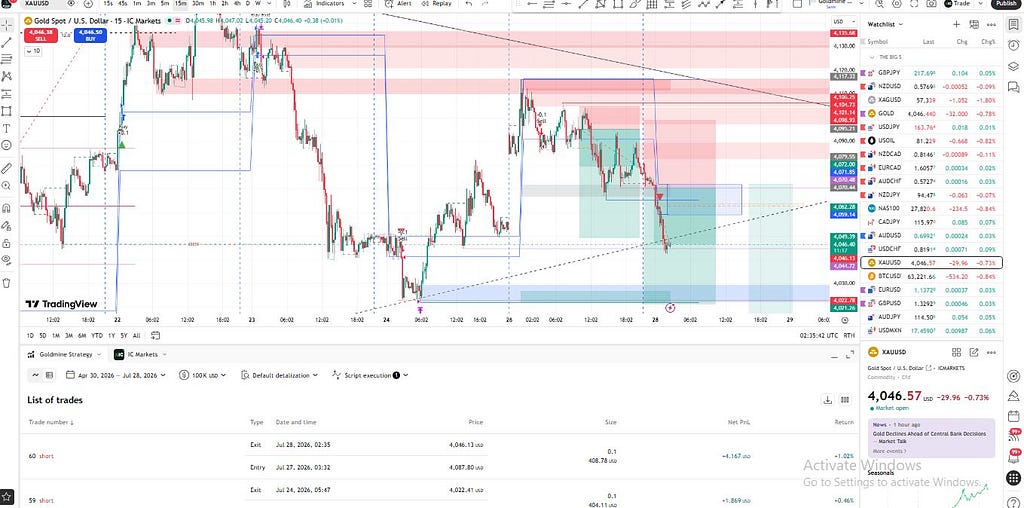
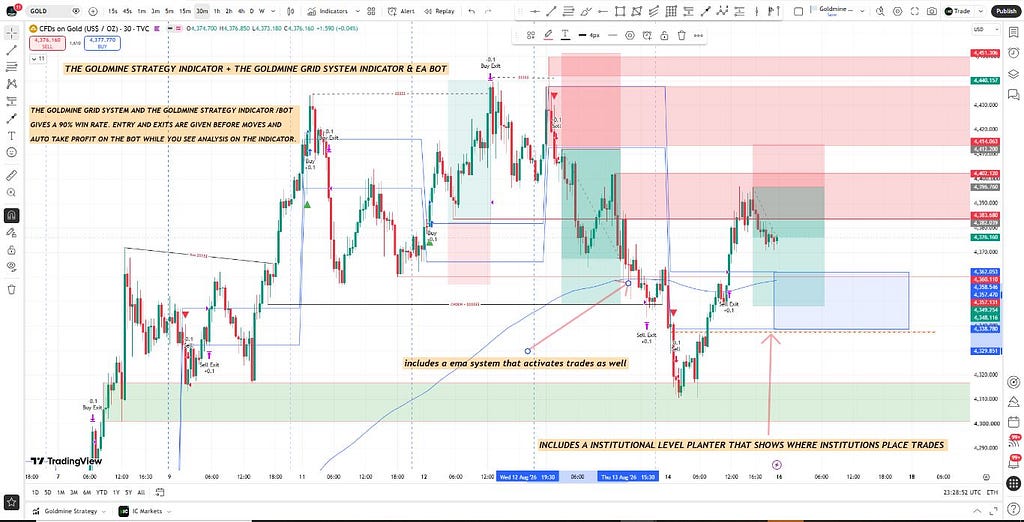
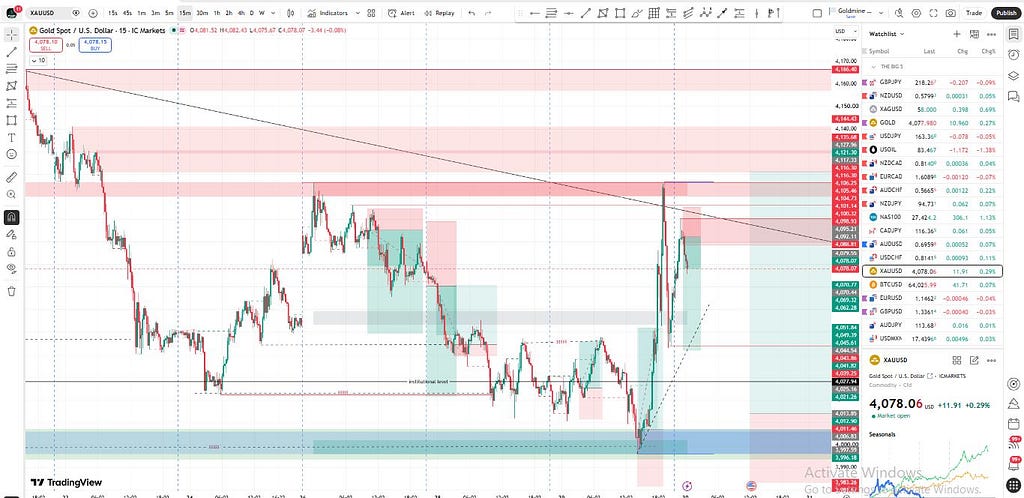
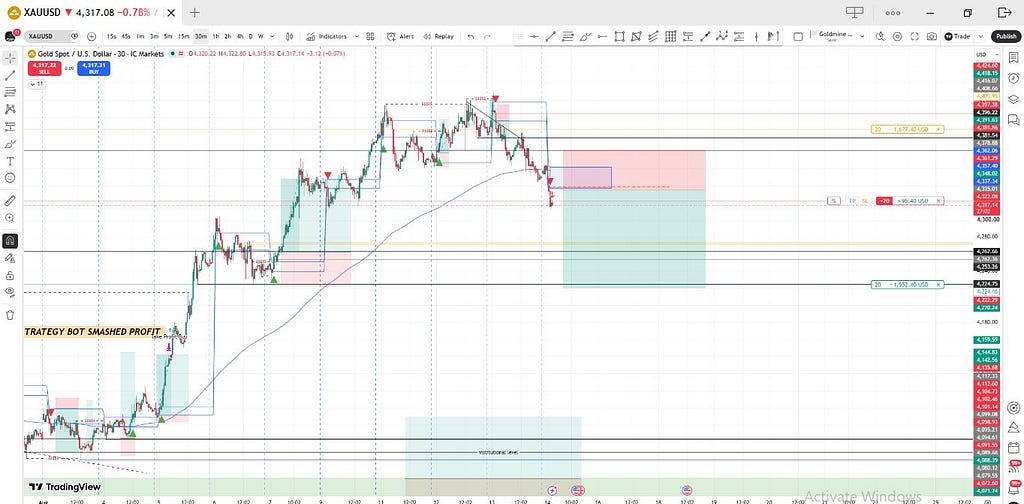
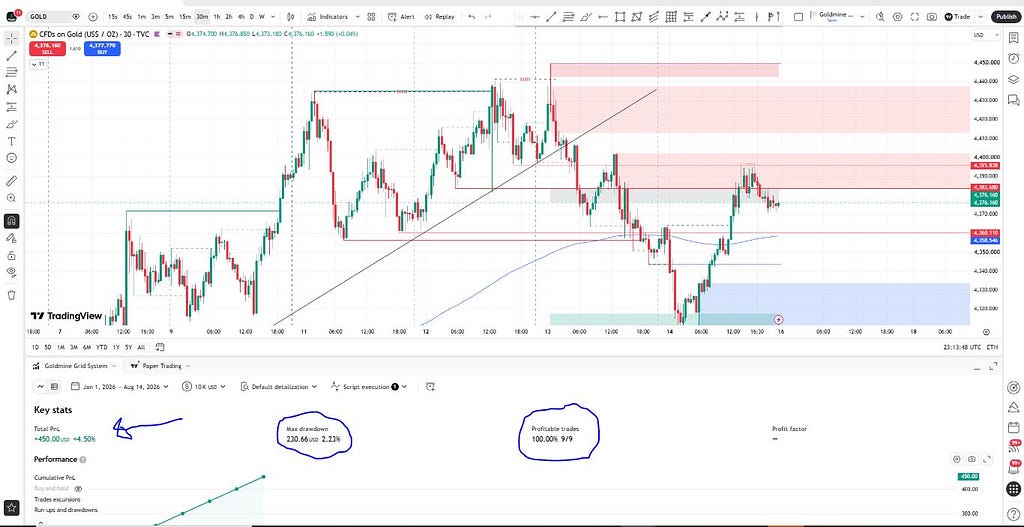
The Bot Trades Gold. I Sleep. Here’s What Changed When I Stopped Being the Bottleneck in My Own Strategy
Inside the Goldmine Trading Bot — why automating a Smart Money Concepts gold strategy fixed more than my schedule, and what it still can’t fix for you
For two years, I had a strategy that worked and a schedule that didn’t.
The setups were there — the CHoCH, the order block, the liquidity sweep, exactly where they were supposed to be. The problem was never the analysis. It was that the best gold setups don’t check what time zone you’re in. They show up during the London-to-NY handover at 1am, or in the ten minutes you stepped away from the desk, and by the time you’re back, the entry is gone and all that’s left is watching the trade you correctly predicted play out without you in it.
That gap — between knowing the setup and being present for it — is what the Goldmine Trading Bot was built to close. Not to replace analysis with magic. To remove the one point of failure that had nothing to do with strategy and everything to do with being a human who sleeps, works, and isn’t staring at a chart 24 hours a day.
Here’s what actually changed, what a real automated cycle looks like, and the honest list of what a bot does and doesn’t fix.
The Real Cost of Being the Execution Layer
If you’ve traded gold manually for any length of time, you know the real threat to your results usually isn’t your analysis. It’s:
Missed entries — the setup formed while you were asleep, in a meeting, or just looked away
Hesitation — the setup formed exactly on plan, and you second-guessed it for four candles until the entry was gone
Fatigue decisions — the 11th chart of the day gets a worse read than the 1st, even though the market doesn’t know it’s your 11th
Emotional override — moving your stop, closing early on a wick, adding size after a loss to “make it back”
None of these are strategy problems. They’re execution problems — and they’re exactly the category of failure a bot doesn’t experience, because it doesn’t get tired, doesn’t hesitate, and doesn’t feel the loss from three trades ago when it’s evaluating trade four.
What the Goldmine Trading Bot Actually Does
The bot runs the same institutional framework a discretionary SMC trader would use — CHoCH, BOS, order blocks, fair value gaps, liquidity sweeps — but it does three things a human execution layer structurally can’t:
It watches every session, not just the one you’re awake for. Gold’s highest-quality setups aren’t evenly distributed across the day. A bot doesn’t need to choose between sleep and the London open.
It scores setups instead of reacting to the first thing that looks right. Every detected structure gets evaluated against confluence factors — higher-timeframe alignment, liquidity context, session quality — before anything is allowed to execute. This is the difference between a bot that trades noise and one that waits.
It executes without hesitation or revision. The entry, stop, and target are set before the trade exists — not adjusted in the moment because a candle looked scary. That discipline is easy to describe and famously hard for a human to hold under real conditions.
Real Scenario 1: The 2am Setup
Setup: A clean bearish CHoCH formed on gold during the Asian-to-London handover — a session window that, for most retail traders in North American or West African time zones, lands well outside a normal waking schedule.
What actually happened: The bot’s structure detection flagged the order block, confirmed liquidity sweep context, and executed within the confluence window — hours before a manually-monitored account would have opened the chart at all. By the time a human trader checked in that morning, the setup that would have been missed entirely was already closed.
Real Scenario 2: The Setup a Tired Trader Would Have Skipped
Setup: Late in a high-volume session, a valid CHoCH and order block formed — textbook on structure, but the kind of setup that’s easy to second-guess after a long day of screen time.
What actually happened: The bot’s confidence scoring evaluated the setup on the same criteria it uses at hour one of the session as at hour ten — no fatigue discount, no hesitation. The trade executed on schedule and closed at target.
Real Scenario 3: The Trade a Human Would Have Closed Early
Setup: A valid long position moved into a temporary pullback shortly after entry — the kind of wick that tests a discretionary trader’s conviction in real time.
What actually happened: With the stop and target already defined at entry, the bot held the position through the pullback with no discretionary override, and price continued to target. This is the scenario worth featuring most prominently if your proof shows a trade a manual trader would likely have closed early out of nerves — it’s the most relatable pain point for readers considering automation.
This is the part most trading-bot content skips, and it’s the part that actually builds trust with readers who’ve been burned by “set and forget” promises before:
A bot doesn’t remove market risk. It removes execution inconsistency. Gold can still move against a structurally valid setup — automation doesn’t change the market, it changes how faithfully your plan gets carried out inside it.
A bot doesn’t replace risk management decisions — it just enforces them consistently. You still set the position sizing, the max drawdown limits, the risk-per-trade ceiling. The bot’s value is that it never quietly ignores those settings on trade seventeen the way a tired human might.
A bot doesn’t guarantee a specific outcome. No automated system — this one included — can promise a win rate, a return, or that any individual trade will close in profit. What it can do is make sure the strategy you designed gets executed the same way at 2am as it does at 2pm, which is a different (and more honest) promise than “guaranteed profits.”
How It Actually Runs
Structure detection — the bot continuously scans for CHoCH, BOS, order blocks, and FVGs across the instrument and timeframe you configure.
Confluence scoring — each detected setup is scored against higher-timeframe alignment, liquidity sweep context, and session quality before it’s eligible to trade.
Defined-risk execution — entry, stop-loss, and take-profit are all set at trade initiation, not adjusted mid-trade.
Session-aware operation — you set the sessions and risk parameters; the bot operates inside those bounds without needing you present.
FAQ
Do I need to watch the bot constantly once it’s running? No — that’s the point — but “unattended” shouldn’t mean “unchecked.” Reviewing performance and confirming the bot’s connection/broker status periodically is still good practice, the same way you’d check in on any automated system handling real money.
What markets/instruments does it work on? Built and tuned specifically around XAU/USD’s volatility and session behavior — the confluence scoring in particular is calibrated to gold’s structure, not a generic multi-asset model.
Will this guarantee profitable trades? No — and treat any bot that claims this with real skepticism. What it guarantees is consistent execution of a defined strategy without the hesitation, fatigue, or emotional overrides that affect manual trading. The underlying market risk is still real.
How is this different from just setting alerts and trading manually when they fire? Alerts still require you to be present, awake, and emotionally neutral at the exact moment they fire — which is the specific gap automation closes. An alert you miss at 2am is functionally the same as no alert at all.
Can I adjust the bot’s risk settings, or is it fixed? Risk per trade, session windows, and confluence thresholds are all configurable — the bot enforces whatever parameters you set rather than deciding risk tolerance on your behalf.
What happens if my connection drops while a trade is open? The system is built to reconcile against your broker’s actual open positions on reconnect rather than trusting a potentially stale local state — this is a core part of running any automated execution system responsibly, not an edge case to ignore.
Final Thoughts
The setups were never the problem. Being human — asleep, distracted, tired, or one bad trade away from an emotional decision — was. The Goldmine Trading Bot doesn’t trade differently than a disciplined SMC trader would on their best day. It just has that best day every day, because it isn’t a person who has bad ones.
The Bot Trades Gold. was originally published in Coinmonks on Medium, where people are continuing the conversation by highlighting and responding to this story.
Bitcoin treasury Strategy has gone another week without buying the leading cryptocurrency — but didn’t sell any this time.
The Nasdaq-listed company said Monday in a regulatory filing that it had upped its cash buffer by selling 3,458,866 shares of MSTR common stock to generate $333.7 million.
Strategy added $150M to its USD Reserve and repurchased $132M of $STRC, extending USD Duration to 2.8 yrs (+41 days) and tightening STRC BTC Credit to 114 bps (-4 bps). As of 8/16/26: ₿840,447 BTC Reserve; $4.8B USD Reserve. $MSTRhttps://t.co/kNWPowilmT
Strategy used $52.4 million to pay dividends on its STRC preferred stock, then spent $132.2 million to buy the stock back. It also added $149.1 million to its dollar reserve.
Strategy — formerly MicroStrategy — has recently pivoted to common stock sales to build up its cash reserves, rather than buying Bitcoin.
It has halted its Bitcoin sales and even sold a chunk of its holdings over the past two months after aggressively buying in 2025.
Strategy stock (Nasdaq: MSTR) has taken a hit in 2026, dropping over 60% year-to-date. At a little over $95 a pop, it is currently trading nearly 80% below its 2024 record.
The company started buying Bitcoin in 2020 as a way to protect shareholder returns. It has since become the largest corporate holder of Bitcoin, with 840,447 coins worth $53.4 billion, acquired at an average price of $63,357, according to its website.
Despite focusing on its cash buffer, Strategy has reassured investors that its long-term posture toward Bitcoin is still the same. CEO Phong Le said earlier this month that he isn’t worried about the current bear market, and that the company plans to remain a long-term buyer of Bitcoin despite its recent sales.
“We’re the J.P. Morgan of the crypto economy, so whether we sell 1,000 Bitcoin out of 840,000 to me is irrelevant to the conversation,” Le said.
Strategy’s approach has spawned a wave of copycat companies that have since adopted similar crypto-treasury strategies of their own.
Bitcoin treasury Strategy has said it “doesn’t need” Morgan Stanley Capital International after the index provider said it could remove the Bitcoin company from its Global Investable Market Indexes.
MSCI said in a consultation that it was consulting on a plan to define “Non-Operating Companies” and make them ineligible for its Global Investable Market Indexes (GIMI).
The removal of such companies would exclude companies like Strategy from indexes visible to a large pool of institutional investors. MSCI said it was weighing up the decision as Strategy is primarily known for holding a large amount of Bitcoin rather than running a traditional operating business.
Digital assets are assets. Index providers should measure markets, not decide which assets companies are allowed to own. MSCI’s proposal puts it out of step with regulators, markets, and its own customers. Bitcoin doesn’t need MSCI. Neither does Strategy. $BTC$MSTR
Writing on X Friday, Strategy wrote: “Digital assets are assets. Index providers should measure markets, not decide which assets companies are allowed to own. MSCI’s proposal puts it out of step with regulators, markets, and its own customers.”
It added: “Bitcoin doesn’t need MSCI. Neither does Strategy.”
The consultation also included Japanese Bitcoin treasury Metaplanet, which trades on the Tokyo Stock Exchange, and uranium investment company Yellow Cake.
Based on financial filings as of May 2026, Strategy and Metaplanet already meet the criteria for removal under MSCI’s proposed rule.
If MSCI adopts the proposal as currently written and their financial profiles remain unchanged, both companies would be deleted from the MSCI ACWI IMI Index as part of the November 2026 Index Review, triggering forced selling by index-tracking funds and loss of future passive inflows.
MSCI is still gathering feedback on the proposal through September 30, and has explicitly said the consultation “may or may not result in changes to MSCI indexes” — meaning the rule could be modified, delayed, or dropped entirely based on responses from affected companies and market participants. Even if adopted, any changes to a company’s underlying financials before the review could also shift the result.
Nasdaq-listed Strategy — formerly MicroStrategy — started buying Bitcoin in August 2020 as a way to generate better returns for its shareholders during the COVID-19 pandemic.
It has since spent around $63.3 billion on Bitcoin and is the largest corporate holder of the asset. Investors can buy its shares to gain exposure to the leading cryptocurrency without having to buy and hold digital coins themselves.
Strategy spawned a long-list of copycat firms which have bought not only Bitcoin, but other cryptocurrencies to boost their stock prices.
Strategy’s stock (MSTR) was trading nearly 3% lower Friday at nearly $95 per share. MSTR year-to-date has dropped by nearly 40%.
Strategy has added $650 million to its USD reserve and repurchased $109 million of STRC preferred stock, showing again that the company’s Bitcoin strategy is no longer just a simple accumulation story.
The company, formerly MicroStrategy, filed an update showing the reserve increase was funded through MSTR common stock ATM sales. It also sold 1,690 BTC for $108.6 million and used that capital to buy back STRC preferred shares.
That combination matters because Strategy remains the market’s most watched corporate Bitcoin holder, but its balance sheet has become much more active. It is still a Bitcoin treasury company, but it is also managing preferred stock obligations, reserve duration, equity issuance, buybacks, and investor expectations.
In other words, this is no longer just about how many BTC Strategy owns.
It is about how the company finances and protects the structure built around that BTC.
For more details, visit the official Sec platform.
TL;DR
Strategy added $650 million to its USD reserve.
The company sold 1,690 BTC for $108.6 million.
It used proceeds to repurchase $109 million of STRC preferred stock.
Why The USD Reserve Matters
A larger cash reserve gives Strategy more flexibility.
Bitcoin-heavy companies face a basic challenge: BTC is liquid, but volatile. If a company has dividend obligations, debt commitments, preferred shares, operating costs, or buyback programs, it may not want to rely entirely on Bitcoin sales during weak markets.
That is where a USD reserve helps.
Cash gives management room to meet obligations without being forced into poorly timed asset sales. It also helps reassure preferred-stock investors, who may care more about payment reliability than long-term Bitcoin conviction.
For a company as visible as Strategy, that reserve is part of the investment case.
The market wants Bitcoin upside, but it also wants to know the capital structure can survive volatility.
STRC Shows The New Strategy Model
The STRC preferred stock program is one of the clearest signs that Strategy’s model has evolved.
Preferred securities create a different kind of investor relationship. Holders may be looking for yield, payment priority, or exposure to a Bitcoin-linked corporate structure without holding common stock. That means Strategy has to think beyond BTC-per-share narratives.
Repurchasing $109 million of STRC suggests management is actively managing that layer of the capital stack.
The sale of 1,690 BTC to support the repurchase will attract attention because Bitcoin investors naturally watch every coin leaving the treasury. But the broader question is whether the sale improves the overall structure enough to justify the reduced BTC balance.
That is the trade-off.
Selling BTC Does Not Automatically Mean Abandoning Bitcoin
This is where the market needs a bit of nuance.
A company can sell Bitcoin tactically while still being built around a long-term Bitcoin thesis. That does not make every sale bullish, and it does not make every sale bearish. It depends on why the sale happened, what the proceeds fund, and whether the company’s net BTC exposure continues to support the broader strategy.
Strategy still holds 840,447 BTC, according to the filing context.
That is a massive position. The sale of 1,690 BTC is meaningful, but not thesis-ending on its own. It looks more like capital-structure management than a reversal of the company’s Bitcoin identity.
Still, it does show that Strategy’s “never sell” image is now more complicated than the market once assumed.
Investors Are Watching Liquidity, Not Just BTC Count
Traditional investors often care about liquidity, duration, obligations, and funding sources.
Bitcoin investors tend to center on BTC holdings.
Strategy now has to speak to both audiences. Its cash reserve gives conventional investors more comfort. Its huge BTC balance keeps the Bitcoin thesis alive. Its preferred stock instruments create yield-oriented products. Its common stock remains tied to both Bitcoin sentiment and capital-markets execution.
That is a lot to manage.
The larger and more complex Strategy becomes, the less useful it is to view the company as a simple BTC wrapper.
It is becoming a Bitcoin financial vehicle.
What To Watch Next
The next important signals will be reserve size, BTC holdings, STRC performance, and whether future Bitcoin sales continue.
If Strategy keeps increasing its USD reserve while maintaining a huge BTC position, the market may accept the structure as mature treasury management. If BTC sales accelerate or reserves become necessary to cover stress, investors may read it differently.
For now, the filing shows active capital management.
Strategy remains a massive Bitcoin holder, but it is also building a more traditional liquidity buffer around that position. That may be less pure than the old accumulation story, but it may also make the structure more durable.
Bitcoin remains the center of Strategy’s identity. Cash is becoming the stabilizer around it.
This article is based on Strategy’s August 2026 corporate filings and reserve update.
This article was written by the News Desk and edited by Samuel Rae.
This report is based on information released by Sec. at Sec
Strategy’s U.S. dollar reserve has reached $4.65 billion, up from $3.75 billion two weeks earlier. It has also sold almost 7,000 BTC since late June 2026.
Many are wondering why a company built around accumulating Bitcoin would choose to hold billions of dollars in fiat. More importantly, should other Bitcoin businesses do the same?
Strategy holds cash because it’s in a very unique position
Strategy increasingly operates as an issuer of Digital Credit: preferred securities backed economically by an enormous Bitcoin balance sheet. These instruments create fixed dollar dividends obligations.
Bitcoin produces no cash flow. Strategy’s software business produces far too little cash to cover its capital structure.
Traditional credit analysis compounds the problem. S&P assigned Strategy a B- rating in October 2025, citing its Bitcoin concentration, weak dollar liquidity, and very weak risk-adjusted capital. Under S&P’s methodology, Bitcoin is effectively excluded from the capital base used for this analysis because of its market risk.
In our coverage of the S&P rating, we specifically mentioned that a cash reserve, amongst other things, was worth exploring to improve credit ratings.
Strategy therefore holds dollars to support its credit issuance. That is literally the whole reason.
More dollar liquidity can improve the perceived safety of its preferred securities, broaden investor demand, and potentially lower its cost of capital—in the eyes of credit ratings agencies.
The cash still carries an economic cost. Excess capital should produce a return. A conventional company can reinvest it, repurchase shares, or distribute it. A Bitcoin company can buy more Bitcoin. Every dollar held in cash replaces potential positive returns with guaranteed negative real returns.
Strategy accepts that cost because its business model depends on issuing more credit. Three unusual conditions exist at once: Bitcoin dominates its balance sheet, rating agencies heavily penalize that Bitcoin exposure, and management intends to keep issuing Digital Credit.
All three conditions are pretty unique individually and it is exactly the combination of all three that creates the situation where they need to hold cash. For instance, if Strategy did not want to issue credit, then it wouldn’t need the cash.
The economic consequence of cash reserves
The math creates some glaring problems with cash reserves.
Suppose Strategy issues $100 of preferred stock carrying a 10% annual dividend and holds three years of dividend coverage in cash. It must reserve $30 and can deploy only $70 into Bitcoin.
The preferred still costs $10 per year. The $70 invested into Bitcoin must therefore generate:
$10 ÷ $70 = 14.29%
A stated 10% cost of capital becomes a 14.29% hurdle rate on the capital actually deployed. The reserve raises the required return by 42.9%. Interest earned on the cash reduces the hurdle somewhat, but the structural drag remains.
The true hurdle is actually higher, however, because BTC’s volatility means it will heavily underperform the hurdle rate in some years, and these years still require the dividends to be paid (here I am assuming that dividends are not skipped). So aside from the cash drag, there is also a volatility drag imposed by attempting to amplify a volatile asset. This risk must be compensated for by adjusting the hurdle rate higher.
The larger the required reserve, the less of every new dollar reaches Bitcoin. If Bitcoin appreciation fails to exceed this higher hurdle over time, common shareholders bear the cost.
However, cash is far from useless. Cash creates useful optionality. It can cover dividends and interest during Bitcoin drawdowns, reducing the risk of forced Bitcoin sales. It can also support opportunistic repurchases of securities when they trade below their stated value.
Strategy recently did exactly that. In late July, it paid $25 million for $28.89 million of STRC stated value, a 13.47% discount. It later used $108.6 million from Bitcoin sales to retire another 1.15 million STRC shares. Buying preferred stock below par removes more senior claims and future dividend obligations than the cash spent. It is also accretive to Net Bitcoin Per Share.
Should Bitcoin companies accumulate cash or bitcoin?
For most Bitcoin companies, cash needs should be tied to the operating business rather than to an arbitrary reserve target—consider that Strategy literally does not know how much reserves it needs to get a better rating or for more credit investors to become interested in STRC.
A cash-flowing company usually has a good understanding of its cash outlay. It should hold enough dollars to cover payroll, taxes, debt service, vendor payments, near-term capital expenditures, and a reasonable buffer for volatility in operating cash flow.
The right reserve depends on the stability of those cash flows. A profitable business with recurring revenue, low fixed costs, and predictable expenses can operate with a smaller buffer. A cyclical or capital-intensive business needs more. The reserve should rise because the business requires liquidity, not because management simply wants a large cash balance.
Once operating needs and a prudent liquidity buffer is covered, additional cash needs a specific economic purpose. Otherwise it dilutes returns by generating a large opportunity cost. For any company, excess capital should compete directly against the company’s hurdle rates, repurchasing undervalued shares, reducing expensive liabilities, or investing in projects that can earn a higher return.
In conclusion, Strategy is a very, very rare case. Its cash reserve exists only because it is building a large credit issuance business on top of a Bitcoin balance sheet while credit ratings agencies impose significant institutional inertia which treats legitimate, liquid assets as zero value. Companies without that liability structure—which is basically all other companies—have far less reason to accumulate dollars beyond their working capital buffer.
Disclaimer: This content was prepared on behalf of Bitcoin For Corporations for informational purposes only. It reflects the author’s own analysis and opinion and should not be relied upon as investment advice. Nothing in this article constitutes an offer, invitation, or solicitation to purchase, sell, or subscribe for any security or financial product.
 Login
Login




Capital B confirms the acquisition of 376 BTC for €25.3 million, the holding of a total of 3,521 BTC, and a BTC Yield of 2.17% YTD






pic.twitter.com/daSanqch1v