Ondo Finance has become the first tokenization company to enter DTCC’s Fund/SERV network, connecting its regulated U.S. subsidiary with infrastructure that processes more than 85% of domestic mutual fund transaction volume. Ondo Finance said its subsidiary Oasis Pro Markets has…
Strategy Executive Chairman Michael Saylor has predicted that the CLARITY Act’s 49-50 Senate defeat could send more capital toward Bitcoin as U.S. regulators continue writing crypto rules under their existing powers. Michael Saylor said in an X post that the…
Deutsche Bank said Wednesday that it would debut a bitcoin custody service for European corporate and institutional clients this year.
The German multinational said that the service was subject to the completion of the applicable regulatory timeline.
Deutsche Bank’s announcement comes as top banks worldwide launch crypto custody services. BNY Mellon, State Street, Standard Chartered, U.S. Bank, and Citigroup have all either launched or committed to direct crypto custody over the past 18 months.
“Digital assets are not a replacement for the traditional financial system but an important complement to it,” Gerald Podobnik, Co-Head Corporate Bank, Deutsche Bank, said in a statement.
“We see them as new rails that can coexist with existing market infrastructures while benefiting from the trust, security and safeguards that regulated financial institutions provide. Our aim is to offer clients a secure and regulated gateway to this evolving market. The service will be further developed in line with client demand, regulatory requirements and the bank’s risk appetite.”
Germany’s biggest lender added it would support a “selected range of digital assets,” other than bitcoin — including stablecoins.
“The range of supported assets may be expanded over time, subject to client demand and the bank’s product-approval, risk management and regulatory processes,” a statement added. “Tokenized financial instruments are also included in the roadmap.”
News first dropped of the bank working on debuting bitcoin custody services in 2025. A report said that the German banking giant would integrate Bitpanda’s custody infrastructure while working with Taurus to build the solution for corporate and institutional clients.
Just last month, Citi said it would this year debut a bitcoin custody service, allowing institutional investors to custody both traditional assets and bitcoin within one framework, rather than needing separate systems.
A strategist at the Danish bank said Coinbase has more at stake in the CLARITY setback because its trading business is directly exposed to US market-structure rules.
Solana is back in the news as its maximum transaction size increased from 1,232 bytes to 4,096 bytes on September 15, a more than threefold expansion delivered through the Transaction V1 upgrade. The feature was activated at the start of mainnet epoch 1,035 at approximately 01:00 UTC.
SOL, however, showed no clear upward reaction to the news, trading modestly lower during a soft session across crypto. The update gives developers more room inside an individual transaction, but it does not change network speed, throughput, or fees.
So what does Transaction V1 do? It allows developers to place more instructions, signatures, and data into a single atomic transaction instead of splitting complex operations across multiple transactions.
Solana Transaction V1: What’s Changing?
.@solana is scheduled to activate Transaction V1 on mainnet around Sep 15, increasing the maximum serialized transaction size from 1,232 bytes → 4,096 bytes.
Before: • Smaller transactions often forced complex actions to be split across… pic.twitter.com/UHTH2zChtR
In an atomic transaction, every step succeeds or fails together. The larger format supports workloads that were difficult to fit under the former 1,232-byte limit, including zero-knowledge proofs, large multisignature wallets, and other data-heavy operations.
The upgrade does not increase the number of transactions Solana can process per second, nor does it alter transaction fees or confirmation speed. As a result, it is not a change in throughput or scalability in the usual sense. The immediate relevance is for developers, wallets, indexers, RPC providers, and applications that need to read, build, send, or support the new format.
Existing legacy and v0 transaction formats continue to work. Applications that want to use the larger transaction limit must opt into v1, while services that read or index transactions may need software updates to handle the new format correctly. That means the practical impact depends on implementation across the surrounding infrastructure, not simply on the feature’s activation.
Capacity News Is Not Throughput, and Solana Adoption Is the Test
The key distinction is between capacity and throughput? Transaction V1 changes how much data can fit within one transaction; it does not make the network process more transactions per second. For developers building complex flows, the ability to bundle operations into one atomic call can reduce the need to split work across chained transactions.
The format also introduces inline account handling for v1 transactions in place of the older Address Lookup Tables, while retaining the existing limit of 64 accounts per transaction. Developers using v1 must set certain limits explicitly, and wallets or applications need v1 support before they can build or sign the new transaction type.
The larger transaction envelope narrows a structural gap between Solana and Ethereum on transaction data capacity. It may make Solana more viable for application types that previously needed workarounds, particularly those involving large proofs, multiple signatures, or substantial transaction data.
Whether that technical flexibility results in additional developer activity or transaction volume remains the relevant medium-term question.
The more useful test is adoption rather than price action on the day of activation. Wallets, indexers, RPC operators, and applications need to support v1 before its additional capacity can be used broadly.
If developers begin using the format for zero-knowledge proofs, large multisig arrangements, batched operations, and related workloads, its effect could become more visible in application development and transaction activity over time.
Now, what’s next for the Solana price itself?
Solana (SOL)
24h7d30d1yAll time
Solana is trading around $97, after losing the psychological $100 level amid the news. The immediate technical picture has weakened, with $95–$98 acting as the key support zone. If buyers reclaim $100 and then push through $103–$105, SOL could regain momentum toward the $110 resistance area.
The next move will also depend heavily on the Federal Reserve decision and crypto sentiment. A sustained break below $95 could expose SOL to the low-$90s, while a recovery above $105 would put $110 back in focus. Recent analysis also identifies $110 as a major resistance zone, meaning SOL likely needs renewed buying pressure to extend the rebound toward $120.
Markets are pricing roughly a 90% probability of a 25-basis-point Federal Reserve rate hike at the September FOMC meeting, according to the Danske Research Team.
The team revised its own call this week and now expects that outcome. For Bitcoin watchers, the key distinction is between market expectations and a confirmed policy decision: the hike is still expected, but it has not yet been delivered.
The research team says tightening now likely represents the path of least resistance, given current market pricing and its longstanding view that rate hikes are eventually on the horizon.
WHAT TO WATCH TODAY — U.S. MARKETS
8:30 AM ET — Retail Sales 8:30 AM ET — Import & Export Prices 10:30 AM ET — EIA Oil Inventories 1:00 PM ET — Treasury Auction 2:00 PM ET — FOMC RATE DECISION + DOT PLOT 2:30 PM ET — Fed Chair Kevin Warsh Press Conference…
At the same time, it does not regard the decision as completely settled. That leaves the meeting relevant not only for the headline rate decision, but also for the details released alongside it.
Readers following FOMC odds into the September rate decision should distinguish between the reported 90% probability and any broader claims about how Bitcoin or other assets are positioned. The supplied research supports the market-pricing estimate, but it does not provide a verified assessment of Bitcoin positioning, leverage, or current price action.
Will the Expected Hike Be the Main Bitcoin Catalyst?
The Danske Research Team identifies the FOMC meeting as the week’s main US event. Alongside its expected 25-basis-point hike, the team expects the Fed to publish updated economic projections and a fresh set of rate projections, commonly called the dot plot.
The vote itself is also worth watching. Danske Research Team expects two or three dissenters in favor of holding rates, even as it maintains its call for a hike. That expectation underscores that the meeting is not a done deal. The final decision and any recorded dissents will provide the clearest evidence of how the committee resolved that tension.
The projections also carry an expected qualification. The team still expects the FOMC to publish the dots even if Fed official Warsh again chooses not to submit personal rate-path views. If that happens, the published material would still be available, but it would not include Warsh’s personal submission.
For Bitcoin-focused market analysis, the meeting presents several elements to monitor: the rate decision, the vote count, updated economic projections, and the dot plot.
Available evidence shows that the market strongly expects a hike and that projections and dots are expected to be published. It does not establish a specific Bitcoin reaction to any of those elements.
Commentary about the dot plot, future policy language, or a possible press-conference message should therefore be treated as market interpretation rather than a conclusion supplied by the primary research.
Likewise, it would be premature to describe any particular outcome as bullish or bearish for Bitcoin without independently verified market evidence.
The immediate question is not whether market pricing confirms it. It does not. The reported probability reflects expectations ahead of the meeting, while the FOMC’s decision will determine the actual policy outcome. The same caution applies to claims about risk assets, crypto-market volatility, or how fully expectations are reflected in trading activity.
Circle has launched the public mainnet of Arc on Sept. 16, bringing its USDC-powered Layer 1 blockchain online with institutional validators, more than 20 fiat stablecoins and tokenized funds available from launch. Circle said in itsofficial Arc mainnet announcement that…
For decades, the mechanics of global equity indexing were treated as plumbing—hidden, technical, and resolutely administrative. Providers like Morgan Stanley Capital International (MSCI) designed benchmarks to reflect the economic reality of public markets, not to shape it. Their mandate was descriptive, serving as a transparent mirror of global capital flows, sector weightings, and free-float market capitalizations.
That architectural assumption has quietly fractured. Today, the sheer scale of passive index-tracking capital has transformed benchmark administrators from passive cartographers into de facto market regulators. When an index provider determines the eligibility criteria for inclusion in indexes such as the MSCI Global Investable Market Indexes (GIMI), it is no longer merely measuring a company’s market value; it is dictating its access to institutional capital, influencing its cost of borrowing, shaping its shareholder register, and driving its liquidity profile.
Nowhere is this transformation more evident—or more contentious—than in MSCI’s ongoing confrontation with public Bitcoin treasury companies. Following a failed attempt in late 2025 to explicitly target digital-asset holding vehicles, MSCI launched a sweeping consultation on August 3, 2026, aimed at redefining and restricting the index eligibility of “non-operating companies.” While the proposal is drafted in neutral financial terminology, its practical architecture threatens to eject major corporate Bitcoin adopters, most notably Strategy (formerly MicroStrategy), from global benchmarks.
This clash is much more than a corporate dispute over index weighting. It raises a profound structural question for contemporary capital markets: What happens when a private, for-profit index provider acquires the power to penalize corporate balance-sheet innovation, and by extension, exercise private market governance without regulatory accountability?
From Direct Exclusion to Structural Filters
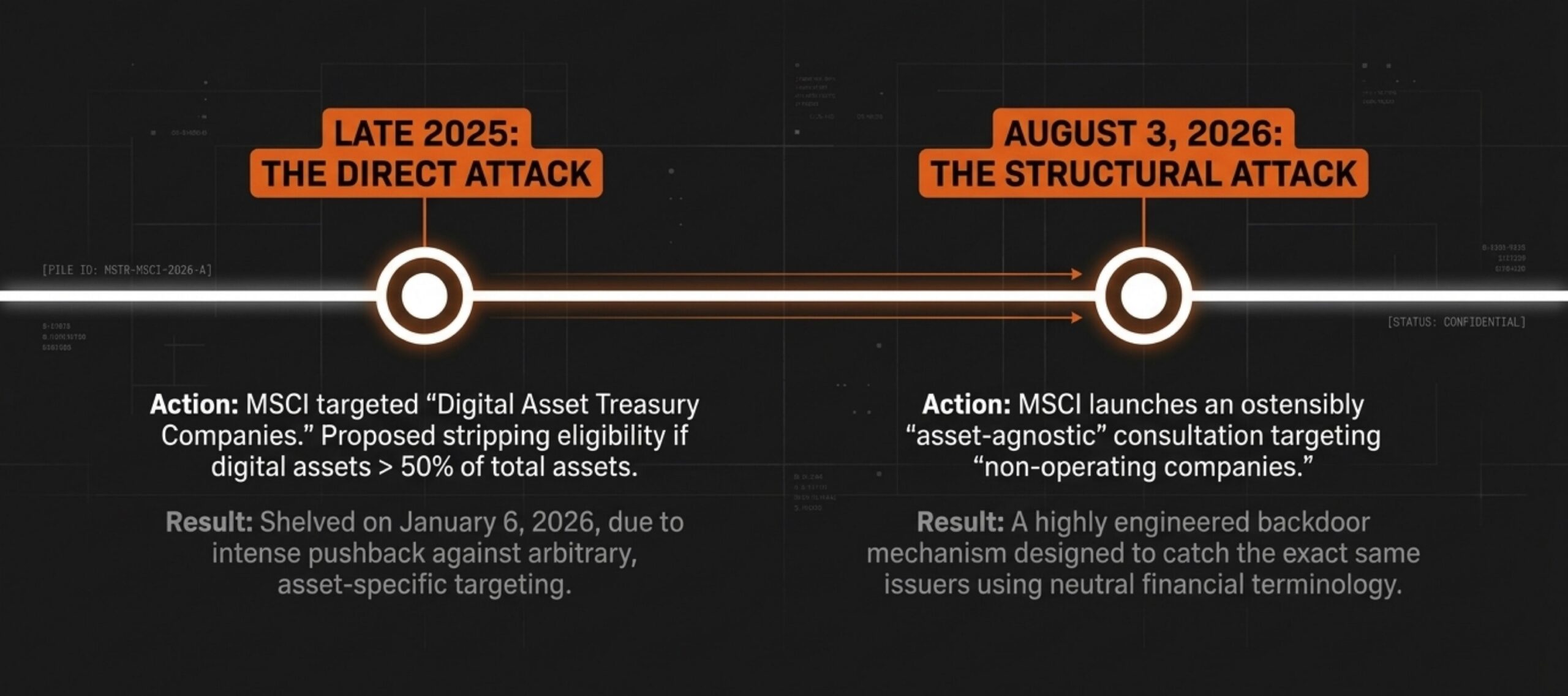
To understand the current crisis, one must trace MSCI’s regulatory maneuvers over the past twelve months. In late 2025, MSCI opened a consultation specifically addressing “Digital Asset Treasury Companies,” proposing to strip index eligibility from any corporate issuer whose digital asset holdings represented 50 percent or more of its total assets. Market participants quickly recognized the measure as an explicit screen against companies that had pivoted their corporate treasuries into Bitcoin.
Facing intense pushback from issuers and institutional investors who pointed out the arbitrary nature of singling out a specific asset class, MSCI shelved that direct approach on January 6, 2026. Rather than dropping the inquiry, however, the index provider retreated to draft a more sophisticated mechanism.
On August 3, 2026, MSCI announced a broader, ostensibly asset-agnostic consultation regarding the eligibility of “non-operating companies” for the GIMI framework. Rather than naming Bitcoin directly, the new proposal establishes a two-step quantitative sieve designed to catch companies deemed to be operating primarily as holding vehicles or investment funds rather than traditional operating businesses.
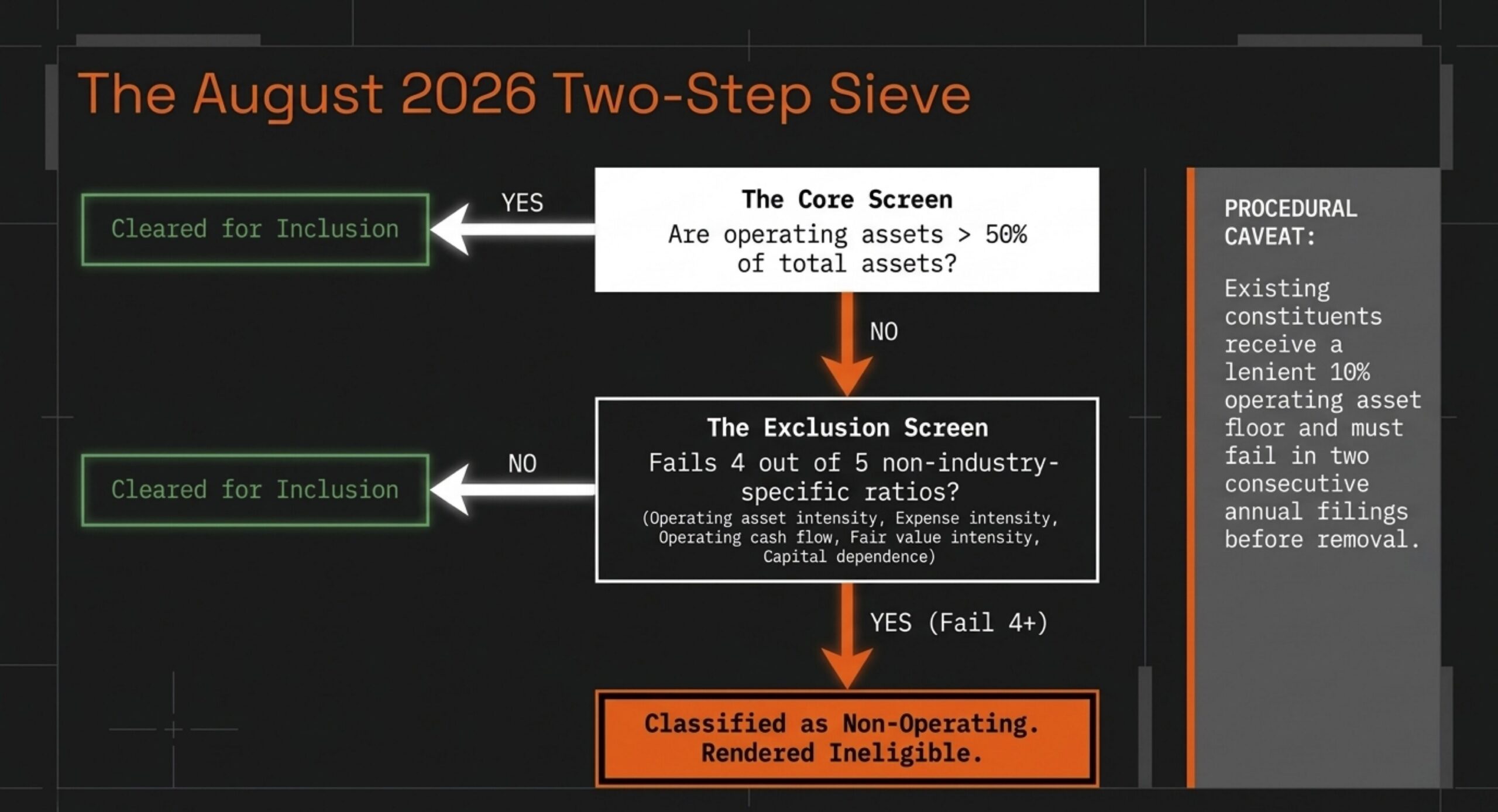
The methodology proceeds in two distinct stages:
The Core Screen: MSCI applies a primary balance-sheet test to determine whether an issuer maintains substantial operating assets. A company clears this initial hurdle if its operating assets exceed 50 percent of its total assets.
The Exclusion Screen: For any issuer failing the core screen, MSCI applies five non-industry-specific financial ratios: operating asset intensity, expense intensity, operating cash flow, fair value intensity, and capital dependence. If a company triggers failing thresholds on at least four of these five metrics, it is classified as a non-operating company and rendered ineligible for index inclusion.
While existing constituents receive modest procedural protections—such as a more lenient 10 percent operating asset floor rather than 20 percent and a requirement to fail the screen in two consecutive annual filings before removal—the structural intent is clear. The simulation accompanying the August 2026 consultation revealed that applying the screen to the MSCI ACWI IMI universe using mid-2026 data would immediately flag and delete major public Bitcoin treasuries, including Strategy and Japan’s Metaplanet, alongside UK-based uranium holding vehicle Yellow Cake plc, while placing firms like SharpLink, Center Laboratories, and Lydia Holding onto a public watchlist.
The Targets and the Quantitative Realities
The primary focal point of this methodology is Strategy. Following its multi-year pivot into accumulating Bitcoin as its primary treasury reserve asset, Strategy has amassed over 845,050 bitcoin, making it the largest corporate holder of the asset globally. In the simulation data released by MSCI, Strategy—boasting a float-adjusted market capitalization exceeding $23.9 billion among the flagged entities—accounts for the vast majority of the affected market value.
The financial stakes of index inclusion for a company of this scale are frequently misunderstood. Critics of corporate Bitcoin strategies often assume that index exclusion triggers a terminal liquidity catastrophe. Yet empirical analysis of trading volumes reveals a more nuanced picture. Industry estimates indicate that passive funds tracking MSCI GIMI indexes hold roughly 3.1 percent of Strategy’s basic shares outstanding, amounting to approximately 13 million shares. When measured against Strategy’s robust trading velocity—where daily volume regularly absorbs hundreds of millions of dollars—that passive exposure represents less than a single average trading day.
Consequently, the true threat of MSCI’s proposal is not a mechanical liquidity shock, but rather a structural and narrative penalty. Index exclusion closes doors to specific institutional mandates, benchmark-restricted pension pools, and broad-market ETFs that are legally or contractually bound to replicate MSCI indexes. It penalizes a company not for operational failure, but for balance-sheet structure.
The Accounting and Legal Clash: GAAP versus Index Discretion
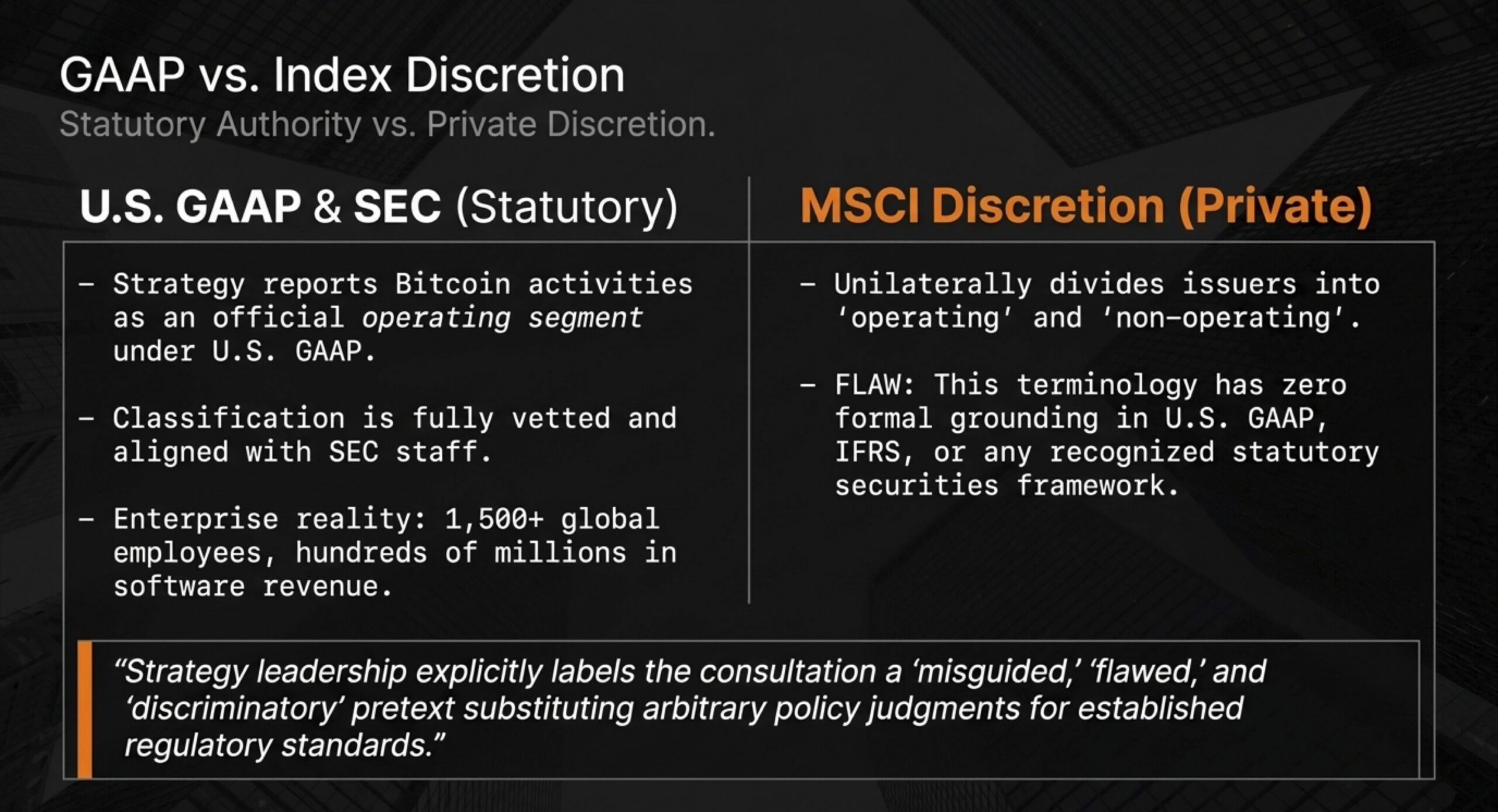
Strategy launched an aggressive counter-offensive in late August 2026, led by founder Michael Saylor and CEO Phong Le. In formal communications to MSCI and public filings, the company blasted the consultation as a “misguided,” “flawed,” and “discriminatory” pretext designed to achieve through backdoor ratio screens what MSCI failed to accomplish with its direct digital asset proposal in 2025.
The core of Strategy’s legal and accounting argument hinges on the definition of an operating business. Strategy noted that its terminology—dividing issuers into “operating” and “non-operating”—has no formal grounding in U.S. Generally Accepted Accounting Principles (GAAP), International Financial Reporting Standards (IFRS), or any recognized statutory securities framework.
Furthermore, Strategy underscored that it reports its Bitcoin activities as an official operating segment under U.S. GAAP, a classification arrived at through extensive engagement and alignment with staff at the U.S. Securities and Exchange Commission (SEC). By treating Bitcoin treasury operations, capital markets issuance, and asset management as core segments of an enterprise that employs over 1,500 people globally and generates hundreds of millions in software revenue, Strategy argues that MSCI is substituting its own arbitrary policy judgments for established regulatory and accounting standards.
In a particularly sharp rhetorical turn, Strategy’s pushback weaponized MSCI’s own historical regulatory positions. The company highlighted a 2022 SEC concept release examining whether information providers and index administrators exercise sufficient market power to bring them within the purview of the Investment Advisers Act. By forcing index providers to judge whether an asset class like Bitcoin belongs inside an operating business, MSCI risks undermining its foundational claim to absolute neutrality—the bedrock principle that index providers merely reflect market reality rather than passing moral or strategic judgment on corporate balance sheets.
The Double Standard of Asset Concentration
Beyond technical accounting definitions, the institutional debate centers on consistency. Critics of MSCI’s methodology argue that the proposed financial ratios are applied unevenly across asset classes.
Consider the treatment of real estate investment trusts (REITs) and mortgage REITs (mREITs). MSCI benchmarks routinely include entities whose balance sheets are overwhelmingly concentrated in a single asset class—commercial real estate, residential mortgages, or physical property portfolios—and whose revenues and valuations are driven entirely by external market cycles, rental yields, and continuous capital raises via debt and equity markets. These entities rely heavily on external capital dependence to scale their portfolios, mirroring the capital-raising mechanics utilized by Bitcoin treasury companies.
Yet under MSCI’s proposed framework, asset concentration and capital dependence in real estate are deemed fully compatible with index inclusion, whereas identical structural strategies executed in digital assets are classified as disqualifying non-operating traits. This disparity exposes the fundamental vulnerability of MSCI’s criteria: they rely on subjective definitions of “operations” that can easily be tailored to exclude disfavored asset classes while sheltering traditional ones.
The Structural Crisis of Private Governance
The confrontation between MSCI and Bitcoin treasury companies transcends the crypto asset ecosystem. It illuminates a broader institutional crisis concerning the unaccountable power of private index providers.
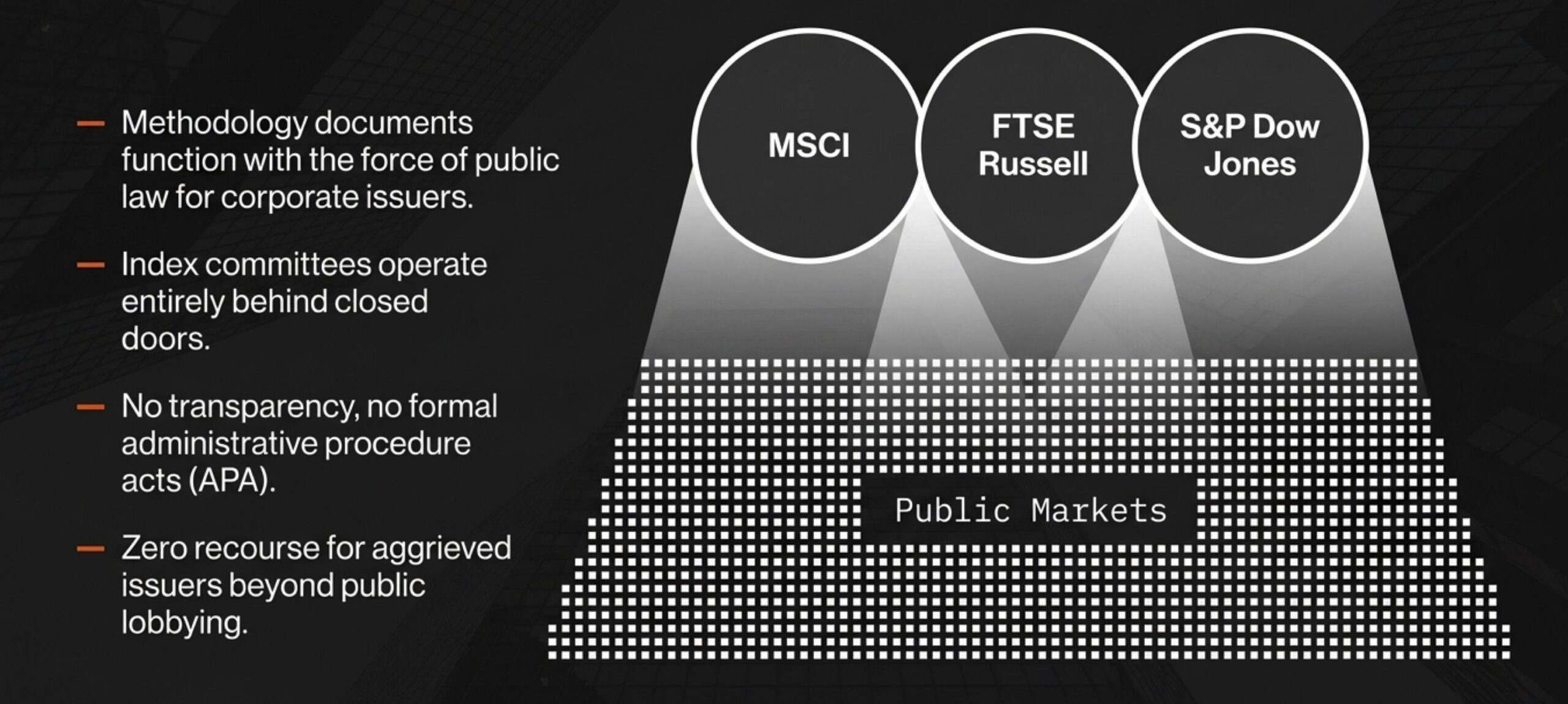
Over the past two decades, the migration of capital from active management to passive index-tracking funds has concentrated immense economic leverage in the hands of a small oligopoly of index administrators, dominated by MSCI, FTSE Russell, and S&P Dow Jones. These firms operate as private, for-profit entities, yet their methodology documents function with the force of public law for corporate issuers.
When an index provider unilaterally alters its inclusion rules to penalize specific corporate treasury models, it engages in private market governance. Unlike regulated public exchanges or statutory securities regulators, index committees operate behind closed doors, subject to limited public transparency, no formal administrative procedure acts, and virtually no recourse for aggrieved issuers other than public lobbying.
If MSCI succeeds in establishing the precedent that holding non-traditional reserve assets on a corporate balance sheet strips a public company of its operating status, it creates a dangerous chilling effect. Today, the target is Bitcoin; tomorrow, it could be corporate holdings of physical commodities, strategic technology stakes, gold, real estate, data centers or alternative monetary reserves that conflict with the prevailing preferences of institutional ESG or benchmark committees. Corporate directors lose the sovereign right to optimize their balance sheets for shareholder value if doing so risks excommunication from the passive capital ecosystem.
The Timeline, the Stakes, and the Regulatory Reckoning
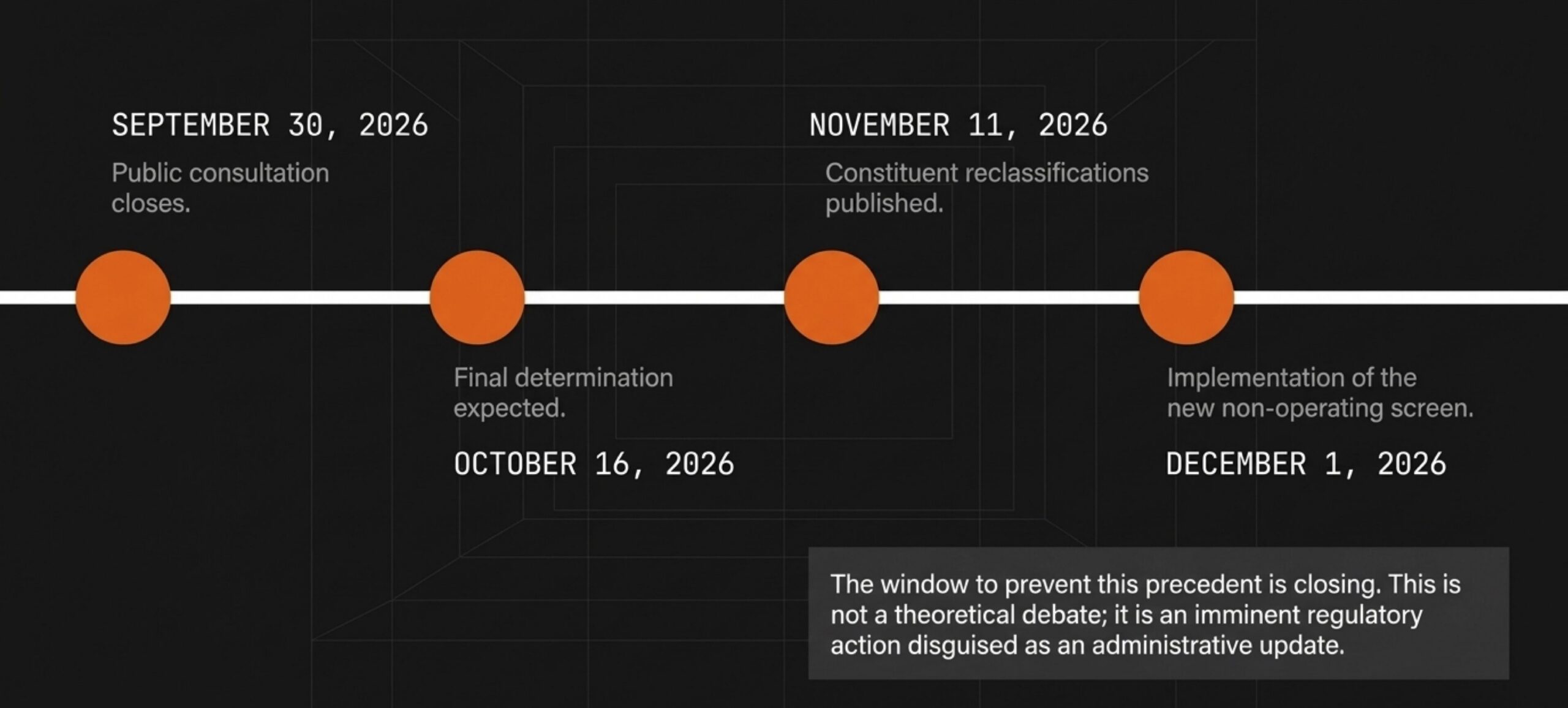
The immediate resolution of this conflict is rapidly approaching. The public consultation period for MSCI’s non-operating company proposal closes on September 30, 2026, with a final determination expected by October 16, 2026. If adopted in its current form, constituent reclassifications will be published on November 11, 2026, and implemented on December 1, 2026.
Yet for institutional investors, asset managers, and corporate executives, the stakes extend far beyond the ticker symbol MSTR. The outcome will test whether public companies retain the autonomy to innovate their balance sheets in an era dominated by passive gatekeepers, or whether benchmark administrators have officially crossed the line from measuring markets to regulating them.
The solution does not lie in government micromanagement of index design, but in statutory accountability. The U.S. Securities and Exchange Commission and global securities regulators must stop treating index providers as invisible software plumbing. When an index committee’s discretionary classifications can dictate corporate access to capital, distort price discovery, and bypass standard administrative notice-and-comment safeguards, that committee is acting as a de facto market regulator.
Regulators must revisit the framework governing dominant index providers under the Investment Advisers Act, demanding transparent due process, strict standards against arbitrary discrimination, and formal accountability for decisions that alter capital formation.
Until market authorities recognize that index providers have become systemic gatekeepers, the free market for corporate control will no longer be governed by shareholders, boards, and public statutes—it will remain at the mercy of unelected private arbiters in New York and London.
Take Action to Protect Index Neutrality
The boundary between measuring market value and regulating corporate behavior is being erased. MSCI’s proposed “non-operating company” screen threatens to penalize balance-sheet innovation, misclassify legitimate operating businesses, and set a dangerous precedent for private governance in capital markets.
Don’t let private index administrators dictate corporate treasury strategy behind closed doors. The public consultation window closes on September 30, 2026.
Join business leaders, institutional investors, and advocates for open capital markets:
Sign the Open Letter: Add your voice or your organization’s signature to demand that MSCI withdraw the proposed screen and publish all market feedback at msci.bitcoinforcorporations.com.
Disclaimer: This content was prepared on behalf of Bitcoin For Corporations for informational purposes only. It reflects the author’s own analysis and opinion and should not be relied upon as investment advice. Nothing in this article constitutes an offer, invitation, or solicitation to purchase, sell, or subscribe for any security or financial product.
Bernstein said the federal agencies will publish new regulations to compensate for the time lost negotiating the CLARITY Act, after its cloture vote failed on Tuesday.
Ethiopia has cut electricity supplied to Bitcoin miners to 23% of contracted levels after a 20% drop in reservoir inflows strained the country’s hydropower system. Bloomberg reported on Tuesday that El Niño had intensified dry conditions across the East African…
On Wednesday, September 16, 2026, the first-ever space mission funded entirely by Dogecoin, DOGE-1, is scheduled to launch from the Kennedy Space Center in Florida. While this marks a historic milestone for digital assets, it arrives during a broader market correction. Yesterday, the US Senate rejected the Clarity Act, triggering a 2% decline in the total crypto market cap, which now sits at $2.57 trillion.
Analyzing the Market: Short-Term Correction vs. Long-Term Meme Coin Strength
The regulatory setback has led to a temporary wave of caution across major digital assets:
Bitcoin (BTC) is trading near $75,500, down approximately 1.5% on the day and 5% over the past week.
Ethereum (ETH) has declined by 5% this week, trading just under the $2,400 threshold.
Dogecoin (DOGE) has experienced a 13% weekly drop, alongside a 3.7% daily decline.
Despite this short-term volatility, the broader outlook for high-utility and community-backed assets remains robust. The meme coin sector has grown 21.6% over the past month, reaching a total valuation of $26.84 billion. Dogecoin itself has gained 13% over the last 30 days, maintaining a market capitalization of $13.62 billion. This sustained interest continues to drive capital into early-stage projects, with the Maxi Doge (MAXI) presale now rapidly approaching the $5 million milestone.
Technical Specifications of the DOGE-1 Mission
The DOGE-1 payload is a compact 40kg satellite designed to orbit the moon, collect surface imagery, and gather sensor data. Developed by Geometric Energy Corporation, the satellite is booked on a SpaceX Falcon 9 rideshare rocket. In addition to its scientific objectives, the satellite features a small external screen that will broadcast logos and digital art back to Earth.
While the launch has faced several delays over the past two years, final countdown preparations are underway. Market analysts, including Trader Tardigrade on X, are monitoring the event closely to assess how this high-profile deployment might influence the next market cycle for dog-themed digital assets.
Maxi Doge Capitalizes on Meme Coin Sector Resilience
For investors seeking exposure to the meme coin ecosystem with structured yield opportunities, Maxi Doge (MAXI) offers a secure entry point on the Ethereum network. To address security concerns, the project’s smart contracts have been fully audited by independent blockchain security firms Coinsult and SolidProof.
The project features a fixed total supply of 150.24 billion tokens, structured to support marketing, liquidity, development, and community incentives.
The Maxi Doge presale has successfully raised $4.86 million, targeting a hard cap milestone of $5.20 million. The current presale price stands at $0.0002839 per token, up from its initial offering price of $0.00025. A key feature of the ecosystem is its staking protocol, which currently offers a 64% Annual Percentage Yield (APY), allowing early participants to accumulate rewards prior to exchange listings.
How to Participate in the Maxi Doge Presale
Eligible participants can secure MAXI tokens by visiting the official Maxi Doge site and connecting a compatible Web3 wallet.
For mobile users, the presale is integrated with the Best Wallet app, which is available for download on the Apple App Store and Google Play. Users can find the presale directly under the “Upcoming Tokens” tab within the application.
The platform supports purchases using ETH, BNB, USDT, USDC, or standard bank cards. Once purchased, tokens can be immediately committed to the staking contract to begin earning the 64% APY. For real-time project updates and community discussions, users can follow the official X page and join the Telegram group.
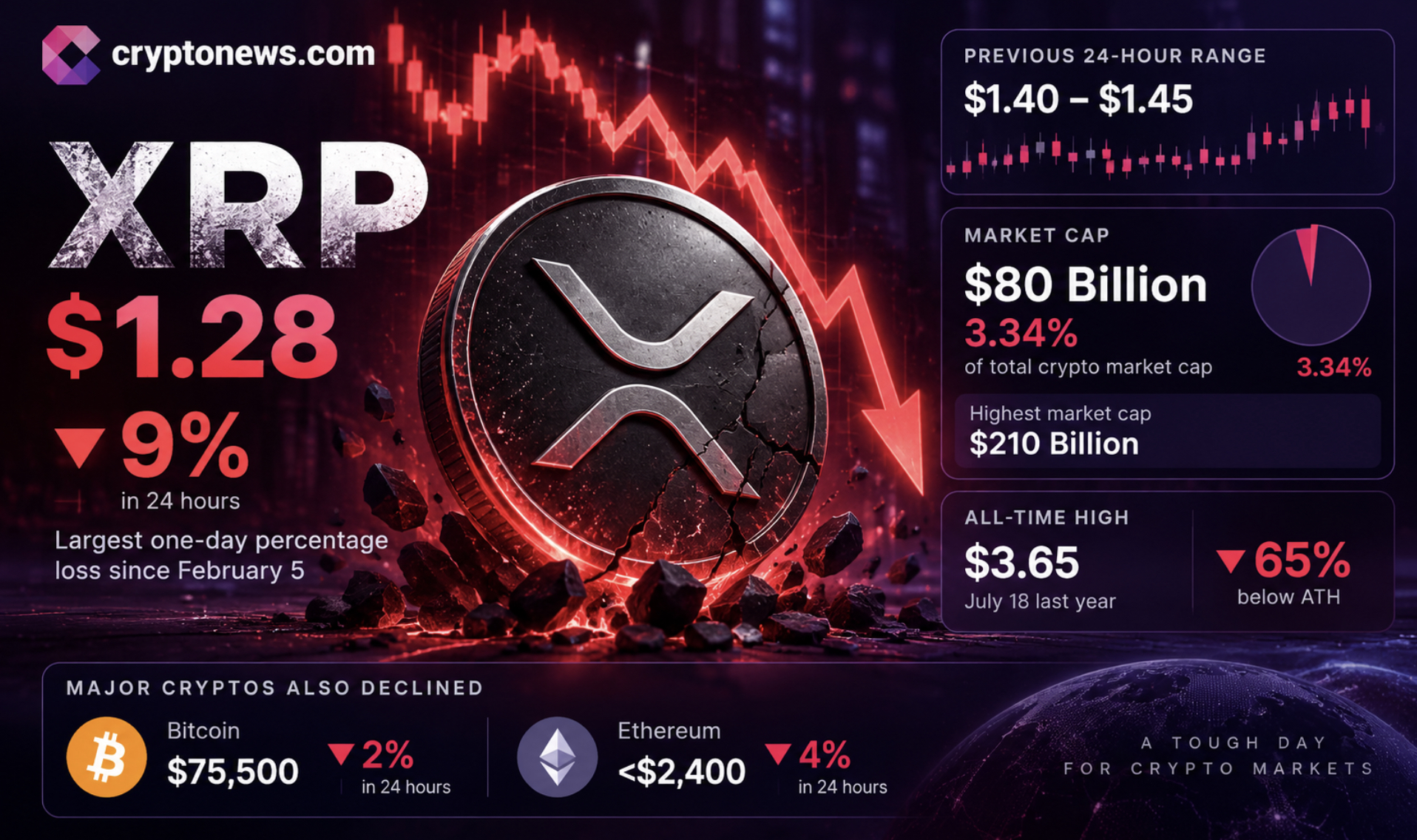
XRP price trades at $1.28, down 9% on the day. The decline was XRP’s largest one-day percentage loss since February 5. The move placed attention on how the token would trade after the sharp fall, as it was trading between $1.40 and $1.45 in the previous 24 hours.
The decline reduced XRP’s market cap to $80 billion, or 3.34% of the total cryptocurrency market cap. XRP’s highest market capitalization was at $210 billion. As this is being reported, the XRP price remains 65% below its all-time high of $3.65, set on July 18 last year.
Other major cryptocurrencies also declined during the session. Bitcoin was last at $75,500, down 2% on the day, while Ethereum traded at under $2,400, down 4%. Those declines provide important market context for XRP’s move.
XRP is trading at $1.28 after another sharp move lower, with the token down 0.7% over the past 24 hours. The decline becomes more significant across longer timeframes, with XRP down 8.2% over seven days and 10.4% over the past month.
Trading activity remains substantial, with XRP recording approximately $80.46 billion in 24-hour volume. Its market capitalization stands at around $5.88 billion, while the latest price action shows a volatile move lower after several failed recovery attempts.
At $1.28, XRP is now testing a much lower level following the recent selling pressure. The immediate question for traders is whether buyers can stabilize the price around this area or whether another wave of selling pushes XRP toward fresh lows.
The chart data also shows a volatile recovery attempt followed by another sharp move lower. XRP briefly rebounded from an earlier decline before sellers returned, pushing the price back toward $1.28. That price action makes the current level an important area to watch as the market searches for a potential stabilization point.
For now, the combination of a 10.4% monthly decline and substantial trading volume keeps the focus on whether buyers can absorb the remaining selling pressure.

 Login
Login







 WHAT TO WATCH TODAY — U.S. MARKETS
 EIA Oil Inventories
 FOMC RATE DECISION + DOT PLOT
 Fed Chair Kevin Warsh Press Conference…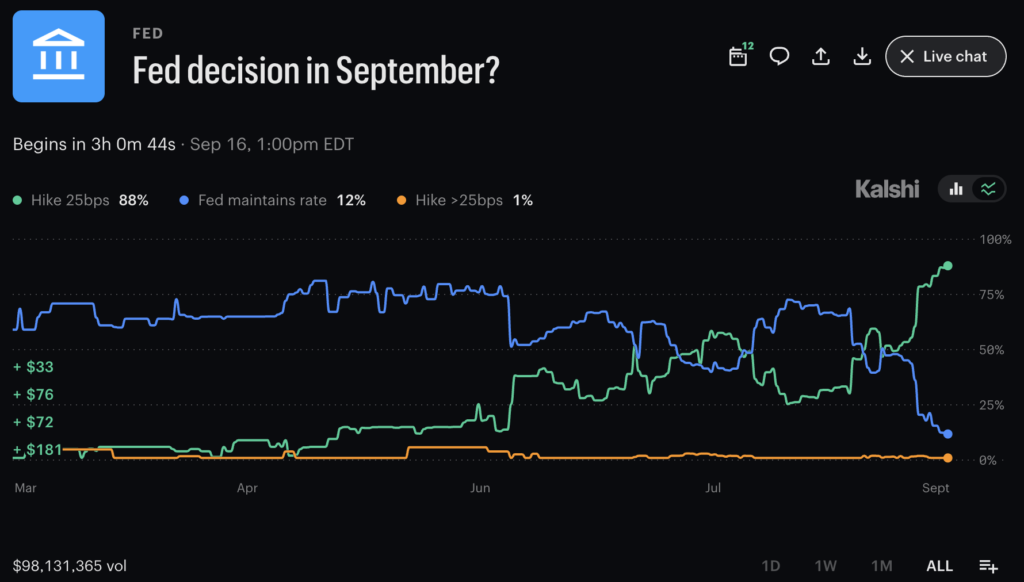














 Three historical floor patterns
 Each floor = massive breakout
 2015 floor → Explosive move
 (@TATrader_Alan)