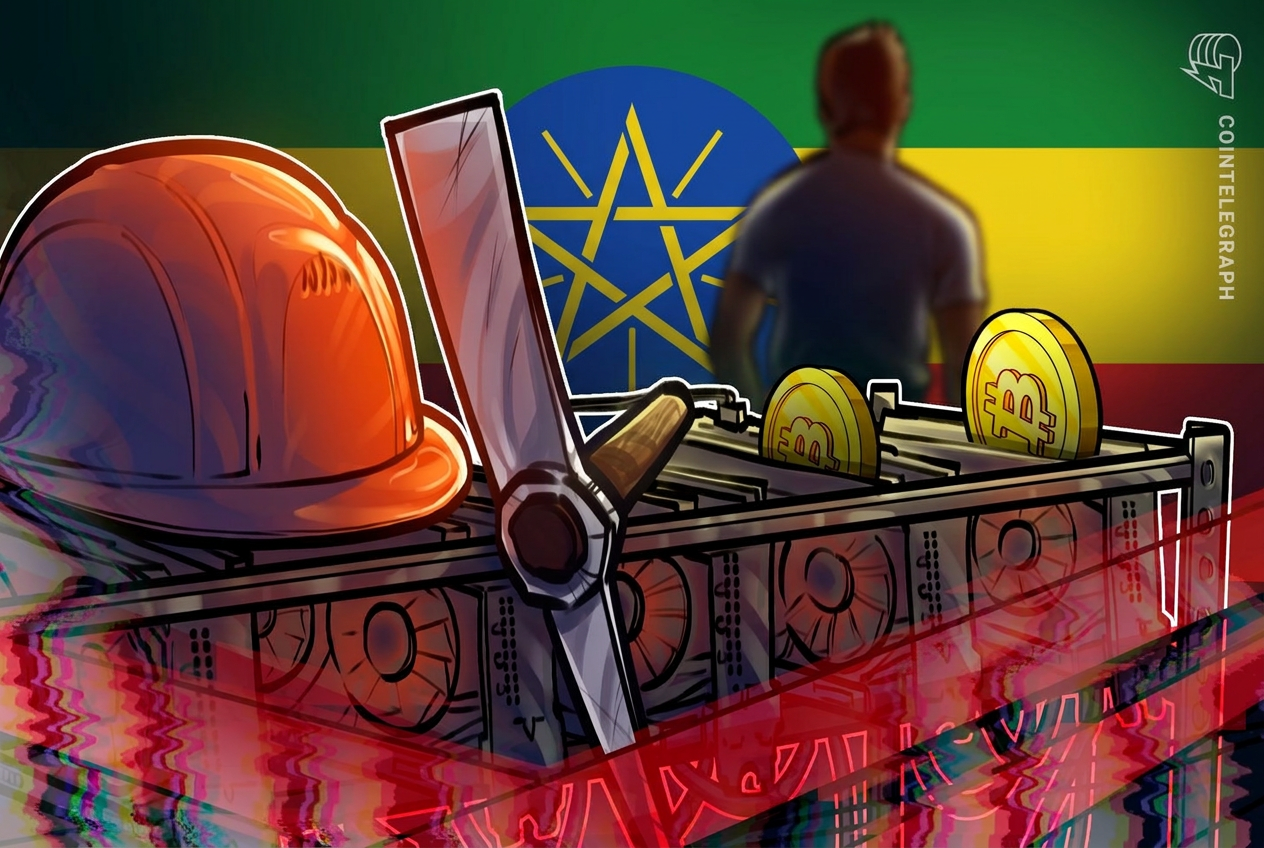
Ethiopia has cut electricity supplied to Bitcoin miners to 23% of contracted levels after a 20% drop in reservoir inflows strained the country’s hydropower system. Bloomberg reported on Tuesday that El Niño had intensified dry conditions across the East African…
On Wednesday, September 16, 2026, the first-ever space mission funded entirely by Dogecoin, DOGE-1, is scheduled to launch from the Kennedy Space Center in Florida. While this marks a historic milestone for digital assets, it arrives during a broader market correction. Yesterday, the US Senate rejected the Clarity Act, triggering a 2% decline in the total crypto market cap, which now sits at $2.57 trillion.
Analyzing the Market: Short-Term Correction vs. Long-Term Meme Coin Strength
The regulatory setback has led to a temporary wave of caution across major digital assets:
Bitcoin (BTC) is trading near $75,500, down approximately 1.5% on the day and 5% over the past week.
Ethereum (ETH) has declined by 5% this week, trading just under the $2,400 threshold.
Dogecoin (DOGE) has experienced a 13% weekly drop, alongside a 3.7% daily decline.
Despite this short-term volatility, the broader outlook for high-utility and community-backed assets remains robust. The meme coin sector has grown 21.6% over the past month, reaching a total valuation of $26.84 billion. Dogecoin itself has gained 13% over the last 30 days, maintaining a market capitalization of $13.62 billion. This sustained interest continues to drive capital into early-stage projects, with the Maxi Doge (MAXI) presale now rapidly approaching the $5 million milestone.
Technical Specifications of the DOGE-1 Mission
The DOGE-1 payload is a compact 40kg satellite designed to orbit the moon, collect surface imagery, and gather sensor data. Developed by Geometric Energy Corporation, the satellite is booked on a SpaceX Falcon 9 rideshare rocket. In addition to its scientific objectives, the satellite features a small external screen that will broadcast logos and digital art back to Earth.
While the launch has faced several delays over the past two years, final countdown preparations are underway. Market analysts, including Trader Tardigrade on X, are monitoring the event closely to assess how this high-profile deployment might influence the next market cycle for dog-themed digital assets.
Maxi Doge Capitalizes on Meme Coin Sector Resilience
For investors seeking exposure to the meme coin ecosystem with structured yield opportunities, Maxi Doge (MAXI) offers a secure entry point on the Ethereum network. To address security concerns, the project’s smart contracts have been fully audited by independent blockchain security firms Coinsult and SolidProof.
The project features a fixed total supply of 150.24 billion tokens, structured to support marketing, liquidity, development, and community incentives.
The Maxi Doge presale has successfully raised $4.86 million, targeting a hard cap milestone of $5.20 million. The current presale price stands at $0.0002839 per token, up from its initial offering price of $0.00025. A key feature of the ecosystem is its staking protocol, which currently offers a 64% Annual Percentage Yield (APY), allowing early participants to accumulate rewards prior to exchange listings.
How to Participate in the Maxi Doge Presale
Eligible participants can secure MAXI tokens by visiting the official Maxi Doge site and connecting a compatible Web3 wallet.
For mobile users, the presale is integrated with the Best Wallet app, which is available for download on the Apple App Store and Google Play. Users can find the presale directly under the “Upcoming Tokens” tab within the application.
The platform supports purchases using ETH, BNB, USDT, USDC, or standard bank cards. Once purchased, tokens can be immediately committed to the staking contract to begin earning the 64% APY. For real-time project updates and community discussions, users can follow the official X page and join the Telegram group.
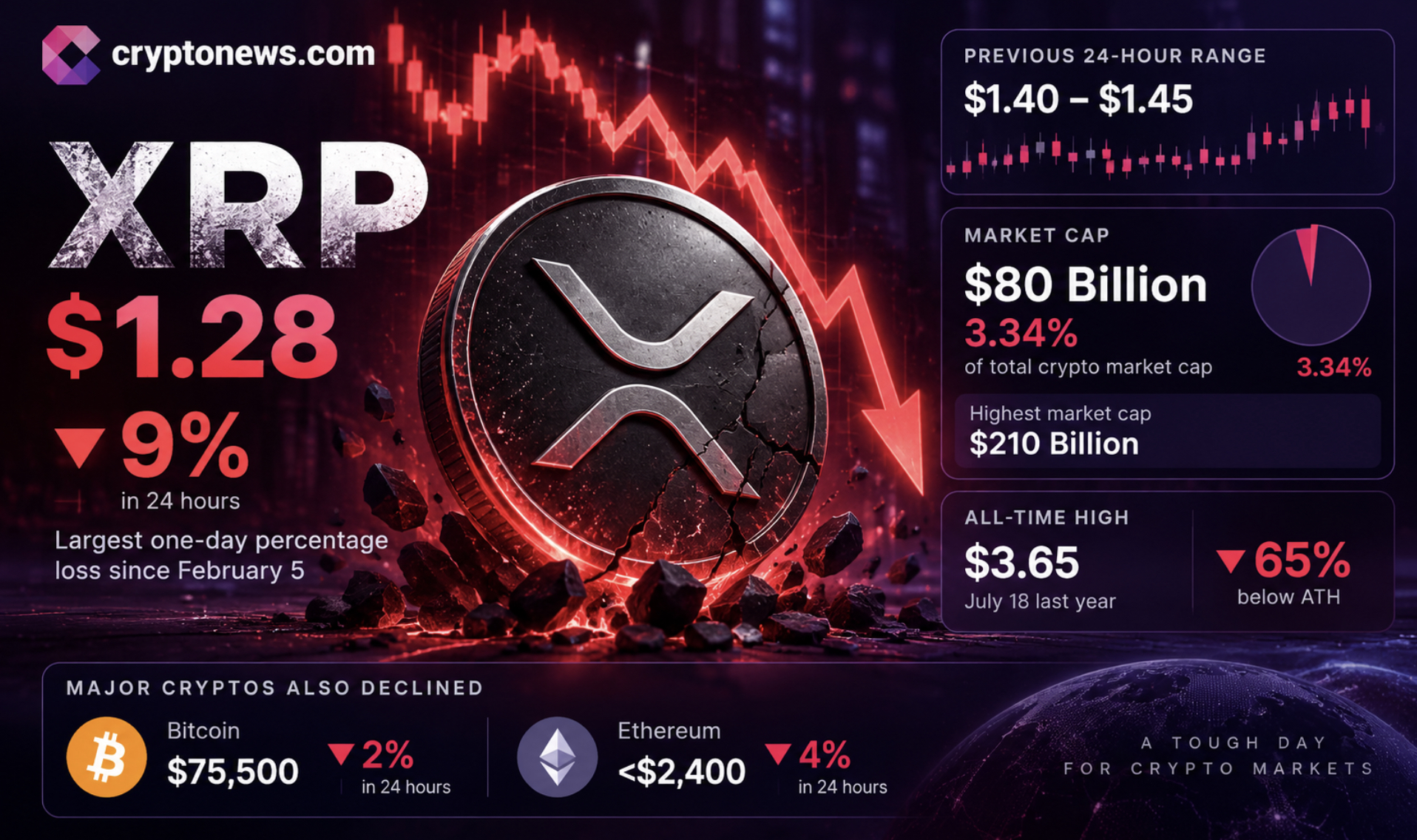
XRP price trades at $1.28, down 9% on the day. The decline was XRP’s largest one-day percentage loss since February 5. The move placed attention on how the token would trade after the sharp fall, as it was trading between $1.40 and $1.45 in the previous 24 hours.
The decline reduced XRP’s market cap to $80 billion, or 3.34% of the total cryptocurrency market cap. XRP’s highest market capitalization was at $210 billion. As this is being reported, the XRP price remains 65% below its all-time high of $3.65, set on July 18 last year.
Other major cryptocurrencies also declined during the session. Bitcoin was last at $75,500, down 2% on the day, while Ethereum traded at under $2,400, down 4%. Those declines provide important market context for XRP’s move.
XRP is trading at $1.28 after another sharp move lower, with the token down 0.7% over the past 24 hours. The decline becomes more significant across longer timeframes, with XRP down 8.2% over seven days and 10.4% over the past month.
Trading activity remains substantial, with XRP recording approximately $80.46 billion in 24-hour volume. Its market capitalization stands at around $5.88 billion, while the latest price action shows a volatile move lower after several failed recovery attempts.
At $1.28, XRP is now testing a much lower level following the recent selling pressure. The immediate question for traders is whether buyers can stabilize the price around this area or whether another wave of selling pushes XRP toward fresh lows.
The chart data also shows a volatile recovery attempt followed by another sharp move lower. XRP briefly rebounded from an earlier decline before sellers returned, pushing the price back toward $1.28. That price action makes the current level an important area to watch as the market searches for a potential stabilization point.
For now, the combination of a 10.4% monthly decline and substantial trading volume keeps the focus on whether buyers can absorb the remaining selling pressure.
Kakao has set a 2030 revenue target of more than 6 trillion won ($4.3 billion) for its planned KakaoAI business as it prepares to bring AI agents directly into KakaoTalk and separate its investment operations into KakaoX. Yonhap reported on…
Binance has opened its Capital Connect investment marketplace to eligible individual users for the first time, giving wealthy clients access to professionally managed strategies previously reserved for institutional investors. CNBC reported that the cryptocurrency exchange is expanding access as it…
Geneva, Switzerland — September 16, 2026 — The Office of Justin Sun today announced the establishment of the Justin Sun Prize, a zero-trust, decentralized academic bounty mechanism based on a “problem list,” with breakthroughs in fundamental disciplines and machine formal verification as the criteria for awarding prizes, and a top prize of up to US$1 million for a single problem. The prize seeks to redefine scientific rewards in the AI era and accelerate fundamental scientific research through collaboration between humans and AI.
The first list of Justin Sun Prize winners was also announced, recognizing solutions and formalized proofs involving 66 mathematical problems. The top prize, worth US$1 million, was awarded to the OpenAI research team in recognition of its solution and formalized proof for the Existence and Smoothness of the Three-Dimensional Navier–Stokes Equations problem. According to information published by OpenAI, the relevant proof was produced by its internal model, and the Lean formalization and verification were completed by GPT‑6 Astra.
This problem concerns the Navier–Stokes equations, which describe the motion of fluids and are commonly abbreviated as the N–S equations. The equations were developed in the 19th century by French physicist Claude-Louis Navier, Irish-born British mathematician George Gabriel Stokes, and others, and have a history of approximately two hundred years. In 2000, the Clay Mathematics Institute listed the Navier–Stokes Existence and Smoothness problem as one of the seven Millennium Prize Problems and offered a US$1 million reward for its solution.
The Justin Sun Prize does not use traditional nominations or credential thresholds as barriers to entry, nor does it operate on a four-year cycle or the rhythm of lifetime achievement. Instead, it ties the prize directly to mathematical problems and machine-verifiable formalized proofs. Anyone can receive the prize as long as they are the first to achieve a qualifying breakthrough.
The vision of the Justin Sun Prize is to become the “Nobel Prize of the AI Era,” responding to the profound transformation of scientific research and incentives in the new era in a more decentralized, formalized, and machine-driven way. The repository of mathematical problems and formalized code will be maintained and publicly updated on an ongoing basis. Once a problem is listed, it is locked in: problems can be added only, never removed; awarded prize funds do not need to be returned under any circumstances.
The current problem list already includes formal verification of the Poincaré Conjecture, the Riemann Hypothesis, Goldbach’s Conjecture, and a large number of unsolved problems proposed during the lifetime of the late mathematician and Wolf Prize laureate Paul Erdős.
In addition to the prize, winners will also receive a certificate and a medal. The edge of the medal is inscribed with the Latin phrase “Quod probatur, solvitur,” meaning “Proved, then paid.”
The Justin Sun Prize adheres to three core principles: openness, public benefit, and open source. It is open to all eligible contributors, with no restrictions based on nationality, institution, or identity, and makes no distinction between humans and AI; funds are used exclusively for prize awards and open initiatives and are not intended for profit; the problem list, confirmation standards, proofs, and verification materials are all made available to the public through GitHub, while prize disbursement records are recorded on-chain for permanent traceability and immutability.
“An award named after a person is the least political thing in the world,” said Sun. “More importantly, it gives me an answer to myself—my wealth is rooted in mathematics. It came from mathematics, and it will return to mathematics.”
According to public records, Sun has donated more than US$45 million across technology, environmental protection, disaster relief, and other fields. The Justin Sun Prize will become a central focus of Sun’s philanthropic efforts, continuing to support breakthroughs in fundamental science through an open and verifiable model.
The prize will be paid out in either USDT on TRON (TRC-20) or USDC on Ethereum (ERC-20) based on the recipient’s choice. For more information, please visit www.hejustinsun.com/prize.
About the Office of Justin Sun
The Office of Justin Sun supports Justin Sun’s global business, philanthropic and public initiatives across technology, blockchain, artificial intelligence, scientific research, investment, art and space exploration.
Justin Sun is the Ambassador and former Permanent Representative of Grenada to the World Trade Organization and the Founder of TRON. TRON is the leading blockchain for the stablecoin revolution, processing over $13 trillion in volume since its inception. In the world’s emerging markets, people rely on USDT on TRON to access the global financial system.
A protégé of Alibaba founder Jack Ma, Sun has been recognized internationally for his work in the digital asset industry, including a Forbes cover profile in April 2025 and multiple appearances on the Forbes 30 Under 30 list. In August 2025, he flew aboard Blue Origin’s NS-34 mission, becoming the 712th person in history to travel to space. His broader interests span technology, investment, philanthropy, art, gaming, and space exploration.
The Justin Sun Prize is an academic initiative established by Justin Sun to support advances in mathematics, formal verification, and AI-assisted scientific discovery. The prize is decentralized and built around the principle that mathematical work should be judged by the strength, rigor, and verifiability of the proof itself, not the prestige or reputation of those submitting it.
Justin Sun established the prize in his own name as a long-term commitment to return wealth created through mathematics and technology back to mathematics itself. Its legacy is intended to be defined by the body of work it recognizes and the laureates whose discoveries stand the test of time. The prize links clearly defined mathematical challenges to machine-verifiable proof. Its guiding principles are openness, public benefit and open-source access.
Mutsamudu, Comoros, September 16, 2026 – MEXC, a pioneer in 0-fee digital asset trading, has released its July–August 2026 security report. The report shows that MEXC successfully intercepted all 215 reports involving risk-related funds during the period, covering approximately 38.66 million USDT. The total balance of the Futures Insurance Fund rose to 792 million USDT. Meanwhile, the reserve ratios for BTC, ETH, USDT, and USDC all remained above 100%.
In July and August 2026, the crypto industry recorded 184 security incidents, with reported losses totaling approximately $535 million. Phishing and fraud incidents, together with endpoint and supply-chain security incidents, accounted for approximately 48% of the total. At the same time, a growing number of attackers are using AI to auto-generate phishing content and help write malware, increasing the efficiency of their attacks. As attack methods become more diverse, promptly identifying and intercepting risk-related funds and strengthening cross-platform investigation have become increasingly important to reducing user losses.
All 215 Reports of Risk-Related Funds Successfully Intercepted, Covering 38.66 Million USDT
In July and August, MEXC assisted with 215 reports involving externally stolen or fraud-related funds flowing into the platform. All 215 cases were successfully intercepted, covering 38,655,490 USDT. Of these cases, 42 involved assistance with judicial freezes. Compared with the previous reporting period, the number of successfully intercepted cases increased by approximately 2,971%, while the value of intercepted funds increased by approximately 12,646%.
In tracking and handling risk-related funds, MEXC shared suspicious addresses with major industry participants, assisted in identifying fund flows, and supported verification and freezing procedures under established joint-investigation and law-enforcement cooperation procedures.
Over 20,000 Risk-Related Accounts Identified and Restricted, With More Than 600,000 USDT in Misdirected Assets Returned
In account risk identification, MEXC identified and restricted 20,752 accounts associated with risk-related activities during the period, an increase of 118.03% from the previous reporting period. The platform identified 5,288 risk groups, up 20.35%. By region of origin, these groups were concentrated primarily in the Commonwealth of Independent States (1,803), Nigeria (1,099), and Indonesia (976).
For user asset recovery, MEXC manually processed 818 applications for the return of misdirected assets, returning the equivalent of 602,225 USDT, an increase of 75.31% from the previous reporting period.
Futures Insurance Fund Reaches 792 Million USDT, Strengthening Protection Against Negative Balance Risk
As of September 1, 2026, the total balance of the MEXC Futures Insurance Fund reached 791,696,422 USDT, an increase of 5.44% from the previous reporting period.
The Futures Insurance Fund covers negative balances that may arise during liquidation, providing a risk buffer during extreme market conditions and helping reduce the likelihood of auto-deleveraging (ADL). When a liquidated position is closed at a price better than the bankruptcy price, the remaining funds are credited to the fund. Users can view the real-time balance on the MEXC Proof of Trust page.
Reserve Ratios for Four Major Assets Remain Above 100%, With BTC at Approximately 288%
According to the proof of reserves disclosed for this period, MEXC maintained reserve ratios above 100% for four major assets, as follows:
Bitcoin (BTC): reserve ratio of approximately 288%, with total wallet assets of 12,312.75 BTC against 4,282.20 BTC in user assets;
Ethereum (ETH): reserve ratio of approximately 113%, with total wallet assets of 66,227.79 ETH;
USDT: reserve ratio of approximately 115%, with total wallet assets of approximately 1.940 billion USDT;
USDC: reserve ratio of approximately 114%, with total wallet assets of approximately 194.85 million USDC.
The on-chain addresses corresponding to these reserve assets have been disclosed, allowing users to verify through the Merkle Tree whether their individual account balances were included in this proof of reserves.
As an additional layer of user asset protection, the MEXC Guardian Fund maintains a dual-reserve structure of USDT and BTC: USDT provides immediate liquidity support, while BTC serves as a long-term reserve asset across market cycles. MEXC plans to expand the fund from $100 million to $500 million, continuing to strengthen user asset protection. The relevant holding addresses are listed below:
Guardian Fund Wallet Addresses:
USDT: 0x469AfE803C54A36674C55231489Cf4b61da8c1bC
BTC: 1MDVjZdX8QD212pT8Z8EMP7DuFQHKqN3mx
MEXC CEO Vugar Usi said, “Trust is the true reserve currency of this industry. Protecting user assets means moving decisively the moment risk emerges, while giving users something they can verify for themselves, not just our word for it. We will continue to strengthen our ability to identify and intercept risk-related funds, deepen cooperation across platforms and with law enforcement, and help affected users recover their losses wherever possible. Our bi-monthly security reports are part of that commitment, allowing our security performance to be measured and tracked over time.”
About MEXC
Founded in 2018, MEXC is a leading global multi-asset trading platform built as your 0-fee gateway to infinite opportunities. Serving users across 170+ markets, MEXC provides simple and efficient access to crypto, stocks, tokenized assets, derivatives, and a growing range of TradFi-linked opportunities through one account and one gateway.
With 0 trading fees, deep liquidity, broad asset coverage, and a high-performance trading experience, MEXC is designed for retail users who want to discover earlier, act faster, and trade with fewer barriers. As crypto and traditional finance continue to converge, MEXC is committed to making global opportunities more accessible, helping users trade freely and MEXCmize every opportunity.
The most-quoted AI agent statistics count intent, and real use in any single department is no more than 10 percent, finds a source-checked analysis by bdautomated
75 figures from 18 publishers traced to the original reports, with who was asked and what counted; the dataset is free to download
15 September 2026. bdautomated today published “AI agent statistics 2026: every number checked at its source”, a free reference page and dataset that traces 75 widely quoted statistics about AI agents and AI use in business back to the documents they came from.
The analysis finds that the numbers disagree because they count different things. In McKinsey’s 2025 global survey, 62 percent of organizations were at least experimenting with AI agents, 23 percent had scaled one somewhere in the company, and in any single business function no more than 10 percent had. Surveys that count any adoption or intent report far higher figures: 79 percent of U.S. executives told PwC in April 2025 that agents were already being adopted in their companies, while a Capgemini survey that re-checked what respondents meant by “agent” found 14 percent had implemented one. Across all U.S. businesses of every size, the Census Bureau found 19.8 percent using AI in any business function as of May 2026.
The page also decodes the figure that rattled markets in 2025. MIT Project NANDA’s finding that “95 percent of organizations are getting zero return” measured profit-and-loss impact within roughly six months of a pilot, in a sample of 52 interviews, 153 conference survey responses and 300 public deployments, and its authors call the findings preliminary. It does not say that 95 percent of AI projects fail. Gartner’s prediction that over 40 percent of agentic AI projects will be canceled by the end of 2027 is a forecast from June 2025; nobody has counted the cancellations yet.
Every figure on the page passed four checks: the number appears in the original document; the exact place and a verbatim quote are recorded; what it measures is written in plain words, including who was asked, how many and when; and it is set against the other sources, with disagreements shown rather than averaged. Market-size forecasts were left out because the reports behind them are paid and cannot be checked. The dataset is published as CSV and JSON under a CC BY 4.0 licence, and the page carries a corrections address.
“Two headlines in the same week said almost nobody has AI agents running and almost everybody does, and both were quoting real surveys. We wanted the page we could not find: what each survey actually asked, so a business owner can tell which number is about a company like theirs,” said a spokesperson for bdautomated.
The page includes four charts that other publications may embed with attribution, and a table of all 75 figures with their sources, dates, samples and quotes.
About bdautomated
bdautomated builds The Book, a named staff of AI agents installed in the accounts a company already runs on. The agents research, prepare, draft, chase and check, each at the level of autonomy the customer sets. bdautomated hosts nothing and stores no customer records.
https://bdautomated.com/
Upbit joins as Presenting Partner, with 0G and BRV confirmed as Official Conference Partners
Stable and Tria join as Diamond Sponsors, while BitGo comes on board as Official Institutional Sponsor
Kyoungsuk Oh, Michael Heinrich, Brian Mehler, John Lilic and Mike Belshe among featured speakers
Korea Blockchain Week 2026 with Upbit (KBW2026), Asia’s leading digital asset conference, has unveiled its partner lineup, bringing together major players across exchanges, blockchain infrastructure, stablecoins and institutional digital assets.
FACTBLOCK, the organizer of KBW2026, announced on August 31 that Upbit, 0G, BRV, Stable, Tria and BitGo will participate as key sponsors of this year’s event. Beyond brand partnerships, CEOs and founders from the participating companies will also take the stage as speakers to discuss some of the most significant shifts shaping the global digital asset industry.
Upbit is the Presenting Partner of KBW2026. Kyoungsuk Oh, CEO of Upbit, will also speak at the conference, sharing his perspective on changes in the global digital asset market and the role of Korea. Through its partnership with Upbit, KBW2026 will broaden the conversation around Korea’s digital asset market beyond retail investors to include institutional participation and global financial markets.
Decentralized AI infrastructure company 0G and global venture capital firm BRV will participate as the Official Conference Partners. Michael Heinrich, Co-Founder and CEO of 0G Labs, will take the KBW2026 main stage to explore the rise of the agent economy and how decentralized infrastructure is creating a new foundation for AI.
0G is the trust layer for AI, bringing together verifiable compute, private inference, decentralized storage and an AI-native blockchain to power the next generation of AI applications and autonomous agents. BRV will also join as a Conference Partner, further strengthening KBW2026’s global investment and industry network.
Global digital asset infrastructure company BitGo will participate as the Official Institutional Sponsor. BitGo Korea, whose strategic shareholders include Hana Financial Group and SK Telecom, recently secured acceptance of its Virtual Asset Service Provider (VASP) registration from Korea’s Financial Intelligence Unit (KoFIU), establishing a regulatory foundation for its domestic operations. Mike Belshe, Co-Founder and CEO of BitGo, will also speak at KBW2026.
Stable and Tria will participate as Diamond Sponsors. Brian Mehler, CEO of Stable, and John Lilic, Co-Founder and Chief Strategy Officer of Tria, will each take the stage at KBW2026. Stable is building blockchain infrastructure optimized for stablecoin payments and transfers, while Tria is building financial infrastructure enabling businesses and AI agents to transact across blockchains and digital assets, powering its growing stablecoin neobank.
This year’s sponsor lineup reflects the continued expansion of the global digital asset industry beyond trading and investment into institutional finance, payments, stablecoins, AI and next-generation infrastructure. With senior executives from many of these companies participating not only as sponsors but also as speakers, KBW2026 will offer attendees a firsthand look at the strategies of companies driving the industry’s next phase of growth.
KBW2026 will take place in Seoul from September 29 to October 1. The Upbit Institutional Summit (UIS), an invite-only gathering focused on institutions and the financial sector, will be held on September 29, followed by the KBW2026 main conference from September 30 to October 1.
Andrew Park, CEO of FACTBLOCK, said, “This year, KBW is bringing together key partners that are shaping the next stage of the industry, spanning exchanges, institutional digital asset infrastructure, AI, stablecoins and next-generation financial services. With senior executives from these companies also taking the stage as speakers, KBW2026 will provide a valuable opportunity to see where the most important changes in the global digital asset market are emerging.
Germany’s largest bank is awaiting regulatory approval to launch institutional custody solutions for Bitcoin, Ether and select stablecoins before expanding into tokenized assets.
Bitcoin miners generated 35% of the state-owned power producer’s revenue last year, but declining reservoir inflows led the utility to prioritize households and manufacturers.
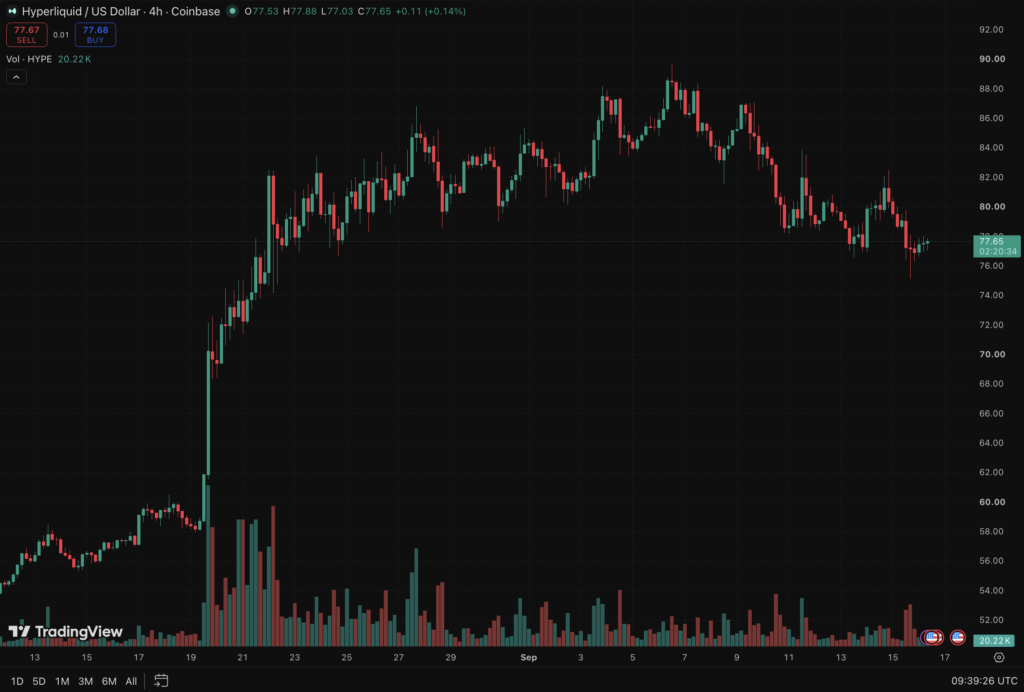
Federal prosecutors charged former Robinhood Crypto engineers Hefu Chai, 36, and Huaisong “Jerry” Xiang, 30, with one count of commodities fraud and one count of wire fraud each, alleging they used confidential information about upcoming Robinhood token listings to trade related perpetual futures on Hyperliquid before those listings went public.
Each defendant allegedly profited more than $50,000 between 2025 and 2026, according to the U.S. Attorney’s Office for the Southern District of New York.
Two Robinhood Engineers Charged With Trading on Confidential Crypto Listing Information
The U.S. Attorney’s Office for the Southern District of New York charged Robinhood engineers Hefu Chai and Huaisong Xiang with commodities fraud and wire fraud for allegedly using… pic.twitter.com/ilNUqbJJj4
The case matters beyond the dollar figures because it extends crypto insider-trading enforcement to decentralized derivatives markets, not just spot exchanges.
Prosecutors are applying commodities fraud and wire fraud theories to trading on a venue with no central listing desk or traditional KYC gatekeeper, signaling that jurisdiction over misappropriated information does not stop at a platform’s front door.
On September 15, 2026, the U.S. Attorney’s Office for the Southern District of New York announced charges against Chai from Menlo Park, California, and Xiang from Jersey City, New Jersey.
Both engineers at Robinhood allegedly accessed nonpublic information about upcoming cryptocurrency listings and profited by buying perpetual futures on Hyperliquid before public announcements.
The DOJ claims this violated their confidentiality obligations for personal gain. U.S. Attorney Jamie McDonald emphasized that corporate insiders cannot evade laws by trading derivatives.
The commodities fraud charge carries a maximum of 10 years, while the wire fraud charge could result in up to 20 years in prison if convicted. Robinhood said it is committed to market integrity and reported the matter to authorities, cooperating fully with the investigation.
Perpetual futures let traders take leveraged bets on an asset’s price without holding the token, and they never expire as long as funding payments keep them aligned with the spot price.
This makes them ideal for front-running listing announcements, since there’s no need to source the actual token and no custody risk.
The DOJ is pursuing this case under the Commodity Exchange Act and wire fraud statutes instead of securities fraud, allowing it to address derivatives trading on decentralized platforms without debating the status of underlying tokens.
This approach differs from the earlier Coinbase case involving Ishan Wahi, who was charged for sharing confidential token-listing information.
Hyperliquid, a major decentralized platform for perpetual futures, is already under regulatory scrutiny, and this case adds a criminal dimension.
The takeaway for traders is clear: pre-listing perp flow on decentralized venues now falls within the DOJ’s focus, and insiders trading through derivatives may face risks similar to those trading spot tokens directly.
The charges against Chai and Xiang are allegations only, and both defendants are presumed innocent unless proven guilty. No trial date or plea has been reported.
 Login
Login




Every single time #Dogecoin has consolidated at a floor level, it has launched into a parabolic bull run.
Three historical floor patterns
Each floor = massive breakout
2015 floor → Explosive move
(@TATrader_Alan) September 16, 2026