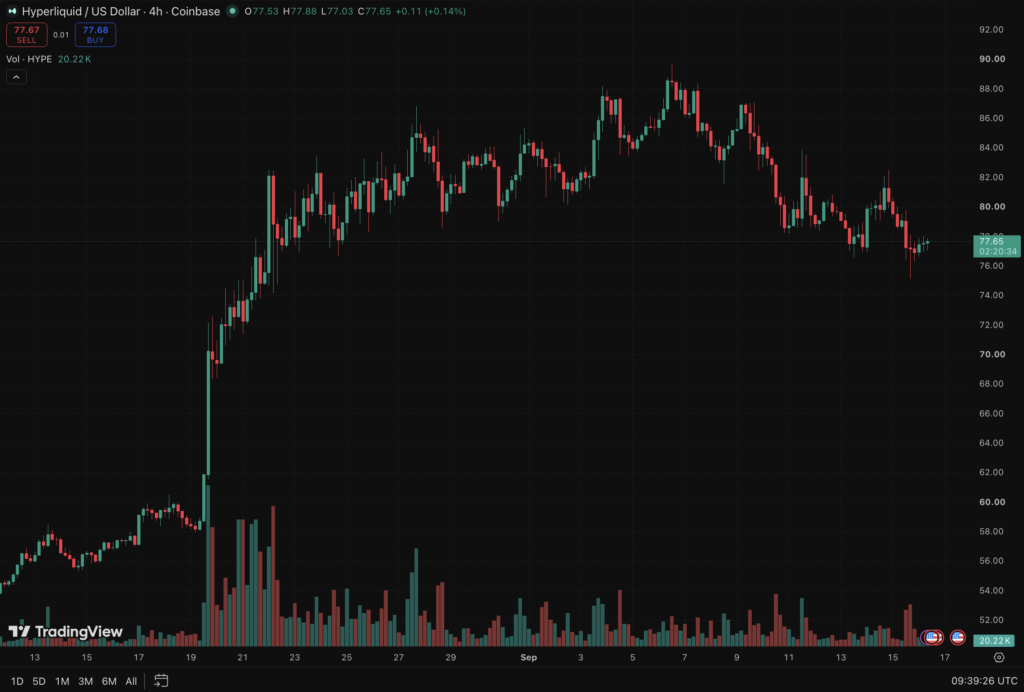
A Grade-S Hyperliquid whale has continued to add to his million-dollar XRP long position despite currently nursing losses due to the recent price crash. XRP recently collapsed alongside the rest of the crypto market after the U.S.
The XRP Ledger’s (XRPL) Batch amendment has received enough validator support and is now in its activation period. XRPL validator Vet (Hussein Zangana) said 29 of 35 validators voted yes, giving the amendment 82.86% support.
Bitcoin and gold are moving together more closely than they have in years. This challenges the usual view that Bitcoin is a riskier asset, while gold is a safe haven.
XRP has posted a sharper decline than most major cryptocurrencies over the past 24 hours, with its price falling below the $1.30 threshold. The broader crypto market also came under heavy selling pressure after the U.S.
Grayscale has responded to the U.S. Senate’s failure to advance the Digital Asset Market Clarity Act, saying the setback will not stop progress toward clearer cryptocurrency regulations.
Federal prosecutors charged former Robinhood Crypto engineers Hefu Chai, 36, and Huaisong “Jerry” Xiang, 30, with one count of commodities fraud and one count of wire fraud each, alleging they used confidential information about upcoming Robinhood token listings to trade related perpetual futures on Hyperliquid before those listings went public.
Each defendant allegedly profited more than $50,000 between 2025 and 2026, according to the U.S. Attorney’s Office for the Southern District of New York.
Two Robinhood Engineers Charged With Trading on Confidential Crypto Listing Information
The U.S. Attorney’s Office for the Southern District of New York charged Robinhood engineers Hefu Chai and Huaisong Xiang with commodities fraud and wire fraud for allegedly using… pic.twitter.com/ilNUqbJJj4
The case matters beyond the dollar figures because it extends crypto insider-trading enforcement to decentralized derivatives markets, not just spot exchanges.
Prosecutors are applying commodities fraud and wire fraud theories to trading on a venue with no central listing desk or traditional KYC gatekeeper, signaling that jurisdiction over misappropriated information does not stop at a platform’s front door.
On September 15, 2026, the U.S. Attorney’s Office for the Southern District of New York announced charges against Chai from Menlo Park, California, and Xiang from Jersey City, New Jersey.
Both engineers at Robinhood allegedly accessed nonpublic information about upcoming cryptocurrency listings and profited by buying perpetual futures on Hyperliquid before public announcements.
The DOJ claims this violated their confidentiality obligations for personal gain. U.S. Attorney Jamie McDonald emphasized that corporate insiders cannot evade laws by trading derivatives.
The commodities fraud charge carries a maximum of 10 years, while the wire fraud charge could result in up to 20 years in prison if convicted. Robinhood said it is committed to market integrity and reported the matter to authorities, cooperating fully with the investigation.
Perpetual futures let traders take leveraged bets on an asset’s price without holding the token, and they never expire as long as funding payments keep them aligned with the spot price.
This makes them ideal for front-running listing announcements, since there’s no need to source the actual token and no custody risk.
The DOJ is pursuing this case under the Commodity Exchange Act and wire fraud statutes instead of securities fraud, allowing it to address derivatives trading on decentralized platforms without debating the status of underlying tokens.
This approach differs from the earlier Coinbase case involving Ishan Wahi, who was charged for sharing confidential token-listing information.
Hyperliquid, a major decentralized platform for perpetual futures, is already under regulatory scrutiny, and this case adds a criminal dimension.
The takeaway for traders is clear: pre-listing perp flow on decentralized venues now falls within the DOJ’s focus, and insiders trading through derivatives may face risks similar to those trading spot tokens directly.
The charges against Chai and Xiang are allegations only, and both defendants are presumed innocent unless proven guilty. No trial date or plea has been reported.
Sports gaming firm Underdog has sued Connecticut officials in federal court to stop the state from treating its sports event contracts as illegal gambling, extending its legal fight against state regulators to a sixth jurisdiction. According to Underdog’s lawsuit filed…
Polymarket has moved its primary blockchain indexing infrastructure in-house, cutting the time needed to surface some onchain events by as much as 14 blocks, or roughly 28 seconds. Polymarket Vice President of Engineering Josh Stevens said the prediction market platform…
XRP whale transactions recently pulled out more than $165 million from exchanges, marking the largest intraday figure since late February. While the XRP price has continued to face selling pressure from the bears after hitting the $1.69 high in late August, on-chain data indicates that whale transactions have become rather dominant on exchanges, skewing more toward withdrawals.
XRP needs to reach a strong double-digit price to overtake Bitcoin in market value, based on David Schwartz’s prediction that XRP will grow faster than BTC. Schwartz, Ripple’s former CTO, recently said he believes XRP will one day surpass Bitcoin.
The Midnight Foundation has announced a major milestone in the NIGHT token redemption process, with users now redeeming 2 billion NIGHT tokens. According to the announcement, users have redeemed 2 billion NIGHT tokens since the redemption process began in December 2025.
The US House Ways and Means Committee will review a broad digital asset tax package that excludes a key proposal sought by crypto miners and stakers. The 114-page Digital Asset Tax Certainty Act, H.R.
XRP derivatives activity has weakened on exchanges, even though XRP is still trading well above its August lows. Meanwhile, rising liquidity on Binance suggests more market activity.
Activity in the XRP market on Binance is picking up, with data showing that the 30-day XRP Liquidity Index has reached its highest level in about six months. The rise comes after several months of weaker activity and indicates that the market may be witnessing more movement.
Ark Invest reduced several major crypto-linked positions on Monday as digital asset stocks moved higher. The firm’s biggest disclosed sale involved its ARK 21Shares Bitcoin ETF, followed by reductions in Circle and Coinbase.
Balancer is moving closer to a possible shutdown after its restructuring failed to produce a sustainable revenue recovery. The decentralized exchange has proposed an orderly wind-down that could return more than $9 million in treasury assets to BAL holders.
The CLARITY Act’s Polymarket probability of becoming law in 2026 dropped to 16% on Monday amid Senate Democratic resistance to Republicans’ revised ethics terms, with Democratic negotiators also working on a counterproposal. Traders had pushed the probability to 35% after Republicans circulated revised legislation containing broader ethics provisions.
Popular Hong Kong-based exchange CoinEx has announced plans to cease operations and begin an orderly wind-down, with the exchange still holding a substantial amount of Shiba Inu in its reserves. According to data from Arkham Intelligence, CoinEx held 442,792,693,142 (442.793 billion) Shiba Inu in the hours leading up to press time.
XRP price could rally soon as Ripple CEO Brad Garlinghouse is urging U.S. senators to approve the CLARITY Act, saying the latest version includes important compromises.

 Login
Login