❌

Reading view

There are new articles available, click to refresh the page.

Coinbase Q3 Earnings Show 66% Profit Jump as Prediction Markets Grow

TL;DR:

  • Coinbase reported $719 million in net income for Q3 2026, marking a 66% increase year over year. However, total revenue declined 35% to $1.22 billion, while prediction markets generated more than $200 million in annualized revenue as the exchange expanded beyond traditional crypto trading.
  • Coinbase reported a significant increase in third-quarter net income, returning to profitability after a challenging period for its core trading business.
  • According to its October 29 earnings report, Coinbase generated $719 million in net income, compared with $433 million during the same quarter last year.

Total revenue reached approximately $1.22 billion, representing a 35% decline year over year. The results highlight the difference between Coinbase’s reported profitability and the pressure still affecting its traditional trading operations.

Prediction Markets Become a New Revenue Driver

One of the most notable developments in Coinbase’s Q3 earnings was the expansion of its prediction markets business.

The company reported that annualized revenue from prediction markets surpassed $200 million, approximately doubling from the previous quarter. CEO Brian Armstrong described the segment as one of the fastest-growing products in Coinbase’s history.

Bernstein analysts noted that prediction markets and derivatives helped offset weaker activity in spot cryptocurrency trading. Together, these businesses accounted for approximately 25% of Coinbase’s transaction revenue.

The development supports Coinbase’s broader ambition to become an everything exchange, bringing multiple financial products under one platform. Bitcoinist previously covered Coinbase’s expansion into prediction markets and stock trading, which forms part of this wider strategy.

Trading Revenue Remains Under Pressure

Despite the growth of newer products, Coinbase’s traditional trading business continued to face challenges.

Transaction revenue fell 43% year over year to approximately $590 million. Spot trading volume also declined 8% quarter over quarter, reaching $135 billion. Derivatives trading volume decreased 7% from the previous quarter to approximately $986 billion, although the decline was smaller than the broader industry’s 11% contraction, according to Bernstein.

Meanwhile, subscription and services revenue contributed $570 million, accounting for nearly 49% of net revenue. Stablecoin-related revenue reached $328 million, increasing 3% quarter over quarter.

This growing contribution from subscriptions and stablecoins reflects Coinbase’s efforts to reduce its dependence on market-driven trading fees. The exchange has also continued expanding its USDC ecosystem, including through its growing stablecoin integration strategy.

Coinbase’s Diversification Strategy Faces Its Next Test

The Coinbase Q3 earnings and latest financial results demonstrate progress in building revenue streams beyond conventional cryptocurrency trading.

The company’s prediction markets business, derivatives offerings, and subscription services are becoming increasingly important as trading activity fluctuates with broader market conditions. However, the $715 million investment gain behind its quarterly profit also highlights how closely Coinbase’s reported earnings remain connected to cryptocurrency valuations.

The exchange will need to demonstrate that its newer businesses can sustain growth even when digital asset prices and trading volumes weaken.

For now, Coinbase’s Q3 results offer evidence that its diversification strategy is gaining traction, although its core trading business remains exposed to the broader crypto market cycle.

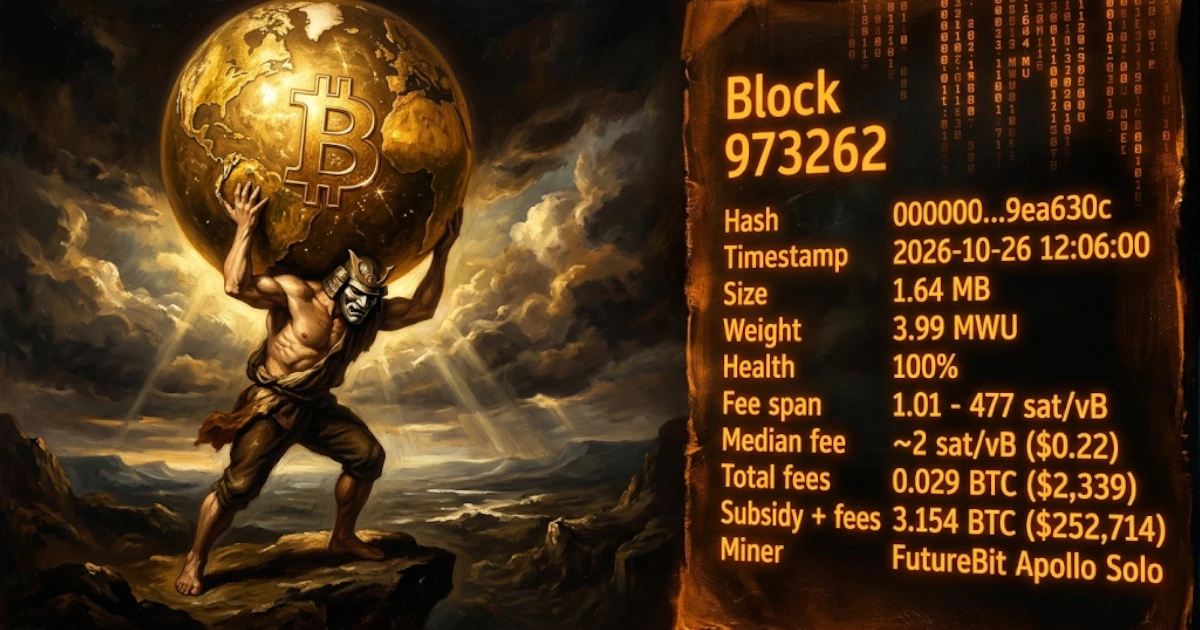
FutureBit Apollo Solo Miner Finds Bitcoin Block 973262, Earning 3.154 BTC

Bitcoin Magazine

FutureBit Apollo Solo Miner Finds Bitcoin Block 973262, Earning 3.154 BTC

A miner operating through FutureBit’s Apollo Solo setup found Bitcoin block 973,262 earlier this week, collecting the full reward of 3.154 BTC plus fees from 2,477 transactions. Multiple explorers, including mempool.space, list the finder as “FutureBit Apollo Solo,” and the coinbase transaction includes text referencing FutureBit and Apollo.

FutureBit posted about the find on X: “Gradually, then suddenly. We (the people) hit a Bitcoin block today. Bitcoin belongs in the hands of sovereign individuals. And we’re building to keep it there.” The company stated that an Apollo device or Solo Node running its built-in solo pool assembled the block template, served the work, and submitted the completed block to the network. The public record does not identify the exact hardware or hashrate that produced the winning hash. It could have been an Apollo BTC, Apollo II, Apollo III, or other compatible machines pointed at a Solo Node, according to FutureBit’s account of the block. 

This marks at least the fourth block attributed to FutureBit Apollo Solo. Earlier ones include blocks 867,760, 881,423, and 888,737. FutureBit designs its Apollo hardware for operators who want to run a full Bitcoin node and mine independently at home rather than through large commercial pools. The most recent model, the Apollo III, is rated for up to 18 TH/s in turbo mode with an integrated full node. Bitcoin Magazine covered the Apollo III launch in February 2026 and previously examined FutureBit’s approach to home mining in a July 2025 piece.

Solo mining, is often called lottery mining because of the low odds relative to the size of the reward, remains uncommon against a network hashrate that has recently sat near 1,070–1,087 EH/s. A home-scale setup in the 10–18 TH/s range still faces expected times to a block measured in centuries under current difficulty, yet verified solo finds continue to appear on-chain. Bitcoin Magazine examined the mathematics of these odds in an article titled Why Bitcoin Lottery Mining Has Better Odds Than The Powerball. It compared continuous Bitcoin block attempts with the much lower frequency of major lottery draws.

Another solo block was found the following day via CKPool Solo,  illustrating that individual operators can still capture full rewards even as industrial pools produce the large majority of blocks. For users running FutureBit hardware, the company notes that the individual users control both the node and the solo pool, retaining the full reward when a block is found. Solo mining also has significant privacy benefits, and hardware and energy costs can be written off against taxes in some jurisdictions.

The October 26 block is one more validation that solo mining can be viable. Satoshi Nakamoto’s original Bitcoin design intended the full Bitcoin node to be able to mine blocks, not just validate and audit the blockchain. Improvements in hardware and mining optimizations later on led to the creation of mining pools, which created a very competitive and industrial mining sector. The secondary effects of industrial Bitcoin mining, such as reliable energy demand that can stabilize the grid, have been a boon for states like Texas. 

However, the dream of bringing mining back to homes and end users remains alive through companies like FutureBit, Bitaxe, and HeatBit, among others, that are converting heating appliances into Bitcoin miners or designing hardware of the sort for the home.

This post FutureBit Apollo Solo Miner Finds Bitcoin Block 973262, Earning 3.154 BTC first appeared on Bitcoin Magazine and is written by Juan Galt.

PHP Hack: How Bitcoin Will Respond to the “Cyber Pandemic”


Bitcoin Magazine

PHP Hack: How Bitcoin Will Respond to the “Cyber Pandemic”

Government websites in France and Finland and hospital sites in the Netherlands are offline, Cloudflare is seeing attack traffic, and Britain’s National Cyber Security Centre is telling organizations to pull systems if they can’t patch fast. Bitcoin Magazine technical editor Shinobi joins Grace Remington and Sean Hagan to explain what broke in PHP, why memory management mistakes are the most common security flaw, and why AI finding the exploit in hours changes the pace of hacking but not its nature. He also answers the question every Bitcoiner is asking: is Bitcoin exposed?

Chapters:
0:00 The PHP Exploit Takes Government and Hospital Websites Offline
0:54 AI Found the Flaw in Hours: The “Cyber Pandemic” Warning
1:45 What Actually Broke: Memory Management Mistakes Explained
3:06 Why PHP Was Never Secure and Why This One Is Different in Scale
3:47 Is the AI Hacking Story Sensationalized? AI Does 95% of the Work
5:08 The Rough Adjustment Period and Why Shinobi Is Confident About the Other Side
6:41 No Serious Software Will Ship Without an AI Security Audit
7:23 Is Bitcoin Exposed? libsecp256k1, Bitcoin Core and Why Slow Development Was Right
9:30 Take Your Lightning Node Offline and Keep Your Coins in Cold Storage
12:09 Multisig and Sparrow Setup Checks, and Where to Follow Security Engineers

DISCLAIMER: The views and opinions expressed in this show are those of the participants and do not necessarily reflect the official policy or position of BTC Inc., Bitcoin Magazine, or any affiliated entities. This content is provided for informational and educational purposes only and should not be construed as investment, legal, tax, or accounting advice. Nothing contained in this show constitutes a solicitation, recommendation, endorsement, or offer to buy or sell any securities or financial instruments. Viewers should consult their own advisors before making financial or business decisions.

This post PHP Hack: How Bitcoin Will Respond to the “Cyber Pandemic” first appeared on Bitcoin Magazine and is written by Patrick Green.

Bitcoin Treasury Analyst: MSTR, ASST & Metaplanet Digital Credit Outlook


Bitcoin Magazine

Bitcoin Treasury Analyst: MSTR, ASST & Metaplanet Digital Credit Outlook

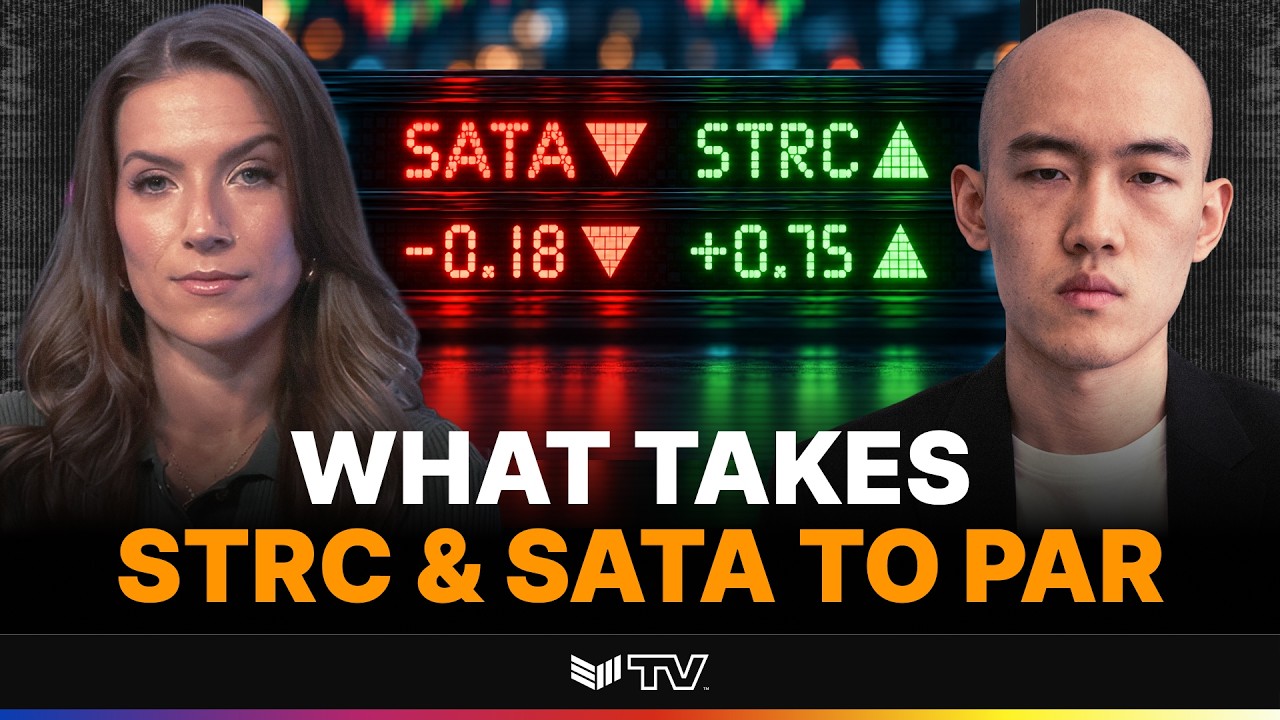
Metaplanet couldn’t make preferreds work in Japan, so it took over a U.S. company to issue them here. Allard Peng explains what that unlocks: access to the same capital pool Strategy and Strive are competing for, where STRC was one of the biggest IPOs of 2025 and it was a preferred stock. He also addresses what still needs clarity about how Metaplanet supports its U.S. subsidiary, and why the move could be accretive to common shareholders.

Chapters:
0:00 Bitcoin ETFs Pull In $1 Billion in Three Sessions While Price Stalls Under $85K
1:28 Why Bitcoin Treasury Preferreds Crashed in June: Leveraged Looping Unwinds
3:51 The Traders Holding Preferreds Below Par and What Gets Them Back
5:28 Strive’s Fixed 15% Junior Pref vs. Variable-Rate SATA
7:37 How a Preferred Trading Above Par Adds to Net Bitcoin Per Share
10:49 What Has to Happen Before a Company Buys Its First Bitcoin
12:22 When Issuing a Preferred Below Par Still Makes Sense
14:52 Metaplanet’s U.S. Listing and the Capital Pool Strategy and Strive Compete For
18:08 Elon Musk, Tesla and SpaceX’s Bitcoin, and Why Money Won’t Become Irrelevant
21:12 Should Small Businesses Hold Bitcoin?

DISCLAIMER: The views and opinions expressed in this show are those of the participants and do not necessarily reflect the official policy or position of BTC Inc., Bitcoin Magazine, or any affiliated entities. This content is provided for informational and educational purposes only and should not be construed as investment, legal, tax, or accounting advice. Nothing contained in this show constitutes a solicitation, recommendation, endorsement, or offer to buy or sell any securities or financial instruments. Viewers should consult their own advisors before making financial or business decisions.

This post Bitcoin Treasury Analyst: MSTR, ASST & Metaplanet Digital Credit Outlook first appeared on Bitcoin Magazine and is written by Patrick Green.

WhiteBIT’s W Group Backs SwapGlobal’s Push Into Pre-IPO Derivatives

W Group, the ecosystem behind crypto exchange WhiteBIT, has invested in derivatives provider SwapGlobal. The October 23 announcement disclosed no deal value and said the company’s first pre-IPO transactions were being prepared.

TL;DR: SwapGlobal is preparing institutional pre-IPO derivatives with backing from W Group. The planned exposure would convey a contractual payoff, without ownership of shares.

WhiteBIT names Marcel Boekhoorn and Amsterdam’s Kenzoll Capital as fellow backers. Funding will add trading and working capital for the expansion beyond crypto. Foreign equities, computing power and digital assets are further ambitions.

Exposure Without A Shareholding

SwapGlobal says it would hedge institutional client positions and use qualified custodians for collateral. Hedge funds and asset managers are among the intended customers.

The arrangement changes what a client is buying. A contractual payoff linked to a company’s value does not itself put the client on the company’s shareholder register. Voting rights, direct ownership and the ability to transfer actual shares cannot be assumed from a product described as pre-IPO exposure.

It also gives the contractual terms particular importance. A private company can remain unlisted longer than expected, making the handling of valuation changes, maturity and settlement central to evaluating a transaction. The announcement provides a business direction rather than the detailed terms of a completed deal.

For example, a contract’s treatment of an eventual listing would need to be understood alongside its treatment of continued private ownership. Those two outcomes can create different settlement questions. The label attached to the exposure does not answer them.

An Institutional Derivatives Model

SwapGlobal’s website describes an over-the-counter model offering swaps, forwards, perpetual forwards and options through a single counterparty relationship and ISDA documentation. Clients can access the service through an interface or an API. The company says its services are limited to Eligible Contract Participants under U.S. rules.

The website also describes initial margin as a fraction of a trade’s notional value, followed by daily variation margin. That means an institution’s liquidity needs can change after it enters a position. Access to an otherwise difficult-to-trade asset still comes with the mechanics of a margined derivative.

The intended custody arrangements address where collateral is held, while the contract determines how the exposure settles. Those are separate parts of the transaction to assess alongside the provider’s ability to hedge its obligations. More capital at the provider does not remove the need to examine the terms of an individual position.

For a group rooted in Bitcoin and broader crypto trading, the investment extends its interest into institutional access to private assets. Completed transactions with identifiable terms would be the next evidence of how the proposed model works beyond the funding announcement.

Written by the News Desk and edited by Samuel Rae.

Bybit Wins Dubai VARA Approval For Spot Crypto Exchange Services

TL;DR: Bybit says its Dubai entity has secured a VARA virtual-asset service provider licence covering spot exchange activity; derivatives permission remains a future objective.

Bybit has obtained a Dubai regulatory licence for spot cryptocurrency exchange services, extending its locally authorized business in one of the industry's most closely watched jurisdictions.

The exchange announced Thursday that Bybit Fintech FZE received a virtual-asset service provider licence from Dubai's Virtual Assets Regulatory Authority, known as VARA. The permission covers spot exchange services. Bybit's management says it wants to expand into derivatives later, but that would require separate regulatory approval.

A defined licence, not an all-purpose passport

Exchange businesses often operate several distinct activities: spot trading, leveraged derivatives, custody, brokerage and payments. A licence for one does not automatically authorize the others, and market participants should read regulatory announcements for their exact scope.

Bybit established an international headquarters in Dubai in 2022. The new authorization is an additional step toward operating local trading services within VARA's framework rather than relying on the company's broader international brand or permissions in other jurisdictions.

The distinction matters to users because legal entity, available products and customer protections can differ across markets. A trader seeing Bybit's name in multiple countries should not assume every account is covered by the same regulator or that all services have identical compliance terms.

Bybit's announcement cites a global base of more than 80 million users. That figure is company-reported and does not tell readers how many users are eligible to open an account under the specific Dubai permission, nor does it establish active local trading volumes.

What Dubai gains from a regulated entrant

Dubai's strategy has been to bring virtual-asset activity within a dedicated local regime rather than treat every exchange as a general technology business. For platforms, meeting authorization conditions may involve governance, market-surveillance and risk-control obligations that would not necessarily arise from simply offering a website.

Regulated status can create commercial opportunities with banking partners and institutional customers. It can also bring higher reporting costs and limits on products that an exchange might offer elsewhere, especially in leveraged markets.

Bybit executives have indicated that derivatives form a substantial part of the group's global business, making future permission an important strategic objective. But there is no basis for saying that Dubai has granted derivatives approval in this announcement.

For customers and competitors, the concrete news is a new spot-exchange licence. The next measures of progress will be the actual service rollout under Bybit Fintech FZE, the categories of client accepted, and whether further applications result in additional legally permitted activities.

Source: www.prnewswire.com original announcement or data.

Related Reading: crypto exchanges; crypto custody; stablecoins.

Written by the News Desk and edited by Samuel Rae.

BlackRock Bitcoin ETF Pulls In $665 Million While Rivals Lose Money

TL;DR: BlackRock’s IBIT recorded roughly $665 million in net inflows on October 19, even as several other US spot Bitcoin ETFs saw investors take money out.

A strong day for Bitcoin ETFs wasn’t quite as broad-based as the headline number suggests. BlackRock’s iShares Bitcoin Trust took in approximately $665.16 million on Monday, according to SoSoValue’s fund-flow figures, while the US spot Bitcoin ETF group recorded a combined inflow of about $526.6 million.

That difference is the story. Money going into IBIT more than offset withdrawals from competing funds. Fidelity’s FBTC registered roughly $83.6 million in outflows, while Grayscale’s GBTC shed about $54.9 million.

Rather than a uniform surge of demand for every Bitcoin product, Monday’s numbers point to a preference for the market’s biggest vehicle. IBIT has become the default choice for many investors seeking exchange-traded Bitcoin exposure, although a single day’s figures cannot establish why individual institutions moved money.

The reversal also follows a Friday session in which the group recorded net withdrawals. It underscores how quickly flows can shift around market volatility and broader risk sentiment.

Flows are useful evidence of ETF subscriptions and redemptions, but they shouldn’t be read as a direct measure of new cash buying Bitcoin at a particular hour. Fund mechanics and market-making activity complicate that picture.

The next question is whether demand spreads to other products or whether IBIT continues to absorb most of the market’s incremental interest.

Written by the News Desk and edited by Samuel Rae.

Strive’s SATS: How 15% Yield Becomes A Bitcoin Accretion Machine

Bitcoin Magazine

Strive’s SATS: How 15% Yield Becomes A Bitcoin Accretion Machine

Strive’s newly IPO’d SATS perpetual preferred stock introduces an interesting opportunity: the company could potentially issue preferred equity above its $100 stated amount and grow Net Bitcoin Per Share (Net BPS) in each issuance round, subject to risks and parameters described below. 

This article discusses how and why it works. The key question is whether SATS will trade above $100. Its unusually high 15% fixed dividend makes that outcome, and the subsequent accretion, plausible.

Why SATS could trade above par

SATS carries a fixed annual dividend of $15 per share, based on its $100 stated amount and its 15% number. It ranks junior to Strive’s SATA preferred stock, but its dividend structure offers investors two attractive features. 

First, SATS dividends are cumulative. Strive can defer payments, but any unpaid dividends accumulate as an obligation to preferred shareholders. 

Second, the $15 annual dividend is fixed. This differs from SATA, which currently pays an annualized $13 per share but uses a variable dividend rate. Therefore, SATA shareholders could receive less income in the future if Strive reduces that rate. SATS dividends accrue at a fixed $15 per share per year, but are payable only “when, as and if” declared by Strive’s board, and may be deferred. 

These features could make SATS particularly attractive to investors seeking predictable long-term income.

Consider Strategy’s STRD, the company’s juniormost preferred. STRD currently trades around $71 per share, 29% below its $100 stated amount. Its fixed $10 annual dividend translates into an effective yield of 14%. STRD dividends are also non-cumulative, meaning Strategy can skip payments without creating an obligation to repay those amounts later.

Admittedly, Strategy has significantly stronger Bitcoin asset coverage supporting STRD than Strive has supporting SATS. In fact, STRD’s 4.7x BTC Rating has twice as much asset coverage as SATA, Strives most senior instrument. 

That said, many income investors may place greater weight on dividend reliability than on coverage ratios. SATS offers cumulative dividends and a substantially higher stated yield, creating a reasonable case for the market to price its effective yield below that of STRD.

For example, if investors bid SATS to a 13% effective yield, its market price would reach $115.38.

This leads to an interesting financing opportunity for Strive.

The Net Bitcoin Per Share opportunity

Suppose SATS trades at $115 and Strive issues another 1 million shares through an at-the-market offering.

Strive raises $115 million in gross proceeds and buys Bitcoin.

However, under a Net BPS methodology that deducts preferred stock at its $100 notional amount, those new shares create only $100 million in additional preferred claims.

The remaining $15 million flows directly into the calculation of net Bitcoin attributable to common shareholders.

Under these parameters, Strive effectively raises $115 of capital for every $100 of preferred notional it creates. The annual dividend remains $15, producing an effective financing cost of 13.04% on the capital raised.

Strive can achieve this accretion without issuing additional common shares.

There is one caveat to mention: SATS has a floating liquidation preference that adjusts based on recent market prices. If SATS trades at $115, its liquidation preference can rise toward $115, temporarily increasing the economic claim held by preferred shareholders. However, liquidation preference can also reset downward. The formula references the previous trading day’s closing price during periods surrounding new issuance and the average closing price over the preceding 10 trading days, subject to a $100 floor. If SATS subsequently trades at $100 for 10 trading days, its liquidation preference returns to $100. 

While SATS trades above par, the higher liquidation preference offsets some or all of the apparent economic accretion. Once the preference returns to $100, the company retains the additional capital raised above par while the preferred liquidation claim falls back to its stated amount. 

But here’s the thing. The exact liquidation preference number only becomes relevant if the company is going to liquidate. And this would only happen if the company goes bankrupt. But if the company goes bankrupt, the preferred stock will almost certainly go below $100, which would make the liquidation preference return to $100. In other words, the caveat of the floating liquidation preference actually does not matter when you look at everything in context—it is perfectly valid to use $100 per share as the de facto notional value to compute Net BPS. (Note also that Net BPS is defined by Strategy, and not a metric explicitly reported by Strive. Strive’s prospectus also identifies tax risks that may arise if shares are issued above the liquidation preference, including deemed distributions, disqualified preferred stock treatment, and fast-pay stock treatment.)

The above-par issuance premium can therefore become genuine residual asset value for common shareholders, when we consider the Net BPS metric. 

This could possibly be one of the main reasons Strive decided to go as high as 15%. The high dividend gives it a greater chance of going above par and enabling the aforementioned mathematically guaranteed Net BPS accretion. 

15% Cost of Capital? 

Of course, this strategy relies on the market price of SATS.

At $115, Strive effectively raises capital at a 13% annual dividend cost. At $100, that cost rises to 15%. At $90, the effective cost climbs to 16.67%, while issuance also becomes dilutive under a Net BPS calculation.

Strive should therefore exercise considerable discipline when issuing SATS through an ATM program. Locking mid-to-high-teens costs of capital would only work out well if the return on capital from Bitcoin is massive and if volatility drag does not become a big issue. 

Strive also intends to maintain an 18-month dividend reserve equivalent to $22.50 per SATS share, adding another capital allocation consideration. 

Assuming the company maintains 18 months of dividend coverage, it would need to set aside $22.50 for each share it sells. Assuming it sells at par, that means 22.5% of the money raised must sit in cash equivalents while the remaining 77.5% can be deployed into Bitcoin. Therefore, we can see that the true cost of capital when accounting for the drag of being able to use only 77.5% of your financing is higher than the effective yield at which shares were issued. 

All these considerations need to be managed carefully. 

The key question

SATS may become one of the most expensive digital credit instruments on a stated dividend basis, while simultaneously becoming one of the more attractive financing tools for the Net BPS metric.

If investors consistently value SATS at an effective yield below 15%, then Strive could issue shares above par, purchase additional Bitcoin, and may generate Net BPS accretion under this methodology.

If SATS struggles to maintain a premium, this situation would not apply.

The opportunity lies in the difference between the $100 stated amount and the price income investors are willing to pay for a fixed, cumulative $15 annual dividend.

That spread could become a valuable source of accretion for ASST shareholders.

Disclaimer: Strive, Inc. (“Strive”), the issuer of the securities discussed here, is a member of Bitcoin For Corporations (“BFC”) and pays membership fees to BFC. Strive did not review this article before publication. This article was written by Allard Peng and reflects the author’s own opinion. Scenarios, prices, and yields are hypothetical illustrations, not predictions or guarantees. “Net Bitcoin Per Share” is the author’s methodology, not a Strive-reported metric. Third-party data is as of 21 October 2026 from Strategy.com, Strive.com. 

This article is for informational purposes only. It is not investment, legal, or tax advice, or an offer or solicitation to buy or sell any security. SATS Stock is offered only by Strive’s prospectus supplement and accompanying prospectus; read them, including the risk factors, before investing. Investing in preferred stock and bitcoin-related securities carries substantial risk, including loss of principal and the risk that dividends are not declared or paid.

This post Strive’s SATS: How 15% Yield Becomes A Bitcoin Accretion Machine first appeared on Bitcoin Magazine and is written by Allard Peng.

BlackRock Files for Bitcoin ETF With Downside Buffer and Capped Upside

Bitcoin Magazine

BlackRock Files for Bitcoin ETF With Downside Buffer and Capped Upside

BlackRock has filed for a new bitcoin exchange-traded fund which, if approved, would cap investors’ upside while limiting their losses. 

The iShares Bitcoin Managed Protection ETF, or PBIT, would aim “to create and manage bitcoin exposure,” according to a Monday filing with the Securities and Exchange Commission. 

It would work buying options and fixed-income strategies to give investors regulated bitcoin exposure with capped upside and some downside protection — but not direct bitcoin ownership. 

The fund would suit investors who want to invest in bitcoin but not experience all the volatility that comes with the top cryptocurrency. 

Bitcoin has attracted attention for its wild price swings over the years but its volatility has dampened as more investors have bought into the space. 

But 2025 was the least volatile year for the asset and the bear market of 2026 has been its most shallow on record: in past cycles, bitcoin’s price has dropped as low as 80% from its all-time high; this year it shed just 50% of its value. 

BlackRock’s iShares Bitcoin Trust — IBIT — started trading in 2024 after the SEC gave the green light to 11 spot bitcoin ETFs. 

The most successful of the ETFs in terms of flows, the investment vehicle has helped bring bitcoin to Wall Street. Now traders, institutions and retail investors can quickly buy shares that track the price of the leading cryptocurrency. 

They don’t need to worry about exchanges or storage of the digital coin, rather, BlackRock buys and holds the bitcoin while investors simply hit the buy or sell button via their brokerage account. 

IBIT has the most assets under management out of the bitcoin ETFs, currently handling $65.7 billion. 

On Monday, the fund received $665.2 million in fresh investment as bitcoin buyers flooded back into the market. 

That’s the biggest number of shares bought in the product since October 2025, when bitcoin notched a new all-time high, according to Farside Investors data. 

This post BlackRock Files for Bitcoin ETF With Downside Buffer and Capped Upside first appeared on Bitcoin Magazine and is written by Mathew Di Salvo.

BlackRock Bitcoin ETF Pulls In $665 Million While Rivals Lose Money

TL;DR: BlackRock’s IBIT recorded roughly $665 million in net inflows on October 19, even as several other US spot Bitcoin ETFs saw investors take money out.

A strong day for Bitcoin ETFs wasn’t quite as broad-based as the headline number suggests. BlackRock’s iShares Bitcoin Trust took in approximately $665.16 million on Monday, according to SoSoValue’s fund-flow figures, while the US spot Bitcoin ETF group recorded a combined inflow of about $526.6 million.

That difference is the story. Money going into IBIT more than offset withdrawals from competing funds. Fidelity’s FBTC registered roughly $83.6 million in outflows, while Grayscale’s GBTC shed about $54.9 million.

Rather than a uniform surge of demand for every Bitcoin product, Monday’s numbers point to a preference for the market’s biggest vehicle. IBIT has become the default choice for many investors seeking exchange-traded Bitcoin exposure, although a single day’s figures cannot establish why individual institutions moved money.

The reversal also follows a Friday session in which the group recorded net withdrawals. It underscores how quickly flows can shift around market volatility and broader risk sentiment.

Flows are useful evidence of ETF subscriptions and redemptions, but they shouldn’t be read as a direct measure of new cash buying Bitcoin at a particular hour. Fund mechanics and market-making activity complicate that picture.

The next question is whether demand spreads to other products or whether IBIT continues to absorb most of the market’s incremental interest.

Written by the News Desk and edited by Samuel Rae.

BlackRock Files For Bitcoin ETF With Managed Downside Protection

TL;DR: BlackRock has proposed another Bitcoin-linked ETF, this time using options to pursue some protection against losses while giving up part of the potential upside.

BlackRock’s latest Bitcoin fund filing takes a different approach from the familiar buy-and-hold exposure offered by its iShares Bitcoin Trust. Instead of simply following the price of Bitcoin, the proposed iShares Bitcoin Managed Protection ETF would use an options strategy linked to IBIT or similar exposure.

The ambition is straightforward enough: participate in some of Bitcoin’s gains and seek a measure of protection during a decline. The trade-off is equally important. Gains could be capped, and the protection is neither unconditional nor guaranteed. The structure is designed around overlapping options positions, meaning an investor’s outcome could depend on when the shares are purchased as well as what Bitcoin does next.

That makes this a different kind of product, not a safer version of holding spot Bitcoin in every circumstance. Options costs, fund expenses and changing market prices all affect what shareholders receive.

The filing arrives as issuers work to move beyond basic spot exposure. Income-oriented and buffered Bitcoin products try to give financial advisers additional ways to fit an unusually volatile asset into conventional portfolios.

For investors, the missing details matter as much as the proposed strategy. An SEC filing does not mean the fund has been approved or launched. Its eventual fees, live portfolio and actual protection terms will determine whether the structure delivers a useful alternative to IBIT.

Written by the News Desk and edited by Samuel Rae.

Qubic Halts Blockchain After Weak Wallet Seeds Leave 1,400 Accounts Exposed

Qubic halted its network after attackers exploited weakly generated wallet credentials to remove roughly $1.4 million in cryptocurrency from more than 1,400 accounts, according to the project’s account of the incident.

TL;DR: The reported loss involved 1,404 wallets and around 2.94 trillion QU. The issue was traced to wallet seed generation rather than a confirmed compromise of the blockchain’s consensus rules.

The distinction matters. Users can lose control of coins even when the underlying network continues to process transactions exactly as designed. If the randomness used to create a private key is predictable, attackers may be able to reconstruct the key and sign transfers that appear valid to everyone else on the chain.

Qubic developers linked the weakness to seed generation in a web-wallet environment, with reports pointing to the use of JavaScript’s Math.random function. That function was never intended to supply cryptographically secure entropy for protecting money. Strong randomness, obtained from appropriate operating-system cryptographic interfaces, is essential when generating wallet secrets.

The project responded with an emergency network halt while investigators and validators worked through containment options. Pausing a decentralized system can reduce immediate movement of funds, but it also prevents normal users from transacting and raises difficult questions about authority and any possible rollback.

People holding QU should rely on official security instructions before importing or moving affected wallet credentials. Generating a fresh address using a patched wallet is not the same as safely recovering funds already transferred away.

The incident is a reminder that wallet security begins before a transaction is broadcast. A flawless ledger cannot compensate for a secret key that was never truly secret.

Written by the News Desk and edited by Samuel Rae.

Richard Byworth: Bitcoin’s Next Run “Just a Mater of Time” thanks to Seller Exhaustion

Bitcoin Magazine

Richard Byworth: Bitcoin’s Next Run “Just a Mater of Time” thanks to Seller Exhaustion

How do you earn yield on Bitcoin without risking your stack? Richard Byworth, who spent his career structuring for hedge funds, explains why Bitcoin is the hurdle rate for everyone, and why covered-call overwriting can cost you a significant portion of your Bitcoin in a rally. He walks through how basis trades collateralized by Bitcoin can deliver low-volatility, market-neutral returns.

Chapters:
0:00 – Richard Byworth on Leaving Syz Capital Over Bitcoin Treasuries
1:43 – Earning Yield in Bitcoin and Why Covered Calls Are Risky
3:51 – Basis Trading: Earning Dollars Collateralized by Bitcoin
4:47 – Inflation, AI Borrowing and How Digital Credit Pressures the Treasury
8:39 – Record Seller Exhaustion: Is the Bitcoin Bottom In?
9:55 – Why SATA Reached Par Before STRC
13:51 – Digital Credit Funds in Swiss Francs
15:51 – MSCI’s “Attack” on Bitcoin Treasury Companies
17:20 – Bitcoin Bonds for Nations: Working With JAN3
20:06 – El Salvador’s Bitcoin Bond and Bitcoin in the Mortgage Market

DISCLAIMER: The views and opinions expressed in this show are those of the participants and do not necessarily reflect the official policy or position of BTC Inc., Bitcoin Magazine, or any affiliated entities. This content is provided for informational and educational purposes only and should not be construed as investment, legal, tax, or accounting advice. Nothing contained in this show constitutes a solicitation, recommendation, endorsement, or offer to buy or sell any securities or financial instruments. Viewers should consult their own advisors before making financial or business decisions.

This post Richard Byworth: Bitcoin’s Next Run “Just a Mater of Time” thanks to Seller Exhaustion first appeared on Bitcoin Magazine and is written by Patrick Green.

Latin America’s MSTR: How OranjeBTC is Running the Saylor Playbook in Brazil | Gui Gomes

Bitcoin Magazine

Latin America’s MSTR: How OranjeBTC is Running the Saylor Playbook in Brazil | Gui Gomes

Bitcoin is “likely the best collateral one could ask for,” says OranjeBTC CEO Gui Gomes. He explains how digital credit, Bitcoin-backed loans, and new financial products are pushing Bitcoin deeper into global financial markets, including a first-of-its-kind Bitcoin-backed loan in Brazil. He also shares why every step brings Bitcoin closer to becoming the world’s reserve currency.

Chapters:
0:00 – OranjeBTC CEO Gui Gomes on Running the Strategy Playbook in Latin America
0:32 – Why Brazil Ranks No. 1 in Grassroots Bitcoin Adoption
1:57 – Brazil’s Advantages for Building a Bitcoin Treasury Company
3:38 – Brazil’s New Bitcoin Regulations and VASP Licensing
5:23 – Brazil’s Elections and the Shift Toward a Pro-Market Economy
7:22 – Lower Rates, the Real and Brazil’s Next Growth Phase
8:27 – How Global Investors Can Buy OranjeBTC Shares
9:21 – DIGI11: Bringing STRC and SATA to Brazilian Investors
11:21 – How DIGI11 Delivered Its First Dividend
14:08 – Bitcoin as Collateral and the Future of Digital Credit

DISCLAIMER: The views and opinions expressed in this show are those of the participants and do not necessarily reflect the official policy or position of BTC Inc., Bitcoin Magazine, or any affiliated entities. This content is provided for informational and educational purposes only and should not be construed as investment, legal, tax, or accounting advice. Nothing contained in this show constitutes a solicitation, recommendation, endorsement, or offer to buy or sell any securities or financial instruments. Viewers should consult their own advisors before making financial or business decisions.

This post Latin America’s MSTR: How OranjeBTC is Running the Saylor Playbook in Brazil | Gui Gomes first appeared on Bitcoin Magazine and is written by Patrick Green.

WhiteBIT Integrates Lightning Network for Fast and Cheap Bitcoin Transactions

Bitcoin Magazine

WhiteBIT Integrates Lightning Network for Fast and Cheap Bitcoin Transactions

The Lightning Network continues to find use cases. 

Crypto exchange WhiteBIT announced on Thursday that the platform has integrated the network to help users quickly and efficiently move funds. 

Powered by BTC infrastructure provider Voltage, the Swiss exchange said that bitcoin withdrawals and deposits can be made over the network. A number of major exchanges — including Coinbase and Kraken — have integrated the second-layer solution in recent years. 

⚡ Lightning Transactions are now on WhiteBIT!
Faster $BTC transactions via the Lightning Network — using a QR code or payment details.
Deposit fee: 0.25%
Withdrawal fee: 0.15%
Move $BTC at Lightning speed. Learn more: https://t.co/nt0svdMqg5 pic.twitter.com/WHfmRKT6QI

— WhiteBIT (@WhiteBit) October 8, 2026

“WhiteBIT’s mission is to make blockchain technology accessible and widely adopted by delivering practical, user-friendly solutions for digital assets,” WhiteBIT Founder and CEO Volodymyr Nosov said in a statement.  

“Adding Lightning support brings us closer to this goal as we are making Bitcoin faster and more useful for customers who want to top up accounts, send and receive funds, and use Bitcoin across more real-world flows.”

Zug-based WhiteBIT, the 17th biggest exchange by transaction volume, according to CoinGecko data, added that the launch supports a faster Bitcoin rail with use cases for “remittances, exchange funding, merchant-style QR payments, and interoperability with Lightning-enabled wallets and applications.”

Transaction volume on Lightning has surged this year. The reason, broadly, is that exchanges are using the network to move funds because it’s so cheap and fast. 

Launched in 2018, Lightning was previously pushed for smaller transactions like tipping or buying a cup of coffee.

The network also offers more privacy than Bitcoin’s main chain: because Lightning payments are settled off-chain rather than recorded on the public blockchain, individual payments are harder to trace.

This post WhiteBIT Integrates Lightning Network for Fast and Cheap Bitcoin Transactions first appeared on Bitcoin Magazine and is written by Mathew Di Salvo.

❌