Reading view

There are new articles available, click to refresh the page.

Treasury Proposes Stablecoin Licensing Rules Under GENIUS Act

The US Treasury Department has proposed new licensing rules for payment stablecoin issuers under Section 3 of the GENIUS Act, opening another major comment period for digital asset regulation.

The proposed rulemaking was issued on August 18 and published on August 21. Under the proposal, payment stablecoin issuers would need to obtain a federal or state license starting January 18, 2027. By July 18, 2028, digital asset service providers would be prohibited from offering unlicensed stablecoins to US persons.

Public comments are open until October 19, 2026.

This is not active law yet.

The proposal is still in the rulemaking stage, and the details could change after public feedback.

TL;DR

  • The Treasury has proposed stablecoin licensing rules under the GENIUS Act.
  • Issuers would need a federal or state license starting January 18, 2027.
  • Service providers would face restrictions on unlicensed stablecoins from July 18, 2028.

Why Stablecoin Licensing Matters

Stablecoins are now one of the most important parts of crypto markets.

They are used for trading, payments, settlement, remittances, DeFi, exchange liquidity, and dollar access outside the traditional banking system. That makes them too large for regulators to ignore.

A licensing framework would move stablecoin oversight closer to the banking and payments world.

Issuers would need to meet requirements around reserves, supervision, compliance, reporting, and redemption. Service providers would also need to know which stablecoins can be offered to US users.

That could reshape the market.

Federal And State Paths Create Competition

The proposal allows for federal or state licensing.

That detail matters because stablecoin regulation has long involved a tug of war between national oversight and state-level regimes. Some issuers prefer state frameworks. Regulators may prefer a more unified federal approach.

A dual path could give issuers options, but it may also create complexity.

The quality of state supervision, reciprocity, reserve standards, examination authority, and enforcement coordination will all matter.

Stablecoin issuers want clarity. Regulators want control. The proposal tries to create both.

The 2028 Service Provider Deadline Is Important

The July 18, 2028 deadline may be the bigger market lever.

By that date, digital asset service providers would be barred from offering unlicensed stablecoins to US persons. That could affect exchanges, wallets, payment apps, DeFi front ends, custody platforms, and other intermediaries.

If enforced strictly, the rule could push the market toward licensed stablecoins.

Unlicensed issuers may lose access to US-facing distribution channels. Licensed issuers could gain market share. Smaller or offshore stablecoins may face new pressure.

The deadline gives the market time, but it also creates a clear end-state.

This Could Consolidate The Stablecoin Market

Regulation tends to favor scale.

Larger issuers may be better able to absorb compliance costs, maintain reserves, handle audits, and negotiate with service providers. Smaller issuers may struggle if licensing becomes expensive or operationally demanding.

That could consolidate stablecoin market share.

The result may be a safer, more regulated market, but also one with fewer issuers and less experimentation.

This is the core trade-off in stablecoin policy.

What Comes Next

The comment period will matter.

Stablecoin issuers, exchanges, banks, fintechs, consumer groups, and crypto policy organizations are likely to respond. They may challenge definitions, deadlines, licensing standards, service-provider obligations, reserve requirements, and state-federal boundaries.

The Treasury can revise the rule after comments close.

For now, the proposal gives the market a clearer timeline.

Stablecoin issuers may have until early 2027 to secure licenses, while service providers face a later 2028 deadline for offering unlicensed products to US users.

That is still a proposal, but it is one the industry cannot ignore.

This article is based on the Treasury Department’s proposed rulemaking and Federal Register materials related to the GENIUS Act.

This article was written by the News Desk and edited by Samuel Rae.

This report is based on information released in disclosures at primary source documentation.

SEC Reg Crypto Proposal Starts 60-Day Federal Register Comment Clock

The SEC’s proposed “Regulation Crypto Assets” framework has been published in the Federal Register, starting a 60-day public comment period for one of the most closely watched crypto rulemaking efforts in the United States.

The proposal, listed as File No. S7-2026-27, was published on August 21. Comments are due by October 20. The framework would create possible exemptions for covered digital asset investment contracts, including a one-time startup exemption of up to $5 million and a 12-month fundraising exemption of up to $75 million.

That could be significant if the proposal survives the rulemaking process.

But it is not final. It is not law. It is not approval of every token sale.

It is the start of a formal comment window.

TL;DR

  • The SEC’s Regulation Crypto Assets proposal has been published in the Federal Register.
  • The comment period runs through October 20.
  • The proposal includes possible $5 million and $75 million exemptions, but the rules are not final.

Why Federal Register Publication Matters

Federal Register publication is more than a clerical step.

It formally opens the public comment process and creates a clear timeline for feedback. Issuers, exchanges, developers, investors, academics, trade groups, lawyers, and consumer advocates can now respond to the proposal.

Those comments matter.

The SEC may revise the proposal based on feedback. It may narrow exemptions, add conditions, adjust definitions, or delay parts of the rule. The final version, if one emerges, may look different from the proposal published today.

That is why the comment clock is important.

It turns the policy idea into a formal regulatory process.

Token Fundraising Gets A Possible Framework

The proposed exemptions are the center of the story.

A $5 million startup path could give early-stage crypto teams a limited route to raise capital while remaining inside a defined regulatory framework. A larger $75 million 12-month exemption could offer more room for mature projects with bigger capital needs.

For years, US token fundraising has been stuck in uncertainty.

Projects have often chosen to launch offshore, avoid US investors, or operate under legal ambiguity. A clearer path could bring more activity back into the US, provided the requirements are practical.

That is the balance regulators now need to strike.

The Safe Harbor Question

The proposal also includes a conditional safe-harbor concept that could allow certain tokens to cease being treated as investment contracts if the issuer certifies that managerial efforts have been completed or discontinued.

That idea goes to the heart of crypto securities law.

Many token projects argue that a token can begin life connected to fundraising or managerial efforts, then later function as part of a decentralized network. Regulators have struggled with when, or whether, that transition should matter.

A conditional safe harbor would not solve every dispute, but it could create a clearer process.

The details will be heavily debated.

This Is Not A Market Green Light

Crypto markets may be tempted to treat the proposal as bullish clarity.

That is understandable, but premature.

The rules are proposed, not finalized. The SEC has not approved token fundraising generally. Issuers cannot assume that a future exemption will protect current activity. The final framework could also become stricter after public comments.

The correct read is that the US is moving deeper into rulemaking, not that the rulebook is finished.

What Comes Next

The comment deadline is now the key date.

By October 20, the SEC will have a record of public responses. After that, the agency can revise, reopen, finalize, or abandon parts of the proposal.

For crypto builders, the comment period is an opportunity to shape the rules.

For investors, it is a chance to see whether the US can create a more predictable path for token issuance without removing basic protections.

The publication of Regulation Crypto Assets is not the end of the debate. It is the beginning of the formal fight over what compliant token fundraising in the US could look like.

This article is based on the Federal Register publication of the SEC’s proposed Regulation Crypto Assets framework.

This article was written by the News Desk and edited by Samuel Rae.

This report is based on information released in disclosures at primary source documentation.

Uniswap Founder Warns CFTC That US Crypto Builders Are Moving Overseas

Uniswap founder Hayden Adams warned at the CFTC’s inaugural Innovation Advisory Committee meeting that regulatory uncertainty in the United States is pushing crypto builders and developers overseas.

The comments came during an August 20 panel discussion, not an enforcement proceeding and not binding testimony. Still, the message matters because it captures one of the industry’s longest-running complaints: US crypto policy has been too unclear for builders trying to launch products, hire teams, and raise capital domestically.

That concern is not new.

What is different now is the setting. The complaint is being made directly in front of US market regulators as policymakers continue to debate crypto market structure, token rules, DeFi oversight, and agency boundaries.

TL;DR

  • Hayden Adams participated in the CFTC’s inaugural Innovation Advisory Committee meeting.
  • He warned that US regulatory uncertainty is pushing crypto builders overseas.
  • The comments were part of a panel discussion, not a formal enforcement action.

Why The CFTC Setting Matters

The CFTC has become central to the US crypto policy debate.

For years, the industry has argued that the SEC and CFTC need clearer jurisdictional boundaries. Some digital assets may fall under securities laws, while others may be treated more like commodities. The lack of clear rules has created uncertainty for exchanges, DeFi protocols, token issuers, investors, and developers.

Uniswap sits directly inside that debate.

As one of the most important DeFi protocols, Uniswap represents the kind of infrastructure that does not fit neatly into older regulatory categories. It is software, market structure, liquidity infrastructure, and governance all at once.

That makes Adams’ comments relevant beyond Uniswap itself.

The Overseas Builder Argument

The argument is straightforward.

If US developers believe launching crypto products domestically creates legal risk without a clear compliance path, some will move abroad or build for non-US markets first. That can shift talent, capital, and innovation into jurisdictions with more defined rules.

This is not only about company headquarters.

It affects where teams hire, where protocols incorporate foundations, where investors allocate capital, and where products are first made available.

If builders leave, the US may still regulate the market eventually, but it may regulate it after much of the innovation has already moved elsewhere.

That is the industry’s fear.

Uniswap Is A Useful Case Study

Uniswap is one of the clearest examples of DeFi’s regulatory challenge.

It is not a traditional exchange with a central order book, listing department, and account structure. It is a protocol that allows users to swap tokens through liquidity pools and smart contracts.

That creates difficult questions.

Who is responsible for compliance? How should front ends be treated? What obligations apply to developers? When does governance matter? How should decentralized liquidity be supervised without simply forcing it offshore?

These are exactly the kinds of questions regulators have struggled to answer.

Not An Enforcement Event

It is important not to misread the meeting.

Adams’ appearance at the CFTC advisory committee does not mean Uniswap is facing a new enforcement action. It does not create binding regulatory policy. It does not mean the CFTC has accepted his view.

It is a public policy signal.

The industry is telling regulators that uncertainty has costs. Regulators, in turn, are gathering input as they think through how digital asset markets should be supervised.

That is useful, but it is not final.

The Bigger Policy Moment

The comments land at a time when US crypto regulation appears to be shifting from pure enforcement toward rule design.

Market-structure bills, SEC proposals, CFTC discussions, ETF approvals, and court cases are all shaping the next phase. The question is whether those pieces eventually become a coherent framework.

If they do, builders may have more reason to stay in the US.

If they do not, the overseas migration argument will keep getting louder.

For now, Adams’ message was simple: unclear rules are not neutral. They shape where crypto gets built.

That makes the CFTC meeting part of a broader fight over whether the US wants to host the next generation of crypto infrastructure or watch it develop somewhere else.

This article is based on the CFTC Innovation Advisory Committee meeting and public reporting around Hayden Adams’ remarks.

This article was written by the News Desk and edited by Samuel Rae.

This report is based on information released in disclosures at primary source documentation.

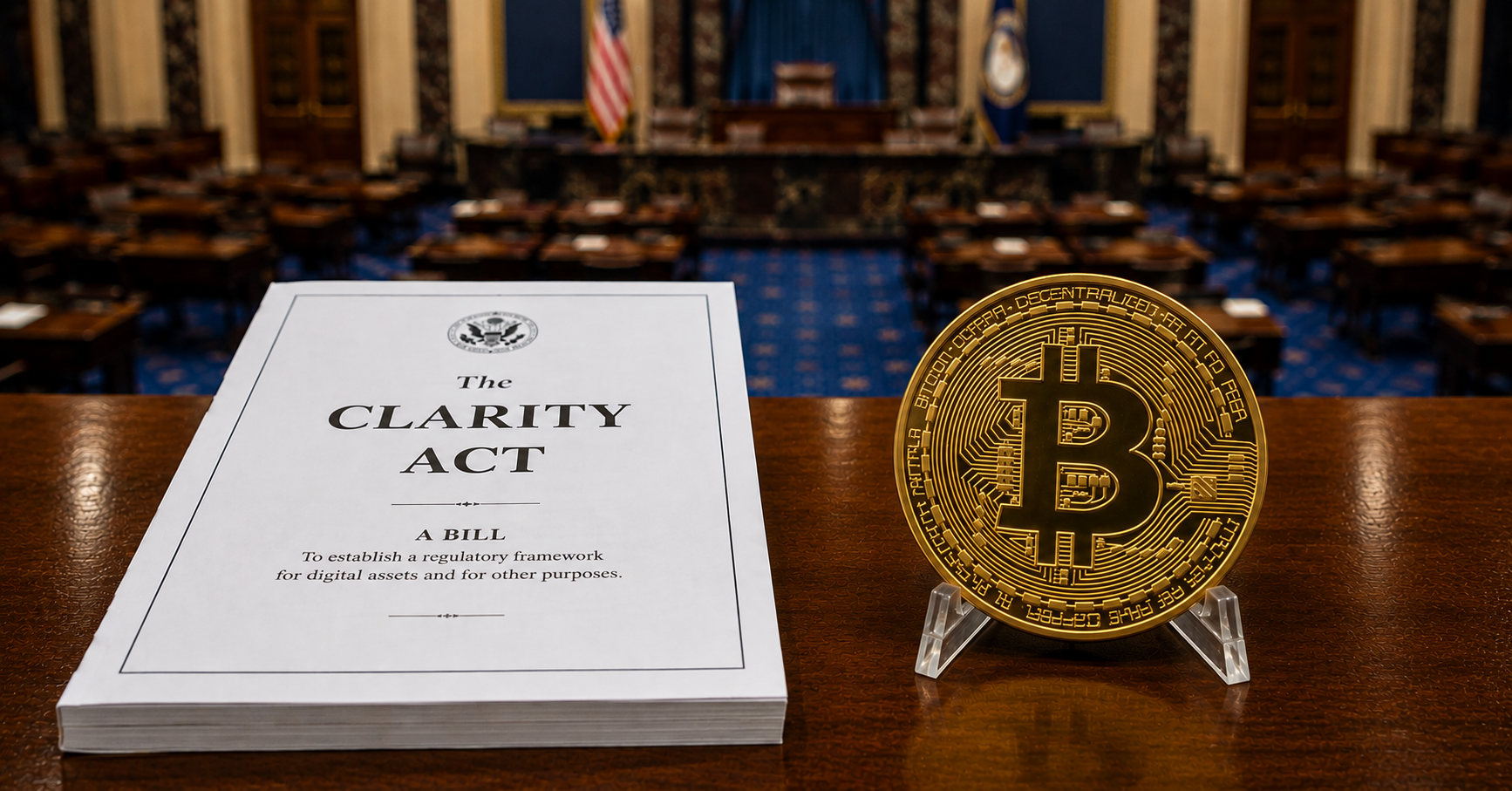
What the CLARITY Act Actually Does for Bitcoin

Bitcoin Magazine

What the CLARITY Act Actually Does for Bitcoin

In July 2025, House Republicans staged a coordinated three-bill blitz they called ‘Crypto Week;, advancing the GENIUS, CLARITY, and the Anti-CBDC Surveillance State Act in the same five day stretch. The GENIUS Act was signed into law within 24 hours, creating a regulatory framework for dollar-backed stablecoins. However, the other two bills weren’t so lucky. The Anti-CBDC Surveillance State passed the House by an extremely narrow margin, and got stuck in Senate purgatory without a floor vote in place for over a year.

Following the House’s bipartisan passage of the CLARITY Act, the bill landed in the Senate Banking Committee where it sat for nearly a year. When the bill finally emerged out of committee, its cover page included the phrase “Strike out all after the enacting clause and insert the part printed in italic.”

Translation: 100% of the bill had been rewritten.

If you pull up the bill on Congress’ website today, you can see that the first 256 pages (the entire House-passed bill) are struck through, line by line, top to bottom. Then, starting on page 257, the Senate’s new version of the bill begins. (This is still the official text on file; a further-updated draft has circulated since, but hasn’t been formally filed as an amendment.)

Given how much the bill has changed shape, it’s worth taking a step back and assessing how the CLARITY Act, in its post-June 1st form, actually affects Bitcoin, and if it can truly “act as the catalyst for the next bull run” as I see so often on X today.

What the bill does do for Bitcoin

Self-custody becomes a legally protected right

Section 605, the ‘Keep Your Coins Act’, prohibits federal regulators from restricting or impairing a person’s ability to self-custody for any lawful purpose. Self-custody currently has no statutory backing, and providing direct legislation creates a defense against future tyrannical powers requiring custodial intermediaries. 

While people often dismiss this threat as ‘fear mongering’ and ‘doomerism’, this type of overreach does have recent historical precedent. In 2020, Treasury Secretary Steven Mnuchin directed FinCEN to propose a rule targeting “unhosted wallets”. It would have required exchanges to collect names and home addresses for anyone moving more than $3,000/day into their private wallet, and file reports to FinCEN for anything over $10,000/day. Although the rule ultimately lost momentum, it remained on the books and un-withdrawn for almost four years. During that period, any Treasury Secretary could have revived and finalized it without any new legislation.

This is the exact scenario Section 605 is written to prevent from happening again.

Bitcoin developers, node operators, and non-custodial wallet makers get explicit immunity from money-transmitter liability

Section 604, Blockchain Regulatory Certainty Act, says a “non-controlling” developer or provider can’t be classified as a money transmitting business for doing that. Prime examples are Samourai Wallet and Tornado Cash. Both were open-source, non-custodial projects whose developers were criminally prosecuted under the theory that publishing the code made them unlicensed money transmitters. Samourai’s founders pleaded guilty in April 2026, and Tornado Cash’s Roman Storm was convicted on the same charge in August 2025.

Section 604 does not undo either case, but it does draw a line so the next open-source developer doesn’t have to find out where it is in federal court.

Bitcoin gets a statutory green light at the banking level

Section 401, the “Permissibility of Digital Asset Activities”, is the only section of the CLARITY Act that is “bullish” for Bitcoin’s price, by my estimations. This section would finally let banks, brokerages, and institutions treat Bitcoin like a real asset class, pulling in a wave of new capital.

The section lets financial holding companies, national banks, state banks, and credit unions custody digital assets, lend against them as collateral, operate nodes, provide brokerage and clearing services, and act as a market maker or dealer, all without needing extra prior approval beyond what banking law already requires. This section uses the term “digital asset,” which is broadly defined through the already-enacted GENIUS Act. Unlike “digital commodity” or “ancillary asset” elsewhere in the bill, Bitcoin clearly and unambiguously qualifies here. 

The addressable market this opens up is enormous. US commercial banks alone hold $25.7 trillion in total assets, nearly 20 times Bitcoin’s entire $1.3 trillion market cap. Custody giants like State Street and Northern Trust each sit on custody books that individually dwarf the whole Bitcoin market several times over. None of that capital needs to move far, or take much risk, to move the price of an asset this size. It just needs a legal, statutory door like Section 401 to walk through.

What the bill doesn’t do for Bitcoin

Bitcoin’s commodity status doesn’t get locked into federal law (at least not yet)

As it currently stands, Bitcoin is treated as a commodity because the CFTC says so and courts have agreed in the course of enforcement cases. However, that is precedent, not statute. There is no framework in place preventing future regulators from not viewing it that way.

The House-passed version of the CLARITY Act would have closed that gap. That language was struck out entirely when the Senate rewrote the bill on June 1, and for weeks, nothing replaced it.

The July 22 draft of the CLARITY Act merges in the Senate Agriculture Committee’s CFTC framework, which does add the missing definition. But that draft isn’t law or a filed amendment yet.

It doesn’t ban a Fed CBDC

The House-passed version of the bill had a section called the “Anti-CBDC Surveillance State Act”, which prohibited the federal reserve from issuing a retail CBDC. This section was part of the 256 pages struck by the Senate Banking Committee, and the current form of the bill offers no operative section on the matter.

Even if it passes, rules won’t actually exist for a while.

This is where the “CLARITY Act supercycle incoming” narrative falls flat. A signed bill doesn’t come with a functioning regulator attached. The CFTC would need to build one almost completely from scratch.

The GENIUS Act, signed last year, missed its entire one-year rulemaking deadline. Zero final rules, across six federal agencies, as of mid-2026. CLARITY would hand the CFTC the biggest new mandate in the bill, and the CFTC currently has a single sitting commissioner and staff headcount has dropped 21% in one year.

So, is CLARITY a Bitcoin bill?

Honestly? No.

CLARITY is bullish for crypto broadly, and only narrowly bullish for Bitcoin specifically. The vast majority of the bill exists to give altcoins a way out of securities law limbo, which is a problem that Bitcoin does not acutely possess.

Though, “not the main point” is not the same as “it doesn’t matter”. The bill provides specific pro-Bitcoin language that’s worth supporting on its own terms.

Ultimately, whether the bill passes or falls into legislative oblivion, Bitcoin’s core principles remain the same: a decentralized protocol governed by mathematical certainty, and the world’s first digital commodity, with a market cap north of $1.3 trillion.

Bitcoin will never live or die on Capitol Hill.

This is a guest post by Isaiah Austin. Opinions expressed are entirely their own and do not necessarily reflect those of BTC Inc or Bitcoin Magazine.

This post What the CLARITY Act Actually Does for Bitcoin first appeared on Bitcoin Magazine and is written by Isaiah Austin.

Chainlink Labs Exec Says CLARITY Act Could Unlock Institutional Crypto

Chainlink Labs executive Andrew McCormick has framed the CLARITY Act as a major potential unlock for institutional crypto, arguing that clearer rules could help break the compliance deadlock that has kept larger financial players cautious around digital assets.

That is a useful angle because institutional adoption is no longer just about whether banks, asset managers, or funds are interested in crypto. Many clearly are. The bigger question is whether their legal and compliance teams are comfortable enough to approve real allocations, tokenization projects, and on-chain market infrastructure.

The CLARITY Act sits directly inside that debate. It aims to clarify how digital assets should be treated under US market structure rules, including where SEC oversight ends and CFTC authority begins.

For Chainlink, the issue is especially relevant. The project has spent years positioning itself as infrastructure for tokenized assets, cross-chain settlement, data feeds, and institutional blockchain adoption. If regulatory uncertainty eases, that infrastructure story becomes easier to sell.

Reference: Chainlink Today

TL;DR

  • Chainlink Labs’ Andrew McCormick described the CLARITY Act as a major institutional crypto unlock.
  • The core issue is whether clearer SEC/CFTC boundaries can reduce compliance hesitation.
  • Chainlink’s role in tokenization and market infrastructure makes the regulatory debate directly relevant to its long-term adoption story.

Compliance Is Still The Gatekeeper

Crypto often talks about institutional adoption as if it is purely a demand problem.

That is only partly true. Many institutions have been studying digital assets for years. Some already offer products, custody, trading, or tokenization pilots. But large-scale adoption depends on more than interest. It depends on internal approval, legal comfort, risk limits, board-level confidence, and regulatory clarity.

That is where the CLARITY Act matters.

If a financial institution cannot clearly classify an asset or service, it has a problem. A trading desk may like the opportunity. A product team may see client demand. But compliance can still block the move if the legal treatment is uncertain.

That is the bottleneck McCormick is pointing toward.

Outdated securities-law frameworks have been a common complaint across crypto because many rules were built around traditional intermediaries, not programmable networks, tokenized assets, and decentralized settlement rails. The industry does not simply want looser treatment. It wants clearer treatment.

Clearer rules can be strict and still useful. The worst environment is one where firms cannot tell in advance which regulator will claim authority or what compliance route is available.

Why Chainlink Cares About Market Structure

Chainlink’s regulatory interest is not abstract.

The network’s long-term story is tied closely to institutional infrastructure. Chainlink provides oracle services, market data, proof-of-reserve tools, cross-chain communication, and other rails that can support tokenized assets and on-chain finance.

Those use cases depend heavily on regulated institutions becoming comfortable with blockchain systems.

A bank exploring tokenized collateral needs to know what it can issue, how settlement works, and which rules apply. An asset manager considering on-chain fund units needs legal certainty. A market infrastructure provider needs confidence that data, identity, and transfer mechanics can operate inside a compliant framework.

If the CLARITY Act helps define those boundaries, projects like Chainlink may benefit indirectly.

That does not mean LINK price automatically reacts to every legislative step. Regulatory progress is not the same as token demand. But it can improve the environment for the infrastructure layer that Chainlink is trying to serve.

The important point is that regulation can act as a blocker or an accelerator. For institutional crypto, it has often been both at once.

The CFTC/SEC Boundary Is The Key Fight

The CLARITY Act debate matters because it goes to the core question of who regulates what.

If digital assets are treated as securities, they sit under one set of expectations. If they are treated as commodities, another structure applies. Some assets may need more nuanced treatment depending on issuance, decentralization, network maturity, and how they are used.

The market has spent years trying to infer these answers from enforcement actions, court cases, speeches, and settlements. That is not enough for institutions managing large amounts of capital.

A clearer SEC/CFTC boundary could help exchanges, token issuers, custodians, DeFi interfaces, and asset managers understand what they can do. It could also reduce the fear that a product considered acceptable today might become an enforcement target tomorrow.

That kind of uncertainty is exactly what compliance departments dislike.

For institutional tokenization, the stakes are high. The market needs rules around custody, settlement, disclosures, collateral, intermediaries, and secondary trading. Chainlink’s infrastructure can support parts of that stack, but institutions still need legal permission to use it.

The Unlock Is Not Guaranteed

It is worth keeping this measured.

The CLARITY Act is not law yet. Even if it advances, details matter. A bill can create clarity in one area while creating new friction in another. Regulators can interpret language aggressively. Institutions can still move slowly even after legislation passes.

But the reason the debate matters is clear.

Crypto does not need institutions to be reckless. It needs them to have a framework that lets them participate responsibly. If the CLARITY Act moves the US closer to that, then McCormick’s “unlock” framing makes sense.

For Chainlink and similar infrastructure projects, the opportunity is not simply more trading. It is a larger role in the plumbing of tokenized finance.

That future still depends on adoption, execution, and actual regulatory outcomes. But the connection between clearer rules and institutional participation is real.

This article is based on Chainlink Today and House Financial Services Committee materials.

This article was written by the News Desk and edited by Samuel Rae.

This report is based on information released by Chainlink Today. at Chainlink Today

❌