Hand tracking in VR/AR can add a substantial amount of immersion and added interactivity. Unfortunately, most camera based tracking suffers when fingers get covered, intertwined, or simply out of view of the headset’s camera. What’s even less common are methods of giving feedback to the user’s hands. [Sebastian Molano] saw these issues and decided if anyone was going to make an open-source solution, it was going to be him with his thesis on TAKTO.
Clear visuals show step-by-step assembly.
TAKTO aims to remove the prior issues mentioned with visual tracking by using magnetic encoders to tell where the device is and the finger’s position inside it. Actuators are able to pull on the fingers themselves to add even further information to the user. Of course, none of this is too crazy, as we have seen similar projects before. Where TAKTO stands out is the extent of the support outside of a one-off hand tracker.
TAKTO.one not only holds general information about the project itself, but also an entire digital twin of the live device. This console can give you a visual of using the glove and general status information. Documentation on how to assemble one for yourself is presented in clean visuals, which should make the build process painless.
Everything else about how to make the hand for yourself can be found on the project’s GitHub. The price tag is steep for the actuated version, though there is a sensing-only version for hand tracking, and most of the cost comes from the quality actuators used. If you want to look into implementing some usability into existing VR hardware, make sure to look at what Valve has released publicly!
Valve recently began shipping its long-awaited VR headset, the Steam Frame. Now, there is a hardware reference repository that includes everything a budding modder might need, and then some.
No need to 3D scan or break out the calipers if one wants to design their own add-ons.
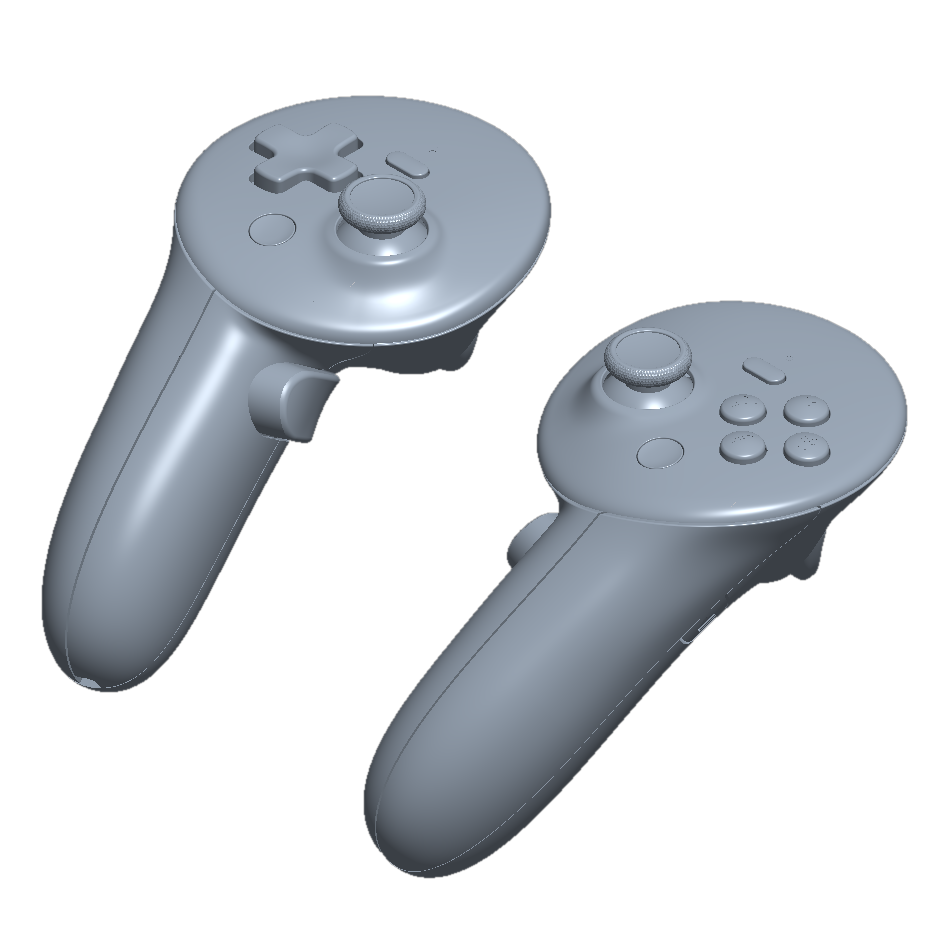
Want to design and 3D print some add-ons, or a carrying case, or some other doodad? There’s no need to break out the calipers or 3D scan the hardware. The repository contains STEP format models of the VR core module, head strap, and controllers, so it’s as easy as possible to design things that’ll fit. The location of the IR tracking LEDs embedded in the controllers is also documented, so one can ensure their design doesn’t occlude them.
That’s not all. The Frame has a user-accessible hardware expansion port at its front. This port exposes two interfaces: high-speed MIPI camera and PCI Express. This expansion port is documented in the repository, and even has a simple reference design built in both KiCad and Altium.
We’re glad to see Valve maintain their hacker-friendly hardware design with the Steam Frame. Demand for The Frame outstrips supply so far, so if you’re on the waitlist, you might want to browse the repository and get an early start on whatever customizations you have in mind while you wait for your confirmation. And when you get something working, drop us a note on the tips line!
In a sudden shadowdrop, Bellevue, Wash.-based Valve Software announced on Monday that it’s launched its new standalone virtual-reality headset the Steam Frame.
Valve’s previous VR device, 2019’s Index, was designed to be installed semi-permanently in a single room. The Frame, conversely, is a standalone wireless device that consists of a lightweight headset and two hand controllers, much in the same spirit as the Meta Quest 2.
As with Valve’s other recent hardware projects, the Frame is essentially a specialized PC running the custom SteamOS 3, a Linux-based operating system. The Frame runs off of a Snapdragon 8 Gen 3 processor, with 16GB RAM, a microSD card slot, and two 2160 x 2160 LCD screens, one per eye. Oddly, it does not ship with its own dedicated power supply, but can be recharged using the same kind of USB-C plug as the Steam Deck uses.
As with the rest of Valve’s hardware, the Frame is designed to run games from your Steam library, but doesn’t necessarily run every game that’s currently on Steam. Instead, the Frame has its own verification system similar to the Steam Deck’s, with over 100 games currently hand-tested to be compatible with the Steam Frame. Every Frame also comes with Valve’s 2020 game Half-Life: Alyx as a pack-in bonus.
As with the Steam Machine, Valve plans to offer the first batch of Frames with a lottery system. To minimize the impact of scalpers, Valve intends to leave signups open for both models of the Frame until Thursday morning, then randomize the list once and email customers to let them know if they’re getting a Frame or will end up on the waiting list.
The Frame, top left, was the final entry for now in Steam’s hardware lineup. (Valve Photo)
Maybe most importantly, however, the Steam Frame’s starting price is $1,059 for a model with a 256GB internal storage drive. Users who want or need more storage can upgrade to a model with a 1 TB drive for $1,299.
Much as how its low price tag was the biggest point in the Steam Deck’s favor back in 2022, the Frame’s high price tag is an albatross around its neck. Reviews note that it’s a uniquely comfortable device and makes it easier than ever to fire up games in VR, but selling it for over $1,000 means it’s unavoidably aimed at the most hardcore members of what was already a niche market.
This is the same problem Valve hit with the launch of the Steam Machine back in June, and it’s likely to be an issue for every hardware manufacturer in the market for the foreseeable future. With AI companies gobbling up most of the RAM and hard drives on Earth for data center construction, in an event that’s often nicknamed the “RAMageddon,” any consumers who look to build or buy a new PC or console can expect a bad case of sticker shock for the foreseeable future.
That having been said, the Frame does position Valve to pick up where other companies have left off. Meta was previously the market leader in the VR space (PC Gamer claimed recently that Meta still commands roughly 54% of the VR market), but has made distinct cutbacks in 2026 in favor of refocusing on AI research and wearable computing.
Meta invested heavily in recent years on the assumption that virtual reality was the next big thing, and while it made big strides in making VR accessible, it appears to be in the process of rethinking that bet. VR still has plenty of fans and advocates, but it has yet to live up to the hype factor that it had in the late 2010s. The AI arms race, to some extent, appears to have eaten its lunch.
On paper, Meta’s pullback could’ve left space for Valve to shoulder-check its way into the VR market, but then RAMageddon hit. This wasn’t a bad plan as recently as last year, but the current state of the hardware market makes the Steam Frame a tough lift.
The Seattle-based video game developer behind the award-winning virtual reality adventure Moss has closed its doors.
The announcement was made via Polyarc Games’ LinkedIn page on Friday afternoon. No specific reason was offered for the studio’s closure.
“After nearly 12 years riding the joyous rollercoaster of emotions that is making video games, our time together has come to an end,” wrote an unnamed Polyarc representative. “Thank you to everyone at Polyarc. Our work is now finished.”
Twenty-nine employees will be dismissed due to the studio’s closure, including co-founders Chris Alderson, Danny Bulla, and CEO Tam Armstrong. Polyarc has posted a list of contact information and profiles for all affected employees, in an attempt to help them line up their next positions.
Polyarc’s first and best-known release was 2018’s Moss, where players helped guide a young mouse named Quill through a fantasy world on a journey to save her uncle. It was followed by 2022’s Moss: Book II, a direct sequel that continued Quill’s story, and the 2025 strategy spin-off Glassbreakers.
Polyarc’s most recent release was this year’s Moss: The Forgotten Relic for PC and console, which collected both Moss games into a single non-VR experience.
Armstrong, Bulla, and Alderson founded Polyarc as a startup in 2015. All three were former employees of Bungie in Bellevue, where they’d all worked in different capacities on Bungie’s online shooter Destiny.
Polyarc’s closure comes almost six months after its announcement in March that it’d had to significantly reduce the size of the company, and almost eight months after a wave of layoffs at Meta that forced a major reduction at Bellevue, Wash.-based VR studio Camouflaj (Republique, Batman: Arkham Shadow).
As noted in January, Meta is perhaps the largest current player in the virtual reality sector, largely off the ubiquity of its standalone Quest headsets. When Meta decided to deemphasize its VR efforts in January, reportedly in favor of wearable computing and AI research, it touched off a negative ripple effect throughout the virtual reality field.
There is a chance that Valve’s upcoming Steam Frame may serve as an effective bailout for the VR sector by reigniting consumer interest, but at time of writing, the Frame has no release date. It’s apparently imminent, as suggested by a big leak in August, but there’s nothing definite. If the Steam Machine’s release in June was any indication, however, we can assume the Steam Frame will launch without warning on some random Tuesday morning in the next two months. (Edit, 9/14: Or the following Monday after this was written.)
 Login