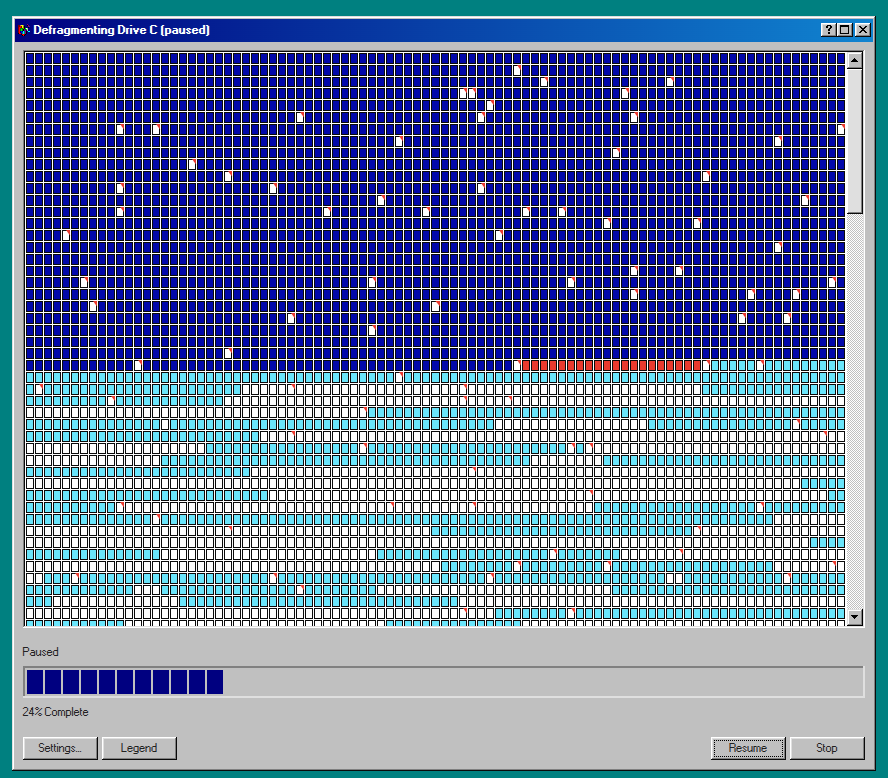
Disk Defragmenter was a wonderful utility that Microsoft included with Windows back in the day. Back then, you’d use it to theoretically speed up disk access. Today, you can run a fun simulation right in your browser thanks to [Dennis Morello].
The theory behind defragmenting hard disks was simple. Your hard drive would store data on spinning magnetic platters. Sometimes, a given file or group of files would end up with their different parts scattered across different parts of a platter, or even multiple platters, as the file system tried to slot everything into the space available over time. On a drive accessed with a literal physical mechanism, this fragmentation of files across multiple areas of a disk could cause functional read speeds to drop. To solve this, you could defragment the drive, wherein a utility would grab disparate bits of different files and put them physically closer together on the drive platters, such that the read heads could access larger contiguous chunks of files more easily.
[Dennis’s] project does none of that. It just simulates the visuals and sound of running Microsoft’s disk defragmenter tool from Windows 98. It’s got the little rows of squares that get rearranged, blue for unoptimized data, dark blue for defragmented data, and white boxes for free space. It’s got the progress bar along the bottom, too, and a nice little simulated sound of a hard disk ca-chunking away as it shuffles little bits of data to and fro. This was the kind of thing you’d do on a rainy Saturday afternoon in the 1990s, just watching your PC make itself a few percent faster while you drank coffee and wondered if your ex-wife Jacinta was ever coming back. She never did, but you did notice that Age of Empires II loaded a fair bit quicker after you ran a full defrag on your main drive. Sometimes, that’s as good as it gets.
Modern file systems are better at managing issues like fragmentation, and the virtually instant seek speeds of solid-state drives essentially eliminated the need for defragmentation for good. Still, it’s fun to visit an ancient tool from yesteryear and remember what it meant to us way back when. Maybe you could give Jacinta a call, too, just for old times sake, and discuss that time a Janet Jackson song started crashing brand-new Windows laptops right out of the box…
While the sound and fury of launch is exciting, it’s just the beginning of the journey for Roman. It will take several months for the spacecraft to complete its roughly 1.5 million-kilometer trek out to Earth’s second Lagrange point (L2), where it will set up shop near — in cosmic terms, anyway — the James Webb Space Telescope (JWST). Along the way, it will switch on and test various systems and components, with its primary 300 megapixel infrared camera scheduled to power up in three weeks or so.
There’s a lot to cover about the Roman Space Telescope. Built from spy satellite spare parts donated by the National Reconnaissance Office and featuring a field of view 100 times greater than that of Hubble, its launch is widely considered to be one of the most important scientific milestones of the decade. We’ll be bringing you more about the past, present, and future of this flagship mission as it progresses.
From real space missions to virtual ones, this week the developers of EVE Online announced that 2.4 million lines of code that keep the massively multiplayer online role-playing game running would finally be making the switch to Python 3. Given the immense complexity of the codebase, it’s been stuck at Python 2.7 since their last overhaul back in 2010, a situation which has become increasingly difficult to manage as time goes on.
The announcement goes into a surprising amount of depth about the state of Python in EVE. We imagine most players couldn’t care less, but naturally the developers have strong feelings about the situation and perhaps thought it would benefit others in a similar situation to get their thoughts out there.
While there’s certainly an argument to be made that the only justification they really need for making the migration is that 2.7 hit end-of-life back in 2020, the developers explain that the more immediate problem for them was that various tools and libraries they wanted to use were no longer compatible with the Python 2.x series. They also point out hopes that speed improvements made in the latest version of Python will eventually translate into better game performance down the road.
In more terrestrial news, this week the necessary regulatory amendments were passed to make plug-in solar systems legal in the United Kingdom. Assuming the wiring meets the necessary requirements, consumers can pick up the hardware and install it themselves without involving an electrician, although they may still need to contend with landlords and local ordinances that may limit their ability to physically mount the panels. The rules as they stand now allow each residence to have four panels with a total combined output rating of no more than 2,000 watts, although critically, the system is only allowed to generate a maximum of 800 watts at the inverter. As the government and consumers get more comfortable with plug-in solar systems, these numbers will likely increase over time.
Solar isn’t the only area where DIY approaches are moving into the mainstream. This week, Citrix pitched a “different approach to endpoint resiliency”: an isolated Linux-based operating system called UniconOS that users can boot into should the computer’s primary Windows installation become compromised or otherwise inoperable. The idea is that an independent, read-only backup OS kept on its own partition will reduce downtime, since the computer can still be used while IT figures out what the hell happened.
This solution will sound suspiciously familiar to anyone who’s booted a live Linux system from CD/DVD/USB in the last few decades. Try not to keep yourself up all night wondering why you never pitched the idea to some hungry venture capitalists in exchange for a yacht in the Bahamas.
Finally, on the theme of new technology embracing the old ways, we bring you Defrag98, a web reincarnation of Microsoft’s dial-up era Disk Defragmenter tool. While it won’t actually improve the performance of your modern solid-state drive, you may find your own mood boosted by the wave of nostalgia when you see — and hear — the classic tool go to work.
That’s right, not only do the blocks dutifully flip from red to blue just like you remember, but all the while you’ll be treated to the unmistakable whirs and clicks of a spinning hard drive circa the turn of the millennium. Never forget what they took from us.
See something interesting that you think would be a good fit for our weekly Links column? Drop us a line; we’d love to hear about it.
Definitions for the AI era. (GPT-5.6 Sol Illustration, Click for larger image.)
Jargon stinks. What do the terms open weights, RAG, and agent mean exactly? Here’s a plain English, slightly snarky glossary of befuddling AI terminology with references for further reading.
AI is a broad name for the technology. Machine learning is the part where a system learns from data instead of following rules somebody wrote, a neural network is the structure that does the learning, and deep learning just means a neural network with a lot of layers.
Here’s the nitty-gritty: the terms that get used loosely, and the distinctions the loose usage hides.
1. Model, LLM, frontier model
ChatGPT is the app you open; an LLM, or large language model, is the AI running inside it.
“Frontier” isn’t a technical category at all. It means the handful of biggest and most capable models at any given moment, so the trophy keeps changing hands.
Everyone says “LLM” and hardly anyone could define it on the spot. “Frontier model” is worse. It’s a ranking, announced by the people being ranked.
Further reading:How ChatGPT Works: A Non-Technical Primer (MIT Sloan). Rama Ramakrishnan walks through the predict-the-next-word mechanism everything else is built on.
2. Prompts, tokens, parameters
A prompt is the thought, question, or instructions you provide to the LLM (plus whatever the app added before it without telling you). The LLM takes the prompt and generates words, both in its internal “thinking” process and in the answer it shows you.
Tokens are (roughly) the words going in and coming out. The model chops your prompt into tokens, then produces more of them as it answers, and they’re what the industry charges by.
Parameters, also called weights, are the numbers inside the model. A frontier model has hundreds of billions of them and the biggest now run to trillions, and nobody can tell you what any single one does.
Parameter counts get quoted like horsepower. The number nobody advertises is how many tokens it takes to answer your question, and that’s the one that shows up on the bill.
Further reading: The only AI glossary you’ll need this year (TechCrunch, July 2026). Its entries on tokens and weights are the clearest short treatment of the building blocks.
3. Pre-training, post-training, fine-tuning
Pre-training is feeding the model most of the internet, so it learns to predict the next word in a sentence. That’s the expensive part, and it produces something that knows a great deal but can’t follow an instruction.
Post-training is where people rank its answers and it learns to give more of what ranked well. Fine-tuning is post-training done by you, to somebody else’s model, on your data.
Pre-training costs hundreds of millions and gets you a model that won’t answer a question well. Post-training is what gets you the product.
From scratch, you buy (or rent) the computers and do the work to build and train a model. Distillation trains a cheap model on an expensive model’s outputs, so it inherits the behavior without the bill. Distillation is against most AI companies’ terms of service.
OpenAI accused DeepSeek of distilling its models, which is a bold position for a company that trained on the whole internet without asking. Learning from other people’s work is fine right up until the other people are you.
Training is how you build a model. Inference is what happens every time it answers: the model runs and produces a result.
Training is a one-time cost. Inference is a cost you’ll pay forever. Training runs for months and costs hundreds of millions; one inference, meaning one answer, costs a fraction of a cent, and it happens billions of times a day.
Training costs get announced. Inference costs get discovered. Only one of them shows up in a press release.
We typically use LLMs by accessing an app like ChatGPT, Claude, or Gemini. But experts often want the model itself, not just an app wrapped around it. Open weights means that an AI expert can download the model and run it on a server. You don’t get the data or the code that made it.
Open source means data and software that experts can use and modify, which almost no major model offers (AI2’s Olmo is a rare exception).
API-only means you can’t have the model at all. You send your text to the company’s computers, the answer comes back, and you pay for every use, which is also what’s happening when you use ChatGPT or Claude through an ordinary account.
Open weights is how you claim the open-source mantle without giving much away. Open washing, basically.
The context window is how much text the model can hold in mind at once, including your question and everything pasted into the conversation.
Memory is a feature that saves facts about you and slips them back into the context window later.
RAG, short for retrieval-augmented generation, searches a document collection and drops the relevant passages into the context window before the model answers.
Nothing in the model remembers you. The app keeps a file on you and pastes it in before every conversation, and that’s a less charming way to describe the same feature.
Further reading:Glossary of Terms: Generative AI Basics (MIT Sloan Teaching & Learning Technologies). Defines context window and RAG in plain language, and is careful to put the model’s “memory” in quotation marks.
8. Chatbot, workflow, agent
A chatbot answers and stops. A workflow runs the steps you defined, in your order. An agent receives a goal instead of steps, and works out for itself what to do, calling out to other software and checking the results until it’s done or stuck.
Ask about a delayed flight and a chatbot quotes you the policy; a workflow uploads the refund form you built; an agent rebooks you.
Useful test: if it decides its own next step, it’s an agent. If you decided the steps, it’s a workflow.
Further reading:Building effective agents (Anthropic, December 2024). The source of the distinction: workflows run predefined code paths, agents direct their own.
9. Hallucination, AI slop, AI cream
A hallucination is a confident falsehood, like a citation to a paper that doesn’t exist. The model isn’t lying; it has no notion of truth to violate. It’s producing text that looks like the right kind of answer.
AI slop is a different failure: accurate, fluent, and worthless. Think of the LinkedIn post that says nothing in 300 fluent words.
AI cream is the third case and the rare one: superb writing authored with the help of AI.
Nobody sets out to make slop. Everyone believes they’re making cream.
Further reading: 2025 Word of the Year: Slop (Merriam-Webster, December 2025). The dictionary definition turns on quantity: low-quality content “produced usually in quantity” by AI.
Why language models hallucinate (OpenAI, September 2025). Argues that hallucinations persist because benchmarks score accuracy alone, so guessing beats admitting ignorance.
10. Alignment, guardrails, censorship
Alignment is the research problem of getting a model to do what people want when nobody’s watching. Guardrails are the rules behind its refusals: “no, I won’t tell you how to make a bio weapon.” Censorship is a guardrail that blocked something you wanted.
The same refusal is “safety” in the press release, “guardrails” in the documentation, and “censorship” on X.
Further reading: Model Spec (OpenAI, updated December 2025). A published rulebook for what one model will and won’t do, which makes refusals arguable rather than mysterious.
I snuck in one novel term that’s been sorely absent from the field. Can you tell which one?
Further reading: other glossaries
Five general AI glossaries, listed roughly from most opinionated to most technical.
Glossary of Terms: Generative AI Basics (MIT Sloan Teaching & Learning Technologies). Twenty-odd entries aimed at people who use the tools rather than build them.
Machine Learning Glossary (Google for Developers). Hundreds of technical entries, and the only glossary here that defines “AI slop” a few lines away from several hundred pieces of real math.

 Login
Login